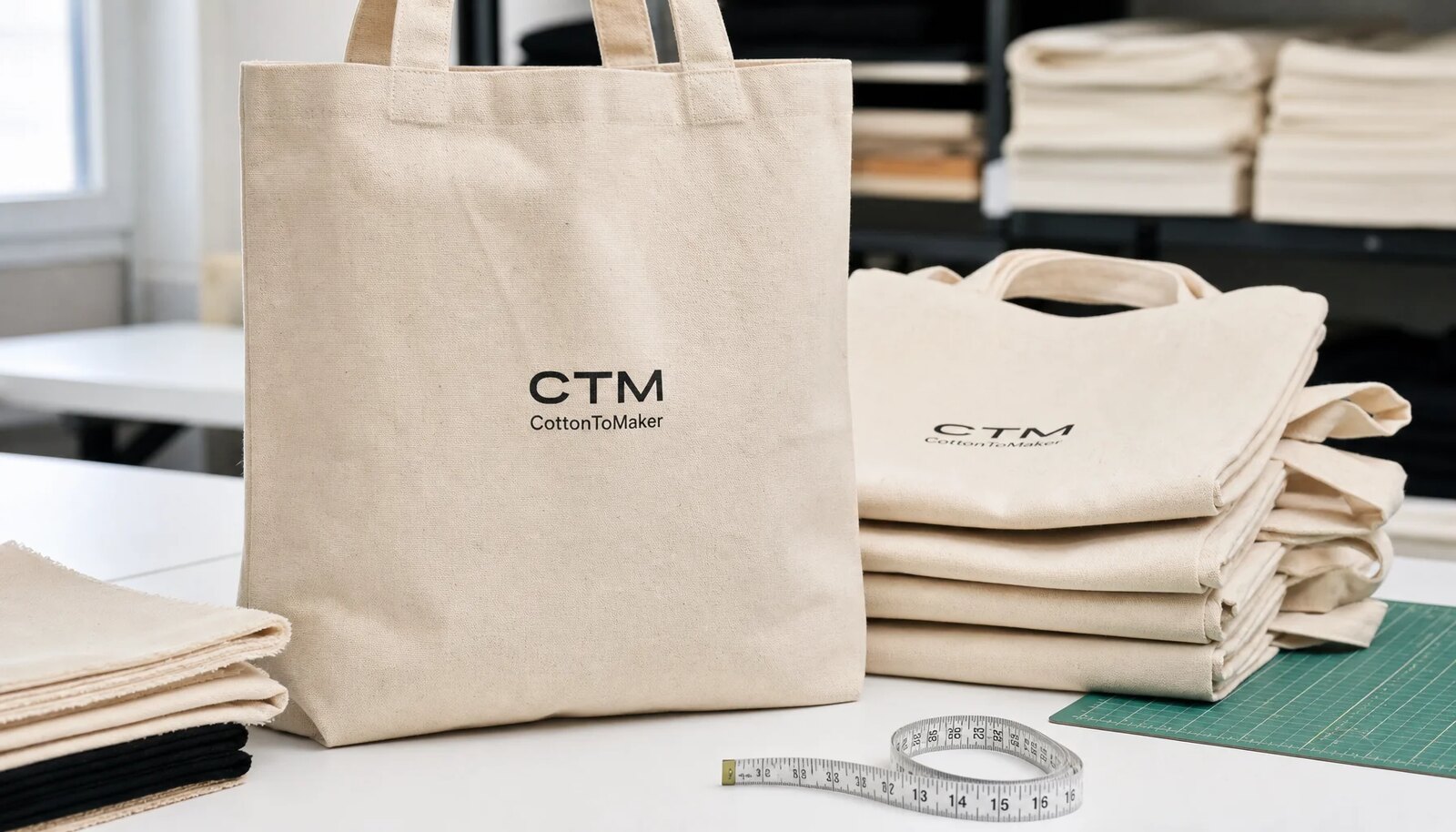
Why craft fair MOQ negotiation is different
Organic cotton totes for craft fairs rarely behave like a single simple bag order. A buyer may see one program: 300 registration bags, 200 sponsor totes, 150 vendor kits, and 100 pieces for the merchandise table. The factory sees something else. It sees fabric buying, cutting yield, sewing setup, print versions, carton segregation, approval steps, and a delivery date that cannot move. That gap is where MOQ friction starts.
A small craft fair order can be efficient if the structure is clean. Keep the same organic cotton fabric, tote size, handle length, seam type, print method, and packing format across every version, and the supplier may be able to combine cutting and sewing. The logos can then be handled as separate print versions, with setup charges listed instead of hidden inside a vague unit price.
The negotiation should not be about pushing the factory below a workable minimum. It should prove that the order is organized enough to run without waste. For B2B procurement buyers, the best result is a practical MOQ structure: low enough to avoid dead stock, high enough for stable production, and detailed enough to protect the event date.
- Strong MOQ position: one fabric, one bag construction, one print method, one packing format, and a clear artwork matrix.
- Weak MOQ position: mixed GSM, custom dyed shades, several bag sizes, multiple print methods, rushed approvals, and split shipments.
- Key sourcing distinction: fabric MOQ, sewing MOQ, print MOQ, artwork MOQ, and packing MOQ can be different numbers.
- Buyer priority: negotiate total program cost and event reliability, not only the lowest possible piece count.
- Useful evidence: share a version matrix that shows quantities, artwork files, print colors, carton marks, and destinations.
Set the tote specification before discussing price
Factories quote better when the bag is already defined. If the RFQ says only organic cotton tote, low MOQ, craft fair logo, the supplier must guess the GSM, fabric source, size, handle, print area, artwork count, packing, and documentation level. Guesswork increases risk. Risk usually comes back as a higher MOQ, a higher price, or exclusions that appear later.
Start with fabric weight. A 180-220 GSM organic cotton plain weave or light canvas works for giveaways, registration packs, brochures, and light attendee use. It keeps fabric cost, carton weight, and freight volume manageable. A 260-340 GSM organic cotton canvas feels stronger and is usually a better fit for paid merchandise, books, ceramics, candles, museum shop programs, and premium sponsor gifts. The heavier option may sell better, but it can also raise fabric cost, cutting waste, freight cube, needle requirements, and mill MOQ exposure.
Size matters too. A practical craft fair reference is about 38 x 42 cm with 2.5 x 60 cm shoulder handles. It carries flyers, apparel, books, boxed goods, and packaged foods without forcing a custom pattern. Gussets add useful depth, but they also add panels, sewing steps, and extra inspection points. If lowering MOQ is the priority, use the supplier’s standard flat tote unless the products truly need a bottom gusset.
- Giveaway starting spec: 180-220 GSM organic cotton, flat body, shoulder handles, bulk folded packing.
- Merchandise starting spec: 260-340 GSM organic cotton canvas, stronger seams, approved reinforcement, optional hangtag.
- Common size reference: about 38 x 42 cm body with 2.5 x 60 cm handles, adjusted only for real product load needs.
- Handle control: approve handle width, length, drop, attachment, reinforcement, and comfort on a physical sample.
- RFQ wording: state GSM, weave, fabric color, dimensions, gusset, seam type, reinforcement, print area, and packing.
Separate organic cotton claims from marketing language
Organic cotton is not one paperwork requirement. A tote described as organic cotton may need transaction-level documents for one buyer, fabric evidence for another, and only an internal material declaration for a third. Those scenarios are not interchangeable. The claim level affects sourcing, price, lead time, and sometimes MOQ.
Define the evidence before comparing suppliers. Depending on the program, you may ask for a supplier declaration, fabric invoice evidence, chain-of-custody documents, scope certificate information, or a transaction certificate where applicable. If the required documentation changes after the quote is approved, the supplier may need a different fabric source. That can restart the MOQ discussion.
Also separate the organic claim from the fabric finish. Natural organic cotton can show seed specks and shade movement. That may be part of the desired craft look, but it still needs swatch approval. Bleached, dyed, washed, or pre-shrunk fabric introduces different controls. Custom dyeing can create dye-house minimums and lab dip approvals. Washed finishes can change hand feel, shrinkage, and dimensions. Treat claim level, finish, and MOQ as linked decisions.
- Claim level: certified product claim, organic cotton material claim, internal preference, or no outward claim.
- Document options: supplier declaration, fabric evidence, chain-of-custody record, scope certificate reference, or transaction certificate where applicable.
- Natural fabric note: seed specks and shade variation may be normal, but stains, mold, and panel mismatch are not acceptable.
- Custom color risk: dyeing and lab dips can add MOQ, lead time, shade tolerance discussions, and extra approval steps.
- RFQ instruction: ask all suppliers to quote the same documentation level before comparing price or MOQ.
Identify which MOQ is blocking the order
MOQ is often presented as one number, but it is really a stack of minimums. Fabric purchase has one logic. Cutting setup has another. Sewing, printing, packing, documentation, and inspection can each create their own threshold. Organic cotton can add pressure because the exact GSM, shade, finish, or documented material may not be available in small stock quantities.
The right first question is diagnostic: which part of the program creates the minimum? If fabric is the blocker, stock natural organic cotton may solve more than hard negotiation. If printing is the blocker, fewer colors or paid setup charges may work. If sewing is the blocker, a standard flat tote may help. If packing is the blocker, bulk folded cartons by version may be more realistic than individual polybags, hangtags, barcode labels, and split deliveries.
This avoids weak negotiation. Asking for 300 pieces can be reasonable when the supplier has stock 220 GSM natural organic cotton, the body is standard, and the logo is one-color screen print. The same 300 pieces can be uneconomical if the order needs custom dyed 320 GSM canvas, ten sponsor artworks, retail labels, individual bags, and several ship-to points. Find the real constraint, then negotiate the part that matters.
- Fabric MOQ: driven by organic cotton availability, GSM, fabric width, color, dyeing, finishing, shrinkage control, and documents.
- Cutting MOQ: driven by marker efficiency, panel size, gusset pieces, handle strips, fabric utilization, and small-lot waste.
- Sewing MOQ: driven by line setup, operator efficiency, stitch type, reinforcement method, and inspection volume.
- Print MOQ: driven by screens, color mixing, artwork count, alignment, drying or curing space, and strike-off time.
- Packing MOQ: driven by fold method, inner bundles, labels, hangtags, polybags, carton marks, and split shipments.
- Documentation MOQ: driven by certified chain-of-custody requirements and whether stock fabric can support the required claim.
Use a quantity matrix to combine versions
For craft fair tote programs, a quantity matrix is often stronger than a long email. Instead of sending separate requests for five small logo runs, present one combined program. Example: 1,000 pieces total, 220 GSM natural organic cotton, 38 x 42 cm flat body, 60 cm handles, one-color screen print, bulk folded packing, split across five artwork versions. That structure lets the factory evaluate one cutting and sewing run with several print setups.
Be transparent about versions. A quote for 1,000 pieces with one artwork is not the same as 1,000 pieces split across ten artworks. Each artwork may require file checking, screen preparation or digital setup, color matching, print alignment, drying control, counting, bundle labels, and carton separation. A supplier that prices those steps clearly is easier to manage than one that hides them and adds charges later.
Once agreed, the matrix should become part of the PO. It should list version code, artwork file name, quantity, print colors, print size, placement measurement, inner bundle quantity, carton mark, destination, and approval status. Procurement, design, supplier, inspector, and warehouse teams should all work from the same version list.
- Good structure: total program quantity first, then version quantities under the same fabric and construction.
- Critical fields: version code, quantity, artwork file, color reference, print size, print position, packing, carton mark, and destination.
- Negotiation request: combine sewing MOQ while quoting setup charges or minimums per artwork separately.
- Avoidable change: different handle lengths, gussets, labels, or packing rules for each vendor when MOQ is already tight.
- Commercial comparison: compare total program cost, not only the unit price for the largest version.
Choose print methods around artwork count
Printing can make or break a low-MOQ tote order. Water-based screen printing is usually a good fit for one or two-color logos on natural organic cotton. It suits bold fair marks, sponsor graphics, simple booth branding, and the soft hand feel many buyers want from cotton. The catch is setup. Every artwork and color can add screens, registration work, ink mixing, cleanup, and approval time.
Digital pigment and transfer methods can help when there are many short artwork runs or full-color graphics, but they still need testing. Natural cotton is textured and slightly irregular. Colors may look softer than a digital proof. Fine lines, tiny sponsor text, gradients, and pale colors can lose clarity. Transfers may change hand feel or show edges, depending on the artwork shape and application.
Approve a physical strike-off on the actual production fabric before bulk printing. A monitor proof confirms layout. It does not show absorption, cotton texture, curing, edge behavior, or folding marks. For paid merchandise, ask how the print is fixed and what basic rub or wash checks the factory can perform. Keep the testing sensible, but do not approve bulk production from a PDF alone.
- Water-based screen print fits: bold logos, one or two spot colors, natural cotton look, and repeatable event branding.
- Digital pigment fits: many artwork versions, detailed graphics, and short runs after physical strike-off approval.
- Transfer or DTF fits: some full-color short runs, but requires approval for hand feel, edges, adhesion, and folding behavior.
- Embroidery fits: premium small logos, but may pucker lightweight cotton and usually raises cost and lead time.
- Artwork file control: provide vector files where possible, final size in centimeters, placement measurements, color references, and version names.
- Approval rule: bulk printing starts only after written approval of strike-off color, placement, coverage, hand feel, and artwork version.
Compare quotes by total landed program cost
The lowest MOQ is not always the better purchase. One supplier may quote a slightly higher unit price but include export cartons, basic carton marks, routine QC, sample handling, and clear print setup charges. Another may quote a lower bag price while excluding the same items. The second quote looks attractive until the PO is built and the extra lines appear.
Ask for cost separation. The quote should show the blank bag, print setup by artwork or color, print running cost, sample charges, labels, hangtags, packing, cartons, documentation, inland freight, and any low-MOQ surcharge. Request price breaks at 300, 500, 800, 1,000, and 2,000 pieces using the exact same specification. This shows whether buying more truly improves the total cost, or whether it only creates surplus after the fair.
Compare landed cost per usable bag. Heavy canvas raises carton weight and freight. Individual polybags add labor, volume, and waste. Split shipments add handling and routing risk. A late inspection failure can cost more than a small unit-price difference. For fixed-date events, a quote with clearer inclusions, realistic production timing, and stronger version control may be the safer buy.
- Bag cost lines: fabric, cutting, sewing, handles, reinforcement, finishing, and standard thread trimming.
- Print cost lines: setup per artwork, setup per color, running charge, strike-off, special ink, transfer film, or curing needs.
- Packing cost lines: bulk fold, inner bundles, hangtags, barcode labels, paper bands, polybags, carton marks, and carton upgrades.
- Logistics data: carton quantity, carton dimensions, gross weight, total CBM, port, Incoterm, and inland freight if quoted.
- Sample terms: swatch, construction sample, print strike-off, full PP sample, courier charge, refund policy, and approval lead time.
- Scenario comparison: standard MOQ, reduced MOQ with surcharge, combined version quantity, simplified artwork, and heavier or lighter GSM option.
Negotiate with production trade-offs
MOQ negotiation improves when the buyer offers changes that reduce factory risk. Useful trade-offs include stock natural organic cotton, a standard body pattern, one handle length, fewer print colors, combined artwork versions, bulk folded packing, and transparent setup charges. Those concessions are practical. They give the supplier a way to say yes without absorbing hidden costs.
Ask in production language. Instead of saying, can you do 300 pieces, be specific: if we use your stock 220 GSM natural organic cotton, standard 38 x 42 cm flat tote, 2.5 x 60 cm handles, one-color screen print, and bulk folded packing, can you combine three 100-piece artwork versions into one sewing run and quote print setup per artwork separately? That question is easier for a production team to answer.
There are limits. Do not trade away core quality controls to hit a smaller number. If the tote is paid merchandise or a sponsor-funded gift, weak handles, crooked printing, or wrong version counts can hurt the event more than extra inventory. When the deadline is close, simplify the tote before forcing custom features into a compressed schedule.
- Use stock fabric: natural organic cotton usually negotiates better than custom dyed or specially finished fabric.
- Standardize construction: one body size, handle length, seam type, reinforcement method, and packing format across versions.
- Simplify artwork: reduce colors, keep one print area, avoid tiny text, and group similar logo sizes.
- Accept transparent charges: a low-MOQ surcharge may cost less than buying unwanted inventory to meet a standard MOQ.
- Protect QC: do not trade away sample approvals, print strike-offs, carton segregation, or final inspection to reach a lower MOQ.
- Negotiate lead time: ask what changes if approvals are completed faster or if artwork versions are reduced before production.
Build sampling into the production calendar
Sampling should lower risk, not consume the entire schedule. For organic cotton craft fair totes, a practical approval route is usually fabric swatch, plain construction sample, and printed strike-off on actual fabric. The swatch confirms GSM, shade, texture, hand feel, odor, and documentation path. The construction sample confirms size, handle drop, seam type, reinforcement, symmetry, and usability. The strike-off confirms artwork, color, placement, coverage, edge quality, and hand feel.
A full pre-production sample is useful for paid merchandise, museum shops, retail programs, and sponsor approvals. It may not be the fastest first step if artwork is still moving through committee review. Buyers can approve construction while final logos are being cleared, then approve the print strike-off once files are locked. Do not allow bulk cutting, sewing, or printing before the required approvals are recorded.
Written approvals prevent disputes. Approval notes should include fabric GSM, shade reference, dimensions, handle length, reinforcement method, print size, print position, color reference, packing method, and any accepted deviation. If artwork size, handle length, shade, packing, or documentation level changes later, price, MOQ, and lead time may need to be reopened.
- Fabric swatch approval: GSM, weave, shade, texture, shrinkage expectation, odor, and organic documentation level.
- Construction sample approval: body size, handle drop, handle width, seam strength, reinforcement, symmetry, and thread trimming.
- Print strike-off approval: artwork version, print size, color, registration, ink coverage, placement, edge quality, and hand feel.
- Packing mockup approval: fold method, inner bundle quantity, carton quantity, carton mark, moisture protection, and polybag policy.
- Release rule: bulk starts only after deposit, final artwork, approved samples, final order matrix, and documentation scope are confirmed.
Define measurable QC tolerances before PO
Organic cotton tote QC must be measurable. Natural cotton may show seed specks, yarn variation, and mild shade character, especially when undyed. That does not mean every flaw is acceptable. Holes, oil stains, mold, strong odor, damp cartons, open seams, weak handles, wrong artwork, severe print defects, and mixed versions should be treated as rejectable unless a specific deviation has been approved.
For standard flat totes, many buyers use body width and height tolerance around plus or minus 1 cm unless the design requires tighter control. GSM tolerance is commonly plus or minus 5 percent unless a tighter range is contracted and priced. Handle length and handle drop should be listed separately. Print placement should be measured from defined points, such as top edge to logo top and side seam to logo centerline. Without measurement points, print disputes become subjective.
Use an inspection plan that matches the order value and event risk. Many B2B buyers reference AQL sampling and define critical, major, and minor defects in the PO or inspection checklist. For craft fairs, assortment accuracy is as important as bag quality. A shipment can pass stitching checks and still fail the event if sponsor logos are mixed, carton marks are unclear, or version quantities do not match the packing list.
- Fabric checks: GSM, shade, stains, holes, broken yarns, slubs beyond approval, mold, odor, dampness, and contamination.
- Construction checks: dimensions, handle length, handle placement, seam strength, reinforcement, skipped stitches, open seams, and thread trimming.
- Print checks: correct artwork, orientation, color, placement, registration, coverage, curing, smearing, cracking, peeling, and pinholes.
- Assortment checks: quantity by artwork, version labels, carton marks, destination, packing list, and sponsor or vendor codes.
- Inspection method: define AQL level, sample size, defect classes, measurement tools, lighting condition, and photo reporting requirements.
- Timing control: complete final inspection early enough to rework, replace, or approve deviations before the fair shipment deadline.
Specification comparison for buyers
| Procurement decision | Recommended approach | Best fit for craft fair buyers | MOQ or quality risk to control |
|---|---|---|---|
| Giveaway fabric weight | 180-220 GSM organic cotton plain weave or light canvas | Registration bags, sponsor handouts, brochure totes, lightweight attendee use, and cost-sensitive programs | Confirm GSM tolerance, expected carrying load, shrinkage after finishing, and whether the supplier has this fabric in stock |
| Paid merchandise fabric weight | 260-340 GSM organic cotton canvas | Artist merchandise, museum shop totes, book fairs, ceramics markets, premium sponsor gifts, and resale programs | Higher GSM increases fabric cost, carton weight, freight cube, needle requirements, and mill MOQ risk; approve a physical swatch |
| Standard body size | Approx. 38 x 42 cm flat body with 2.5 x 60 cm shoulder handles | General craft fairs carrying flyers, apparel, packaged foods, books, and small boxed goods | Changing body size can reduce cutting yield; use the supplier’s standard pattern if MOQ reduction is the priority |
| Gusset choice | Flat tote for lowest complexity; 8-12 cm bottom gusset only when product depth requires it | Flat for general events; gusseted for boxed goods, candles, books, and retail bundles | Gussets add panels, sewing operations, and measurement points; confirm whether gusseted bags have a separate MOQ |
| Print method for simple artwork | Water-based screen print, usually 1-2 spot colors | Bold fair logos, sponsor marks, simple booth branding, and natural cotton aesthetic | Screen charges may apply per artwork and per color; define print size and position before comparing quotes |
| Print method for many versions | Digital pigment or transfer after strike-off approval | Vendor-specific graphics, short artwork runs, full-color illustrations, and sponsor assortments | Check hand feel, edge finish, rub resistance, wash behavior, color clarity on natural cotton, and folding marks |
| MOQ negotiation lever | Combine one fabric, one construction, one print method, and one packing style across all versions | Event organizers, distributors, museums, and craft collectives buying for multiple booths or fairs | Factory may combine sewing quantity but still charge setup or minimums by artwork, color, or destination |
| Packing format | Bulk folded by artwork, typically 50-100 pcs per export carton depending on GSM and carton weight limit | Warehouse receiving, booth stock, event kits, distributor repacking, and low-waste programs | Mis-sorted versions cause event failures; require inner bundle labels, carton marks, and packing list by version code |
| Organic claim documentation | Define claim level before RFQ: certified transaction documents, chain-of-custody evidence, or material declaration | Retailers, brands, museums, and organizers with sustainability requirements | Documentation level can change fabric source, lead time, MOQ, and price; do not compare quotes until paperwork scope matches |
Buyer checklist before sampling
- Define the business use: free giveaway, paid merchandise, vendor welcome kit, attendee tote, sponsor gift, retail carryout bag, or booth bundle.
- Set a maximum landed cost per usable bag, including samples, setup, packing, inspection, freight, duties if applicable, and expected surplus or shrinkage.
- State the organic claim level clearly: certified organic product claim, certified organic cotton material claim, chain-of-custody requirement, fabric evidence, or internal material preference.
- Choose fabric by GSM, weave, color, finish, and hand feel: for example, 220 GSM natural organic cotton plain weave or 300 GSM organic cotton canvas.
- Confirm whether fabric is stock, greige-to-finished, custom dyed, pre-shrunk, washed, or finished to a requested shade; each option can change MOQ.
- Lock one standard bag construction wherever possible: body size, gusset, handle length, handle width, seam type, reinforcement method, label position, and fold style.
- Define MOQ language precisely: total program MOQ, sewing MOQ, fabric MOQ, minimum per artwork, minimum per color, minimum per packing version, and minimum per destination.
- Group artwork versions by identical fabric, construction, print method, print area, packing, and ship-to location before asking the supplier to combine quantities.
- Submit artwork files with vector format when available, version code, quantity, print dimensions, placement measurements, color references, and sponsor approval status.
- Request separated quote lines for blank bag, print setup, print running cost, low-MOQ surcharge, labels, hangtags, packing, cartons, samples, inland transport, and documentation.
Factory quote questions to send
- What is your standard MOQ for this organic cotton tote if all pieces use the same fabric, size, handle construction, print method, and packing?
- Which MOQ applies separately: fabric purchase MOQ, cutting MOQ, sewing MOQ, printing MOQ, artwork MOQ, color MOQ, packing MOQ, or documentation MOQ?
- Can you combine multiple artwork versions into one sewing run, and what is the minimum quantity or setup charge per artwork and per print color?
- Is the quoted organic cotton fabric in stock? If not, does it require weaving, dyeing, washing, finishing, or a mill minimum?
- What documents can you provide for the organic cotton claim: supplier declaration, fabric invoice evidence, scope certificate, transaction certificate, or chain-of-custody documents?
- What GSM tolerance, shade tolerance, shrinkage expectation, and fabric width will apply to the production lot?
- Which print method are you quoting, what ink or transfer system will be used, and what curing or finishing process is required?
- What are the maximum recommended print dimensions for this bag size and fabric, and what placement tolerance will your production team hold?
- Can you quote price breaks at 300, 500, 800, 1,000, and 2,000 pcs with the same specification, Incoterm, packing, and documentation level?
- If we order below your standard MOQ, which costs increase: stock fabric premium, cutting setup, screen setup, line setup, QC time, packing labor, or management fee?
Quality-control points to confirm
- Fabric GSM within the agreed tolerance, commonly plus or minus 5 percent unless a tighter range is specified, tested from representative production fabric.
- Organic cotton shade consistent with the approved swatch or lab dip, allowing reasonable natural variation but rejecting obvious panel mismatch, stains, or batch mixing.
- Fabric surface free from major slubs, holes, broken yarns, oil marks, mold, mildew odor, dampness, foreign fibers, and visible contamination beyond approved natural cotton character.
- Bag body width and height within the PO tolerance, often plus or minus 1 cm for standard flat totes unless a tighter tolerance is agreed and priced.
- Gusset width, bottom alignment, side seam alignment, and bag symmetry checked where gussets are used; distorted or twisted bags should be classified as major defects.
- Handle length, width, drop, placement, and left-right alignment consistent across the lot and matching the approved construction sample.
- Handle attachment reinforced by the agreed method such as bartack, box stitch, cross-stitch, or folded seam reinforcement, with no loose or broken stitches at stress points.
- Seams straight, closed, and secure, with no skipped stitches, open seams, thread nests, raw edges where not approved, untrimmed threads beyond standard, or seam puckering that affects appearance.
- Print artwork, version code, orientation, color, size, and placement checked against the approved strike-off and final order matrix, not only against a digital proof.
- Print placement within the agreed tolerance, commonly plus or minus 1 cm from a defined measurement point such as top edge to logo top or side seam to centerline.