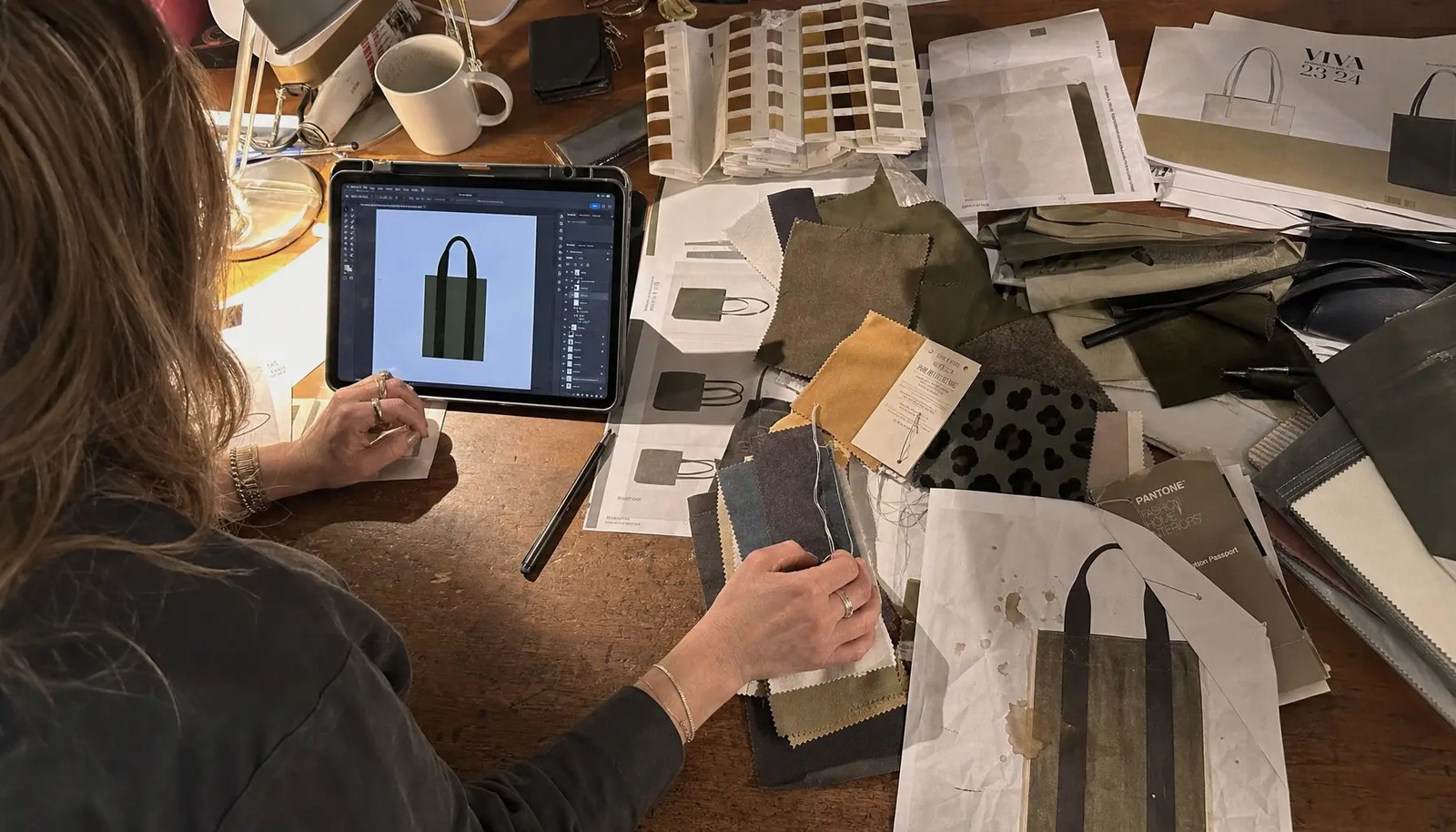
Why logo placement matters on trade show totes
For trade show exhibitors, a tote is not a fashion item first. It is a carrying tool that must be visible from a distance, comfortable enough to be reused through the day, and simple enough for the factory to repeat at volume. Logo placement controls all three outcomes. Put the mark too low and it gets hidden by arm swing, brochure load, or folding. Put it too close to the seam and the artwork can distort, cut off, or sit in a weak print zone.
Buyers often focus on artwork file quality before they define the bag geometry. That is the wrong sequence. Start with the use case: registration desk giveaway, exhibitor handout, VIP kit, or booth retail bag. Each use case changes the best print zone, print size, and bag size. For a trade show tote, the logo must read cleanly while the bag is in use, not just on a white background in a mockup.
- Prioritize visibility from 2–3 meters for booth traffic.
- Keep logo away from seam stress and top hem distortion.
- Match placement to how the tote will be carried and loaded.
Choose the right bag structure before you place the logo
Organic cotton totes are not all built the same. A light sheeting tote in 140 GSM behaves very differently from a 200 GSM canvas tote. Lighter fabric is cheaper and folds smaller, which helps when the bag is a pure giveaway. Heavier fabric gives the print a flatter surface and a more retail-like feel, which matters when the tote is part of a branded kit or needs to carry samples and catalogs without looking thin.
The logo zone depends on the body structure. A flat tote with clean side seams gives the printer a larger usable face. Gusseted bags add capacity but can narrow the visible front panel. If you want a centered logo, check how the gusset changes the front panel width once the bag is filled. On narrow bags, a left-chest-style mark or slightly higher placement can read better than a center logo that ends up too crowded.
- 140–160 GSM: lower-cost giveaway use, lighter loads, faster folding.
- 180–200 GSM: stronger hand-feel, better print stability, better for resale-style presentation.
- Longer handles can interfere with top placement; confirm handle drop before artwork approval.
Pick a print method that matches the artwork and event schedule
For most trade show totes, silkscreen is the default choice because it handles bold logos, solid colors, and reasonable volume at a sensible cost. It is also easier to control on organic cotton when the artwork is simple. If the design has fine gradients, tiny text, or photographic detail, buyers sometimes ask for heat transfer or DTG, but those methods need stricter sample approval because the hand-feel, wash resistance, and color behavior can vary more across suppliers.
A good supplier will quote differently depending on the number of print colors, print size, and print location. A one-color chest mark on the front panel is usually the cheapest stable option. Add a second imprint position, such as a back logo or side message, and both setup and rejection risk go up. If the logo must stay crisp across repeated handling, confirm cure method and abrasion resistance during sampling, not after delivery.
- Use silkscreen for bold logos and repeat events.
- Use heat transfer only when fine detail justifies the risk and cost.
- Set a target for opacity on natural cotton so the art does not look washed out.
What drives MOQ and quote differences between suppliers
The lowest quote is often tied to a hidden assumption: standard fabric, one print color, one placement, one carton method, and a production slot already open. Once you change any of those, the real price moves. Organic cotton tote MOQ usually depends on fabric color, fabric availability, print complexity, and packaging requirements. A supplier that owns printing in-house can sometimes support smaller repeats because there is less coordination loss. A trading company or outsourced printer may need a higher MOQ to cover setup and internal handling.
For procurement teams, the useful comparison is not only unit price. It is the total landed cost per usable bag. That includes setup fee, sampling fee, print tooling, inner packing, carton marks, and freight weight. If one supplier quotes a lower ex-factory price but uses heavier cartons or less efficient packing, the landed cost may be higher. Ask for quote data that separates fabric cost, print cost, sewing cost, and packaging cost so you can compare routes correctly.
- Compare ex-factory price and landed cost separately.
- Request MOQ by fabric, print color count, and packing style.
- Watch for hidden charges on sample approval and artwork revisions.
Use this sourcing comparison to narrow the supplier route
Not every supplier type is right for every trade show order. A direct factory is usually the safest route when logo placement, fabric GSM, and packing must be tightly controlled. A trading company can be useful if you need mixed categories or a smaller trial order, but the chain of responsibility is longer. A printer-specialist can be strong on logo finish yet weak on seam consistency or carton discipline. The right route depends on whether your main risk is decoration quality, production lead time, or logistics control.
Buyers should compare sourcing routes against the same business problem: can the supplier deliver a tote that looks correct, survives booth handling, and arrives on time in the needed carton count? That is the real decision. If the answer is uncertain, the quote is not ready for PO even if the price looks attractive.
- Direct factory: best for repeatability, QC control, and fewer handoffs.
- Trading company: useful for multi-item consolidation, but verify the actual maker.
- Printer specialist: good for decoration, but inspect sewing and packing more closely.
Sample approval should lock the logo position, not just the art
The biggest mistake on organic cotton totes is approving artwork without locking its physical placement. A logo that looks fine on a screen can move several millimeters in production, and that is enough to make a bag look off-center or crowded. A sample must show the exact fabric, final print method, final artwork scale, and the measured distance from the top hem and side seam. If the supplier cannot mark these dimensions on the sample, the bulk order is still at risk.
Use the sample to test more than appearance. Fold the bag, load it with catalogs or sample boxes, and check whether the print stays visible under use. Compare the ink feel, stiffness, and panel drape. If the bag is for trade show staff distribution, place one sample in a carton and confirm that print rub does not leave transfer marks after packing. That simple check prevents a lot of receiving problems later.
- Approve physical placement measurements, not only a mockup.
- Test the bag when filled, folded, and carton-packed.
- Match sample fabric and print system to bulk conditions.
Set acceptance criteria for print, sewing, and fabric
Quality control becomes easier when the buyer writes acceptance criteria that are measurable. For print, define the acceptable shift, color tolerance, and edge sharpness. For sewing, specify handle bar-tack quality and whether loose threads are acceptable at all. For fabric, define the expected GSM range and whether slight shade variation is acceptable across lots. This is especially important with organic cotton, where natural fiber variation can be visible if the buyer has not set a realistic tolerance.
The best QC standards are practical, not decorative. A tote for a trade show does not need luxury-level perfection, but it does need consistency. A small amount of weave variation may be acceptable if the bag still reads cleanly and the logo remains legible. A misaligned print or weak handle is not acceptable because it affects brand presentation and field use during the event.
- Specify logo shift tolerance in millimeters.
- Define allowable stitch defects before shipment release.
- Require fabric and print consistency between approved sample and bulk.
Packing choices affect booth readiness and landed cost
Packing is where many buyers lose time after the freight lands. If the totes are packed too loose, the print can crease, rub, or collect dust. If they are packed too tight, the bags can show fold memory or pressure marks on the decoration. For trade shows, the packing method should support easy handout and fast booth setup. Bulk inner bundles may be the best option when the local team will rework bags into display cartons or event kits.
If the tote is destined for retail distribution after the show, retail-ready packing may be worth the extra labor. But do not pay for retail packing unless it solves a real downstream problem. Ask the supplier to quote carton count, bundle count, carton dimensions, and gross weight so your logistics team can calculate freight impact. Small changes in carton size can shift shipping cost enough to change the best supplier choice.
- Use inner bundles to protect print surfaces from abrasion.
- Match packing method to the receiving workflow at the show site.
- Request carton dimensions for freight and storage planning.
A simple cost breakdown helps compare quotes fairly
When buyers receive three quote lines that look different, the fastest way to compare them is to break the bag into cost drivers. Fabric cost changes with GSM and weave width. Sewing cost changes with handle style, gusset depth, and reinforcement. Print cost changes with number of colors, imprint size, and position. Packaging cost changes with bundle method, inner poly, carton quality, and labeling. Once you see those levers, the cheapest quote often stops being the cheapest in practice.
For example, a lighter bag may look cheaper per unit, but if it prints poorly or wrinkles around the logo, it can create a hidden cost in rejected stock or last-minute reorders. A slightly higher unit price on a 180–200 GSM bag can be the better buying decision if the event requires a stronger presentation and the tote will be reused after the show. Good procurement is not about minimizing unit price alone; it is about minimizing failures.
- Compare fabric, sewing, print, and packaging as separate cost buckets.
- Use total landed cost per usable bag, not only ex-factory price.
- Treat artwork complexity as a cost driver, not an afterthought.
Specification comparison for buyers
| Spec decision | Recommended option | When it fits | Buyer risk to check |
|---|---|---|---|
| Logo placement zone | Upper front panel, 6–8 cm below top hem and centered or slight left | Works for booth handouts, registration desk use, and quick brand recognition | Avoid seam-crossing art, handle interference, and placement too low to read when carried |
| Fabric weight | 140–200 GSM organic cotton canvas or sheeting depending on size and print area | Use 140–160 GSM for lighter giveaways; 180–200 GSM for heavier retail-style totes | Too light can show print distortion and poor drape; too heavy raises unit cost and carton weight |
| Print method | Silkscreen for 1–2 solid colors; heat transfer or DTG only for fine-detail samples | Best for stable logos, bold type, and repeat event runs | Check opacity on natural cotton, cure durability, and whether print hand-feel affects folding |
| Handle construction | Self-fabric handles or reinforced stitched handles with bar-tacks | Fits trade show traffic where bags carry catalogs, samples, or small purchases | Weak handle attachment causes claims after one busy event day |
| Supplier route | Direct factory with sample room and print control | Best for controlled repeat orders and layered approvals | Risk of longer sampling cycle if the vendor outsources printing or embroidery |
| MOQ logic | Base MOQ by fabric color + print setup, not just bag style | Useful when logo and body color stay standard across events | Low MOQ often hides setup fees, packing surcharges, or limited placement options |
| Sample approval | Pre-production sample with actual fabric, ink, and placement ruler | Needed for multi-buyer approvals and brand-sensitive events | Do not approve from digital mockups alone; scale and color shift on cotton can be material |
| Packing route | Bulk packed in cartons with clear poly inner bundles, or retail-ready if rebagging is costly | Bulk packing fits distributor and importer replenishment; retail-ready suits premium giveaways | Loose folding can crease prints; overpacking can transfer ink and cause panel marks |
| Lead time structure | Sample 5–10 days; bulk 20–35 days after approval depending on print complexity | Reasonable for planned trade show calendars with lock-in dates | Rush orders raise the chance of curing issues, color mismatch, and carton shortage |
Buyer checklist before sampling
- Confirm final bag size, gusset, handle drop, and usable loading weight.
- Specify fabric type, GSM/oz weight, color tolerance, and shrinkage expectations.
- Send vector artwork and define logo size, print position, and Pantone references.
- Ask for sample photos plus one physical pre-production sample before bulk approval.
- Agree carton packing, barcode or hangtag needs, and shipment marks before production.
- Record inspection checkpoints for stitching, print adhesion, stains, and quantity count.
Factory quote questions to send
- What is your exact fabric GSM and shrinkage range after washing or finishing?
- Will the logo be silkscreened, heat transferred, embroidered, or woven into a label, and what setup cost applies to each option?
- What is the minimum order quantity by fabric color, print color count, and packaging style?
- Can you produce a pre-production sample with the final logo position measured from the top hem and side seam?
- What carton size, inner packing count, and gross weight should we use for freight comparison?
- How many production days are needed after sample approval, and what part of the schedule is most likely to move?
Quality-control points to confirm
- Logo position tolerance: keep the print within ±5 mm of the approved placement spec unless the artwork intentionally uses an off-center layout.
- Print clarity: no visible smudging, broken strokes, or color bleeding on the face of the tote after full cure.
- Stitch integrity: handle bar-tacks and seam ends must hold under reasonable tote loading without loose threads at the attachment points.
- Fabric consistency: confirm body GSM, weave density, and shade match between sample and bulk within the agreed tolerance.
- Packing accuracy: verify bundle count, carton count, carton marks, and whether inner packing protects the printed face from abrasion.