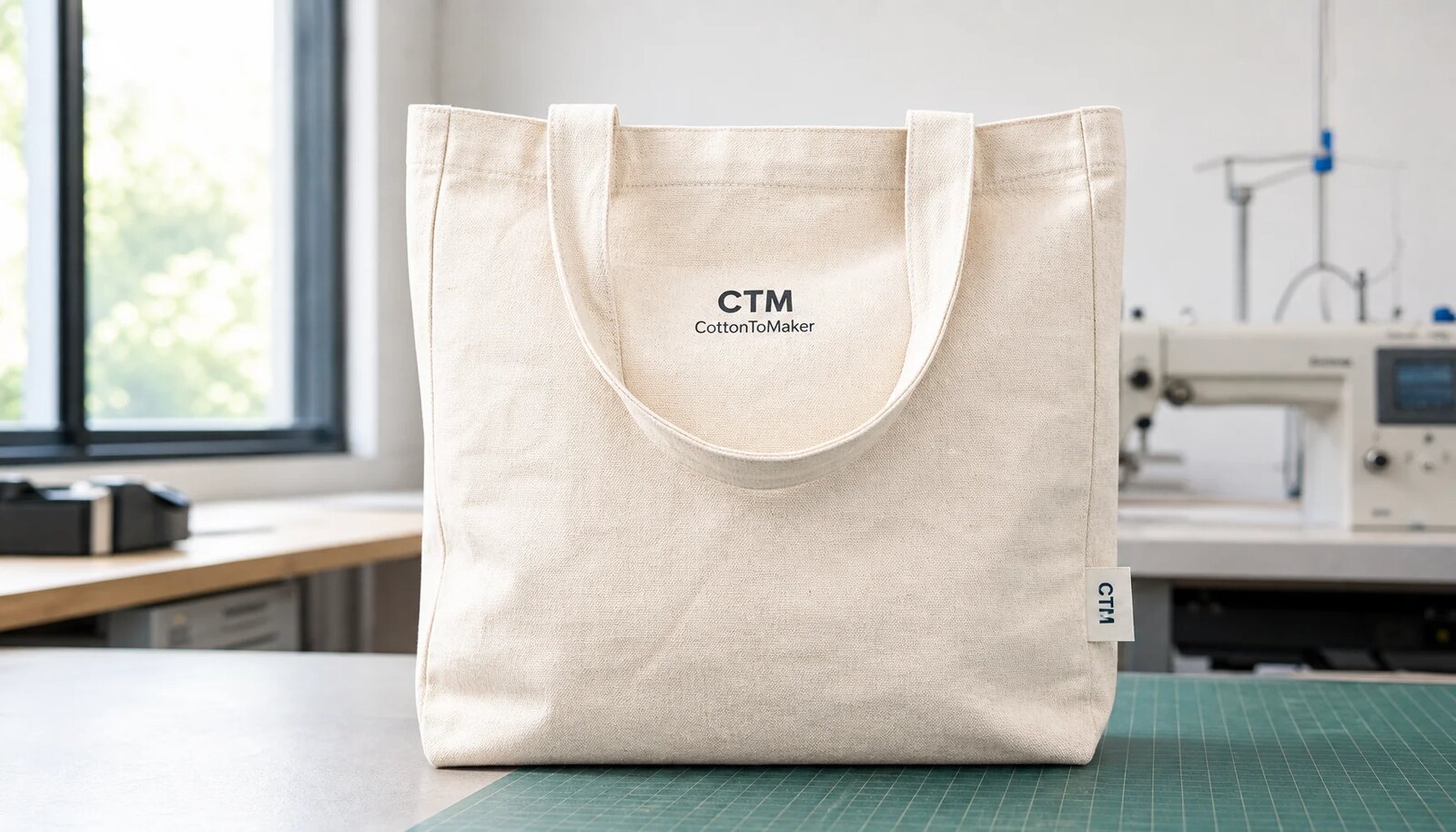
Start with the tote's commercial job
For craft fair procurement, an organic cotton tote may be a checkout carrier, sponsor giveaway, paid merchandise item, vendor kit, or gift-with-purchase. Logo placement should follow that job. A mark that looks balanced on a flat mockup can sit too low when carried, hide behind handles when hung, or disappear into a folded stack on a booth table.
Decide visibility before sending the RFQ. Sponsor and event-recognition bags usually need a clear front-center print. Paid merchandise may benefit from a smaller upper-front mark, woven side label, or patch. Multi-vendor programs often work better with restrained tote branding and sponsor details on a hangtag, rather than crowding the bag face.
The buying file should treat placement as a production specification. Include logo size, measurement points, clearances, tolerances, decoration method, sample approval requirements, and packing orientation. This prevents suppliers from interpreting broad phrases such as "center front" in different ways.
- Define giveaway, resale, checkout, sponsor, vendor-kit, or premium use before artwork approval.
- Choose brand hierarchy: event logo, maker logo, sponsor logo, label, hangtag, or barcode.
- Approve placement on a finished sewn bag, not only on a digital mockup.
- Check the logo in flat, folded, hung, filled, and packed states.
Verify the organic claim before artwork
Organic sourcing language should be precise. Avoid vague terms such as "eco cotton," "organic look," or "natural style" in the specification. Ask what the supplier can document for the order: organic cotton fiber, certified yarn or fabric, finished-product certification scope, and transaction certificate support if required by the buyer, retailer, or end customer.
Recognized paths may include GOTS or OCS scope certification, supplier scope certificates, transaction certificates for eligible orders, and chain-of-custody records. The exact documentation available depends on the supplier's certification scope and the product route. Do not print certification marks, organic claims, or retailer-facing claims until the documentation and labeling rules are confirmed.
Documentation can affect MOQ, lead time, labeling, and price. A tote made with organic cotton fabric is not the same commercial claim as a fully certified finished product. Keep the quote clear so buyers do not compare a documented certified route against a looser material-only claim.
- Ask for current supplier scope certificates before deposit.
- Confirm whether transaction certificate support is available for this specific order.
- Separate organic material claims from finished-product certification claims.
- Do not add certification logos unless the certifier's rules and chain-of-custody requirements are met.
- Include documentation cost and timing as quote lines when they affect the order.
Lock construction and fabric weight
Logo placement becomes easier when the base tote is fixed. Specify finished width, height, gusset depth, handle length, handle width, top hem depth, seam construction, fabric GSM, and color. A flat shopper, bottom-gusset tote, and side-and-bottom-gusset tote each create a different usable print zone.
Fabric GSM should be chosen before final logo size. Lightweight 120-140 gsm cotton can work for simple low-coverage prints, but may show more waviness, print-through, and panel movement. Midweight 150-180 gsm is practical for many craft fair totes because it balances cost, hand feel, print stability, and carton weight. Heavier 180-220 gsm supports larger artwork, patches, and a stronger retail presentation, with higher material and freight cost.
Build normal sewing tolerance into the plan. Cotton can move during cutting, stitching, pressing, and packing. Finished body tolerances may be wider than logo placement tolerances, so write them separately. The supplier should confirm what can be held in bulk on the chosen fabric and construction.
- Specify finished dimensions rather than cut-panel dimensions.
- Request a construction drawing showing seams, gussets, top hem, handles, bartacks, and safe decoration areas.
- Use 150-180 gsm for many standard craft fair programs and 180-220 gsm for larger logos or retail positioning.
- Agree finished size tolerance separately from logo placement tolerance.
Choose placement for real display conditions
Craft fair totes are not viewed in one position. They may be stacked folded on a table, hung from a peg wall, displayed open with filler, carried through aisles, or packed into vendor kits. Each view changes the first visible part of the bag.
For folded table stacks, approve the folded panel, not just the open tote. A large centered print may cross a fold line and become unreadable. A smaller centered logo, upper-front logo, side label, or hangtag may perform better. The packing spec should state fold size, fold direction, logo-facing orientation, and whether handles are tucked.
For hanging display, handle drop can cover the upper third of the bag. For filled use, the panel curves and side seams pull backward, which can distort wide artwork. If the tote will hold books, ceramics, candles, textiles, or boxed goods, test the sample with similar weight and shape before bulk approval.
- Use front-center placement for maximum aisle visibility and sponsor recognition.
- Use upper-front placement, side labels, or patches for resale and boutique positioning.
- Check whether handles cover the logo when hung.
- Avoid wide artwork that distorts around filled side panels.
- Approve the folded retail view when totes will be stacked or basket-displayed.
Build a measurable placement map
A placement map turns subjective artwork direction into production control. It should show the finished bag outline, logo dimensions, reference points, clearances, no-print zones, fold lines, and tolerances. For repeat orders, this drawing is as important as the artwork file.
Use finished sewn-bag reference points: top hem edge, left and right side seams, bottom fold, gusset crease, and handle bartacks. For a front-center logo, specify the bag centerline, logo centerline, distance from top hem to top of logo, and minimum clearance from bottom fold. For an upper-front mark, include distance from top stitching and handle bartacks.
Clearance should be visible on the drawing. For many screen-printed totes, 20-30 mm from seams, hems, and folds is a practical starting point, but the supplier should confirm the final safe area on the actual construction. Tighter placement can be acceptable when proven by sample and written into QC criteria.
Use realistic tolerances. A one-color screen print on stable 180 gsm fabric may hold tighter placement than a woven label sewn near a seam or embroidery on lightweight cotton. Many buyers discuss +/-5 mm for tightly controlled programs and +/-10 mm for standard tote production, but the supplier's confirmed capability should decide.
- Show finished width, height, gusset, top hem, handles, bartacks, and decoration area.
- Measure logo width, height, and position in millimeters.
- Reference logo location from top hem, side seams, bottom fold, gusset creases, and handle bartacks.
- Mark no-print zones around seams, hems, gussets, fold lines, and bulky stitching.
- Attach the placement map to the RFQ, sample approval, PO, and inspection checklist.
Match decoration method to the bag
Decoration should fit the fabric, logo, MOQ, and event deadline. Screen printing is often the most practical option for one- or two-color organic cotton tote logos. It is efficient, repeatable, and suitable for front-center or upper-front artwork when registration, ink deposit, drying, curing, and inspection are controlled.
Water-based inks can create a softer hand that suits organic cotton positioning, but they still need proper cure. Heavier ink systems may improve opacity, especially on natural cotton, but can stiffen large print areas. Large coverage should be tested after folding, stacking, rubbing, and carton compression.
Embroidery is not automatically the best premium option. On lightweight cotton, it may cause puckering, needle holes, and panel tension. It works better for small logos on heavier canvas or reinforced zones, with stabilizer and stitch density approved on the actual fabric.
Woven labels and patches are strong choices for subtle branding and paid merchandise. Their QC risks are different: stitch straightness, label softness, patch curling, needle holes, and panel distortion. Transfers can suit detailed or low-MOQ artwork, but should be tested for adhesion, edge lift, cracking, hand feel, and fold-line durability.
- Use screen print for simple repeatable logos and clean MOQ structures.
- Use water-based print when soft hand feel matters.
- Use embroidery only after puckering and stabilizer are tested on the actual GSM.
- Use woven labels or patches for subtle branding, with stitch and edge inspection.
- Use transfers for detailed or low-MOQ artwork only after adhesion and fold testing.
Make RFQs comparable
A useful RFQ separates the cost drivers. Ask suppliers to itemize the base tote, organic documentation, decoration, setup, sampling, labels, hangtags, barcode work, packing labor, cartons, inspection, and freight basis. If suppliers quote different assumptions, the lowest unit price may exclude services needed for a dependable event delivery.
Decoration ownership must be clear. If the tote factory decorates in-house, one supplier can be accountable for sewing, printing, curing, packing, and final QC. If decoration is subcontracted, ask where goods move, how blanks are inspected before decoration, who approves first production, and who pays for rejected or damaged units.
MOQ changes with fabric availability, organic documentation, bag size, GSM, logo color count, print size, placement count, label or patch MOQ, hangtag printing, barcode work, and individual packing. A one-color logo in one front placement with bulk bundle packing is usually the simplest launch structure.
Lead time should be quoted by stage: artwork review, strike-off, pre-production sample, bulk production after approval, inspection, packing, and transit. For fixed craft fair dates, ask for the latest sample approval date that still protects delivery.
- Request itemized pricing for bag, decoration, setup, sample, trim, packing, carton, inspection, documentation, and freight.
- Ask whether decoration is in-house or subcontracted and who owns rework liability.
- Compare MOQ by GSM, bag size, color count, placement count, documentation level, and packing method.
- Confirm whether setup charges repeat on reorder or only when artwork changes.
- Compare landed cost, schedule reliability, and QC responsibility, not only ex-factory unit price.
Use sampling as the control point
Sampling is where placement risk becomes visible. A digital mockup can confirm layout direction, but it cannot show how ink behaves on organic cotton or how the logo sits against seams, handles, folds, and fabric movement. A strike-off confirms print color and hand feel, while a pre-production sample confirms the finished bag geometry and decoration together.
The best production approval sample uses actual bulk fabric, approved GSM, final construction, final decoration method, final logo size, and intended packing fold. Measure it and record target values: top hem to top of logo, side seam to logo edge, bottom fold to bottom logo edge, and logo centerline to bag centerline. Photos support communication, but measurements control production.
Test the sample as it will be used. Fold it to the packed size, stack it under pressure, hang it by the handles, fill it with similar craft fair goods, and view it from normal aisle distance. If the logo is hidden, too low, distorted, under-cured, or crowded by stitching, revise before bulk release.
Do not approve a flawed sample with the expectation that mass production will improve. Sample notes should state what is approved, what must change, and which tolerance applies.
- Approve a blank construction sample before final decoration when the bag is new.
- Approve a strike-off for color, opacity, hand feel, and cure on actual fabric.
- Approve a pre-production sample for final placement, construction, decoration, and packing.
- Measure placement from sewn-bag reference points and record target values.
- Release bulk only when artwork, placement map, sample notes, and packing spec match.
Inspect and pack for event readiness
Inspection criteria should be written before production. A PO that says "logo centered" leaves room for dispute. A stronger PO states logo size, target location, allowable placement tolerance, color standard, cure expectation, defect classes, sampling plan, and remedies for rejected goods.
Placement inspection should combine measurement and visual review. Measure from the same points shown on the placement map, then check the tote flat, folded, hung, and filled. Inspect across cartons and production intervals because registration, ink viscosity, curing, fabric shade, and sewing tension can drift during a run.
Defect classes should be practical. Critical defects may include unsafe contamination, severe odor, or incorrect certification labeling. Major defects may include wrong artwork, placement beyond tolerance, under-cured ink, stains, broken handles, open seams, wrong barcode, or wrong packing. Minor defects may include small loose threads or tiny print imperfections that do not affect saleability.
Packing affects the first customer view. State fold size, fold direction, logo-facing orientation, units per bundle, hangtag position, barcode position, carton quantity, and carton marks. For individual packing, define material, closure, warning label if required, and whether the logo remains visible. For bulk bundles, check print blocking, ink transfer, patch crushing, and carton pressure marks.
- Define logo placement tolerance in millimeters for each decorated panel.
- Set approved standards for logo size, color, opacity, edge sharpness, and cure.
- Use AQL or another written sampling plan when order size and risk justify it.
- Inspect base tote quality and decoration quality together.
- Use carton marks showing PO, SKU, artwork version, color, quantity, and destination.
- Keep a reorder file with artwork, placement map, sample photos, fabric spec, ink references, and packing details.
Specification comparison for buyers
| Spec decision | Recommended option | When it fits | Buyer risk to check |
|---|---|---|---|
| Primary logo position | Front-center print on the finished sewn bag body; for many medium totes, 60-90 mm below the top hem is a useful starting point | Giveaways, checkout bags, sponsor totes, market merchandise, and event bags that need quick visibility in crowded aisles | Measure from finished top hem and side seams, not cut panels. Agree horizontal and vertical tolerance, often +/-5 mm to +/-10 mm depending on fabric, size, and print method |
| Retail-style placement | Small upper-front logo, woven side label, inner label, or soft sewn patch with a defined stitch zone | Maker brands, museum shops, boutique sellers, paid resale totes, and gift-with-purchase programs | Check handle bartacks, top hem bulk, fold lines, label stitching, and patch edges so the logo is not crowded, puckered, or distorted |
| Folded table display | Logo placed inside the visible folded panel; packing fold approved with the pre-production sample | Totes stacked on booth tables, sold from baskets, packed in vendor kits, or shipped to multiple fair locations | A flat-centered logo may disappear after folding. Confirm fold size, logo-facing orientation, bundle pressure, and carton compression |
| Decoration ownership | In-house decoration by the tote factory where available, with print, cure, packing, and inspection under one PO | Repeat programs, simple one- or two-color artwork, and buyers who want one accountable supplier | Confirm whether printing is truly in-house or subcontracted. Put responsibility for registration, cure, rework, rejected units, and final inspection in writing |
| Separate decoration partner | Blank organic cotton totes supplied to an approved local or regional decorator after incoming blank-bag QC | Local event deadlines, complex artwork, short reprints, color-critical approvals, or existing brand printer relationships | Clarify who owns freight damage, soiling, off-center prints, ink failure, late decoration, and rejects after blanks leave the tote factory |
| Fabric weight for visible prints | 150-180 gsm for many standard craft fair totes; 180-220 gsm for larger artwork or stronger retail presentation | Programs balancing unit cost, print stability, cotton hand feel, carton weight, and booth display | Request strike-offs on the exact fabric color and GSM. Lighter cotton can show more waviness, ink penetration, print-through, and panel skew |
| Large artwork | Controlled print zone on heavier cotton canvas, with clearance from seams, bottom folds, gusset creases, and handle reinforcement | Sponsor bags, illustrated craft fair merchandise, limited-edition art drops, and higher perceived-value retail programs | Large ink areas can stiffen cotton or crack if under-cured. Test after folding, stacking, rubbing, filling, and carton compression |
| Subtle branding | Woven side label, small sewn patch, hangtag, inner label, or low-contrast upper-front logo where construction allows | Artisan sellers, co-branded markets, multi-retailer resale, and organic cotton programs where fabric texture should remain visible | Check label softness, edge folding, stitch density, needle holes, patch curling, and whether labels catch during folding or customer handling |
| Low-MOQ launch | One logo color, one placement, standard tote size, standard fabric color, standard packing, and no custom trims | First fair seasons, test runs, seasonal drops, sponsor pilots, and buyers validating sell-through before scaling | Ask how MOQ and setup charges change by color count, print size, placement count, label, hangtag, barcode, individual packing, and organic documentation level |
Buyer checklist before sampling
- Define the tote's commercial role: free giveaway, paid merchandise, checkout carrier, sponsor bag, vendor kit, gift-with-purchase, or premium retail accessory.
- Confirm the organic claim scope before quoting: organic cotton fiber, certified yarn or fabric, certified finished product, and whether transaction certificate support is available for the order.
- Name the documentation path required by the buyer or retailer, such as GOTS scope certification, OCS certification, supplier scope certificate, transaction certificate, or other recognized chain-of-custody evidence when applicable.
- Lock the finished tote specification: body width and height, gusset depth, handle length, handle width, top hem depth, seam construction, fabric GSM, fabric color, and expected finished tolerance.
- Provide logo dimensions in millimeters and a placement drawing measured from finished sewn-bag reference points such as top hem, side seams, bottom fold, gusset crease, and handle bartacks.
- Define no-print or caution zones around top hems, side seams, bottom folds, gusset creases, handle reinforcement, woven labels, patches, hangtags, and intended fold lines.
- State decoration method, ink or thread colors, Pantone or brand references, color tolerance expectation, underbase requirement if any, and whether artwork size may be adjusted during sampling.
- Request a strike-off or pre-production sample on actual bulk fabric in the approved GSM and color, using the same decoration method, logo size, placement map, and packing fold.
- Approve the sample in five states: flat, folded to retail pack size, hung by handles, filled with typical craft fair goods, and stacked under carton-like pressure.
- Separate base bag cost, decoration cost, setup charges, sample cost, organic documentation cost if any, packing cost, carton marks, inspection cost, and freight basis in the quote comparison.
Factory quote questions to send
- What organic cotton documentation can you provide for this order: supplier scope certificate, fiber or fabric documentation, GOTS or OCS transaction certificate support where applicable, and finished-product certification scope if claimed?
- What are the finished tote dimensions, gusset depth, handle length, handle width, top hem depth, fabric GSM, weave construction, and normal production tolerance for each dimension?
- Is the tote printed before sewing or after sewing, and how do you control placement on the finished bag if cutting, sewing, pressing, or folding variation occurs?
- What exact printable area in millimeters do you recommend for front-center, upper-front, lower-front, side gusset, woven label, sewn patch, inner label, and hangtag options?
- What placement tolerance can you hold in bulk for horizontal centering, distance from top hem, distance from side seam, distance from bottom fold, and distance from handle bartacks?
- Which decoration method do you recommend for this artwork: screen print, water-based print, pigment print, transfer, embroidery, woven label, or sewn patch, and what are the risks on this fabric weight?
- What is your standard color-matching process for natural cotton, and do you use Pantone visual approval, lab dip, approved swatch, or instrument reading as the control standard?
- What cure or fixation method is used for the print, and what in-line checks confirm no blocking, transfer, cracking, powdering, peeling, or tackiness before packing?
- How many setup charges apply for screens, films, embroidery files, woven labels, patches, strike-offs, Pantone matching, hangtags, barcodes, or special packing?
- What MOQ applies by fabric weight, bag size, logo color count, placement count, decoration method, organic documentation requirement, and individual packing requirement?
Quality-control points to confirm
- Logo placement is measured from fixed sewn-bag reference points and remains within the approved tolerance from top hem, side seams, bottom fold, gusset crease, and handle area.
- Horizontal centering is checked by measurement and by visual balance when the tote is flat, folded, hung, filled, and carried by the handles.
- Logo size matches the approved artwork within the agreed tolerance, with no unauthorized scaling, stretching, rotation, cropping, or art simplification.
- Print edges are sharp with no unacceptable bleeding, feathering, smearing, ghosting, pinholes, excessive ink build, double-hit misregistration, or screen marks.
- Ink cure is complete and does not block, transfer, crack, powder, peel, or remain tacky after folding, rubbing, stacking, and carton compression.
- Color match stays within the approved standard under agreed light conditions, with no obvious shade drift between cartons, production intervals, or fabric lots.
- Fabric GSM, hand feel, body size, gusset depth, handle length, handle width, and top hem depth match the approved sample and purchase order tolerance.
- Seams, bartacks, handles, woven label stitching, patch edges, and needle holes do not distort the logo panel, weaken the tote, or create uncomfortable handling points.
- No logo is hidden, cut off, creased through a critical detail, or covered by the intended fold, hangtag, bundle tie, handle drop, side seam turn-in, or retail display arrangement.
- Large artwork does not cross seam allowances, bottom folds, gusset folds, handle reinforcement, or sharply compressed packing areas unless specifically approved.