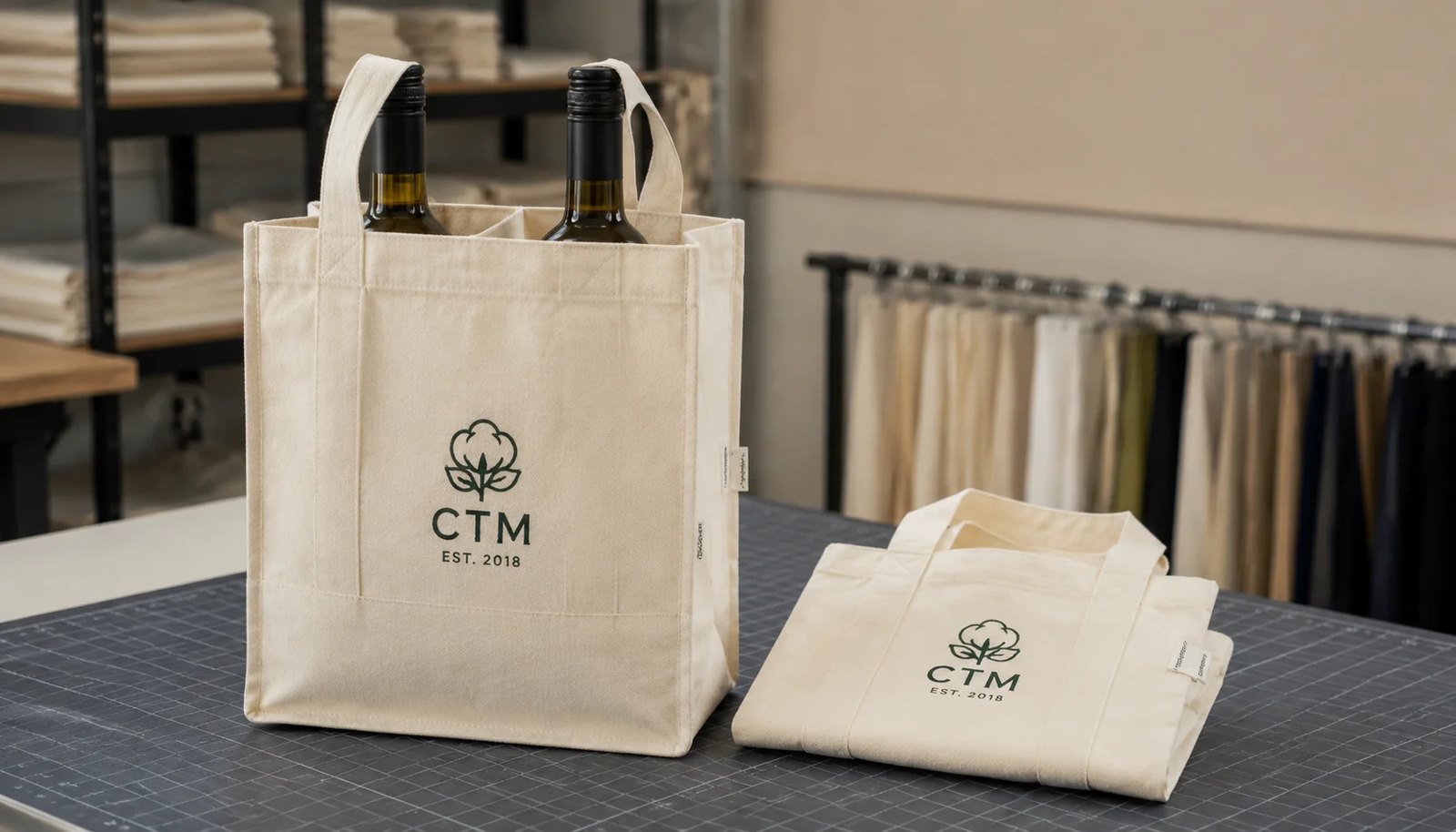
The MOQ Problem
For liquor retailers, organic cotton totes are often ordered for seasonal gifting, loyalty programs, local store promotions, or branded checkout packaging. The buying problem is rarely just price. The real issue is whether the factory can make a sturdy bottle-carry tote at a quantity that matches the retailer's campaign, without forcing excess inventory or weakening the specification to hit a low minimum.
MOQ becomes negotiable when the RFQ separates fixed production inputs from flexible marketing inputs. Fabric weight, bag size, gusset, handle construction, and print method drive the factory's cutting, sewing, and printing setup. Store logo, label language, carton allocation, and delivery split create extra handling work. A buyer who mixes all of these into one vague request will receive quotes that are hard to compare.
- Strong RFQ position: one construction, one fabric, one base color, limited artwork changes.
- Weak RFQ position: several sizes, different fabrics, multiple logo colors, and unclear packing by store.
- Best MOQ discussion point: total quantity by shared material and sewing setup, with clear rules for artwork splits.
Start With Load Use
A liquor tote must be specified around the actual product load. A bag for one 750 ml wine bottle is not the same as a retail tote expected to carry two bottles, a boxed spirit, and a receipt folder. The buyer should define bottle count, approximate loaded weight, and whether the bag needs to stand on a counter or hang from a checkout hook.
For most retail liquor programs, 10 oz to 12 oz organic cotton canvas is a practical starting point. In GSM terms, this is often around 340-410 GSM, depending on weave and finishing. Lighter 6 oz or 8 oz fabric can work for general merchandise, but it may feel weak with glass bottles and can show distortion around the handle area after repeated carrying.
- One bottle promotion: 8 oz may be acceptable if the handle is reinforced and the bag is not positioned as premium.
- Two bottle carry: 10 oz is a safer baseline, with wider handles and stronger top folding.
- Gift pack or boxed spirits: 12 oz, gusseted base, and tighter dimension control are worth quoting.
Fabric And Certification
The phrase organic cotton can mean different things in supplier quotes. One supplier may quote organic cotton fabric from available stock, while another may quote certified material with traceable documentation for a finished goods claim. The price and MOQ can change sharply depending on whether the buyer needs marketing language supported by formal documents.
Procurement teams should define the claim before negotiating the minimum. If the tote will simply be described internally as made with organic cotton, the documentation requirement may be lighter. If the retailer will print an organic claim on hangtags, product pages, or store signage, the RFQ should state what certificate route is needed and whether transaction documentation must cover the finished shipment.
- State the target fabric as organic cotton canvas with oz or GSM, weave, and color.
- Clarify natural, bleached, dyed, or custom-dyed fabric because dyeing increases MOQ and lead time.
- Do not accept a lower quote until the supplier confirms what certification evidence is included.
Construction Choices
MOQ negotiations often fail because buyers try to reduce quantity while also adding construction complexity. A basic flat tote is easier to combine in production than a boxed-base bag with inner bottle dividers, zipper pocket, special label, and custom handle webbing. Each added operation creates setup time, line training, and more inspection points.
For liquor retail, the most useful construction upgrades are not decorative. They are a bottom gusset for bottle fit, reinforced handle stitching, consistent top hem, and enough handle length for shoulder carry. If a buyer must reduce MOQ, it is usually better to keep these functional features and simplify trims or packing rather than reduce fabric strength.
- Flat tote: lower cost and easier MOQ, but limited bottle stability.
- Bottom gusset tote: better retail use and display shape, with moderate sewing complexity.
- Boxed base tote: premium feel and better standing shape, but tighter sewing tolerance and higher labor.
Print Method Decisions
Print method affects MOQ because it changes setup cost, labor speed, color control, and reject risk. For simple liquor retailer logos, water-based screen printing is usually the most balanced choice. It works well on natural cotton, keeps the hand feel acceptable, and gives stable results for one to three spot colors when artwork is clean.
Large solid print areas, metallic effects, gradients, and photographic labels need more caution. They may require pigment printing, heat transfer, or digital printing, each with different cost behavior. A lower MOQ may be possible with digital or transfer methods, but the buyer should evaluate durability, edge feel, color appearance on natural cotton, and whether the finish matches the brand position.
- Use screen print for clean logos, compliance text, and repeatable Pantone color work.
- Use print strike-offs when color is important or the logo sits on natural unbleached cotton.
- Avoid approving mass production from a PDF only; fabric absorption changes the print result.
MOQ Negotiation Levers
Factories set MOQs around material sourcing, cutting efficiency, sewing line setup, printing setup, and packing administration. A buyer can often reduce the minimum per artwork if the total order quantity supports one efficient production run. For example, three store logos may be easier to accept when all use the same organic cotton fabric, same bag size, same ink colors, and same carton pack.
The strongest negotiation lever is standardization. Instead of requesting five different totes for five retail groups, define one approved base tote and treat logo changes as print variants. The factory still needs to price screen charges and sorting labor, but the sewing operation remains stable. That gives the supplier a reason to quote a lower MOQ per design without hiding cost in quality shortcuts.
- Negotiate total MOQ by fabric and construction, then minimum split by artwork.
- Offer a repeat-order forecast only if it is realistic; factories will not price serious concessions on vague promises.
- Accept one carton packing method across all variants to reduce warehouse and labeling work.
- Keep ink colors shared across artwork versions when possible to reduce screen setup and washdown time.
Sample Approval Path
A good sample process is cheaper than a shipment dispute. For first-time organic cotton liquor totes, the buyer should separate fabric approval, print approval, and construction approval. A swatch confirms fabric weight and shade. A print strike-off confirms ink, opacity, and logo position. A pre-production sample confirms the finished tote, handle strength, gusset, label, and packing method.
The sample should be tested with real bottle dimensions. Empty tote photos are not enough for this product category. Put the intended wine bottle, spirits bottle, or gift box inside the sample and look for pulling at the handles, base distortion, poor standing shape, and awkward carry height. This is also the right point to adjust gusset depth before bulk fabric is cut.
- Approve fabric by physical swatch when GSM, shade, or texture matters.
- Approve print by strike-off before cutting bulk fabric for printed panels.
- Approve pre-production sample with loaded bottle photos and measured dimensions.
- Record acceptance comments in writing so the factory quality team can inspect against the same standard.
Quote Data To Compare
A low unit price can disappear after adding screen charges, sample fees, certification documentation, individual packing, carton labels, and inland freight. Buyers should compare quotes in one table using the same assumptions. The cleanest comparison is not just FOB unit price, but landed cost impact by finished specification and packing volume.
For organic cotton totes, fabric weight and carton volume are two common quote traps. A supplier quoting lighter GSM may appear cheaper but produce a weaker bag. A supplier using individual polybags or low carton counts may increase CBM and shipping cost. Procurement should require carton dimensions, pieces per carton, gross weight, and estimated CBM before selecting the quote.
- Compare included and excluded costs: sample, screen, labeling, packing, certification documents, and inspection support.
- Require the quoted GSM and finished dimensions to be written on the quotation, not only in the email discussion.
- Calculate cost per usable approved unit, allowing for inspection rejects and any spare quantity required for store allocation.
- Review payment terms and remake responsibility for print or sewing defects before deposit.
Packing And Allocation
Packing is part of the MOQ conversation because it affects labor and warehouse receiving. Bulk packing in export cartons is usually the most efficient for reusable totes. Individual polybags may be requested for retail cleanliness, but they add cost, time, plastic use, and carton volume. If the retailer has sustainability rules, polybag decisions should be made before quoting.
Liquor retailers and distributors often need store allocation. That can be handled by carton labels, inner bundles, or separate cartons by store group. The RFQ should state whether the supplier must pack by SKU, by artwork, by store, or by purchase order. Mixed cartons without clear labels create receiving delays and make shortage claims harder to resolve.
- Use bulk pack for warehouse replenishment and lower unit cost.
- Use inner bundles when store allocation matters but individual bags do not need retail packaging.
- Use individual packing only when cleanliness, barcode scanning, or resale presentation justifies the cost.
- Specify carton markings, SKU labels, country of origin labels, and any retailer routing requirements.
Lead Time Risk
Lead time should be counted from final sample approval and deposit, not from the first inquiry. Organic cotton fabric availability, certification document review, artwork approval, screen preparation, cutting, sewing, printing, inspection, and packing all sit on the schedule. The buyer should identify which approval step is likely to delay production and manage it before the campaign date becomes fixed.
Seasonal liquor programs create extra risk because many orders cluster around holidays. If the tote is needed for a gift-with-purchase event, the delivery date should include warehouse receiving, allocation, and store distribution time. A supplier can finish production on time and the retailer can still miss the shelf date if packing labels, booking, or import documents are late.
- Reserve time for certified fabric if the supplier does not hold suitable stock.
- Do artwork approval before sample approval whenever possible to avoid reprinting strike-offs.
- Set inspection booking before final packing, especially for chain retail orders.
- Add buffer for carton label corrections and export document review.
Specification comparison for buyers
| Spec decision | Recommended option | When it fits | Buyer risk to check |
|---|---|---|---|
| Fabric weight for bottle carry | 10 oz to 12 oz organic cotton canvas, roughly 340-410 GSM, with reinforced handle stitching | Best for one to two wine or spirits bottles, retail gift sets, and reusable checkout bags that must feel sturdy | Do not compare a 6 oz quote with a 10 oz quote as equal; lower GSM may pass price review but fail loaded use |
| Bag construction | Flat tote with 8-12 cm bottom gusset or boxed base, depending on bottle count | Works when the bag must stand better on counter displays and carry bottles without sharp corner stress | A no-gusset flat tote can look cheaper and may not fit boxed liquor bottles or gift packs cleanly |
| Handle specification | Self-fabric handles 2.5-3 cm wide, 55-65 cm long, cross-stitch or X-box reinforcement | Suitable for shoulder carry and loaded bottle weight in retail use | Short handles reduce fabric use but create complaints when customers carry multiple purchases |
| Print method | Water-based screen print for 1-3 spot colors; pigment print for solid coverage; heat transfer only for complex gradients | Best when the retailer needs a clean logo, compliance text, or campaign art with repeat orders | Large ink coverage on natural cotton can change hand feel; Pantone matching needs pre-production approval |
| MOQ negotiation lever | Fix one fabric, one size, and one handle, then vary only artwork by store group or campaign | Useful for distributors serving multiple liquor stores under one buying program | Factories may accept mixed artwork only if print setup, packing labels, and carton sorting are priced correctly |
| Certification documentation | Request transaction certificate route or scope certificate evidence only when the selling claim requires it | Needed for brands making organic cotton claims on product pages, hangtags, or retail signage | Unclear certification language can create quote gaps; organic cotton fabric and certified finished goods are not the same claim |
| Packing format | Bulk pack 50-100 pcs per export carton, with optional inner bundles by store or SKU | Best for chain retail replenishment, warehouse receiving, and distributor allocation | Individual polybags add labor, material, carton volume, and sustainability objections |
| Sample approval path | One fabric swatch, one print strike-off, then one pre-production sample with loaded bottle fit test | Good for first orders where the buyer needs to control color, GSM, handle strength, and size | Skipping strike-off can push print color disputes into mass production, where correction is expensive |
Buyer checklist before sampling
- Define whether the bag must carry one bottle, two bottles, boxed spirits, or mixed retail goods before discussing MOQ.
- State fabric as organic cotton canvas with target oz or GSM, not only as cotton tote.
- Include finished size, gusset depth, handle width, handle length, seam allowance expectation, and reinforcement stitch type.
- Separate certification requirement from material preference: specify whether documentation must support a finished organic claim.
- Limit artwork variables if MOQ is the main negotiation point; multiple logos, colors, and pack-outs all affect factory minimums.
- Provide print size, print position, Pantone colors, and whether ink coverage is light logo work or large solid coverage.
- Request sample steps in writing: fabric swatch, print strike-off, pre-production sample, and approval photos before bulk cutting.
- Specify packing by carton quantity, inner bundle, barcode label, store allocation, and whether individual polybags are allowed.
- Compare quotes using net finished dimensions, GSM, print method, packing, certification paperwork, and included sample cost.
- Reserve extra lead time for certified fabric sourcing, peak season sewing capacity, and retailer artwork approval delays.
Factory quote questions to send
- What is the lowest MOQ for this exact fabric weight, size, handle, gusset, and print method without changing construction?
- Can the MOQ be split across two or three artwork versions if fabric, size, and print colors stay the same?
- Is the organic cotton fabric in stock, greige stock, or made to order, and what documentation can be supplied with the shipment?
- What GSM tolerance do you use for this fabric, and will the bulk fabric be from the same lot as the approved swatch?
- Which print method is included in the quote, and what is the maximum print area before the unit price changes?
- Are screen charges, sample charges, Pantone matching, and pre-production sample courier cost included or separate?
- What carton size, carton weight, pieces per carton, and estimated CBM will be used for the quoted packing method?
- What is the production lead time after deposit and sample approval, and which approval step is on the critical path?
- What stitch reinforcement is included at the handles, and can you provide photos of a loaded sample test before shipment?
- What inspection standard and AQL level can be supported for dimensions, print defects, stains, stitching, and packing accuracy?
Quality-control points to confirm
- Finished bag size should be measured flat with a practical tolerance, commonly plus or minus 1 cm for width and height and plus or minus 0.5 cm for gusset.
- Fabric weight should match the approved GSM or oz target within the supplier's stated tolerance; large variance changes both cost and carrying strength.
- Handle attachment must show consistent X-box or cross-stitch reinforcement, no skipped stitches, and no loose thread at stress points.
- Loaded fit should be tested with the buyer's target bottle or retail pack weight, not only by visual inspection on an empty tote.
- Print position should be centered within agreed tolerance and checked against the approved strike-off for color, opacity, edge sharpness, and ink hand feel.
- Natural cotton shade variation should be controlled by lot; mixed shade cartons create visible differences on retail displays.
- Carton packing should protect the bags from moisture, compression marks, dust, and barcode label mismatch during warehouse receiving.
- Certification or material documents should match the supplier name, material route, order quantity, and shipment details where claims are being made.