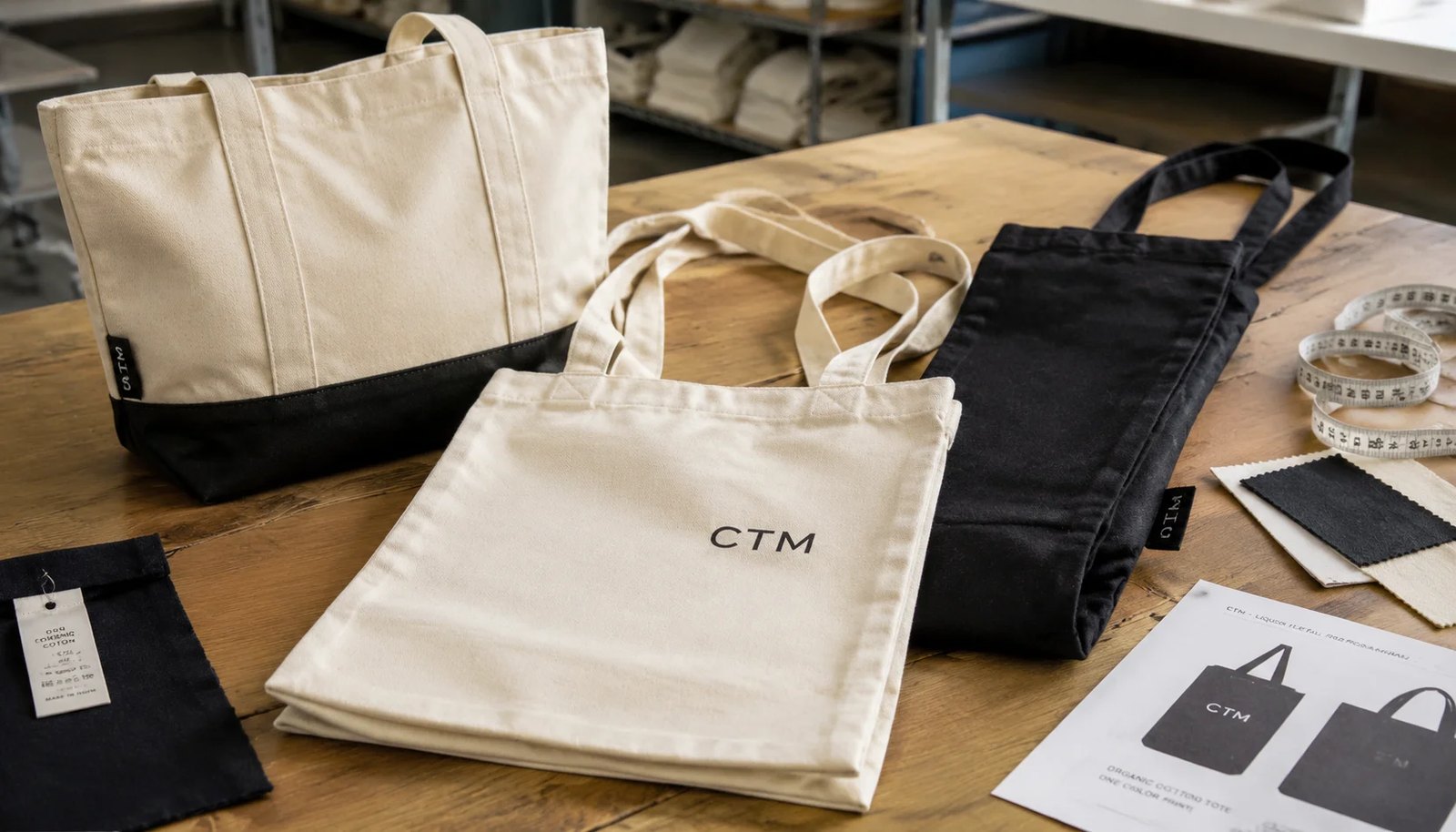
Why lead-time planning matters more for liquor retail than for generic tote programs
Liquor retail tote orders are usually tied to a fixed selling window: holiday gifting, a bottle launch, a tasting event, loyalty redemption, or a seasonal checkout program. If the bags arrive after that date, the order may still be usable, but the commercial value is lower. That makes schedule planning as important as unit cost.
The main mistake buyers make is treating tote bags as a simple sew-and-pack item. In practice, lead time depends on specification clarity, fabric readiness, print approvals, packing instructions, and release documents. Organic cotton adds another control layer because some retail programs require traceable material support rather than a generic 'organic' claim on the invoice.
For this reason, the best approach to an organic cotton totes for liquor retailers lead time planning guide is not to ask for one total factory lead time. Break the order into milestones, confirm what must happen at each stage, and identify where buyer-side delays can stall the schedule.
- Work backward from in-warehouse date, not from factory start date
- Separate factory lead time from total delivery lead time
- Treat approval speed as a procurement variable, not just a supplier variable
Start with the bag use case so suppliers quote the same product
A broad request for 'organic cotton tote bags' creates weak comparisons. One supplier may quote a flat 8 oz shopper, another a gusseted 12 oz bottle tote, and both will appear competitive on paper. That does not help a procurement team planning a retail launch.
For liquor retailers, the use case determines the structure. A single-bottle gift tote needs a narrower body and more vertical fit. A checkout carryout tote for two bottles or mixed purchases needs more base stability and stronger handle attachment. A loyalty tote for light use may tolerate a lower weight if the expected load is limited and clearly defined.
Before comparing prices, define bottle count, approximate bottle height, desired presentation, and whether the bag is meant for repeated reuse. That information does more to protect lead time than asking suppliers to sharpen price on an undefined RFQ.
- Single-bottle gift tote: narrower profile and cleaner presentation priorities
- Two-bottle or mixed-purchase tote: wider gusset and stronger bottom support
- General shopper tote: broader size tolerance but still needs realistic load expectations
Specifications that change the schedule: fabric, color, construction, and print
Some specification choices add very little schedule risk. Others can extend the critical path by days or weeks. Natural organic cotton with a simple one-color print is generally easier to plan than dark dyed fabric with multiple print passes. A repeat bag shape is easier than a new gusset format that needs fit confirmation. Store-bulk packing is easier than retail-sorted carton allocation.
Fabric weight should also be practical for the actual load. For liquor retail, many buyers start around 10 oz to 12 oz canvas because it gives better structure and lower show-through than light promo fabric. If a supplier quotes body and handle in different constructions, make sure both are clearly stated; otherwise the lead-time conversation may look stable while the delivered bag is weaker than expected.
Print method is part of schedule planning, not just branding. One-color or two-color screen printing on natural fabric is often the most scalable route for repeat programs. Dark body colors can require dye approval, underbase printing, and more visible color variation control. These factors should appear in the quote discussion rather than surfacing after deposit.
- Natural fabric usually simplifies color control and shortens approvals
- Dark dyed fabric can add shade review and slower print setup
- New gusset or handle construction should be treated as a sample-risk item
- Extra trims and premium details should be costed with schedule impact, not as free add-ons
Milestone timeline from RFQ to delivery buffer
A dedicated timeline table is one of the most useful tools for buyers planning organic cotton tote programs. It turns a vague lead-time promise into a working schedule with responsibilities on both sides. The exact ranges vary by supplier and season, but the milestone structure should stay consistent.
Use the schedule below as a planning template, then replace the ranges with supplier-confirmed dates. The point is not to force unrealistic promises. The point is to make sure RFQ alignment, sample approval, production, packing, ex-factory release, and transit buffer are all visible before the PO is locked.
- Do not approve a launch date until the sample path is clear
- Treat packing and export release as milestones, not minor admin tasks
- Add buffer before both vessel cutoff and warehouse intake
Organic cotton verification: what documents to ask for without overclaiming certification
Buyers should be precise about what they need from organic documentation. 'Organic cotton' in a product description is not the same as lot-linked support for a specific shipment. At the same time, not every program needs the same paperwork. The right question is: what document route satisfies your retailer, importer, or internal compliance requirement for this order?
Likely document routes can include a GOTS or OCS scope certificate reference for the supplier or relevant supply-chain party, a transaction certificate where applicable within the chosen standard and supply setup, a material declaration from the supplier, and internal lot mapping that links purchase order, production lot, and shipment documents. Buyers should ask what the supplier can support before deposit, not after bulk production is complete.
The practical control is PO-lot linkage. Whatever the document route, confirm how the supplier will tie material used in production to the order you are receiving. If that mapping is weak, the paperwork may exist in general form but still be difficult to use during customer review or audit.
- Ask which document route is available for the actual order, not just the factory in general
- Confirm whether transaction certificate support is applicable and feasible for the supply chain used
- Request a material declaration format if your customer does not require full certification paperwork
- Check that packing list, invoice, and production lot references can align to the same PO
Sampling and approval controls that actually reduce bulk risk
Sampling should prove the critical features of the final bag. For liquor retail totes, that usually means actual fabric weight, correct gusset construction, final handle attachment, and the real print method. If the sample uses substitute fabric or digital artwork while bulk will be screen printed, approval value is limited.
A strong approval pack combines the physical sample with a written tolerance sheet and a print reference. If the bag is bottle-specific, include a simple fit test or load test during internal review. This does not need to be overengineered, but it should answer the practical question: will the bag carry the intended bottle format without obvious instability or seam stress?
Buyers also save time by locking packing details during sampling. A bag can pass visual approval and still miss launch because carton marks, barcode label rules, or store allocation counts were left open until the end.
- Approve width, height, gusset, and handle drop in writing
- Require actual print method on the PPS when appearance is schedule-critical
- Use the sample review to freeze packing assumptions as well as bag appearance
- If the launch date is tight, define who can approve the PPS within your organization
Packing decisions that affect both schedule and landed cost
Packing is a frequent source of late changes because it sits between procurement, retail operations, and logistics. Flat bulk packing is usually the fastest route, but some liquor retail programs need store-ready counts, barcode labels, or distributor allocation by carton. Those are valid requirements, but they should be treated as production work, not clerical add-ons.
Heavier organic cotton bags also change carton cube and freight efficiency. A 12 oz gusseted tote may deliver better retail feel than a lighter bag, but it can reduce pieces per carton and raise freight per piece. Buyers comparing only FOB unit price can miss the real delivered cost difference.
The best buyer action is to ask for carton assumptions early: pieces per carton, carton dimensions, gross weight, inner-pack format, and any extra days needed for sorting. That way, the landed-cost model and lead-time model are based on the same bag program.
- Flat pack is usually the lowest-risk schedule option
- Store-pack and barcode sorting should be specified before bulk completion
- Carton cube matters when comparing 10 oz versus 12 oz programs
- Ask whether individual polybags are required or only assumed
Quality-control points linked to bottle-carry use and schedule release
QC should focus on the defects that matter in use, not just appearance on an inspection table. Liquor retail bags need secure handle attachment, stable seam construction, and balanced dimensions because bottle weight exposes weakness quickly. A bag that looks acceptable when empty may fail the customer experience at checkout if one handle is longer, the gusset is uneven, or the bottom seam grins under load.
Appearance still matters because these bags sit in a visible retail environment. Print skew, major stains, patchy ink coverage, and dirty fabric can trigger rework or hold shipment. The key is to define what counts as a major defect before inspection rather than debating it once cargo is packed.
Schedule reliability improves when QC criteria are specific. Instead of saying a print should look 'good,' define acceptable alignment, color reference, and visible defect limits. Instead of saying dimensions should be 'standard,' define tolerance ranges in the approved spec.
- Handle security and symmetry are priority checks for bottle bags
- Front-facing print and stain review should be based on the approved display side
- Measurement tolerances should be attached to the PO or approved spec
- Carton count and marking accuracy matter because repacking can delay release
How to compare quotes without repeating the same RFQ mistakes
Many quote comparisons fail because the buyer keeps asking the right questions but does not rebuild the answers into one normalized view. If one quote includes 10 oz canvas, reinforced handles, and store-pack labor while another assumes lighter fabric and bulk cartons, the lower price is not automatically the better buy.
A sharper comparison method is to line up five things: construction, print route, milestone timing, packing basis, and organic document support. Then ask suppliers to confirm what would change the schedule. This shifts the conversation from generic warnings about vague quotes into specific procurement actions.
For repeat buying, keep a standard quote sheet. It should force suppliers to state body fabric, handle construction, print method, sample path, packing basis, ex-factory estimate, and document route. That one tool does more to protect schedule than repeated email clarifications after the PO is placed.
- Normalize bag body and handle spec before comparing price
- Compare milestone timing, not only total lead time
- Separate packing labor assumptions from bag manufacturing assumptions
- Treat missing document support as a risk item, not a footnote
Practical buyer actions to keep the launch date intact
The strongest buyers do not rely on urgency messages after the PO. They reduce schedule risk before production starts. That means narrowing SKUs, approving real samples quickly, locking carton rules early, and confirming what organic support is actually available for the shipment.
For liquor retail programs, a small amount of front-end discipline usually protects more value than aggressive last-minute expediting. If the launch window is fixed, prioritize the options that simplify approvals: natural fabric, common bag construction, fewer artwork splits, and straightforward packing. If premium details are important, budget extra time openly rather than expecting the factory to absorb the complexity.
In short, use a milestone plan, not a single date. That is the most practical way to manage an organic cotton tote order for retail launch timing.
- Choose the simplest specification that still meets the retail objective
- Escalate document questions before deposit, not before shipment
- Approve one final spec sheet that operations, quality, and logistics all use
- Keep buyer-side approval ownership clear so samples do not sit idle
Specification comparison for buyers
| Lead-time scenario | Typical timing range | What drives the timing | Buyer checks before approval |
|---|---|---|---|
| Natural fabric, repeat construction, 1-color screen print | Around 3-5 weeks ex-factory after final approval if fabric is already supported by the supplier | Uses a familiar bag pattern, simpler print setup, and fewer color approvals | Confirm the exact fabric weight, prior production reference, and whether organic paperwork can still be linked to the PO lot |
| Natural fabric, new size or gusset, printed PPS required | Around 4-6 weeks ex-factory after final approval | Pattern confirmation and sample approval add time even when fabric color is unchanged | Approve measured PPS, handle reinforcement, print position tolerance, and carton pack before bulk starts |
| Dyed dark fabric with light print underbase | Around 5-7 weeks ex-factory after final approval | Fabric dyeing, shade review, and extra print process steps extend the critical path | Require shade standard, print strike-off, and confirmation of curing method and color coverage |
| Multiple artworks on one common bag body | Timing depends on artwork count and print scheduling; usually longer than a single-artwork run | Frequent screen changes and sorting can slow output even if fabric is common | Ask how MOQ, line scheduling, and carton segregation work by artwork version |
| Store-pack or barcode-sorted program | Adds several days after sewing and final inspection depending on allocation complexity | Manual sorting, relabeling, carton marking, and cross-checking store quantities can become the last delay point | Lock allocation file, barcode format, carton marks, and pack counts before production completes |
| Order requiring lot-linked organic document support | Timing depends on document route and supplier controls; should be confirmed before deposit | Material traceability, internal lot mapping, and post-production paperwork review can slow release if not defined early | Ask for scope certificate route, transaction certificate availability where applicable, material declaration format, and PO-lot linkage method |
Buyer checklist before sampling
- Define the retail use case first: single-bottle gift bag, 2-bottle carryout, or general shopper for mixed purchases
- State finished size, gusset type, handle width, and handle drop in the RFQ so all suppliers quote the same construction
- Specify fabric in oz or GSM and confirm whether the same weight applies to body and handles
- Request a milestone plan covering RFQ alignment, sampling, production, packing, ex-factory, and transit buffer
- State whether natural fabric is preferred for speed or whether dyed colors are mandatory for brand reasons
- Confirm the print method, print location tolerance, and whether dark fabric needs underbase or extra strike-off approval
- Clarify if the retailer needs GOTS or OCS scope certificate details, transaction certificate where applicable, material declaration, or other lot-linked support
- Define required sample stages: digital proof, fit sample, printed PPS, and any bottle load test
- Freeze packing instructions early, including inner pack count, carton marks, barcode labels, and store allocation rules
- Build buffer time between ex-factory date and retail launch for booking rollover, customs, and warehouse intake
Factory quote questions to send
- What exact body fabric and handle fabric are included in the quote, including weight tolerance and weave description?
- Which organic document route can you support for this order: GOTS or OCS scope certificate reference, transaction certificate where applicable, material declaration, or other PO-lot linked paperwork?
- Is the quoted lead time based on natural fabric, dyed fabric, or fabric booked only after deposit?
- What milestone dates do you estimate for sample submission, bulk material readiness, printing, sewing, final inspection, packing completion, and ex-factory release?
- What print method is included, and what schedule impact should we expect for dark fabric, underbase printing, or multiple artworks?
- What is the MOQ by style, body color, and artwork, and what changes if we split one order into several SKUs?
- How are handles attached, and what reinforcement pattern is standard for bottle-carry use?
- What sample stages do you recommend for this bag, and which one is the last approval point before bulk starts?
- What packing format is included in the price, and how many extra days are needed for barcode labeling, store-pack, or allocation sorting?
- What final inspection criteria do you use for major defects such as print skew, seam opening, handle mismatch, stains, and carton count errors?
Quality-control points to confirm
- Verify fabric weight against the approved spec and record the tolerance used for bulk acceptance
- Measure finished width, height, gusset, handle width, and handle drop against the approved tolerance sheet
- Check handle attachment security, stitch count consistency, and left-right handle symmetry on sampled cartons
- Confirm print position, tilt, color density, and edge quality against the approved strike-off or PPS
- Inspect front-facing panels for stains, needle damage, holes, heavy slubs, oil marks, mildew odor, or fabric contamination
- Review seam condition at side, bottom, and gusset areas for skipped stitches, seam grin, or opening under load
- Check packing count, carton dimensions, gross weight, carton marks, barcode labels, and store allocation accuracy
- Confirm any required needle control or metal detection records if requested by the retailer or importer
- Review organic support documents against the PO lot, production lot, and shipping documents before release
- Record inspection findings by defect type so schedule decisions are based on evidence, not assumptions