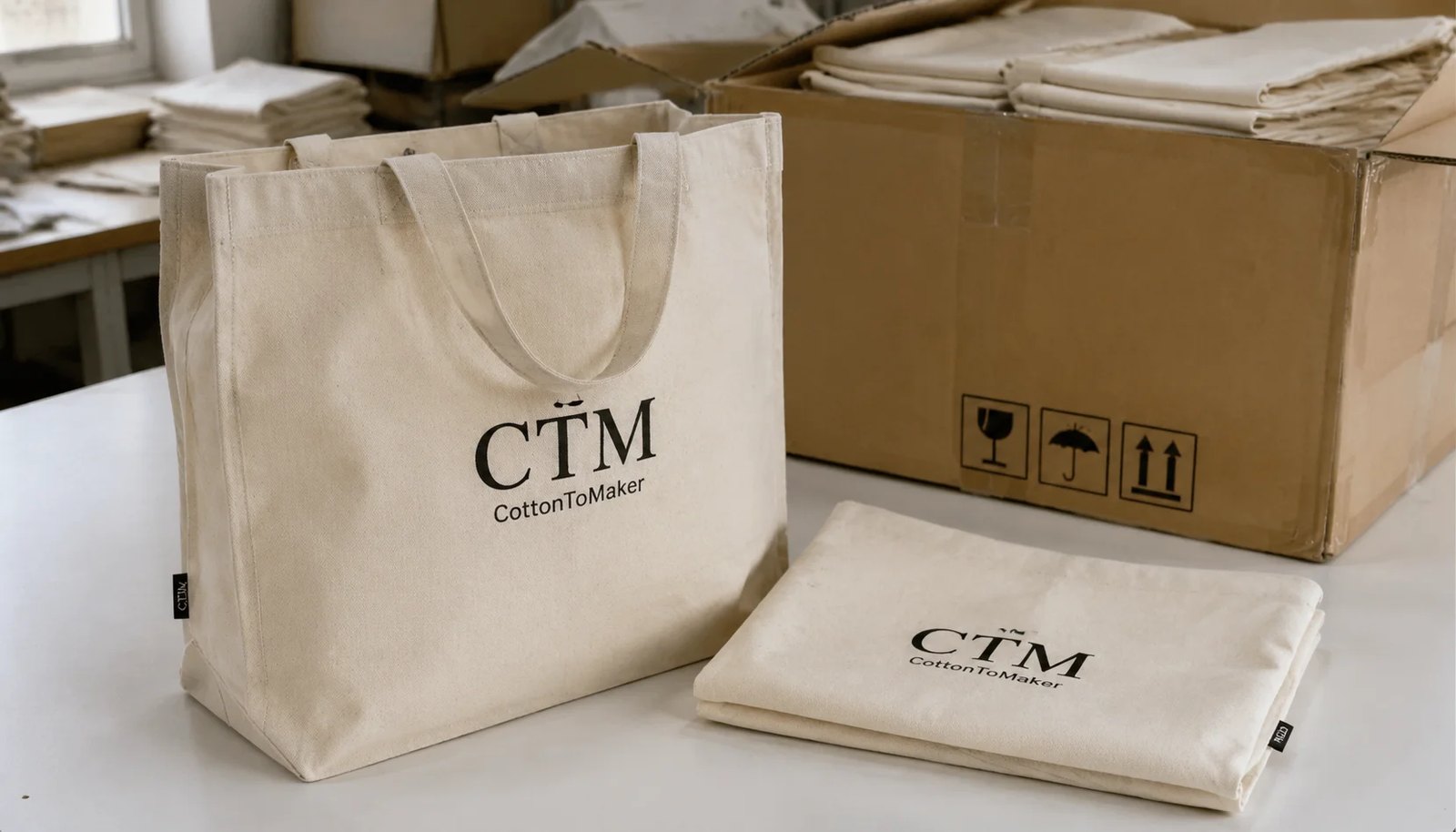
Why liquor retailers should plan the tote and the carton at the same time
For liquor retail, an organic cotton tote is not just a branded giveaway. It often has to carry dense glass bottles, survive repeated use, and still look presentable at checkout. That changes the sourcing brief immediately. Fabric choice matters, but so do fold direction, carton count, and carton weight. A bag that looks strong on the sample table can still arrive with a deep crease through the logo or in cartons that are awkward for warehouse teams to handle.
This is why the carton packing plan belongs in the same conversation as bag construction. If the supplier quotes only the open-bag spec, buyers are forced to evaluate price without seeing the full operational picture. Later, at packing stage, the factory may choose a fold that compresses the print, a carton count that pushes gross weight too high, or outer marks that do not match the retailer's receiving format. None of those issues are dramatic on their own, but together they create friction at the DC and on the shop floor.
The keyword topic organic cotton totes for liquor retailers carton packing plan is really about controlling those avoidable surprises. A 12 oz canvas tote may be the correct retail choice, but if it is packed too tightly, the extra fabric body that made it appealing can also increase crease memory and carton stress. On the other hand, a slightly lower carton count with a cleaner fold may protect appearance, simplify receiving, and reduce rework in stores.
A practical buying approach is to freeze the bag specification and the packing specification together. Suppliers should quote body size, gusset type, handle build, print method, fold method, pieces per carton, estimated dimensions, gross weight, and carton marks in one set of assumptions. That makes comparisons sharper. Buyers are no longer choosing on ex-factory price alone; they are choosing on total procurement fit.
- Treat the fold method and master carton count as part of the SKU, not as a late packing detail.
- Compare suppliers on ex-factory price plus gross carton weight, CBM, and receiving practicality.
- Flag logo crease position as a quality issue that affects sell-through and brand presentation.
- Confirm store or DC allocation logic before approving carton count.
Start with the real load case, not the logo artwork
Many tote projects begin with artwork, but liquor retail buyers usually get better results by starting with the load case. Ask a simple question first: what will the customer actually put inside this bag most of the time? One 750 ml bottle, two bottles, a boxed gift set, or a mixed purchase with snacks and accessories all place different stress on the base, seams, and handles.
This step sounds basic, yet it changes almost every downstream decision. A flat cotton tote that works for brochures or cosmetics may be a poor fit for bottles because the weight concentrates at the lower corners and side seams. A gusseted design, stronger handle insertion, and firmer fabric body may cost more up front, but those changes usually align better with liquor checkout use.
It also helps to describe the expected load in practical terms when issuing the RFQ. Even if you do not intend to make a public load claim, giving suppliers an internal usage target can improve quote quality. Without that reference, some factories will default to the lightest acceptable-looking spec in order to keep the quoted price attractive.
This load definition is especially useful when the tote serves more than one commercial role. A low-cost event bag handed out with one bottle has different priorities from a premium reusable tote sold at the register. The first may emphasize budget discipline. The second may justify heavier canvas, better fold recovery, and a stronger visual finish because the bag itself becomes part of the customer experience.
When buyers define the load case first, quote comparisons become more realistic. It becomes easier to spot when one supplier is pricing a true bottle-carry tote and another is pricing a generic promo bag.
- State the expected use in plain language, such as one bottle, two bottles, or boxed set.
- If helpful, include an internal target load in kilograms for sample checking.
- Separate giveaway requirements from paid reusable merchandise requirements.
- Use the same load description across all supplier RFQs to normalize pricing.
Choose fabric with bottle use, appearance, and tolerance control in mind
For most liquor retail programs, 10 oz to 12 oz organic cotton canvas is the practical starting range. In many cases that translates to roughly 340 to 410 GSM after finishing. It gives the tote enough body for bottle use without making every carton unnecessarily bulky. In broad terms, 10 oz is often suitable for standard checkout use, while 12 oz is commonly considered for premium reusable programs or stores that expect heavier mixed purchases.
The key point is not to rely on ounce language alone. In sourcing conversations, nominal oz terms are often used loosely. Two suppliers may both say 10 oz while delivering noticeably different fabric body in bulk because weave density, finishing, and test methods vary. That is why buyers should ask for the approximate GSM after finishing and the tolerance the supplier expects to control in mass production.
A practical tolerance may sit around plus or minus 5% to 7%, depending on the fabric source and finish. The exact number matters less than having a number in writing. If no tolerance is stated, later inspection becomes subjective. A delivered lot that feels light may still be defended as within trade practice if the PO is vague.
Finish also shapes the commercial result. Natural cotton can carry seed specks, slubs, and some lot variation. For some retailers that is acceptable, even desirable, because it supports a natural-material look. Others want a cleaner, more uniform appearance for premium gifting or stronger logo contrast. Bleached or dyed fabric may improve visual consistency, but buyers should also consider its effect on hand feel, shrinkage behavior, and price.
If the tote will be washed or dyed, dimensional movement deserves extra attention. Final bag size should be assessed after finishing, not before. A bag that arrives smaller than expected can create fit problems with boxed products or make the base less stable under two-bottle loads.
In procurement terms, the best RFQ language combines commercial wording and measurable controls: organic cotton canvas, nominal weight, approximate GSM after finishing, color or finish description, and agreed tolerance. That gives both the factory and the inspector a clear standard.
- Ask suppliers to quote both nominal oz and approximate GSM after finishing.
- Agree the fabric weight tolerance in writing before PO release.
- Clarify whether natural specks and slubs are acceptable on this program.
- If using washed or dyed fabric, confirm how final dimensions are measured after finishing.
Size, gusset, and handle details determine whether the bag actually works
For bottle-carry applications, shape often matters more than buyers expect. A flat bag may appear economical on the quote sheet, but bottles tend to force the body outward, pull against the side seams, and distort the print panel. In many liquor retail programs, a bottom gusset of about 80 to 100 mm gives a more stable base for one or two bottles. A common body size is around 380 x 420 mm finished, though the final dimensions should reflect your bottle mix and whether gift packaging or accessories are added at checkout.
If your assortment includes boxed sets or wider premium packs, a side-and-bottom gusset may be the better construction. It usually creates a squarer carrying profile and more usable volume. The trade-off is that it changes material consumption, print layout, and folded bulk. That is not a reason to avoid it. It is simply a reason to specify it clearly rather than letting the factory substitute a cheaper flat body.
Handle construction is often underwritten in RFQs. Terms like reinforced handles are too loose for procurement use. Buyers should state handle material, width, total length or handle drop, insertion depth, and reinforcement pattern. For liquor retail use, 25 to 30 mm handle width is often more comfortable than a narrow strap when carrying bottles. Reinforcement with bartacks or box-X stitching is common because the load concentrates where the handle enters the body seam.
Length also affects carton planning. Shorter hand-carry handles pack more compactly and may suit a fast checkout environment. Longer shoulder handles can increase customer convenience, especially for heavier purchases, but they add folded bulk and can create pressure points if the fold method is not controlled. This is one reason packed sample review is so valuable.
Where possible, buyers should ask for a practical internal load check on the pre-production sample. That does not mean requesting a formal public performance claim. It means verifying that the body shape, gusset, and handle insertion work together under realistic use before mass production begins.
- Specify finished width, height, and gusset type in millimeters.
- State handle width, total length or drop, insertion depth, and reinforcement pattern.
- Avoid comparing flat promo-bag quotes against gusseted bottle-carry quotes.
- Review the folded bag with handles arranged as planned for carton packing.
Print method, logo placement, and fold lines need to be reviewed together
For many liquor retailer tote programs, screen print is still the most practical choice. It works well for one to three spot colors, usually fits common MOQs, and can perform reliably when curing is controlled. Buyers should still ask what is included in the price: number of colors, print area, whether an underbase is needed, and how curing is checked before packing.
Transfer-based methods may fit smaller runs or more detailed artwork, but they require extra caution when the bags will be tightly folded and cased. A graphic that looks sharp on a fresh flat sample can become a problem if the print layer is stiff, if fold pressure causes visible cracking, or if stacked bags offset before the ink or transfer stabilizes fully.
Logo placement should be measured, not described loosely as centered. Buyers should supply vector artwork, Pantone references, print dimensions, and measured distances from the top seam and side seam. This allows the factory to align the fold plan against the real artwork. A fold line that lands across a crest, a small text line, or a circular store mark can make the bag look damaged even when the print itself was applied correctly.
The strongest approval process combines print review with packing simulation. Ask the supplier to print the intended fabric, fold the bag in the proposed direction, compress it in a realistic stack, and then reopen it for review. Look for cracking, whitening, transfer, and visible fold memory. In some cases, a small logo shift upward or a different fold direction solves the issue without changing the bag construction at all.
Another useful question is how long the printed bags rest before folding and casing. If goods are packed too quickly after printing, heavy ink coverage may block or scuff, especially in humid conditions. This process detail is easy to miss during quoting but can have a direct effect on delivered quality.
- Provide vector artwork, Pantone references, and measured logo placement.
- Review fold lines against the actual artwork before approving bulk production.
- Ask for compressed folded sample images when the print area is large or ink-heavy.
- Confirm print curing and resting practice before cartons are sealed.
Quote comparison should cover MOQ, hidden setup costs, and packing efficiency
Price comparison gets distorted quickly if the quote does not separate recurring and non-recurring costs. For custom organic cotton totes, MOQ often begins around 500 to 1,000 pieces per artwork or colorway, with better efficiency at 3,000 or 5,000 pieces. That is normal because screens, fabric booking, cutting plans, and packing labor all affect cost.
A useful quote should break out the unit bag price, print setup or screen charge, sample fee, labels or hangtags, unit packing materials, carton upgrades if required, and palletization if requested. Without that detail, a low headline unit price can hide weaker assumptions elsewhere, such as downgraded carton quality or unrealistic packing density.
MOQ also needs to be clarified at the right level. Buyers should ask what minimum applies per fabric color, per artwork, per SKU, and per destination label. A retailer order that looks large in total may still become operationally complex if it is split across several print versions, barcode sets, or compliance labels.
Another comparison point is landed packing efficiency. One factory may offer a very aggressive unit price but propose cartons that are overweight or over-compressed. Another may quote slightly higher while giving a more workable carton count, lower gross case weight, and a fold plan that protects the logo. The second option may save more time and cost once freight handling, warehouse receiving, and store replenishment are considered.
For repeat programs, ask how pricing changes when screens already exist and the specification is unchanged. Repeat-order economics can improve meaningfully when the buyer standardizes the artwork placement, fold style, and carton marks across seasons.
- Request price tiers at multiple volumes if final demand is not fixed.
- Separate unit price from setup, sample, label, and packing-material charges.
- Clarify MOQ per artwork, colorway, SKU, and destination label.
- Compare operational suitability, not just the lowest ex-factory number.
Build the carton packing plan around weight, fold safety, and receiving flow
The carton packing plan is where many otherwise solid tote projects begin to drift. The right count per carton depends on more than piece quantity. Fabric weight, gusset bulk, handle length, tag format, print stiffness, and unit packing all change the case dimensions and gross weight. A supplier should therefore quote fold method, pieces per inner bundle if any, pieces per master carton, estimated carton dimensions, net weight, gross weight, and CBM.
Gross weight matters because bottle-carry totes are heavier than lightweight promotional bags. Many buyers try to keep cartons roughly under 15 to 18 kg gross for easier manual handling, though internal standards differ by company and market. If the supplier maximizes piece count only to reduce carton quantity, the result may be cases that are harder to handle, more likely to crush in stacks, and less suitable for mixed-SKU receiving environments.
Fold direction needs visual approval. Half-fold, tri-fold, and nested-handle styles all produce different crease paths. The right answer depends on the logo position and the fabric's recovery behavior. Over-compression to save carton height can be a false economy, especially for premium totes sold to consumers. The bag may reach the store with a permanent line through the front print or a gusset that opens unevenly at checkout.
Carton count should also fit downstream allocation logic. If stores receive replenishment in 25, 50, or 100 unit increments, matching the master carton to that pattern can reduce recounting and split-case handling. For distribution centers, accurate outer marks are equally important. PO number, style code, quantity, carton number sequence, gross and net weight, country of origin, and destination labels should all be approved before bulk packing starts.
If palletization will be used, ask for the proposed pallet pattern and total load height. This is especially useful for larger retail chains where warehouse teams need to evaluate storage fit and handling in advance.
- Require carton dimensions, gross weight, and CBM as part of the quotation.
- Set carton count with both handling limits and store allocation in mind.
- Approve the fold direction from actual packed sample photos, not verbal description.
- Freeze outer carton marks before shipment production is packed.
- If palletized, review pallet pattern and estimated finished height.
Decide whether bulk pack or retail-ready unit packing makes more sense
For many liquor checkout programs, bulk packing is the most practical option. It reduces material use, lowers cost, and supports faster in-store handling. It also aligns more naturally with the sustainability positioning often associated with organic cotton. But bulk pack only works well when the supplier controls cleanliness, print curing, and fold consistency. Otherwise, the buyer may receive dusty goods, unevenly folded units, or scuffed fronts that create extra work at store level.
A carton liner can be a sensible compromise for export orders. It offers basic protection from dust and incidental moisture exposure without placing every bag in its own unit-level plastic sleeve. Buyers should still verify whether the liner changes packing density and whether the factory is using it as genuine protection rather than as a way to hide insufficiently rested print surfaces.
Individual polybags are usually more relevant when the tote is sold as merchandise, fulfilled through ecommerce, or presented as part of a premium gift program. In those cases, buyers should ask whether the bag film is virgin or recycled-content, whether vent holes are needed, and how barcode labels or hangtags will sit on the folded presentation. Those choices affect both cost and carton dimensions and should appear clearly in the quotation.
Paper belly bands can work when the buyer wants a cleaner folded presentation with less plastic. However, they need to be designed around the fold line and print area. A poorly placed band can leave a pressure mark, cover the main logo, or create inconsistent folding in production.
The guiding principle is straightforward: match the unit packing to the end use. A checkout utility tote does not need the same presentation treatment as a premium boutique bag sold as a reusable product.
- Use bulk pack when checkout speed, lower cost, and lower waste are the priority.
- Consider carton liners when export protection is needed but unit polybags are unnecessary.
- Use individual unit packing for sold merchandise or ecommerce programs.
- If using belly bands or tickets, specify placement and barcode orientation clearly.
Use a sample workflow that includes packing simulation, not just a pretty prototype
A disciplined sample workflow reduces most major sourcing risks before they become shipment problems. The most useful sequence usually includes a fabric swatch or color reference, a print strike-off on the actual fabric, a pre-production sample to final construction, and a folded packing simulation or sealed sample carton. Each stage answers a different question, and skipping one usually shifts risk to the buyer later.
Swatches and strike-offs confirm the visual base: fabric look, hand feel, and logo behavior on the real substrate. The pre-production sample then confirms sewing, gusset shape, and handle construction. For liquor retail programs, this stage should use the same intended fabric, thread, handle material, and print process as bulk. Hand-made showroom shortcuts can conceal later production issues.
A practical next step is to place the intended contents or equivalent weight into the sample. One or two 750 ml bottles plus a small add-on can reveal gusset collapse, handle discomfort, or seam strain quickly. This is not about making a marketing claim. It is simply a sensible internal check before committing to volume.
Packing simulation is the part many buyers omit, yet it often identifies the last important risk. Ask the supplier to fold the sample exactly as planned, compress it under realistic stacked conditions, and then reopen it. Review logo creasing, fold memory, transfer, gusset recovery, and overall presentation. If there is a problem, the correction may be simple: a different fold, a lower carton count, or a small adjustment in artwork placement.
Keep the approval record organized. The signed sample, approved artwork placement sheet, and approved carton reference should all be linked to the PO. That gives inspectors and suppliers a common benchmark at final inspection.
- Approve from real-fabric strike-offs and sewn samples, not from mockups alone.
- Use bulk-intended materials and print methods in the pre-production sample.
- Run a practical bottle-load check before authorizing mass production.
- Review the bag after folded compression, not only when it is lying flat and fresh.
Set QC rules before bulk starts so inspection is measurable, not subjective
Quality control for organic cotton totes used by liquor retailers should cover fabric, dimensions, construction, print, and packed-carton accuracy. Because cotton is a natural textile, buyers should distinguish acceptable natural character from true defects. Minor slubs or seed specks may be acceptable on a natural-finish program if the approved sample allows them. Oil marks, stains, holes, severe shade variation, wrong dimensions, print defects, and missing reinforcement generally should not be accepted.
The biggest improvement a buyer can make is to replace vague wording with measurable requirements. Write body dimensions in millimeters with tolerance. Write handle drop tolerance. Write target GSM with tolerance and note the agreed checking method. If logo position matters, define placement from the top seam and side seam. When these details are missing, the factory and the inspector often fall back on visual judgment, which creates disputes that could have been avoided.
Print inspection should go beyond color matching. Buyers should ask inspectors to review registration, edge clarity, coverage, curing, rub resistance, and fold response on production fabric. If the print panel is large, checks for offset or blocking between stacked pieces become more important. A logo that looks fine on the top sample may still fail under packed-carton conditions.
Construction review should focus on stress points. Side seams, bottom seams, gusset corners, and handle insertion areas deserve close attention because that is where concentrated bottle weight shows up first. Stitch security, skipped stitches, reinforcement consistency, and loose thread trimming should all be part of the inspection checklist.
Carton inspection matters too. Open random cartons from different pallet positions or lot sections to verify count, fold pattern, cleanliness, odor, and outer-mark accuracy. Overfilled cartons, crushed corners, moisture exposure, and wrong destination labels can create downstream issues even if the tote itself is acceptable.
If the buyer uses AQL, the defect categories should be agreed before inspection. If not, at least define critical, major, and minor defects internally so there is a consistent basis for shipment decisions.
- Write measurable tolerances for size, GSM, and print placement into the PO.
- Define which natural cotton characteristics are acceptable and which are defects.
- Inspect print curing and fold response, not color appearance only.
- Open random cartons during final inspection to confirm count, fold, and labels.
- Agree defect severity rules before shipment review begins.
Specification comparison for buyers
| Spec decision | Recommended option | When it fits | Buyer risk to check |
|---|---|---|---|
| Fabric weight for bottle carry | 10 oz to 12 oz organic cotton canvas, typically about 340 to 410 GSM after finishing | Checkout bags expected to carry one to two 750 ml bottles, gift packs, or mixed purchases | Ask how GSM is measured and tolerated; some quotes use nominal ounce language while delivered fabric runs lighter |
| Bag body construction | 380 x 420 mm finished size with 80 to 100 mm bottom gusset, or side-and-bottom gusset for boxed gift sets | General wine and spirits retail use where flat totes are too unstable | Flat bags can look cheaper on quote but stress side seams and distort the print panel under bottle load |
| Handle specification | 25 to 30 mm self-fabric or cotton webbing handles, 600 to 700 mm total length for shoulder style or 350 to 420 mm for hand carry, reinforced with box-X stitch or bartacks | Programs needing repeat use and better comfort under bottle weight | Handle width, insertion depth, and reinforcement are often omitted from RFQs, leading to weak bulk production |
| Print method | Screen print for 1 to 3 spot colors; transfer only when artwork detail or low MOQ makes it necessary | Most retailer logos, campaign marks, and store branding on natural cotton | Large solid prints can crack on fold lines if curing is poor or carton compression is excessive |
| Finished size tolerance | Body dimensions within about +/- 10 mm and handle drop within about +/- 10 mm after sewing, unless buyer sets a tighter standard | Typical sewn cotton bag production with practical B2B QC controls | If tolerances are not written into the PO, inspectors and factories may judge size by sample feel instead of measurable criteria |
| Fabric GSM tolerance | Target GSM with practical tolerance often around +/- 5% to +/- 7%, measured on conditioned fabric or agreed method | Bulk production where buyers need consistency without unrealistic zero-variance expectations | Nominal 10 oz quotes may hide lighter lots if no tolerance and test method are agreed |
| Carton packing style | Half-fold or tri-fold based on logo position, 25 to 100 pcs per master depending on weight, no over-compression | DC receiving and export shipments needing consistent counts and manageable carton weights | Chasing lower CBM by force-compressing bags can set hard creases and damage print appearance |
| Carton weight target | Keep gross carton weight typically under 15 to 18 kg unless buyer logistics allows more | Manual warehouse handling, mixed-SKU receiving, and safer pallet stacking | A carton count based only on piece quantity can create overweight cases or crushed lower cartons |
| Organic claim evidence | Transaction certificate scope and PO-linked material documentation when product or packaging states organic cotton | Retail buyers using certified claims on hangtags, web listings, or sustainability communications | Generic mill statements are not enough if claim substantiation is needed for a specific shipment |
Buyer checklist before sampling
- Define the actual use case by load: one 750 ml bottle, two bottles, boxed gift set, mixed basket add-ons, or paid reusable checkout tote.
- Specify fabric as organic cotton canvas with target weight in both oz and GSM, weave type if known, color or finish, and acceptable GSM tolerance.
- State finished body dimensions in millimeters, gusset type, handle length, handle width, insertion depth, and reinforcement pattern required.
- Confirm whether the bag must work as hand carry, shoulder carry, or both, and whether the base needs to hold shape when loaded.
- Provide artwork in vector format with Pantone references, print size, exact placement, and any no-fold zone across key logo elements.
- Write carton requirements into the RFQ: fold method, pieces per carton, optional inner bundle count, max gross weight, carton dimensions target, and outer carton marks.
- Clarify unit packing policy: bulk pack, carton liner, individual polybag, belly band, barcode ticket, hangtag, or retail-ready folded unit.
- Ask for quotation lines separately for bag price, print setup, sample fee, labels or tags, unit packing materials, carton upgrades, and palletization if required.
- Require a pre-production sample made with bulk-intended fabric and print method, plus folded packing photos or a sealed carton sample.
- Set QC criteria for fabric defects, size tolerance, print position, print curing, handle reinforcement, seam integrity, count accuracy, and carton labeling.
Factory quote questions to send
- What exact fabric construction is included in the quote: nominal oz, approximate GSM after finishing, weave, and whether the cotton is natural, bleached, dyed, or washed?
- What GSM tolerance can you control in bulk, and how is fabric weight checked before cutting?
- What finished size tolerance do you quote for width, height, gusset, and handle drop after sewing?
- What handle material, width, total length, insertion depth, and reinforcement pattern are included in the unit price?
- What static load check can you perform internally on pre-production samples for a one-bottle and two-bottle retail use case?
- Which print method is quoted, how many colors are included, what are the screen or setup charges, and what curing process is used?
- Can you propose a fold direction that avoids a hard crease across the main logo, and will you supply folded compressed sample photos before bulk packing?
- What carton count do you recommend for this exact bag spec, and what are the estimated carton dimensions, net weight, gross weight, and CBM?
- Will you use a carton liner, inner bundles, or unit polybags, and how do those choices change carton size and cost?
- What MOQ applies per fabric color, per print artwork, per barcode set, and per destination label?
Quality-control points to confirm
- Fabric weight checked against the approved standard before cutting, using the agreed GSM or ounce method and tolerance.
- Fabric shade and visible contamination reviewed lot by lot, especially for natural fabric where small specks may be acceptable but stains and oil marks are not.
- Finished bag dimensions measured after sewing at the agreed inspection stage for width, height, gusset depth, and handle drop.
- Handle construction checked for width, insertion depth, stitch pattern, bartacks or box-X reinforcement, loose threads, and skipped stitches.
- Seam integrity inspected at side seams, bottom seam, gusset corners, and handle stress points where bottle weight concentrates.
- Print position measured from top edge and side seam against approved artwork placement, not judged by eye alone.
- Print quality checked for color match to approved standard, registration, edge sharpness, ink coverage, curing, rub resistance, and fold response.
- Folded sample pieces reviewed for cracking, whitening, offset, or visible logo damage after compression similar to packed-carton conditions.
- Carton quantity verified by piece count and weight cross-check, with random cartons opened from different lot sections or pallet positions.
- Carton condition checked for burst risk, corner crush, moisture exposure, overstuffing, and whether gross weight stays within the agreed limit.