Start With the Receiving Date, Not the Show Date
For trade show exhibitors, the true deadline is usually earlier than the date on the badge. The practical cutoff is the moment your freight forwarder, advance warehouse, booth builder, or internal receiving team needs the cartons in hand. If the bags arrive after that point, the order may still be technically complete, but it is no longer useful for the show program that depended on it.
A workable schedule starts from the last safe receiving date and works backward through approval, sample, fabrication, packing, export booking, transit, customs, and domestic delivery. The more custom the tote, the less margin there is for optimistic assumptions. Procurement should treat timing as a chain of dependent milestones, not a single lead-time number copied from a quote email.
- Use the earliest required receiving date as the delivery deadline in the RFQ.
- Add domestic handling time if the totes will be inserted into exhibitor kits or retail bundles.
- Allow extra days for carton relabeling, palletizing, or mixed-SKU distribution.
- Treat artwork approval and sample approval as production milestones, not admin tasks.
- If the show uses a warehouse-in deadline, plan against that date instead of the public opening date.
- Ask whether the supplier’s calendar is based on working days or calendar days before you compare offers.
Write a One-Line Spec Before You Request Pricing
Organic cotton tote bags look simple, but small spec changes move cost, lead time, and risk quickly. A 180 GSM flat tote, a 280 GSM gusseted canvas tote, and a 340 GSM retail-style bag may all be described casually as cotton totes, yet they require different fabric sourcing, cutting layouts, sewing operations, print control, carton planning, and freight budgeting. Buyers get better quotes when the intended use is defined up front.
The RFQ should describe the real load and event role of the bag. A lightweight visitor giveaway that holds a brochure and a pen does not need the same construction as a VIP gift bag carrying a bottle, product sample, or catalog set. The trade show context matters because the bag may need to look good on the floor, hold together through repeated use, and still stay economical enough for a large visitor count.
- Common light trade show range: 160-200 GSM for thin documents and low-cost distribution.
- Common balanced range: 200-260 GSM for brochures, small samples, and general booth giveaways.
- Common premium range: 260-340 GSM canvas for retail resale, heavier contents, and longer reuse.
- Typical flat tote size: about 38 x 42 cm for A4 documents and catalogs.
- Typical gusset option: 8-10 cm side or bottom gusset when the bag must carry fuller contents.
- Define whether you need short hand-carry handles, shoulder carry, or both.
- State the fabric color up front: natural, bleached, or dyed, because that affects both timing and cost.
Separate Organic Claims From Material Choices
If the bag will be marketed as organic cotton, documentation has to be settled before sampling becomes a production order. Some buyers only need a supplier declaration for internal sustainability review. Others need certificate scope, transaction documents, chain-of-custody evidence, or sign-off from legal, quality, or brand compliance before the PO can be released. The supplier should know which version of the claim will appear on invoices, cartons, and any accompanying marketing language.
The main procurement risk is not whether organic cotton exists in the market. It is whether the quoted supplier can connect the claim to the actual lot used for the order. A low quote may be based on stock natural cotton rather than documented organic cotton, and those are not the same buying decision. The safest RFQ asks for the claim requirement explicitly so the supplier can price the correct material and paperwork from the start.
- Write the exact claim your brand intends to make on packaging, website, or booth materials.
- Specify whether documentation must cover fabric, finished bag production, or both.
- Request certificate scope before deposit if your compliance team must approve it.
- Match purchase order wording, invoice wording, and carton labels to the approved claim.
- Avoid mixing certified and non-certified language in the same RFQ unless both options are being compared clearly.
- Ask whether the factory can trace fabric lots to finished goods if your compliance process requires traceability.
- Confirm whether the supplier can issue the paperwork in time for customs or internal audit review.
Choose the Construction That Matches What People Will Put in the Bag
Fabric weight changes more than the unit price. Heavier organic cotton increases fabric cost, cutting resistance, stitch stress, needle and thread requirements, carton gross weight, and sometimes freight class. A heavier tote can improve perceived quality, but it can also reduce carton quantity and make the landed cost higher than the first quote suggests. Buyers should compare delivered value, not only the bag price.
For trade show orders, the best GSM is usually the lightest fabric that still fits the brand position and the contents. If the bag only carries a catalog and a few inserts, a heavy canvas can waste budget and add unnecessary transit cost. If the bag carries samples, retail packaging, or a product kit, a thin bag can feel cheap, print unevenly, or fail during the event. Procurement, brand, and operations need the same spec language before quoting.
- Request actual GSM, fabric weave, and whether the quoted fabric is stock or custom woven.
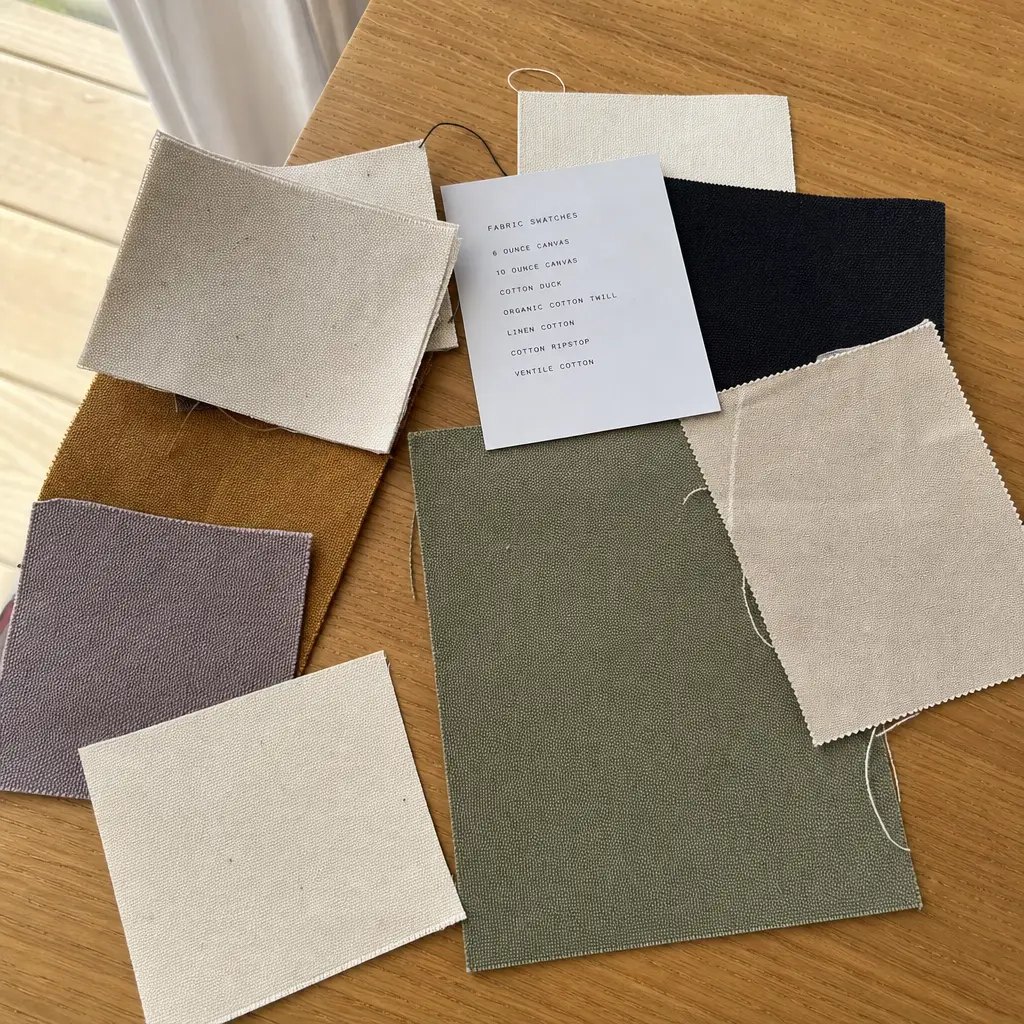
- Ask for a swatch from the same GSM family, not only a photo of a previous bag.
- Compare carton quantity and gross weight when moving from 180 GSM to 280 GSM.
- Use a load test when the bag will carry bottles, boxed samples, hardware, or thick catalogs.
- Expect natural cotton shade variation unless bleaching, dyeing, or shade bands are agreed.
- If the bag must stand upright on a counter, add structure and confirm whether that changes the sewing method.
- Check handle width as well as length; thin handles can cut into the hand even when the bag itself is strong.
Pick the Print Method Around Artwork, Not Preference
Most trade show organic cotton totes use screen printing because it is reliable for one-color or two-color logos, event slogans, and simple brand graphics. It produces a clean result on cotton when the artwork is suitable and the ink is properly cured. The timing impact is not just printing itself; it includes screen preparation, ink matching, test runs, drying, and the time needed for buyer approval. Buyers often underestimate how much of the schedule is tied to artwork readiness.
Full-color graphics require a different evaluation. Digital pigment print or DTF transfer can support more colors and shorter artwork cycles, but the buyer should judge hand feel, edge visibility, cracking risk, and rub performance on the actual fabric. A print that looks right on a screen mockup can still fail once the bag is folded, packed, and handled repeatedly during the show. The safest approach is to approve the print on a physical sample, not on a rendering alone.
- Provide vector artwork and Pantone references before the factory calculates print setup.
- Define print size in centimeters and position from the top edge and side seams.
- Avoid very small QR codes on coarse cotton; test scan performance on the actual printed sample.
- For screen print, review ink coverage, registration, edge sharpness, and fabric show-through.
- For transfer print, review film outline, flexibility, adhesion, and heat mark risk.
- If the design will be reused across events, ask whether the screen or file setup can be retained for future orders.
- If there is fine type, define the minimum line width the factory must hold so the file does not get simplified later.
Treat MOQ, Sampling, and Revision Rounds as One System
MOQ for organic cotton totes usually comes from several parts of the order at once: fabric purchase, dyeing, printing setup, label weaving, cutting efficiency, and packing flow. A supplier may accept a lower bag quantity when stock natural fabric and a simple screen print are used. The same supplier may require a higher MOQ for custom dyed organic fabric, custom webbing, a woven brand label, or a more complex insert. The number is usually a function of the full production path, not a universal rule.
Procurement gets better answers by asking how the MOQ changes at different volumes. Instead of only asking for the minimum, ask what happens at 500, 1,000, 3,000, and 5,000 pieces. That makes it easier to compare a slightly larger order with a lower unit price, fewer setup charges per bag, or a more stable production slot. It also clarifies whether the factory is quoting a true production quantity or simply a one-off sample run scaled into a quote.
- Stock natural organic cotton usually supports lower MOQ than custom dyed fabric.
- One-color screen print has lower setup friction than multi-color print or full-panel artwork.
- Custom woven labels may have their own MOQ and sample time separate from the bag.
- Small orders can carry higher sample, screen, and handling cost per unit.
- Very low MOQ quotes should be checked for fabric substitution and documentation limits.
- Ask whether the supplier’s MOQ applies to each colorway or to the total order across colorways.
- If your program needs multiple event destinations, ask whether the MOQ changes for split delivery.
Approve the Pre-Production Sample Like a Mini QA Gate
A digital mockup is useful for layout, but it is not enough for a trade show order with a fixed deadline. The buyer needs to see fabric thickness, handle drop, seam strength, print edge quality, logo scale, and the way the bag folds into cartons. A physical pre-production sample is the cheapest point in the process to catch expensive mistakes, especially when the event date is immovable and the bags will be part of booth-ready inventory.
Sample approval should be structured like a small acceptance test. If the tote is approved only as a photo, later disputes become subjective and slow. If the buyer signs off on size, GSM, handle length, print method, print position, label placement, and packing fold, the factory has a clear target and the inspection team has measurable criteria. That reduces the chance of a last-minute redesign or a freight delay caused by rework.
- Measure finished size flat and compare it with the RFQ tolerance.
- Load the sample with the expected catalog or product weight and carry it by the handles.
- Rub the printed area with a clean white cloth after curing to check obvious ink transfer.
- Fold the bag as it will be packed and review whether the print cracks or sticks.
- Photograph the approved sample with a ruler and keep it as the golden sample reference.
- If the sample reveals a problem, ask for a revised sample before bulk fabric cutting starts.
- Do not approve a sample with ambiguous color or logo placement if the event signage or brand standards are strict.
Build Packing, Carton, and Pallet Details Into the Order
Packing is often treated as a shipping detail, but it changes labor at the event. Individual polybags may be useful for retail resale or clean distribution, but they slow booth setup and create extra waste. Bulk packing is usually better for trade show handouts, provided the bags are folded consistently and protected from moisture. The buyer should decide the packing method based on how the bags will be used on arrival, not only on transit protection.
Carton planning should be part of the quote comparison from the beginning. A cheaper unit price can become less attractive if carton quantities are low, gross weight is high, or carton markings are not suitable for warehouse receiving. For multi-booth programs or distributor shipments, consistent carton labels and packing lists prevent time-consuming sorting on arrival. The event team should know exactly how the cartons will be unpacked and distributed before the PO is issued.
- Typical bulk packing: 50-100 pieces per export carton depending on GSM and bag size.
- Request carton dimensions and estimated gross weight before confirming freight.
- Use inner liners or moisture control for ocean shipments and humid routes.
- Mark cartons with item name, PO number, quantity, carton number, destination, and event code if needed.
- Avoid over-compressed packing that creates deep print creases or distorted handles.
- If bags will be kitted with inserts, confirm whether the factory or your warehouse will do the insertion.
- If the order will ship on pallets, ask for pallet count, pallet height, and whether pallet wrapping is included.
Compare Quotes on the Same Basis, or the Lowest Number Will Mislead You
The lowest unit price is not necessarily the lowest show cost. A serious quote comparison should include sample charges, screen charges, label charges, packing method, carton size, estimated weight, Incoterm, freight, duties, customs fees, inspection cost, and domestic handling. Organic documentation and heavier GSM can also change the final landed cost in ways that do not show up in the headline bag price.
A clean quote table helps procurement avoid false savings. If one supplier quotes EXW with no cartons specified and another quotes FOB with carton details and inspection support, the numbers are not directly comparable. The best RFQ forces each supplier to price the same bag, same print, same packing, same document requirement, and same shipment basis. Only then can buyers compare supplier value instead of comparing assumptions.
- Compare unit price at the same quantity and same approved specification.
- Separate tooling, sample, print screen, label, and document charges from bag unit price.
- Request carton CBM and gross weight so freight estimates can be checked early.
- Confirm whether export cartons, moisture protection, and shipping marks are included.
- Use landed cost per delivered usable bag when deciding between fabric weights or supplier routes.
- Ask the supplier to call out any charge that changes if the artwork or packing method changes.
- If the supplier offers multiple Incoterms, make them quote the same basis for each line item so the comparison stays honest.
Use a Backward Lead-Time Plan With Buffers That Match the Risk
A workable lead time is built from smaller blocks: quote clarification, artwork review, sample production, sample shipping, buyer approval, fabric reservation, cutting, printing, sewing, finishing, inspection, packing, export booking, international freight, customs, and final delivery. Removing one block on paper does not remove it from the factory floor. Buyers who compress the calendar too aggressively usually end up paying for expedite freight, rush approvals, or a simplified spec that does not match the brand standard.
For many custom organic cotton tote orders, planning 8-12 weeks before the required receiving date is a practical starting point when overseas freight is involved. Faster schedules may be possible with stock fabric, simple printing, and air freight, but the risk and cost should be visible before the PO is released. The buyer needs to decide whether speed is worth a simpler spec, a higher freight spend, or reduced contingency for rework.
- Quote and spec alignment: 2-5 working days when artwork and requirements are clear.
- Custom sample: often 5-10 working days after artwork and sample charge approval.
- Sample transit and review: commonly 3-7 days depending on destination and internal approval speed.
- Bulk production: often 20-35 days depending on fabric availability, print complexity, and quantity.
- Freight and receiving: can range from several days by air to several weeks by ocean plus local handling.
- Add a buffer if the event is in peak shipping season or if the receiving location has limited delivery appointments.
- Build a separate contingency window if your organization needs compliance sign-off or legal review before the PO can be released.
Specification comparison for buyers
| Spec decision | Recommended option | When it fits | Buyer risk to check |
|---|---|---|---|
| Fabric weight for basic event handouts | 160-200 GSM organic cotton plain weave | Low-cost brochure bags, lightweight inserts, and visitor giveaways that do not carry heavy contents | Thin fabric can look flimsy once printed; ask for actual GSM, a swatch, and a finished-bag photo under normal room light |
| Fabric weight for premium exhibitor gifts | 260-340 GSM organic cotton canvas | VIP packs, retail-style gifts, resale items, or kits with catalogs and samples | Heavier fabric raises sew time, carton weight, and freight cost; compare landed cost, not only ex-factory price |
| Bag style for flat documents | Flat tote, about 38 x 42 cm | A4 brochures, catalogs, thin product literature, and simple booth handouts | Flat bags can feel shallow; confirm usable interior depth after hem and seam allowances |
| Bag style for sample kits | Gusseted tote with 8-10 cm side or bottom gusset | Bottle packs, boxed samples, multi-item kits, and visitor bags that must stand fuller | Gussets reduce carton efficiency; ask for folded dimensions and carton count before approval |
| Single-color logo method | Screen print with water-based or low-PVC ink | Most trade show logos, short slogans, and QR codes with simple artwork | Fine lines can fill on textured cotton; approve a physical sample and define minimum line width |
| Full-color artwork method | DTF transfer or digital pigment print after fabric testing | Short runs, event graphics, detailed artwork, or frequent campaign changes | Check edge visibility, cracking, and rub fastness after folding and handling |
| Handle construction | Self-fabric handles with reinforced cross stitching | Standard shoulder-carry booth bags with a natural look | Handle drop must suit coat or jacket use; measure from stitch point to stitch point and confirm carry comfort |
| Organic claim documentation | Lot-linked chain-of-custody evidence or certificate scope, if required by your compliance process | Retail brands, distributors, and importers that need audit-ready documentation | A verbal organic claim is not enough; verify the exact claim language before the PO is issued |
| Packing method | Bulk packed 50-100 pcs per export carton with moisture protection | Booth distribution, warehouse receiving, and event kit insertion | Poor folding or weak cartons create receiving delays; ask for carton dimensions, gross weight, and shipping marks |
Buyer checklist before sampling
- Confirm the real deadline: warehouse receiving date, booth move-in date, or kit-assembly date, not just the public show opening date.
- Write the bag spec in one line before quoting: size, gusset, handle length, fabric GSM, fabric color, print position, print size, and print method.
- State whether the order must be documented as organic cotton and whether your team needs GOTS, OCS, or another chain-of-custody format.
- Provide vector artwork, Pantone references, and minimum line thickness instead of low-resolution logo files.
- Request fabric swatches or a previous production sample in the same GSM range before paying for a custom sample.
- Approve a physical pre-production sample for size, fabric hand feel, print placement, label placement, and handle strength before bulk cutting.
- Define acceptable tolerances in the PO: size, print placement, seam quality, carton quantity, and carton marking format.
- Compare quotes using the same packing method, carton dimensions, estimated gross weight, sample charge, screen charge, and Incoterm.
- Reserve time for customs, domestic trucking, warehouse receiving, and possible carton relabeling or palletizing.
- Keep 2-3% extra quantity in the order plan when the totes will be used for booth traffic, staff kits, press packs, or VIP bags.
Factory quote questions to send
- What exact fabric construction, weave, and GSM are quoted, and is the organic cotton claim supported by lot-level documentation if required?
- Is the price based on stock natural fabric, bleached fabric, dyed fabric, or made-to-order fabric?
- What MOQ applies to the bag body, fabric color, print method, woven label, and export carton marking separately?
- How many calendar days are needed for fabric reservation, sample making, print setup, bulk sewing, inspection, and packing after deposit and artwork approval?
- Which print method is quoted, and what are the limits for line thickness, small text, Pantone matching, and print area?
- Is a physical pre-production sample included before bulk production, and how many revision rounds are allowed before extra charges apply?
- What packing method, pieces per carton, carton size, estimated gross weight, and moisture-control measures are included?
- What inspection standard does the factory use for measurement tolerance, appearance defects, print defects, and seam defects?
- Can the supplier provide photos or video of fabric inspection, first-article printing, inline sewing, and packed cartons before shipment?
- Which Incoterm is quoted, and are export documents, HS code suggestion, and carton shipping marks included in the price?
Quality-control points to confirm
- Verify fabric GSM by cutting a known area and weighing it, or by requesting mill data; visual thickness is not a reliable substitute.
- Set the finished bag size tolerance in the PO. A common target is plus or minus 1 cm on length and width unless a tighter tolerance is required.
- Measure handle length flat from stitch point to stitch point, and confirm handle drop against the intended carry position over a coat or jacket.
- Define print placement against the top edge and side seam in centimeters, not by eye against a folded sample.
- Screen print should show clean edges, no heavy ink buildup, no obvious off-registration, and no ink transfer when rubbed after curing.
- Seams should be consistent, with no open seams, skipped stitches, loose thread tails, or weak reinforcement at handle attachment points.
- Natural cotton shade variation should be approved within a controlled range because unbleached organic cotton is rarely identical from lot to lot.
- Cartons should be dry, strong enough for stacking, marked clearly with PO, quantity, carton number, and destination, and packed to a consistent count per carton.
- If the order includes a woven label, check the label position, fold direction, and stitch security, not just the logo artwork.
- Ask for a first-article photo set showing the front, back, handle attachment, inside seam, and folded carton view before bulk approval.