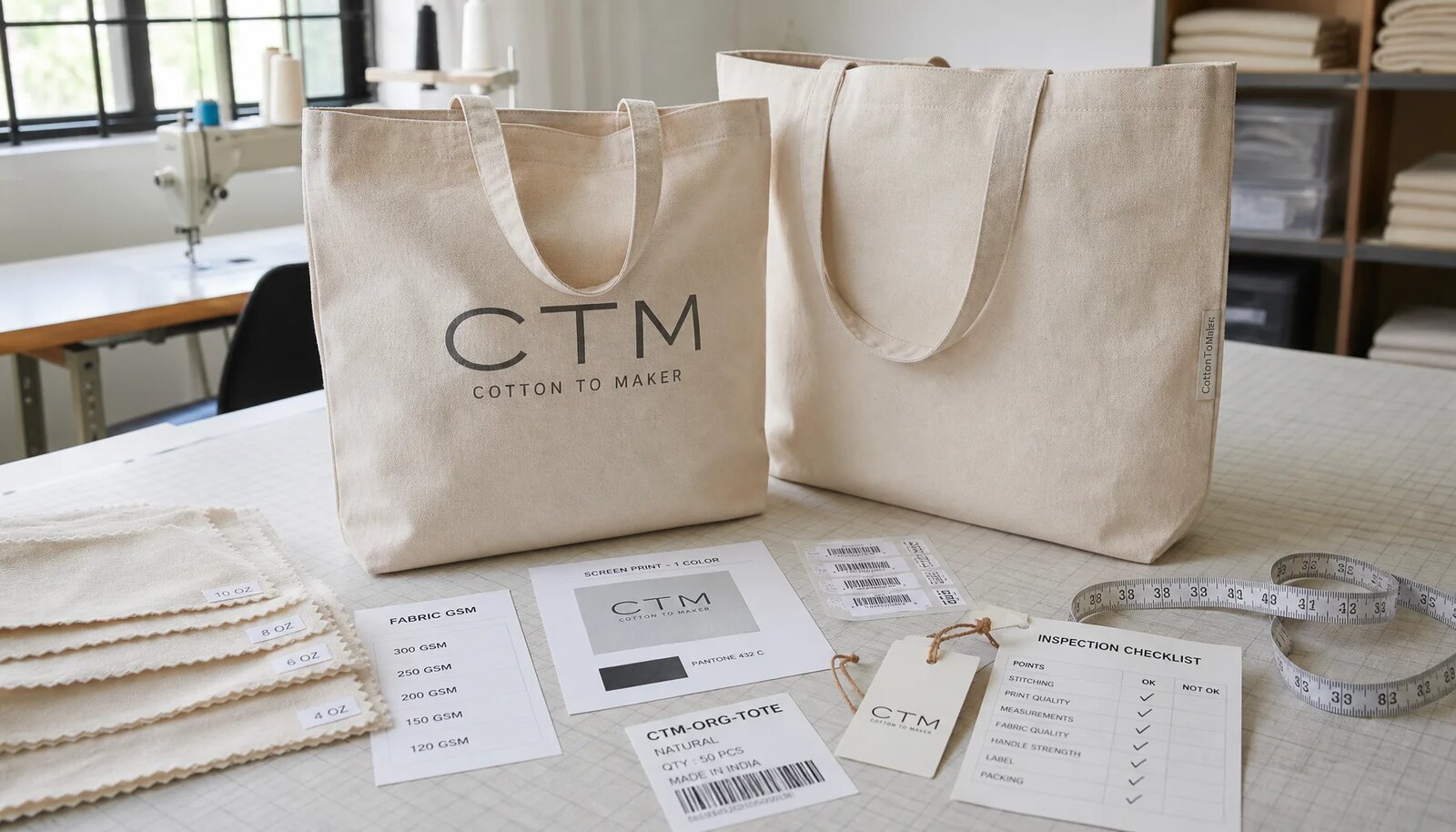
Start With the Shelf-Ready Date
A useful organic cotton totes lead time planning guide for hotel retail starts with the date the tote must be sellable, not the date the factory says sewing can finish. Hotel retail dates are rarely flexible. They may be tied to a resort opening, spa launch, seasonal shop reset, conference arrival window, loyalty campaign, or multi-property brand refresh. When procurement asks only for production lead time, the calendar misses the slower steps: internal artwork approval, organic claim review, barcode setup, packing confirmation, inspection booking, freight, warehouse appointments, and property receiving.
For a first custom organic cotton tote program, plan around 8-12 weeks from frozen specifications, confirmed artwork, and deposit to factory-ready cartons. That means cartons are packed, inspected, labeled, and ready for shipment handover. It does not mean the totes are on the hotel shelf. Freight, export documents, customs clearance, inland delivery, warehouse receiving, price tagging, property distribution, and retail setup must be added separately. Ocean freight and multi-property distribution can stretch the plan. Air freight can reduce transit time, but canvas totes are bulky, so the landed cost can change quickly.
Build the schedule backward. If totes must be in the boutique on June 1, decide the latest date goods can arrive at the hotel dock or central warehouse. Then set the latest shipment arrival date, factory-ready date, inspection date, packing date, production start, sample approval deadline, and artwork freeze. This backward plan makes ownership visible. The factory controls fabric booking, cutting, sewing, printing, curing, trimming, packing, and export readiness once approvals are frozen. The buyer controls artwork release, claim wording, barcode data, payment timing, inspection booking, shipment instructions, and receiving coordination.
- Shelf-ready date: goods are counted, priced, scanned, and available for sale or guest distribution.
- Required arrival date: cartons reach the hotel dock, central warehouse, or distributor with enough time for receiving.
- Factory-ready date: packed cartons are complete, inspected, labeled, and ready for shipment handover.
- Approval freeze date: fabric, construction, print, labels, hangtags, barcodes, and carton marks are signed off.
- First-order buffer: add 7-14 days for sample revision, claim review, fabric delay, print rework, or inspection hold.
- Logistics buffer: allow for carrier rollover, customs exam, warehouse appointment changes, holidays, and hotel receiving limits.
Define the Hotel Retail Use Case
An organic cotton tote is not one standard SKU. A paid gift shop tote must feel substantial enough for the shelf price and durable enough for repeat guest use. A welcome amenity tote may be more cost-sensitive, but it still appears in guest rooms, lobbies, and social content. A spa retail tote may carry boxed skincare, robes, slippers, candles, or bottles. A resort tote might hold towels, sunscreen, books, snacks, or beach purchases. These uses change the fabric weight, gusset depth, handle drop, seam reinforcement, print method, packing, and QC plan.
Before asking for quotes, prepare a short product brief. Include the sales channel, launch date, estimated quantity by property, intended load, target handfeel, shelf presentation, artwork type, organic documentation requirement, barcode needs, packing route, and delivery destination. This protects the buyer from receiving a lightweight promotional bag quote when the hotel expects a retail-grade canvas tote. It also keeps internal teams aligned before sampling starts. Marketing may care about the destination artwork. Sustainability may care about organic documentation. Retail operations may care about barcode scans. Logistics may care about carton size and receiving windows.
Separate fixed requirements from preferences. Organic cotton documentation, finished size, handle drop, print placement, barcode accuracy, and direct-to-property carton marks may be non-negotiable. Exact natural fleck level, optional belly band material, or carton count may allow some flexibility if the warehouse can accept alternatives. When a factory knows what is fixed and what can move, it can suggest cost or lead time savings without weakening the retail program.
- Paid retail tote: prioritize handfeel, structure, print quality, barcode readiness, and shelf presentation.
- Welcome amenity tote: prioritize delivery reliability, efficient packing, acceptable appearance, and cost control.
- Spa merchandise tote: check load strength, color transfer, moisture exposure, and premium finishing details.
- Conference tote: plan fixed event deadlines, attendee buffers, carton sorting, and logo approval cutoffs.
- Resort shopping tote: test gusset volume, shoulder comfort, print durability, and towel or bottle load.
- Multi-property tote: standardize the base bag and split only artwork, labels, barcodes, or carton marks where necessary.
Specify Fabric Precisely
Fabric is usually the biggest specification driver and one of the most common lead time risks. A quote request that says only organic cotton tote bag leaves too much room for interpretation. The RFQ should state GSM or ounce weight, weave, color, finish, expected shrinkage, fabric width if relevant, acceptable slub level, and documentation needs. For many hotel retail programs, 10 oz to 12 oz organic cotton canvas, typically about 280-340 GSM, gives a more substantial retail handfeel than thin calico while staying practical for sewing, printing, folding, and export packing.
Lightweight fabric can still be the right choice. A 6 oz to 8 oz cotton tote, roughly 170-240 GSM depending on construction and finish, can work for welcome bags, light conference use, or low-load amenity packaging. It may reduce fabric cost and carton weight, but it can wrinkle more, show contents, and feel less valuable on a paid retail shelf. Heavy canvas above about 14 oz can feel premium, yet it raises material cost, carton volume, needle stress, sewing time, and sometimes print stiffness. The safest decision is to test the bag with the items guests will actually carry.
Natural organic cotton also needs a visual standard. It is not pure white. Cream tone, seed flecks, slubs, and lot-to-lot shade movement are normal unless the buyer specifies a cleaner finish. Those natural details can support the product story, but they still need boundaries. If the hotel brand needs a cleaner or more controlled shade, request bleaching, dyeing, or lab dip approval and add time for color review. Dyed organic cotton adds dye lot control, shade tolerance, possible minimums, shrinkage checks, and colorfastness review. Approve a physical swatch before bulk cutting, then keep that swatch as the inspection reference.
- 6 oz to 8 oz cotton: suitable for light welcome bags, events, and lower-load amenity packaging.
- 10 oz to 12 oz canvas: balanced for hotel gift shops, spa retail, and reusable resort shopping bags.
- 14 oz and above: premium feel, but higher cost, bulkier cartons, slower sewing, and more freight impact.
- Natural shade: expect cream tones, flecks, and slubs unless a stricter shade standard is approved.
- Dyed fabric: add lab dip approval, dye lot minimums, shade tolerance, shrinkage review, and possible colorfastness checks.
- RFQ data: record GSM, ounce weight, weave, finish, width, shade, shrinkage expectation, and acceptable visual defects.
Confirm Organic Claim Scope
Organic cotton documentation is a procurement control point, not a detail to tidy up after production. A supplier may be able to show that organic cotton fabric was purchased, but that does not automatically support every finished-product claim a hotel may want to print. The buyer should define whether the program needs fabric-level evidence for internal files, transaction documentation, chain-of-custody support, supplier declarations, or a specific claim approved by legal and sustainability teams.
The risky moment is artwork approval. If a hangtag, belly band, care label, invoice description, product page, or hotel ESG record uses words such as organic, eco, sustainable, responsible, natural, plastic-free, low-impact, or certified, the wording should match the available evidence and the buyer's compliance review. Do not send claim language into bulk print while the documentation route is still uncertain. A claim change after hangtags, labels, or packaging are printed can add rework cost and delay the order.
Keep organic cotton separate from other claims. Organic cotton describes fiber origin and production route. It does not automatically prove recycled content, carbon reduction, biodegradability in all conditions, fair labor, chemical safety, or finished-product certification. If the hotel needs any of those claims, put them in the RFQ as separate requirements. Clear wording keeps the quote accurate and prevents broad sustainability language from turning into a production dispute.
- Fabric evidence: ask what documents identify organic cotton fabric, supplier, quantity, and lot connection.
- Finished-product claim: confirm whether additional chain-of-custody support is required before printing.
- Artwork control: freeze claim wording before hangtags, belly bands, labels, invoices, and web copy are produced.
- Internal review: involve sustainability, legal, compliance, and retail teams before approving public claims.
- Separate claims: do not treat organic cotton as proof of recycled, biodegradable, low-carbon, or labor claims.
- Document timing: include review time in the lead time plan before sample approval and bulk packaging print.
Engineer for Guest Loads
Construction is what separates retail merchandise from a short-life giveaway. A flat tote is efficient, economical, and easy to pack. A bottom gusset improves capacity for folded apparel, spa products, boxed gifts, and souvenir purchases. A full side gusset gives a more structured retail profile and better volume, but it also adds fabric consumption, sewing steps, and inspection points. Procurement should define capacity by real contents, not by the appearance of a flat sample on a table.
Handle design deserves close attention. Shoulder handles are often more useful for resort and shopping use than short hand-carry handles. A finished handle length around 55-65 cm is common for shoulder carry, but the buyer should approve handle drop on a physical sample because bag height, body fit, and intended load all matter. Handle tape width, fabric layers, reinforcement pattern, stitch density, and seam allowance affect durability. For heavier retail use such as wine, books, beach items, or spa products, request box-stitch or cross-stitch reinforcement and include a load test in QC.
Extra features can improve perceived value, but each one adds a purchasing and approval path. Inner pockets, magnetic snaps, zippers, linings, metal trims, reinforced bottoms, woven side labels, and care labels all need separate review. Zippers need color and puller checks. Metal snaps may need finish and corrosion review. Pockets add placement and seam checks. If the launch date is tight, a well-made canvas tote with strong handles and clean print may be safer than a complex design with several outsourced trims.
- Flat tote: efficient material use, good carton packing, and lower sewing complexity.
- Bottom gusset: better capacity for folded apparel, towels, boxed gifts, and spa retail products.
- Full gusset: stronger retail shape, but higher fabric consumption and longer sewing time.
- Shoulder handles: confirm handle drop physically over the shoulder, not only by measurement.
- Handle reinforcement: use box-stitch, cross-stitch, or another agreed reinforcement for heavier loads.
- Added trims: quote pockets, snaps, zippers, linings, labels, and reinforced bottoms with separate MOQ and lead time.
Make Printing a Schedule Gate
Print method affects sampling, approval, bulk flow, curing time, inspection, and rework risk. Water-based screen printing is often practical for hotel logos, resort names, spa marks, and destination graphics in one to three solid colors. It can keep a softer handfeel on natural canvas when cured correctly. It still needs time for screen making, ink mixing, strike-off approval, drying, curing, rub testing, and print line scheduling.
Artwork should be production-ready before the supplier makes screens or transfers. Send editable vector files, Pantone references, print dimensions, placement from measurable reference points, print side, orientation, and artwork version number. Natural cotton is not a bright coated substrate. Ink can look warmer, softer, or more textured than it appears on a screen. If brand color matters, approve a physical strike-off on actual or bulk-intended fabric. A digital mockup helps with layout, but it cannot prove ink coverage, curing, handfeel, rub resistance, or color behavior on canvas.
Digital, DTF, and hybrid printing can help with detailed artwork, small seasonal runs, destination illustrations, or multi-property splits. Test them carefully. Some films feel plastic, look glossy, lift at the edge, crack when folded, or create a handfeel that conflicts with a natural organic cotton story. Embroidery can feel premium for a small logo, but dense embroidery may pucker the panel and increase cost. Woven labels or side labels can provide subtle branding with less front-panel print risk. Whatever method is chosen, treat strike-off approval as a lead time milestone, not a nice-to-have.
- Screen print: efficient for solid logos, repeat programs, and moderate-to-large order quantities.
- Water-based ink: softer handfeel, but curing, drying, rub resistance, and odor must be checked.
- Digital or DTF: useful for detail and small splits, but test gloss, edge adhesion, cracking, and fold marks.
- Embroidery: premium for small marks, but watch puckering, stitch density, and cost on large fills.
- Woven label: suitable for subtle branding, property identification, or a premium side-seam detail.
- Strike-off standard: keep a signed sample with Pantone notes, placement measurements, handfeel comments, and approval date.
Decode MOQ and Price Breaks
MOQ is not just a sales rule. It comes from fabric roll availability, dye lot size, cutting efficiency, print setup, trim sourcing, packing material minimums, documentation requirements, and production line scheduling. Organic cotton can add limits when the fabric must come from a specific mill route, custom weave, custom GSM, controlled dye lot, or documented supply chain. A factory may be able to sew a small order from available natural fabric, while a custom dyed organic canvas or special trim may require a higher minimum.
Hotel groups often need several property logos in quantities that are small for factory production. The strongest procurement strategy is to standardize the base tote and split only what must vary. One fabric, one size, one gusset, one handle, one natural color, and several one-color logo prints are easier to quote and control than different colors, trims, labels, and packing formats for each property. Standardization lowers sample rounds, reduces picking errors, and makes inspection cleaner.
Ask for MOQ and price breaks by component, not only by total order quantity. Request minimums for fabric color, bag size, print design, print color count, woven label, care label, hangtag, barcode sticker, belly band, inner packaging, and carton mark. This shows where the pressure sits. The print workshop may accept a 300-piece design split while a custom woven label requires a larger run. Or the tote sewing MOQ may be manageable, while dyed fabric minimums exceed the launch quantity. Knowing this early lets the buyer consolidate designs, share trims, or phase the rollout.
- Fabric MOQ: driven by roll quantity, fabric width, weave, color, dye lot, and documentation route.
- Print MOQ: driven by screen setup, artwork changes, color matching, and line cleaning between designs.
- Trim MOQ: driven by woven labels, care labels, hangtags, barcode stickers, snaps, zippers, and pullers.
- Packing MOQ: driven by belly bands, printed wraps, inner bags, printed cartons, and pallet labels.
- Best leverage: consolidate base fabric and construction, then split only artwork or property label.
- Price breaks: request tiers such as 300, 500, 1,000, 2,500, and 5,000 pieces when relevant to the program.
Use Samples to Prevent Rework
A first custom organic cotton tote order should not be approved from one photo or a single generic prototype. The approval path should follow the production path. A fabric swatch confirms GSM, weave, color, texture, slub level, shrinkage expectation, and handfeel. A construction sample confirms finished dimensions, gusset, handle drop, handle width, seam quality, reinforcement, and bag shape. A print strike-off confirms print size, placement, color, edge quality, opacity, curing, rub behavior, fold response, and handfeel. A pre-production sample pulls final materials, print, labels, hangtags, barcode, and packing together before bulk production.
Staged approval prevents expensive late changes. If the buyer objects to natural cotton flecks at pre-production stage, fabric may already be purchased. If artwork placement is approved only from a flat digital mockup, the logo may look too low or off-center when the gusset opens. If handle drop is accepted only from a measurement sheet, the tote may not carry comfortably over the shoulder. Hotel retail totes are touched, carried, folded, displayed, scanned, and stored before sale. Physical approval matters.
Control the approval record. Keep signed samples where practical, dated photos, measurement sheets, Pantone references, barcode proofs, packing photos, and written change notes. Every artwork file should have a version number. If marketing changes a logo, sustainability changes claim wording, or retail operations changes barcode data, the supplier should receive one complete revised file set rather than scattered email instructions. The quote should state how many sample rounds are included, what extra rounds cost, and whether courier time is included in the lead time.
- Fabric swatch: approve GSM, shade, weave, texture, slub level, shrinkage expectation, and documentation route.
- Construction sample: approve width, height, gusset, handle drop, handle width, stitching, reinforcement, and shape.
- Print strike-off: approve color, opacity, edge sharpness, placement, curing, handfeel, dry rub, and fold result.
- Pre-production sample: approve actual fabric, print, label, hangtag, barcode, packing method, and carton mark.
- Packing mockup: approve fold method, belly band, hangtag position, barcode scan, inner packaging, and retail presentation.
- Approval record: keep signed samples, dated photos, measurement sheets, file versions, change notes, and approval owners.
Compare Quotes Fairly
Many tote quotes look comparable until the details are lined up. One supplier may quote 8 oz cotton while another quotes 12 oz canvas. One may include hangtags, barcode labels, carton marks, and inspection readiness, while another includes only the sewn tote. One may quote bulk production after all approvals, while another quote may not include fabric booking, lab dip, print strike-off, claim documentation, packing material purchase, or final inspection time. Procurement should force every quote into the same structure so a lower unit price is not mistaken for lower total risk.
A comparable quote should list finished size, fabric GSM or ounce weight, fabric finish, organic documentation scope, construction type, handle specification, print method, number of colors, print size, label details, hangtag details, barcode needs, packing style, carton data, sample lead time, bulk lead time, payment terms, Incoterms, quote validity, and assumptions. Setup charges should sit outside the unit cost. Screens, artwork cleanup, lab dips, strike-offs, prototype samples, courier charges, barcode setup, custom hangtags, woven labels, and packing artwork can all change the total cost.
The lowest FOB price is not always the best hotel retail outcome. A supplier with confirmed fabric access, realistic sample milestones, measurable tolerances, complete carton data, and a clear rework process may reduce launch risk. Landed cost also depends on carton volume, gross weight, Incoterms, inspection result, and distribution route. The program succeeds when the right cartons arrive at the right property, with the right SKU and barcode, in time to sell or distribute.
- Product basis: compare only when GSM, size, gusset, handles, print, labels, and packing match.
- Setup charges: separate screens, lab dips, strike-offs, labels, hangtags, barcodes, and packing artwork.
- Sample charges: identify fabric swatch, construction sample, print strike-off, pre-production sample, and courier costs.
- Carton data: require units per carton, gross weight, net weight, carton size, total CBM, and folding method.
- Lead time data: separate sample days, approval days, production days, inspection days, packing days, and document days.
- Commercial terms: confirm Incoterms, payment terms, quote validity, overage or shortage tolerance, and rework responsibility.
Set QC Before Bulk Starts
Organic cotton totes look simple, which is exactly why QC language often becomes too vague. Purchase orders that say premium fabric, strong handles, clean sewing, or nice print leave inspectors and factories guessing. Cotton can move during cutting and sewing. Dimensions can shift after pressing. Natural canvas can show flecks or slubs. Print placement can drift if panels are not stabilized. These variables are manageable when the buyer sets measurable criteria before cutting and printing.
Exact tolerances should match the design, but many standard hotel totes can use finished width and height tolerance around +/-1 cm, gusset tolerance around +/-0.5-1 cm, handle drop tolerance around +/-1 cm, and print placement tolerance around +/-5 mm to +/-8 mm. GSM should be checked from bulk fabric against the agreed range. Shade should be judged against an approved swatch or lab dip under consistent lighting, not a phone image. For premium retail, stains, oil marks, holes, heavy contamination, strong odor, severe slub concentration, and obvious weaving defects should be rejectable unless specifically accepted as part of the natural fabric character.
Load testing should reflect the intended guest use. A lightweight amenity bag and a beach retail tote should not use the same test weight. The buyer can specify a practical handle test by suspending the tote with a defined weight for a defined duration and checking for seam breakage, handle tearing, or severe distortion. Print checks should include dry rub, light scratch, fold behavior, handfeel, tackiness, and curing quality. Packing QC should reconcile hotel property, SKU, barcode, hangtag, carton mark, carton sequence, and packing list. For multi-property programs, sorting accuracy is a quality requirement, not an admin task.
- Fabric checks: GSM, shade, stains, holes, weaving defects, odor, contamination, and unacceptable slub clusters.
- Dimension checks: finished width, height, gusset, handle drop, handle width, and symmetry after sewing and pressing.
- Sewing checks: stitch density, seam allowance, skipped stitches, backstitching, reinforcement, loose threads, and trimming.
- Print checks: placement, Pantone match, opacity, edge sharpness, curing, rub resistance, cracking, fold marks, and handfeel.
- Load checks: define weight, duration, suspension method, acceptable distortion, and failure criteria.
- Packing checks: reconcile property, SKU, barcode, hangtag, carton mark, quantity, carton sequence, and purchase order.
Specification comparison for buyers
| Planning item | Recommended B2B specification | Typical lead time impact | Buyer control point |
|---|---|---|---|
| Retail-grade fabric weight | 10 oz to 12 oz organic cotton canvas, typically about 280-340 GSM; confirm whether the ounce rating is before or after washing or finishing | Stock natural fabric may move faster; custom weave, dyeing, washing, or tight shade control can add 1-4 weeks | Require fabric GSM range, weave, width, finish, shrinkage expectation, and approved bulk swatch before cutting |
| Lightweight program option | 6 oz to 8 oz cotton, typically about 170-240 GSM, only when the tote is a welcome bag, light amenity, or event giveaway | Often easier to source, but buyers should review opacity, handfeel, wrinkling, and perceived retail value | Do not compare 6 oz promotional quotes with 12 oz retail canvas quotes unless the specification is separated |
| Organic cotton documentation | Define whether the buyer needs fabric purchase evidence, organic transaction certificate, supplier declaration, or finished-product chain-of-custody support | Documentation review can delay artwork, hangtags, web copy, and invoice release if it is left until late approval | Do not approve organic, eco, sustainable, responsible, or similar claims until documentation scope and claim wording are cleared |
| Finished size tolerances | Set finished width and height tolerance around +/-1 cm for standard totes, gusset around +/-0.5-1 cm, and handle drop around +/-1 cm unless the design needs tighter control | Late tolerance disputes can hold inspection or trigger sorting and rework after packing | Approve dimensions on a physical construction sample and inspection sheet before bulk cutting |
| Print placement tolerances | For most front-panel logos, set placement tolerance around +/-5 mm to +/-8 mm from approved reference points; tighter tolerances require pre-agreement | Incorrect placement is difficult to repair after bulk printing and can create high rejection rates | Use a placement diagram measured from top edge, side seam, gusset fold, or bag centerline |
| Simple hotel artwork | Water-based screen print for 1-3 solid colors on natural or dyed cotton, with physical strike-off on actual or bulk-intended fabric | Screen making, ink matching, strike-off approval, curing, and rub testing should be scheduled before bulk printing | Check dry rub, fold line behavior, opacity, edge sharpness, handfeel, and color appearance on cotton |
| Detailed seasonal graphics | Digital, DTF, or hybrid print only after testing film feel, edge adhesion, cracking, gloss level, and crease resistance on selected canvas | Can help small split designs, but may add sample iterations and extra QC checks | Approve a physical print panel or finished tote; do not rely only on digital mockups |
| Multi-property MOQ planning | Standardize one fabric, size, gusset, handle, base color, and packing format; split by logo, hangtag, barcode, or carton mark only where needed | Too many small splits increase setup time, picking risk, label errors, and inspection complexity | Request MOQ and price breaks by fabric color, print design, print color count, label, hangtag, barcode, and packing style |
| Hotel retail packing | Flat packed in export cartons; use hangtags, barcode stickers, belly bands, paper wraps, or inner bags only when required by POS or retail presentation | Custom retail packaging can add artwork approval, material purchasing, hand-packing, and barcode verification time | Confirm carton quantity, gross weight, carton dimensions, total CBM, SKU sequence, property labels, and scan accuracy |
Buyer checklist before sampling
- Define the commercial use: paid gift shop item, spa retail tote, welcome amenity, resort shopping bag, event tote, loyalty gift, in-room retail bundle, or conference merchandise.
- Set the shelf-ready date first, then work backward through hotel receiving, warehouse appointment, inland delivery, customs, freight booking, final inspection, packing, production, sampling, and internal approvals.
- State the intended load in plain language, such as beach towel and sunscreen, two wine bottles, folded apparel, spa retail products, conference collateral, or light guest amenities.
- Specify finished width, height, gusset depth, handle drop, handle tape width, fabric GSM or ounce weight, weave, finish, color, shrinkage expectation, and acceptable natural cotton flecks or slubs.
- Confirm whether ounce weight is quoted as fabric ounce per square yard and whether GSM is measured before washing, after washing, or after finishing.
- Define the organic cotton evidence needed before artwork approval, especially if hangtags, labels, invoices, web listings, or hotel ESG records will use organic or sustainability wording.
- Send editable vector artwork with Pantone references, print dimensions, placement from measurable reference points, print side, orientation, clear space, and latest artwork version number.
- Separate approvals for fabric swatch, construction sample, print strike-off, pre-production sample, packing mockup, barcode proof, carton mark, and final inspection checklist.
- Request MOQ and price breaks by fabric color, bag size, print design, print color count, label type, hangtag, barcode sticker, belly band, inner packing, and carton mark.
- Ask suppliers to quote unit cost, setup cost, sample cost, lab dip cost, organic documentation cost, retail packing cost, inspection readiness date, carton data, and freight dimensions separately.
Factory quote questions to send
- Which organic cotton fabrics are available now, and what are the exact GSM or ounce weight, weave, width, finish, color, shrinkage expectation, and roll quantity limits?
- Is the quoted fabric greige, natural, bleached, dyed, washed, pre-shrunk, brushed, or enzyme-finished, and which steps are included in the quoted lead time?
- How will GSM be verified: from mill record only, from incoming bulk fabric, or by cutting and weighing a measured sample during inspection?
- What organic cotton documentation can be provided, and does it support fabric-level evidence, buyer internal compliance files, transaction documentation, or a finished-product claim?
- Which claim wording should not be printed unless additional chain-of-custody or buyer compliance approval is completed?
- What is the MOQ by fabric color, fabric lot, bag size, print design, print color, label type, hangtag, barcode sticker, belly band, packing style, and carton mark?
- Which quoted components are in stock, and which require weaving, dyeing, washing, label production, hangtag printing, screen making, outsourced printing, or special packing purchase?
- How many working days are needed for fabric booking, lab dip, sample making, print strike-off, buyer revision, pre-production sample, bulk cutting, sewing, printing, curing, trimming, inspection, packing, and export documents?
- Which print method is quoted, what ink, pigment, transfer film, or thread is used, and what curing or setting process is required for the selected canvas?
- Can the factory provide a print strike-off on actual or bulk-intended fabric rather than a paper proof or digital mockup?
Quality-control points to confirm
- Verify fabric GSM from bulk fabric or bulk-intended fabric using an agreed method; do not rely only on the quoted supplier specification.
- Check fabric shade against the approved swatch or lab dip under consistent lighting, and separate obvious shade panels before cutting or sewing.
- Inspect natural cotton for stains, oil marks, holes, mixed yarn contamination, heavy slub clusters, weaving lines, odor, and foreign fibers before printing.
- Measure finished tote width, height, gusset, and handle drop after sewing and pressing, using agreed tolerances before the inspection starts.
- Confirm handle tape width, handle length, reinforcement pattern, stitch density, backstitching, seam allowance, and loose thread trimming.
- Run a practical handle load test using defined weight, duration, suspension method, and failure criteria such as seam breakage, handle tearing, or severe distortion.
- Measure print placement from approved reference points such as top edge, side seam, gusset fold, or bag centerline, not from a photo alone.
- Check print color, opacity, edge sharpness, registration, curing, dry rub, light scratch, folding behavior, odor, tackiness, and handfeel before packing.
- Confirm embroidery, woven labels, care labels, hangtags, barcode stickers, belly bands, and carton marks match the hotel property, SKU, design version, purchase order, and packing list.
- Scan barcode labels from packed goods or approved packing mockups to confirm POS readability and SKU accuracy before shipment release.