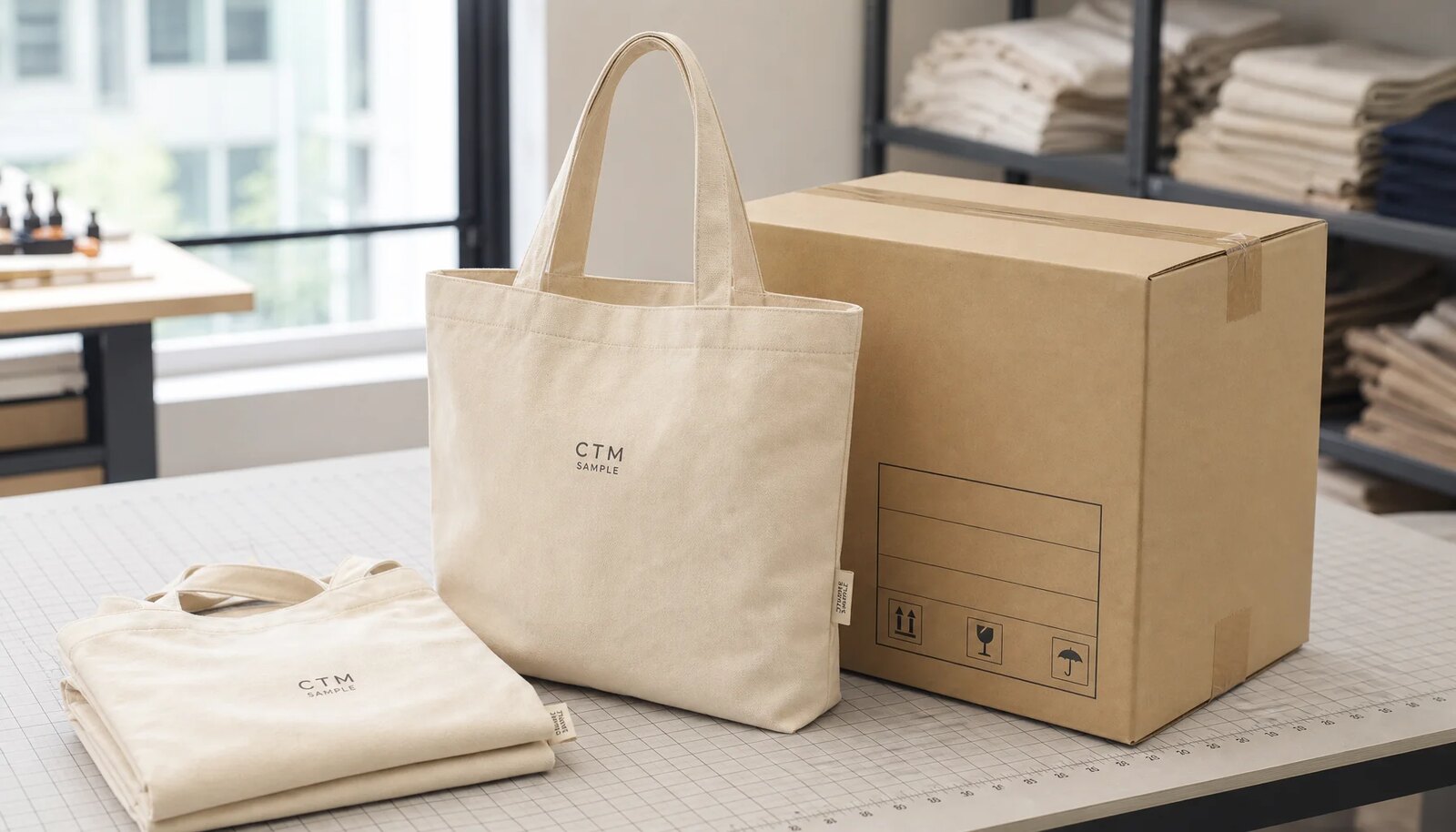
Why carton planning belongs in the first RFQ
Organic cotton totes for hotel retail are often quoted first as a unit-price product and treated as a packing issue later. That sequence creates avoidable cost surprises. A 12 oz canvas tote with a gusset, long handles, hangtag, belly band, and barcode sleeve can occupy much more carton space than a flat 7 oz promotional tote. If the RFQ only says organic cotton tote with hotel logo, suppliers may quote an attractive FOB price using a dense flat pack that is not suitable for retail presentation or long-distance shipping.
For hotel retail buyers, the carton plan affects landed cost, warehouse receiving, shelf condition, and stock allocation by property. Cartons that are too full can crush folds into the front panel and leave pressure marks on screen prints. Cartons that are too large increase CBM and freight cost. The right RFQ gives the factory enough information to engineer the bag and the carton together before sampling, so the sample approval reflects the actual retail and shipping condition.
- Treat packing density as a commercial spec, not a factory afterthought.
- Request carton data with the first quote so FOB, freight, and warehouse costs can be compared fairly.
- Use the same packing method for sample review and bulk quotation whenever possible.
- Do not approve a beautiful loose sample without seeing how it folds, stacks, and ships.
Choose fabric weight around retail use and carton cube
The most common buying mistake is selecting fabric only by the premium feeling in hand. For hotel retail, 10 oz to 12 oz organic cotton canvas usually gives a better balance between perceived value and durability. It supports a printed destination logo, feels substantial on a boutique shelf, and can carry typical resort purchases. The tradeoff is carton cube: heavier canvas is thicker, less compressible, and more likely to hold strong fold lines when packed under pressure.
A 7 oz or 8 oz organic cotton tote may be correct when the item is a low-price add-on, an amenity bag, or a checkout accessory. It folds tighter and reduces freight volume, but it does not communicate the same retail value. If the hotel brand plans to sell the tote at a premium price, specify fabric weight by GSM or ounce, construction, and finishing. Natural cotton, bleached cotton, dyed cotton, and washed cotton can all behave differently in folding and packing.
- Light retail tote: about 200 to 240 GSM for compact packing and lower freight exposure.
- Standard hotel retail tote: about 280 to 340 GSM for better structure and stronger perceived value.
- Premium resort tote: heavier canvas may work, but carton quantity per box drops and freight cost rises.
- Always approve fabric swatch and finished bag sample because GSM alone does not define stiffness.
Build the tote spec before calculating cartons
Carton quantity depends on the finished bag, not just the flat panel size. A tote with a bottom gusset, side gusset, inner pocket, zipper closure, contrast handles, or boxed seams changes the folded thickness. Handle drop also matters because long handles can create uneven bundles if folded carelessly. If the factory proposes pieces per carton before confirming these details, the number is only a rough estimate and should not be used for landed-cost comparison.
A practical hotel retail RFQ should define finished width, height, gusset depth, handle width, handle drop, seam construction, and reinforcement method. For example, a 38 x 42 cm tote with 10 cm gusset and 65 cm handles packs differently from a flat 38 x 42 cm tote with short handles. The buyer should also state whether the tote must stand nicely when filled, hang on a retail peg, fit a shelf bin, or ship to multiple hotel properties.
- Confirm whether dimensions are finished size after sewing, not fabric cut size.
- Specify gusset style: bottom gusset, side gusset, full box gusset, or flat no-gusset construction.
- Define handle drop in finished measurement because guest comfort and packing thickness both change.
- Include any inside pocket, zipper, snap, label, or hangtag before asking for final carton dimensions.
Match print method to folding and compression risk
Water-based screen print is usually the best starting point for hotel retail totes with one to three solid colors. It gives a softer hand on cotton and can be cost-effective at normal bulk quantities. For natural organic cotton, the fabric surface is not always perfectly smooth, so very fine lines, small text, and pale colors need a strike-off. Large dark ink areas should be tested for curing and rub because stacked bags inside a carton can create pressure and friction during transit.
Digital pigment printing or DTF can solve multi-color artwork and small split-design orders, but the buyer should not assume the same handfeel or durability as screen print. For retail totes, the print must survive folding, carton pressure, warehouse handling, and customer use. A pre-production sample should be folded in the intended direction so the print is not creased through a critical logo area. If the brand requires the print to face outward under a belly band, include that orientation in the packing instruction.
- Use screen print for simple hotel logos, destination names, and bold graphic marks.
- Use digital methods only after approving handfeel, edge detail, and wash or rub performance.
- Avoid placing heavy ink exactly on a sharp fold line unless the sample proves it is safe.
- Define print position tolerance, such as center alignment and distance from top edge.
Understand MOQ by fabric, artwork, and packing SKU
MOQ for organic cotton totes is rarely one simple number. A supplier may be able to sew 500 pieces, but fabric sourcing, dyeing, print setup, woven labels, hangtags, paper sleeves, and carton labels each have their own minimum or setup cost. A hotel group ordering 2,000 total pieces across four property logos may not receive the same unit price as one hotel ordering 2,000 identical pieces. Split artwork means more screen setup, more production control, and more packing segregation.
For carton planning, MOQ affects how efficiently each SKU fills cartons. If a buyer orders 300 pieces for one boutique property and 1,700 pieces for another, the small SKU may require partial cartons, special labels, or mixed-carton instructions. Mixed cartons can reduce freight waste but increase receiving errors if not labeled clearly. The RFQ should ask the factory to price the base order and the split-SKU plan separately, including any surcharge for under-MOQ colors, labels, or packing materials.
- Separate MOQ for fabric color, print design, woven label, hangtag, sleeve, and barcode.
- Ask for price breaks at realistic volumes, such as 500, 1,000, 3,000, and 5,000 pieces per design.
- Request mixed-carton rules if several hotel SKUs ship in one container or courier shipment.
- Compare savings from combined production against the cost of more complicated packing control.
Specify the carton plan in measurable terms
A useful carton plan includes pieces per carton, carton length, width, height, net weight, gross weight, carton material, and CBM. Without these details, a buyer cannot calculate freight cost, container loading, courier dimensional weight, or warehouse receiving limits. For hotel retail programs, practical handling matters. A carton that looks efficient on paper may be rejected by a warehouse if it is too heavy, unstable, or poorly marked for SKU receiving.
The factory should develop carton quantity from actual folded samples. Organic cotton canvas has memory, and compressed folds can look worse after several weeks than they do immediately after packing. If a bag is individually sleeved, tied with cotton tape, or packed with a hangtag, the carton count may drop. Buyers should request a packed carton photo or video during pre-production when the packing method is unusual or when the order ships by courier where dimensional weight is expensive.
- Require carton dimensions in centimeters and CBM per carton for freight comparison.
- Set a target gross weight that warehouse staff can handle safely and consistently.
- Use double-wall export cartons when bags are heavy, routes are long, or cartons are palletized.
- Avoid over-compression that causes permanent creases, print transfer, or bulged cartons.
Plan retail packing before approving unit price
Retail packing can change both cost and carton volume. A loose bulk pack is efficient but may not be acceptable for a hotel boutique where staff need to place items directly on shelves. A belly band, paper sleeve, hangtag, barcode sticker, or recyclable polybag improves presentation and SKU control but adds material cost, labor time, and thickness. If packing is added after the unit price is negotiated, the supplier may revise both price and carton data.
The buyer should decide whether the tote is sold folded, hung, stacked, or displayed filled. A folded tote with a belly band needs a consistent fold size, clean front panel, and readable barcode. A hanging tote needs hangtag placement that does not distort the handle. If the hotel group has multiple retail locations, carton marks should identify property, SKU, color, print design, and quantity. This reduces warehouse sorting time and helps prevent one hotel receiving another property logo.
- Bulk pack works for back-of-house distribution but gives less control over retail presentation.
- Paper sleeve or belly band improves shelf presentation but reduces pieces per carton.
- Individual recyclable polybag protects from moisture but may conflict with plastic-reduction policies.
- Barcode and SKU labels should be tested on the actual sleeve or hangtag material.
Use samples to approve the shipping condition
Sample approval should not stop at the tote lying flat on a desk. For organic cotton hotel retail totes, the buyer needs to approve fabric, sewing, print, folding, packing, and carton behavior. A blank size sample confirms structure and handle comfort. A print strike-off confirms ink color and curing on the selected fabric. A pre-production sample confirms all details together. For higher-risk orders, a packed carton sample or at least a packed bundle review is worth the time.
The sample should be checked after it has been folded for several days, not only immediately after the factory packs it. Look for crease lines through the logo, ink offset, trapped moisture, odor, distorted handles, and uneven bundle thickness. If the tote includes a CTM/CottonToMaker sample logo or buyer logo on a side label, verify label placement and seam strength. Once the packing method is approved, changes should be controlled because even a small fold change can affect carton count.
- Approve blank sample for dimensions, gusset, handle drop, and construction.
- Approve print strike-off for color, curing, handfeel, and rub resistance.
- Approve pre-production sample with final label, tag, sleeve, barcode, and fold method.
- Keep one sealed approved sample as the reference for final inspection.
Set QC thresholds that protect sellable units
Hotel retail buyers should define defects from the customer view, not only from factory sewing standards. A small slub in organic cotton may be acceptable if it looks natural and does not affect the logo area. A stain, oil mark, broken stitch, crooked handle, misprinted logo, or barcode failure is not acceptable because it directly reduces sellable stock. Organic cotton can have natural specks, so the approved standard should distinguish normal cotton character from visible contamination.
For production inspection, use measurable tolerances where possible. Dimensions can have an agreed tolerance, print position can be measured from edges, and handle pull strength can be tested with a defined load and duration. Carton inspection is also part of QC. Wet, crushed, under-taped, overweight, or poorly marked cartons can create claims even if the bags were sewn correctly. The final inspection should compare the packing list against actual carton marks and SKU counts.
- Dimension tolerance should cover bag width, height, gusset, handle width, and handle drop.
- Print defects should include misregistration, pinholes, ink smears, color drift, and poor curing.
- Sewing defects should include skipped stitches, loose threads, open seams, and weak handle reinforcement.
- Carton defects should include moisture, bulging, wrong marks, mixed SKUs, and damaged retail sleeves.
Compare quotes by landed cost and schedule risk
The lowest FOB price is not always the lowest landed cost. One supplier may quote a cheaper tote but pack fewer pieces per carton because the fabric is thicker, the fold is less efficient, or the retail sleeve is bulkier. Another supplier may quote slightly higher FOB but provide better carton density, cleaner print curing, and more reliable SKU separation. For importers and distributors, the correct comparison is cost per sellable unit after freight, duty, warehouse handling, rework, and damage risk.
Lead time should be reviewed in the same way. Organic cotton fabric availability, dyeing, print screen making, label production, sample approval, packing material printing, and final inspection all affect shipment date. A realistic schedule includes time for artwork corrections and sample courier transit. If the program supports a hotel opening, seasonal retail launch, or resort event, build a buffer instead of forcing the factory to compress curing, inspection, or packing time.
- Request FOB unit price and carton CBM together so freight cost can be estimated early.
- Compare suppliers using the same fabric GSM, print method, packing method, and carton rules.
- Add rework risk when a quote lacks sample stages, QC criteria, or carton details.
- Protect launch dates by approving artwork, labels, and packing materials before fabric cutting.
Specification comparison for buyers
| Spec decision | Recommended option | When it fits | Buyer risk to check |
|---|---|---|---|
| Fabric weight for retail shelf totes | 10 oz to 12 oz organic cotton canvas, about 280 to 340 GSM | Hotel gift shops, spa boutiques, resort welcome stores, and souvenir retail where the bag must stand better than a thin giveaway tote | Confirm finished GSM after washing or finishing, not only greige fabric weight; very soft finishing can reduce perceived structure |
| Lower-cost organic cotton option | 7 oz to 8 oz plain weave, about 200 to 240 GSM | Lightweight folded bags sold near checkout, in-room amenity packaging, or promotions where carton cube matters more than premium handfeel | Thin fabric may show dark print strike-through and can wrinkle heavily inside tight cartons |
| Print method for hotel logo retail | Water-based screen print for 1 to 3 solid colors | Most hotel retail logos, destination graphics, and simple line artwork on natural or dyed cotton | Specify ink coverage, curing standard, and rub test because under-cured ink can transfer during carton compression |
| Print method for detailed artwork | DTF or digital pigment print after factory sample approval | Small MOQs, gradient destination artwork, multi-color retail designs, or seasonal hotel collections | Unit cost is higher and print handfeel may be different from screen print; approve a production-size sample, not only a small swatch |
| Handle construction | Self-fabric cotton handles with reinforced cross-stitch at stress points | Retail totes expected to carry towels, robes, bottled products, books, or beach items | Require pull test criteria and check whether handle length is quoted as cut length or finished drop length |
| Individual packing | Flat fold with belly band or recyclable paper sleeve when retail presentation matters | Hotel boutiques selling the tote as a finished retail item and distributors needing barcode or SKU separation | Extra packing material increases carton volume and labor cost; include it in carton planning before freight comparison |
| Master carton plan | Export carton based on finished folded size and target gross weight below practical warehouse handling limits | Mixed hotel retail orders shipping by sea, air, or courier to distribution centers | Avoid cartons that are too heavy or bulged; carton compression can crease bags and damage printed surfaces |
| MOQ logic | Set MOQ by fabric color, print design, and packing SKU, not only total order quantity | Retail buyers ordering several hotel properties, resort names, or seasonal graphics in one program | A supplier may quote one total MOQ but later add surcharges for split artwork, split labels, or split carton marks |
Buyer checklist before sampling
- Define finished tote size, gusset, handle drop, fabric GSM, fabric color, print size, and packing method in the RFQ before asking for carton quantity.
- State whether the bag is organic cotton certified material, certified finished product, or simply made from organic cotton fabric supplied with transaction documents.
- Request a folded-size estimate and master carton proposal with pieces per carton, carton dimensions, net weight, gross weight, and CBM per carton.
- Approve print strike-off on the same fabric weight and color planned for bulk production, especially for natural cotton, black ink, and large solid areas.
- Set acceptance criteria for stitching, handle pull strength, print rub, shade tolerance, fabric defects, loose threads, odor, moisture, and carton condition.
- Clarify whether barcodes, hangtags, belly bands, polybags, paper sleeves, silica gel, carton labels, and palletization are included in the unit price.
- Compare supplier quotes using landed cost per sellable unit, not only FOB unit price, because packing density can change ocean freight, courier cost, and warehouse handling.
- Lock the carton mark format early if several hotel properties, SKUs, colors, or destination names ship together.
Factory quote questions to send
- What fabric construction and actual GSM are included in the quote, and can you provide a fabric swatch before sampling?
- Is the cotton organic at fiber level only, or can the finished bag be supplied with transaction certificate support if required by our retailer?
- What is the recommended folded size, pieces per carton, carton dimension, net weight, gross weight, and CBM for this exact tote and packing method?
- How does the MOQ change if we split the order by hotel property logo, fabric color, print color, barcode, or individual retail sleeve?
- Which print method are you quoting, what is the maximum print area, and what test will you use for curing, washing, or dry rub performance?
- What sample types are included: blank size sample, print strike-off, pre-production sample, and packed carton sample?
- What lead time applies after deposit and artwork approval, and which steps can delay it: fabric booking, dyeing, label approval, print screen making, or packing material production?
- Are export cartons standard double-wall cartons, what carton strength is used, and can cartons be palletized or sized for our warehouse receiving limits?
- What quote validity, payment terms, Incoterm, port, carton data, HS code suggestion, and packing list format are included?
Quality-control points to confirm
- Measure finished bag width, height, gusset, handle width, and handle drop against agreed tolerance before packing.
- Check fabric GSM and handfeel against approved swatch, not only supplier invoice description.
- Inspect print position, color, edge sharpness, curing, rub resistance, and ink transfer risk after stacking pressure.
- Perform handle pull testing using an agreed load and time suitable for the intended retail use.
- Review stitching density, backstitching, cross-stitch reinforcement, seam allowance, loose threads, and broken needles risk.
- Confirm shade consistency within carton and across cartons, especially for dyed organic cotton lots.
- Check individual packing, barcode readability, retail sleeve alignment, carton marks, SKU separation, and packing list match.
- Inspect export carton strength, tape sealing, moisture condition, carton bulging, and gross weight before shipment.