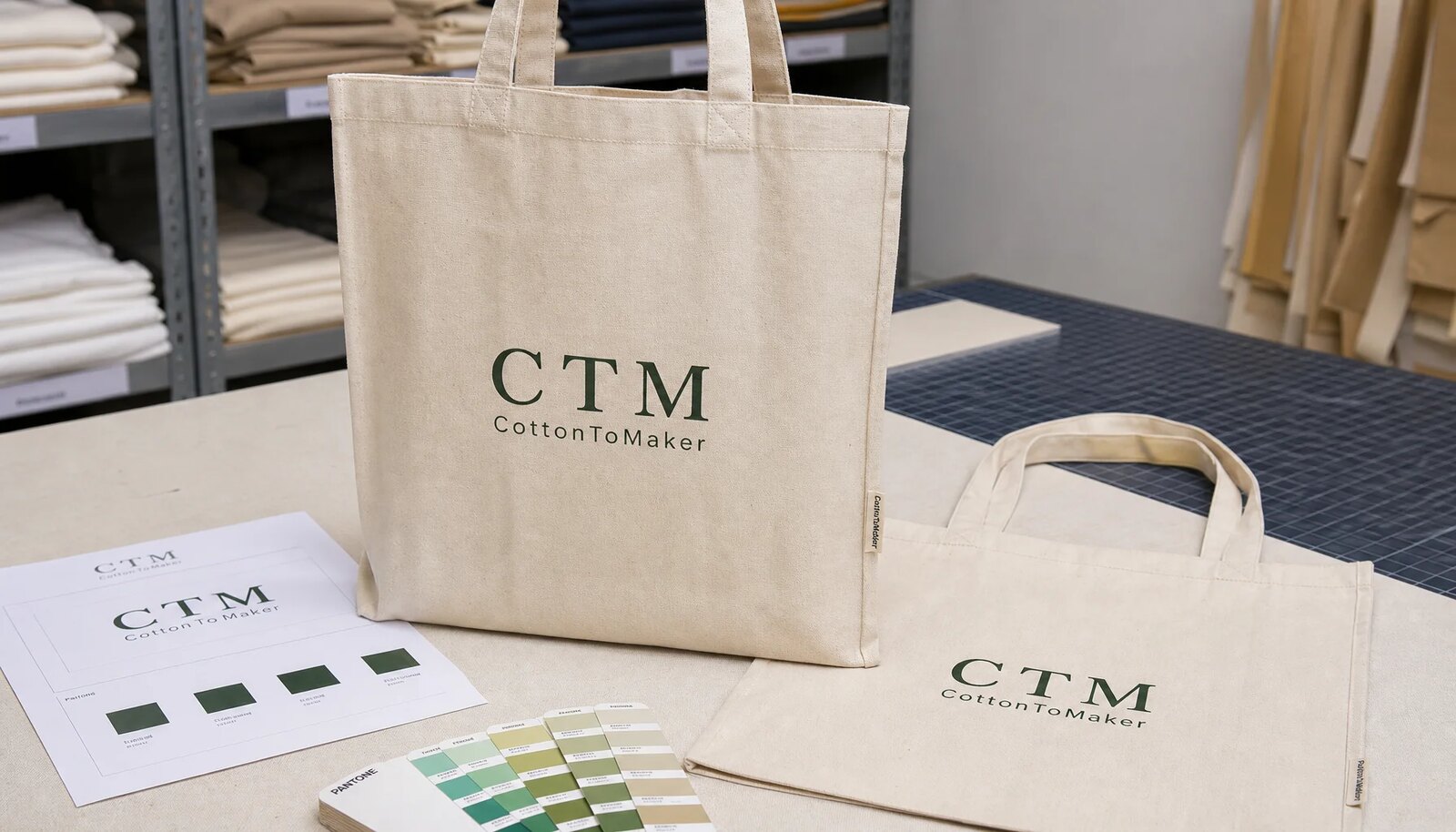
Why Hotel Retail Totes Need Controlled Proofing
Organic cotton totes sold in hotel shops are not the same as conference giveaways. Guests see them beside spa products, resort apparel, candles, books, local food, beach items, and destination merchandise. The tote needs to feel intentional enough for retail. If the fabric feels thin, the print sits off-center, the ink looks weak, or the fold line cuts through the artwork, the product can quickly feel promotional instead of sellable.
Most avoidable issues start before production. A digital mockup makes the artwork look flat and centered, but bulk production happens on textured cotton, sewn panels, handles, gussets, and folded finished bags. Natural organic cotton may include seed flecks and lot shade variation. Dyed cotton can shift how ink color is perceived. Cutting and sewing can move the visual center. Packing can create hard creases across the logo.
A practical proofing checklist turns subjective comments into measurable approvals. The buyer, brand team, retail manager, and supplier should agree on fabric, artwork, print method, print tolerance, organic documentation, packing, and inspection responsibility before bulk starts.
- Approve print on actual or production-equivalent fabric, not only on a PDF mockup.
- Measure placement on the finished tote because sewing and gussets change the visual center.
- Keep approved references for artwork, fabric swatch, lab dip if dyed, print strike-off, pre-production sample, and packing sample.
- Define rejection rules for smudges, poor opacity, tacky ink, off-center print, wrong labels, stains, and damaging fold marks.
- Name one decision owner for each approval stage to avoid delays between brand, procurement, and retail teams.
Build the Tote Specification First
A quote is only useful when suppliers are pricing the same bag. One offer may cover an 8 oz flat shopper with a one-color print. Another may include a 12 oz bottom-gusset tote, woven side label, reinforced handles, hangtag, barcode, folded retail packing, and carton liner. Both may be described as organic cotton totes, but they are commercially different products.
For many hotel retail programs, 10 oz to 12 oz organic cotton canvas is a practical starting range, often around 280-340 GSM depending on weave and finishing. It usually gives a more substantial hand feel than lightweight promotional cotton while remaining manageable for sewing, folding, and freight. Lighter 6 oz to 8 oz cotton, roughly 170-230 GSM depending on construction, can work for entry-level souvenir pricing, room amenity packaging, or event welcome bags. Heavier canvas may feel more premium, but it can raise fabric cost, sewing difficulty, carton weight, and freight exposure.
Construction affects print approval. A flat tote is easier to print and fold. A bottom-gusset tote is more useful for retail purchases, but logo placement should be approved on the sewn bag. A boxed-bottom tote may stand better on shelf, though it adds seams and pressing variation. Zip tops, linings, pockets, and inside labels add more approval points and more inspection risk.
- Flat retail tote: often around 35 x 40 cm for books, spa items, and light purchases.
- Resort shopper: often around 38 x 42 cm with an 8-12 cm bottom gusset for bulkier items.
- Shoulder handles: often 55-65 cm total length, but approve by physical fit over the shoulder.
- Handle width: specify clearly, such as 2.5 cm, 3 cm, or 4 cm, and confirm reinforcement type.
- Finished-size tolerance: many sewn totes need about +/-1 cm unless tighter control is factory-confirmed.
- Quote separately: lining, zipper, pocket, woven patch, side label, care label, hangtag, barcode, and special folding.
Specify Organic Cotton Documentation Clearly
Organic cotton claims need to be handled before the order is priced, not after goods are finished. Some hotel buyers only require a supplier declaration for internal sustainability records. Others need documentation connected to a certification system such as GOTS or OCS. The correct requirement depends on the buyer's claim, sales market, label wording, internal compliance policy, and whether the finished item will carry a certification claim.
A scope certificate usually shows that an organization is certified for certain activities, such as trading, processing, or manufacturing within a standard. It does not by itself prove that a specific shipment contains certified organic cotton. A transaction certificate, when applicable and available through the certification route, is normally tied to a specific transaction or shipment. Buyers should confirm early whether they need to review only the supplier's valid scope certificate or whether a transaction certificate is required before shipment.
Documentation timing matters. Ask what can be shared at quotation, before purchase order, before bulk production, and before shipment. If labels, hangtags, or product pages mention certified organic cotton, confirm the wording and documentation route before printing any claim.
- Define the claim level: organic cotton material claim, certified organic content claim, GOTS claim, OCS claim, or internal sourcing statement.
- Ask whether the supplier can provide a valid scope certificate for the relevant facility or trading entity.
- Confirm whether a transaction certificate is required for the specific order and when it can be issued.
- Check whether certification covers fabric only, bag manufacturing, printing, labeling, trading, or the full chain required by the buyer.
- Do not approve hangtag or product-copy claims until documentation and allowed wording are confirmed.
- Keep documentation requirements in the purchase order, not only in email notes.
Choose Fabric for Both Feel and Print
Fabric controls retail feel and print performance. Organic cotton can support a natural, spa, wellness, coastal, or low-impact positioning. The same natural texture can also interrupt artwork. Slubs and seed flecks may break fine lines. Open weave can make small text look rough. A delicate crest or destination map that looks refined on paper may lose clarity on coarse canvas.
The RFQ should state GSM, ounce name, weave, color, finishing, and when the weight is measured. Some suppliers quote greige weight before dyeing or finishing. Others quote finished fabric. Dyeing, washing, softening, and enzyme finishing can change hand feel, shade, shrinkage, and finished dimensions. A specification that only says "12 oz organic cotton" is not enough for a fair comparison.
Shade should be agreed early. Natural unbleached organic cotton is not one fixed color. It may move warmer, cooler, lighter, or darker by lot. Dyed fabric should go through lab dip approval when the background color is important. For repeat hotel programs, ask whether the supplier can manage shade continuity against the retained approved sample.
- Use smoother, tighter fabric for fine-line artwork, serif typography, QR codes, coordinates, or small icons.
- Use textured canvas only when the artwork is bold enough to tolerate uneven ink edges.
- For natural cotton, decide whether seed flecks and slubs are acceptable inside the print area.
- For dyed cotton, approve lab dip before print strike-off because background color changes contrast.
- For washed totes, test the print after the intended wash or softening process.
- For repeat orders, retain a reference swatch and ask how lot variation will be managed.
Match Print Method to Artwork Risk
Screen printing is often the most practical method for hotel logos, destination graphics, short slogans, and one to four spot colors. It gives buyers a clear cost structure: screen setup, number of colors, print size, print sides, ink type, and per-unit print charge. It can also be repeatable for replenishment orders when screens, ink, fabric, and curing are controlled.
Water-based ink is popular on cotton because it can feel softer, but it does not automatically solve every artwork problem. On natural or dark cotton, coverage may look weaker than expected. High-opacity ink can improve light-color coverage, but large solid areas may feel heavier. Plastisol or other ink systems may be available in some supply chains, but acceptability, curing, compliance, and hand feel must be confirmed before approval.
Heat transfer can work for full-color artwork, gradients, or photographic destination images. It should be tested for edge lift, cracking, fold behavior, rub resistance, and surface feel. Embroidery can look premium for small marks, initials, or spa logos, but it is not suitable for large front graphics or tiny text. Woven labels and patches are useful when the brand wants subtle detail without pushing fine artwork onto textured cotton.
- Screen print: best for solid logos, clean icons, simple destination artwork, and repeatable spot colors.
- Water-based ink: check opacity, curing, rub performance, and hand feel on actual organic cotton.
- High-opacity ink: useful for light prints, but review stiffness on large ink areas.
- Heat transfer: test adhesion, cracking, edge lift, fold sensitivity, and retail appearance.
- Embroidery: keep artwork small and check fabric puckering or distortion.
- Woven label or patch: use when fine detail is risky or the retail look should be quieter.
Control Artwork Before Proofing Starts
A mockup is not a production file. It may hide missing fonts, thin lines, unclear scale, incorrect color references, or placement measured from the wrong point. Before screens or transfers are made, the supplier should receive production-ready artwork and a clear layout for every print position.
Vector artwork is preferred for most logo and line-art screen prints. Fonts should be outlined. The file should show print width and height in centimeters, print side, color count, color references, and placement from finished bag edges. If the design includes fine map lines, small coordinates, QR codes, crest details, or small type, ask the supplier to confirm the minimum printable line thickness and minimum readable text height on the selected fabric.
Version control is critical for hotel groups. One tote body may be used across multiple properties, languages, seasonal capsules, or retail SKUs. Each version may need separate screens, separate proofing, separate barcode labels, separate carton marks, and separate packing counts. A controlled artwork schedule prevents mistakes that are expensive to catch after printing.
- Send AI, EPS, SVG, or production-ready PDF files where appropriate; avoid low-resolution mockup-only files.
- Outline fonts and include the font name for reference.
- State Pantone or approved color reference, but make the physical strike-off the final production standard.
- Show exact print size, print side, color count, and maximum printable area.
- Measure placement from finished top edge, side seams, and bottom or gusset line.
- Freeze artwork before strike-off; if artwork changes later, confirm whether a new strike-off is required.
- List every property name, SKU, barcode, artwork version, label, and carton mark in one schedule.
Use a Proofing Workflow Buyers Can Enforce
The common mistake is approving the digital layout as if it answered every production question. It does not. For hotel retail totes, proofing should move from artwork to material to print to finished product to packing. Each stage controls a different risk.
A practical sequence is digital layout, fabric swatch, lab dip if dyed, print strike-off, pre-production sample, packing sample, and retained bulk reference. The digital layout confirms artwork scale, side, color references, and approximate placement. The fabric swatch confirms GSM, weave, shade, texture, and hand feel. The lab dip confirms dyed background color. The strike-off shows opacity, edge sharpness, registration, curing, rub behavior, and hand feel on the selected fabric.
The pre-production sample should be a complete finished tote. It confirms cutting, sewing, handle position, label placement, finished dimensions, and print placement on the sewn body. Packing approval then checks fold position, hangtag, barcode, belly band, carton liner, units per carton, and print protection. Photo approval can help when timelines are tight, but physical samples are stronger for color, hand feel, stiffness, odor, and curing.
- Digital layout: approve size, side, placement, color references, and version schedule.
- Fabric swatch: approve GSM, weave, shade, texture, and documentation route.
- Lab dip: approve dyed fabric color before bulk dyeing when color is controlled.
- Print strike-off: approve ink color, opacity, edge sharpness, registration, curing, rub, and hand feel.
- Pre-production sample: approve finished dimensions, stitching, handles, labels, print position, and retail look.
- Packing sample: approve fold line, hangtag, barcode, belly band, carton liner, and print protection.
- Bulk reference: retain signed sample, tagged sample, dated approval photos, or inspection reference set.
Set Tolerances, Tests, and Responsibilities
"Good quality" is not an inspection standard. The purchase specification should define print width, print height, distance from finished top edge, distance from side seams, color approval basis, registration tolerance, opacity expectation, curing requirement, rub test method, and unacceptable defects. These rules should be set before bulk printing starts.
For small and medium front logos, a placement target around +/-5 mm is often practical when cutting and sewing are controlled. Large front graphics, gusseted bags, and soft structures may need around +/-8 mm. Finished body dimensions often need about +/-1 cm tolerance, and handle length may need about +/-1 cm to +/-2 cm depending on construction. These are starting points, not universal standards. The supplier must confirm what can be held in normal production.
Responsibility should also be clear. The factory should check fabric, cutting, printing, curing, sewing, trimming, pressing, and packing during production. A third-party inspector, if used, checks sampled finished goods against the approved references and AQL or agreed sampling plan. The buyer approves the standard, tolerances, documentation requirements, and final shipment release process.
- Factory responsibility: in-line checks for fabric defects, print setup, curing, sewing, trimming, and packing.
- Inspector responsibility: sampled checks of dimensions, placement, color, defects, labels, cartons, and packing against approved references.
- Buyer responsibility: approve specifications, samples, tolerances, defect categories, and documentation requirements before production.
- Critical defects: wrong artwork, wrong logo, wrong colorway, unsafe contamination, severe ink transfer, or missing required labels.
- Major defects: placement beyond tolerance, poor curing, obvious smudge, heavy bleeding, unreadable text, serious seam issue, or wrong packing.
- Minor defects: small loose thread, slight approved shade variation, minor slub outside logo area, or cosmetic issue within agreed limits.
Read Quotes Beyond Unit Price
Organic cotton tote pricing has multiple layers. Fabric, cutting, sewing, screen setup, ink count, print sides, label setup, hangtags, barcode stickers, folding, carton liners, sample charges, inspection support, and courier fees can all change the landed cost. A low unit price that excludes these items is not a better quote; it is an incomplete quote.
MOQ also needs interpretation. The sewing line may accept one quantity, while the fabric mill, dye house, print department, woven label supplier, or hangtag supplier may require another. A 500-piece pilot may be feasible with stock natural fabric and one-color printing. The same order may need a higher MOQ for dyed-to-order fabric, custom woven labels, multiple artwork versions, retail sleeves, or special carton packing.
Freight can change the economics quickly. Canvas totes in the 10 oz to 14 oz range are heavier than many promotional products. If proofing delays force air freight, margin may disappear. Buyers should request carton dimensions, quantity per carton, gross weight, net weight, and packing orientation before comparing shipping routes.
- Ask for separate lines for fabric, sewing, print setup, per-unit print, extra color, and second-side print.
- Quote woven labels, patches, care labels, hangtags, barcode stickers, belly bands, and retail folding separately.
- Confirm which charges are one-time setup costs and which repeat on every reorder.
- Request pricing at 500, 1,000, and 3,000 pieces using the same specification and packing.
- Ask what changes at reorder: screen reuse, label MOQ, fabric availability, shade variation, and lead time.
- Request carton data before freight comparison: dimensions, units per carton, net weight, gross weight, and liner type.
Protect the Print in Packing and Receiving
A tote can pass print approval and still arrive looking poor if packing is not controlled. Hard folds can cut through a logo. Ink-to-ink contact can transfer. Tight cartons can create pressure marks. Natural cotton can pick up carton dust. These issues are preventable when packing is approved before bulk cartons are sealed.
Hotel retail presentation may need a hangtag, barcode sticker, SKU label, belly band, paper sleeve, kraft wrap, or shelf-ready fold. Each item should be checked on the actual tote. A belly band can hide the artwork. A barcode sticker placed directly on cotton may leave residue. A tight hangtag string can dent handles. A fold across a heat-transfer edge can increase lifting risk.
Receiving should also be planned. Carton marks, SKU labels, purchase order references, and count per carton must match the hotel warehouse or retail team's requirements. If the destination team needs fast store allocation, ask for carton-level SKU separation and a packing list that reflects the final carton marks.
- Approve a folded sample or dated packing photo set before final packing.
- Avoid hard folds across logos, transfer edges, QR codes, or large ink areas.
- Use tissue, slip sheets, or print-facing protection when abrasion or ink transfer is a risk.
- Use clean carton liners for natural cotton to reduce dust and carton fiber contamination.
- Approve hangtag string, barcode position, belly band width, and SKU label placement against the artwork.
- Check carton quantity, compression risk, gross weight, shipping marks, and receiving labels before shipment.
Specification comparison for buyers
| Order scenario | Practical specification route | Commercial trade-off | Proofing priority |
|---|---|---|---|
| 500-piece pilot for one boutique hotel | Stock natural organic cotton, flat or bottom-gusset tote, one-color screen print, simple hangtag or barcode sticker | Lower MOQ and faster launch, but fewer options for custom dyeing, labels, and fabric shade control | Approve actual fabric swatch, one print strike-off, finished pre-production sample, and folding photo before bulk |
| 1,000-2,000 pieces for resort retail | 10 oz to 12 oz organic cotton canvas, shoulder handles, bottom gusset, screen print or woven patch, retail hangtag | Better retail feel and stronger shelf presence, with moderate setup and sample cost | Check print opacity, placement on finished gusseted bag, handle reinforcement, carton quantity, and print-safe folding |
| Multi-property hotel group order | Same tote body across properties, artwork version schedule, separate SKU/barcode control, shared fabric lot where possible | Unit cost can improve, but screens, labels, cartons, and approvals multiply by artwork version | Use a controlled artwork matrix and require supplier confirmation for every property name, SKU, barcode, print side, and carton mark |
| Dyed fabric retail capsule | Dyed-to-order organic cotton, lab dip approval, print strike-off after fabric shade approval | More brand control and seasonal color value, but higher MOQ, longer lead time, and more shade risk | Approve lab dip before bulk dyeing, then judge print contrast on dyed fabric rather than on natural cotton |
| Premium spa or gift-shop tote | Heavier canvas or twill, subtle embroidery or woven label, reinforced handles, clean retail fold, minimal plastic packing where feasible | Higher unit and freight cost, but stronger perceived value if construction and presentation are consistent | Inspect stitching, label position, embroidery distortion, shade consistency, fold marks, and shelf-ready presentation |
| Full-color destination artwork | Heat transfer or digital-compatible method on tested fabric, larger printable area, controlled folding | Supports complex images, but can introduce cracking, edge lift, heavier hand feel, or fold sensitivity | Test adhesion, rub, fold behavior, edge lifting, color match, and whether the transfer survives approved packing |
| Repeat replenishment program | Repeat-approved fabric spec, saved screens where possible, documented shade range, previous sample retained as reference | Faster reorders if records are clean, but fabric lot variation and screen wear still need checking | Compare new swatch and strike-off against retained reference before authorizing bulk repeat production |
Buyer checklist before sampling
- Define the finished tote style: flat tote, bottom-gusset tote, side-gusset tote, boxed-bottom tote, zip-top tote, lined tote, pocket tote, or foldable retail shopper.
- Specify finished dimensions in centimeters: width, height, bottom gusset, side gusset if any, handle length, handle width, label position, and target tolerances.
- State fabric requirements by organic cotton claim, GSM, ounce description, weave, color, finish, hand feel, and whether weight is greige, dyed, washed, or finished.
- Confirm organic documentation needs before quoting: supplier declaration, scope certificate review, transaction certificate request, GOTS, OCS, or another chain-of-custody requirement.
- Send final vector artwork with fonts outlined, color references, print size, print side, placement measurements, and an artwork version table if multiple properties are involved.
- Ask the supplier to confirm minimum line thickness, minimum text height, maximum printable area, number of screens or transfers, setup costs, and revision costs.
- Require a fabric swatch or production-equivalent fabric before print approval, especially for natural, dyed, washed, or textured organic cotton.
- Approve a print strike-off on actual or confirmed production fabric before the finished pre-production sample is signed off.
- Define placement tolerance, registration tolerance, color approval basis, opacity expectation, curing requirement, rub test method, and unacceptable print defects.
- Approve packing before shipment: fold position, hangtag, barcode, belly band, carton liner, units per carton, carton marks, and print-facing protection if needed.
Factory quote questions to send
- What is the exact organic cotton fabric construction, GSM, ounce description, weave, color, finish, shrinkage expectation, and bulk GSM tolerance for this order?
- Is the fabric weight measured before finishing, after dyeing, after washing, or on finished fabric, and what test method or internal standard do you use?
- Is the fabric stock natural organic cotton, stock dyed organic cotton, custom dyed fabric, or custom milled fabric, and what MOQ and lead time apply to each option?
- Which organic documentation can you provide at quotation, before production, and before shipment: supplier declaration, scope certificate, transaction certificate, GOTS, OCS, or other records?
- Can you provide swatches from the proposed lot or production-equivalent fabric before making the artwork strike-off?
- Which print method do you recommend for this artwork on the selected fabric, and what are the risks for opacity, line sharpness, registration, cracking, rub resistance, curing, or hand feel?
- What minimum line thickness, minimum text height, and maximum printable area do you recommend for this tote size and fabric texture?
- How many screens, transfer setups, ink colors, sample rounds, courier fees, and revision charges are included in the quote?
- What changes if we add a second print side, additional color, woven label, hangtag, barcode sticker, belly band, or property-specific artwork version?
- What placement tolerance, finished-size tolerance, handle-length tolerance, color tolerance, and registration tolerance can your factory hold in normal bulk production?
Quality-control points to confirm
- Fabric GSM checked against the approved swatch or pre-production sample using an agreed method and tolerance, often around +/-5% only when supplier-confirmed.
- Organic documentation checked against the purchase requirement before shipment; buyer defines whether a declaration is enough or whether scope certificate or transaction certificate review is required.
- Fabric shade compared under consistent lighting against approved swatch or lab dip, with natural organic cotton lot variation and dyed fabric variation recorded before cutting.
- Fabric surface inspected before printing or cutting for stains, oil marks, holes, heavy slubs, knots, weaving faults, excessive seed flecks, and defects in the planned logo area.
- Finished tote dimensions measured after sewing, trimming, pressing, and washing if applicable: width, height, gusset, handle length, handle width, pocket size, and label position.
- Handle attachment checked for stitch pattern, reinforcement, thread breaks, skipped stitches, loose threads, and symmetry between left and right handle positions.
- Print color compared with the approved strike-off under agreed lighting; Pantone is used as a communication guide, not the only approval standard on textured cotton.
- Print placement measured from finished top edge, side seams, and bottom or gusset line, with front and back checked separately when both sides are printed.
- Print opacity and edge sharpness reviewed on real fabric texture, especially for light ink, reverse-out artwork, fine lines, small text, QR codes, and crest details.
- Ink adhesion checked by supplier-confirmed methods such as dry rub, wet rub where suitable, tape test where appropriate, and post-fold review; pass/fail limits should be agreed before inspection.