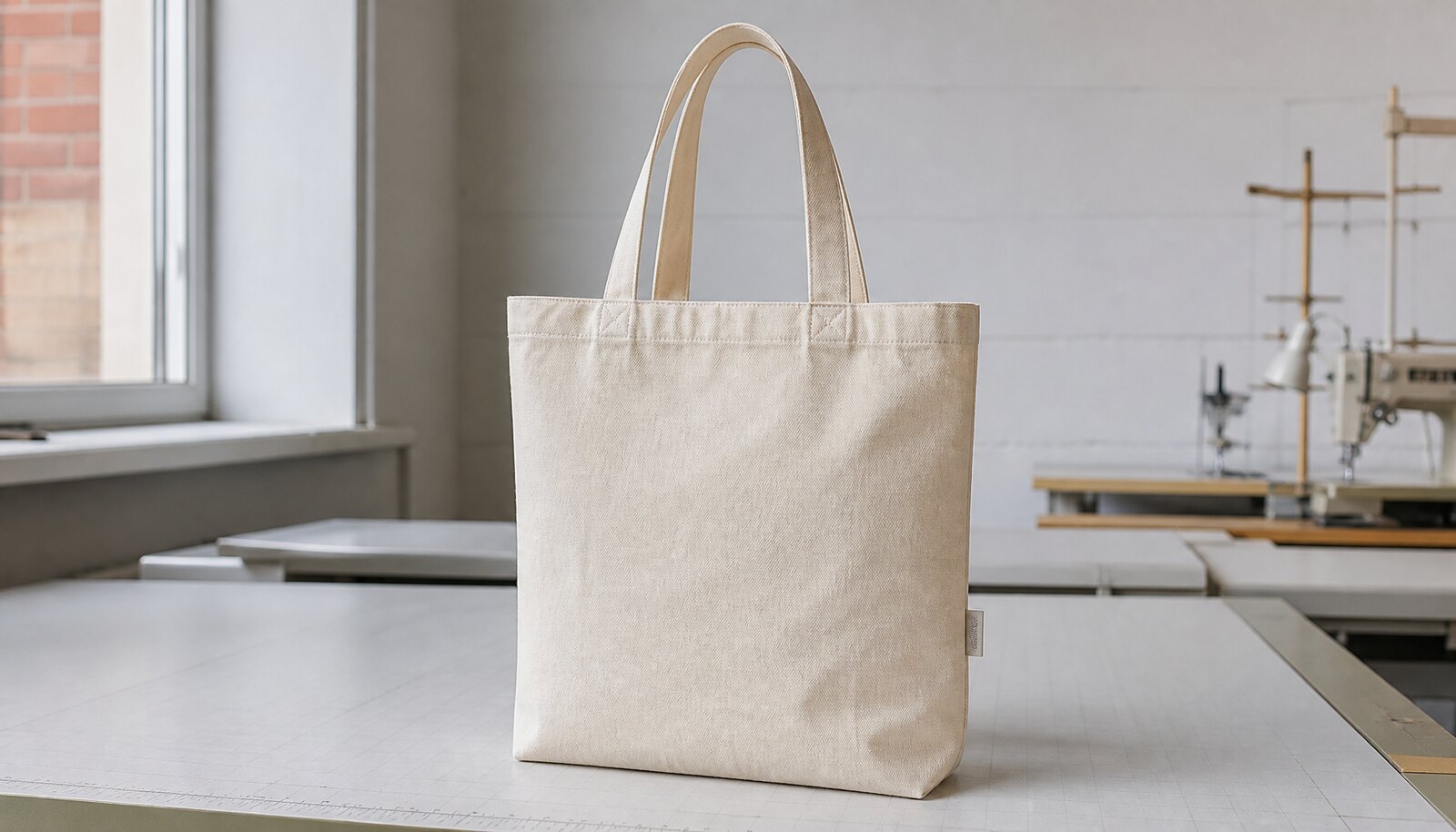
Why print proofing fails on gift-shop totes
Organic cotton totes for gift shops look simple, but proofing often fails because buyers approve the artwork in isolation instead of the finished product system. A logo that looks clean on a screen can change once it is printed on woven cotton with natural texture, slight yarn irregularity, and a different ink absorbency than the design file assumes. The tote may technically match the artwork and still feel wrong on the shelf.
Gift-shop buying is more demanding than a one-off promo order. The tote sits beside candles, books, stationery, and seasonal goods, so the visual standard is commercial, not casual. Print placement, hand feel, fold behavior, and the way the bag hangs all affect whether the item reads as a retail product or a throwaway bag. That is why an organic cotton tote proof needs production detail, not just design approval.
The other common failure is vague language. Phrases like “good quality,” “nice print,” or “looks fine” do not help a factory price or build the order. If the spec sheet does not define the fabric weight, decoration method, and acceptable variation, the supplier will fill in the gaps with its own assumptions. Those assumptions are where disputes start, especially when the quote is cheap but the retail result is off by a small, visible amount.
- Treat proofing as production control, not as design sign-off.
- Approve the tote as a complete retail object: fabric, print, seams, labels, fold, and carton pack.
- Use written tolerances so everyone knows what passes, what gets reworked, and what gets rejected.
Start with the retail use case, not the artwork
Before talking about color or placement, decide how the tote will actually be sold. A bag hung on a peg in a gift shop needs a different construction than a tote stacked in a display bin or packed flat for seasonal rollout. Handle drop, finished size, gusset depth, and print position all change based on display method and load expectations.
For organic cotton tote programs, the biggest commercial decisions are usually hidden in the dimensions. A wider body can move the logo farther from the seam, which often improves print clarity. A longer handle can make the tote feel more premium, but it also uses more fabric and can change carton volume. A deeper gusset helps the bag stand up better on shelf, yet it may raise sewing time and the ex-factory price. These are not cosmetic choices; they affect cost and presentation at the same time.
If the tote is part of a branded gift-shop line, build the spec around the assortment rather than around the logo alone. Ask where the tote will hang, whether it needs a barcode or hangtag, and whether it must fold to a fixed size for shelf or mail-order packing. Put those decisions into the proof stage because they affect print area, labor, and the final customer impression.
- State the intended display method: hanging, folded stack, or counter bin.
- Define the finished size and handle drop before placement is drawn.
- Check whether the tote must hold a specific retail load, such as books, boxed gifts, or general merchandise.
Choose the fabric before you judge the logo
Organic cotton gift-shop totes often sit in a midweight range, but buyers should not rely on vague terms like “heavy duty” or “premium cotton.” Ask for the actual GSM, weave description, finishing method, and whether the fabric is pre-shrunk. A 140 GSM tote, a 180 GSM tote, and a 220 GSM tote may all be sold as organic cotton bags, but they do not behave the same way in print, in hand, or in carton.
Surface texture matters almost as much as GSM. Natural cotton usually has more visible irregularity than bleached promotional fabric, and that can soften the edge of a logo. A lightly brushed or napped surface can mute fine detail, while a smoother weave can hold a sharper print but may feel less rustic. If the brand wants an earthy look, the print file should be developed for that finish from the beginning rather than expected to survive unchanged.
Shrinkage is another procurement detail that should be written into the spec sheet before sampling starts. If the tote is not pre-shrunk or washed, dimensions can move after steam exposure, transport conditions, or customer laundering. That matters for print placement and for folded size. Ask the supplier to state the expected shrinkage range and whether the quoted dimensions are measured before or after finishing.
- Request the exact GSM range and the acceptable variance from lot to lot.
- Confirm whether the fabric is pre-shrunk, washed, or left raw.
- Match fabric texture to the print style; fine logos need a smoother and more predictable surface.
- Ask for a measurement method if dimensions are critical to shelf fit.
Match the print method to the artwork, not the other way around
For most organic cotton totes for gift shops, screen printing is still the most reliable method when the design uses one to four flat colors, simple shapes, and readable text. It usually gives better control over opacity, edge sharpness, and repeat consistency than a casual digital or transfer setup. Water-based ink is often preferred for retail bags because it can preserve a softer hand feel, which matters when the tote is meant to feel like a finished consumer item instead of a giveaway bag.
The best method, however, is the one that fits the artwork and the fabric. Transfer and digital options can help with gradients, photographic art, or very small detail, but they create different proofing questions. How does the print sit on natural cotton? Does the finish feel glossy or rubbery? Does the design keep its edge after folding? If the artwork relies on thin fonts or tight registration, insist on a physical strike-off before the order is released.
A useful procurement rule is to judge the logo on the actual bag surface at the actual size. A design that looks fine on screen at 80 percent may become illegible at production scale if the lines are too thin or the contrast is too low. Ask the supplier to flag risky line thickness or text size before sampling starts. That saves rework and gives you a factual reason to revise the file rather than debating taste later.
- Use screen print for flat retail branding and repeatable reorder programs.
- Use transfer or digital only when the artwork truly needs it and the supplier can show a production-like sample.
- Avoid hairline text and tiny detail unless you have already approved it on the real fabric.
- Require the factory to identify artwork risk areas before sampling starts.
Write the RFQ so supplier quotes can be compared line by line
A good RFQ for organic cotton totes for gift shops does more than request a price. It creates a shared definition of the product. Include tote dimensions, handle length, gusset, fabric GSM, color, print size, print position, artwork count, label requirements, packing style, carton count, and delivery destination. Without those details, two quotes may look similar while describing different products.
The RFQ should also separate one-time charges from recurring costs. Screen setup, plates, sample revisions, label tooling, carton artwork, and special packing are not the same as the recurring bag price. When those costs are blended into one number, the cheapest quote may be cheap only because it hides setup fees or assumes a lower-cost fabric. Procurement teams need a clean breakdown so they can compare same-to-same instead of chasing a misleading unit rate.
For multi-store or seasonal programs, ask the supplier to quote each SKU separately if artwork, size, or pack-out differs. That gives you a real commercial picture of where the cost sits. If the supplier will not separate charges, ask why. Sometimes the answer is practical; sometimes it shows that the quote depends on assumptions that will have to be revised later.
- Send a complete spec sheet rather than a short email summary.
- Require line-item pricing for setup, unit cost, packing, and export charges.
- Quote each artwork version separately if the program has store-specific or seasonal variants.
- Make sure the supplier confirms what is included and what is excluded.
Read the price like a procurement buyer, not a design buyer
The lowest unit price is not necessarily the best buy if the tote will be sold in a retail environment. For gift-shop programs, the commercial question is often how the quote changes when you add proofing, packing, and freight. A tote with a low ex-factory price can become expensive once you add artwork setup, a hangtag, a polybag, carton labeling, export handling, and the cost of a second sample if the first proof misses the mark.
A practical way to compare suppliers is to build the quote into landed-cost buckets. Separate bag price, print setup, internal packing, outer carton cost, documentation, and freight. Then ask which items are fixed and which scale with volume. That helps you see whether a high-MOQ factory is genuinely cheaper or only cheaper if you can fill the carton and keep the run simple. If the order is a pilot, the lower total may come from a supplier with a slightly higher unit price but no punitive setup charges.
Decision thresholds should also be written into the buying logic. For example, if a supplier’s quote is lower but the proof lead time is longer than the store launch date, the savings do not matter. If one quote uses a heavier fabric and another uses a lighter one, they are not equivalent items. Buyers should compare spec against spec, then ask where the cost difference comes from: fabric weight, decoration method, labor, pack style, or compliance paperwork.
- Build the quote into landed-cost buckets before comparing suppliers.
- Separate fixed setup charges from recurring unit costs.
- Treat long proof lead times as a commercial cost if they threaten the launch date.
- Do not compare prices until the fabric and packing standard match.
Compare supplier routes by control, not just by price
The right sourcing route depends on how repeatable the tote program needs to be. A direct factory is usually best when you need consistent fabric control, repeat orders, and clear accountability for print, sewing, and packing. That route often gives the strongest leverage on recurring cost, but it also asks the buyer to manage specifications carefully because there is no middle layer to interpret mistakes.
A trading company or sourcing partner can be useful when the program has many SKUs, multiple destinations, or several decoration variants. The value is coordination and easier communication. The tradeoff is that the buyer must be more disciplined about asking who actually owns the factory relationship, who signs off the sample, and who is accountable if a later lot changes. If those roles are not clear, the quote may be easy to get but harder to govern.
Low-MOQ suppliers are useful when the commercial question is still open. For example, a gift shop may want to test whether shoppers prefer natural-tone cotton or a brighter finish, or whether a smaller logo sells better than a larger one. In that situation, flexibility can be more valuable than unit price. But if the tote is already a planned retail item, the buyer should favor a supplier that can preserve the same spec, same print method, and same pack style across reorders.
- Compare factories and traders using the same spec sheet and the same approval standard.
- Ask who owns the screens, files, and approved sample for reorders.
- Use low-MOQ vendors for pilot launches, not for long-term programs unless consistency is documented.
- Check whether the supplier can keep the same fabric lot or a controlled substitute on repeat orders.
Approve the sample like a production tool, not a design prop
The sample is where the program becomes real. A digital proof can tell you whether the artwork is centered on the page, but it cannot tell you whether the logo looks right on woven cotton, whether the handles sit evenly, or whether the folded bag fits the shelf plan. That is why the pre-production sample should be treated as a production tool. It must prove that the tote can be manufactured to the agreed standard, not just that the artwork file was received.
When the sample arrives, check the whole bag in daylight and under retail lighting. Review the print size, placement from seam to edge, ink opacity, stitch alignment, handle symmetry, label position, and fold behavior. Hold the sample against the approved dimension sheet and against the display context you actually use in store. A tote that looks balanced on a white table may appear off-center when hung beside other merchandise.
If the sample is not correct, revise it before release. Do not assume the bulk order will settle out or that the factory will correct the issue during mass production. Keep one sealed approved sample on the buyer side and ask the factory to keep a matching reference sample. Label both with order number, date, artwork version, and approval signature. That simple workflow prevents confusion when a reorder happens months later.
- Approve only a sample made on the actual bulk fabric and intended print process.
- Measure placement from seam or edge, not by eye alone.
- Keep a sealed reference sample on both buyer and supplier sides.
- Document the artwork version and approval date on the sample itself.
Set measurable QC thresholds before bulk starts
Quality control needs concrete acceptance criteria. If the standard is too vague, the inspection becomes a negotiation instead of a test. For printed totes, define dimensional tolerance, print position tolerance, seam workmanship expectations, handle length tolerance, and the acceptable range for color deviation. Even a simple tote can drift enough to affect retail appearance if these limits are not stated in advance.
A practical QC approach starts with the sample and ends with the bulk carton pull. The factory should compare the production run to the approved reference sample, then inspect for workmanship defects, ink problems, label placement issues, and packing errors. If the order is high enough in value, use an AQL or equivalent sampling plan and state the acceptable defect threshold in the purchase order or quality appendix. That gives the buyer a defined basis for acceptance instead of an argument after shipment.
Common tote defects are easy to miss if you only look at the front panel. Handle attachment points can be uneven, seams can pucker under load, and the print can crack after folding or rub transfer during packing. Ask the supplier what method it uses to test rub resistance, how it checks size after finishing, and how it records rejected units. A factory that can explain its process in practical terms usually manages the program more reliably than one that only says “QC checked.”
- State a measurable print placement tolerance and dimension tolerance.
- Require the supplier to retain a master sample and batch-retention sample.
- Use a sampling plan when the order value or risk justifies formal inspection.
- Check print rub resistance, seam quality, handle symmetry, and label placement before release.
Specify packing and shelf presentation at the same time
Retail packaging decisions should be made before bulk production starts, not after the tote is already sewn. A gift shop may want a tote folded flat with a barcode label, a belly band, a hangtag, or a retail polybag. Each option adds labor and can change the way the bag looks when it reaches the shelf. A fold that is too tight can crease the print. A polybag can make the product look protected, but it can also create glare or make the item feel less natural.
Carton planning matters just as much as retail presentation. Overfilled cartons can crush folded edges and mark the print. Underfilled cartons can increase freight cost and make warehouse handling inefficient. Ask the supplier to confirm carton dimensions, pack count, and whether the goods are sorted by SKU or mixed by store allocation. If your retail team needs a specific facing arrangement, put that in the pack spec so the factory does not improvise.
If the tote will be sold as part of a gift-shop display set, ask for a pack sample that includes the insert card, barcode, label, or hangtag, not just the bag itself. Packaging changes the buyer’s perception more than many factories expect. A clean fold and a consistent label location can make an organic cotton tote feel like a premium retail item instead of a commodity bag.
- Define the folded size to match the shelf bay or display bin.
- Specify barcode location, label type, and whether country-of-origin marking must be visible.
- Approve retail inserts with the bag sample, not after bulk starts.
- Avoid carton overstuffing that can crease the print or distort the tote shape.
Specification comparison for buyers
| Spec decision | Recommended option | When it fits | Buyer risk to check |
|---|---|---|---|
| Repeat retail program | Direct factory with in-house printing | You expect the same tote to be reordered across seasons, store groups, or campaigns | Ask who owns the screen, file, and master sample; without file retention, repeat orders drift in color and placement |
| Very small pilot run | Local decorator or low-MOQ supplier | You need 50-300 units for merchandising tests, opening events, or a small gift-shop trial | Unit cost is usually higher and fabric options may be limited; confirm whether the proof is truly production-like or a simplified sample |
| One- to four-color logo on natural cotton | Factory with screen printing and a pre-production strike-off | Artwork has solid shapes, type, and limited spot colors that need crisp edges | Check minimum line thickness, registration tolerance, and whether fine text will fill in on the absorbent cotton surface |
| Soft hand feel for premium gift shops | Water-based screen print on midweight organic cotton | The tote should feel retail-ready and not stiff, shiny, or promotional | Light inks can disappear on natural beige fabric; approve the actual bulk fabric, not a screen preview |
| Fast turnaround | Supplier with stock fabric and standard construction | The launch date matters more than custom handles, special labels, or unusual dimensions | Stock fabric can vary by lot, so verify GSM, shade, shrinkage, and width before release |
| Strict brand control | Integrated bag maker with dedicated QC and art review | You need tight control over placement, labels, pack style, and sample approval | Make sure approvals are documented in writing and tied to a physical reference sample, not only a chat screenshot |
| Many SKUs or store-specific logos | Trading company or sourcing partner with factory network | You need one contact coordinating multiple logos, pack-outs, or destination requirements | Confirm who is accountable for artwork sign-off, line-item pricing, and defect correction if multiple sites are involved |
| Lowest landed cost | Direct factory with consolidated packing and carton optimization | You can trade speed and flexibility for volume efficiency and repeat ordering | A low ex-factory price can hide setup fees, carton charges, inner packing, and export handling, so ask for a full landed-cost breakdown |
| Premium gift-shop presentation | Factory that can provide strike-off, sewn label, hangtag, and retail pack proof | The tote needs to sit next to branded merchandise, not look like a giveaway bag | Verify whether pack samples, label placement, and fold method are part of the approved sample or added later |
Buyer checklist before sampling
- Lock tote size, gusset depth, handle length, and finished folding size before artwork is approved.
- State fabric weight in GSM, weave type, color, and expected shrinkage range for the exact cotton construction.
- Ask whether the fabric is pre-shrunk, enzyme-washed, bleached, dyed, or left natural, because that changes print appearance and dimensional stability.
- Send vector artwork, Pantone targets, and a placement drawing with exact distances from seams, top edge, and centerline.
- Specify print method preference, but require the supplier to confirm whether the artwork is suitable for screen, transfer, or digital decoration.
- Request a pre-production sample on the actual bulk fabric and print method, not a generic blank tote.
- Confirm MOQ by color, artwork version, and size if the tote program has variants or store-specific logos.
- Ask for separate pricing for fabric, print setup, print run, label, packing, carton, and freight so quote comparisons stay clean.
- Approve wash, rub, and color-deviation criteria in writing before bulk production starts.
- Define folding style, polybag or no polybag, barcode placement, carton pack count, and whether the tote ships retail-ready or bulk-packed.
Factory quote questions to send
- What fabric GSM, weave, and finishing are you quoting, and is the fabric bleached, dyed, or natural organic cotton?
- Which print method are you pricing, and what is included in the setup charge for screens, plates, films, or transfer tools?
- What is the MOQ by artwork version, color count, and size, and do mixed sizes share the same setup cost?
- Will the sample be made on the same fabric lot and print method as bulk production?
- What is your standard tolerance for print position, print size, and handle length deviation?
- What is your shrinkage expectation before and after wash or steam, and how do you measure it?
- What are the packing details per carton, including fold method, inner polybag, insert card, barcode label, and carton count?
- Which tests or documents can you provide for the fabric and print process if the buyer needs compliance support?
- Do you have traceability records that connect the quoted finished tote back to the fabric source and the approved sample?
- What is the lead time for sample approval, bulk production, and final packing after proof sign-off?
Quality-control points to confirm
- Print placement stays within the agreed tolerance from top edge, side seam, and centerline; for most tote programs this should be stated as a measurable range rather than a visual estimate.
- Artwork dimensions match the approved proof, with a defined allowance for shrinkage or stretch if the bag is washed or steamed before shipping.
- Color matches the approved physical reference under daylight and under store lighting, with the factory retaining a signed master sample and the buyer retaining a duplicate.
- Fabric GSM falls within the approved range, and the hand feel does not shift materially from sample to bulk lot.
- Seams are straight, stitch density is consistent, and no loose threads remain at stress points, handle joins, or gusset corners.
- Handle lengths are consistent enough that the tote hangs level when filled with a typical retail load; uneven handles should be treated as a defect if they affect shelf presentation.
- Shrinkage after wash, steam, or humidity conditioning stays within the agreed limit and does not distort the logo or reduce usable size below the pack requirement.
- Ink does not crack, bleed, offset, or transfer during rub testing, stack pressure, or packing handling.
- Fine text, thin strokes, and small registration details remain legible after print curing and do not close up on the woven cotton surface.
- Folded dimensions fit the planned shelf or carton configuration without overstuffing, edge crushing, or visible print creasing.