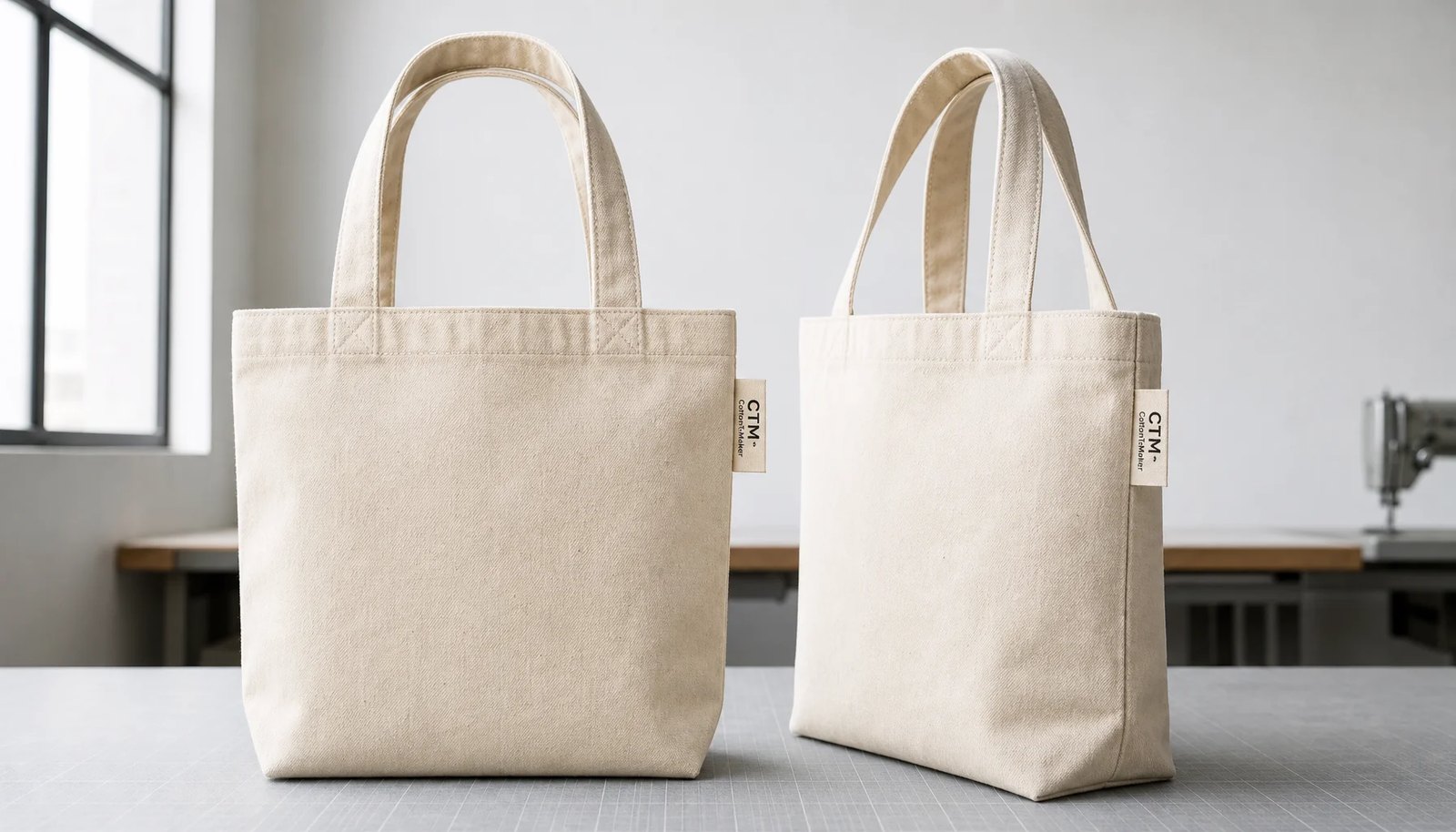
Start With the Show Load, Not the Mockup
Organic cotton totes for trade show exhibitors fail for practical reasons: the bag is asked to carry more than the fabric, handles, seams, or print were specified to handle. A registration tote holding a map, badge card, and two brochures is a different product from a sample-kit bag carrying catalogs, drinkware, cables, boxed parts, or cosmetic bottles. The artwork mockup may look identical, but the stress path through the handle root, top hem, side seam, bottom corner, and print face is not identical.
Before asking for price, create a load profile. Weigh the likely contents and decide whether the tote only needs to survive the event or should feel credible for reuse afterward. As a planning guide, 1-2 kg is usually light paper use, 3-5 kg is a mixed handout load, and anything above that deserves a buyer-defined test weight based on the actual kit. These are sourcing ranges, not universal standards. The important move is to put the expected maximum weight into the RFQ so suppliers can quote fabric and construction against the same target.
- State the maximum loaded weight in kg or lb instead of asking for a vague durable tote.
- Separate literature-only use from mixed handouts, sample kits, and reusable merchandise bags.
- Name the main failure to prevent: handle tear, seam spread, print crack, bottom sag, or carton crease.
- Ask suppliers to recommend GSM and reinforcement against the stated load, then compare the trade-offs.
- Keep one approved sample loaded overnight if the kit contains dense items that stress cotton slowly.
Specify Organic Cotton as a Fabric, Not a Slogan
Organic cotton is a claim about the material route. It does not automatically tell you the fabric weight, weave, finish, shrinkage, surface smoothness, or print behavior. A buyer-ready specification should include composition, GSM, tolerance, weave, color, finish, width if relevant, and expected shrinkage. For trade show totes, 240 gsm can work for light literature, 280 gsm is often a balanced starting point for mixed booth handouts, and 320-380 gsm is more appropriate for heavier kits or a stronger reusable feel. Higher GSM also increases fold bulk and carton volume, so it is not a free upgrade.
Write tolerances before sampling. A common GSM tolerance is +/-5%, but the supplier should confirm how it is measured and whether finishing can affect the result. Finished dimensions often sit around +/-0.5 cm to +/-1.0 cm, with larger gusseted bags sometimes needing a wider window. Natural ecru fabric may show seed flecks and shade variation; bleached or dyed fabric may improve logo contrast but needs dye-lot control. Approve a labeled swatch, then retain it with the signed pre-production sample.
- Tie each fabric weight option to load, reuse expectation, print coverage, carton volume, and budget.
- State whether fabric is natural, bleached, dyed, washed, softened, or otherwise finished.
- Ask for GSM tolerance, shrinkage expectation, and finished measurement tolerance in the quote.
- Approve fabric under consistent lighting because natural cotton and dyed lots can shift visually.
- Keep the signed swatch, sample, and document references together for inspection.
Decide Where Strength Must Be Added
Most tote durability comes from a few stress points. Handle attachment should be specified as bar-tack, box, X-box, or another named reinforcement method. The top hem should be deep enough to distribute load, and the side, bottom, and gusset seams should be finished so raw edges do not fray during handling. A sample photo of the outside of the bag is not enough; ask for close-ups of handle roots, inside seams, bottom corners, and the underside of any gusset.
Stitch density is a useful quote question because a seam can look tidy and still be weak if stitches are too long, thread tension is uneven, or needle damage appears around the handle root. Ask the supplier to state a target in stitches per inch or centimeter for stress areas. For flat literature totes, a simple body may be efficient. For boxy samples or bottles, a gusset helps contents sit at the base instead of pulling diagonally against side seams. Handle drop should match expected carrying style: shoulder carry, hand carry, or short-distance booth pickup.
- Specify handle width, handle drop, attachment size, and reinforcement pattern.
- Ask for side seam, bottom seam, top hem, and gusset construction in writing.
- Require close-up sample photos before bulk approval, especially for first orders.
- Use a gusset when kits include boxes, bottles, samples, or thick catalogs.
- Reject approval samples with puckering, skipped stitches, loose tension, frayed edges, or uneven handles.
Choose Decoration by Durability Risk
The decoration method affects both appearance and service life. Screen printing is usually the easiest to control for one to three spot colors at volume, especially when brand color and repeat orders matter. Still, the quote should state whether printing is in-house or subcontracted, what ink type is used, how curing is controlled, and how first, middle, and late-run pieces are compared. A clean press sample does not protect the order if bulk curing is inconsistent.
Transfer, DTF, and heat-applied methods can be useful for gradients, photographic art, small runs, or many colors. They should be tested on the final organic cotton fabric, not on a generic swatch. Check edge lift, fold cracking, gloss difference, heat marks, opacity, rub-off, and whether the print face is damaged by the planned fold. If a fold line crosses dense ink, the bag may look worn before it reaches the booth. A smaller mark, lower-coverage design, woven label, or adjusted fold can sometimes perform better than a large front graphic.
- Use screen print for simple spot-color artwork where repeatability matters.
- Test DTF, transfer, and heat-applied decoration for edge lift, rub-off, fold cracking, and heat marks.
- Approve color on final fabric after curing or bonding, not only from a digital proof.
- Define print position tolerance, registration tolerance, and acceptable color variation.
- Open a folded sample after 24 hours to check whether carton-style packing damages the logo.
Use a Pass/Fail Durability Checklist
A practical durability testing checklist does not need to be complicated, but it must be repeatable. Start with a pre-production sample made from final fabric, final stitching, final handle spec, final decoration, final label, and final fold. Load it with the actual event kit or an agreed equivalent weight. Inspect before testing, immediately after testing, and after the bag rests. Cotton can relax after stress, and small seam openings may be easier to see after the tote is set down.
For many trade show programs, a useful buyer-side test includes a 30-minute static hang at the target load, 25-50 lift-and-lower cycles, a short drop from table height onto a clean surface, a corner-stress check, a dry rub on the logo, and a fold check through the printed area if the production fold crosses artwork. Heavy kits may need longer hang time or more cycles. The numbers are less important than matching the risk and writing the same method into the factory inspection sheet.
- Record test weight, hang time, cycle count, drop height, surface, and pass/fail result.
- Pass: no handle tearing, open seams, stitch failure, unacceptable bottom distortion, or print damage.
- Fail: any open seam at a stress point, tearing at handle roots, severe print transfer, or visible cracking beyond the agreed limit.
- Keep one untested golden sample and one tested reference sample with dated notes.
- Repeat simplified functional tests on random finished bags from different cartons before shipment.
Classify Defects Before Cartons Are Packed
Clear defect rules prevent emotional arguments when the event date is close. Critical defects should include contamination, mold, safety issues, wrong material claim, unsupported organic labeling, or construction failure that makes the bag unusable. Major defects include open seams, handle anchors outside approved construction, dimensions outside tolerance, obvious print errors, incorrect carton marks, wrong quantity, or decoration that rubs off. Minor defects can include small loose threads, light wrinkles, or natural cotton marks that remain within the approved fabric character.
Many buyers use AQL for final inspection, but AQL should not replace functional testing. Visual sampling catches stains, print placement errors, measurement issues, and packing mistakes. Load testing catches performance failures. If AQL is used, state the inspection level, acceptable limits, defect classes, and sample size. If the order does not use formal AQL, the inspection sheet should still state how many cartons to open, how many pieces to measure, and how many bags to load-test.
- Define critical, major, and minor defects on the PO or inspection sheet.
- Measure body size, gusset, handle drop, handle width, and print position against tolerance.
- Check early, middle, and late production cartons when possible.
- Separate visual inspection from functional load testing.
- Agree rework, replacement, credit, or shipment hold rules before production begins.
Verify Organic Claims at the Right Level
Organic wording should match the documents available for the order. The claim may be supported at fiber, yarn, fabric, or finished-product level depending on the supply chain and certification route. A supplier saying organic cotton in a quote is not the same as providing documentation tied to the fabric used in your production lot. If the tote, side label, invoice, campaign page, or procurement report will say organic, ask your compliance team what evidence is required before labels are printed or bags are packed.
The safest procurement language separates material preference from public claim. If organic cotton is preferred but not printed or reported, the documentation burden may be different from a customer-facing claim. Avoid broad unsupported wording such as eco-friendly, sustainable, green, or natural unless your organization has approved definitions and evidence. Ask when documents will be available, whether they identify the supplier and lot, and who is responsible for collecting them when fabric, sewing, and printing are handled by different parties.
- State whether organic cotton is mandatory, preferred, or required for customer-facing claims.
- Ask whether documentation covers fiber, yarn, fabric, or finished goods.
- Confirm approved wording for labels, cartons, invoices, product pages, and event copy.
- Request lot-linked documents before bulk release when the claim matters commercially.
- Do not combine organic, recycled, natural, and sustainable claims unless each term is supported.
Compare Quotes by Hidden Assumptions
The lowest unit price is rarely meaningful until every supplier has quoted the same bag. A sewing factory may control cutting and stitching but outsource printing. A printer may decorate stock blanks quickly but have limited control over fabric weight, seam construction, or organic proof. A trading company may coordinate the order well, but the buyer still needs visibility into fabric sourcing, sewing, decoration, inspection, and packing. Each model can work if responsibilities are clear.
Send the same dimensions, GSM, finish, handle spec, reinforcement, print size, print colors, organic document requirement, packing format, inspection plan, delivery point, and receipt date to every bidder. Ask for practical price breaks, such as 1,000, 3,000, and 5,000 pieces, or the supplier's nearest efficient tiers. If a quote is much lower, check whether it reduced GSM, used stock fabric, removed reinforcement, outsourced print without QC, excluded setup, simplified packing, or omitted documentation handling.
- Ask who controls fabric, cutting, sewing, printing, inspection, packing, and rework.
- Request line items for unit price, sample, setup, label, packing, documents, inspection, and freight.
- Compare delivery terms clearly so factory-gate and delivered pricing are not mixed.
- Make fabric, print, construction, packing, and document substitutions subject to written approval.
- Treat a very low price as a question list, not an automatic saving.
Lock the Timeline Around Approval Gates
Trade show delivery dates do not move easily, so the schedule should be part of the purchase specification. Work backward from the date the bags must reach the booth, warehouse, distributor, or kitting vendor. Include time for fabric confirmation, artwork review, sample making, sample revision, organic document review if needed, bulk cutting, sewing, printing, curing or bonding, finishing, inspection, packing, and dispatch. If bags are going into kits, the receiving deadline is often earlier than the show date.
Approval gates should be owned by named people. First approve the written spec and artwork. Then approve the physical pre-production sample with measurements, load-test notes, print review, and fabric swatch. Next approve carton marks, inner pack count, fold direction, and pallet plan. After production, require inspection release before shipment. Late changes to artwork, label copy, or carton marks can reset work that looks finished, so freeze those items before bulk production starts.
- Build the calendar backward from warehouse, kitting, or venue receipt.
- Add review time for organic documents when the claim appears in commercial materials.
- Quote multiple tiers instead of chasing the lowest possible MOQ.
- Freeze artwork, label copy, carton marks, and packing rules before bulk release.
- Use approval gates for spec, sample, packing, inspection, and dispatch.
Write the RFQ So Suppliers Can Price Cleanly
A strong RFQ is specific enough to compare suppliers and open enough for them to suggest better production choices. Include finished dimensions, gusset, handle drop, handle width, fabric GSM, finish, organic documentation requirement, print method, print size, colors, label requirement, target quantity, load target, durability test, packing method, delivery destination, and required receipt date. Add one sentence describing how the tote will be used at the event; it helps the factory understand the real duty cycle.
The phrase organic cotton totes for trade show exhibitors durability testing checklist may sound like an SEO keyword, but the underlying procurement idea is practical: every bidder should understand the same material claim, show-use case, and pass/fail test. Ask for alternate GSM options only when each alternative keeps reinforcement and testing visible. The final purchase order should repeat the approved spec, tolerance, sample rule, substitution rule, inspection method, and shipment release condition.
- Send one spec sheet, one artwork file, one packing instruction, and one delivery requirement to all suppliers.
- Require a pre-production sample with final fabric, print, label, reinforcement, stitching, and fold.
- Ask for line-item pricing and alternate GSM options so durability choices are visible.
- State the load test and print checks that must pass before shipment.
- Make written approval mandatory for any fabric, print, construction, document, or packing change.
Specification comparison for buyers
| Decision point | Practical buying target | Use when | Pass/fail risk to control |
|---|---|---|---|
| Event load class | Light: 1-2 kg; standard mixed contents: 3-5 kg; heavy sample kit: buyer-defined test weight above actual packed kit | The tote must carry brochures, badges, bottles, boxed samples, cables, or catalogs at a show | Approving fabric and seams before defining the loaded weight the bag must survive |
| Fabric GSM | 240 gsm for light paper use; 280 gsm for mixed handouts; 320-380 gsm for heavier kits or reusable feel | You need a first comparison point across suppliers, then adjust for fold bulk, price, and reinforcement | Treating GSM as the only durability measure instead of checking construction and load results |
| GSM and size tolerance | GSM tolerance stated in writing, often +/-5%; finished size tolerance often +/-0.5 cm to +/-1.0 cm depending on bag size | Custom production, repeat orders, or programs where cartons must kit consistently | No tolerance on the PO, making borderline fabric weight or dimension changes hard to reject |
| Handle reinforcement | Bar-tack, box, or X-box anchors with agreed stitch density and no tearing after load test | Any tote carrying more than paper inserts or expected to be reused after the event | Handle roots that look neat in photos but open, pucker, or tear after carrying |
| Seam construction | Overlocked, turned, bound, or otherwise protected seams with no skipped stitches or open edges | Gusseted bags, heavier kits, and rough venue handling | Side seam spread, bottom corner distortion, fraying, and loose threads in stress areas |
| Decoration method | Screen print for simple spot colors; tested transfer, DTF, or heat-applied print for complex art | Brand logo must stay clean after folding, carton pressure, and attendee use | Poor curing, fold cracking, edge lift, ink rub-off, heat marks, or color drift |
| Organic proof | Claim tied to fabric lot or finished-goods route with documents available before shipment | The word organic appears on the bag, label, invoice, campaign copy, or ESG records | Generic organic wording without traceable support for the material used in the order |
| Bulk inspection | Material check, in-line sewing check, print check, final AQL if used, and functional load tests on finished bags | First order, new supplier, high-visibility event, or tight delivery window | Visual inspection only, which misses handle failure, seam spread, and print durability problems |
| Packing plan | Fixed inner count, print-safe fold, carton marks, moisture protection, and destination-ready labels | Bags ship to a venue, distributor, kitting vendor, warehouse, or multiple booth locations | Permanent logo creases, dirty bags, overfilled cartons, unclear carton marks, and extra on-site labor |
Buyer checklist before sampling
- Classify the event use as literature-only, standard mixed handout, sample kit, VIP gift, retail-style reusable tote, or post-show mailing insert.
- Weigh the heaviest expected contents and set a maximum loaded weight, then add a small safety margin for attendee-added items.
- Specify finished width, height, gusset depth, handle drop, handle width, top hem depth, fabric GSM, and written tolerances.
- Ask for fabric composition, weave, finish, color, expected shrinkage, GSM tolerance, and an approved swatch reference tied to the sample.
- Require organic documentation only at the level your claim needs, and confirm whether it covers fiber, yarn, fabric, or finished product.
- Define handle reinforcement, side seam, bottom seam, gusset construction, stitch density target, and thread color or quality requirement.
- Approve a pre-production sample made with final fabric, final print method, final label, final reinforcement, and final fold.
- Set pass/fail rules for loaded hang, carry cycles, short drop, seam spread, handle root damage, print rub, print cracking, stains, and measurement variance.
- State inspection method before production, including sample size, defect classes, load-test quantity, photo records, and rework responsibility.
- Confirm inner pack count, fold direction, carton quantity, carton marks, moisture protection, pallet plan, and delivery point for booth, warehouse, or kitting.
Factory quote questions to send
- What exact fabric are you quoting: composition, weave, GSM, GSM tolerance, width, finish, color, and expected shrinkage?
- Which organic documents can be tied to this order, and do they cover fiber, yarn, fabric, or finished product?
- Will the approved swatch, pre-production sample, and bulk fabric come from the same fabric quality or lot reference?
- What finished measurement tolerances do you recommend for body width, height, gusset, handle drop, handle width, and top hem depth?
- What seam types will be used at the side, bottom, gusset, top hem, and handle attachment, and what stitch density do you target?
- Will handle anchors use bar-tacks, box stitching, X-box stitching, or another method, and can you provide close-up sample photos?
- What loaded hang, carry-cycle, drop, seam-spread, and print-rub tests will you run on finished bags before shipment?
- Is decoration printed in-house or subcontracted, and who controls ink, curing, color approval, and rework if the print fails?
- For DTF, transfer, or heat-applied decoration, how do you test edge lift, heat marks, fold cracking, and rub resistance on this fabric?
- What does your quote exclude: sample cost, print setup, labels, organic document handling, special packing, inspection, inland freight, or export freight?
Quality-control points to confirm
- Fabric GSM matches the approved swatch and written tolerance, commonly +/-5% unless another tolerance is agreed.
- Fabric shade, hand feel, weave density, surface cleanliness, seed-fleck character, and finish match the signed approval sample under consistent light.
- Finished width, height, gusset depth, handle drop, handle width, and top hem depth stay inside the approved measurement tolerance.
- Panels are cut on grain so the bag does not twist, skew, or pull diagonally when loaded.
- Side seams, bottom seams, gusset seams, and inner edges show no open seams, skipped stitches, broken threads, unraveling, or excessive loose ends.
- Handle anchors match the approved reinforcement pattern and show no stitch gaps, needle damage, thread breaks, puckering, or tearing at the root.
- Stitch density is consistent across stress areas and does not fall below the agreed target on handles, top hem, and bottom corners.
- Loaded sample bags pass the agreed static hang, carry-cycle, short drop, and corner-stress checks without seam failure or visible tearing.
- Print position, size, registration, color, opacity, and edge quality match the approved artwork and signed pre-production sample.
- Print is fully cured or bonded and passes agreed dry rub, fold, scratch, and tape-lift checks without unacceptable transfer, cracking, or peeling.