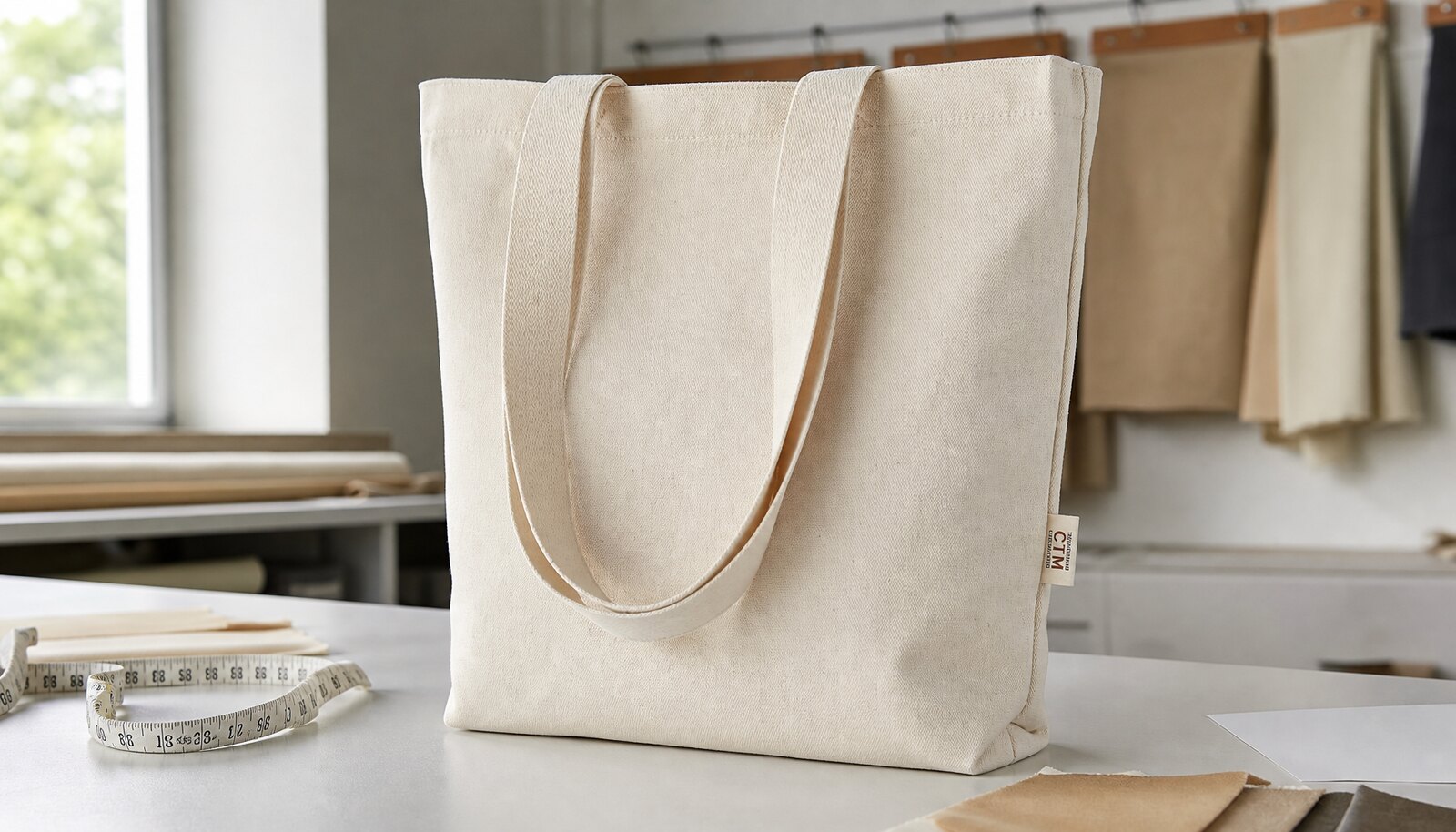
Why gift shop totes fail inspection
Gift shop buyers are not evaluating a grocery tote. They are buying a shelf-facing product that has to look clean, fold neatly, print well, and survive repeated handling by shoppers who often carry it immediately after purchase. The most common failures are not dramatic. They are the small things that make a tote look cheap at retail: uneven seams, a crooked logo, thin handles, shade mismatch across panels, or fabric that arrives with lint and oil marks.
A useful inspection checklist starts with the end use. If the tote is a souvenir item, the visual standard is much tighter than for a free event bag. If it is meant to sit on a hook or in a basket near the cash desk, the front panel, handle symmetry, and fold consistency matter as much as raw carrying strength. Buyers should define which defects are cosmetic, which are functional, and which are unacceptable before the first sample is approved.
- Set the visual standard at arm's length, not only from a sewing bench.
- Decide whether the tote is display merchandise, a gift insert, or a carry bag first.
- Write down which defects are minor, major, and automatic rejection.
Choose the spec before you price
For organic cotton totes sold in gift shops, the fabric spec usually drives both the look and the quote. In many programs, a plain weave around 180 to 240 GSM gives a better retail hand-feel than very light fabric, while heavier builds near 280 to 300 GSM suit customers who want a bag that stands up on its own or carries books and bottles. Natural unbleached cotton shows more slubs and specks, which can be acceptable if the buyer wants an earthy look. If the brand wants a cleaner retail appearance, say so in writing and define the shade band up front.
Printing method changes the inspection standard. Screen print is usually the cleanest option for one to three solid colors because it gives strong edge definition and low cost at volume. Heat transfer or digital print is more flexible for small orders, gradients, or detailed illustrations, but it must be tested for abrasion and hand-feel. The right spec is not just about GSM. It also includes handle width, reinforcement, gusset depth, seam allowance, and whether the bag should hold a flat folded shape or a softer natural drape.
- Use a single master spec for size, gusset, handle length, and seam allowance.
- Match the print method to artwork complexity and reorder volume, not just unit price.
- If the bag will be washed or steamed, require pre-shrink or post-process dimension tolerance.
Compare supplier routes before you compare unit price
A low unit price only means something if you know who is actually making the tote. A direct factory gives the cleanest path for controlling fabric, stitching, and print tolerances, but only if the buyer can manage the spec discipline. A trading company can be helpful when the order includes labels, inserts, and mixed packing needs, yet the buyer should still identify the real maker and the point of liability for defects. Local decorators and stock-bag resellers are faster, but they usually bring more variation in size, shade, and handle strength.
The same order can look cheap or expensive depending on the route. A quote from a factory near the port may save freight and simplify paperwork, while a stock bag with local print may look cheaper until the buyer sees the inconsistency between lots. The correct question is not only what is the per-piece price. It is what process you are buying, who controls each step, and whether the supplier can support repeat orders without spec drift.
- Ask who owns cutting, sewing, printing, inspection, and carton packing.
- Do not compare a custom-made tote with a stock tote unless the process is the same.
- If you need a backup supplier, keep the master sample and test plan identical across both sources.
What the sample must prove
The sample that wins the order is often better finished than bulk production. That is normal, which is why the buyer should insist on a pre-production sample that uses the actual fabric, thread color, print method, label, and packing style planned for the order. A hand-finished sales sample proves very little unless it can be reproduced on the line. If the supplier changes the fabric lot, the print screen, or the fold method later, the buyer is not getting the same product.
Sample approval should happen under normal light, not only in a photo sent by email. Measure at least three pieces, check both sides, and fold the tote several times to see whether the shape recovers cleanly. Smell matters too. Organic cotton should not arrive with a chemical odor, damp storage smell, or oil from the sewing line. For gift shop buyers, the sample is not only a technical approval. It is a retail presentation test.
- Require the same fabric lot or a clearly identified equivalent lot for bulk.
- Measure size, handle length, and print placement on more than one sample.
- Approve the sample only after checking fold behavior, smell, and visible surface finish.
QC thresholds that catch avoidable defects
A good inspection plan turns subjective problems into measurable ones. For bag buyers, the main failure points are stitching, handle attachment, print accuracy, and fabric consistency. If the tote is expected to carry shopping items, the handle attachment must be reinforced with bartacks or an equivalent stress-point finish. The front panel should not be distorted by print tension or bad sewing alignment. If the bag is meant to look premium, even a small print shift becomes a retail defect because shoppers notice it at the rack.
Use a clear defect map before bulk starts. Major defects should include open seams, missing or broken handles, visible holes, severe print misplacement, bad odor, and wrong carton packing. Minor defects can include small thread ends, slight natural slubs, or limited shade variation if the buyer has already accepted that look. The goal is not to reject every handmade imperfection. It is to stop the defects that will create returns, markdowns, or a bad first impression in the shop.
- Set a clear line between acceptable organic texture and defective fabric contamination.
- Treat crooked print, open seams, and weak handle attachments as major defects.
- If you use AQL, define the lot size, inspection level, and defect classification before production starts.
Print and label control is where retail damage happens
Gift shop buyers often focus on bag size and forget that the logo is the retail face of the product. A clean tote with a weak print still gets rejected by store staff because it looks unfinished on the shelf. For screen printing, the buyer should specify the Pantone target or a physical color standard, the print area in millimeters, the number of passes, and the curing approach. For digital or heat transfer, the buyer should add a rub test and ask how the print will behave after repeated folding or abrasion against hangtags and other bags.
Labeling deserves the same discipline. A side woven label, stitched logo patch, or care label must be straight, centered, and secure. If the bag is sold as organic cotton, the buyer should not assume that any logo printed on the bag is enough evidence. The paperwork and the pack mark have to line up with the fabric claim. If the buyer wants a clean retail look, the supplier should also be told whether exposed slubs, seed specks, and natural tone variation are part of the approved visual standard.
- Approve print on the actual panel size, not a separate art proof.
- Define the exact label position, stitch count, and visible edge tolerance.
- If the design uses fine lines or gradients, ask for a print test on the real fabric before bulk.
Packing should protect shelf readiness
Packing can destroy good production if it is treated as an afterthought. A tote that arrives dirty, wrinkled, or stuffed too tightly into a carton loses retail value even when the sewing is fine. For gift shops, folding consistency matters because the customer sees the bag before they feel it. Decide whether the bag will be packed flat, folded to a fixed dimension, wrapped in a polybag, or banded with paper. If the buyer wants a more sustainable presentation, paper bands or simple insert cards often fit better than heavy plastic, but the fold has to be repeatable so the shelf display remains uniform.
The outer carton should protect against crush and moisture without making the pack too heavy to handle. Ask for carton count, net weight, gross weight, carton size, and carton marks before approval. If the shipment uses mixed SKUs, each inner pack needs a clear count and style code. A retail buyer should never discover that the quantity per carton changed after the sample stage. That usually means the supplier was optimizing packing density instead of maintaining the agreed presentation.
- Freeze the fold spec if the bag must stand neatly in a display basket or gift shop bin.
- Keep carton weight practical for warehouse handling and retail receiving.
- Make sure carton marks, style code, and pack count match the commercial invoice and packing list.
Lead time and scheduling risk
Lead time for organic cotton totes is usually driven by the slowest step, not the sewing line itself. If the supplier is working from stock fabric and a simple one-color print, the schedule can be fairly short. If the order needs custom fabric, a new label, special folding, or revised artwork, the timeline extends quickly because the buyer is now waiting on fabric confirmation, sample correction, and print preparation. The order should be planned as a chain of approvals, not a single production date.
The biggest schedule risks are predictable. Buyers lose time when they leave artwork decisions open, change carton packing late, or approve a sample that does not match the bulk line. Seasonal gift shop programs are especially sensitive because a missed delivery window can turn a good tote into slow inventory. Ask the supplier where the true bottleneck is. Sometimes it is printing capacity. Sometimes it is fabric sourcing. Sometimes it is packaging materials. That answer is more useful than a generic promise to ship on time.
- Build a buffer for sample correction, especially if the tote has custom print or special packaging.
- Confirm which steps are stock items and which steps require fresh production.
- Ask whether peak season will affect sewing, printing, or shipping capacity.
Read the quote as a landed-cost sheet
A real buyer compares quotes on the same terms. EXW, FOB, CIF, and DDP are not interchangeable, and neither are quotes that hide items like screen charges, labels, carton marks, or inland trucking. Break the price into the parts that actually move it: fabric weight, handle construction, print color count, packaging method, carton count, and order volume. Once the quote is separated this way, the buyer can see whether a higher unit price is justified by better fabric, tighter print control, or lower defect risk.
For gift shops, the cheapest tote is often the one that passes inspection and lands on time. Rework, rush freight, and retail markdowns can erase a small saving very quickly. Ask the supplier to state what changes the price if the order goes from 1,000 to 3,000 pieces, or from one color print to two colors. That information tells you whether the factory really understands cost structure or is just quoting a headline number.
- Compare quotes only after the same spec, pack plan, and incoterm are fixed.
- Ask for separate line items for blank bag, print, label, packing, and freight.
- Treat rework risk as part of landed cost, not as an afterthought.
Specification comparison for buyers
| Spec decision | Recommended option | When it fits | Buyer risk to check |
|---|---|---|---|
| Direct factory with in-house sewing and print | Best for full control over GSM, stitching, and print placement | Repeat programs, custom sizing, and retail-ready gift shop orders | If the spec sheet is weak, the factory may substitute standard fabric or looser tolerances |
| Trading company that manages multiple mills | Useful when you need one contact for bag, label, and packing | Small procurement teams and mixed-SKU launches | Confirm who actually makes the bag and who owns defect liability |
| Blank stock tote with local decoration | Fastest route for a short seasonal run or pilot sell-through test | Under 500 pcs or urgent launch dates | Stock lots can vary in shade, size, and handle strength from batch to batch |
| OEM or ODM factory with sample room | Best when you need custom details like lining, pocket, or special label | Brand-led retail lines and annual reorder styles | Sample approval can drift if dimensions and accessory specs are not frozen in writing |
| Factory with in-house screen printing | Best for one to three solid colors and sharp logo edges | Simple branding at medium to high volume | Poor curing or low mesh count can cause bleed, stiffness, or cracking |
| Factory using heat transfer or digital print | Good for gradients, fine detail, and smaller quantities | Artwork-heavy logos and short runs | Check abrasion resistance and whether the print feel matches the retail price point |
| Exporter near port with shipment consolidation | Helpful when documents, carton grouping, and mixed containers matter | Orders with multiple SKUs or shared shipments | Make sure they still control production, not just freight paperwork |
| Dual-source setup for quote benchmarking | Useful for price comparison and backup supply | Large programs and risk-sensitive buyers | Use one master sample and the same test plan to avoid spec drift between suppliers |
Buyer checklist before sampling
- Freeze finished size, gusset, handle length, fabric GSM, and seam allowance before you ask for price.
- Specify whether the fabric should be natural, bleached, or dyed, and define the acceptable shade band.
- Confirm the print method, number of colors, placement, and whether the artwork will sit on one or both sides.
- Request a pre-production sample made with the same fabric lot, label, and packing method planned for bulk.
- Ask for sample measurements on at least three pieces, not one hand-picked piece.
- Decide your tolerance for slubs, seed specks, and minor color variation in organic cotton.
- State the required carton pack count, carton marks, and whether the tote must arrive folded for shelf display.
- Ask the supplier to separate blank bag cost, print cost, label cost, and packing cost in the quote.
- Verify any organic claim with scope documents and lot traceability, not only a logo on the sales sheet.
- Set a defect rule for major issues like crooked print, open seams, weak handles, and bad odor.
Factory quote questions to send
- What GSM, fabric width, and weave construction will you use for the quoted tote?
- Is the quote based on stock fabric or fresh production fabric from the same mill lot as bulk?
- Which print method are you quoting, how many colors are included, and what is the curing process?
- What is your MOQ by color, print version, and carton configuration?
- What are your dimensional tolerances for finished size, handle length, and print placement?
- Can you show a pre-production sample made to the exact bulk spec before sewing the full order?
- What packaging is included in the unit price, including folding, insert, polybag or paper band, and carton labels?
- How many days do you need for sampling, bulk production, inspection, and shipping documents?
- What inspection standard do you use for major and minor defects, and can you share the report format?
- If you claim organic cotton, what documents can you provide for the fabric and the finished goods lot?
Quality-control points to confirm
- Fabric weight should stay within plus or minus 5 percent of the agreed GSM unless the buyer approves a wider tolerance.
- Finished size should stay within plus or minus 1.5 cm for small totes and plus or minus 2 cm for larger tote formats.
- Handle length should be even from bag to bag, with no visible twist, and stress points should use bartack or X-box reinforcement.
- Stitching should be straight, complete, and consistent, with no skipped stitches, open seams, or loose thread bundles at the handle root.
- Print position should stay within the approved placement window, with no smearing, pinholes, ghosting, or color breakup.
- Shade variation should be acceptable only within the approved natural cotton band; any lot-to-lot mismatch must be flagged before packing.
- The bag should be free of oil marks, heavy lint, musty odor, broken needles, or contamination from cutting dust.
- If the tote is pre-folded for retail display, the fold should be repeatable and centered so the bag stacks cleanly in carton.
- Cartons should arrive intact, dry, and correctly marked, with no corner crush that can distort the packed bags.
- Any organic claim on the product or packaging should match the paperwork and the lot identification on the shipment.