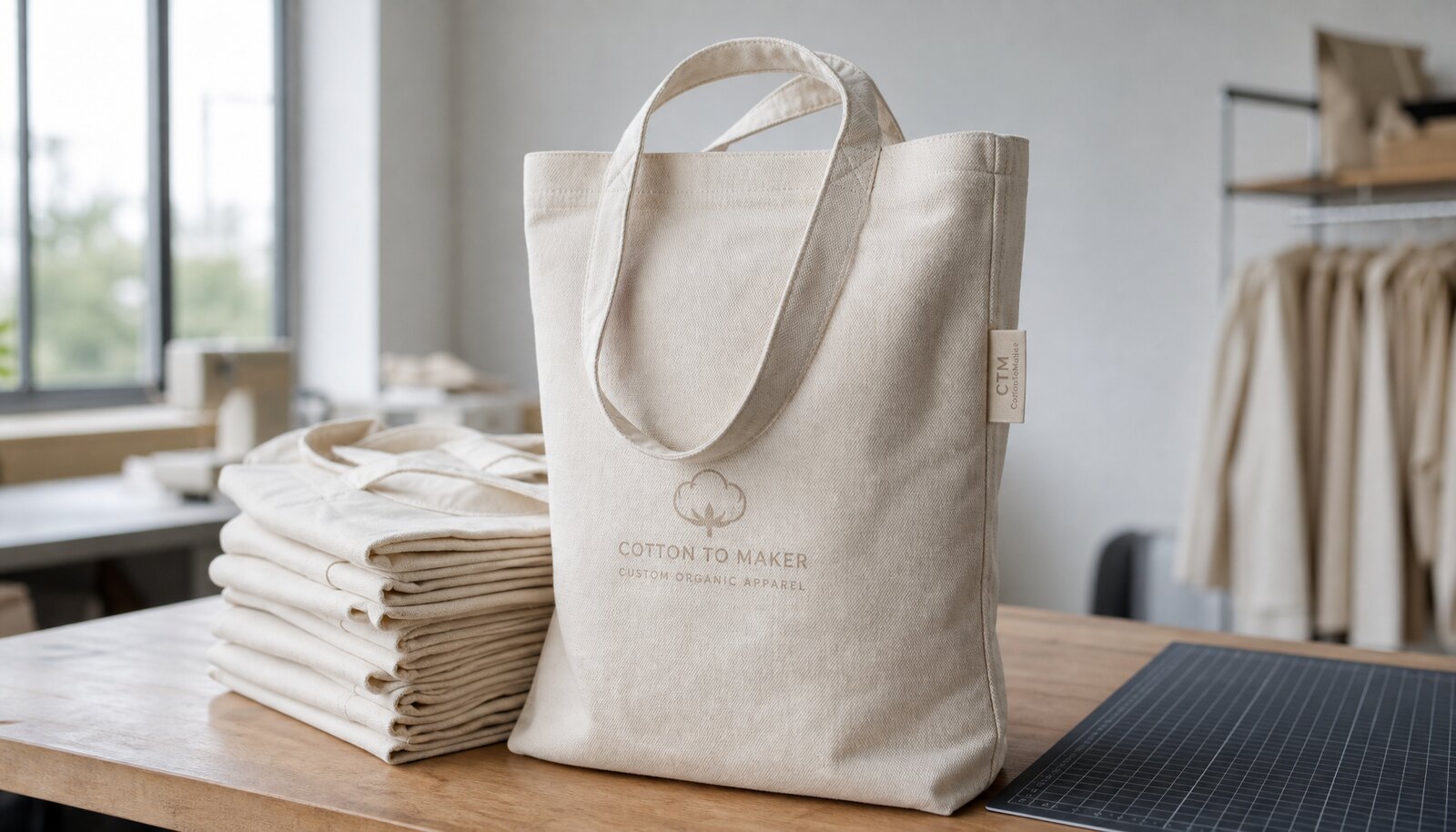
1. What the buyer is really paying for
With organic cotton totes for gift shops, the cheapest quote is rarely the cheapest program. The buyer is paying for a bag that looks credible on shelf, survives checkout traffic, and can be reordered without a new round of artwork disputes. In a gift shop, the tote is not just packaging. It is part of the merchandising mix, so the right spec protects margin in two places: the bag itself and the average basket value it supports.
For that reason, the commercial question is not whether the tote is cotton. It is what role the tote plays in the store. A free carry bag for books and souvenirs can tolerate simpler sewing and less retail polish. A paid souvenir tote needs a cleaner fold, better shape retention, and print that still reads when it is stacked, hung, or carried out of the store. The spec should match the selling motion, not an abstract idea of a tote.
- Checkout carry bags can prioritize utility and bulk packing.
- Retail SKUs need a cleaner front panel, better fold consistency, and stronger shelf appeal.
- A tote that looks good in a flat PDF can still fail the buying test if the handles twist, the body sags, or the print loses clarity on cotton weave.
2. Pricing bands that make bulk planning possible
Use pricing bands as a sanity filter, not as a claim about the whole market. For RFQ screening, a 5 oz natural tote with one-color screen print and bulk packing should sit in a lower band than a 6 oz tote with retail fold, label work, and a second print pass. The useful question is not whether a supplier matches a published benchmark. It is whether the quote is internally consistent with the spec.
Illustrative planning bands can help procurement teams sort realistic offers from incomplete ones. A 5 oz bulk-packed tote with one-color print often lands around $0.80-$1.25 ex-factory at mid-volume. A 6 oz tote with a cleaner retail finish often lands around $1.05-$1.75. Add a woven label, hangtag, polybag, or a second print color, and either band can move higher. Treat those numbers as RFQ screening ranges, not market averages.
- The biggest cost jump usually comes from moving from 5 oz to 6 oz fabric and from one-color to multi-color print.
- Retail-ready folding, labels, and polybags can add more to landed cost than a small fabric upgrade.
- A quote that is materially lower than the spec would suggest usually means a missing line item, not a better deal.
3. Landed cost math buyers can use in the RFQ stage
Compare landed cost per sellable tote, not ex-factory price. Use one formula across every quote: unit price plus setup amortization plus packing plus document handling plus inland and export moves plus freight plus duty and tax. That gives you a number the finance team can defend and a comparison the suppliers cannot blur with different quote structures.
Illustrative example A: 3,000 pcs of a 5 oz natural tote, one-color print, bulk packed. If the factory quotes $0.92 per unit ex-factory, the base spend is $2,760. Add a one-time print setup of $90, packing at $0.08 per unit ($240), and origin handling at $0.05 per unit ($150). Before international freight and duty, you are already at about $1.10 per unit equivalent. If freight, port charges, and import costs add another $0.28-$0.45 per unit, landed cost becomes roughly $1.38-$1.55 per tote.
Illustrative example B: 1,500 pcs of a 6 oz tote with a woven label and two-color print. If ex-factory is $1.58 per unit, the base spend is $2,370. Add setup at $180, packing at $0.12 per unit ($180), and origin handling at $0.07 per unit ($105). Your pre-freight total is about $1.87 per unit. If freight, port charges, and import costs add $0.35-$0.70 per unit, landed cost ends up around $2.22-$2.57. That spread matters because a retail tote may need a much higher shelf price to preserve margin.
- Keep setup charges separate from recurring unit costs.
- Use the same freight and duty assumption for every supplier, or the comparison will be distorted.
- Track landed cost per sellable unit if any packing or labeling step can reduce received yield.
4. Spec sheet discipline: the fastest way to get comparable quotes
The RFQ only works when each supplier is pricing the same tote. Give them finished dimensions, not bag family names, and define every field that changes fabric use or sewing time. If a field is open, the factory will make a choice for you, and that choice will be reflected either in the quote or in the sample stage.
The fields that matter most are finished width, height, and gusset or base construction; handle length and carry drop; fabric GSM after finishing; seam type; reinforcement at the handle anchor; artwork size and placement; label type; and pack format. If the bag needs to stand open on a counter, say so. If the print must never cross a seam, say that too. If the tote must fold to a target size for display, make that a spec item instead of a casual preference.
- Specify finished measurements, not cut dimensions.
- State whether the tote should stand flat, fold compactly, or hold shape in retail display.
- Lock the artwork file version and approve a placement proof before the supplier starts bulk planning.
5. Certification and traceability: what to document before bulk starts
Organic claims need document control, not hope. For a tote, the papers that usually matter are the factory scope certificate, any mill or converter certification that covers the fabric source, and a transaction certificate or lot-level chain-of-custody document for the shipment. The commercial invoice and packing list should use the same legal entity and style code as the certificate pack.
The common failures are predictable and expensive. An expired scope certificate, the wrong factory name on the invoice, a certificate that covers the mill but not the sewing site, or a finished tote made from mixed lots can all create a claim problem after the goods arrive. Another recurring issue is label copy that says organic cotton while the supplier cannot tie the exact shipment back to a certified lot. Buyers do not need to audit the mill, but they do need enough paper to defend the claim.
The best audit checkpoint is boring: compare the cert name, factory address, style code, lot reference, invoice, packing list, and carton marks before you release production. If any one of those items drifts, the claim trail is weaker than it should be.
- Scope certificate: verify the legal entity, site address, and expiry date.
- Transaction certificate or lot trace: tie it to the exact shipment, not a prior order.
- Invoice and packing list: make sure the style code and seller name match the certificate pack.
- Label and hangtag copy: avoid claim language that the supplier cannot support with the document set.
6. Construction and print choices that affect both cost and retail performance
Fabric weight is only one part of the hand feel. Handle width, stitch density, seam allowance, and base construction change whether a tote feels sturdy or temporary. A 5 oz body with reinforced handles can outperform a 6 oz body with weak seam work. That is why sample review should include loading the bag, not just looking at it flat.
For print, simple one-color screen print remains the easiest path for repeat orders. It keeps setup light and is forgiving on margin, but it still needs proof control because fine text and thin rules can fill in on cotton weave. Two-color work, transfers, or oversized art add cost and proof cycles, and they also make reorders less predictable. If the tote will be a long-running gift shop staple, choose an artwork method the factory can repeat without retuning every season.
Handle and print placement deserve special attention. A logo that sits too close to the top edge can look rushed. A seam that cuts through the mark can make the whole piece feel off-center even when the bag dimensions are correct. The point is not to over-engineer the tote. It is to avoid the small visual errors that make a retail product look cheaper than it is.
- Use a reinforcement pattern that spreads load at the handle anchor.
- Set a minimum line thickness for text and rules if the art includes fine detail.
- Approve artwork placement from the top edge and centerline, not from a loose visual estimate.
7. Supplier route tradeoffs: direct factory, trading company, or regional stock program
The best sourcing route depends on how often you expect to reorder and how much document control your team can manage. Direct factory sourcing usually gives the best visibility into fabric, sewing, and certification trail. It works well when the spec is stable and the order is likely to repeat. The tradeoff is that the buyer has to be more disciplined: a vague brief will come back as a vague quote.
Trading companies or consolidators can help when you need multiple SKUs, faster onboarding, or someone to coordinate documents across several factories. That can reduce friction on the first order, especially for a smaller procurement team. The tradeoff is transparency. If the quote is not broken down cleanly, the margin stack is hidden and the real factory issue may be slower to resolve.
Regional stock or local print programs can shorten replenishment time, but they usually come with fewer choices on size, color, and exact brand presentation. That route works only when the buyer is willing to accept less customization in exchange for speed.
- Direct factory: best for repeat orders, custom dimensions, and lower long-term variance.
- Trading company: good for first orders or mixed programs, but verify the real producer and the document trail.
- Regional stock: fastest replenishment, but the least flexible option for custom branding and certification detail.
8. MOQ, sampling, and packing that do not surprise receiving
MOQ is tied to setup, not just total volume. One tote size with one print and one packing style is easier to price than three colors, two labels, and retail wrapping. The hidden MOQ is usually per color, per artwork, and per packaging variant. If the supplier offers a low total MOQ but adds separate charges for each variant, the final cost can climb quickly.
Plan for samples in stages: a photo or paper proof, a pre-production sample, and then a sealed reference sample that sits beside the purchase order. Budget courier and revision time separately. Sample charges often disappear in quote comparisons but show up in the schedule. If the bag will sit in a gift shop, add a packing standard that protects corners and print quality in transit instead of assuming a loose fold will be good enough.
Packing is where procurement meets warehouse reality. Bulk packing is cheapest and easiest for wholesale replenishment. A size-sorted bundle or retail fold is better when the tote is going straight to a display fixture or when your receiving team needs clean counts. Polybags and insert cards are useful only when the tote is part of the merchandising experience, because they increase labor and materials.
- Bulk pack: lowest cost, easiest replenishment, least shelf-ready.
- Retail fold: better presentation, but slower to produce and usually more expensive.
- Ask for carton dimensions, gross weight, and pallet pattern before you finalize the order so warehouse fit is not an afterthought.
9. Quality control thresholds that prevent avoidable disputes
A usable tote spec has pass-fail limits. For finished goods, agree on size tolerance, handle symmetry, seam quality, print registration, shade variation, and carton count. If you want a commercial standard, write it down. "Looks good" does not survive a dispute, and a retail tote with a sloppy visual finish will hurt more than a plain carry bag with the same defect.
A practical inspection plan uses the approved sealed sample plus a pre-shipment check. Many buyers use an AQL-style sampling plan for visible defects and quantity control, then add category-specific checks for handle pull, stitch skip, print rub, and carton marks. If the tote is sold as a retail item, inspect it under daylight and warehouse light, because cotton shade and print contrast shift more than buyers expect.
The most expensive failures are often small. A bag that is slightly under size, a print that sits too close to the edge, or handles that twist by a few millimeters can make the whole program feel off. None of those issues may trigger a catastrophic failure, but they absolutely change how a gift shop buyer judges the line.
- Set a written size tolerance and make sure the warehouse can measure it consistently.
- Check handle length on the finished bag, not the cut strap, and confirm left-right symmetry.
- Inspect print placement, clarity, and rub resistance against the approved sample.
- Reject mixed cartons, wrong fold patterns, and bundles that do not open flat if the bag is meant for resale.
10. A procurement workflow that turns quotes into a usable plan
The cleanest RFQ process is short and disciplined: freeze the spec, send one pricing sheet, compare landed cost, verify documents, approve the sample, then release production. If the supplier needs to reinterpret the brief after quoting, the quote was not truly comparable. The job of procurement is to reduce that ambiguity before money or time gets spent.
A simple scorecard keeps the decision grounded: price, document pack, sample fidelity, lead time, packing quality, and reorder stability. That scorecard matters because gift-shop totes are small-ticket items. The procurement win is not squeezing a single invoice. It is building a stable program that stays on shelf and reorders without a new sourcing cycle every season.
If you are building a bulk pricing plan for organic cotton totes for gift shops, the real target is repeatability. The best supplier is the one that can keep the same bag, the same claim trail, and the same packing standard intact across reorder cycles without forcing you back into a new spec debate.
- Freeze the spec before comparing final prices.
- Use one freight and duty assumption for every quote.
- Approve the sample, packing standard, and document pack before bulk production starts.
Specification comparison for buyers
| Spec decision | Practical threshold | Supplier-side tradeoff | Procurement impact |
|---|---|---|---|
| Fabric weight | 5 oz / 170-180 GSM | Lower material cost and lighter freight, but less body and more risk of a thin retail feel | Best for checkout carry bags and lower price points; confirm handle stretch and seam performance before approval |
| Fabric weight | 6 oz / 200-220 GSM | Higher material and freight cost, but better drape, shelf presence, and reduced translucency | Better for museum stores, gift shops, and resale totes; usually stronger margin pressure but fewer presentation complaints |
| Handle construction | Self-fabric handles with reinforced attachment | Adds sewing time and can extend sample review if the reinforcement is weak | Improves carry confidence for books and bottles; ask for handle drop and pull-test results |
| Print method | 1-color screen print | Lowest setup cost and fastest repeat order path, but fine type can fill in on cotton weave | Best for core logo programs; sample cost is usually lower and reorders are easier |
| Print method | 2-color screen print or transfer | More setup, more proofing, and more registration risk | Useful for seasonal art and retail SKUs; expect higher sample cost and longer artwork approval |
| Packing format | Bulk packed, size-sorted cartons | Lowest labor and fastest production, but less shelf-ready presentation | Works well for wholesale replenishment and DC receiving; check carton counts and pallet fit |
| Packing format | Retail fold with polybag or insert card | Adds materials, labor, and often lead time | Better for gift shop display, but build the extra unit cost into margin planning |
| Supplier route | Direct factory | Best visibility into fabric, sewing, and certification trail, but requires a tighter spec sheet | Usually strongest for repeat orders and stable reorders; lower long-term variance if the brief is clear |
| Supplier route | Trading company or consolidator | Easier onboarding and mixed-SKU coordination, but less transparency into the factory margin stack | Good for first orders or smaller teams; verify the real producer and document consistency |
Buyer checklist before sampling
- Freeze finished tote size, gusset or base construction, handle length, and fabric GSM before asking for final quotes.
- State the bag's role clearly: checkout carry bag, retail souvenir SKU, or branded merchandise support item.
- Define the artwork spec in writing: print size, print color count, placement from the top edge, and whether the design crosses a seam.
- Separate one-time setup charges from repeat unit pricing so the first order does not hide the true reorder cost.
- Require a pre-production sample and a sealed approval sample tied to the same spec version and artwork file.
- Ask for carton pack count, carton dimensions, gross weight, and pallet pattern if your warehouse has receiving rules.
- Set acceptance thresholds for size, shade, print position, stitch quality, and count accuracy before production starts.
- Compare landed cost, not only ex-factory price, and include freight, duty, inland moves, cartonization, and label changes.
Factory quote questions to send
- What is the exact finished fabric weight after processing, and is it measured on the final bag or on fabric before conversion?
- Which legal entity is selling the tote, and which organic certificate number and scope cover this production site?
- Can you show the transaction certificate, lot reference, or equivalent chain-of-custody document for the goods you are quoting?
- What is the MOQ by size, fabric color, print version, label type, and pack format, not just the total order quantity?
- Please break the quote into fabric, sewing, print, label, packing, export handling, and inland movement so the price stack is visible.
- What is the pre-production sample cost, courier cost, and the number of revision rounds you include before charges apply?
- What changes reset the lead time after art approval and sample sign-off?
- What are the carton dimensions, gross weight, carton count, and pallet pattern for this style?
- How do you handle mixed lots or a late substitute fabric batch if the approved lot is unavailable?
Quality-control points to confirm
- Verify the bulk bag against the sealed sample for size, shade, hand feel, and print placement under daylight and warehouse light.
- Measure finished width, height, and gusset against the approved spec, and use a written tolerance such as plus or minus 6 mm if that fits your operation.
- Check handle length and carry drop on the finished tote, not on the cut strap, and confirm both sides are symmetrical.
- Inspect handle anchors, side seams, and base seams for skipped stitches, broken thread, seam puckering, or weak bar-tack reinforcement.
- Review print registration, line thickness, and opacity on cotton weave; reject artwork that fills in, bleeds, or lands too close to a seam unless the spec allows it.
- Weigh a sample bag or carton if your team has seen underweight lots before, because fabric underfill is easier to miss visually than by measurement.
- Verify carton marks, SKU, size, quantity, purchase order number, and country of origin against the packing list before shipment release.
- Quarantine mixed cartons, wrong fold patterns, or bundles that do not open flat if the tote is sold as a retail item.