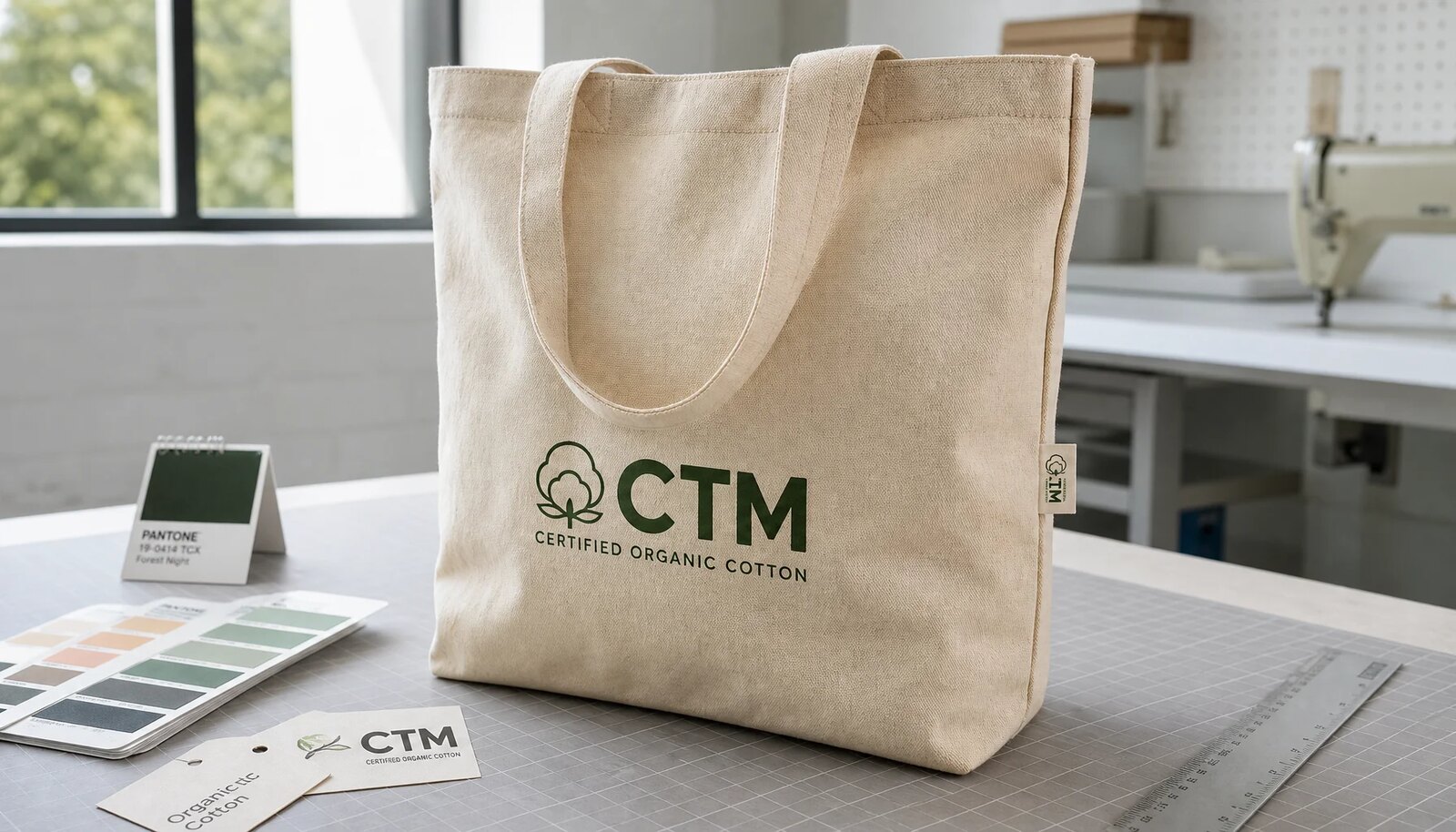
Start with the real market environment
Organic cotton totes for farmers market vendors work harder than many promotional bags. They sit on tables, hang from hooks, slide across damp counters, get opened with one hand, and carry produce, jars, bread, flowers, and prepared foods. A customer may notice the bag before the label on the product. That makes print proofing a business control, not a decoration formality.
Natural cotton is also unforgiving in its own quiet way. It is not a flat white screen. The base color may read cream, grey, warm beige, or slightly flecked depending on the lot and finishing. A pale logo that looks clean in a PDF can lose contrast on undyed cotton. Fine strokes can break over the weave. Heavy ink can feel sticky or crack if it is folded too soon.
For procurement teams, the best organic cotton totes for farmers market vendors print proofing checklist starts before the artwork file goes to the factory. The buyer needs the bag spec, cotton documentation request, artwork rules, sample sequence, tolerances, and packing method aligned early. Once totes are sewn, printed, packed, and routed to seasonal vendors, even a small proofing miss becomes expensive to fix.
- Review proofs under the same kind of light customers will see at a market stall, not only under office lighting.
- Check readability from normal stall distance as well as close inspection distance.
- Treat the approved physical sample as the standard for bulk QC, reorder matching, and dispute resolution.
- Write pass, fail, and resample rules before bulk production begins.
Define the tote's job before setting specs
A farmers market tote may be a giveaway, a resale item, a CSA pickup bag, a loyalty reward, a staff bag, or branded packaging for prepared foods. Those uses should not share one default specification. A low-cost giveaway can tolerate a simpler construction if the expected load is light. A resale tote needs better fabric handfeel, straighter sewing, cleaner folding, and a print that feels worth paying for.
Load expectation should be written plainly. A tote for brochures and herbs is different from a tote expected to carry root vegetables, glass jars, flowers, and bread in the same trip. Many B2B buyers look at 200-280 GSM cotton for repeat market use because it feels more substantial and gives the print a steadier surface. GSM alone does not prove durability, so it should be reviewed with weave, handle width, handle attachment, seam type, and finished size.
Distribution matters too. A vendor selling bags from a stall may want loose-packed totes without individual polybags. A retail program may need barcode stickers, hang tags, belly bands, or inner packs. A multi-farm program may need carton marks by market, farm name, logo version, or destination. These details belong in the RFQ. If they arrive after sampling, the supplier may need to rework folding, labeling, cartons, and cost.
- State the use case: giveaway, resale, CSA pickup, staff use, loyalty program, event distribution, or retail sale.
- List expected contents by category, including produce, jars, baked goods, flowers, prepared foods, paper goods, or mixed groceries.
- Choose a spec tier before quoting: light promotional, everyday market retail, or heavier repeat-use tote.
- Confirm whether the tote must fold flat, stand with a gusset, hang from a peg, fit a shelf, or ship to multiple locations.
- Include packing and display requirements in the first quote request, not after sample approval.
Lock the bag before proofing the artwork
A print proof can only prove the selected bag. Change the cotton weight, weave, gusset, or handle construction later and the proof loses value. A 140 GSM plain-weave tote absorbs ink differently from a 280 GSM canvas tote. A flat bag prints differently from a gusseted bag. A long-handle shoulder tote may need the logo placed lower so it is not hidden by the user's arm.
Write finished dimensions in measurable terms: width, height, gusset depth, handle length, handle drop, handle width, top hem, seam construction, reinforcement, and fabric GSM. Then agree how those measurements will be taken. A supplier measuring before pressing and a buyer measuring after unpacking can both think they are right. Sewn cotton bags need practical tolerances because fabric, cutting, stitching, pressing, and humidity all introduce movement.
Cotton color deserves the same discipline. Natural, bleached, dyed, washed, and pre-shrunk cotton will not give the same print result. Natural cotton can make brand colors warmer and less saturated. Bleached cotton may brighten color but change the product's visual position. Washed fabric may feel softer but can add dimension variation. Keep the approved fabric swatch with the print proof so the team is judging one product, not a memory of one.
- Specify finished width, height, gusset, handle length, handle drop, handle width, fabric GSM, weave, cotton color, top hem, and seam construction.
- Confirm measurement method and tolerance for body size, gusset, handle length, handle drop, and print position.
- Define a print-safe area away from top hem, side seams, bottom fold, gusset folds, handle stitching, and bar tacks.
- Ask whether the fabric is natural, bleached, dyed, washed, or pre-shrunk before approving color.
- Avoid approving artwork placement until the final construction is selected and quoted.
Check organic cotton claims separately from artwork
A tote can look natural without being documented organic, and a clean print does not verify fiber status. Procurement should separate sourcing claims from decoration approval. Before issuing the PO, ask what organic cotton documentation can be supplied, what it covers, and whether it can be linked to the specific shipment, material lot, product category, or order.
The wording matters. A factory may have experience making organic cotton bags, but that is not the same as order-linked material traceability. A scope certificate, transaction certificate, material declaration, invoice reference, packing list, or shipment document may each tell a different story. Buyers should check company names, validity dates, product categories, and whether the seller, mill, sewing factory, and exporter are aligned in a way the buyer can support.
This is especially important if the tote or packaging will carry organic claims, certification marks, or sustainability language. Do not ask the print supplier to place certification marks unless the buyer has confirmed permission and documentation. Keep the documentation file cross-referenced with the approved sample, artwork proof, and PO line so marketing, procurement, and quality teams are working from the same evidence.
- Ask what certificate, scope document, transaction document, material declaration, or shipment paperwork can be provided.
- Confirm whether documentation applies to fiber, yarn, fabric, finished goods, facility scope, or the specific shipment.
- Check company names, product categories, validity dates, order references, and material lot references where applicable.
- Do not print certification marks or organic claims unless documentation and permissions support that use.
- Store the approved proof, product spec, and organic documentation together for reorders and audits.
Match the print method to the risk in the artwork
Screen printing is often the practical choice for one to three spot-color farmers market tote logos. It can be repeatable, clean, and cost-effective at moderate volume. Water-based ink is commonly chosen when the buyer wants a softer handfeel on organic cotton. The tradeoff is opacity. Pale ink, thin strokes, small reverse text, and delicate icons may need adjustment to remain readable on a warm natural base.
Higher-opacity screen systems can help when the logo must stay bold. They should be sampled with the actual fold and packing method because a heavier ink surface changes how the tote feels and behaves. If dense ink crosses a fold line, the buyer should check for cracking, shine, transfer, and surface stress. A bold print is only useful if it still looks clean after the bag is opened and stacked.
DTF or digital transfer can make sense for short runs, many colors, gradients, seasonal campaigns, or multiple vendor logo versions. It is not automatically the wrong choice for organic cotton, but the inspection points change. Look closely at film edge, adhesion, surface feel, heat-press marks, crease behavior, and whether the transfer finish feels too plastic for a simple cotton tote. Embroidery may suit a small badge, but it can pucker fabric and shifts the cost structure.
- Use water-based screen print for simple spot-color logos where soft handfeel and repeatability matter.
- Use higher-opacity systems only after checking surface feel, flexibility, odor, cure, and fold performance.
- Use DTF or digital transfer for complex artwork or shorter runs, then inspect film edge, adhesion, handfeel, and crease behavior.
- Avoid tiny reverse text, very thin strokes, low-contrast colors, and QR codes that are too small for the weave.
- Ask the supplier why the proposed method fits the selected cotton color, GSM, artwork size, and order volume.
Build a proof package a factory can measure
A useful proof package removes guesswork. Send vector artwork in AI, EPS, or production-ready PDF format with fonts outlined. Include exact print size in millimeters, Pantone or approved color targets, logo version, orientation, placement diagram, revision number, and approval contact. If the factory may not adjust the artwork, say that directly. If line thickening, trapping, QR code resizing, or small-type cleanup is allowed, require approval before the change is sampled.
Placement should be anchored to physical reference points. Instead of saying centered on front, define the bag centerline and the distance from the top hem, side seams, bottom edge, gusset fold, or handle stitch box. If the logo is close to construction, define clearance. If the bag will be folded for retail display, show where fold lines should land relative to the print.
Give the supplier priority rules. Brand name readability may matter more than perfect coverage inside a small icon. QR code scannability matters more than a slightly better color match. Certification marks may have fixed clear space rules. The more clearly the buyer ranks these details, the easier it is for the supplier to flag artwork that will not print well before screens, films, or transfer files are made.
- Provide vector artwork with outlined fonts and embedded links where needed.
- State print size, placement, orientation, color target, revision number, artwork owner, and approval contact.
- Define placement from top hem, side seams, gusset folds, bottom edge, handle stitching, and bag centerline.
- Call out minimum line weight, smallest normal text, smallest reverse text, QR code size, certification marks, and no-change brand elements.
- Include folded-view requirements when totes will be packed, stacked, shipped, or displayed folded.
- Use one signed proof sheet combining artwork, placement diagram, color target, tolerances, date, and approver name.
Use samples to prove production conditions
A rendering can help people agree on the idea. It cannot prove production. The first serious print check is a flat strike-off on the actual cotton color or the closest approved bulk fabric. This shows color shift, opacity, line breakage, edge quality, registration, ink cure, odor, and surface feel. If the strike-off is printed on a different fabric shade or weight, treat it as a technique sample rather than bulk approval.
A sewn pre-production sample is the stronger gate when the artwork is large, close to a seam, near a gusset, close to handle stitching, or affected by folding. The sample should use the planned fabric, construction, print method, print size, placement jig, curing process, fold method, and packing approach. Handle it like the final product: open it, hang it, add reasonable load, fold it, stack it, and inspect again.
Approval notes should be operational. Approve, approve with correction, reject and resample, or hold for buyer artwork revision are clearer than casual comments. If the logo must move 10 mm lower, the ink needs more opacity, or a QR code needs resizing, the revised sample should prove the change before bulk starts. Keep the approved physical sample for final inspection and repeat orders.
- Request a flat strike-off when color, opacity, registration, cure, or fine detail is the main risk.
- Request a sewn pre-production sample when placement, seams, gussets, handle joins, folding, or resale quality matter.
- Check the sample against the written spec, artwork proof, fabric swatch, packing plan, and carton label reference.
- Inspect after opening, loading, hanging, folding, stacking, and a light rub test with a clean white cloth.
- Confirm whether bulk will use the same fabric lot, ink system, screens, placement jig, curing settings, and print facility.
Set tolerances before anyone argues about defects
Tolerances turn taste into inspection criteria. For placement, define horizontal centering, vertical distance, rotation, and clearance from seams, handles, hems, and gussets. A practical placement tolerance such as +/-5 mm may be workable on many tote programs, but the supplier should confirm it against bag construction, print size, loading method, and whether the bag is printed flat before sewing or after sewing.
Color tolerance should be tied to a physical reference. Pantone numbers are useful for communication, but natural cotton is warmer and more textured than coated paper. The approved strike-off or sewn pre-production sample is often the better standard for bulk. Define what fails: wrong brand color, visibly mixed shades within one order, weak opacity through key text, or registration that creates obvious halos around letters, borders, QR codes, or certification marks.
Defect classifications should be agreed before inspection. Critical defects may include unsafe contamination, severe odor, or illegal labeling. Major defects may include wrong logo, unreadable brand name, sticky ink, ink transfer, severe misplacement, broken handles, wrong carton mix, or print bleed through key artwork. Minor defects may include small fabric slubs or tiny print specks outside critical brand areas, provided they do not harm presentation.
- Define placement tolerance for centerline, top distance, side distance, rotation, and clearance from construction features.
- Set registration tolerance for multi-color artwork so visible halos around text and borders are not debated later.
- Use the approved strike-off or pre-production sample as the color, opacity, and handfeel standard.
- Classify major print defects: wrong logo, wrong color, unreadable text, heavy bleed, missing ink, tackiness, transfer, blocking, and severe misplacement.
- Classify construction defects that affect branding: twisted body, uneven top hem, puckered seam, distorted gusset, or handle stitching pulling into the print zone.
- State whether inspection follows AQL, a custom sampling plan, first-piece approval, or 100 percent sorting for critical orders.
Compare quotes on the same product, not the same noun
Unit price is only useful when every supplier is quoting the same tote. One offer may be based on 170 GSM natural cotton with a small one-color print. Another may include 260 GSM fabric, a gusset, longer handles, a sewn pre-production sample, retail packing, and carton labels. Both may be described as organic cotton totes, but they are not the same commercial offer.
Break MOQ down by the variable that drives it. Organic cotton fabric sourcing, cotton color, dye lot, bag size, print color count, screen setup, logo version, barcode label, carton mark, and destination split can each affect the minimum. A 2,000-piece order with one logo and one packing method is simpler than 2,000 pieces split across six vendors, two bag colors, and several carton labels.
A clean B2B quote separates the bag, material requirement, decoration, sampling, packing, testing, inspection, freight, and payment terms. Lead time should be stated after final sample approval, not only after deposit. For farmers market buyers, timing is not an abstract planning detail. If bags miss the market season, the cheapest unit price may be the most expensive option.
- Compare quotes only after matching finished size, GSM, weave, cotton color, handle length, gusset, print method, print size, print colors, and packing.
- Request MOQ by fabric color, bag size, logo version, print color count, packing method, barcode label, carton mark, and destination split.
- Ask whether setup charges repeat by order, logo, color, size, or reorder, and whether screens or jigs are retained.
- Separate sample fees, testing, inspection, hang tags, barcode stickers, inner packs, carton labels, freight, duty, and destination handling.
- Confirm Incoterms or delivery terms, payment terms, quote validity, approval timeline, and lead time after final sample approval.
Control packing before it damages a good print
Packing can ruin a print that passed proofing. If bags are folded through dense ink before cure is complete, the print can crack, transfer, or develop a permanent stress line. If warm printed panels are stacked tightly, ink can block from one tote to another. The sample approval should include the fold method, folded dimensions, inner pack quantity, master carton quantity, and whether printed panels need protection from pressure.
The right pack depends on the channel. Many farmers market vendors prefer loose-packed totes with no individual polybag because setup is faster and packaging waste is lower. Retail programs may need a hang tag, barcode sticker, belly band, or individual bag. Wholesale, 3PL, and multi-location programs may need carton labels, destination marks, carton sequencing, pallet labels, and line-item separation.
Carton accuracy is a quality-control issue. Orders split by farm name, market, logo version, bag color, or destination are easy to mix if the packing plan is vague. Final inspection should compare the carton label, inner pack, printed logo, quantity, and PO line. Sorting mixed inventory after arrival can erase any savings from loose packing or a cheaper quote.
- Approve fold method, folded dimensions, inner pack count, master carton count, carton label layout, and carton sequence format.
- Avoid folding directly through dense ink coverage unless the approved sample has passed fold, stack, and transfer checks.
- Specify no polybag, individual polybag, paper band, belly band, hang tag, barcode sticker, or retail label by sales channel.
- Require moisture protection appropriate for sea transit, humid storage, or long warehouse dwell time.
- Mark cartons by PO, item code, logo version, bag color, quantity, destination, and carton number to reduce mixed inventory.
- Inspect packed cartons for correct count, clean folding, no odor, no blocking, no transfer, and accurate labels.
Specification comparison for buyers
| Spec or sourcing decision | Recommended B2B approach | Useful target or tolerance | Buyer risk to check |
|---|---|---|---|
| Finished tote body | Lock finished width, height, gusset depth, handle length, handle drop, handle width, fabric GSM, weave, and cotton color before artwork proofing | Common market tote ranges include 350-420 mm width, 380-430 mm height, 80-120 mm gusset, and 200-280 GSM for more substantial repeat use | A lower quote may be based on a smaller blank, lighter GSM, shorter handles, narrower gusset, or a different natural cotton shade |
| Organic cotton documentation | Ask what certificate, scope, transaction, material declaration, or shipment paperwork can be linked to the order | Confirm whether documents reference the seller, mill, factory, product category, material lot, and order where applicable | A facility capability claim is not the same as shipment-level traceability; document type must be clear before PO approval |
| Water-based screen print | Use for one to three spot-color logos where soft handfeel, clean edges, and repeatability are important | Approve on actual cotton; set placement tolerance such as +/-5 mm where the construction and print size allow | Light inks can look weak on natural cotton, and under-cured ink can feel tacky or transfer in folded stacks |
| Plastisol or high-opacity screen print | Consider when opacity matters more than a very soft fabric handfeel | Check surface feel, flexibility across folds, cure performance, and odor before bulk production | A heavier ink layer may feel inconsistent with an organic cotton product or crack if folded through a high-stress area |
| DTF or digital transfer | Use for short runs, many colors, gradients, seasonal artwork, or multiple vendor logo versions | Inspect film edge, handfeel, adhesion, crease behavior, heat-press marks, and wash or rub performance if required | Transfers can feel plastic on plain cotton and may lift, shine, or show a visible film border |
| Flat strike-off | Print the artwork on the actual fabric color and comparable GSM before approving the production method | Use to confirm color, opacity, line detail, registration, ink cure, odor, and surface feel | It does not prove placement on a sewn bag, distortion near seams, folding behavior, or retail presentation |
| Sewn pre-production sample | Approve a finished tote made with planned construction, print method, placement, folding, packing, and carton labeling | Use for large prints, gusseted totes, logo placement near seams, resale programs, and multi-destination orders | Costs more and takes longer, but catches placement, folding, handle, and packing issues a flat strike-off cannot show |
| Supplier with in-house printing | Use when one supplier can control sewing, printing, curing, final QC, packing, and carton labels | Ask whether sample and bulk are made on the same line with the same ink system, screens, jigs, and curing settings | Lower handoff risk, but confirm the supplier has real print capability, not only bag sewing capability |
| Bag factory plus external decorator | Use when the sewing factory coordinates printing with a proven partner | PO should state who owns final quality if placement, cure, carton mixing, or shipment timing fails | Subcontracting can work well, but accountability and sample-to-bulk controls must be written clearly |
Buyer checklist before sampling
- Define the commercial use: giveaway, resale, CSA pickup, loyalty reward, staff bag, produce box insert, event bag, or retail-packaged tote.
- Lock finished bag dimensions, gusset depth, handle length, handle drop, handle width, fabric GSM, weave, cotton color, seam construction, and measurement tolerance before artwork proofing.
- State whether the cotton must be certified organic and ask which documents can be provided for this shipment, not only for general factory capability.
- Send vector artwork with outlined fonts, exact print size in millimeters, Pantone or approved color targets, minimum line weights, and smallest text size.
- Specify logo placement with measurable distances from top hem, side seams, bottom edge, gusset fold, handle stitching, and bag centerline.
- Set tolerances for horizontal centering, vertical position, rotation, color, registration, and acceptable visual defects before the factory makes samples.
- Request a flat strike-off on the actual cotton color, then a sewn pre-production sample when the artwork is large, close to construction seams, affected by folding, or used for resale.
- Ask the supplier to quote MOQ by fabric color, bag size, print color count, logo version, packing method, barcode version, carton mark, and destination split.
- Require the quotation to separate bag cost, organic material requirement, print setup, screen or film fees, artwork adjustment, samples, testing, packing, freight terms, and inspection charges.
- Approve one physical reference sample against the actual fabric, print process, placement, folding, and packing method; do not approve bulk from a rendering alone.
Factory quote questions to send
- What finished bag width, height, gusset depth, handle length, handle drop, handle width, fabric GSM, weave, seam construction, and cotton color are included in this quote?
- What finished-size tolerance do you hold after sewing and pressing, and how will measurements be taken during inspection?
- Is the cotton certified organic, and what documentation can be linked to this shipment, product, or material lot?
- Is the fabric natural, bleached, dyed, washed, or pre-shrunk, and what shrinkage should the buyer expect after consumer washing or steam pressing?
- Which print method and ink system will you use, how many colors are included, and are screen, film, plate, or setup fees quoted separately?
- What minimum line weight, reverse text size, normal text size, QR code size, and registration tolerance do you recommend for this artwork on the selected cotton?
- What placement tolerance can you hold from the top hem, side seams, gusset fold, handle join, bottom edge, and centerline?
- Will the bulk bags be sewn, printed, cured, inspected, and packed in the same facility as the approved sample? If not, which steps are subcontracted?
- Can you provide a flat strike-off on actual fabric and a sewn pre-production sample using the planned bulk construction, print process, fold, and packing method?
- What curing method, temperature range, dwell time, cooling time, and post-cure resting time do you use for this ink on organic cotton?
Quality-control points to confirm
- Finished width, height, gusset, handle length, handle drop, fabric GSM, weave, cotton color, handfeel, and seam construction match the approved sample and purchase order.
- Measured dimensions stay within the agreed tolerance, such as +/-10 mm for finished body dimensions where the buyer and supplier have approved that standard.
- Logo placement stays within the agreed tolerance for horizontal centering, vertical distance, rotation, and clearance from seams, gusset folds, top hem, and handle attachments.
- Ink coverage is opaque enough that the cotton weave does not break the logo or make brand text unreadable at normal farmers market stall viewing distance.
- Print edges are clean with no heavy bleed, sawtooth edges, pinholes through key lettering, screen drag, ghosting, shadow marks, or ink outside the artwork boundary.
- Color matches the approved physical strike-off within the agreed tolerance for natural cotton, which can read warmer and less saturated than a digital mockup.
- Multi-color registration stays within the agreed tolerance and does not create visible halos around text, icons, borders, QR codes, or certification marks.
- Fine text, social handles, web addresses, QR codes, and small marks remain readable after curing, folding, stacking, and normal handling.
- No curing smell, tackiness, blocking, ink transfer, or surface sticking appears when printed panels are stacked face to back or folded for the approved inner pack.
- Stitching around handles, side seams, hems, and gussets is secure and does not pull, pucker, or distort the print area.