Start with the buying purpose, not the mockup
Organic cotton totes for farmers market vendors are rarely just giveaway bags. They may be booth packaging, paid merchandise, CSA pickup bags, staff totes, sponsor items, or reusable shoppers sold alongside produce, bread, coffee, flowers, candles, soap, pantry goods, and craft products. Each use changes what the buyer should specify. A tote that only carries a few bakery items can be lighter and simpler. A tote that customers buy as branded merchandise needs stronger construction, better presentation, and tighter visual consistency.
Logo placement sits inside that decision. A vendor logo that looks neat on a flat digital mockup can behave differently once the bag is sewn, folded, packed, filled, and carried. Top hems create thickness. Handle bartacks interrupt a smooth print surface. Gussets curve the front panel. Natural cotton texture softens fine lines. If procurement only writes front logo on the purchase order, the factory has to guess at top margin, centering, print size, fold clearance, and tolerance.
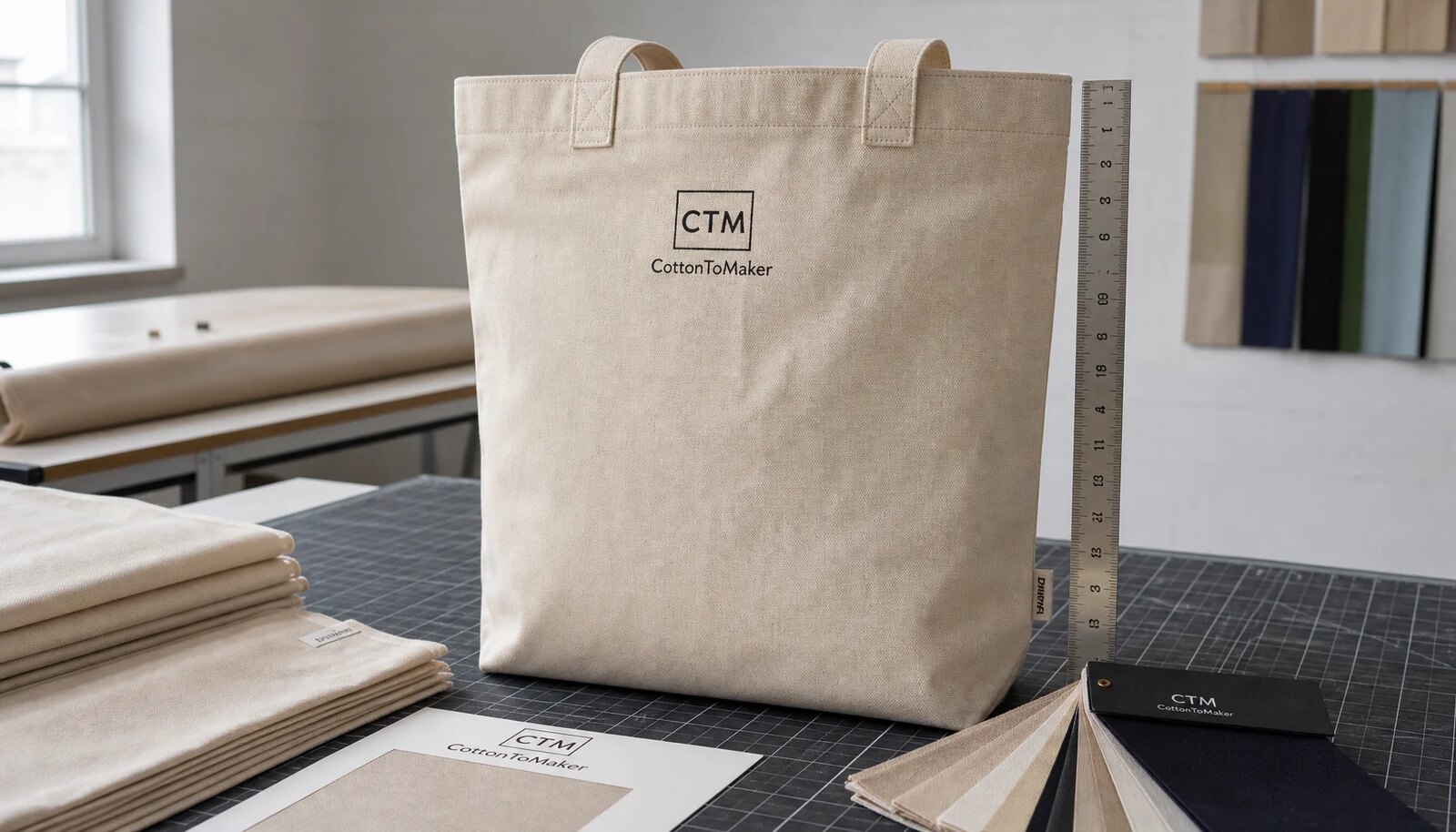
For most farmers market tote programs, the practical starting point is an upper-center front logo. On a common 14 x 16 in. tote, many buyers begin around 60-80 mm below the finished top hem. That number is a starting point, not a universal rule. The approved position should reflect the final bag construction, handle attachment, logo shape, and packing fold.
The strongest RFQ treats placement as a product specification. Include a finished bag diagram, logo dimensions, measurement points, no-print zones, print method, ink reference, and inspection tolerance. Marketing gets brand control. Procurement gets comparable quotes. Quality teams get a measurable standard when the cartons arrive.
- Define whether the tote is packaging, merchandise, sponsor inventory, CSA use, staff use, or event distribution.
- Put logo placement in the RFQ before suppliers quote, not after a price has been selected.
- Measure placement from the finished top hem and finished side edges.
- Approve placement on a physical sample for custom, retail-facing, or brand-sensitive orders.
- Keep the approved sample for reorder comparison and incoming QC.
Match construction to farmers market use
A farmers market tote has to work in a busy, physical setting. Shoppers carry jars, fruit, greens, flowers, coffee bags, bread, sauces, soaps, and boxed items. Vendors may hang bags from a booth rail, stack them on a table, bundle them behind the counter, or ship them to several market locations. The tote construction should be chosen before final artwork placement because size, gusset, handle style, and fabric weight all affect the visible print area.
A 14 x 16 in. or 15 x 16 in. body is a useful starting size for many programs. It is large enough for common purchases but still easy to fold, carton, and distribute. A 3-4 in. bottom gusset improves capacity for bulky goods, but it also changes the front panel once the bag is filled. The lower panel may curve outward, and a logo placed too low can distort, crease, or disappear behind the contents.
Handle length deserves more attention than it often gets. Shoulder handles in the 24-28 in. range usually suit reusable shopping because customers can carry the tote while walking the market. They also let the front panel hang naturally, which helps logo visibility. Short handles may be fine for light packaging, but they change how the bag sits when displayed or photographed. Handle width matters too: 1-1.5 in. handles usually feel more substantial than narrow straps when the bag carries heavier goods.
The buyer should also decide whether the tote needs to fold very flat, stand with some structure, or look polished enough for retail resale. A lighter flat tote may be right for economical distribution. A heavier gusseted tote may be better for paid merchandise. Those choices influence material cost, sewing time, print pressure, carton count, and freight weight.
- Use flat totes for simple giveaways, light packaging, or compact market distribution.
- Use bottom gussets when the bag must carry bulky goods such as jars, boxed foods, produce, bouquets, or coffee bags.
- Choose shoulder handles when customers will carry the bag for more than a few minutes.
- Mark handle attachment and bartack zones as no-print areas.
- Confirm whether one base tote must support multiple vendor logos.
Specify organic cotton in measurable terms
Procurement language around organic cotton needs to be exact. The phrase organic cotton tote can mean different things in supplier quotes: certified organic cotton fiber, organic cotton in conversion, a finished product supported by chain-of-custody documentation, or a claim with limited backup. Buyers should state what documentation is required with the shipment, especially when the tote supports sustainability messaging, retail labeling, or internal sourcing policy.
Fabric weight should be written in oz/sq yd or GSM. The quote should also state whether that weight refers to greige fabric, finished fabric, or washed fabric. The number alone is not enough. Weave, yarn, finishing, shrinkage, sewing quality, and reinforcement all shape the final product. A 6 oz canvas from one source may not feel or print like a 6 oz canvas from another.
For many reusable market programs, 6 oz to 7 oz organic cotton canvas or twill gives a workable balance of cost, handfeel, durability, print clarity, and shipping weight. A 5 oz tote can suit light promotional use or low-cost packaging, but it may feel less substantial if the vendor plans to sell it. An 8 oz tote creates a sturdier retail-grade impression, though it increases material cost, carton weight, and sometimes lead time. Heavier fabric also needs careful printing because texture and seam bulk can affect ink laydown.
Natural shade is another real variable. Undyed organic cotton can range from warm cream to light beige depending on fiber lot and finishing. That variation may be acceptable, but it changes how ink reads. Dark green, brown, black, navy, and red inks can all look warmer or softer on natural cotton than on a white digital proof. The approved strike-off should be the color standard, not a screen image.
- State the exact organic cotton documentation required with the shipment.
- Specify fabric weight in oz/sq yd or GSM and ask how it is measured.
- Define weave, color, shade tolerance, shrinkage expectation, and approved reference sample.
- Avoid vague RFQ terms such as eco canvas, premium cotton, thick tote, or natural bag without measurable specs.
- For reorders, compare shade, handfeel, and print behavior against the retained sample.
Build a logo placement zone that survives real handling
The safest placement for many vendor logos is front upper-center because it remains visible in several real situations: hanging at a booth, stacked on a table, carried on the shoulder, photographed for ecommerce, or packed for retail display. On a 14 x 16 in. tote, a top margin of 60-80 mm below the finished top hem is often a sensible first proof. Final approval should still happen on the finished construction.
Logo width should follow the artwork and the sales role. For simple farm names, bakery wordmarks, coffee roaster logos, market association marks, or sponsor logos, 80-150 mm wide is usually readable without dominating the tote. A 150-200 mm print can work when the bag itself is merchandise or when the artwork is bold and simple. Larger prints, however, increase ink coverage, drying needs, folding risk, and cost.
Artwork shape matters. A horizontal wordmark may sit well in the upper third. A circular farm seal may need more height and often contains curved small type that can fill in. A stacked logo with a tagline may need a simplified tote version. Social handles, web addresses, crop lists, and fine slogans should be tested carefully because woven cotton does not hold tiny details the way paper or labels do.
For a multi-vendor program, standardizing the placement zone keeps production simpler. The supplier can use a consistent jig or proof template even when artwork changes. Still, do not force every logo into the same size box without review. A tall logo may need a smaller width to stay clear of the handles. A wide logo may need reduced size to avoid side seam crowding.
- Start with upper-center front placement and confirm it on the physical tote.
- Keep key artwork at least 20 mm from top hem bulk, bartacks, side seams, gusset folds, and planned fold lines.
- Use 80-150 mm logo width for most simple vendor logos.
- Reserve 150-200 mm prints for bold merchandise designs or sponsor-led bags.
- Measure top margin from the finished top hem, not from a digital artboard.
Prepare artwork suppliers can print cleanly
A logo file is not a production package. Suppliers need vector artwork, final dimensions, placement references, ink instructions, and limits on where the print may sit. Send AI, EPS, PDF, or SVG files when available, with fonts outlined. Include final logo width and height. If there is a one-color version of the brand mark, supply that file instead of asking the factory to interpret a full-color logo.
The placement proof should show the finished bag width and height, top margin, horizontal centerline, logo dimensions, no-print zones, and measurement method. If the tote has a bottom gusset, clarify whether measurements are taken on the flat front panel. If bags will be folded for retail packing, show the fold line so the print does not sit directly on a hard crease unless that has been approved.
Color instructions should be practical. Pantone references help everyone speak the same language, but ink on natural organic cotton will not match coated paper exactly. The cotton base can warm, mute, or dull a color. Fabric texture can soften edges. If brand color matters, approve a physical strike-off under consistent lighting. If the buyer prefers a softer natural look, water-based ink may be suitable, but opacity still needs review.
The artwork itself may need adjustment for cotton. Thin rules, small serif type, reversed lettering, dense badge text, distressed textures, gradients, and tiny icons are all risk areas. Ask the supplier to flag line weight and type size concerns before screens are made. For market totes, one strong mark usually reads better than a crowded illustration.
- Send vector artwork with fonts outlined and final production dimensions included.
- Attach a measured placement proof, not only a mockup.
- Identify no-print areas around hems, handles, bartacks, seams, gussets, and fold lines.
- Ask the supplier to review small type, thin lines, reversed text, gradients, and distressed effects before setup.
- Use revision-controlled artwork names for multi-vendor, sponsor, or seasonal programs.
Choose print methods for repeatable bulk results
One-color screen printing is usually the most practical decoration method for organic cotton totes for farmers market vendors. It works well for bold logos, holds up as a repeatable process, and is typically cost-efficient for medium and larger B2B runs. Water-based or soft-hand ink is often chosen for cotton because it feels less heavy than a thick plastisol-style print, but the buyer should still approve opacity, edge quality, and handfeel on the actual fabric.
Two-color screen printing can be worthwhile when the brand mark truly depends on it. It adds setup cost and registration control, though. On textured organic cotton, small registration errors can show around outlines, icons, or fine type. If the second color is only a small accent, ask whether the tote artwork can be simplified to one color. Many farmers market brands look cleaner on natural cotton as a single dark ink.
Other methods may be useful, but they change the sourcing logic. Heat transfer can reproduce detail but may create a different handfeel and durability profile. Direct-to-garment printing can suit very low quantities or complex artwork, but it may not be the best route for a seasonal reorder program. Embroidery can look premium for small marks, yet large filled embroidery is costly and can distort lighter fabrics. Woven labels and patches can support retail styling, but they are less visible from booth distance than a front-panel print.
Buyers should also ask whether the supplier prints panels before sewing or prints finished bags. Panel printing may support cleaner alignment on some custom constructions. Finished-bag printing may be more practical for stock blanks. Both approaches can work, but the supplier must explain how placement, seam clearance, ink consistency, and bulk handling will be controlled.
- Use 1-color screen print for most simple vendor logos and repeat orders.
- Use 2-color screen print only when the brand value justifies registration checks and added setup.
- Consider embroidery for small premium marks, not large front-panel artwork.
- Use woven labels or patches when retail styling matters more than booth-distance visibility.
- Require print method, ink type, number of colors, print size, print location, and setup charges in the quote.
Write an RFQ that exposes the real unit cost
A useful supplier quote needs more than a unit price. It should identify tote construction, fabric, organic cotton documentation, print method, artwork assumptions, sampling route, packing, carton details, and lead time. If those details are missing, the lowest quote may simply be based on lighter fabric, smaller print area, stock blank dimensions, bulk packing, no sample, or weaker documentation.
Separate the cost layers. The tote body includes fabric, cutting, sewing, trimming, and basic packing. Logo application includes screens, ink, print labor, color changes, registration time, and expected print waste. Sampling may include digital proofs, strike-offs, pre-production samples, courier fees, and revision charges. Packing may include inner bundles, individual bags, hangtags, barcode labels, inserts, master cartons, or special folding. Freight comparison requires carton dimensions and gross weight.
MOQ should be written carefully. A supplier may offer a low MOQ for stock blanks with one logo in one print color. A custom cut-and-sew organic cotton tote may require a higher MOQ because fabric procurement, cutting, sewing, and finishing are planned as a production lot. Multi-vendor programs add complexity because each artwork version may carry its own setup charge or minimum quantity even when the base tote is shared.
Lead time should be linked to approval milestones. Ask for timing after artwork approval, after strike-off approval, and after pre-production sample approval. Farmers market programs are often seasonal, so buyers should allow time for sample corrections, inspection, inland movement, export handling, and final distribution to vendors. Bulk printing should begin only after written sample approval.
- Request line-item pricing for tote body, logo printing, setup, sampling, packing, labels, cartons, and inland freight where applicable.
- Confirm whether pricing is based on stock blanks or custom cut-and-sew production.
- Ask for MOQ by artwork, bag color, fabric weight, tote size, print color count, print location, and packing method.
- Request pieces per carton, carton dimensions, net weight, gross weight, and shipping marks before comparing landed cost.
- Tie production lead time to written sample approval, not just purchase order date.
Use samples to remove guesswork before bulk production
Sampling is where vague sourcing language becomes visible. A digital placement proof can confirm logo position, spelling, and basic proportions, but it cannot prove fabric handfeel, ink opacity, seam clearance, handle strength, fold behavior, or shade. For a simple stock tote with a one-color logo, a physical strike-off on the selected fabric may be enough. For custom construction, gussets, heavier fabric, retail packing, multi-color logos, or strict brand work, request a finished pre-production sample.
Review the sample with a ruler and the spec sheet nearby. Measure logo top margin, logo width and height, left-right centering, body dimensions, gusset width, handle length, handle drop, handle width, and hem straightness. Inspect fabric shade, print opacity, edge clarity, ink handfeel, stitching, thread trimming, fold method, and packing. Written approval should state exactly what is approved, not simply that the sample looks good.
Decide in advance what changes require another physical sample. Moving a logo a few millimeters may only require an updated proof if it stays clear of seams and fold lines. Changing fabric weight, ink color, print size, print method, handle construction, gusset shape, or retail packing usually deserves a new physical approval. When the tote will be sold, approve hangtag placement, barcode readability, fold direction, and how the logo faces in the package.
Reorders need sample discipline too. Send the approved standard or clear reference photos, confirm that the same fabric and ink will be used, and ask the supplier to disclose any changes. Many reorder issues come from small substitutions: a slightly warmer fabric, shorter handle, softer ink, changed fold, or different carton pack can make the new lot look inconsistent beside the previous one.
- Approve a physical strike-off on the actual fabric for brand-sensitive logos.
- Request a finished pre-production sample for custom construction, gussets, retail packing, or multi-color artwork.
- Measure the sample against the spec sheet and record approval notes in writing.
- Keep one approved production sample for inspection, reorder comparison, and dispute handling.
- Do not release bulk production until artwork, sample, packing, and QC standards are documented.
Inspect the tote and logo as one finished product
Quality control should not separate the bag from the print. A centered logo will not save a tote with weak handles, stains, skipped stitches, or inconsistent sizing. A well-sewn tote can still fail commercially if the logo drifts, bleeds, fills in, or creases through the fold. The inspection plan should cover material identity, fabric quality, construction, decoration, packing, count, and labels.
For logo placement, write a measurable tolerance into the approved standard. For many standard screen-printed totes, +/-5 mm from the approved top margin and horizontal centerline is a practical target. The final tolerance should match the supplier's process and the bag construction. Inspectors should measure sampled units from the finished top hem and side edges. Visible tilt, drift, or printing into seam bulk should be classified according to the agreed defect rules.
Print checks should cover opacity, edge definition, ink bleeding, pinholing, lint contamination, color smears, filled-in small type, ink starvation, banding, and registration for multi-color artwork. Some texture interaction is normal on natural cotton, but the logo must remain legible at normal viewing distance. If the tote may be exposed to damp conditions at outdoor markets, buyers can specify dry rub, wet rub, crocking, or wash checks suitable for the intended channel.
Construction checks should focus on the points that fail in real use. Handles need secure bartacks or X-stitches, consistent width, clean stitching, and practical pull resistance. Side seams and bottom seams should be secure, with no skipped stitches or raw edges that affect durability. Fabric should be free from major stains, oil marks, holes, severe slubs, and shade variation beyond the approved standard. Packing inspection should confirm quantity, SKU separation, fold direction, barcode accuracy, shipping marks, and carton condition.
- Measure logo position on sampled bulk units rather than relying on factory photos.
- Classify logo drift, tilt, bleeding, ink contamination, unreadable small type, and poor registration before inspection begins.
- Check handle stitching and seam quality because market shoppers may carry heavy produce, jars, or boxed goods.
- Inspect fabric cleanliness, shade, and handfeel against the approved sample.
- Confirm carton counts, labels, barcode data, SKU separation, fold direction, and shipping marks before shipment release.
Plan packing and distribution early
Packing decisions affect cost, warehouse handling, and how the tote looks when it reaches the vendor. Bulk bundle packing is efficient for distributors, farmers market offices, and vendors who will hand out bags locally. Retail-ready packing may require a specific fold, individual bagging, hangtag, barcode label, insert, or outer carton marking. Those details may be necessary, but they add labor, materials, carton volume, and sometimes plastic use.
Fold direction should be reviewed with the logo placement. A large or heavy front print can crease if the tote is folded directly through the ink. If the tote is sold at retail, the logo may need to face outward in the package or align with a hangtag. Barcode labels should not cover the logo, sit on bulky seam areas, or leave residue on a visible surface. If several vendor logos ship together, carton-level separation prevents receiving mistakes.
Carton planning belongs in the RFQ stage. A 5 oz flat tote may pack at a much higher piece count than an 8 oz gusseted tote with hangtags. Individual packing can reduce carton efficiency further. Ask for pieces per inner bundle, pieces per master carton, carton dimensions, net weight, gross weight, shipping marks, and whether cartons contain mixed or single artwork versions. These figures help procurement compare landed cost and storage needs.
For multi-location shipments, packing instructions should be part of the purchase order. If cartons need to be sorted by vendor, market date, region, store, or sponsor, define the marks before packing begins. Rework after final packing is expensive and can wrinkle bags, damage hangtags, or mark printed surfaces.
- Use bulk bundles for local distribution or buyer-side repacking.
- Use retail packing only when the channel needs visible presentation, barcode control, or individual protection.
- Approve fold direction when the logo is large, high on the panel, or printed with heavier ink.
- Keep hangtags, stickers, and barcode labels clear of logos, seams, and stress points.
- Request carton dimensions and gross weight before final freight and storage planning.
Specification comparison for buyers
| Sourcing decision | Recommended specification | Why it matters for farmers market vendors | Quote or QC risk to control |
|---|---|---|---|
| Logo position | Front upper-center, often 60-80 mm below the finished top hem on a 14 x 16 in. tote, adjusted after reviewing the physical sample | Keeps the vendor logo visible when the tote hangs from a booth rack, sits on a table, is carried on the shoulder, or is photographed for online sales | A logo placed too close to the top hem, bartacks, seams, or fold line can print unevenly, look tilted, or crease during packing |
| Logo size | 80-150 mm wide for most simple vendor marks; 150-200 mm only for bold artwork, retail merchandise, or sponsor bags | Gives readable brand visibility without turning a reusable market tote into an oversized advertisement | Fine type, badge copy, thin rules, and reversed lettering may fill in on textured cotton; require a strike-off at final size |
| Placement tolerance | Set a written bulk tolerance such as +/-5 mm from approved top margin and horizontal centerline for standard screen-printed totes | Allows receiving teams and third-party inspectors to judge logo drift consistently instead of relying on subjective photos | Without a tolerance, the supplier may treat visibly inconsistent placement as normal production variation |
| Fabric weight | 6 oz to 7 oz organic cotton canvas or twill for most reusable market programs; 8 oz for sturdier retail-grade totes | Balances handfeel, durability, print clarity, carton weight, and cost for produce, bread, jars, flowers, coffee, and small retail goods | Quotes are not comparable if one supplier prices a 5 oz stock blank and another prices a custom 7 oz cut-and-sew tote |
| Fabric measurement | Specify oz/sq yd or GSM, weave, fabric color, shrinkage expectation, and shade tolerance against an approved sample | Organic cotton texture and natural shade affect ink appearance, perceived value, and repeat-order consistency | Vague terms such as heavy cotton or natural canvas create substitution risk and shade mismatch across lots |
| Bag size and gusset | 14 x 16 in. or 15 x 16 in. body; optional 3-4 in. bottom gusset for bulky market goods | Fits common purchases such as produce, bread, jars, bouquets, coffee bags, soap, candles, and pantry items | A gusset changes the front panel curve when filled, so a low logo can disappear, distort, or crease |
| Handle construction | 24-28 in. shoulder handles, 1-1.5 in. wide, reinforced with bartack or X-stitching | Improves carrying comfort, supports heavier market loads, and keeps the front panel visible in use | Weak handle stitching creates more serious complaints than small cosmetic variation; include handle checks in QC |
| Print method | 1-color screen print with water-based or soft-hand ink for most simple farmers market logos | Cost-effective and repeatable for medium and larger B2B runs, especially seasonal reorders | Light ink on natural cotton may need opacity adjustment; multi-color artwork adds registration checks, setup cost, and approval time |
| Artwork package | Vector file plus dimensioned placement proof showing finished bag size, logo width, top margin, centerline, no-print zones, and approved tolerance | Reduces factory interpretation and helps procurement compare supplier quotes on equal assumptions | A logo file alone does not define placement, print size, seam clearance, fold clearance, or acceptable bulk variation |
Buyer checklist before sampling
- Define the tote role: vendor packaging, reusable shopper, paid merchandise, farmers market sponsor giveaway, staff bag, CSA pickup bag, or event kit item.
- State whether the tote is a stock blank with logo printing or a custom cut-and-sew production, because MOQ, pricing, tolerance, and lead time differ.
- Specify finished body width, body height, gusset type and width, handle length, handle drop, handle width, seam style, and reinforcement method.
- Define organic cotton fabric by weight in oz/sq yd or GSM, weave, color, certification documentation needed, shrinkage expectation, and approved shade reference.
- Provide vector artwork with fonts outlined, final logo width and height, Pantone or ink reference, minimum line weight concerns, and any simplified one-color version.
- Attach a dimensioned placement diagram showing top margin, horizontal centerline, no-print zones, and whether placement is measured from the top hem or finished bag edge.
- Set logo placement tolerance, print registration tolerance for multi-color logos, and acceptable variation for finished dimensions before production starts.
- Ask whether the supplier will print panels before sewing or print finished bags; confirm how the method affects placement accuracy and seam clearance.
- Require a digital placement proof plus a physical strike-off on the actual fabric; request a finished pre-production sample for custom bags, gussets, retail packing, or strict brand work.
- Confirm MOQ per artwork, print color count, print location, bag color, fabric weight, tote size, and packing configuration.
Factory quote questions to send
- Is the quoted tote made from certified organic cotton, organic cotton in conversion, or conventional cotton, and what documentation can be supplied with shipment?
- What fabric weight are you quoting in oz/sq yd or GSM, and is that weight measured before washing, after finishing, or as finished fabric?
- Are you quoting a stock blank tote or a custom cut-and-sew tote, and what finished dimension tolerance applies to each option?
- What are the finished body dimensions, gusset width, handle length, handle drop, handle width, seam style, and reinforcement method included in the price?
- Will the logo be printed before sewing or on finished bags, and how will you control alignment on the final tote?
- What is the usable print area after allowing for top hem thickness, handle bartacks, side seams, bottom fold, gusset expansion, and packing fold lines?
- Where exactly will the logo sit in millimeters from the top hem and side edges, and what bulk placement tolerance will you accept in writing?
- Which print method, ink type, number of colors, print size, and print locations are included in the unit price?
- What are the setup, screen, color-change, artwork adjustment, strike-off, pre-production sample, and courier charges?
- Can you hold small text, thin lines, reversed copy, or badge details on the selected organic cotton fabric at the requested final size?
Quality-control points to confirm
- Certification and material identity: verify that the organic cotton documentation matches the order requirement, supplier name, fabric lot, and product description; do not rely on a hangtag claim alone.
- Fabric weight and weave: check oz/sq yd or GSM against the approved spec, compare several fabric areas, and record thin spots, severe slubs, contamination, weaving defects, or shade difference from the approved sample.
- Finished measurements: measure body width, body height, gusset width, handle length, handle drop, and handle width; confirm deviations remain within agreed tolerance and do not affect packing or use.
- Logo placement: measure top margin and left-right centering on sampled units; for standard totes, a written tolerance such as +/-5 mm is commonly practical, but the approved production standard should control.
- No-print clearance: confirm the logo is not printed into top hem bulk, handle bartacks, side seams, bottom folds, gusset folds, or planned packing creases unless the approved sample shows that placement clearly.
- Print opacity and edge quality: inspect for pinholing, bleeding, banding, ink starvation, filled-in type, blurred edges, lint contamination, color smears, and uneven pressure across seams or wrinkles.
- Print color and handfeel: compare bulk output against the approved strike-off under consistent lighting; check whether ink is too stiff, too transparent, or materially different from the approved sample.
- Registration for multi-color logos: verify that outlines, icons, and type are aligned within the agreed tolerance and do not create visible shadows, doubled edges, or broken brand marks.
- Rub and crocking check: perform a dry rub test and, when the intended channel requires it, request wet rub, wash, or colorfastness testing appropriate to reusable cotton bags.
- Handle strength and stitching: inspect bartacks or X-stitches, stitch density, thread trimming, skipped stitches, loose threads, seam allowance, and practical pull resistance at handle stress points.