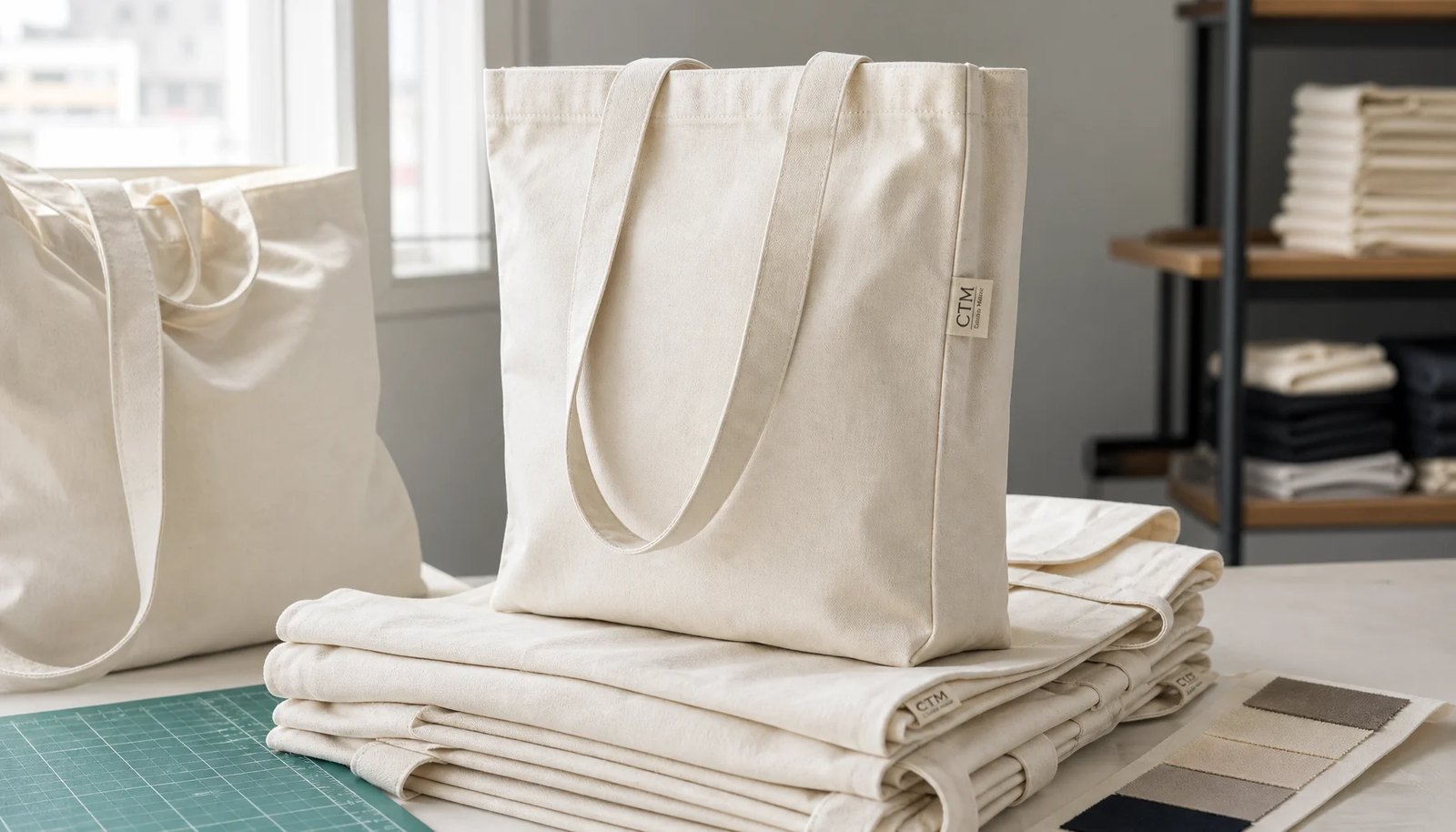
Start with the selling job, not the bag
For craft fairs, an organic cotton tote is not just a carrier. It can be a resale item, a checkout bag, a gift-with-purchase, or a branded add-on that carries the rest of the booth experience home. Those are different jobs, and they call for different specs. A tote that is fine for handing out receipts or small samples may look underbuilt if it is sold next to handmade candles, ceramics, textiles, or printed art. If the bag is part of the retail assortment, it has to justify its own price and still feel useful after the fair ends.
That is why the RFQ should start with the use case and the merchandise it needs to carry. A flat tote that works for zines or postcards may be too shallow for boxed soap or a mug set. A deeper gusset makes sense when the tote has to sit upright on a booth table and hold irregular shapes, but it is not always worth the added cost for a light giveaway. Buyers get better quotes when they describe the commercial role in plain terms: how the bag will be sold, what will go inside it, and what impression it needs to make when a customer picks it up off the table.
- State whether the tote is a resale item, checkout bag, gift-with-purchase, or giveaway.
- List the actual merchandise shapes it must handle, such as boxes, bottles, books, or textiles.
- Write the requirement in commercial terms, not just as a marketing brief.
Choose fabric weight and weave for shelf appeal
Fabric weight sets the first impression. In this category, 140-160 gsm is usually the lightest practical range and works when the tote is a low-cost add-on or event handout. It can still function, but it often reads soft, translucent, and less durable in unbleached natural cotton. For most retail-ready craft fair totes, 180-240 gsm is the safer procurement range because it gives the bag more body, better opacity, and a more stable print surface. Above 280 gsm, the tote starts to feel premium and heavy-duty, but sewing becomes harder, freight weight increases, and the unit cost rises quickly.
Weave matters almost as much as GSM. A tightly woven plain weave can work for a simple, price-sensitive line, but a twill or canvas-style weave usually creates a better retail presentation because it holds shape, hides minor wrinkles, and improves print legibility. Buyers should ask for the nominal GSM, the weave construction, and the acceptable lot tolerance. If the supplier can only say organic cotton without naming the fabric build, the quote is not yet procurement-ready. The difference between a bag that stands neatly on a booth table and one that collapses into a soft pile is usually the fabric construction, not the logo.
- Use 140-160 gsm only when low cost matters more than shape and opacity.
- Use 180-240 gsm for most retail-ready craft fair totes.
- Use 280+ gsm only when the bag must feel premium and carry heavier goods.
- Ask for the bulk-lot GSM tolerance and the weave type, not just the target number.
Match size, gusset, and handles to craft-fair purchases
Craft fairs are messy from a tote-design point of view. Customers buy objects that are flat, boxed, soft, tall, fragile, or awkwardly shaped, and the bag has to work across that spread. That is why width, height, and gusset should be treated as a set. If the tote is too narrow, it will crush wrapped goods and make the customer feel rushed at checkout. If the gusset is too shallow, the bag will sag and read as a promotional item instead of a retail bag. A common middle ground is a 4-6 inch gusset, which usually gives enough volume for mixed merchandise without making the tote bulky on the shelf.
Handles should be designed for actual use, not just appearance. Self-fabric handles are a good fit for organic cotton because they keep the look consistent and feel coherent in a natural product line. The important details are handle width, handle drop, finished length, and reinforcement at the mouth. For a craft fair, the tote should be comfortable to carry by hand and still work over the shoulder for a customer leaving the booth with several items. If the bag twists, digs in, or feels unstable when partially loaded, the problem is often the handle geometry or the stress stitching rather than the body fabric.
- Specify finished width, height, and gusset together.
- Set the handle drop for the way the bag will actually be carried at the fair.
- Use a 4-6 inch gusset when the tote needs to hold mixed merchandise and stand up on display.
- Reinforce handle anchors with box stitching or bar tacks.
Let decoration support resale price and booth identity
Decoration is not an afterthought in a craft fair assortment. The tote may sit beside handmade goods that were priced carefully for margin and perceived value, so the decoration needs to feel intentional rather than generic. Simple screen print is usually the most practical option because it gives clean branding, holds up well in use, and keeps costs under control. Water-based ink is often the right visual fit for organic cotton, but the artwork should be simplified before sampling. Fine lines, tiny type, and detailed gradients can disappear into the fabric texture or lose registration on production run printing.
If the tote itself is being sold as a product, not just used as packaging, the decoration has to carry more weight. A woven label, sewn patch, or limited embroidery can create a more premium retail feel than a complicated multi-color print on textured cotton. That said, those methods add cost and can affect lead time and MOQ. The right way to compare them is to quote the same bag spec in multiple decoration routes, then judge the result on the actual bulk fabric. Buyers should think about how the bag will look from 1-2 meters away on a booth table, because that is the distance at which customers usually decide whether to pick it up.
- Keep the first order to one or two print colors unless the artwork truly needs more.
- Simplify logos and event graphics before sampling.
- Compare print, woven label, patch, and embroidery on the same bag spec if the tote is a resale item.
- Treat legibility from booth distance as part of the design requirement.
Ask for traceability, not just an organic claim
For procurement, 'organic cotton' is only useful when the claim is backed by the right document route. The supplier should say whether the cotton is organic at fiber, yarn, or fabric stage, and what proof can be supplied for the exact order. If the product needs certified chain-of-custody, ask for the applicable documents, such as GOTS scope certificates and transaction certificates where relevant, or the OCS documentation route if that is what the supply chain uses. If the buyer only needs a non-certified material statement, a supplier declaration may be acceptable, but it should be clear that this is not the same as certification.
This matters because craft fair buyers often start with a small order and reorder later when the tote starts moving. If the paperwork is vague on the first order, the same vagueness tends to reappear on the second. Ask who actually controls the fabric source, whether the factory buys yarn or finished fabric, and whether any dyeing or finishing is done in-house or by a subcontractor. The more specific the document trail is at the quote stage, the less likely it is that a later shipment quietly changes source, finish, or certification status while keeping the same product name.
- Ask whether the organic claim is at fiber, yarn, or fabric level.
- Request the exact document route the supplier can support for the shipment.
- Use GOTS or OCS scope certificates and transaction certificates where applicable, or a supplier declaration only when that meets your policy.
- Confirm whether the factory or a trading layer controls the fabric decision.
Build the quote around MOQ, split versions, and landed cost
MOQ is rarely a single number. It usually changes with fabric booking, color, decoration setup, and packaging. That is why a procurement buyer should ask for the MOQ by color, by artwork version, and by label version instead of accepting one headline figure. A stock natural tote with a simple one-color print can often be quoted with a lower MOQ and shorter lead time than a custom-weight fabric with multiple print locations or a sewn label. If the supplier cannot separate those variables, the quote is too coarse to compare.
For craft fairs, the most useful economic question is not only unit price but replenishment flexibility. Seasonal selling means a bag may need a top-up after one good weekend, and the supplier's ability to repeat the same construction matters more than shaving a few cents off the first order. Ask whether the same fabric lot can be held, whether a reorder can be produced from the same spec without a full re-development cycle, and what happens if you need to split a color order across several fair dates. Landed cost should include cartons, inner packing, freight, inspection, and any repacking labor needed after arrival.
- Ask for MOQ by color, print version, and label version.
- Separate stock-fabric pricing from newly produced fabric pricing.
- Check whether split colors or split artwork versions change the unit price.
- Include freight, cartons, inspection, and repacking in the landed-cost view.
Make the sample prove the production path
A sample only reduces risk if it mirrors the real order. Sales samples are often made from hand-picked fabric or by a sample room that does not follow the same steps as bulk production. For this product, the right approval sample is a pre-production sample built from the actual bulk fabric, thread, label, print method, and folding method. If the tote will be packed flat in cartons, the sample should be packed that way too. If the tote will include a woven side label or a specific print placement relative to the seam, those details need to appear in the sample exactly as they will appear in production.
Approval should be tied to measurable points, not vague approval language. Check width, height, gusset, handle symmetry, seam alignment, label placement, and print position. If the tote is meant to sell in a retail setting, the sample should also be judged for shelf behavior: does it stand up, does it collapse neatly, and does the opening look intentional rather than distorted by the handles. Keep one signed sample with the buyer and one with the factory, and do not allow a change to fabric, label, or decoration method after signoff unless a revised sample is approved first.
- Approve the sample against the bulk spec sheet, not against a showroom sample.
- Keep one signed sample on the buyer side and one with the factory.
- Require a new sample if the factory changes fabric, thread, label, or print method.
- Check how the bag looks when folded, displayed, and partially loaded.
Set QC thresholds before production starts
QC works best when the acceptance criteria are written before cutting begins. Buyers should set numeric thresholds for the things that matter most: size, fabric weight, shrinkage, print placement, and load performance. A practical starting point is a size tolerance of +/- 1 cm or +/- 3 percent on width, height, and gusset; a GSM tolerance of +/- 5 percent; and post-wash shrinkage no greater than 3-5 percent unless the care instruction says otherwise. Print registration should be close enough that obvious drift is not visible at arm's length, and a sensible control target for simple logo work is within about 2 mm.
Functional testing matters as much as appearance. The tote should be loaded with realistic craft fair merchandise and held for at least 60 seconds without seam failure, handle pull, or obvious mouth distortion. A useful control target is 5-8 kg for retail-ready totes, depending on the intended use case. Check stitch density on the critical seams, especially the handle anchors and bottom corners, and make sure there are no skipped stitches, open seams, or loose thread ends that will become customer complaints. If the tote is sold as a premium item, the buyer should also define what cosmetic defects are acceptable across cartons, because natural cotton can vary without being sloppy.
- Set size tolerance, GSM tolerance, shrinkage allowance, and print shift limits in writing.
- Use a load test that reflects real craft fair merchandise, not just a generic pull test.
- Define acceptable shade variation and cosmetic defect limits before bulk production.
- Inspect handle anchors, bottom seams, and label placement as primary failure points.
Plan packing, carton labels, and replenishment
Packing affects both freight cost and how the tote reaches the booth. If the bags are going into wholesale inventory for later repacking, a flat-folded carton pack is usually the simplest and most efficient route. If the tote is being sold directly from the carton or needs to look polished when opened by store staff, an insert board or a more controlled fold may be worth the extra labor. The right packing spec depends on who opens the carton and what they need to see first. A craft fair seller often has limited storage, so carton count and box size matter almost as much as bag cost.
Small-batch replenishment is the real operational issue for many fair-based sellers. A tote that performs well at a spring market may need to be reordered quickly for summer and holiday events. Ask the supplier whether cartons can be mixed by color, whether reorders will match the same spec without a new setup charge, and how quickly a repeat run can be booked after approval. Carton labels should show SKU, color, count, and carton number so the receiving team can split inventory across fairs without opening every box. Overpacking with unnecessary polybags or oversized inserts usually adds cost without helping the buyer sell more bags.
- Confirm whether the tote ships flat, folded once, or with insert boards.
- Request carton count, carton dimensions, gross weight, and carton labeling in the quote.
- Use inner packing only when presentation or protection clearly requires it.
- Ask how quickly the factory can repeat the same spec for a seasonal reorder.
Specification comparison for buyers
| Spec decision | Recommended option | Price / MOQ / lead-time impact | When it fits | Buyer risk to check |
|---|---|---|---|---|
| Fabric weight | 140-160 gsm organic cotton | Lowest unit cost, usually lower MOQ, shortest lead time if stock fabric is available | Giveaways, low-price add-ons, or bags that do not need to stand upright on a table | Can read thin, show strike-through, and lose shape after the first wash |
| Fabric weight | 180-240 gsm organic cotton canvas or heavy twill | Mid-range cost, standard MOQ, standard lead time for most cut-and-sew programs | Retail-ready craft fair totes that need body, better print clarity, and repeat use | Too-light lots can vary in opacity and drape, especially in natural unbleached shades |
| Fabric weight | 280+ gsm heavy canvas | Highest unit cost, often higher MOQ, longer lead time, and higher freight weight | Premium resale totes or bags expected to carry heavier handmade goods | Can feel stiff, cost more to ship, and require stronger sewing to avoid bulky seams |
| Weave | Twill or tightly woven canvas-style plain weave | Usually a small premium over loose plain weave, with little MOQ penalty if the fabric is standard | When the tote must present cleanly on a booth table and support sharper print edges | Open weaves can look less refined and make small text harder to read |
| Handle construction | Self-fabric handles with box stitch or bar-tack reinforcement | Low to moderate cost impact; stronger reinforcement can add sewing time but not a large MOQ penalty | When the bag should keep a natural look and carry ceramics, candles, books, or mixed goods | Thin handles or weak anchoring fail first, even if the body fabric is heavy enough |
| Decoration method | 1-2 color screen print with water-based ink | Lowest decoration cost, fastest setup, and easiest reorders; complex art adds lead time | Booth names, simple logos, event marks, or resale designs on natural cotton | Fine detail, gradients, and tight registration can fail on textured fabric |
| Decoration method | Woven label, sewn patch, or limited embroidery | Higher unit cost and often higher MOQ or slower lead time due to setup | When the tote itself is sold as a retail item and the brand needs a cleaner premium finish | Can distort the opening, rub the user, or increase labor if placement is not controlled |
| Traceability route | GOTS or OCS proof where applicable, with scope certificates and transaction certificates or supplier declaration as appropriate | Documentation adds little cost but can affect supplier pool and lead time if papers are incomplete | When the buyer needs a file that survives internal review, customer questions, or retailer onboarding | A generic organic claim without the right document path is not enough for procurement control |
| Packing route | Flat-folded cartons with clear carton count and SKU labeling | Lowest packing cost and usually fastest for bulk shipping; adds less labor than retail-ready packing | Wholesale replenishment, pop-up storage, and most craft fair resale programs | Poor fold consistency, crushed corners, or unclear carton labels create receiving friction |
Buyer checklist before sampling
- Define the tote's job in the RFQ: resale item, checkout bag, giveaway, or gift-with-purchase, because the acceptable GSM, handle length, and decoration method change with the use case.
- Lock the fabric spec with a target GSM range, weave type, finish, and acceptable lot tolerance instead of using a generic organic cotton description.
- Specify finished width, height, gusset depth, handle drop, handle width, and stitch reinforcement so suppliers cannot quote different constructions as if they were equivalent.
- State whether the tote must stand upright on a booth table, hold boxed or irregular merchandise, or fit inside another gift set, because that changes the gusset and base requirements.
- Ask for the exact organic document route the supplier can support, such as GOTS scope certificates and transaction certificates or the equivalent OCS documentation path where applicable.
- Request a pre-production sample built from the actual bulk fabric, thread, label, print method, and folding method, not a showroom sample made from a different lot.
- Ask for separate pricing on color, print version, label version, and packing version so the quote shows the real cost drivers.
- Set measurable acceptance thresholds for size variation, GSM tolerance, shrinkage, print registration, stitch quality, and shade variation before placing the order.
- Confirm carton count, carton dimensions, gross weight, and whether the bags ship flat, folded, or with insert boards, because craft fair storage and replenishment are usually tight.
- Compare landed cost and replenishment speed, not just ex-factory price, if you expect to reorder during a selling season or split inventory across multiple fairs.
Factory quote questions to send
- What exact fabric construction, weave, and GSM are you quoting, and what tolerance do you allow on the bulk lot?
- Is the cotton organic at fiber, yarn, or fabric level, and which documents can you attach to the quote or later to the shipment file?
- Can you provide GOTS or OCS scope certificates, transaction certificates where applicable, or a supplier declaration if the order is not certified?
- Is the quoted price based on stock fabric or newly produced fabric, and how does that affect MOQ and lead time?
- What is the MOQ by color, by print version, by label version, and by carton pack size?
- Can MOQ be split across multiple booth colors or artwork versions without changing fabric or raising the unit price sharply?
- Which decoration method is included in the base price, and what changes if we move from one color to two colors or from print to embroidery?
- What are the handle width, handle drop, handle length, and reinforcement details at the mouth and bottom corners?
- How many stitch rows, bar tacks, or box stitches do you use at the stress points, and what thread type is used?
- Will the pre-production sample use the same bulk fabric, label, thread, ink, and folding method as the final order?
Quality-control points to confirm
- Measure width, height, gusset, and handle length against the approved spec sheet. A practical tolerance is +/- 1 cm or +/- 3 percent, whichever is greater, unless your brand requires tighter control.
- Check fabric GSM on the bulk lot. A reasonable acceptance band is +/- 5 percent from the target unless the buyer has a stricter retail requirement.
- Inspect handle anchoring at the mouth and bottom corners. Look for even reinforcement, no skipped stitches, and no frayed starts or stops.
- Verify stitch density on the critical seams. A typical control target is 3-4 stitches per cm on cotton tote construction, with clean backtacking or bar tacks at stress points.
- Test print registration and placement. For simple logo work, keep visible misalignment within about 2 mm and reject obvious ghosting, bleeding, or under-cured ink.
- If shrinkage matters, wash a sample and compare post-wash dimensions. A practical target is no more than 3-5 percent shrinkage in length or width, based on the approved care instruction.
- Load-test the bag with realistic merchandise weight. For craft fair resale totes, test at 5-8 kg for at least 60 seconds without seam opening, handle tear, or obvious distortion.
- Review shade consistency across cartons and between cartons. Some natural variation is normal in organic cotton, but the lot should stay within the approved visual range.
- Check folding, carton count, and carton labels at packing. The carton should match the SKU, color, and quantity on the packing list, and the bags should not arrive creased in a way that hurts shelf presentation.