Start With the Coffee Roaster Buying Job
A coffee roaster does not need a generic tote spec. It needs a bag that suits a specific job: retail merchandise next to whole-bean coffee, a tasting-room carry bag, an event giveaway, a subscription-box insert, a wholesale account gift, or a limited release tied to a seasonal roast. Each job changes the right fabric weight, handle length, print durability, packing format, inspection standard, and acceptable landed cost. If the RFQ says only "organic cotton tote with logo," suppliers will fill in the blanks in different ways. The quotes may look comparable, but they will not be quoting the same product.
Procurement should translate the marketing idea into measurable requirements before asking for prices. A sellable cafe tote should feel structured enough to justify its retail price, carry multiple coffee bags without handle distortion, and arrive packed cleanly. An event giveaway may put speed, lower MOQ, and simple one-color decoration first. A subscription insert may need to fold flat because bulky packing can increase dimensional freight. A wholesale customer gift may need a hangtag, barcode, cleaner folding, or custom carton marks.
Also state the expected order pattern, not only the first order quantity. A one-time promotional run can tolerate some compromise when the date is fixed. A repeat merchandise program needs stable construction that can be reordered without obvious drift in GSM, shade, handle length, or logo position. Ask whether the supplier can hold the same fabric construction and approved print standard for reorders, or whether every purchase will be treated as a fresh production lot.
- Define the use case before fabric weight, print method, or packing format.
- State whether the tote will be sold, gifted, bundled, shipped, or used as a cafe carry bag.
- Give the target retail price or landed cost ceiling if procurement has one.
- Tell suppliers what the tote must carry, such as two to four coffee bags, cups, apparel, sample packs, or event materials.
- Include the in-hands date, retail launch date, or wholesale delivery window that actually matters.
Write a Production-Ready Tote Specification
A strong RFQ for organic cotton totes reads like a production brief, not a casual price request. At minimum, include finished body width, finished body height, gusset depth, handle length, handle width, handle material, stitch reinforcement, fabric construction, target GSM, fabric color, print method, print size, print placement, labels, packing, carton marks, quantity by SKU, destination, Incoterm, required documents, and inspection expectations. Any missing field becomes a supplier assumption.
Use finished-goods dimensions, not approximate mockup dimensions. A flat tote behaves differently from a side-gusset tote, and both differ from a boxed-bottom tote that stands more easily in a retail display. Handle length should be measured along the handle curve from attachment point to attachment point. The RFQ should also say whether the handle is intended for hand carry or shoulder carry. For coffee retail, shoulder handles are often convenient, but a compact hand-carry bag may be better for a small tasting-room purchase bag.
Construction language matters. State whether handles are self-fabric, cotton webbing, or folded cotton tape. Specify box stitch, cross stitch, bartack, or reinforced stitch-down at the handle attachment. Identify seam type, top hem depth, and whether inside seams need binding or overlock finishing. These details are not minor. They affect sewing time, load performance, defect rates, and price.
- Use finished measurements and include a tolerance field beside each dimension.
- State body style: flat, side gusset, bottom gusset, boxed bottom, or reinforced mouth.
- Define handle length, width, material, spacing, and attachment reinforcement.
- Clarify seam finish, top hem depth, and whether loose threads must be trimmed.
- Attach a simple line drawing or annotated spec sheet when possible.
Choose GSM, Weave, and Finish by Use
Fabric weight is one of the largest cost and quality decisions in an organic cotton tote RFQ. For many coffee roaster retail totes, 180-220 GSM organic cotton canvas or twill is a practical starting range. It has enough body for paid merchandise while still controlling weight and cost. A 140-160 GSM tote can work for event giveaways, subscription inserts, or lightweight promotions, but it may wrinkle more easily and feel less substantial. Heavier fabrics can look premium, although they raise material cost, sewing difficulty, carton weight, and freight cost.
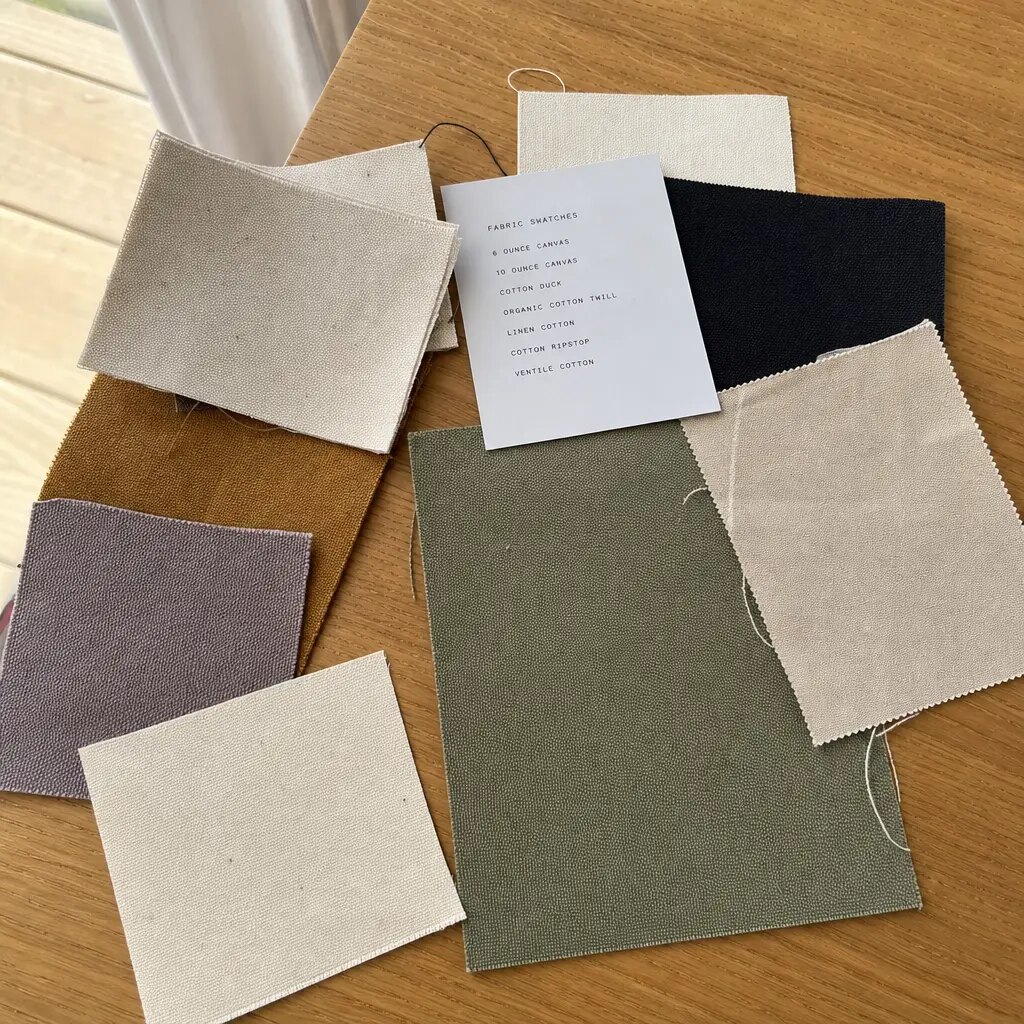
GSM alone is not a full fabric specification. Ask whether the material is canvas, twill, plain weave, or another construction. Canvas usually gives a sturdy casual feel. Twill has a diagonal texture and softer drape. Plain weave may be economical but less structured. If the supplier can provide yarn count or fabric construction, request it. Always ask for a swatch from the production-intended material, because two fabrics with the same GSM can feel noticeably different.
Finish affects measurement, shade, and print behavior. Natural unbleached cotton may show seed flecks, slubs, and slight shade variation, which can support a coffee brand's natural look. But procurement should define what is acceptable before inspection. Bleached white improves contrast for some logos but changes the appearance and processing route. Dyed or washed cotton may shrink or soften differently. Ask whether GSM is measured before or after finishing and whether bulk will use the same finishing process as the approved sample.
- Use 180-220 GSM organic cotton canvas or twill as a common retail tote starting point.
- Use 140-160 GSM when low cost, light packing, or event timing matters more than structure.
- Request swatches for each quoted GSM instead of choosing by number alone.
- Agree a GSM tolerance, commonly around +/-5 percent unless the supplier confirms otherwise.
- Define acceptable slubs, seed flecks, shade variation, wrinkles, and fabric specks for natural cotton.
Control Organic Cotton Claims and Documents
If the tote, hangtag, product page, invoice, or wholesale line sheet will make an organic cotton claim, documentation must be discussed before the PO is issued. A supplier saying "organic cotton" in an email is not the same as providing documents that support the buyer's claim. Depending on the program, the buyer may need a scope certificate, transaction certificate, material declaration, shipment records, or other documents tied to the standard being used. Requirements vary by market, certification scheme, and claim wording, so avoid vague sustainability language.
Ask whether the supplier is quoting GOTS, OCS, or another organic content standard, and whether the certification scope covers the relevant steps. Fiber, spinning, weaving, dyeing, printing, cutting, sewing, and trading may involve different facilities. If printing or sewing is subcontracted, ask whether those steps are included in the chain-of-custody requirements for the claim. The answer affects whether the finished tote can carry a certified organic claim or whether the buyer should use more limited wording.
Document control should connect directly to labeling and invoicing. The product label, hangtag, commercial invoice, packing list, and website copy should not make stronger claims than the document pack supports. If the buyer only needs internal sourcing evidence, the documents may be different from those needed for a consumer-facing claim. Put the required document list in the RFQ and require the supplier to confirm what they can provide before sample approval. It is much harder to fix claim language after goods are packed.
- Define the exact claim: organic cotton content, certified organic cotton, GOTS certified, OCS certified, or another approved wording.
- Request the supplier's relevant certificate scope and confirm which facilities and processes are covered.
- Ask whether transaction or shipment documents are available where applicable to the standard and order structure.
- Make label, hangtag, invoice, and website wording consistent with the document pack.
- Do not approve bulk production until document responsibility is clear.
Make Supplier Quotes Comparable
A useful RFQ template forces each supplier to quote against the same assumptions. Start with buyer details, project name, quote due date, target PO date, target sample date, target ship date, delivery destination, Incoterm, and payment expectations. Then provide the product specification and artwork package. Finally, require itemized pricing, sample timing, production timing, packing details, and a list of exclusions. This is not paperwork for its own sake. It prevents a cheap quote from winning because it quietly removed important requirements.
Include a quote-deviation section. Suppliers should state any change they made in order to quote the job, such as substituting 180 GSM for 220 GSM, using shorter handles, excluding the woven label, changing individual packing to bulk packing, or quoting a different print method. Deviations are not automatically a problem. A factory may suggest a smarter construction or more efficient packing format. They become a problem when they are hidden.
Commercial terms need the same discipline as product specs. Ask whether prices are EXW, FOB, CIF, DAP, DDP, or another Incoterm, and specify the named place. Request price validity and list factors that can change the quote, such as cotton cost, exchange rate, freight, artwork changes, or quantity changes. Ask for carton dimensions and gross weight with the quote. Landed cost cannot be judged from unit price alone.
- Send every supplier the same RFQ file, artwork, quantity table, and packing requirement.
- Require separate line items for bag, print, labels, hangtags, packing, samples, screens, inland freight, documents, and inspection support.
- Ask suppliers to list deviations and exclusions in writing.
- Request carton dimensions, gross weight, net weight, carton count, and pieces per carton before comparing landed cost.
- Compare quotes after normalizing Incoterm, MOQ, lead time, sample cost, and document support.
Understand MOQ and Cost Drivers
MOQ is rarely just a factory preference. It can be driven by fabric minimums, cutting efficiency, print setup, label production, dyeing minimums, sewing line allocation, packing labor, and export carton setup. A natural organic cotton tote with one-color front screen print may support a lower MOQ than a custom-dyed tote with two-sided print, woven label, barcode sticker, hangtag, individual folding, and multiple carton marks. The RFQ should ask which component sets the minimum.
Request price breaks at several quantities rather than asking for one unit price. Breaks at 500, 1,000, 3,000, 5,000, and 10,000 pieces help procurement see where the cost curve changes. A 500-piece pilot may be enough for a new retail design. A 3,000-piece quote may reveal the efficient repeat-order price. If the difference between tiers is large, the buyer may decide to consolidate artwork versions or increase the first order. If the difference is small, a smaller order may reduce inventory risk.
Separate recurring cost from one-time charges. Screen charges, artwork setup, sample fees, label setup, custom carton plates, and testing fees should be visible. Ask whether screens are retained for reorders, whether sample charges are credited against bulk, and whether label MOQs create leftover inventory. This makes first-order and reorder economics clearer, especially when the tote becomes part of a roaster's ongoing merchandise assortment.
- Ask what is driving MOQ: fabric, dyeing, printing, labels, packing, or production scheduling.
- Request price breaks instead of only one MOQ and one unit price.
- Separate setup charges from repeat unit pricing.
- Ask whether overruns or underruns are allowed and how they are billed.
- Reduce MOQ pressure by limiting tote colors, print versions, and label variations.
Match Print and Branding to Cotton Texture
Screen printing is often the most practical default for coffee roaster totes when the artwork is bold, colors are limited, and reorders are likely. It can give a clean, integrated look on natural cotton and keeps setup logic clear. Water-based inks may provide a softer hand feel, while other ink systems may improve opacity on darker fabrics. The RFQ should ask the supplier to recommend the ink system based on fabric color, artwork coverage, line detail, and expected use.
Not every artwork file belongs on textured cotton without adjustment. Small origin names, tasting notes, fine-line illustrations, distress effects, halftones, and low-contrast colors can break down on canvas or twill. Ask the supplier to state minimum printable line thickness and minimum text height for the chosen method. Print placement should be measured from fixed edges, such as the top hem and side seam, and the tolerance should be written into the spec. For many tote programs, a print placement tolerance around +/-3 mm to +/-5 mm is a practical target, but it must be confirmed with the supplier.
Branding can also be built with trims rather than large ink coverage. A woven side label, inside content label, sewn patch, or small exterior mark may feel more premium and reduce print risk. Hangtags can communicate care, fiber content, or the roaster's story, but they add material cost and hand labor. Barcode stickers and SKU labels may be essential for retail or wholesale even when they add no visual charm. Quote these items separately so the buyer can choose the right branding package.
- Use screen print for bold logos, limited colors, and repeatable merchandise programs.
- Request a strike-off for fine type, thin lines, halftones, large ink coverage, or critical brand colors.
- Define print size, placement from fixed edges, color reference, ink type, and placement tolerance.
- Quote woven labels, patches, hangtags, belly bands, and barcode stickers as separate components.
- Confirm whether print durability expectations include rubbing, folding, washing, or normal retail handling.
Approve Samples With Measurable Rules
Sample approval is the strongest control point before bulk production. Treat it as a measured approval, not just a visual decision. Measure the bag flat and record body width, height, gusset, handle length, handle spacing, handle width, and print position. Compare fabric hand feel and shade against the approved swatch. Inspect seams, handle reinforcement, label placement, and print clarity. Then load the sample with the kind of products the tote is expected to carry. An empty tote can look fine while a loaded tote twists, stretches, or distorts.
Use sample stages based on risk. A material swatch confirms fabric and shade. A proto sample confirms size and construction. A print strike-off confirms ink color, line detail, and edge clarity. A pre-production sample confirms the final combination of fabric, sewing, print, labels, and packing. For a simple reorder, fewer stages may be enough. For a new retail tote with claim-sensitive organic content, custom labels, or tight artwork, staged approval is usually worth the time.
Write sample decisions precisely. If a sample is approved except for moving the logo 2 cm lower, lengthening the handles by 3 cm, or changing label orientation, state the correction in writing and require supplier acknowledgement. If the sample uses available fabric but bulk will use a new fabric lot, note that shade and hand feel are not fully approved until the bulk swatch is confirmed. Keep one approved sample with the buyer and one sealed reference sample with the factory.
- Measure the sample and record actual dimensions beside the target spec.
- Check handle symmetry, stitch security, seam finish, print placement, label position, and folding result.
- Load-test the sample using the buyer's expected real-world coffee retail weight.
- Approve corrections in writing, with dimensions and placement changes stated clearly.
- Retain a signed or sealed approved sample for inspection and future reorders.
Set QC Standards Before Cutting
Quality control should be part of the RFQ, not a reaction after defects appear. Name the inspection standard, sampling plan, AQL if used, defect categories, measurement tolerances, print tolerances, and reinspection rules before the PO is issued. Many buyers use ANSI/ASQ Z1.4 or ISO 2859-1 sampling with buyer-defined AQL levels, such as 2.5 for major defects and 4.0 for minor defects, but the exact plan should match order risk and be agreed with the supplier. The key point is simple: both sides need to know the rejection threshold before cutting starts.
Define defects in practical terms. Major defects can include wrong artwork, wrong fabric, wrong GSM outside tolerance, incorrect label, open seams, broken handles, severe stains, obvious print misalignment, missing barcode, or incorrect SKU packing. Minor defects can include small loose threads, slight natural shade variation within approved range, small creases from folding, or tiny print imperfections not visible at normal viewing distance. Critical defects should include safety, contamination, mold, sharp foreign objects, or incorrect claim labeling that could create compliance risk.
Inspection should cover product and packing. For product, inspectors should measure random samples, check fabric against the approved swatch, inspect stitching, test handle attachment, review print quality, and verify labels. For packing, they should count pieces per bundle and carton, check carton marks, confirm barcode labels, measure cartons, record gross weight, and compare the packing list to the PO. Coffee roasters shipping to retail distribution centers may need stricter carton labels and routing compliance than roasters shipping to their own cafe warehouse.
- Agree AQL level, sampling plan, defect definitions, and measurement tolerances before production.
- Classify wrong artwork, open seams, weak handles, severe stains, wrong GSM, and incorrect labels as major defects.
- Classify safety issues, mold, sharp objects, severe contamination, and incorrect organic claim labeling as critical defects.
- Inspect cartons, labels, counts, and packing list accuracy, not only the tote body.
- Keep inspection photos, defect counts, and retained samples for rework or reorder decisions.
Define Packing, Cartons, and Routing
Packing affects cost, freight, receiving efficiency, and retail presentation. A flat-packed tote can reduce carton volume, but it must not crease the print in a visible way. Individual polybags protect presentation but add material, labor, and waste. No-polybag bundle packing may fit a roaster's sustainability preference, but the buyer should confirm moisture protection and cleanliness during transit. The RFQ should specify the fold method, inner pack quantity, pieces per carton, and any protective paper or liner needed.
Ask for carton data before final quote comparison. Carton dimensions, gross weight, net weight, and carton count affect ocean freight, air freight, parcel cost, warehouse handling, and palletization. If the goods ship to multiple cafes, a central warehouse, a 3PL, or a wholesale retail distribution center, carton marks may need destination codes, PO numbers, SKU names, barcodes, country of origin, or routing labels. These details should be priced and approved before shipment week, not negotiated while the goods are already packed.
Retail-ready packing should be a deliberate choice. A tote folded with hangtag, barcode sticker, and belly band requires more labor and more inspection than bulk bundle packing. It may be worth it when the bag goes directly to stores, but it may be unnecessary for staff giveaways or back-of-house cafe use. Quote retail packing as a separate line item so procurement can judge whether presentation value justifies the cost.
- Choose flat pack, folded pack, bulk bundle, individual polybag, or retail-ready pack before quoting.
- State inner pack count, export carton quantity, carton marks, barcode placement, and destination routing rules.
- Request carton dimensions, gross weight, net weight, and estimated carton count with the quote.
- Confirm packing protects natural cotton from dirt, moisture, and print transfer during transit.
- Price hangtags, belly bands, insert cards, SKU stickers, and barcode labels separately.
Specification comparison for buyers
| Sourcing route | Best-fit coffee roaster use | Quote details to normalize | Main procurement risk |
|---|---|---|---|
| Stock organic blank plus local print | Rush events, small tasting-room drops, pilot merchandise tests, or orders below custom factory MOQ | Blank SKU, finished size, fabric GSM, handle length, print method, organic document availability, decorator setup charges, delivery date | The blank lot can change; organic documents may cover only the blank supplier and not the decorated finished product |
| Direct custom factory order | Repeat retail totes, wholesale gifts, seasonal merchandise, or programs needing stable measurements and repeatable packing | Finished spec sheet, fabric construction, GSM tolerance, print setup, labels, packing, carton count, sample stages, FOB or EXW price | Longer lead time and higher MOQ make sample approval, inspection, and written tolerances more important |
| Organic cotton specialist factory | Programs where the tote or hangtag will make an organic cotton claim or procurement needs a cleaner document trail | Certification scope, fiber/content claim, transaction or shipment documents where applicable, lot traceability, subcontracted printing or sewing details | A general certificate is not enough if it does not relate to the fabric, processor, shipment, or claim language used by the buyer |
| General cotton bag factory | Simple natural cotton totes where price is tight and the buyer can manage stronger QC controls | Actual fabric source, construction history, print capability, measurement tolerances, inspection plan, sample match process | May lack organic chain-of-custody discipline, consistent GSM control, or repeatable print placement on textured cotton |
| Trading company or sourcing agent | Multi-product sourcing, language support, document collection, shipment consolidation, or coordination across bags, aprons, pouches, and trims | Factory identity or capability summary, itemized margin/service charges where possible, document responsibility, inspection responsibility | Embedded costs and unclear factory visibility can make quality accountability harder if the PO is vague |
| Domestic decorator on imported blanks | Fast retail refreshes, cafe events, retailer promos, or small batches with simple artwork | Blank brand/SKU, batch consistency, print area, ink type, setup fees, spoilage allowance, packing format, in-hands date | Higher unit cost and limited construction control; the decorator may not control fabric sourcing or future blank availability |
| Hybrid local artwork test, offshore bulk | Testing logo size, retail appetite, or cafe staff feedback before committing to a larger custom order | Local blank measurements versus offshore production spec, print color standard, fabric hand-feel target, sample approval limits | A local sample can accidentally become the aesthetic standard even when the offshore factory cannot match the blank exactly |
| Full-service factory with packing and kitting | Retail-ready launches needing hangtags, barcode labels, inserts, bundles, carton marks, or multiple ship-to setups | Separate bag, print, label, hangtag, folding, polybag, inner pack, carton, barcode, and routing costs | Hidden charges appear when folding, labeling, SKU splitting, carton marks, and rework are not defined in the RFQ |
Buyer checklist before sampling
- Define the buying job first: sellable merchandise, event giveaway, tasting-room carry bag, subscription insert, wholesale account gift, employee merch, or seasonal roast launch.
- State finished tote dimensions in centimeters or inches: body width, body height, gusset depth, handle length measured along the curve, handle width, and print placement from fixed edges.
- Specify fabric construction and target weight, such as organic cotton canvas or twill at 180-220 GSM for retail use, and ask whether GSM is measured before or after finishing.
- Write practical tolerances into the RFQ, for example finished dimensions +/-1 cm or +/-2 percent, GSM +/-5 percent, and print placement +/-3 mm to +/-5 mm, subject to supplier confirmation.
- Define fabric color and finish: natural unbleached, bleached white, dyed, washed, softened, or custom-dyed, including expected shade tolerance and whether seed flecks and slubs are acceptable.
- Supply vector artwork with Pantone or other color references, maximum print size, print location, ink type preference, minimum line thickness concerns, and whether each SKU prints front only, back only, or both sides.
- Break order quantity down by tote color, artwork version, label version, retail bundle, and ship-to location, and state whether overruns or underruns are allowed, commonly 0 percent for strict retail SKU orders or a small agreed range for bulk programs.
- List all labels and trims: woven side label, inside care/content label, country-of-origin label if required, hangtag, barcode sticker, removable price sticker, belly band, insert card, or roaster story card.
- Define packing: no polybag bundle, individual polybag, folded retail pack, flat pack, inner bundle count, export carton quantity, carton marks, pallet requirements, and any warehouse routing rules.
- Name the delivery destination, Incoterm, requested ship window, in-hands deadline, freight responsibility, and whether the quote should include duty, customs clearance, or only factory/FOB cost.
Factory quote questions to send
- What exact fabric are you quoting: organic cotton canvas, twill, plain weave, or another construction, and what are the yarn count, weave type, and GSM before and after finishing if available?
- What tolerance are you applying for finished dimensions, fabric weight, handle length, handle placement, and print placement, and can those tolerances be written into the PI or PO?
- Can you provide the organic cotton documentation relevant to this order, and does the document scope cover the fiber, fabric supplier, cutting/sewing facility, printing process, and shipment records where applicable?
- Are you quoting GOTS, OCS, or another organic content standard, and will the finished tote, label, invoice, and claim language be consistent with the certification scope?
- What shrinkage should we expect after washing, steaming, or normal handling, and is the sample made with the same fabric lot and finishing process planned for bulk?
- Have you produced this tote size, gusset, handle construction, and fabric weight before, and can you confirm the recommended maximum load for normal use?
- What is the MOQ for this exact bag at the quoted GSM, print count, label requirement, and packing format, and which component is driving the MOQ?
- Please quote price breaks at 500, 1,000, 3,000, 5,000, and 10,000 pieces, and separate one-time charges from reorder unit pricing.
- Is the print price based on one color, two colors, full coverage, front only, back only, or multiple positions, and how many screens, setups, or print passes are included?
- What print method do you recommend for this artwork on natural organic cotton, and what are the limits for minimum line thickness, small text, halftones, ink opacity, and wash durability?
Quality-control points to confirm
- Verify fabric construction and weight against the agreed standard before cutting or during inline inspection. For many tote programs, a practical GSM tolerance is around +/-5 percent, but the RFQ should confirm the exact tolerance with the supplier.
- Check color, texture, and hand feel against the approved fabric swatch or pre-production sample. Natural unbleached cotton may show seed flecks, slubs, and shade variation; define what is acceptable before inspection.
- Measure finished body width, height, gusset depth, handle length, handle width, handle spacing, and print position against the approved spec. Common sewn-goods tolerances may be around +/-1 cm or +/-2 percent for dimensions and +/-3 mm to +/-5 mm for print placement, depending on design and factory capability.
- Inspect seam construction for straight stitch lines, even seam allowance, secure back-tacking, reinforced handle attachment, no skipped stitches, no open seams, no loose thread clusters, and no broken needle damage.
- Check handle strength with a realistic coffee retail load. For example, test the approved sample with 8-10 kg or the buyer's defined load for a short static hold, then inspect for tearing, stitch failure, distortion, or handle twisting.
- Review print quality for agreed color target, clean edges, acceptable ink penetration, no obvious bleeding, no ghosting, no pinholes in critical logo areas, no heavy cracking, no misregistration, and no ink transfer to the reverse side.
- Confirm labels and trims match the PO: woven label orientation, inside label content, country-of-origin wording where required, hangtag placement, barcode accuracy, SKU version, and removable retail sticker requirements.
- If an organic claim will be made, confirm certificate scope, transaction or shipment records where applicable, invoice language, and label claim wording before bulk release, not after goods are packed.
- Use an agreed inspection plan, such as ANSI/ASQ Z1.4 or ISO 2859-1 with AQL levels defined by the buyer, and write major, minor, and critical defect examples into the PO.
- Check packing and cartons against the purchase order, including fold method, bundle count, pieces per carton, carton dimensions, gross weight, carton marks, barcode labels, pallet notes, moisture protection, and destination routing requirements.