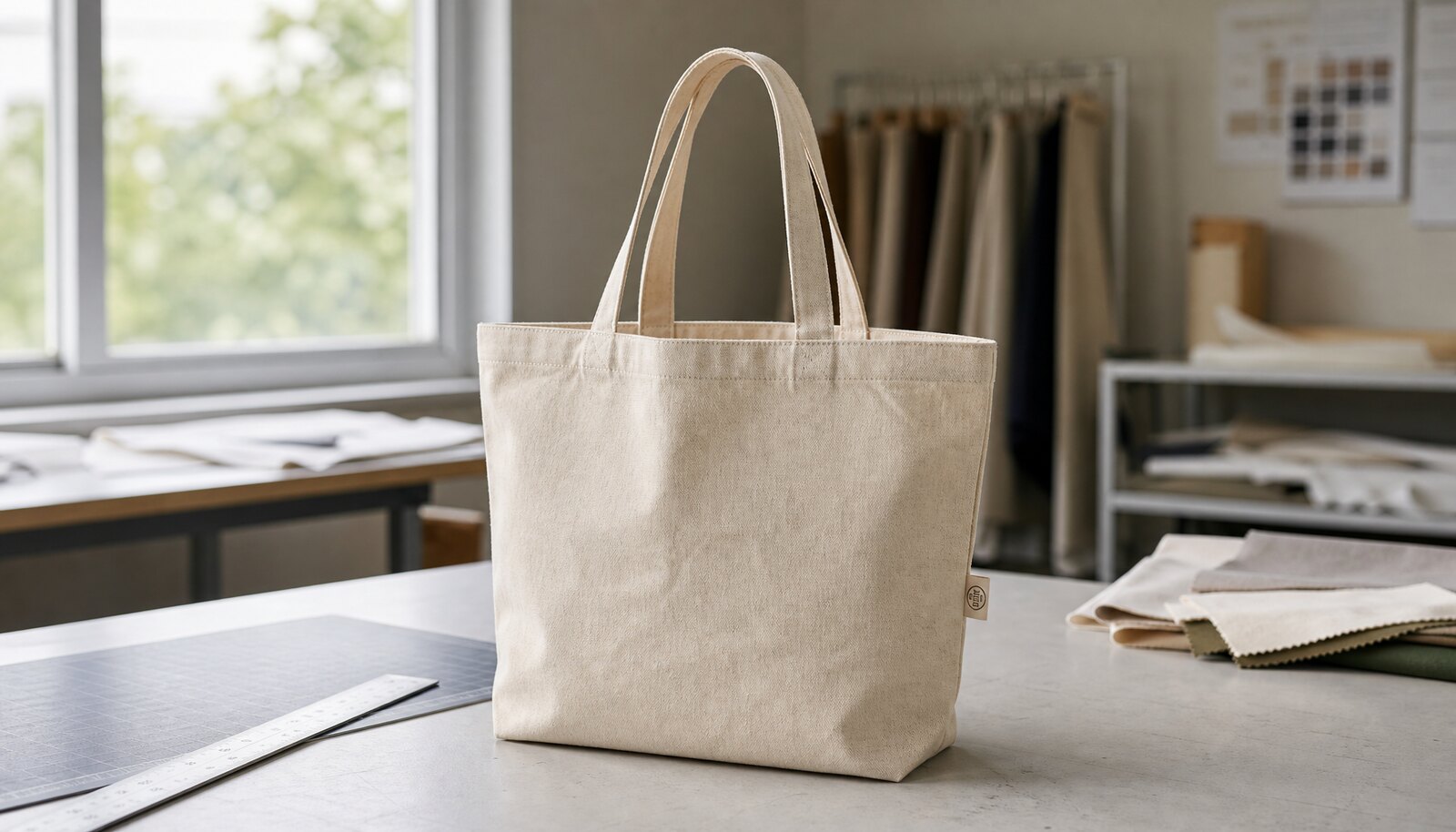
Start With the Tote Job, Not the Fabric Quote
For boutique wineries, an organic cotton tote is not just a giveaway. It can sit on a retail shelf, support a bottle purchase at the tasting room, and carry the brand into a guest’s home, car, or gift table. That means the buying decision is not really about finding the cheapest cotton bag. It is about matching the material, structure, and decoration to the actual job the tote must do.
The first mistake many buyers make is asking suppliers for a price before the use case is written down. A tote meant for a brochure and a post-visit purchase has very different requirements from a tote used to carry a single 750 ml bottle with tissue or a two-bottle gift set. A simple merch tote can tolerate lighter cloth and softer structure. A bottle-carry tote needs more body, more stable seams, and a handle system that does not feel like it is stretching at the first lift.
For RFQ purposes, write the tote job in plain language. State whether the bag is for tasting-room retail, gift-with-purchase, seasonal promotion, distributor merchandising, or a premium winery shop SKU. Add the bottle count, approximate load weight, whether the tote needs to stand upright on a shelf, and whether the bag is expected to be folded flat for packing or displayed open. Those details decide the fabric weight, seam construction, print area, and even the carton pack format.
When buyers skip this step, they usually get one of two bad outcomes: a bag that looks nice but fails in use, or a bag that is technically durable but too heavy, too expensive, or too structured for the brand. The best organic cotton totes for boutique wineries material selection guide starts with the job definition because the product spec should follow the use case, not the other way around.
- Define the channel first: tasting room, gift set, retail shelf, or distributor pack.
- State the load: one bottle, two bottles, or mixed merch and brochures.
- Write the handling expectation: display-ready, shelf-flat, or packed for shipping.
Choose GSM by Load, Drape, and Shelf Use
GSM is the easiest number to compare across suppliers, but it should not be treated as the only truth. For a winery tote, the fabric must look good empty, hold its shape when loaded, and stay comfortable in the hand. In practical sourcing terms, 160-180 GSM organic cotton is light-to-midweight and can work for brochure carriers or lower-load retail totes. It is not the best choice if the bag will repeatedly carry a heavy bottle without visible sagging.
A more reliable starting point for many boutique winery programs is 180-220 GSM. That range usually gives enough body for bottle carry while keeping the tote soft enough for retail use and economical enough for larger seasonal orders. If the bag must feel premium, stand on its own more easily, or support a two-bottle or gift-set load, 220-260 GSM organic cotton or a dense twill construction often performs better. The tradeoff is price, freight weight, and a firmer handfeel that may be too heavy for a casual souvenir item.
Do not buy on the number alone. A 200 GSM fabric with loose weave and low yarn density can look thinner than a 180 GSM fabric with a tighter construction. Ask the supplier for both GSM and the construction details: weave type, fabric width, and if possible, yarn count or thread density. Request a measured sample, not a verbal promise. If a supplier can only say “heavier cotton,” the buyer cannot judge whether the tote will carry a bottle cleanly or collapse after a few uses.
For bottle-based winery programs, a useful procurement rule is to ask for a loaded sample with the actual bottle size you plan to sell or give away. A long Burgundy bottle behaves differently from a shorter standard bottle, and a tote can be mis-sized even if the cloth is right. The load target should be described in the RFQ as a real product item, not just a vague kilogram estimate.
- Ask for a physical swatch labeled with measured GSM and fabric width.
- For bottle carry, test with the actual bottle profile, not a generic weight.
- Treat the fabric as a structure decision, not only a decoration base.
Select Weave and Finish for the Brand Positioning You Want
The weave changes both the look and the functional behavior of the tote. Plain weave is the most common option because it is stable, economical, and easy to cut and sew consistently. It is the most forgiving platform for screen printing and usually the simplest route to repeatable bulk quality. For many winery programs, plain weave hits the sweet spot between natural appearance and procurement control.
Twill is worth considering when the bag needs a more premium handfeel or a slightly more elevated retail presence. The diagonal texture can make the tote feel more substantial in hand and may support a more giftable look. But buyers should not assume twill is automatically better. On some artwork, twill texture can slightly soften fine lines or small text. If the winery logo includes delicate typography, a busy weave can work against legibility.
Finish matters as much as weave. Unbleached organic cotton has the most natural appearance and is often the right match for a winery with an earthy, vineyard-forward identity. But buyers should explicitly allow for flecks, fiber specks, and shade variation. Those are normal in natural cloth and should be agreed before bulk. Bleached or brighter natural-looking cotton gives a cleaner backdrop for print and can make logos pop more sharply, but it may fit the brand less well if the winery wants an intentionally rustic or low-intervention aesthetic.
Pre-shrunk, enzyme-washed, or otherwise stabilized fabric can be useful when the tote must meet tighter finished-size requirements, especially if it will be folded into a retail pack or matched with an insert card. Washing or finishing can change softness, color tone, and cost, so the buyer should ask what process was used and what dimension shift is expected after that process. The more the bag is tied to retail presentation, the more important that detail becomes.
- Plain weave is the default choice when you need stable pricing and print control.
- Twill is best reserved for a premium feel that the winery can justify at retail.
- If the bag is folded for shelf sale, ask how the finish affects size consistency after packing.
Size the Tote Around Bottle Geometry and Shelf Reality
Organic cotton totes for boutique wineries are often sized poorly because buyers use a generic shopping-bag shape rather than a bottle-carry shape. If the tote is intended to hold one bottle vertically, the internal height must clear the bottle plus any closure, neck wrap, or insert. If the tote is meant for two bottles, the gusset needs enough depth so the base does not pinch and the handles do not feel overstretched. This is where many programs fail: the tote can look right in a flat sketch but behave badly once a real bottle is inserted.
A useful buyer approach is to define the tote by the merch or bottle it must hold. For example, a standard single-bottle tote may need a narrower body with a reinforced base and a handle drop that lets the bottle hang comfortably without banging the wrist. A two-bottle tote usually needs a wider gusset, stronger bottom seams, and handle reinforcement because the load shifts more aggressively when the bag is lifted from a car seat or wine counter. If the tote also needs to hold tasting notes, a small cheese item, or a brochure, the internal width should account for that added thickness.
This is where dimensional clarity matters more than broad style language. The RFQ should state finished width, height, gusset depth, handle length, and allowable tolerance. If the winery sells multiple bottle shapes, the buyer should identify the longest bottle profile that the tote must accept. If a tote is also intended to fit inside a gift box or display tray, the outer dimensions and folded profile should be included as well. A supplier cannot price or pattern the bag accurately without those numbers.
A practical dimensional control point is to ask the factory to build a pre-production sample against the exact bottle or merchandise item. The sample should be tested with the item inserted, lifted, and carried. That test tells the buyer more than a dimension sheet alone, because handle drop, base stability, and overall balance only reveal themselves in use.
- Use the real bottle shape in sample testing.
- Write finished dimensions and tolerances into the PO.
- Do not let the supplier choose a generic tote size without buyer signoff.
Specify Stitching and Reinforcement for Bottle-Carry Performance
For winery totes, the bag’s strength is usually determined by the seam and reinforcement system, not by fabric weight alone. If the bag will carry glass, the buyer should ask for seam type, stitch density, seam allowance, handle anchoring method, and whether bartacks are added at the stress points. A tote with a good-looking fabric but weak handle stitching will fail in the one area that matters most: the first firm lift.
A basic retail tote can sometimes use standard side seams and a simple top hem, but a bottle-carry tote needs more discipline. The side seams should be even, the bottom seam should be straight and well locked, and the handles should be anchored in a way that distributes force instead of concentrating it on one narrow stitch line. If the supplier uses folded handles, self-fabric handles, or webbing handles, the buyer should ask how the handle system was chosen and how it will be tested. The stitching should be defined in measurable terms, not only as “strong” or “reinforced.”
A practical specification for B2B procurement is to include a stitch density target, even if the factory wants to translate it into its own process language. Ask the factory to state stitches per inch or stitches per centimeter, the seam allowance used on each panel, and where bartacks are placed. For bottle tote programs, handle anchors and the top edge should be reviewed under load because these areas show strain first. If the tote is intended for premium retail or repeat consumer use, ask for a small pull or lift test on a sample batch before bulk release.
If the winery wants the tote to last beyond a one-time purchase, the QC plan should include seam inspection after a practical carry test. That means checking for loose threads, skipped stitches, opening at the seam intersection, or handle stretch after the bag has been loaded and lifted repeatedly. Those findings are much more useful than a purely visual inspection at the sewing table.
- Ask the factory where the force lands when the bag is lifted full.
- Require a real load test on the same bottle or product the tote is designed for.
- Define reinforcement details in the PO so the factory does not improvise.
Match the Print Method to Artwork, Cloth, and Brand Tone
Decoration is where organic cotton totes for boutique wineries often gain or lose value. For most simple winery logos, water-based screen print is a strong default because it keeps the cloth handfeel soft and can look clean on natural cotton. That said, “safe default” should not be read as “always best.” The right method depends on artwork complexity, expected wear, print area, and whether the bag is being sold as a retail item or handed out as a promotional carry bag.
Screen print works well when the logo is bold, the color count is low, and the print area is straightforward. Buyers should still ask about mesh count, ink type, curing method, and whether the printer will do a rub test before packing. If the logo has tiny type or fine lines, the buyer may need to simplify the art or switch to a woven label, patch, or embroidery. For a premium capsule or a giftable winery line, those sewn options can look more intentional than forcing a complex print onto coarse cotton.
Heat transfer can be useful for certain graphics, but it deserves extra caution on cotton bags because the finish can feel less natural and the edges can lift if the curing and adhesion are not controlled. It is not the preferred route for every program. Use it only when the artwork or schedule justifies the process tradeoff. If the product line is positioned as organic and understated, the print should support that tone rather than create a plasticky or overly glossy finish.
When comparing quotations, make sure the print area and color count are identical across suppliers. A quote for a small chest logo is not comparable to one for a large front panel graphic. Ask for a sample reference showing the actual artwork size or a similar prior job. For wineries, the print should look deliberate and high-contrast, not oversized or promotional in a generic retail sense.
- Simplify artwork before asking for quotes if the logo has fine detail.
- Confirm the print area in millimeters or inches, not just “front logo.”
- Ask for a dry rub or adhesion check before cartons are packed.
Compare Sourcing Routes Before You Compare Prices
The sourcing route determines how much control you really have. A direct factory quote is often the best choice for repeat winery programs because one team owns fabric, cutting, sewing, printing, and packing. That makes sample approval cleaner and gives the buyer a clearer answer if something goes wrong. If the same factory handles the bag from cloth to carton, it is easier to define defect responsibility and rework expectations.
Trading companies and local decorators can still be useful, especially for short runs, urgent launch dates, or programs where the buyer wants a domestic finishing step. But the quote should be explicit about who supplies the fabric, who handles printing, who packs, and who stands behind the final bag. Otherwise the buyer is comparing only a middleman price, not a production offer. For organic cotton programs, chain-of-custody clarity matters because the fabric story and the production story should not be guessed at after the order is placed.
For procurement, the practical question is not “Which route is cheapest?” but “Which route gives the cleanest control over spec, timing, and defect ownership?” A lower unit price can disappear if the program needs local repacking, extra artwork handling, or correction after poor print registration. A direct factory may not always be the lowest quote, but it is often easier to manage when the tote is part of a branded retail SKU with seasonal deadlines.
Buyers should also remember that the best route depends on the order profile. Small seasonal quantities may justify a decorator or trading intermediary if the schedule is tight. Reorderable core SKUs usually benefit from a stable factory relationship. The key is to make the quote path visible so the buyer can compare offers on the same basis.
- Direct factory: strongest for repeatability and defect ownership.
- Trading company: useful when coordinating multiple steps, but ask for production transparency.
- Local decorator: can work for short runs, but confirm who owns the fabric and final QC.
Build the RFQ Around Measurable Commercial Inputs
If the RFQ is vague, the quote will be vague. The supplier should receive a spec sheet that includes fabric composition, actual GSM, weave, finished dimensions, handle length, seam allowance, bottle load target, print area, color count, fold style, carton pack, and approval timeline. This is the minimum to keep offers comparable. A supplier who has to guess size, decoration, or packing will build in margin for uncertainty, and the buyer will not be able to tell why one quote is higher than another.
A useful RFQ also states what the supplier must return in the quote. Ask for unit price by quantity tier, sample charges, screen or setup charges, MOQ per color and version, lead time after sample approval, overrun or underrun terms, and freight assumptions. If the buyer wants price by cartons rather than by each tote, say so. If the buyer needs a specific carton count to support warehouse handling, define it. These details are not paperwork for paperwork’s sake; they prevent pricing gaps and misunderstandings later.
For winery tote programs, quote structure should also reflect packaging and presentation. A bag sold on a shelf may need retail folding or a belly band, while a bag shipped to a distributor may need only flat-fold bulk packing. A quote that ignores pack format is incomplete. Likewise, if the supplier’s proposal does not list the exact fabric reference or a sample code, the buyer should treat the price as provisional. Commercial specificity is what turns a sample into a repeatable product.
The buyer should also ask suppliers to explain what drives their MOQ. In many cases the minimum is not arbitrary; it is tied to fabric roll size, print setup, or cutting efficiency. Knowing that reason helps the buyer decide whether to adjust the spec, combine SKUs, or accept a higher initial buy. That is much better than being told only that the MOQ is fixed.
- Use the same RFQ template for every supplier.
- Do not accept a quote that leaves GSM, dimensions, or packing undefined.
- Ask for a sample code or production reference tied to the exact offer.
Review Samples Like a Production Buyer, Not a Brand Reviewer
A sample needs to be judged for production repeatability, not only for appearance. Hold the tote empty, loaded, and folded. Check the symmetry of the handles, the straightness of the top edge, the neatness of the side seams, and whether the bag keeps its shape when a bottle is inserted. For a winery tote, the sample should feel balanced when carried by one hand and should not tilt so much that the bottle collides with the leg or swings excessively.
The buyer should measure the sample after it has rested, because freshly sewn fabric can read differently right off the line. If washing, pre-shrinking, or enzyme treatment is part of the process, inspect the sample after the same treatment the bulk lot will receive. Keep the approved fabric swatch, decorated sample, and dimension sheet together as the control record. That gives the buyer a clean reference if bulk production drifts.
It is also useful to run a simple abuse check on the sample before approval. Load it with the real bottle or merch combination and lift it several times. Look for handle stretch, seam creep, thread popping, and any print cracking or rubbing. The objective is not to destroy the bag; the objective is to find weak points before the factory produces thousands of units. A supplier that welcomes this process usually understands B2B expectations well.
If revisions are needed, ask for the change to be recorded clearly. That prevents a production team from relying on memory or on an older sample version. Sample control is one of the fastest ways to reduce later disputes, especially when several versions of the same winery tote are being ordered in different seasons or for different channels.
- Approve against the real bottle or merch load.
- Measure after resting and after any finishing process used in bulk.
- Keep one master reference set: swatch, sample, and dimension sheet.
Set Packing, Carton, and Warehouse Rules Before Bulk Starts
Packing can affect buyer satisfaction as much as the bag itself. A tote that is destined for a tasting room shelf may need to open neatly, present well, and remain free from wrinkles or ink transfer. A tote shipped in bulk to a distributor needs efficient cartonization and clear labeling. Those two requirements often call for different pack methods, so the buyer should specify the channel before the order is placed.
Flat bulk folding is usually the most efficient and economical route for wholesale replenishment. It keeps freight cube lower and simplifies warehouse handling. But for retail-ready programs, the buyer may want an insert card, a belly band, or a more deliberate fold that keeps the tote looking intentional when removed from the carton. Each extra finishing step adds labor and may affect carton count, so the buyer should ask for pack samples if the presentation matters.
Carton labeling should be treated as part of quality control, not an admin detail. The carton mark should show the PO number, style code, size, color, packed quantity, and carton sequence if there are multiple cartons. If cartons are going into a multi-SKU warehouse flow, ask for any pallet or master carton logic up front. That reduces receiving errors and speeds up inspection at destination.
For printed totes, the curing and stacking sequence deserves attention. If the print is still warm or not fully cured, the bags can mark each other during packing. Ask the factory to confirm how they prevent ink transfer, dust contamination, and moisture issues before they close the carton. A good pack plan can prevent a lot of avoidable rework.
- Define carton label content before the first bulk carton is packed.
- Ask whether any ink transfer risk exists during stacking and curing.
- Require pack samples if the tote will be sold directly from carton to shelf.
Specification comparison for buyers
| Material / sourcing option | Typical spec range | Best use case | Buyer checks before approval |
|---|---|---|---|
| 160-180 GSM organic cotton plain weave | Light-to-midweight; soft handfeel; lower freight cube | Brochure carriers, gift-with-purchase inserts, lower-load retail totes | Confirm bag still holds shape after loading a full bottle; check seam puckering and handle stretch |
| 180-220 GSM organic cotton plain weave | Midweight; balanced body and print clarity | Most boutique winery retail programs | Request actual measured GSM, fabric width, and shrinkage after conditioning; ask for bottle-carry sample |
| 220-260 GSM organic cotton twill or dense plain weave | Heavier cloth; better structure and premium feel | Two-bottle carry, gift sets, premium retail SKU | Check handle comfort, carton weight, and whether the bag is overbuilt for the channel |
| Unbleached natural organic cotton | Natural speckling and shade variation are expected | Earth-toned, organic, rustic winery positioning | Approve acceptable fleck level, yarn slub, and shade band before bulk |
| Pre-shrunk or enzyme-washed organic cotton | More stable finished dimensions; softer hand | Retail programs needing tighter pack and repeat sizing | Ask for process details, expected shrinkage range, and whether washing changes base color |
| Plain weave | Stable, economical, easy to cut and print | Most logo-forward retail tote programs | Check if weave density is high enough to prevent limpness and print show-through |
| Twill weave | More texture and perceived premium quality | Limited releases, gift sets, premium tasting-room retail | Verify print detail clarity and whether the weave texture affects small type |
| Water-based screen print | Soft hand, durable enough for simple brand marks | One- or two-color logos, simple winery graphics | Confirm mesh count, ink type, cure method, and adhesion rub performance |
| Embroidery or woven label | Premium branding on small areas | Capsule collections, higher-margin retail SKUs | Check stitch density, backing, thread color match, and snag risk |
Buyer checklist before sampling
- Define the actual tote job first: one bottle, two bottles, brochures only, or mixed retail carry.
- Lock finished width, height, gusset depth, handle length, target GSM, and acceptable shade range before requesting quotes.
- Ask for one unprinted fabric swatch and one decorated pre-production sample; do not approve from photos alone.
- State bottle size and load target in the RFQ, including glass bottle diameter and whether the tote must stand upright.
- Specify stitch and reinforcement details: seam allowance, stitch density, bartacks, and whether handle anchors need extra reinforcement.
- Require carton counts, fold direction, carton labels, moisture control, and whether individual polybags are allowed.
- Request shrinkage data, colorfastness note, print cure method, and overrun/underrun tolerance in writing.
- Match the quote to a physical sample reference number so all suppliers are pricing the same product.
Factory quote questions to send
- What exact cotton composition, weave, and finished GSM will you use, and what tolerance do you allow on GSM from lot to lot?
- Where is the fabric sourced and processed, and can you identify the organic fabric certification or transaction chain you are quoting against?
- What are the finished dimensions, seam allowance, gusset depth, and handle length you will build to?
- For bottle carry, what load test can you run on the handles and anchor points, and what failure criteria do you use?
- Which print method do you recommend for this artwork, how many colors/screens are needed, and what cure process do you use?
- What stitch density, seam type, and reinforcement method do you use at the side seams, bottom seams, and handle anchors?
- What is the MOQ per color, print version, and style, and which part of the workflow is driving that MOQ?
- What is your overrun or underrun policy, and how do you handle replacement for defects found in pilot cartons?
- How will the bags be folded, packed, carton marked, and protected from moisture, dust, and ink transfer?
- What are the sample stages, sample lead time, bulk lead time, and the point at which artwork or dimensions become frozen?
Quality-control points to confirm
- Fabric weight should match the approved spec within a practical tolerance agreed in the PO; ask the factory to state whether it measures GSM before or after finishing.
- Finished dimensions should be checked after resting; acceptable tolerance should be written into the order, especially if washing or shrinking is part of the process.
- Handle length and symmetry should be matched side to side, with no visible twist, skew, or uneven top alignment.
- Seam stitch density should be specified in stitches per inch or stitches per centimeter, with clean backtack and no skipped stitches, broken threads, or open seam sections.
- Handle anchors and bartacks should pass a real bottle-load lift test using the agreed payload, not only a visual inspection.
- Bottom seams and gusset seams should be checked for seam allowance consistency, seam slippage, and abrasion at stress points.
- Print position should stay within the approved placement window, with no smearing, pinholes, ghosting, or off-register edges.
- Color should remain within the approved natural range; for unbleached cotton, the buyer should define acceptable flecking, slub, and shade variation.
- Cartons should match the pack plan, style code, color, and quantity count, with carton labels showing PO number, item code, size, and packed quantity.
- Pilot cartons should be checked for oil stains, dye marks, odor, needle damage, crushed corners, loose threads, and ink transfer before releasing the bulk lot.