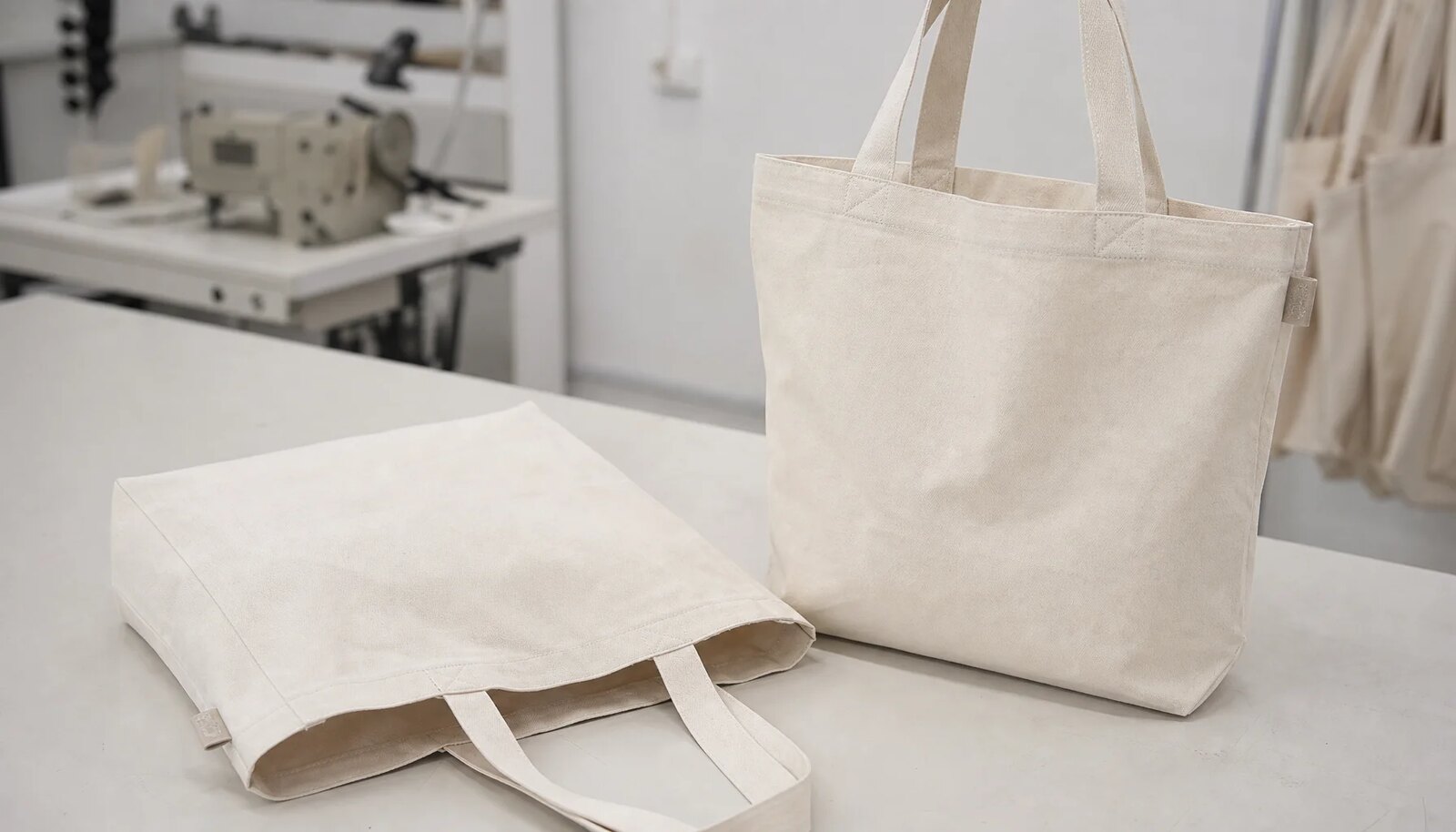
Start With The Market Job, Not The Bag Name
Organic cotton totes for farmers market vendors sound simple until procurement has to compare quotes. A reusable produce tote, a market-wide customer giveaway, a CSA pickup bag, and a premium farm shop retail bag may all be called the same thing in email. They are not the same product. They carry different loads, face different cosmetic expectations, and deserve different inspection priorities.
Write the real use case at the top of the RFQ. A free seasonal event tote may only need to carry light packaged goods for a short trip home. A tote sold at a farm shop needs a cleaner front panel, tighter thread trimming, and consistent print placement because customers are paying for it. A CSA pickup tote may carry root vegetables, glass jars, leafy produce, eggs, and chilled items, so handle attachment and base seam strength become more important than a perfectly sharp fold.
Good sourcing language gives the factory something measurable. Replace sturdy with 8 kg working load. Replace premium with 240 gsm finished cotton canvas, clean front panel, trimmed threads, and print placement within plus or minus 0.5 cm. Replace market tote with finished size, gusset depth, handle drop, artwork size, packing method, carton marks, and required organic cotton documentation. The clearer the job, the easier it is to quote, sample, inspect, and repeat.
- Define the tote as retail resale, vendor utility, CSA pickup, farm shop merchandise, event giveaway, or mixed-use program.
- Name likely contents: produce, jars, bakery boxes, bouquets, canned goods, folded signs, packaged groceries, or merchandise.
- State working load and use frequency, such as occasional event use, weekly customer reuse, or recurring CSA pickup.
- Decide whether the bag must stand open on a booth table, hang from hooks, fold flat, or ship directly to retail locations.
- Separate functional blockers from cosmetic preferences before asking suppliers to quote.
Turn The RFQ Into A Measurable Spec Sheet
A strong tote quote starts with a complete spec sheet. If the RFQ only says organic cotton tote with logo, every supplier fills in the blanks differently. One may quote lighter cloth. Another may shorten the handles. A third may exclude screen charges, individual labels, or export cartons. The lowest unit price may simply be the least complete interpretation.
Include finished body width, body height, gusset depth, handle width, handle drop, fabric gsm, weave type, decoration method, label requirements, packing, carton marks, inspection method, and Incoterm. For many general farmers market totes, a useful starting size is around 38 x 40 cm with an 8-12 cm gusset. Shoulder handles often fall around 55-65 cm drop, while hand-carry handles may sit closer to 35-45 cm. These are not universal rules. The right dimensions come from the product mix, the display method, and the way customers will actually carry the bag.
Set tolerances before sampling. Sewn cotton products vary because fabric shifts, seams consume cloth, and finishing can affect shape. Variation is normal; unlimited variation is not. For many tote orders, practical tolerances are plus or minus 1 cm on body width and height, plus or minus 0.5 cm on gusset depth and handle width, plus or minus 1 cm on handle drop, and plus or minus 0.5 cm to 1 cm on print placement depending on artwork size. Confirm what the factory can hold, then write the final numbers into the purchase order and inspection checklist.
- Attach final-size artwork and mark placement from fixed reference points such as top edge, side seam, or panel centerline.
- Ask suppliers to list all deviations from the RFQ instead of silently substituting fabric, handles, labels, or packing.
- Request sample lead time and bulk lead time, with bulk timing starting only after written pre-production sample approval.
- Clarify whether screen charges, embroidery digitizing, labels, hangtags, barcodes, export cartons, and inspection support are included.
- State Incoterm and named port or destination so freight and commercial comparisons are fair.
Specify Organic Cotton Fabric With Care
Organic describes the cotton claim. It does not automatically define thickness, weave stability, shrinkage, strength, or print quality. For farmers market tote procurement, finished gsm is one of the first commercial decisions. A 180-220 gsm organic cotton canvas often works for standard reusable vendor totes because it balances cost, foldability, printability, and hand feel. For heavier produce, preserves, glass bottles, or retail resale, 240-280 gsm is usually a more appropriate range to evaluate.
Ask for finished gsm after finishing, washing, or shrinkage treatment. Suppliers may describe fabric as canvas, duck, natural cotton, heavy cotton, or premium cloth, but those words do not belong alone in a purchase order. Ask whether the cloth is greige, scoured, bleached, dyed, washed, or pre-shrunk. Natural unbleached cotton can show specks, seed particles, yarn slubs, and shade variation. Those characteristics may be acceptable when approved in advance, but they can become disputes when the buyer expected a cleaner retail surface.
Keep organic cotton claim support separate from workmanship approval. A well-sewn sample proves that the supplier can cut, sew, print, and pack the tote. It does not prove organic status by itself. If the bag will be marketed, invoiced, tagged, or sold as organic cotton, request the documentation your customer, retailer, internal policy, or destination market requires. Procurement should approve both the physical product and the claim support before shipment.
- Request finished gsm, weave type, fiber composition, shade standard, and fabric treatment in the quote.
- Approve a physical fabric swatch before a full sample when hand feel or print surface matters.
- Ask for expected shrinkage if the tote may be washed, steamed, or exposed to moisture during normal use.
- Define acceptable natural cotton specks, slubs, and shade variation with an approved sample or photo standard.
- For reorders, reference the previous approved gsm, shade, and hand feel rather than relying only on a style name.
Control Handles Before You Approve Artwork
Handles are the main functional risk on a cotton tote. The entire load transfers through small attachment points, often while the bag is lifted from a car, hung from a shoulder, pulled from a booth hook, or carried unevenly with jars and produce inside. A front logo can look excellent while the handle reinforcement is still too weak for real market use.
Self-fabric handles are common for organic cotton totes because they match the body and give a clean retail look. Specify handle width, drop, fabric layers, stitch pattern, thread type, and stitch color. A 2.5-3.5 cm handle width is common for reusable totes, but the right choice depends on load, comfort, and target price. Shoulder-carry handles need more drop than hand-carry totes. Check the sample while loaded, not only flat on a table.
The attachment method should be visible enough for inspection. Box stitching with an X-tack or a dense bar tack gives the inspector a repeatable reinforcement pattern to verify. A single short straight stitch at the bag mouth may reduce cost, but it is risky for totes expected to carry produce, jars, bottles, or weekly groceries. Ask the factory to confirm stitch density and thread type, then load test the sample. After the test, look closely at the handle base, bag mouth seam, and inside seam allowance for stretch, broken threads, or fabric tearing.
- Specify handle drop from the top opening to the highest point of the handle curve when the bag lies flat.
- Measure both handles on the same tote; visible asymmetry is a common defect.
- Require boxed stitch plus X-tack or bar tack for bags expected to carry heavier goods.
- Inspect the inside of the handle attachment, not only the outside face.
- Repeat the load test during final inspection for large orders or recurring vendor programs.
Make Gussets And Base Seams Do Real Work
The gusset determines how the tote behaves when vendors and customers load bulky market items. A flat cotton tote can carry light goods, but it may not sit open, accept containers neatly, or protect the printed panel from distortion. A gusset around 8-12 cm is common for general farmers market bags because it adds useful depth without making the tote difficult to fold or expensive to ship. Larger gussets can work for grocery and CSA programs, but they should be sampled, packed, and tested before approval.
Gusset defects usually come from cutting inaccuracy, uneven seam allowance, or rushed sewing. When side panels do not align, the tote twists, the bottom corners pucker, and the opening may not sit level. These issues are not only cosmetic. A twisted base can concentrate weight on one seam, especially when the bag carries jars, bottles, or angular produce boxes.
During sample review, open the tote fully on a flat surface and check whether the base sits square. Then fold it flat and see whether the side seams stack evenly. Measure gusset depth on both sides and compare it with the written tolerance. Inspect the bottom seam for balanced tension, skipped stitches, seam grin, and loose thread ends. For heavier programs, ask whether the factory recommends a stronger seam construction or reinforcement, then judge the added cost against the actual load requirement.
- Specify finished gusset depth and whether the bag must stand open for display.
- Check corner symmetry on both the open bag and folded bag.
- Measure the gusset at multiple points, not only at the top edge.
- Inspect base seam strength after the load test, not before only.
- Reject twisted gussets when the tote is intended for retail resale or branded display.
Match Decoration To Fabric, Artwork, And Use
Decoration should be chosen after fabric and construction are clear. Screen printing is usually the practical default for simple farmers market logos, sponsor marks, and one- or two-color artwork. It is efficient at volume and works well on cotton canvas when the weave is stable and the ink is properly cured. The inspection risks are placement, registration, coverage, edge sharpness, color match, and curing quality.
Water-based textile inks are often selected for a softer hand feel on cotton, while other ink systems may be used depending on artwork, fabric, and buyer requirements. The important question is not the ink label alone. The print must meet the approved appearance and handling standard. Poor curing can leave tackiness, cracking, weak rub resistance, or transfer marks. Fine type and thin lines should be reviewed with the printer before approval because cotton weave can soften edges.
Embroidery, woven labels, cotton patches, and woven side labels can give a more premium retail finish. They also add QC points: stitch density, backing, label orientation, attachment strength, thread shade, and color consistency. Heat transfers and some digital methods may be useful for detailed or lower-volume artwork, but they must be checked on the actual tote fabric for cracking, peeling, fold marks, and surface feel. A digital mockup is useful for layout; it is not a production approval.
- Specify artwork file version, final print size, print position, color reference, and placement tolerance.
- Ask the supplier for minimum line width and minimum letter height that can print cleanly on the selected fabric.
- Approve ink color on the actual fabric shade, especially for natural cotton where background tone affects color perception.
- Check curing, rub, fold, and handling behavior before bulk production.
- Confirm whether setup charges are one-time, per color, per artwork, or repeated for reorders.
Use Samples As Production Controls
Sampling should catch production risk while there is still time to fix it. A development sample can help refine fabric, shape, handle length, decoration, and price. A pre-production sample has a stricter purpose: it should represent what the factory will make in bulk. It should use the final or production-equivalent fabric, final handle construction, final print or label method, final stitch pattern, and realistic packing fold.
A proper sample review combines measurement, use testing, and visual inspection. Measure body width, height, gusset depth, handle width, handle drop, print size, and print placement. Load the tote with the agreed weight and representative contents, then carry it, set it down, and inspect the handle base, bag mouth, side seams, bottom seam, and gusset corners. Check whether the print cracks along fold lines, whether the bag distorts, and whether the handles feel comfortable enough for the expected use.
When a sample fails, the correction must be written as a measurable change. Improve quality is not a production instruction. Move print 2 cm higher, change handle attachment to boxed stitch with X-tack, trim loose threads inside bag mouth, increase gusset to 10 cm plus or minus 0.5 cm, or reduce print placement tolerance to plus or minus 0.5 cm are actionable instructions. Keep one signed sample with the buyer and one with the factory, both dated and marked with revision status.
- Approve pre-production samples only after construction, fabric, decoration, labels, and packing match the purchase order.
- Create a sample approval sheet with dimensions, tolerances, stitch details, print position, labels, and packing method.
- Photograph key approval points such as handle reinforcement, gusset corners, print placement, and carton fold.
- Do not allow bulk cutting until material, measurement, and decoration corrections are closed in writing.
- Use the signed sample as the final inspection reference, not as a general inspiration piece.
Compare Quotes On Equal Commercial Terms
Two quotes for organic cotton totes can look similar while covering very different products. One supplier may quote 180 gsm fabric, basic handle stitching, one-color print, and EXW terms. Another may quote 240 gsm fabric, reinforced handles, included screen charges, export cartons, organic cotton documentation support, and FOB terms. A price comparison that ignores those details is not a real comparison.
Normalize the quote before choosing. Align finished gsm, dimensions, gusset, handle construction, decoration method, artwork count, label requirements, packing, inspection support, and Incoterm. Ask for price breaks at relevant quantities such as 500, 1,000, 3,000, and 5,000 pieces, but also ask how variants are handled. MOQ may apply per fabric color, per artwork version, per print color, or per decoration method. Small artwork splits can turn a simple order into a sorting problem.
Documentation and compliance support should be visible in the quote. If your customer requires organic cotton claim support, a supplier offering only a verbal organic claim is not equivalent to a supplier providing usable documents. The same applies to special testing, barcode labels, retailer carton marks, or third-party inspection support. Ask what is included, what is optional, and what is excluded so procurement can defend the final supplier choice with facts rather than price alone.
- Compare unit price only after matching fabric, construction, decoration, packing, documentation, and Incoterm.
- Ask whether setup charges are included or billed separately for screens, embroidery, labels, and hangtags.
- Request a clear production lead time after approved sample, not after deposit only.
- Check whether carton configuration supports your freight estimate and warehouse handling limits.
- Ask suppliers to state the cost impact of changing gsm, handle reinforcement, or artwork count.
Write Packing And Carton Rules Early
Packing is part of quality control. Cotton totes are often flat packed in export cartons because it is efficient for freight and warehouse receiving. The packing method still needs to be written: fold direction, pieces per bundle, bundles per carton, units per carton, carton dimensions, gross weight, carton marks, and inner protection.
Many buyers want to avoid individual polybags, especially for organic cotton products. That can be a reasonable choice, but the goods still need protection from dust, moisture, carton rub, and transfer stains. If individual polybags are removed, consider bundle wrapping, paper interleaving, lined cartons, or stricter carton moisture checks. The packaging decision should protect the product while matching the buyer's environmental and retail presentation goals.
Carton marks matter when a market program includes multiple destinations, artwork versions, vendor groups, or SKUs. A warehouse can receive the correct total quantity but allocate the wrong bags if carton marks are vague. Specify purchase order number, item code, fabric color, artwork version, quantity, carton number, gross weight, destination, and barcode where needed. For retail resale, hangtags and barcodes should be finalized before packing starts because late labeling creates rework and counting errors.
- Set units per carton and maximum gross weight before production packing begins.
- Define whether bags are loose packed, bundled, paper wrapped, or individually packed.
- Use carton marks that identify artwork version, color, PO number, destination, and carton sequence.
- Inspect cartons for compression, moisture signs, broken edges, dirt, and incorrect labels.
- Confirm final packed carton dimensions before freight booking.
Run Final Inspection Against Written Standards
Final inspection should confirm that bulk goods match the signed sample, written spec, purchase order, and packing instruction. Many B2B buyers use an AQL sampling plan to determine inspection quantity, but defect definitions are just as important as sampling math. Before inspection, define critical, major, and minor defects. A broken handle, open seam, wrong artwork, wrong material, mold odor, or carton shortage is not equivalent to one loose thread.
Inspect function first. Check handles, bag mouth, side seams, bottom seam, and gusset corners before spending time on small cosmetic issues. Measure body width, height, gusset depth, handle width, handle drop, print size, and print position across a representative sample. Perform the agreed load test using the defined weight and duration. For example, the inspection can require the tote to hold the agreed working load for a set period and be lifted repeatedly, then checked for seam opening, thread breakage, fabric tearing, or handle elongation. The exact test should be approved before production so everyone knows the standard.
The inspection report should include photos, measured results, defect counts, carton references, and a clear recommendation: pass, hold for rework, reinspect, or reject. If rework is required, inspect again after correction. For repeat orders, keep accepted samples and prior reports so the next run is judged against the same baseline. That is how a basic tote purchase becomes a controlled vendor program with fewer surprises.
- Classify critical, major, and minor defects before the inspector arrives.
- Measure dimensions and print placement against written tolerances, not by visual judgment only.
- Check inside seams, thread trimming, label orientation, and bottom corners as well as the front panel.
- Verify carton count, assortment, carton marks, barcode labels, gross weight, and packing condition.
- Hold shipment when functional defects, wrong artwork, wrong material, or carton errors exceed the agreed acceptance standard.
Specification comparison for buyers
| Spec decision | Recommended option | When it fits | Buyer risk to check |
|---|---|---|---|
| Target use and load | Define a working load before pricing, commonly 5-8 kg for general market use and 8-12 kg for heavier produce, jars, or CSA pickup programs | Vendor resale, CSA pickup, farm shop merchandise, market-wide programs, and customer carry bags | A vague heavy-duty request leads suppliers to quote different fabrics, handle reinforcement, seam strength, and inspection assumptions |
| Fabric weight | 180-220 gsm finished fabric for standard reusable vendor totes; 240-280 gsm for heavier repeat-use or resale programs | Balances foldability, cost, printability, and hand feel for most farmers market orders | Ask for finished gsm after finishing or washing; canvas, cotton duck, natural cotton, and premium cotton are not enough as specifications |
| Fabric construction | Plain-weave cotton canvas or duck with stable yarn density, agreed shade standard, and shrinkage expectation | Useful for screen printing, clean folding, and predictable sewing on structured tote shapes | Loose weave can stretch at handles, distort print edges, and create seam grin even when gsm appears acceptable |
| Typical dimensions | Approx. 38 x 40 cm body, 8-12 cm gusset, 2.5-3.5 cm handle width, 55-65 cm shoulder drop or 35-45 cm hand-carry drop | Good starting range for general vendor programs, then adjusted for product mix and display needs | Dimension changes affect fabric consumption, carton volume, carry comfort, display behavior, and artwork placement |
| Measurement tolerances | +/- 1 cm on body width and height, +/- 0.5 cm on gusset and handle width, +/- 1 cm on handle drop, +/- 0.5 cm to +/- 1 cm on print placement depending on artwork | Appropriate for many sewn cotton tote orders when confirmed with the factory before bulk cutting | Unwritten tolerances create disputes during inspection, especially for crooked prints, uneven handles, and mismatched gussets |
| Handle construction | Self-fabric handles with boxed stitch plus X-tack, or dense bar tack at the bag mouth using matching heavy cotton or poly-cotton thread | Needed for loaded produce, jars, bread, flowers, packaged groceries, and repeated weekend use | Single straight-line attachment is a common failure point; require load testing on the signed sample and final inspection sample |
| Decoration method | Screen print with water-based or approved textile ink for simple one- or two-color logos; woven label, patch, or embroidery for premium resale programs | Screen print fits most B2B market tote orders; labels and embroidery suit higher perceived-value retail programs | Confirm ink curing, rub resistance, placement tolerance, minimum line width, and fabric shade effect on color |
| Organic claim control | Request transaction or supporting documentation, material scope details, and labeling instructions separately from workmanship approval | Required when the tote is marketed, invoiced, tagged, or sold as organic cotton | A physical sample proves construction quality, not organic status; documentation must match the buyer's claim and market requirements |
| MOQ and variants | Consolidate around one fabric shade and one or two artwork versions for first production; request price breaks at 500, 1,000, 3,000, and 5,000 pieces | Reduces setup cost, shade variation, carton sorting errors, and inspection complexity | Too many small artwork splits increase unit cost and make allocation mistakes more likely |
Buyer checklist before sampling
- Define the buying purpose in writing: retail resale tote, CSA pickup bag, vendor booth utility bag, market-wide customer bag, event merchandise, farm shop packaging, or mixed-use program.
- State the expected working load in kg or lb and name likely contents such as apples, root vegetables, glass jars, bakery boxes, bouquets, canned goods, or mixed packaged food.
- Specify finished fabric gsm, weave type, fiber composition, fabric color, shade standard, shrinkage expectation, and whether the fabric is raw, scoured, dyed, washed, or pre-shrunk.
- Request organic cotton documentation separately from sample approval so material claim verification and workmanship approval do not get treated as the same task.
- Approve finished body width, height, gusset depth, handle width, handle drop, seam allowance, print size, and print placement with written tolerances before bulk cutting.
- Specify handle reinforcement: boxed stitch dimensions, X-tack or bar tack, stitch density target, thread type, stitch color, and placement at the bag mouth.
- Lock decoration method, ink or thread reference, artwork file version, color standard, print hand feel, curing requirement, and acceptable shade or registration variation.
- Ask for a pre-production sample made from the actual bulk fabric or confirmed production-equivalent fabric, using the final sewing method, final decoration, labels, and packing fold.
- Perform a practical load test on the approved sample using the real type of items the tote is expected to carry, then inspect handle stretch, seam opening, and fabric distortion.
- Define defect categories for stains, oil marks, weaving defects, loose threads, skipped stitches, seam openings, crooked gussets, print misalignment, wrong labels, and carton count errors.
Factory quote questions to send
- What exact finished gsm, weave type, yarn appearance, fabric width, fabric color, shade standard, and shrinkage allowance are included in this quote?
- Is the quoted cloth documented as organic cotton, and which supporting documents can you provide for our compliance file before shipment?
- Which production steps are handled in-house, and which are subcontracted: fabric sourcing, cutting, sewing, printing, embroidery, labeling, inspection, packing, and export handling?
- What is the MOQ per fabric color, per artwork version, and per decoration method, and how does price change at 500, 1,000, 3,000, and 5,000 pieces?
- Can the pre-production sample be made from the same bulk fabric lot, same thread, same handle construction, same decoration process, same label, and same packing fold as production?
- What stitch construction will be used at the handle attachment, bag mouth, side seam, bottom seam, and gusset corners, and what stitch density do you target per inch or centimeter?
- What measurement tolerances do you recommend for body width, body height, gusset depth, handle width, handle drop, and print placement?
- What load test can you perform before shipment, what weight and duration will be used, and can the test be repeated during third-party inspection?
- What print method, ink system, curing process, color control method, and minimum printable line width are included in the quote?
- Are screen charges, embroidery digitizing, woven labels, swing tags, barcode stickers, inner packing, export cartons, and inspection support included or listed separately?
Quality-control points to confirm
- Finished fabric gsm matches the approved spec within the agreed tolerance, and hand feel is consistent across sampled pieces and cartons.
- Fabric surface is free from oil marks, dirt, weaving defects, yarn slubs beyond the approved standard, holes, needle damage, mold odor, and obvious panel-to-panel shade variation.
- Body width, body height, gusset depth, handle width, and handle drop stay within the written tolerance on both sides of the tote.
- Handles are symmetrical, securely attached, not twisted, and reinforced with the approved boxed stitch, X-tack, or bar tack pattern.
- Side seams, bottom seams, bag mouth seams, and gusset corners show balanced stitch tension with no skipped stitches, seam grin, loose ends, broken threads, or open seam allowance.
- Stitch density matches the approved sample closely enough that reinforcement is equivalent, especially at the handle attachment and bottom corners.
- The bag stands, folds, and opens as intended; gussets are square and not twisted, puckered, collapsed, or uneven from side to side.
- Print placement, print size, ink coverage, edge sharpness, registration, and color match the signed sample and approved artwork file within tolerance.
- Printed areas show no cracking, peeling, tackiness, smudging, pinholes, heavy bleed, poor curing, or unacceptable shade shift after reasonable handling.
- Labels, swing tags, barcodes, care labels, or woven side labels are attached in the correct location, facing the correct direction, and using the approved wording.