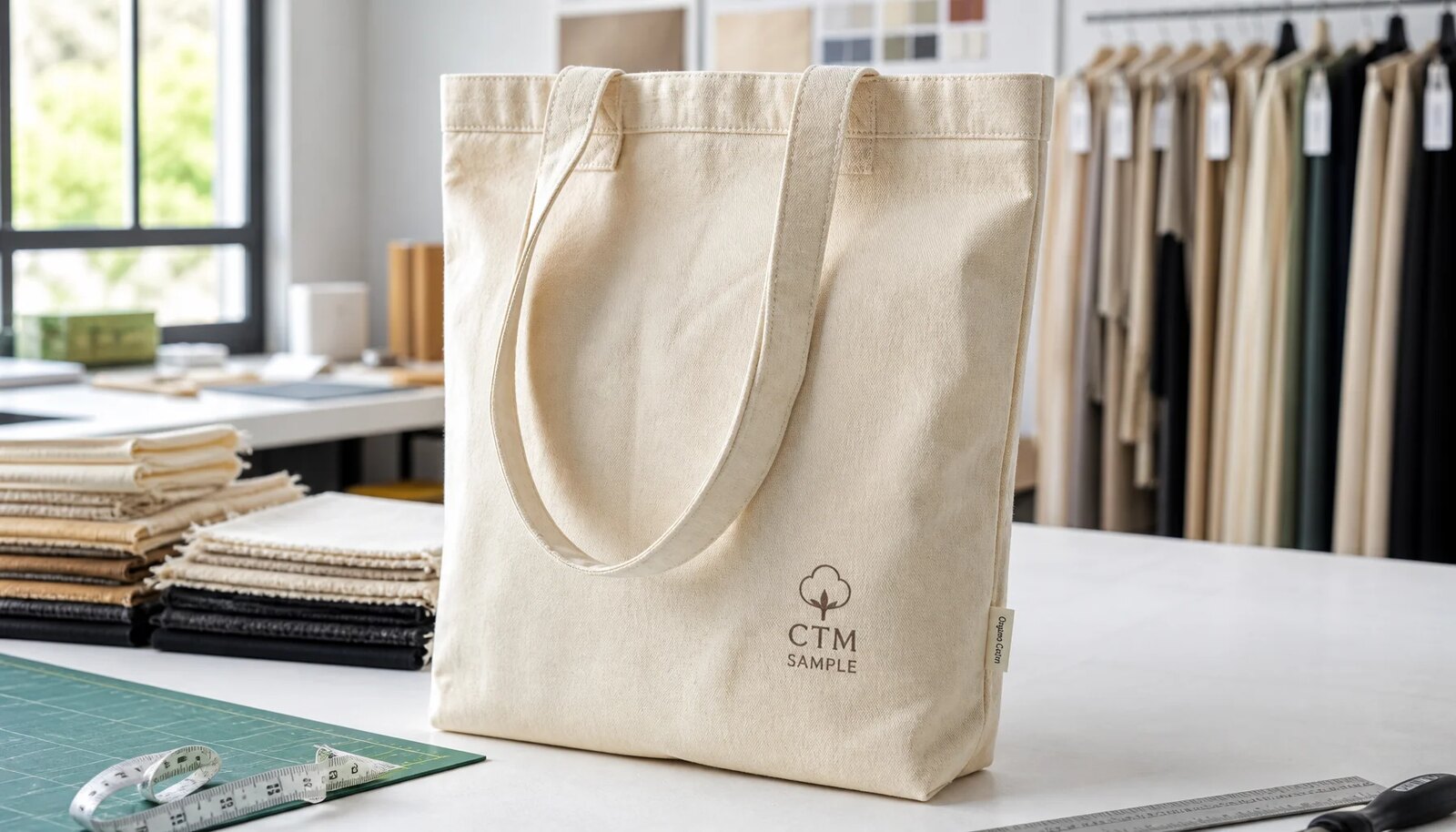
Start with the event load, not the tote name
A useful organic cotton totes fabric weight guide for event planners starts with the physical job the bag has to do. In sourcing conversations, the phrase "organic cotton tote" can mean a thin natural cotton carrier for brochures, a midweight conference tote, or a structured canvas bag for a premium sponsor kit. Those are not interchangeable products. If the RFQ only says organic cotton tote bag, each supplier will quietly fill in fabric weight, handle construction, finish, print method, and packing with their own assumptions.
Begin with the event use case. List the items attendees will receive, the approximate total load, whether any contents have hard corners, how long people will carry the bag, and whether the handles need to sit comfortably on the shoulder. A light cotton tote can work perfectly for badges, maps, postcards, and a folded agenda. The same tote can look underbuilt when it is loaded with catalogs, drinkware, boxed samples, or apparel.
Procurement should also separate a carrier from a keepable item. A carrier needs to move event materials at the right cost and schedule. A keepable item needs better structure, cleaner finishing, stronger packing control, and more careful print approval. That single distinction prevents two common mistakes: overspending on heavy canvas for a simple handout, or choosing a thin bag for a sponsor kit that is supposed to feel durable after the event.
- Define expected contents by item and estimated total weight, not only by attendee count.
- State whether the bag will be hand-carried only or must fit comfortably over the shoulder.
- Identify whether the tote is a registration carrier, trade show collection bag, VIP gift bag, merchandise item, or sponsor kit package.
- Treat fabric weight as one part of performance; handle width, handle attachment, seam construction, and print method matter too.
Translate GSM and ounces without losing precision
Tote fabric weight is usually discussed in grams per square meter, written as gsm, or ounces per square yard, often written as oz. GSM is clearer for international procurement because it is a metric area measurement. Ounces remain common in promotional product catalogs, but buyers should be careful: one supplier's "8 oz" tote may not match another supplier's 8 oz tote once weave, yarn count, finish, and tolerance are considered.
For practical comparison, 5 oz is roughly 170 gsm, 6 oz is roughly 203 gsm, 7 oz is roughly 237 gsm, 8 oz is roughly 271 gsm, 10 oz is roughly 339 gsm, and 12 oz is roughly 407 gsm when converted by area. In day-to-day trade, suppliers may round these numbers or use nearby commercial weights. That is why the quote should show the actual gsm and the allowed tolerance, not only a catalog label. A tolerance such as +/-5% may be workable for many woven cotton lots, but it should be agreed in writing.
Also ask what stage the weight refers to. Greige fabric, bleached fabric, dyed fabric, washed fabric, and pre-shrunk fabric can differ in handfeel, width, shrinkage, and measured weight. A washed 240 gsm fabric may feel softer and less crisp than an unwashed 240 gsm fabric. A tighter weave can print more cleanly than a looser weave with a higher nominal weight. The goal is not to memorize one conversion chart. The goal is to make every supplier quote the same measurable basis.
- Use gsm as the control unit and ask suppliers to include the equivalent oz for stakeholders who expect ounce language.
- Confirm whether fabric weight is measured before or after finishing, and whether the production tolerance is written into the quote.
- Request a swatch from the intended production fabric when shade, weave tightness, opacity, or handfeel affects approval.
- Avoid comparing a catalog ounce label from one supplier with a measured gsm from another without normalizing the basis.
Choose the weight band that fits the job
Most event tote projects fall into four practical weight bands. Very light organic cotton around 140-170 gsm can be useful for low-cost, flat handouts, but it has limited structure and may show more print-through or wrinkling. Light to midweight cotton around 200-240 gsm is a common conference range when contents are moderate and carton efficiency matters. Midweight to heavier cotton around 270-340 gsm gives better body and a more confident print surface. Canvas around 340-407 gsm and above is more suitable when the tote itself is part of the perceived value.
The best choice is usually the lightest fabric weight that performs well for the actual contents, brand standard, and logistics plan. Heavier fabric can add material cost, sewing time, carton weight, storage volume, and freight cost. Very light fabric can create event-day problems if handles pull, the bag twists, or a large logo looks weak. To compare fairly, ask for adjacent options such as 240 gsm and 300 gsm using the same finished size, handle spec, print method, and packing format.
A quick contents test is worth the time before the final RFQ goes out. Put the expected event items into a tote of similar size and fabric body. Check sagging, handle comfort, shoulder fit, logo distortion, and whether the bottom seam carries the load cleanly. This gives marketing, procurement, and event operations a shared reference. It also makes the tradeoff clear: sometimes a higher GSM is justified, and sometimes heavy canvas is simply unnecessary.
- Use about 140-170 gsm only for light, flat, low-load programs where premium structure is not expected.
- Use about 200-240 gsm for practical conference totes carrying agendas, notebooks, literature, and light sponsor inserts.
- Use about 270-340 gsm when the tote must hold shape better, support heavier contents, or present a large logo cleanly.
- Use about 340-407 gsm for premium kits, retail-adjacent programs, or heavier contents, after confirming freight and packing impact.
Do not let the organic claim ride on appearance
Organic cotton sourcing accuracy depends on documentation and process control, not on a natural-colored look. A natural cotton tote may contain organic cotton, conventional cotton, or blended material unless the supply chain records support the claim. Procurement should ask which certification or transaction documentation applies, which entity is certified, and whether the seller can provide documents that match the fabric lot or finished goods.
The finish also needs to be named. Natural greige cotton often has flecks and shade variation, which may suit the brand's visual direction but can shift how a logo color appears. Bleached fabric gives a brighter print base but adds processing and may change handfeel. Dyed fabric gives a controlled bag color, but it introduces color matching, crocking, shade-lot, and lead-time questions. Pre-shrunk or washed fabric can improve softness and post-use behavior, while also reducing crispness and altering final dimensions.
If a sponsor or brand plans to make a public organic claim, review the wording before ordering. "Made with organic cotton," "certified organic cotton," and finished-product certification can imply different documentation needs. Printing, labels, and packaging may also affect how the claim should appear. Do not wait until cartons are ready to ship to ask for documents; by then the material trail may be difficult or impossible to correct.
- Ask which certification standard, certificate holder, and transaction or scope document supports the cotton used for the order.
- Confirm whether the certification covers fiber, yarn, fabric, finished bag production, trading, or only part of the chain.
- Approve natural shade, flecks, and fabric finish before artwork color approval.
- For dyed or washed bags, request shrinkage and rub-fastness expectations before bulk approval.
Match the print method to the artwork and fabric
Decoration should be chosen after the fabric and finish are fixed. On lighter organic cotton, weave texture and fabric movement can make large solid prints look uneven. On midweight fabric, screen printing is often a strong default for simple event logos because it is repeatable at volume and usually cost-efficient once screens are made. On heavier canvas, the body can support bolder artwork, although rougher texture may still affect fine lines and small type.
Transfer and digital methods can be useful for complex artwork, gradients, sponsor grids, or lower quantities, but they need testing for handfeel, edge visibility, color consistency, and adhesion. Embroidery can feel premium on heavier totes, yet it can pucker lightweight fabric and may not suit large event quantities or dense artwork. Ask the supplier to explain the limits of each method on the selected fabric, including minimum line width, maximum print size, curing time, and setup fees.
A print strike-off matters most when the design includes a large solid logo, small sponsor marks, QR codes, or strict brand colors. Natural cotton is not a coated paper base, so exact Pantone matching can be difficult. Buyers should define a practical tolerance and approve the result on the actual fabric. A digital mockup is useful for layout, but it does not prove opacity, registration, ink behavior, or transfer durability.
- Use screen print for simple one-color or few-color event branding when quantities justify setup.
- Use transfer or digital printing when artwork complexity matters more than a fully natural handfeel.
- Use embroidery mainly on heavier bodies, and confirm stitch density, backing, puckering, and lead time.
- Define tolerances for print placement, color variation, registration, opacity, pinholes, cracking, and transfer edge lift.
Build an RFQ suppliers can quote cleanly
A strong RFQ prevents suppliers from competing through hidden substitutions. Include finished size, gusset, fabric weight, fabric finish, handle length, handle width, seam construction, print method, print size, color count, label requirements, packing format, organic documentation, inspection expectation, incoterm, destination, and delivery deadline. When those details are missing, the lowest quote may simply be based on a lighter fabric, smaller print, shorter handle, lower stitch density, or cheaper packing.
Keep technical requirements separate from commercial terms. Technical requirements include gsm tolerance, size tolerance, fabric finish, handle reinforcement, print tolerances, load test, and packing specification. Commercial terms include MOQ, unit price, sample fee, setup charge, payment term, lead time, quote validity, incoterm, and document fees. This makes it easier to negotiate price without accidentally changing product performance.
When stakeholders are unsure about the best fabric weight, request controlled alternatives. For example, ask for one quote using 240 gsm natural organic cotton and one quote using 300 gsm natural organic cotton, with the same finished size, handle, print, and packing. That shows the real cost and logistics difference between weights. It is far more useful than comparing one supplier's 200 gsm bulk-packed tote with another supplier's 300 gsm individually packed tote.
- State finished dimensions and tolerances instead of relying on rough sketches or catalog names.
- Require written approval for substitutions in fabric weight, finish, handle spec, print process, labels, or packing.
- Attach final artwork files with print size, position, color references, print side, and any QR or fine-type requirements.
- Ask for carton count, carton size, gross weight, and packing method with the quote so logistics can compare landed cost.
Turn samples into production controls
The sample stage should approve construction, not just appearance. A digital mockup can show the intended logo location, but it cannot prove fabric weight, handle comfort, seam strength, print coverage, or fold behavior. For meaningful B2B event orders, a pre-production sample should be made with the quoted fabric weight, final or equivalent fabric finish, final handle construction, and intended print method. If timing does not allow a fully printed sample, approve a blank construction sample plus a print strike-off on the same fabric.
Label and retain the golden sample as the control reference. Include date, supplier, fabric weight, finish, dimensions, handle spec, print method, print size, packing method, and approved tolerances. If marketing, procurement, and event operations all send separate comments, the supplier may receive conflicting instructions. Centralized sample approval keeps the standard clear.
Sample feedback should use measurements rather than impressions. Instead of saying the bag feels thin, state whether the target should move from 200 gsm to 240 gsm or from 240 gsm to 300 gsm. Instead of saying the logo is too low, give the distance from the top edge, bottom seam, or side seam. Instead of saying the handle is awkward, specify the required handle drop and width. Measured feedback is one of the simplest ways to prevent production disputes.
- Measure finished width, height, gusset, handle drop, handle width, print size, and print placement on the sample.
- Fill the sample with expected event contents and check sagging, seam stress, handle comfort, and shoulder fit.
- Review natural shade, flecks, fabric opacity, fold marks, and how the approved artwork appears on the selected fabric.
- Approve folding and packing if the tote will be staged in hotel rooms, registration kits, sponsor packs, or direct handout lines.
Set QC around the failures people notice
Event tote QC should focus on problems that become visible during distribution: weak handles, open seams, crooked prints, unreadable sponsor marks, stains, wrong carton splits, and inconsistent counts. A tote can look acceptable in a single factory photo and still fail under load or create sorting issues onsite. Written inspection criteria should be agreed before bulk production, especially when the order is large, the event date is fixed, or replacement time is limited.
Fabric weight should be verified from production material, not assumed from the quote. The buyer and supplier should agree how gsm will be measured and what tolerance applies. Finished dimensions should be checked after sewing and after any washing or finishing process. Handle attachment deserves special attention because attendees often add materials throughout the day. Reinforcement should be consistent, with no skipped stitches, broken threads, loose clusters, or tearing around the handle base.
Print QC should include placement, color consistency, opacity, edge definition, registration, curing, and durability indicators. On natural cotton, some variation in surface and shade may be acceptable, but the logo still needs to be legible and professionally positioned. Transfers should not lift at the edges. Screen prints should not offset onto adjacent bags because packing happened before adequate curing. For QR codes or small sponsor text, inspect actual readability, not just visual resemblance.
- Define critical, major, and minor defects, and use AQL or another written sampling plan when order risk justifies it.
- Check production from the beginning, middle, and end of the run to catch drift in fabric, sewing, or print placement.
- Run a load test based on expected contents or a stated kilogram target, and inspect handle bases and bottom seams after testing.
- Require inspection photos that show random units, measurements, print close-ups, defects, carton labels, and carton-count evidence.
Plan packing for venue operations
Packing is not a small afterthought for event totes. It affects receiving, staging, registration speed, sponsor allocation, storage, and waste handling. Bulk packing is usually efficient for large programs where staff will insert materials or distribute totes from registration tables. It can reduce individual packaging and keep unit cost down. The tradeoff is that cotton may wrinkle, prints may rub if poorly cured, and onsite teams may need more time to count or sort.
Individual packing can protect presentation, simplify counting, and make direct handout cleaner, but it adds material, labor, and unpacking time. Some event teams prefer paper bands or inner bundles instead of individual polybags, depending on sustainability goals and venue operations. Decide this before quotation, because packing changes labor cost, carton volume, and sometimes production lead time.
Split delivery needs extra control. If cartons must go to different venues, hotels, booths, sponsors, or registration zones, the PO should specify destination quantities, carton marks, and packing lists before final packing. Heavier fabric changes the plan because fewer pieces may fit per carton or carton weight may become harder to handle. A 12 oz canvas tote can create more cartons than an 8 oz tote at the same order quantity, which affects receiving space and labor.
- Choose bulk packing when onsite teams will insert materials and distribution is centrally controlled.
- Choose individual packing or inner bundles when presentation, counting, humidity protection, or direct handout appearance matters.
- Confirm pieces per carton, inner pack count, carton dimensions, gross weight, net weight, and carton marks before shipment.
- For split shipments, require destination-specific packing lists and carton labels that match the receiving team's terminology.
Control lead time before it controls the event
Lead time for organic cotton totes includes more than sewing. It can include documentation review, fabric booking, shade approval, artwork preparation, sample making, sample transit, buyer review, cutting, printing, curing, sewing, finishing, inspection, packing, export booking, freight, customs, and final delivery. Event planners often count backward from the event date but underestimate sample revision and document review time.
The fastest reliable path is to reduce variables. Stock natural fabric, standard size, standard handle drop, one-position screen print, and bulk packing are usually easier to manage than custom dyed fabric, heavy canvas, multi-position decoration, special labels, individual packing, and split cartons. This does not mean urgent orders must be plain. It means procurement should decide which features truly support the event and remove the ones that only add risk.
Organic documentation can also affect timing. If the buyer needs transaction documentation, certificate review, or claim approval, that work should start before the PO is finalized. Waiting until cartons are ready can expose mismatches between the claimed material, the certified entity, and the seller of record. Treat the sourcing claim as a specification item, not an after-sale paperwork request.
- Build the schedule from the event date backward, including sample review, revision time, inspection, freight, customs, and local delivery.
- Freeze fabric weight, finish, artwork, labels, and packing before bulk cutting or printing begins.
- Use stock or pre-approved fabric when the deadline is fixed and the approval window is short.
- Ask the supplier to identify which choices add lead time, including dyed fabric, custom labels, special packing, documentation, and split shipment.
Specification comparison for buyers
| Procurement scenario | Better fabric weight choice | Why it fits | Quote or QC risk to control |
|---|---|---|---|
| Light registration handout with agenda, badge, map, and postcards | 5-6 oz / about 140-170 gsm organic cotton | Keeps unit cost, carton volume, and handout weight low when contents are flat and light | Confirm the bag will not carry bottles, catalogs, boxed samples, or multi-day loads; test opacity and print show-through on the actual fabric |
| Standard conference tote for notebooks, literature, and sponsor inserts | 7-8 oz / about 200-240 gsm organic cotton | Gives a practical balance of foldability, print surface, attendee comfort, and moderate carrying strength | Set finished size tolerance, handle drop, stitch density, print placement tolerance, and carton quantity before the PO |
| Trade show bag where attendees add brochures and samples throughout the day | 8-10 oz / about 240-300 gsm organic cotton | Adds body and seam confidence for unpredictable event-day loading without moving straight to heavy canvas | Require a load test using a written kilogram target or realistic insert pack; check handle-base stress after hanging |
| Premium sponsor kit with boxed gifts, books, or drinkware | 10-12 oz / about 300-407 gsm organic cotton canvas | Feels more retail-adjacent and holds shape better when presented filled | Check carton count, carton gross weight, needle and stitch suitability, handle reinforcement, and whether freight cost changes materially |
| Large solid logo or bold sponsor panel | 8-10 oz / about 240-300 gsm with screen print testing | A more stable fabric helps ink coverage, edge definition, and repeatable placement | Approve a strike-off on final fabric; define acceptable pinholes, registration shift, opacity, and curing requirements |
| Fine detail, QR code, gradient, or many sponsor logos | 8 oz+ / about 240 gsm+ with print method matched to artwork | A stable base reduces distortion, but the decoration method matters as much as fabric weight | Ask for line-width guidance, QR scannability testing, color matching limits on natural cotton, and transfer edge-lift criteria |
| Short lead-time giveaway using available blanks | Stock 5-7 oz / about 140-200 gsm, only if contents are light | Can reduce sampling and cutting time when the event date is fixed | Request current lot photos, a blank sample, fabric-weight confirmation, and written approval for any stock substitution |
| Split shipment to several venues or registration points | Usually 7-8 oz / about 200-240 gsm when contents allow | Moderate fabric weight keeps cartons easier to handle, count, store, and distribute | Require carton marks by destination, packing list by venue, carton dimensions, gross weight, and over/short tolerance |
| Organic claim is part of brand or sponsor compliance | Any selected weight with documentation matched to the order lot | The claim depends on certified material control, not handfeel, natural color, or marketing language | Confirm certificate scope, seller of record, transaction certificate or equivalent documentation where applicable, and whether decoration affects claim wording |
Buyer checklist before sampling
- Define the event type, attendee count, expected contents, maximum likely load, carry duration, distribution method, and whether the tote is a simple carrier or a reusable brand item.
- Specify finished bag width, height, gusset depth, handle width, handle drop, seam construction, handle reinforcement, and target fabric weight before requesting unit pricing.
- Quote fabric weight in gsm and ounces where possible, and state whether the acceptable tolerance is measured on finished fabric or from the approved production lot.
- Clarify whether the organic cotton claim requires certified yarn, certified fabric, finished-product certification, transaction documentation, or only certified-material sourcing records.
- State the fabric finish: natural greige, washed natural, bleached, dyed, pre-shrunk, enzyme washed, or another finish, because each changes shade, shrinkage, print behavior, and lead time.
- Send final artwork with vector files where possible, print dimensions, placement measurements from edges or seams, number of colors, Pantone or brand references, and acceptable color variation on cotton.
- Name the required decoration method or ask the supplier to recommend one with limitations documented, including setup charges, curing time, color matching limits, and wash or rub expectations.
- Require a pre-production sample made with the quoted fabric weight, handle construction, print method, and packing format, or approve a blank sample plus print strike-off when timing is tight.
- Set written acceptance criteria for fabric weight, finished dimensions, print placement, visible defects, stitching, handle strength, shrinkage, rub fastness, carton count, and packing.
- Request carton quantity, pieces per carton, carton dimensions, gross weight, net weight, inner pack format, carton marks, destination labels, pallet requirements, and shipping term before comparing landed cost.
Factory quote questions to send
- What exact fabric weight are you quoting in gsm and ounces, and what tolerance can you hold across the production lot, for example +/-5% or another stated range?
- Is the quoted weight based on greige fabric, finished fabric, washed fabric, or a trade description, and can you verify it with a fabric-weight record or swatch from the intended lot?
- What organic certification or material-control documents can support this order, and are they issued by the fabric mill, bag factory, exporter, or seller of record?
- Is the fabric natural, bleached, dyed, pre-shrunk, enzyme washed, or otherwise finished, and what shrinkage, shade variation, or colorfastness limits should we expect?
- What are the finished bag dimensions, gusset depth, handle width, handle drop, seam allowance, and size tolerance after sewing, printing, finishing, and packing?
- What stitch type, stitch density, thread type, seam construction, and handle reinforcement do you use for this fabric weight and load expectation?
- Which print method is included in the price, how many colors are included, what is the maximum print area, and what setup or screen charges apply if artwork changes?
- Can you provide a strike-off on the actual production fabric and define tolerances for print position, color difference, registration, opacity, pinholes, cracking, and transfer edge lift?
- Can the pre-production sample be made with the same fabric lot or equivalent approved weight, final handle spec, final print method, final packing method, and final label placement?
- What load test do you recommend for this tote, can you test to our required kilogram load, and how long will the bag be held or cycled during the test?
Quality-control points to confirm
- Verify fabric weight from production material using an agreed sampling method, such as cutting a measured area and calculating gsm, and record results against the approved tolerance before or during cutting.
- Check fabric shade, natural flecks, weaving defects, stains, slubs, holes, oil marks, and unacceptable shade variation under consistent lighting before printing and sewing.
- Measure finished width, height, gusset, handle drop, handle width, and print placement on a representative sample, including pieces from the beginning, middle, and end of production.
- Inspect seam construction for straight sewing, even stitch density, secure seam allowance, no skipped stitches, no broken threads, no loose thread nests, and no twisting when the bag is filled.
- Check handle attachment for consistent reinforcement, clean bar tacks or cross stitches where specified, no tearing around the handle base, and no visible stress under the agreed load test.
- Perform a practical load test based on expected event contents or a written kilogram target, with special attention to handle bases, side seams, bottom seam, and fabric distortion after hanging.
- Inspect print quality for placement, color consistency, registration, opacity, edge definition, pinholes, smearing, ink offset, cracking, transfer edge lift, and QR or fine-type readability where relevant.
- For dyed, washed, or heavily printed totes, check shrinkage, dry rub, wet rub, and color transfer against the buyer's stated acceptance limit or the supplier's declared standard.
- Confirm labels, hangtags, organic-claim wording, care labels, country-of-origin labels, and sponsor marks match the approved artwork and compliance requirements.
- Confirm folding method, inner pack quantity, individual polybag or paper band use if specified, pieces per carton, carton dimensions, gross weight, net weight, carton marks, and destination split.