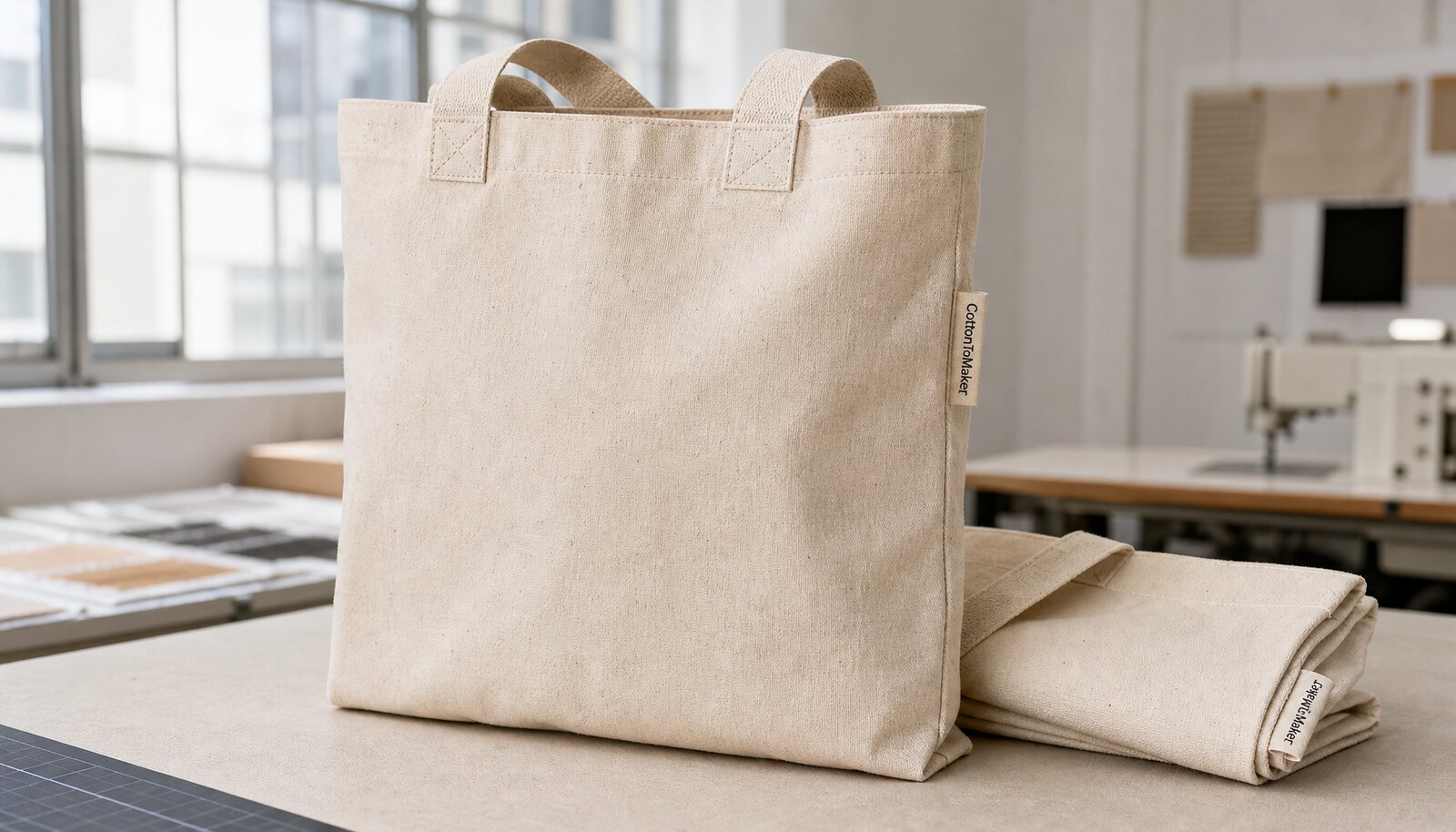
Why gift-shop totes fail in the field
Gift shops use totes differently from supermarkets or trade-show giveaways. A customer may buy the bag at the counter, fill it immediately with mixed purchases, then keep using it as an everyday carry bag. That means the first failure is often not a dramatic tear. More often, the tote starts looking tired too soon: handles stretch, seams pucker, the print loses sharpness, and the bag collapses after repeated folding and refilling.
That usage pattern changes the procurement question. The right tote is not just the one that looks good on a shelf; it is the one that survives the way a gift-shop customer actually handles it. If the load profile is not defined up front, suppliers will quote different assumptions, and the cheapest price will usually hide the weakest build.
For organic cotton totes durability testing checklist for gift shops, the first decision is to define the real merchandise mix. A tote for postcards and keychains can be lighter than one that needs to handle books, candles, glassware, or bundled gifts. The bag should be tested against the shop's actual carry scenario, not an abstract tote standard.
- Common field failures: handle stretch, seam opening, print abrasion, shrinkage, and shape loss after folding.
- Most common sourcing mistake: approving a flat sample that never gets loaded or packed the way it will be sold.
- Procurement takeaway: define the load, the carry style, and the shelf presentation before comparing quotes.
Set the bag spec before asking for price
Price only becomes meaningful after the product spec is locked. The RFQ should define the tote size, target GSM, weave or canvas type, handle construction, print area, pack format, and any organic claim wording. If those items are loose, suppliers will respond with quotes that are not directly comparable.
GSM is useful, but it is not enough by itself. A workable starting range is 140-160 GSM for low-load souvenir bags, 180-200 GSM for everyday retail use, and 200-240 GSM when the tote needs more body and a higher load tolerance. The right number depends on the merchandise mix, the price point, and the visual standard of the shop.
Weave and finish matter as much as weight. A tighter weave often gives better print sharpness and a more structured look, while a looser weave can feel softer but may distort sooner. If the bag is going to sit on a retail display, ask the supplier to show the approved sample under normal store lighting, not only on a white background photo.
Handle length should also be written into the spec. A tote that is meant to be carried by hand can use a shorter drop than one that should sit on a shoulder. Once that choice is made, keep it fixed across quotes, or the price comparison will be misleading.
- Use one numbered spec sheet for every supplier so GSM, size, handle drop, print area, and packing are identical.
- Treat weave, finish, and body structure as part of the quote, not as visual details to decide later.
- Write the intended carry mode into the spec: hand carry, shoulder carry, or mixed use.
- Ask the supplier to quote the same sample stage and approval process, or the lowest price will not be comparable.
Build the bag as one system, not separate parts
A durable tote is a system. Fabric weight, seam density, handle width, reinforcement, base shape, and print placement all interact. A strong body with weak handles still fails. A heavy handle on a soft body can distort the opening. A large logo placed across a fold line can look good in artwork proof and fail in real packing.
For gift shop programs, handle build usually deserves the most attention. Self-fabric handles are economical, but they need enough width to spread the load. Folded handles with bartacks or box-X reinforcement perform better when the tote carries books or bottled items. A boxed base or gusset can improve capacity, but it also changes how the bag folds and how the logo sits on the panel.
Seams should be treated as a structural feature, not a finishing detail. Double-needle seams, neat edge turns, and consistent stitch spacing reduce the chance of stress failure. If the bag is meant to be sold as a retail item, the workmanship should look deliberate from the inside as well as the outside. Loose thread ends, crooked seam lines, and uneven reinforcement are visible quality cues, even before the bag is loaded.
The print zone should be chosen after the construction is known. If the artwork crosses a fold, the buyer needs to know how that fold affects cracking and rub wear. A cleaner approach is to move the main graphic off the fold line by at least 10 mm and keep the highest-stress areas clear of dense ink or transfer edges.
- Specify handle width, handle drop, and reinforcement style in the RFQ.
- Ask for a boxed base or gusset only if the actual merchandise mix needs the extra volume.
- Keep artwork away from the fold line when possible; if not, test the packed state before approval.
- Review the inside stitching and reinforcement finish, not only the exterior view.
Use a durability test with clear pass and fail limits
A tote test should do more than lift the bag once and inspect it visually. For gift-shop buying, the useful test sequence is simple: measure the bag, load it with representative merchandise, repeat lift cycles, inspect seams and handles, check the print, and then test the folded packed state. The bag must survive the way it will actually be handled after purchase.
A practical RFQ default is 25 lift cycles at expected load, plus 5 more cycles at 110% of expected load for bags intended to carry books or bottles. During those cycles, look for seam opening, bartack failure, handle pull-through, or permanent distortion. A useful threshold is no seam opening at all, no handle elongation over 5%, and no shape distortion greater than 5 mm at the attachment point.
For print testing, use fold and dry-rub checks on the actual fabric, not just on a paper proof. A good starting requirement is 20 full fold cycles and 10 dry rub cycles with no visible cracking, peeling, or edge lift greater than 2 mm. If the tote will be washed, add the intended wash method and require shrinkage within 5% after the test cycle.
Body size, handle drop, and artwork position should also be checked after loading and after folding. If the bag is sold as a premium retail item, it should still sit flat, keep its shape, and look neat when unpacked. A tote that passes load but looks crushed in the carton is not a clean commercial result.
- Run the same test steps on every supplier sample so the price comparison stays fair.
- Use representative merchandise, not only sandbags or a single static weight.
- Set the rejection line before testing: open seam, handle failure, visible print cracking, or out-of-tolerance shrinkage.
- Repeat the test on bulk or top-of-production samples, because one good sample does not prove the run.
Compare tote builds side by side, not supplier routes
A useful comparison table should show product builds, not sourcing channels. The table above lets a buyer compare lighter souvenir totes, everyday retail bags, bottle-carry bags, short-run art bags, premium retail builds, and economy promo bags side by side. That view makes the tradeoffs visible: a higher GSM, wider handle, or stronger seam may improve durability, but it also changes cost, lead time, and folding behavior.
The point of the table is to normalize the decision. If one supplier quotes a 150 GSM light tote and another quotes a 220 GSM retail tote, those are not the same product. Likewise, a screen-printed logo and a transfer-applied logo have different failure modes. The quote should be compared by build, not by headline price.
For gift shops, the best answer is often the middle ground: enough fabric weight and reinforcement to handle real customer use, but not so much that the tote becomes stiff, expensive, or difficult to display. The right build is the one that matches the merchandise mix and the selling price, then holds that standard through bulk production.
- Use the same build line when comparing quotes, or separate the options into distinct product tiers.
- Read the table as a set of starting bands, not as fixed rules for every market.
- If the bag is meant for books, bottles, or bundled gifts, do not accept a light promo build just because it is cheaper.
Ask quote questions that expose hidden risk
A good tote quote should explain what it assumes. If the supplier does not name the fabric lot, print method, reinforcement style, or packing format, the quote may be hiding cost shifts that appear later as change orders. The real sourcing risk is not only a high unit price; it is a quote that looks complete but leaves key details open.
MOQ can also shift by component, not just by bag count. A factory may accept a low tote quantity but require a higher minimum for a custom label, a second print color, a special handle, or a different fold pack. That matters for gift shops testing seasonal designs or trying several artwork versions at once.
The most useful follow-up question is not 'what is your best price' but 'what are you assuming that I still need to verify.' That pushes the supplier to reveal where the quote is soft. Once those assumptions are visible, the buyer can compare one factory against another on equal terms.
Use the same logic for lead time. A single ship date is not enough. Ask for the critical path: fabric booking, sample approval, print setup, production start, packing, and final inspection. That schedule matters because a tote that misses the selling window is commercially weak even if the seams are perfect.
- Ask for MOQ by fabric color, print color count, label type, and packing format.
- Request the supplier's assumed fabric GSM, handle build, and QC standard in writing.
- Ask what changes will add cost or extend lead time before you approve the order.
- Treat a very low price as a prompt to identify which durability or QC item was reduced.
Verify organic claim and traceability, not just the sample
Organic cotton is a sourcing claim, a documentation claim, and a product label claim. Those are related, but they are not the same. A factory may work with certified input fabric and still need a clean paper trail to support the finished order. Buyers need to know exactly which step in the chain is certified: fiber, yarn, fabric, cut-and-sew, or final product.
Ask for the certificate scope, issuing body, expiration date, and the named company or site that is covered. Then compare that information with the supplier name on the quote, invoice, and packing list. If the factory is not itself certified, ask how the certified input is transferred into the order and what document links the material lot to the finished tote. Where applicable, request the transaction certificate or equivalent traceability document for the order.
This distinction matters because the bag's construction site and the organic input source may be different businesses. A valid certificate for the fabric mill does not automatically prove that every downstream party can make the same claim without documentation. The order should use wording that is supported by the actual chain of custody, not by a generic marketing phrase.
Organic traceability is separate from physical durability. A tote can be fully documented and still fail on seams, print wear, or shrinkage. That is why the compliance check and the durability test must both be written into the sourcing file.
- Confirm whether the claim covers fiber, yarn, fabric, or finished product.
- Match the certificate name, scope, site address, and expiration date to the order documents.
- Ask for transaction certificate handling or equivalent transfer records where applicable.
- Do not let an organic claim replace the physical durability requirements.
Approve samples by stage, not by a single hero photo
A tote is not approved until the bag, the print, and the packed unit have all been checked. A front-facing photo can hide problems that appear in the fold, the seam corners, or the carton. For gift shops, that matters because the customer sees the bag in retail form and then receives it packed, folded, and handled by a warehouse or counter staff.
The sample sequence should include a fabric swatch, a pre-production sample, and a top-of-production sample. The swatch confirms the base material. The pre-production sample confirms the construction and decoration method. The top-of-production sample confirms that the actual production run matches the approved version after setup and before the order is fully released.
Keep the sample record version-controlled. Size, handle length, print placement, thread color, label position, and fold pattern should all be frozen on the spec sheet. If the factory changes any of those items, even slightly, the sample should be re-approved. Small changes can alter shoulder carry, shelf presentation, and carton fit more than they first appear to.
Print approval should be done on the actual tote fabric, not on paper artwork alone. Check color density, registration, edge sharpness, and how the print behaves across the fold and handle stress areas. If the tote will be washed, add the wash method to the sample approval and review the result against the same acceptance limits used for bulk.
- Require three sample stages: fabric swatch, pre-production sample, and top-of-production sample.
- Freeze the spec sheet before approval so any later change is visible and controlled.
- Inspect the packed sample, because folding can damage print and shape even when the open sample looks fine.
- Keep close-up photos of seams, handles, labels, and print edges as part of the approval record.
Packing, labels, and cartons can change the outcome
Packing is part of product quality, not just a warehouse task. A folded tote can rub in transit, crease the print, or lose its shape if the fold pattern is too tight. If the bag is meant to arrive retail-ready, the packing format should be treated as a product spec from the beginning.
Ask for inner pack count, carton dimensions, and target gross weight in the quote. Those numbers affect freight, warehouse handling, and the chance of crushing or edge scuffing. If the printed area crosses a fold, request a packed sample and inspect whether the logo remains clean after unpacking. No print method should be assumed safe at the fold line without testing it in the packed state.
Labels and barcodes should also be planned early. A sewn label can improve shelf presentation, but it needs clean stitching and correct placement. Adhesive barcodes can leave residue or scuff the fabric if they are used too close to the print area. If the store needs inventory barcodes, ask for the barcode position and size in the RFQ so the supplier does not improvise later.
The simplest packing spec is usually the safest one: enough protection to prevent scuffing, a fold pattern that avoids the logo, and a carton size that allows the tote to arrive without being crushed flat. If the receiving process is wholesale rather than shelf-ready, bulk carton packing may be fine as long as the tote still looks presentable when unpacked.
- Test the bag in its folded and packed state, not only open on a table.
- Specify label type, barcode position, and carton mark format before production starts.
- Use a fold pattern that keeps the main logo away from crease lines whenever possible.
- Ask for photos of the packed sample from multiple carton positions, not only the top piece.
Release the order only after inspection is written down
Final release should be controlled by a clear inspection rule. If the team uses AQL, the major and minor limits should appear in the RFQ or purchase order. A common starting point is zero tolerance for critical defects, AQL 2.5 for major workmanship defects, and AQL 4.0 for minor cosmetic defects, but the buyer's own standard should take priority if it is stricter or more specific.
Critical defects usually include open seams, wrong size outside tolerance, missing labels, or a broken organic claim. Major defects include weak handles, noticeable print failure, heavy stains, or wrong carton count. Minor defects include loose threads, small puckering, or slight cosmetic variation that does not affect use. The factory needs to know which bucket each issue belongs in before shipment, or the discussion becomes subjective.
For larger orders, ask for a pre-shipment inspection against the approved sample and the signed spec sheet. The release file should include count reconciliation, carton marks, net and gross weight, and one retained sample. That record matters when reorders happen, because it gives the next production run a stable reference point.
Reorders should stay locked to the same revision. Any change to GSM, handle width, print method, label, or packing should trigger re-approval. Gift-shop totes are easy to simplify on paper and hard to control later if the revision history is loose.
- Write defect limits into the order so the factory knows what is critical, major, and minor.
- Use a retained approved sample and a signed spec sheet as the reference for reorders.
- Reject any shipment that changes the approved build without written re-approval.
- Treat packing and carton count as part of the release decision, not as a separate warehouse issue.
Specification comparison for buyers
| Product build | Typical GSM / fabric | Handle and seam build | Print method fit | QC outcome to expect |
|---|---|---|---|---|
| Light souvenir tote | 140-160 GSM plain weave or light canvas | 2.5 cm self-fabric handles, single- or double-needle seams, no gusset or shallow gusset | 1-2 color screen print or simple transfer | Passes 15-20 lift cycles at light retail load; accept only minor wrinkling, no seam opening, shrinkage within 6% |
| Everyday gift-shop retail tote | 180-200 GSM canvas or tight plain weave | 3 cm folded handles, bartacks or box-X at stress points, reinforced side seams | 1-3 color screen print, water-based print, or simple transfer | Should hold 25 lift cycles at expected load with no handle failure, no visible cracking after 20 fold cycles, shrinkage within 5% |
| Book and bottle tote | 200-240 GSM canvas | 3-4 cm handles, reinforcement patches, double-needle seams, boxed base | Screen print or limited-color transfer with artwork moved off the fold line | Pass 30 lift cycles at target load, no seam creep greater than 5 mm, print edges stay intact after rub and fold checks |
| Short-run art tote | 180-220 GSM canvas with stable finish | 3 cm handles and bartacks, standard gusset, consistent top stitching | Direct-to-film or other transfer for multi-color art, if rub tests are acceptable | Accept only if no edge lift, no peeling, and no visible print damage after 10 rub cycles and 15 folds |
| Premium retail tote | 220-240 GSM canvas or brushed finish | Wide handles, reinforcement patches, neat inside seams, tighter stitching tolerance | Screen print or embroidered logo for simple branding | Should look structured on shelf, resist distortion after loading, and keep dimensions within 1 cm of spec |
| Economy promo tote | 120-140 GSM light cotton | Narrow self-fabric handles and simpler seam build | 1-color screen print only | Only suitable for low-load giveaways; reject if the bag distorts, goes semi-transparent, or fails basic handle stress |
Buyer checklist before sampling
- Define the real carry load before asking for a quote. Separate a normal load from a worst-case load, such as books, bottles, or bundled gifts, so the supplier is not guessing.
- Start the spec with a fabric band, not a single GSM number. A useful starting point is 140-160 GSM for light souvenir bags, 180-200 GSM for everyday retail totes, and 200-240 GSM when the bag must carry heavier mixed merchandise.
- Lock the handle build in the RFQ: width, drop length, stitch method, bartacks or box-X reinforcement, and whether the handle is self-fabric or a separate webbing-style component.
- Set a load test target in numbers. A practical default for retail totes is 25 lift cycles at expected load, plus 5 additional cycles at 110% of expected load for book- or bottle-carry programs.
- Write pass/fail limits for seams and handles before samples arrive. Reject any seam opening, bartack failure, or permanent handle elongation over 5% after testing.
- Approve the print method by durability, not by appearance alone. Require no visible cracking, peeling, or edge lift greater than 2 mm after 20 fold cycles and 10 dry rub cycles.
- Require shrinkage data from the same fabric lot intended for bulk. Set the acceptable limit at 5% or less unless the tote is intentionally pre-shrunk and the display spec allows more movement.
- Ask for a pre-production sample, a top-of-production sample, and packed-sample photos. If any construction, print, label, or packing detail changes, re-approve the sample.
- Check organic claim support at the order level. Confirm certificate scope, transaction certificate handling where applicable, and whether the factory or only the input fabric is in scope.
- Specify carton details early: inner pack count, carton dimensions, gross weight target, and carton markings. Packing affects freight cost and also affects crease marks and print scuffing.
Factory quote questions to send
- What exact GSM will you quote, and what tolerance do you hold between the approved sample and bulk production lot?
- Is the cotton claim supported at fiber, yarn, fabric, or finished-product level, and will you provide the certificate scope and expiration details for the named company and site?
- If the factory is not itself certified, what traceability record links the certified input fabric to this specific order, color, and quantity?
- Who performs weaving or fabric sourcing, cutting, sewing, printing, and packing, and which steps are in-house versus outsourced?
- What is the handle width, handle length, stitch count, bartack count, reinforcement patch detail, and seam allowance on this tote?
- Which print method will you use, and what are your results for dry rub, fold-line cracking, edge lift, and wash performance if the tote is washable?
- What are your sample stages before bulk release, and can you provide a retained top-of-production sample plus packed-carton photos?
- What is the MOQ by fabric color, print color count, label type, and packing format, and which spec item raises the MOQ the most?
- What defect limits do you apply for loose threads, skipped stitches, open seams, stains, shade variation, print misregistration, and size deviation?
- Can you quote with carton dimensions, piece count per carton, net and gross weight, carton marks, and estimated freight volume included?
Quality-control points to confirm
- GSM should stay within plus or minus 5% of the approved sample unless the spec sheet states a different tolerance.
- Body dimensions should stay within 1 cm of the approved size, and handle drop should stay within 5 mm unless the tote is intentionally relaxed or prewashed.
- After a wash or steam check, shrinkage should remain within 5% in both directions for standard retail totes.
- Load testing should show no seam opening, no bartack failure, no handle pull-through, and no permanent distortion greater than 5 mm at the handle attachment points.
- Print should remain intact after 20 fold cycles and 10 dry rub cycles, with no visible cracking, peeling, or edge lift greater than 2 mm.
- Loose thread tails should be trimmed to a defined limit, usually 5 mm or less, and skipped stitches should not appear in any critical seam or reinforcement area.
- Handle attachment should be symmetrical left to right, with matching reinforcement placement and no twisting when the bag is loaded.
- Fabric shade and print color should match the approved strike-off or top-of-production sample, with no obvious panel-to-panel mismatch in the same carton.
- Packed totes should not show oil marks, crushed corners, severe fold creases across the print area, or contamination from packing materials.
- Carton count, inner pack count, labels, and carton marks should match the purchase order exactly, with no unexplained substitution.