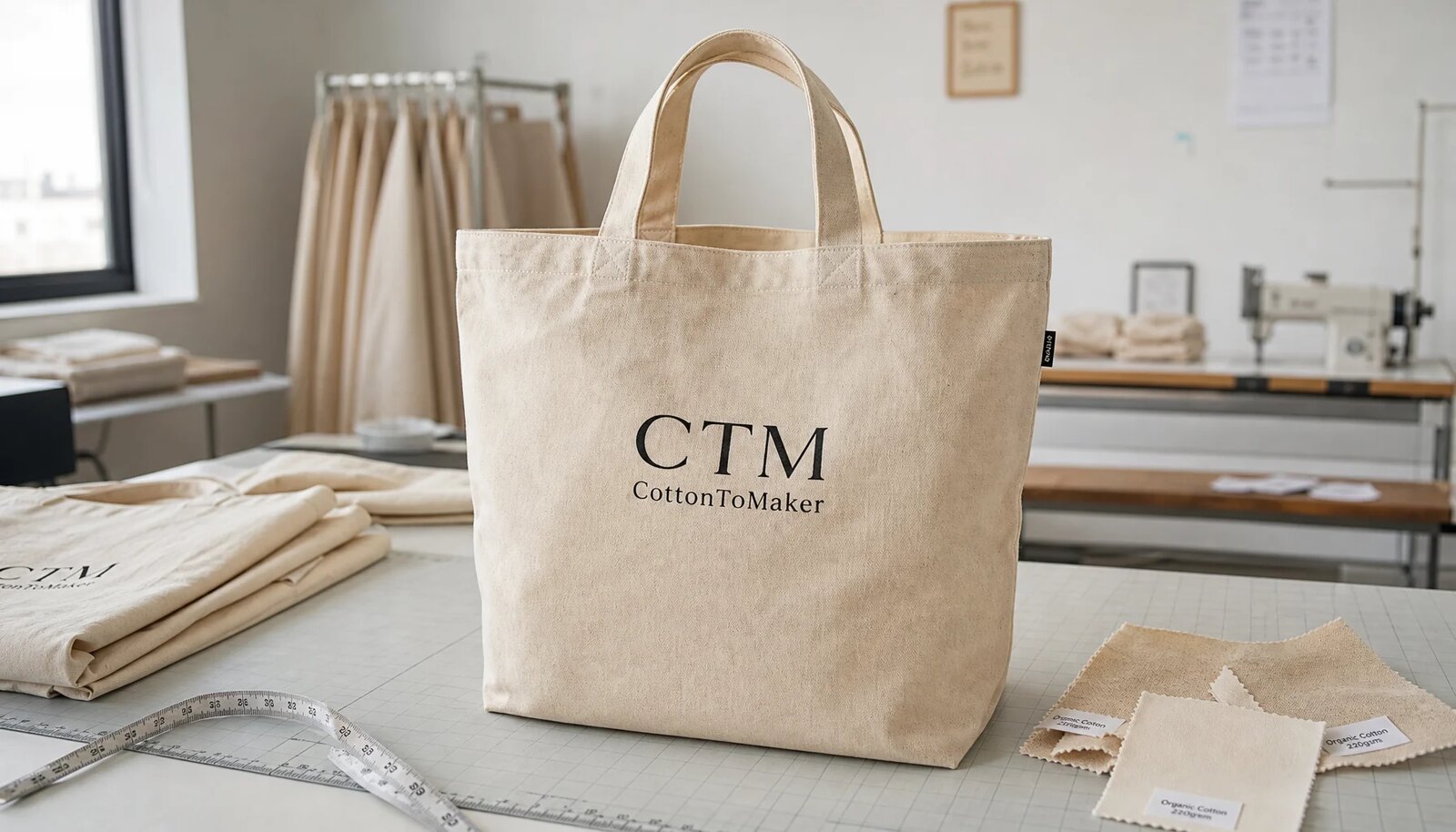
Start With the Craft Fair Load
A practical durability program begins with what customers actually put in the tote. Craft fair purchases are uneven and often rigid: a candle tin presses into one corner, a mug shifts against the side seam, and a stack of small books pulls directly on the handles. A tote used for postcards and T-shirts is a different product from a tote expected to carry jars, ceramics, boxed soap sets, or vendor kits.
Before comparing suppliers, write the use case in plain operational language. Is the tote a low-cost handout, a reusable shopping bag, a branded merchandise item, or part of a booth kit that must look clean on arrival? This matters because procurement risk is not only a broken bag. It includes customer complaints, dirty natural cotton, late repacking, damaged print, and cartons that are too heavy for event staff.
- Set a working load before sampling: light paper goods, mixed retail purchases, or heavier craft fair items.
- List example contents so the factory understands shape and stress, not only total weight.
- Use a safety margin when goods are rigid, sharp-edged, or likely to collect in the bottom corners.
- Test the finished tote with final handles, seams, print, label, and packing fold.
- Treat sold merchandise more strictly than free one-day giveaways because buyer expectations are higher.
Choose Fabric Weight by Use
Organic cotton tote quotes often look comparable until the fabric weight is checked. A 6 oz tote may photograph well and carry flat paper items, but it is not the same product as a 10 oz or 12 oz canvas tote. For craft fair retail use, 10 oz finished organic cotton canvas is often the balanced specification because it gives a sturdier handfeel without making cartons excessively heavy. A 12 oz option can be useful for premium totes or heavier goods, but it increases unit cost, sewing difficulty, carton weight, and freight cost.
Ask for finished fabric weight, not only greige fabric weight. Dyeing, washing, enzyme finishing, and pressing can change weight, shrinkage, surface feel, and final dimensions. If the order depends on a certified organic claim, fabric weight and documentation should be checked together because a substitute fabric may solve a delivery problem but create a compliance problem.
- 6 oz / about 180 GSM: use for lightweight giveaways, not heavy merchandise unless tested.
- 8 oz / about 240 GSM: suitable for moderate reuse and compact packing.
- 10 oz / about 270-300 GSM: strong general choice for reusable craft fair totes.
- 12 oz / about 340 GSM: premium and sturdy, but raises freight cost and carton handling risk.
- Require finished GSM on the sample report and inspection checklist.
Make Organic Claims Verifiable
Organic cotton wording should be specific enough for purchasing, marketing, and compliance teams to use consistently. The phrase organic cotton tote can mean different things: certified finished product, certified fabric made into a tote, a material claim supported by supplier paperwork, or simply a natural-looking cotton bag with no certification. These are not equal claims, and they should not be priced as if they are.
Buyers should request documentation before approving the purchase order, not after production. At minimum, ask what certification standard applies, which company is certified, what product scope is covered, and what shipment documents can be supplied. The supplier’s certificate should be current, relevant to the process being claimed, and consistent with invoice and label wording. If transaction documentation is required by the buyer or retailer, confirm who can issue it and when.
- Ask for the supplier certificate and verify the company name, validity date, scope, and product category.
- Clarify whether certification covers fabric production, dyeing, printing, sewing, trading, or finished product handling.
- Request transaction or material documentation where needed for the buyer’s claim and retailer files.
- Align product label, hangtag, invoice, packing list, and website wording before production.
- Avoid upgrading marketing language beyond what the supplier documents can support.
Engineer the Handles and Seams
Most tote failures occur where stress concentrates: handle attachment, top hem, bottom seam, side seam, and gusset corners. A heavier fabric will not compensate for short handle stitching, narrow seam allowance, skipped stitches, or weak thread tension. Craft fair customers also twist handles, wear bags on the shoulder, hang them from booth hooks, and set loaded bags on the ground, so the construction must survive more than a single lift.
Specify construction details that a factory can actually build and inspectors can verify. Handle width affects comfort and strength. Handle length determines whether the tote is hand carry or shoulder carry. Cross-box or X-stitch reinforcement spreads stress better than a short straight seam. For retail-grade totes, the inside finish should look clean, but it must also resist seam slippage after the load test.
- Specify handle length, handle width, top hem depth, stitch density, and thread color.
- Use cross-box, X-stitch, or reinforced bar-tack construction for heavier craft fair loads.
- Check the bottom seam and corners with rigid items, not only soft fabric weights.
- Set a seam allowance requirement and inspect for loose threads, skipped stitches, and needle damage.
- Keep the approved sample as the standard for handle placement and reinforcement size.
Use Clear Durability Test Parameters
A strong organic cotton totes durability testing checklist for craft fairs should include measurable steps. Static hanging shows whether the bag fails immediately, but it does not show what happens when a shopper walks, swings the tote, sets it down, and picks it up again. The test should combine static load, repeated lifting, swing simulation, seam inspection, and print review after fabric flexing.
The exact load depends on the tote’s intended use. For light promotional totes, a 3 kg working load may be enough. For general craft fair purchasing, many buyers use a 5 kg target. For heavier items such as candles, small books, jars, and ceramics, 8 kg may be more realistic. The test load can be set above the working load for safety, but the method and pass/fail standard must be written before sampling.
- Static load: hang the finished tote with the agreed weight for 30 minutes; inspect immediately and again after 10 minutes of rest.
- Lift cycle: lift and set down the loaded tote 25-50 times at normal speed; check handle base and top hem.
- Swing test: swing the loaded tote 50-100 gentle cycles, about one cycle per second, without violent jerking.
- Pass standard: no handle tearing, open seam, fabric split, broken reinforcement, or bottom seam failure.
- Conditional pass: minor wrinkles are acceptable, but visible seam slippage, stitch popping, or print cracking should trigger revision.
- Record sample version, load weight, test duration, cycle count, photos, inspector name, and date.
Test Print Durability Separately
Print failure can make a structurally sound tote unacceptable. Craft fair totes rub against tables, cartons, denim, coats, display hooks, and other bags. Natural and undyed cotton can also show smudges easily. For organic-positioned products, water-based screen printing is popular because it has a softer handfeel, but it still needs proper curing and rub resistance.
Choose the print method based on artwork, order size, handfeel, and durability requirements. Screen printing is efficient for repeat logos and simple color counts. DTF and heat transfer work for detailed artwork or short seasonal runs, but they should be tested for edge lifting and flex cracking. Embroidery can look premium on 10 oz or 12 oz canvas, but it may pucker lighter fabric if backing and stitch density are not controlled.
- Require artwork size, color count, Pantone references, print placement, and placement tolerance.
- Run dry rub and light wet rub checks on the approved print before bulk production.
- Flex the printed panel after the load test to see whether ink cracks when the fabric bends.
- Use tape pull or peel testing for transfers where the method is applicable.
- Confirm curing time, heat-press temperature, pressure, and dwell time when relevant.
- Reject dirty print edges, ink strike-through, excessive handfeel, color migration, or inconsistent opacity.
Sample Approval Should Be Physical
A photo sample is useful for design discussion, but it is not enough to approve production durability. A proper pre-production sample should use final bulk fabric, final handle construction, final stitching, final print method, final label, and final packing style. If any part is temporary, the sample should be marked design reference only, not production approved.
Measure the sample in the same way the final inspection will be performed. Record width, height, gusset, handle length, handle width, top hem, stitch density, fabric weight, print position, label position, carton fold, and visible shade. If the tote will be used in booth kits, test how it looks after being folded and unpacked because deep creases on heavy canvas can slow event setup.
- Approve one sealed pre-production sample as the production standard.
- Attach fabric swatch, print swatch, label sample, and packing reference to the approval file.
- Measure finished dimensions after sewing and pressing, not only from the pattern.
- Repeat load and print checks if the factory changes fabric lot, thread, ink, or handle construction.
- Do not release bulk cutting if the final material differs from the approved sample.
Understand MOQ and Cost Drivers
MOQ is shaped by more than factory preference. It can come from organic fabric sourcing, dye lots, cutting efficiency, print setup, woven label production, packing labor, and carton planning. A supplier may offer a low MOQ for natural blank totes but require higher minimums for dyed fabric, custom handles, individual packing, or multi-color screen printing.
For fair comparison, separate the cost of the tote body from setup and customization costs. A quote using 12 oz certified organic cotton, cross-box handles, water-based print, woven label, paper band, and export cartons is not comparable with a quote for 8 oz natural cotton, basic stitching, and bulk packing. Buyers should also check freight impact because heavier fabric can make a low unit price less attractive once landed cost is calculated.
- Break out fabric, cutting, sewing, printing, labels, packing, sample fees, and screen charges.
- Ask whether price changes at 500, 1,000, 2,500, or 5,000 pieces.
- Check whether dyed fabric or certified material has a separate MOQ from sewing.
- Compare carton CBM and gross weight, not only unit price.
- Ask which costs are one-time setup charges and which apply to repeat orders.
Plan Packing for Event Operations
Packing affects cost, cleanliness, freight, and event setup time. Craft fair totes may ship to a distributor, a retail store, a brand warehouse, or directly to an event team. Flat packing in bundles of 25 or 50 pieces is efficient for booth allocation and bulk distribution. Individual packing can protect a retail product but adds labor, material cost, carton volume, and sustainability questions.
Heavier organic cotton canvas can crease when over-compressed, especially during long transit. Natural cotton also shows dirt, moisture, oil marks, and carton dust more easily than dark synthetic bags. Buyers should set carton weight limits and request carton dimensions early so freight and warehouse teams can plan receiving, storage, and repacking.
- Use 25-50 piece flat bundles for fast booth setup and distributor handling.
- Use paper bands or belly bands when retail presentation matters but individual bags are not needed.
- Use individual packing only when cleanliness, retail sale, or fulfillment requirements justify the extra cost.
- Keep carton gross weight practical for manual handling and reduce crushing risk.
- Request carton quantity, dimensions, gross weight, and CBM before quote approval.
Compare Suppliers by Landed Risk
The best supplier is not always the lowest unit price. For craft fair totes, procurement teams should compare durability, documentation, schedule reliability, carton data, and rework readiness. A low quote can become expensive if fabric weight is lower than stated, organic documents are incomplete, cartons are too heavy, or the print fails after handling.
Build the schedule backward from the required arrival date, not the factory ship date. Include time for sample approval, material booking, lab dips if dyed, print setup, bulk sewing, inspection, packing, export handling, customs clearance, inland transport, and event kit preparation. If the tote is late, the buyer may lose inspection time or pay for air freight, so the quote should include realistic lead-time milestones.
- Compare quotes under the same delivery term, such as EXW, FOB, CIF, or DDP.
- Collect lead times for sampling, material booking, bulk production, inspection, and shipment separately.
- Ask whether inspection can occur before final packing to allow faster rework.
- Confirm quote validity because cotton, dyeing, labor, and freight costs can change.
- Choose the supplier that provides clear specifications, test evidence, document support, and carton data.
Specification comparison for buyers
| Spec decision | Recommended option | When it fits | Buyer risk to check |
|---|---|---|---|
| Light giveaway tote | 6-8 oz / about 180-240 GSM finished organic cotton | Brochures, postcards, flat paper goods, apparel samples, or low-cost event handouts | Low carton weight and lower unit cost, but weaker handle tear resistance; do not use for jars, ceramics, or books without load testing |
| General craft fair retail tote | 10 oz / about 270-300 GSM finished organic cotton canvas | Most reusable vendor bags, handmade goods, small retail purchases, and branded merchandise | Confirm finished GSM after dyeing, washing, or finishing; some quotes state greige fabric weight before processing |
| Premium heavy-duty tote | 12 oz / about 340 GSM finished organic cotton canvas | Candles, small books, boxed goods, ceramics, or higher-value merchandise where a sturdy handfeel matters | Higher material cost, slower sewing, heavier cartons, higher freight, and more visible creasing if over-compressed |
| Handle reinforcement | Self-fabric or cotton webbing handles with cross-box or X-stitch reinforcement | Shoulder-carry totes and programs expecting repeated reuse | Reject simple straight stitching unless a loaded sample passes the agreed static and swing tests |
| Bottom and side seams | Inside overlock plus lockstitch, bound seam, or French seam depending on price point | Retail-grade totes where the interior finish is visible to customers | Inspect seam slippage after load testing; clean inside finishing does not guarantee strength |
| Print method for simple logos | Water-based screen print with documented curing control | Organic-positioned branding, repeat orders, single to medium-color artwork | Run dry rub, light wet rub, and flex checks; under-cured ink can look acceptable before handling |
| Print method for detailed artwork | DTF, heat transfer, or embroidery after approval testing | Short runs, many colors, gradients, seasonal artwork, or premium decoration | Transfers may lift or feel heavy; embroidery can pucker thinner fabric; test peel, flex, and fabric distortion |
| Organic documentation | Clear claim level plus supplier documents before PO release | Brands that market the tote as organic cotton or need retailer compliance files | Request certificates, scope details, transaction or material documentation where applicable, and consistency between invoice, labels, and packing list |
| Packing format | Flat packed in 25-50 piece bundles, paper-banded sets, or individual retail packing | Distributor replenishment, booth kits, retail display, or direct event delivery | Packing changes carton CBM, labor cost, plastic use, freight cost, and unpacking speed at the fair |
Buyer checklist before sampling
- Define the real use case: free handout, vendor merchandise, retail shopping bag, booth kit, or premium reusable tote.
- List expected contents such as paper goods, apparel, candles, jars, mugs, ceramics, books, boxed products, or mixed purchases.
- Set a target working load, for example 3 kg for light goods, 5 kg for mixed purchases, or 8 kg for heavier craft fair items.
- Specify finished fabric weight in oz and GSM, not only organic cotton, canvas, or natural cotton.
- State the organic claim level: certified finished product, certified fabric, organic cotton material claim, or non-certified natural cotton style.
- Set finished bag dimensions, gusset if required, handle length, handle width, seam type, and reinforcement pattern.
- Require a physical pre-production sample made with final fabric, final print, final label, final stitching, and final packing fold.
- Use written durability checks: static load duration, lift cycles, swing cycles, inspection timing, and pass/fail criteria.
- Check print durability with dry rub, light wet rub, flexing, tape pull if applicable, and visual inspection after load testing.
- Compare quotes with carton quantity, carton dimensions, gross weight, CBM, setup charges, document availability, and delivery term.
Factory quote questions to send
- What is the finished fabric weight in GSM and oz after dyeing, washing, or finishing?
- Is the cotton certified organic, and what certificate, scope, and shipment documents can be provided for this order?
- Will the invoice, packing list, labels, and product description use the same organic claim wording?
- What are the MOQ and price breaks for blank totes, printed totes, dyed fabric, woven labels, paper bands, and individual packing?
- Which seam construction will be used on the side seams, bottom seam, gusset, top hem, and handle attachment?
- What handle width, handle length, stitch density, and reinforcement pattern are included in the quoted price?
- What load test has this construction passed, including test weight, static duration, swing count, and inspection result?
- Which print method do you recommend for the artwork, and what curing, rub, wash, peel, or flex checks will be applied?
- What are the placement tolerances for the front print, side label, care label, and any inside branding?
- Can the pre-production sample use final bulk fabric, final ink, final stitching, final label, and final packing?
Quality-control points to confirm
- Finished fabric weight within agreed tolerance, commonly plus or minus 5 percent unless the buyer sets a tighter range.
- Fabric composition and organic claim documentation match the purchase order, approved sample, invoice, label, and packing list.
- Bag width, height, gusset, top hem, and handle length are measured after sewing and pressing, not from pattern only.
- Handle width, stitch density, cross-box dimensions, and reinforcement placement match the approved pre-production sample.
- Static load test shows no handle tearing, seam opening, fabric splitting, or obvious deformation after the agreed weight and duration.
- Swing test shows no seam slippage, broken threads, handle distortion, or bottom seam failure after the agreed cycle count.
- Print passes dry rub, light wet rub, hand flexing, and peel or tape pull where relevant without cracking, lifting, or color transfer beyond the approved limit.
- Logo placement stays within approved tolerance from top edge, side edge, and center line across inspected cartons.
- Natural cotton shade, dyed color, print color, odor, and surface cleanliness remain within the approved sample range.
- Cartons are dry, export-suitable, correctly marked, not overloaded, and packed in the approved quantity per bundle and per carton.