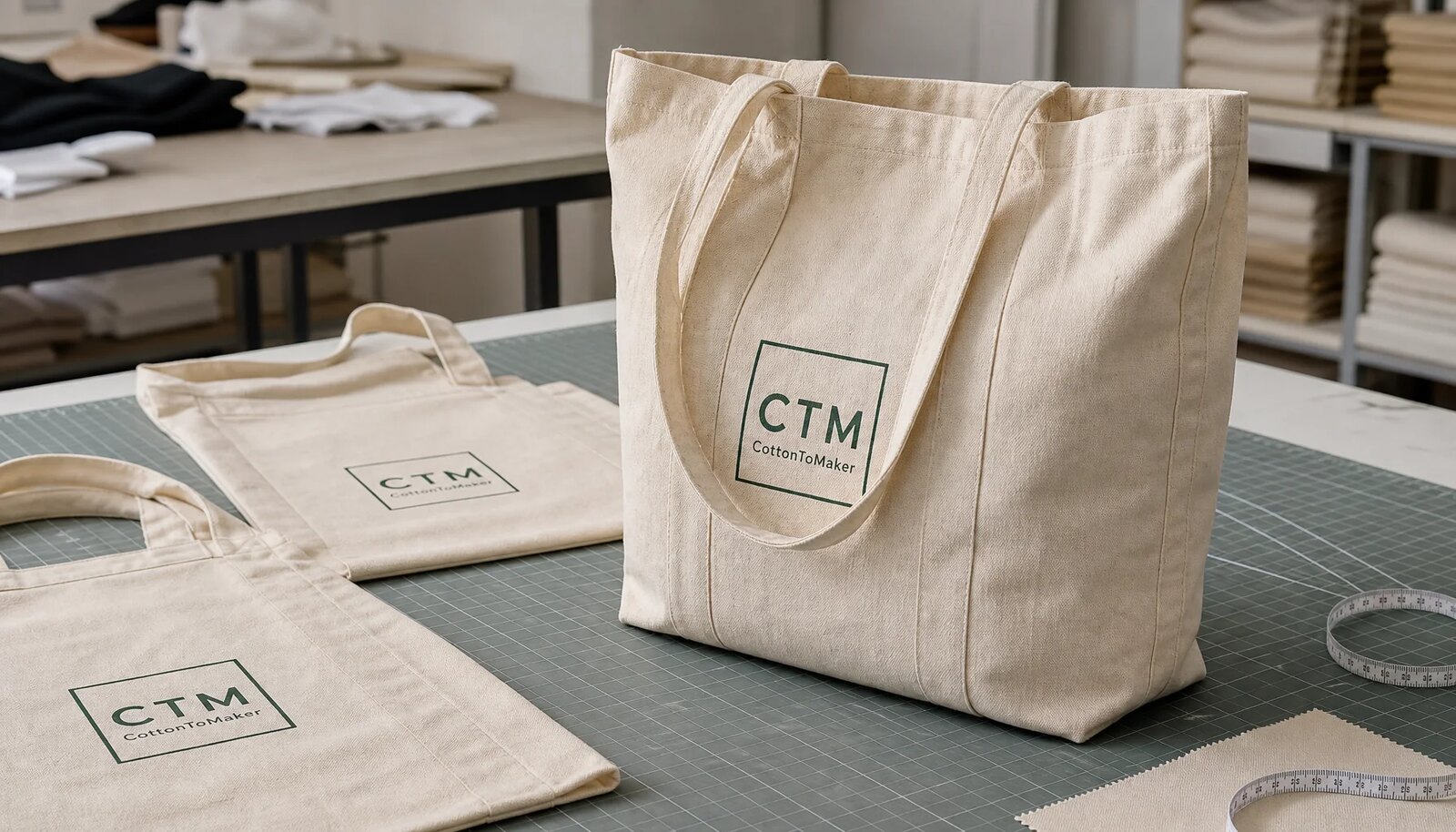
Start With Finished-Bag Placement, Not A Mockup
Logo placement on organic cotton totes for craft fairs has to be written like a production spec. A digital mockup can help everyone understand the look, but it is not enough for purchasing, sampling, or inspection. These bags are stacked on tables, hung from hooks, folded into retail packs, filled with jars or books, and carried over the shoulder. A logo that looks centered on screen can sit too close to the top hem once the bag is sewn, or look slightly crooked when the finished top edge becomes the shopper’s visual reference.
Give the supplier reference points that still exist after production. The most reliable ones are the finished top opening, the finished left and right side seams, the bottom edge or bottom fold, and the visible front-panel centerline. Avoid vague instructions such as "print in the middle" unless the artwork file is backed by millimeter measurements. State the logo width, logo height, distance from the top opening to the top of the artwork, horizontal centerline rule, side clearance, and acceptable tolerance.
For a common 38 x 42 cm flat tote, a good starting spec is a front-center logo 180-240 mm wide, with the top of the artwork 90-120 mm below the finished opening. That range keeps the print below the top hem and handle stitch area while keeping it visible when the bag hangs. Adjust from there. A narrow vertical logo may need a higher top-distance control. A round badge is easier to manage by specifying diameter and center point. A long wordmark may need optical centering, not only mathematical centering.
- Measure placement on finished sewn bags, not cut panels, CAD patterns, or mockups.
- Use millimeters for logo size, top distance, side clearance, and tolerance to reduce conversion mistakes.
- Set a front-panel centerline from finished side seams, then state whether the logo is optically or mathematically centered.
- Attach a technical sketch to the PO showing top edge, centerline, logo size, restricted zones, and tolerance.
- Ask whether printing happens before sewing, after sewing, or after pressing because each route affects placement control.
- Request first-bulk approval before the factory prints the full quantity.
Choose Fabric Weight Before Final Artwork Approval
Fabric weight changes the way a tote prints, folds, ships, and feels in the buyer’s hand. In RFQs, cotton tote fabric may be quoted in GSM or ounces per square yard. As a practical reference, 7 oz/yd² is about 237 GSM and 10 oz/yd² is about 339 GSM. Ask the factory to confirm the unit and the test basis, because informal ounce descriptions do not always match measured fabric weight.
For craft fair retail, maker merchandise, sponsor bags, and higher-value giveaways, 7-10 oz organic cotton canvas is usually a stronger choice than lightweight plain cotton. The front panel has more body, the screen holds cleaner edges, and the finished tote feels more reusable. Lightweight 140-180 GSM bags can still be useful for budget handouts, but they wrinkle more easily under print pressure, show contents through the fabric, and may not support a premium craft-market position.
Do not assume heavier is automatically better. A 12 oz canvas can feel substantial, yet it also adds fabric cost, seam bulk, needle wear, carton gross weight, freight cost, and drying time after printing. Thick folds can run across a printed area if the bag is packed tightly. The cleanest procurement comparison is to ask for two or three fabric weights using the same dimensions, same logo, same packing method, and same trade term, so unit price and logistics impact are visible together.
- 140-180 GSM: use for low-cost handouts, small logos, and limited load expectations.
- 220-260 GSM: use for practical reusable totes where cost and structure need balance.
- 280-340 GSM: use for craft fair retail, boutique merchandise, and larger front prints.
- 360 GSM and above: use only when premium handfeel justifies higher sewing and freight cost.
- Confirm whether GSM is tested before or after washing, dyeing, calendaring, or finishing.
- Approve fabric shade and texture because natural organic cotton may show seed flecks, slubs, neps, and shade variation.
Map Safe Zones Around Seams, Handles, And Gussets
The printable area is always smaller than the visible front panel. Top hems, handle stitch boxes, side seams, bottom folds, labels, and gussets all reduce the zone where a logo can be printed consistently. If artwork sits too close to these areas, the printer may need slower loading, custom fixtures, or looser tolerance. Ink can also break or look uneven when the screen crosses a thick seam or fold.
On a flat 38 x 42 cm tote, keep the main logo at least 25-35 mm from finished side seams and 60-80 mm above the bottom fold. Keep it clear of handle reinforcement boxes and top hem stitching. If the tote has side gussets, inspect the logo on an empty bag and on a filled bag because the front panel expands. If it has a bottom gusset, avoid putting the key brand mark too low; the logo may curve under the bag once shoppers add bulky craft fair purchases.
Two-sided printing needs separate instructions. The back panel may not behave exactly like the front if labels, seams, or handle attachments differ. If one side carries a sponsor mark and the other carries marketplace branding, specify each side with its own print size, top distance, centerline, color, and carton identification. That detail helps prevent mixed versions and placement disputes at receiving.
- Keep primary artwork away from side seams, gusset folds, bottom folds, handle attachments, and label seams.
- For side-gusset totes, inspect the logo on both an empty bag and a filled bag.
- For bottom-gusset totes, avoid placing the main brand mark in the lower fold zone.
- For handle printing, approve a sample because narrow, curved, stitched handles are harder to feed consistently.
- For side labels, specify folded size, sewing allowance, label orientation, and distance from top or side seam.
- For two-sided totes, write separate front and back placement rules in the PO.
Match Print Method To Artwork And Brand Risk
Water-based screen printing is often the best fit for organic cotton craft fair totes with one-color to three-color vector artwork. It gives a softer handfeel than heavy plastisol and works well for repeat orders once screens are made. Still, it has limits. On unbleached organic cotton, colors can look softer than they do on white fabric. Fine details may break over canvas texture, especially around slubs or raised yarns.
Plastisol can improve opacity, particularly on darker dyed cotton, but it leaves a heavier handfeel and may not match a natural organic positioning. Heat transfer can reproduce gradients, small type, or many colors, yet it may feel like a film and can show edge lift or cracking if the transfer is not matched to fabric and washing expectations. Embroidery can look premium for a small mark, but dense stitching can pucker lighter cotton and is rarely economical for large filled logos.
Artwork should be reviewed before final pricing. Fine lines, tiny lettering, distressed textures, halftones, large solid ink areas, and tight multi-color registration all affect setup, yield, drying, and inspection. Ask the supplier to confirm minimum line thickness, minimum readable text height, number of screens, color reference method, expected color variation, and whether the chosen print method can hold the requested placement tolerance on the selected fabric.
- Use water-based screen print for clean logos, simple typography, soft handfeel, and repeat programs.
- Use plastisol only when stronger opacity matters more than a low-handfeel finish.
- Use heat transfer for detailed or full-color graphics after approving handfeel, fold behavior, and edge durability.
- Use embroidery for small premium marks, not large dense artwork on lightweight canvas.
- Use woven or printed labels when subtle folded-display branding matters more than a large front logo.
- Require final-fabric strike-offs for dark inks, dyed fabric, multi-color artwork, or strict brand color targets.
Set Tolerances The Factory Can Inspect
Tolerances are where tote orders often become unclear. Buyers may expect retail-level precision, while the factory assumes normal movement from cutting, sewing, pressing, and screen printing. Organic cotton canvas can shift at every stage. If the tote is printed after sewing, seams and handles make it harder to position the finished bag on the platen. If panels are printed before sewing, the logo may move after hemming and assembly. Either method can work, but the tolerance must match the process.
For many commercial orders, +/-10 mm on finished-bag logo placement is a practical starting point. Premium programs may request +/-5 mm, but that needs supplier confirmation because it can require tighter cutting, sewing, fixtures, and inspection. Print size tolerance should be written separately; logo width may be controlled within +/-2-3 mm depending on the method. Skew also needs its own rule. A logo can be in the right spot and still look tilted.
Defect classification should be agreed before production starts. Critical defects may include safety or legal issues such as contamination, incorrect certification claim, or sharp foreign objects. Major defects can include wrong logo, placement outside tolerance, severe stains, open seams, broken handles, ink transfer, and mixed SKUs. Minor defects may include small thread ends, slight natural slub variation, or minor print imperfections within the approved standard. If a third-party inspection is planned, state the sampling plan and AQL levels in advance, such as critical 0, major 2.5, and minor 4.0, only when those levels fit the buyer’s risk tolerance.
- Define placement tolerance from the finished top opening and side seams, not raw panel edges.
- Set separate tolerances for logo position, logo size, print skew, finished bag size, handle length, and gusset depth.
- Use +/-10 mm for normal commercial placement unless the factory confirms tighter control in writing.
- Classify natural cotton flecks and slubs separately from stains, oil marks, mildew, dirt, and water marks.
- State whether inspection follows the buyer’s standard, the supplier’s standard, or a third-party AQL plan.
- Stop first-bulk output if logo position, color, opacity, or curing differs from the approved sample.
Build Quotes Around Real Cost Drivers
A low unit price is not useful when the quote hides setup charges, carton limits, packing materials, or certification assumptions. Organic cotton totes have many cost drivers: fabric weight, fabric availability, certification scope, tote size, gusset construction, handle length, print method, number of colors, artwork versions, labels, packing, inspection, and freight term. Ask suppliers to itemize these elements so bids can be compared on the same basis.
Logo placement can also change cost. A standard front-center print on a flat panel is efficient. A logo close to a seam, handle, gusset, or bottom fold may need slower positioning and produce more rejects. Two-sided printing doubles handling and requires more drying space, print startup checks, and carton separation. Side labels add label MOQ, color approval, folding, cutting, and sewing labor. Retail packing adds barcodes, hangtags, paper bands, inner packs, and receiving controls.
Plan repeat orders during the first quote, not after the first shipment. Craft fair programs often reorder for seasonal markets, regional events, sponsor updates, or maker collections. Ask whether screens are retained, how long they are stored, and whether repeat setup fees apply. If several logo versions share one tote body, request price breaks by total quantity and by version quantity so procurement can see where setup and handling costs are absorbed.
- Compare unit price, setup charges, carton weight, carton volume, and freight term together.
- Ask for realistic price breaks, such as 300, 500, 1,000, 2,500, and 5,000 pieces, if those volumes match demand.
- Quote each artwork version separately, including screen charge, strike-off, packing identification, and minimum per version.
- Separate fabric, printing, label, sample, packing, carton, documentation, and local delivery costs.
- Confirm whether quoted organic status includes transaction certification or only organic cotton fabric sourcing.
- Ask whether screens, labels, and packing materials can be reused on reorders.
Verify Organic Cotton Claims Before Artwork Locks
Organic wording matters in B2B sourcing. A tote can be made with organic cotton fabric without the finished product being certified under a specific chain-of-custody program. If the buyer wants to market the tote as GOTS-certified, the supplier must support the required certification scope and documentation, not simply purchase organic yarn or fabric. If the buyer only needs wording such as "made with organic cotton," the documentation requirement may be different, but it still belongs in the RFQ.
Ask which documents will be available with the shipment. Depending on the claim and market, these may include a fabric certificate, scope certificate, transaction certificate, packing list, commercial invoice, and inspection report. Do not let printed artwork, hangtags, or carton labels make a stronger claim than the documentation supports. For that reason, the logo placement approval should also include any organic, recycled, compostable, or sustainability wording printed on the tote.
Natural organic cotton has appearance characteristics that inspection teams need to understand. Unbleached fabric can show seed flecks, shade variation, slubs, and neps. These are not automatically defects. They must, however, be separated from oil stains, mildew, dirt, rust, water marks, or handling contamination. Approve an appearance standard with swatches or sample photos, then write that standard into the PO.
- Clarify whether the order requires GOTS transaction certification, organic cotton fabric documentation, or buyer-specific material records.
- Check that product claims on logos, labels, hangtags, and cartons match the documents available from the supplier.
- Approve acceptable natural cotton shade range, seed flecks, slubs, neps, and weaving variation before bulk production.
- Do not use certification logos unless the buyer and supplier have the right documentation and approval process.
- Keep certification and material documents tied to PO number, SKU, fabric lot, and shipment quantity.
- Include organic claim wording in artwork approval if the tote print includes sustainability language.
Sample Under Production Conditions
A pre-production sample should prove the production method, not just look attractive in a photo. It should use the final organic cotton fabric, final GSM, final print method, final ink, final logo size, final handle length, final label if any, final stitch construction, and proposed packing method. A digital proof can confirm layout. It cannot show fabric absorption, ink edge quality, panel movement, handle drop, shade variation, or carton compression effects.
Make the approval record measurable. Record finished bag width and height, gusset depth, handle length and drop, top hem width, logo width and height, distance from top opening, distance from side seams, ink color reference, fabric shade reference, seam type, label position, and packing format. Mark the approved sample with PO number, date, SKU, version, and buyer signature or seal. Then the factory, buyer, and inspector are judging against the same physical reference.
Add simple handling checks when the tote will be sold or used as reusable merchandise. Load it with the type of goods it will carry at craft fairs: books, candles, jars, ceramics, prints, or catalogues. If the bag will be folded through the logo, approve the fold mark. If dark ink is printed on natural cotton, stack or compress samples after curing to check transfer. If the tote will hang on a display, inspect how the logo sits when the handles carry weight.
- Approve physical samples, not only photos, for final logo placement and fabric handfeel.
- Measure and record all placement dimensions from the fully sewn, pressed tote.
- Keep sealed reference samples with the buyer, factory, and inspection company if used.
- Approve first-bulk pieces at print startup before mass printing continues.
- Test folding, rubbing, carton compression, and realistic loading when the tote is retail merchandise.
- Treat changes after sample approval as formal revisions with updated cost, lead time, and tolerance confirmation.
Inspect Construction As Closely As The Print
Craft fair totes usually disappoint users because of weak construction, not because the logo is a few millimeters off. Shoppers may load one bag with pottery, books, framed prints, glass jars, candles, food items, or catalogues. If the handle attachment tears or the bottom seam opens, the print quality no longer matters. The product specification should include seam construction, thread quality, reinforcement method, handle width, handle length, and intended load expectation.
Common handle reinforcements include box stitch, cross stitch, bar-tack, or multiple rows of stitching. The right choice depends on fabric weight, handle width, and expected load. Do not write "strong handles" and hope the supplier interprets it correctly. Ask the factory to state the construction and propose a static load or pull test. A practical commercial check may use a 10-15 kg static load for 60 seconds when appropriate for the bag design, but the buyer should confirm the method against intended use and fabric weight.
Inspection should cover appearance and function. Finished size should be measured after sewing and pressing. Handle length and handle drop matter because short handles can push the logo under the arm and reduce usability. Side seams, bottom seam, top hem, skipped stitches, needle holes, thread trimming, odor, stains, and carton shortages should be on the inspection checklist. A tote can look good on a table and still fail in the field.
- Specify handle width, handle length, handle drop, stitch pattern, and reinforcement method in the PO.
- Measure finished bag size after pressing because cotton can shift during sewing and handling.
- Check skipped stitches, open seams, seam slippage, loose threads, needle damage, and uneven top hems.
- Inspect handle attachment with the agreed static load or pull method before shipment.
- Confirm handle length supports shoulder carry if the tote is meant for craft fair shopping.
- Reject odor, mildew, oil marks, dirty panels, rust marks, and wet cartons as major risks.
Control Packing, Cartons, And Receiving
Packing can turn an acceptable tote into a customer-facing defect. Fresh screen print must be fully dried or cured before tight stacking. Dark ink can transfer to natural cotton under pressure, heat, or humidity if curing is incomplete. Folding directly through a large print can create a permanent crease or crack depending on ink type and fabric thickness. Approve packing during sampling, not after the bags have already been printed.
Flat packing protects the front-logo appearance and makes counting easier at craft fair distribution points, but it increases carton volume. Folded packing improves carton efficiency, though it may crease the print. Retail packing may require paper bands, recyclable polybags, hangtags, barcode stickers, size labels, country-of-origin labels, or SKU-specific cartons. Each added element affects cost, lead time, and inspection, so it belongs in the RFQ.
Carton control becomes important when a program has multiple logo versions, event cities, sponsor designs, or retail SKUs. Carton marks should include PO number, SKU, logo version, fabric color, print color, size, quantity, carton number, destination, and gross weight if required. Ask for carton dimensions and weight early for freight planning. Set a maximum carton gross weight that receiving teams can handle safely, often around 15-20 kg depending on buyer requirements and local handling rules.
- Approve whether bags ship flat, half-folded, bundled, individually packed, paper-banded, or polybagged.
- Avoid folding through the main logo unless the fold appearance is approved on the pre-production sample.
- Use separation sheets or clean paper when dark ink transfer risk is identified.
- Confirm pieces per bundle, pieces per carton, carton dimensions, carton gross weight, and carton marks.
- Keep different logo versions in clearly marked cartons unless mixed packing is explicitly approved.
- Check carton count, carton condition, SKU labels, barcodes, and destination marks before shipment release.
Specification comparison for buyers
| Spec decision | Recommended option | When it fits | Buyer risk to check |
|---|---|---|---|
| Front-center logo placement | Set the top of the logo 90-120 mm below the finished bag opening and center it on the finished front panel, not on the cut panel | Works for standard 38 x 42 cm craft fair totes, sponsor bags, maker merchandise, and table or peg display | If measured before hemming, pressing, or sewing, the print can finish 10-20 mm higher or off-center; require finished-bag measurement |
| Logo size on standard tote | Keep main artwork about 180-240 mm wide on a 38 x 42 cm flat tote; use 140-180 mm for subtle boutique branding | Balances visibility, fabric movement, print cost, and inspection consistency | Oversized prints increase ink use, drying time, fold cracking risk, and visible placement variation |
| Fabric weight | Use 7-10 oz cotton canvas, approximately 237-339 GSM, for most craft fair retail and reusable giveaway programs | Provides better panel stability than lightweight plain weave while keeping carton weight manageable | Ask whether quoted GSM is before or after washing, finishing, or calendaring; handfeel can differ at the same GSM |
| Lightweight budget option | Use 140-180 GSM only for low-cost event handouts with small logos and limited load expectations | Fits short campaigns where unit cost and low freight weight matter most | Fabric can wrinkle under screen pressure, show contents, feel less retail-ready, and need looser QC expectations |
| Printable safe zone | Keep artwork at least 25-35 mm from side seams, 60-80 mm from bottom folds, and clear of handle stitch boxes | Improves repeatability across bulk production and reduces broken ink near seams | Artwork close to seams may require custom fixtures, slower loading, and wider placement tolerance |
| Print method | Use water-based screen print for 1-3 color vector logos on natural or dyed organic cotton canvas | Good fit for soft handfeel, repeat orders, and organic-positioned merchandise | Color can appear muted on unbleached cotton; approve a strike-off on final fabric with Pantone or lab-dip reference |
| Placement tolerance | Set normal finished-bag logo position tolerance at +/-10 mm; request +/-5 mm only for premium programs after supplier confirmation | Suitable for manual sewing and screen printing where fabric movement is expected | Tighter tolerance may raise reject rate or cost; define whether tolerance applies to top edge, centerline, skew, or all three |
| Print quality tolerance | Define rejectable smears, pinholes, poor opacity, ink transfer, skew, and wrong print size before production | Useful for simple natural totes where defects are highly visible | Without defect definitions, suppliers may treat light ink voids, fiber show-through, or slub-related breaks as acceptable |
| Side label option | Add woven or printed side label only when folded display, boutique retailing, or secondary branding requires it | Useful for premium craft brands that want subtle identification | Label MOQ, color approval, folding direction, side seam tolerance, and sewing labor can change cost and schedule |
Buyer checklist before sampling
- Define finished tote size, gusset type, handle length, seam construction, fabric GSM or oz/yd², shrinkage tolerance, intended load, and whether the claim is organic cotton, GOTS-certified, or made with organic cotton.
- Send vector artwork in AI, EPS, SVG, or print-ready PDF with outlined fonts, final logo width and height in millimeters, Pantone or approved color references, and a placement diagram measured from finished bag edges.
- Mark restricted zones in the RFQ: top hem, handle stitch box, handle reinforcement, side seam, bottom fold, gusset panel, label seam, and any area that must not receive print pressure.
- Ask suppliers to quote fabric weight options separately, such as 237 GSM, 280 GSM, and 339 GSM, with estimated pieces per carton, carton gross weight, and unit price for each option.
- State the required placement tolerance, print-size tolerance, print-skew tolerance, finished-size tolerance, handle-length tolerance, and acceptance standard before sampling, not after bulk production.
- Approve a pre-production sample made with final organic cotton fabric, final ink, final artwork size, final handle length, final label if any, final stitching, and intended packing method.
- Keep one signed or sealed approved sample with the buyer, one with the factory, and one with the third-party inspector if inspection is planned; mark date, PO number, SKU, fabric lot, and print method.
- Separate one-time screen/setup charges, sample charges, organic fabric surcharge, dyeing or bleaching cost, label cost, hangtag cost, inner packing cost, carton cost, inspection cost, and freight term in the quote.
- Confirm whether MOQ is driven by fabric roll quantity, organic certification chain-of-custody, dye lot, cutting efficiency, print setup, label weaving, carton packing, or factory scheduling.
- Specify flat pack or folded pack, pieces per bundle, pieces per carton, maximum carton gross weight, carton markings, polybag policy, paper band needs, barcode position, and mixed-SKU rules.
Factory quote questions to send
- Which organic cotton standard can you support for this order: transaction-certified GOTS product, organic cotton material claim, or conventional production using organic cotton fabric only? What documents are included?
- What fabric constructions are available in stock for natural organic cotton totes, and which require greige weaving, bleaching, dyeing, washing, or special finishing before cutting?
- Can you quote the same 38 x 42 cm tote at approximately 237 GSM, 280 GSM, and 339 GSM, including unit price, estimated carton quantity, carton size, gross weight, and production lead time?
- For our logo at 220 mm wide, what is the maximum safe printable area after top hemming, handle stitching, side seam sewing, bottom folding, and gusset expansion?
- Will the logo be printed on cut panels before sewing, on finished sewn bags, or after pressing? How will you ensure the approved placement is correct on finished goods?
- What logo placement tolerance can you hold on finished bags: +/-5 mm, +/-10 mm, or more? Does it change near side seams, bottom gussets, handle stitch boxes, or labels?
- Which print method do you recommend for this artwork: water-based screen print, plastisol, discharge print, heat transfer, embroidery, woven label, printed label, or digital print? Why?
- What are the setup charges per color and per artwork version? Are screens stored for reorder, and for how long, if the same artwork size and print position are repeated?
- Can you make a pre-production sample using final organic cotton fabric, final ink, final logo size, final handle length, final label, final stitch construction, and final packing method?
- What inspection standard do you use for print defects, seam defects, stains, odor, fabric shade, size deviation, handle attachment, carton shortage, and mixed-SKU packing?
Quality-control points to confirm
- Measure logo placement on finished, sewn, pressed bags from the finished top opening, left and right side seams, and bottom edge; do not inspect only unsewn panels or digital mockups.
- Check the logo top distance, horizontal centerline, logo width, logo height, and baseline skew against the approved sample and PO tolerance.
- Use +/-10 mm as a practical commercial placement tolerance unless the approved sample and supplier process justify +/-5 mm; record the agreed tolerance in the PO.
- Check print skew by comparing the logo baseline to the top hem; reject pieces that exceed the agreed skew limit or look visibly tilted in normal viewing.
- Inspect opacity, edge sharpness, pinholes, broken lines, registration, smears, fingerprints, ink splash, and poor curing under consistent neutral lighting.
- Rub-test dark ink on natural cotton after curing and after carton compression to identify dry crocking, transfer, or blocking risk before shipment.
- Classify natural seed flecks, slubs, and neps separately from oil stains, mildew, dirt, rust marks, water marks, and handling contamination.
- Measure finished bag width, height, gusset depth if any, handle length, handle drop, seam allowance consistency, and top hem width according to the approved size spec.
- Check handle attachment with a realistic static load, such as 10-15 kg for 60 seconds if appropriate for the construction, or use the buyer-approved test method.
- Inspect bar-tacks, cross-stitches, box stitches, side seams, bottom seam, thread trimming, needle damage, skipped stitches, and seam slippage.