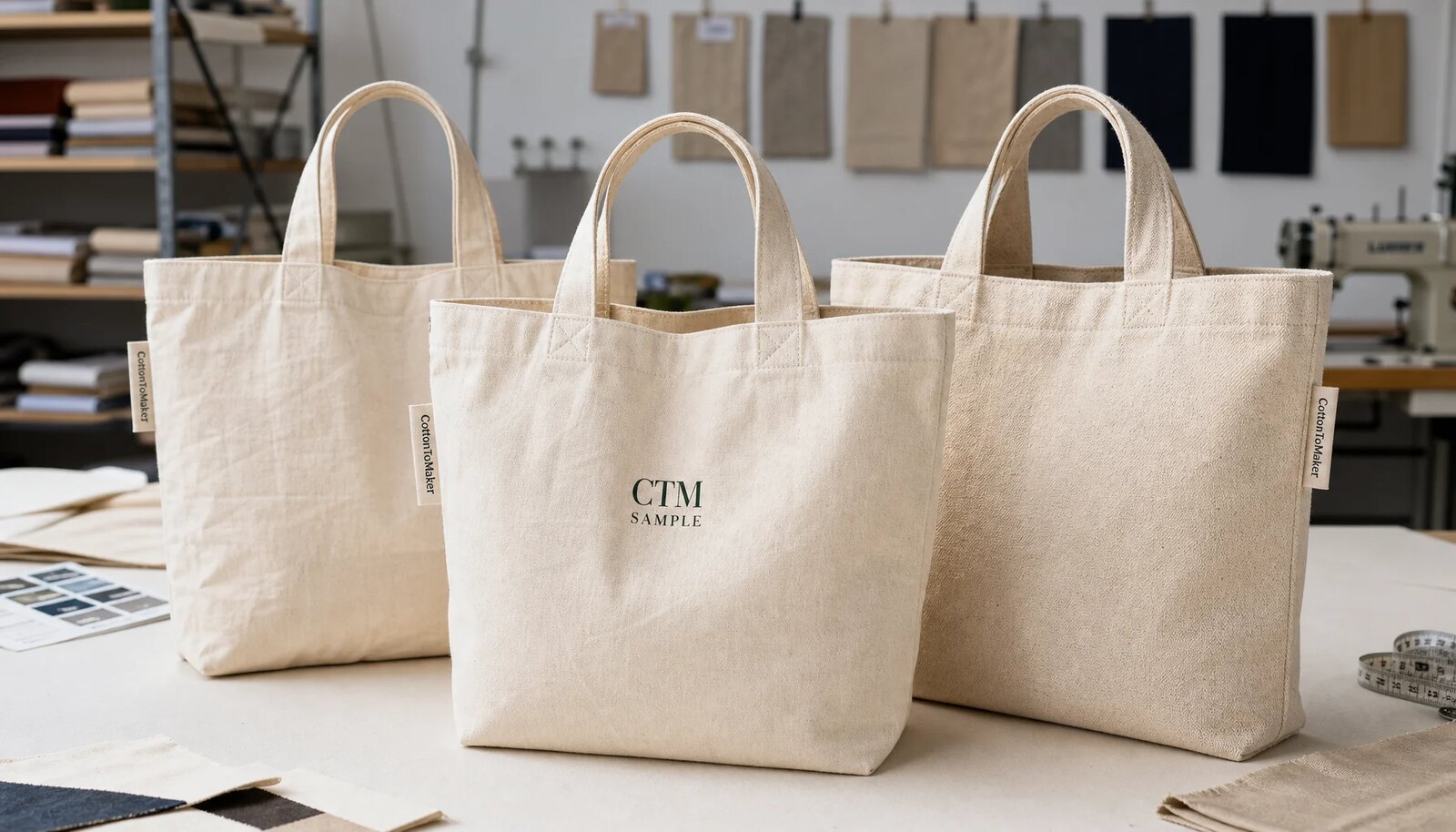
Start with the Tote’s Job, Not Only GSM
GSM is usually the first number buyers ask for when sourcing organic cotton totes for craft fairs. It matters, but it is only the starting point. GSM means grams per square meter, so it describes fabric weight before the bag becomes a finished product. It does not, on its own, confirm carrying strength, print coverage, shrinkage behavior, handle comfort, sewing quality, or retail presentation. A 220 GSM plain weave tote can feel soft and flexible. A 220 GSM canvas tote can feel firmer because the yarn and weave construction behave differently. Two suppliers can quote the same GSM and still deliver different bag sizes, handle strength, cotton shade, carton quantities, and landed cost.
Craft fair use is unusually varied. One attendee may use the tote for a program, postcards, and business cards. Another may load it with candles, jars, books, boxed craft kits, folded textiles, ceramics, packaged food, or several small purchases from different booths. The bag also has to look right in a crowded retail setting. It may sit on a booth table, hang from a display rail, or be sold as branded merchandise. For procurement teams, the stronger RFQ ties fabric weight to the actual job: expected contents, target load, finished size, gusset, handle design, seam construction, print method, packing method, and inspection criteria. A brief that says only “organic cotton tote, 220 GSM, logo print” leaves too many decisions to the factory and makes quotes difficult to compare.
- Define the use case first: event giveaway, craft fair shopping bag, paid merchandise tote, or heavy product carrier.
- State expected contents and estimated load before selecting 160, 200, 240, 280, or 320 GSM.
- Compare weave, bag size, gusset, handle reinforcement, stitch density, print method, and carton data together.
- Ask suppliers to quote several GSM options using the same body size, artwork size, packing method, and delivery term.
- Approve production only after checking a finished sample made with the final fabric and print method.
Choose the Fabric Weight Range by Use Case
The right fabric weight depends on physical performance and brand position. For an event organizer handing out thousands of welcome bags, 140-160 GSM organic cotton plain weave may be enough when the tote carries a program, coupons, light inserts, and a few samples. It keeps fabric consumption and freight lower. It can also look thin if the bag is large, if the cotton is very light in shade, or if the artwork needs strong coverage. For booth checkout, museum shops, bookstores, artisan retail, and maker markets, 180-220 GSM is often a safer middle range. It gives the tote more body without turning it into a heavy canvas product.
For paid retail totes, gift shop merchandise, subscription packaging, candle brands, ceramic studios, and premium craft fair programs, buyers often move into 240-320 GSM. The tote becomes part of the product experience, not just a carrier. That said, the range is not a rigid rule. A small 180 GSM tote with good reinforcement may outperform a large 220 GSM tote with narrow handles and weak seams. A 280 GSM canvas tote can be excessive for prints and postcards, yet appropriate for jars, books, or boxed kits. Treat the GSM range as a shortlist, then verify with a finished sample and a load test that reflects real use.
- 140-160 GSM: brochures, event packs, light samples, and low-cost attendee distribution.
- 180-220 GSM: apparel, stationery, cards, candles, small gifts, and most standard craft fair shopping.
- 240-280 GSM: paid totes, gift shops, subscription packs, and branded merchandise that needs better body.
- 280-320 GSM: jars, books, ceramics, boxed kits, glass containers, and heavier reusable shopping bags.
- Flat totes: efficient to pack and ship, but limited for bulky purchases.
- Gusseted totes: better capacity and base stability, with higher fabric use, sewing time, and carton volume.
Specify Weave, Finish, and Tolerance
GSM measures weight, not construction. Organic cotton plain weave is generally more flexible and economical, which makes it practical for lightweight promotional totes and lower-cost retail bags. Organic cotton canvas is usually more structured and often gives a cleaner display shape. Washed canvas creates a softer lifestyle look, but washing can increase variation in shade, texture, and finished dimensions if shrinkage is not controlled. Dyed organic cotton can support a stronger brand palette, though it may require lab dips, fabric MOQ planning, additional shade checks, and longer lead time.
Procurement teams should make tolerances part of the specification, not a late inspection argument. Ask the supplier what range it can consistently hold for GSM, shade, finished size, and print placement. Some buyers use a GSM tolerance such as +/-5% when the supplier can support it, but the important point is written agreement. State whether GSM is measured on greige fabric, finished rolls, or production lots before cutting. Finished dimensions should be listed in centimeters for width, height, gusset depth, handle drop, and handle width. Print placement should also be controlled from the top edge and centerline. The sample becomes much more useful when everyone knows what variation is acceptable.
- Name the fabric: plain weave, canvas, washed canvas, dyed canvas, natural unbleached cotton, bleached cotton, or pre-shrunk fabric.
- Request GSM tolerance and confirm the measurement stage, especially for washed or finished fabrics.
- Specify finished size tolerance for width, height, gusset depth, handle drop, and handle width in centimeters.
- Control shade by approving a swatch or lab dip and keeping a sealed reference for production comparison.
- For repeat orders, keep the same fabric construction, supplier reference, shade standard, and approved finished sample.
- If the tote is washed or garment-finished, agree wider tolerances before bulk production rather than after inspection.
Build Strength into the Bag, Not Just the Cloth
A tote fails at the weakest point. Fabric weight helps, but handle width, handle drop, seam type, stitch density, thread quality, reinforcement method, and bottom construction decide how the finished bag behaves under load. Narrow handles can cut into the hand when the bag carries books or jars, even if the canvas itself is heavy. Long handles are useful for shoulder carry, but they add fabric use and can look awkward on a small tote. Gussets improve capacity and help the bag sit better when filled, yet they also add seam lines that need clean sewing and inspection.
For general craft fair shopping totes, a handle width around 2.5-3.0 cm is a practical starting point. Heavier product totes may need wider handles, reinforced patches, box stitching, cross stitching, bar tacks, or another approved reinforcement. Avoid vague language such as “strong handles” or “good stitching.” Ask the factory for its standard stitch density per inch or centimeter, then confirm it on the sample. If the tote is expected to carry heavy goods, include a finished-bag load test in the purchase order. Testing fabric strips does not prove that handle attachments, gusset seams, and bottom seams will hold after the bag is sewn.
- Specify handle width, handle drop, handle material, reinforcement shape, and stitching method.
- Define side seams, bottom seam, gusset seam, and top hem instead of relying on sample photos.
- Ask for the supplier’s stitch density standard and confirm it on the approved pre-production sample.
- Match handle drop to the use: hand-carry for compact bags, shoulder-carry for retail shopping totes.
- Use finished-bag load testing for heavy contents; do not rely only on fabric GSM or supplier assurance.
- Inspect handle joints and bottom seams closely because they are common failure points under craft fair loads.
Match Print Method to Artwork and Fabric
Craft fair totes often carry event branding, maker logos, seasonal illustrations, sponsor graphics, or retail artwork. The right decoration method depends on fabric weight, weave texture, cotton shade, artwork size, line detail, color count, and target hand feel. Water-based screen printing works well for one to three solid colors on natural or light organic cotton, especially when the buyer wants a soft finish. But lighter fabric can absorb ink and reduce opacity. Coarser canvas can soften fine lines. Large solid print areas need closer attention to coverage, curing, and final hand feel.
DTF transfer, digital print, and embroidery solve different problems. DTF can handle full-color artwork and small multi-design runs, but buyers should check adhesion, edge quality, cracking, flexibility, heat marks, and whether the transfer feels too heavy on a light tote. Digital printing can suit complex illustrations, although color accuracy and durability depend on the fabric surface and process control. Embroidery can look premium on heavier canvas, but it may pucker lighter cotton unless backing, stitch count, and placement are tested. The safest approval rule is simple: approve the artwork on a finished tote made with the exact production fabric, not on paper, not on a different cotton weight, and not on a loose swatch only.
- Water-based screen print: best for soft logos, simple color counts, natural cotton branding, and repeat programs.
- Higher-opacity ink systems: useful for stronger coverage, but confirm hand feel, curing, and cracking risk.
- DTF transfer: useful for full-color craft fair graphics; check adhesion, cracking, edge quality, and flexibility.
- Digital print: useful for complex art; approve color accuracy, fine-line sharpness, and surface durability on the actual cotton.
- Embroidery: best for small premium marks on 240 GSM+ canvas or tested lower GSM fabric with backing.
- For every method, define print placement tolerance, artwork size, color reference, and inspection criteria.
Structure MOQ Around Real Production Drivers
MOQ is not only a supplier’s sales preference. It is shaped by fabric purchasing, cutting yield, print setup, sewing-line planning, trims, packing, carton marks, and inspection work. A buyer may think of the order as 2,000 totes. The factory may see four artwork versions, two fabric colors, three packing methods, and multiple delivery splits. Each variation adds setup time, sorting risk, and potential rework. This is why 2,000 identical bags can quote very differently from 2,000 bags divided into many customized lots.
The most efficient B2B structure is usually one common tote body with controlled artwork variation. Keep the fabric weight, size, gusset, handle length, handle width, thread color, and packing method consistent wherever possible. Then quote artwork versions separately for screens, transfers, sorting, and carton labeling. If every craft fair customer needs a different dyed fabric, custom size, handle length, GSM, barcode label, and packing method, the project becomes several small productions rather than one efficient bulk run. Ask suppliers to break MOQ down by component so sales, marketing, and procurement can decide which customization is worth the cost.
- Lowest-risk structure: one fabric, one size, one handle spec, one packing method, and multiple printed logos.
- Higher-cost structure: mixed GSMs, many fabric colors, small artwork lots, separate packing rules, and multiple carton mark sets.
- Screen print MOQ pressure: each artwork and color may require screens, alignment, curing, cleanup, and approval.
- Fabric MOQ pressure: custom dyed organic cotton normally needs more planning than natural or standard shade cotton.
- Packing MOQ pressure: barcodes, belly bands, paper sleeves, inserts, and individual packaging add labor and sorting.
- Ask the supplier to separate MOQ by fabric, print method, artwork version, packing method, and shipment split.
Compare Landed Cost, Not the Lowest FOB
A low FOB price can hide an incomplete specification. A higher price may be justified if it includes organic cotton documentation, better fabric control, reinforced stitching, controlled printing, retail-ready packing, and reliable carton data. Buyers should request a quote format that separates the main cost drivers: GSM, weave, finished size, gusset depth, handle length, handle width, print method, print color count, artwork versions, setup charges, sample charges, packing style, carton dimensions, carton CBM, gross weight, net weight, and delivery term. Without that detail, the comparison is not clean.
Fabric consumption is often the largest cost driver, and it changes quickly. Moving from 200 GSM to 280 GSM, adding a 10 cm gusset, widening handles, or increasing body size can affect both unit price and freight. Print and packing also influence landed cost. Individual polybags, barcode labels, belly bands, paper sleeves, smaller carton quantities, and special carton marks add labor and sometimes carton volume. For procurement teams, the useful number is cost per sellable tote after setup, sampling, inspection, freight, receiving efficiency, and rejection risk are considered.
- Fabric cost: GSM, weave, fabric width, cutting yield, organic cotton documentation, shrinkage treatment, and cutting waste.
- Construction cost: gusset, handle length, handle width, top hem, seam type, reinforcement, thread, and trimming standard.
- Print cost: artwork size, color count, screens, transfers, curing time, ink type, rejection allowance, and artwork versions.
- Packing cost: bulk bundles, inner bags, individual bags, belly bands, sleeves, labels, inserts, carton grade, and carton quantity.
- Documentation cost: organic cotton certificates, transaction records, labeling controls, buyer compliance files, and inspection reports.
- Landed-cost check: compare FOB, setup charges, sample charges, CBM, gross weight, delivery schedule, and inspection plan together.
Use Samples to Lock the Standard
A disciplined sample route prevents many disputes because the buyer and factory are approving the same physical standard. Start with fabric swatches when GSM, shade, weave, or surface finish is still open. Move to a blank sample to review finished size, gusset, handle drop, handle width, seam construction, reinforcement, and overall hand feel. Once artwork is ready, request a printed sample using the final print method, print size, cotton shade, and production fabric. For important bulk orders, the final approval should be a pre-production sample that includes fabric, print, stitching, trimming, folding, labels, packing, and carton presentation.
The approved sample should be sealed and treated as the production reference. Keep one sample with the buyer or distributor and one with the factory. If a third-party inspector is involved, make sure the inspector can compare bulk goods against the approved sample. Any change after approval should be documented in writing and reflected in cost, lead time, and QC criteria. Common changes include moving from 200 to 240 GSM, changing cotton shade, adjusting handle drop, enlarging the print, adding individual packing, or requesting extra organic cotton documentation. Informal sample changes are a common source of production arguments.
- Fabric swatch approval: GSM, weave, shade, finish, hand feel, shrinkage treatment, and visible fabric defects.
- Blank sample approval: size, gusset, handle drop, handle width, seam type, reinforcement, symmetry, and sewing quality.
- Printed sample approval: color, opacity, placement, registration, curing, surface feel, rub result, and artwork scale.
- Pre-production sample approval: final fabric, print, stitching, trimming, folding, labels, and packing.
- Sealed sample control: retain matching samples for buyer, factory, and inspector reference.
- Change control: revise quote and lead time if GSM, fabric color, artwork, handle spec, packing, or documents change.
Write QC Criteria Before Production Starts
Most tote bag claims are predictable: finished size variation, weak handles, uneven printing, shade mismatch, open seams, skipped stitches, loose threads, dirty fabric, mildew odor, poor folding, barcode errors, and carton damage. These issues are easier to prevent when acceptance criteria are written into the purchase order before production. Instead of saying “print centered,” specify the print position from the top edge and centerline with an agreed tolerance. Instead of saying “strong handles,” specify the reinforcement method and finished-bag load test. Instead of saying “good fabric,” specify GSM tolerance, shade standard, and defect limits.
Inspection can follow an agreed AQL standard or a buyer-specific defect list. Critical defects may include contamination, mold, incorrect artwork, unsafe foreign objects, or wrong certification labeling. Major defects may include open seams, broken handles, severe stains, wrong size outside tolerance, poor print curing, or incorrect carton count. Minor defects may include small loose threads, slight creases, or small print imperfections within the approved standard. Define the categories before inspection so the factory, inspector, and procurement team use the same pass/fail logic.
- GSM check: measure production fabric by roll or batch and record actual results against the agreed tolerance.
- Size check: inspect width, height, gusset, handle drop, handle width, top opening, and symmetry after sewing.
- Print check: verify placement, color, opacity, registration, curing, edge sharpness, cracking, and dry rub resistance.
- Stitch check: reject open seams, skipped stitches, broken threads, seam slippage, loose reinforcement, and needle damage.
- Load test: test complete bags with agreed weight, duration, sample quantity, and pass/fail criteria.
- Cleanliness check: reject visible oil, dirt, mildew odor, transfer stains, heavy lint, foreign material, and wet cartons.
Control Packing, Documents, and Schedule
Packing affects freight cost, receiving speed, storage condition, and resale presentation, so it belongs in the RFQ. Lightweight organic cotton totes can often be bulk flat packed in larger carton quantities. Heavy canvas totes may need fewer pieces per carton to avoid over-compression, hard creases, carton bulging, or handle distortion. Event organizers may prefer counted bundles that can be opened quickly at check-in. Retailers may require barcodes, individual packaging, paper bands, or clean presentation folds. Ecommerce sellers may need individual protection for fulfillment. Each choice changes labor, material cost, carton CBM, and warehouse handling.
Organic cotton documentation and schedule control should be confirmed before quote approval. Some buyers only need supplier documentation for internal procurement records. Others may need transaction certificates, scope certificates, controlled labeling, or specific chain-of-custody files depending on their marketing claims and compliance process. These requirements can affect lead time and administration, so they should not be added after production starts. For fixed craft fair dates, build a reverse calendar from the event deadline and include sample approval, fabric booking, printing, sewing, inspection, export booking, customs clearance, domestic delivery, and warehouse receiving.
- Packing data: request pcs/carton, carton dimensions, CBM, gross weight, net weight, folding method, carton marks, and pallet preference.
- Plastic-reduction options: counted bundles, bulk inner bags, kraft belly bands, paper sleeves, or carton liners where suitable.
- Retail packing: confirm barcode format, label position, individual packing, hangtags, inserts, and presentation fold before quoting.
- Moisture control: use dry cartons, suitable inner protection, clean storage, and inspection for odor or dampness before shipment.
- Certification control: confirm required organic cotton documents, label wording, and transaction records before purchase order release.
- Schedule control: count lead time from approved sample, approved artwork, confirmed packing, payment arrangement, and available fabric.
Specification comparison for buyers
| Spec decision | Recommended option | When it fits | Buyer risk to check |
|---|---|---|---|
| Entry promotional tote | 140-160 GSM organic cotton plain weave; finished size tolerance should be agreed in centimeters before sampling | Attendee welcome bags, brochure carriers, vendor inserts, light samples, or short-use event giveaways where unit cost and freight efficiency matter most | May look thin, wrinkle easily, and show weaker print opacity; approve the exact cotton shade, artwork size, and ink system on a finished sample |
| Standard craft fair shopping tote | 180-220 GSM organic cotton canvas or heavy plain weave; 2.5-3.0 cm handle width is a practical starting point for general retail use | Maker markets, museum shops, bookstore counters, artisan retail, and booth sales carrying apparel, cards, candles, small gifts, or packaged goods | GSM does not prove strength by itself; check handle reinforcement, stitch density, bottom seam, and finished-bag load test results |
| Retail merchandise tote | 240-280 GSM organic cotton canvas with reinforced handle patches, box stitching, cross-stitching, or another approved reinforcement | Paid tote programs, branded merchandise, gift shop resale, subscription packaging, and brands that want the bag to feel more substantial on display | Higher fabric consumption raises FOB and freight; request carton CBM, gross weight, net weight, and pcs/carton with every GSM option |
| Heavy product tote | 280-320 GSM organic cotton canvas; wider handles and reinforced seams recommended | Ceramics, jars, books, glass containers, boxed goods, or premium reusable shopping bags expected to carry weight repeatedly | Heavy fabric still fails if handles are narrow or poorly attached; require static load testing on complete finished bags |
| Flat tote without gusset | 180-220 GSM for most retail uses; 240 GSM+ when the tote is sold as merchandise | Stationery, apparel, prints, postcards, light gifts, and programs that need efficient flat packing | Limited volume for boxed or bulky items; confirm actual product fit using representative contents, not only dimensions on paper |
| Gusseted tote | 220-280 GSM depending on contents; 8-12 cm gusset is common for craft retail goods | Candles, jars, folded textiles, craft kits, and mixed booth purchases needing a more stable base | Gusset increases fabric use, sewing time, and carton volume; compare landed cost rather than FOB alone |
| Water-based screen print | Best for 1-3 solid colors on natural or light organic cotton; approve opacity on production fabric | Maker logos, event marks, simple illustrations, and repeat programs requiring a soft hand feel | Ink absorption varies by weave and GSM; specify print placement tolerance, curing control, and rub resistance checks |
| DTF or digital print | Useful for full-color artwork, gradients, short runs, and many seasonal designs | Limited-edition craft fair graphics, illustrator artwork, and small multi-design orders | Transfers may feel heavy on light fabric or crack if poorly cured; require adhesion, rub, edge quality, and wash checks if washability is claimed |
| Embroidery | Best on 240 GSM and above, or on a tested lighter fabric with suitable backing | Premium logo placement, small marks, and higher-value retail totes | Can pucker lighter cloth; specify stitch count, backing type, thread color, placement tolerance, and loose-thread criteria |
Buyer checklist before sampling
- Define the commercial role before requesting price: free giveaway, event welcome bag, paid retail tote, vendor kit, subscription pack, ecommerce insert, or heavy product carrier.
- List expected contents and estimated load in kilograms: brochures, apparel, candles, jars, ceramics, books, craft kits, boxed goods, or mixed purchases.
- Specify finished dimensions in centimeters, including width, height, gusset depth, handle drop, handle width, seam type, top hem, and reinforcement method.
- Name the fabric construction and finish: plain weave, canvas, washed canvas, dyed canvas, natural unbleached cotton, bleached cotton, or pre-shrunk fabric.
- Set fabric tolerances before sampling, including GSM tolerance, shade tolerance, and whether GSM is measured on greige fabric, finished fabric rolls, or production lots before cutting.
- Request comparable quotes using the same bag body, artwork size, packing method, and delivery term so 160, 200, 240, and 280 GSM options can be judged fairly.
- Approve print method on the same GSM, weave, cotton shade, and surface finish planned for bulk production; do not approve from a paper proof only.
- Set measurable QC criteria for size tolerance, print placement, stitch defects, shade variation, cleanliness, odor, carton condition, and handle strength.
- Ask for FOB unit price together with setup charges, sample charges, carton CBM, pcs/carton, gross weight, net weight, packing method, and estimated production lead time.
- Clarify organic cotton documentation before quoting, including whether the order needs supplier certificates, transaction records, scope certificates, labeling controls, or buyer-specific compliance files.
Factory quote questions to send
- What organic cotton GSM options can you supply for this tote size, and what tolerance can you consistently hold for each option, such as +/-5% or another agreed range?
- Is the quoted fabric plain weave, canvas, washed canvas, dyed canvas, or another construction, and is it pre-shrunk or finished before cutting?
- Can you quote the same tote in 160 GSM, 200 GSM, 240 GSM, and 280 GSM with FOB price, setup charges, pcs/carton, carton dimensions, carton CBM, net weight, and gross weight for each?
- What fabric shade is included: natural, bleached, piece dyed, yarn dyed, or custom dyed, and does the shade affect MOQ, lab dip timing, or lead time?
- What MOQ applies separately to fabric purchase, bag size, fabric color, print method, print color count, artwork version, packing style, and shipment split?
- Which print method do you recommend for our artwork size, color count, line detail, print area, and target hand feel, and what setup charges or screen charges apply?
- For screen printing, how many screens are needed, what ink type is used, what curing temperature or process control is applied, and how is print opacity checked?
- For DTF, digital print, or embroidery, what tests do you run for adhesion, dry rub, wet rub, wash performance, cracking, puckering, loose threads, or thread security?
- What seam type, stitch density, thread type, handle width, handle drop, and handle reinforcement are included in the standard price?
- What finished-bag load test do you recommend for this bag construction, what weight and duration will be used, and how many samples will be tested?
Quality-control points to confirm
- Fabric GSM measured from approved production fabric rolls or batches before cutting, with actual readings recorded against the agreed tolerance and linked to production lots.
- Fabric construction checked against the approved swatch, including weave type, surface finish, shade, hand feel, shrinkage treatment, slubs, stains, holes, yarn faults, and visible defects.
- Finished bag dimensions checked after sewing, including width, height, gusset depth, handle drop, handle width, seam alignment, body symmetry, and top opening shape.
- Print checked for color, placement, opacity, registration, edge sharpness, curing, cracking, dry rub, wet rub where required, and comparison to the approved printed sample.
- Embroidery checked for stitch density, backing, loose threads, thread color, puckering, needle damage, skipped stitches, and correct logo position where applicable.
- Handle attachment tested on finished bags using the agreed static load, test duration, number of test pieces, and pass/fail criteria based on intended contents.
- Side seams, bottom seams, gusset seams, and handle joints inspected for skipped stitches, open seams, broken threads, loose reinforcement, seam slippage, and needle holes.
- Thread trimming and finishing checked so bags are clean enough for retail handling without excessive loose threads, lint, chalk marks, or trimming waste inside the bag.
- Fabric shade consistency checked across production lots and cartons to avoid visible mismatch within the same shipment, especially for natural and dyed organic cotton.
- Cleanliness checked for oil marks, dirt, mildew odor, transfer stains, excessive creasing, foreign material, pest contamination, and moisture damage before packing.