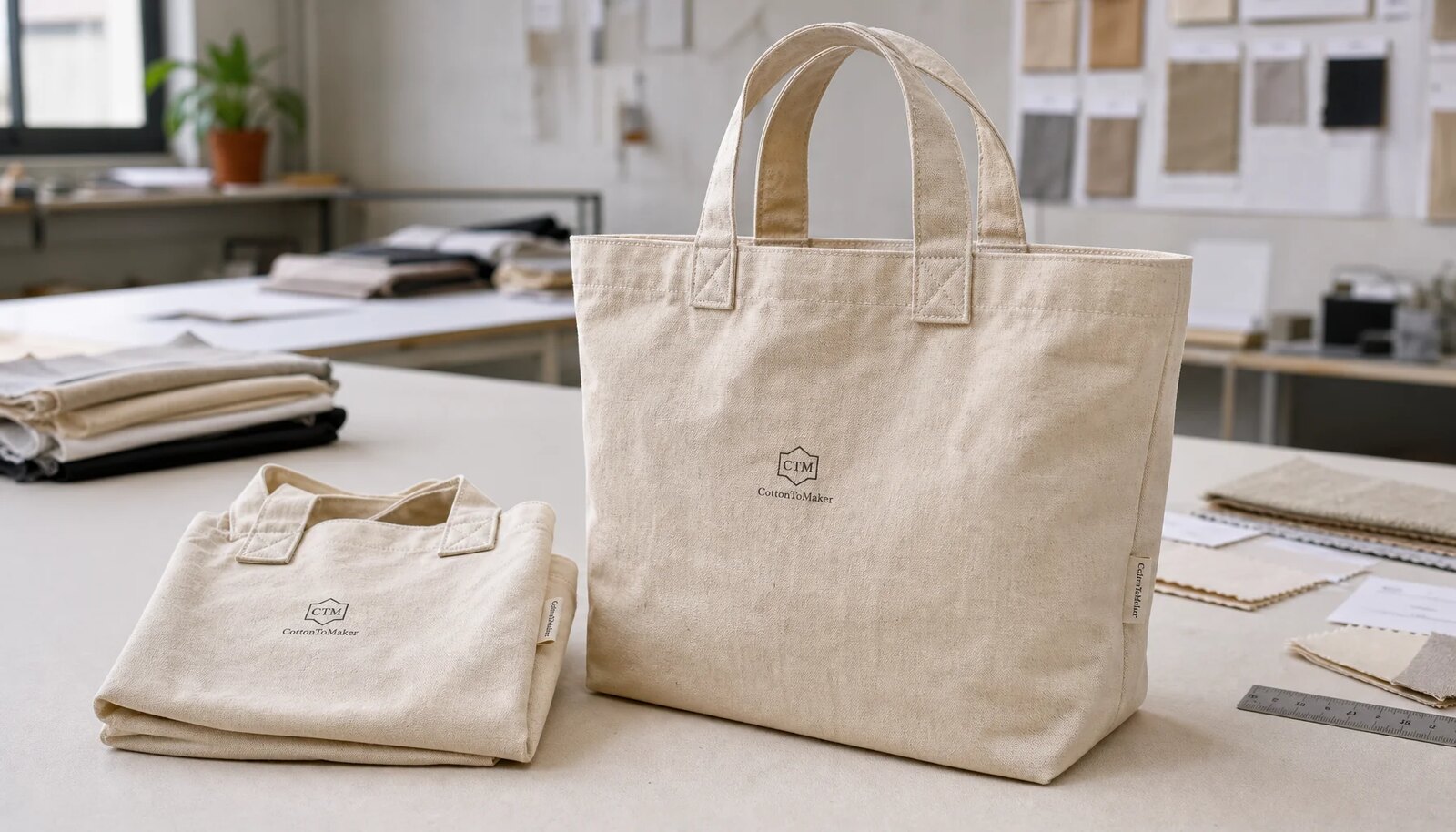
Start With the Craft Fair Use Case
Organic cotton totes for craft fairs are handled differently from ordinary conference giveaways. A shopper may start with a folded print, then add candles, soap bars, a ceramic mug, packaged food, a book, vendor cards, and small impulse purchases. The bag may be carried for hours, placed on grass or concrete, rubbed against display tables, packed into a car, and reused at another market. Durability needs to match that use case, not just the word tote.
The first buying decision is the commercial role of the bag. A free sponsor tote can be lighter than a paid merchandise tote displayed beside handmade products. A fair organizer may value fast counting and simple distribution. A retail-ready tote needs neater sewing, cleaner folding, and more consistent logo placement because customers judge it as a finished product, not packaging.
Set a realistic safe-use load before sampling. The brief can say light apparel only, two paperback books, three 250 g candles, one boxed mug, or mixed purchases up to 5 kg. That one line helps the factory choose fabric weight, handle width, reinforcement, thread, seam construction, and carton packing. It also gives the inspector a measurable target instead of a subjective opinion.
- Classify the tote as giveaway, resale merchandise, vendor packaging, retail product, or event kit.
- Name likely contents: candles, ceramics, books, prints, soaps, apparel, jars, or boxed goods.
- Define hand-carry, shoulder-carry, or dual use because handle drop changes stress points.
- Set a practical test load such as 3 kg for light use or 5 kg for reusable shopper use.
- Identify the route: direct-to-event, warehouse, retail shelf, vendor bundles, or split shipment.
Specify Fabric by Weight and Appearance
The phrase organic cotton tote is too broad for bulk procurement. Suppliers can quote different yarns, fabric widths, weaves, weights, finishes, shrinkage behavior, and shade standards while using similar product wording. For craft fair orders, specify the target fabric weight in both ounces and GSM, weave type, finished color, shrinkage expectation, shade range, and documentation need.
Fabric weight should match the tote’s job. A 7-8 oz fabric, roughly 240-270 GSM, can work for lightweight giveaways, brochures, and apparel. A 10 oz canvas, roughly 340 GSM, is a practical middle choice for reusable craft fair shoppers. A 12 oz canvas, roughly 407 GSM or higher, gives more structure and perceived value for resale, but it increases material cost, carton weight, freight volume, cutting difficulty, and crease risk.
Tolerance language prevents silent downgrades. If the PO only says 10 oz canvas, a lighter available lot may be treated as close enough. A stronger spec states the agreed fabric weight tolerance, commonly +/-5% or the mill’s documented tolerance. It also says whether fabric weight, weave, finish, or color substitutions require written buyer approval before cutting.
Natural cotton also needs appearance limits. Seed flecks, slubs, and slight shade movement may be acceptable for a natural look. Oil marks, dark contamination, strong yellowing, mildew odor, or obvious lot mismatch should not be accepted as character. Approve a shade range and define rejectable defects before production.
- Use 7-8 oz, about 240-270 GSM, for low-cost light event totes.
- Use 10 oz, about 340 GSM, for reusable craft fair shoppers carrying mixed purchases.
- Use 12 oz, about 407 GSM+, for premium resale totes when budget and freight allow.
- State GSM tolerance and whether mill tolerance must be submitted before cutting.
- Approve limits for seed flecks, slubs, shade tone, stains, and lot variation.
Clarify Organic Claim Support
Organic cotton wording may appear in purchase files, product pages, hangtags, invoices, retailer compliance folders, and event materials. These uses do not all need the same level of support, but they should not be treated as identical. A supplier declaration is different from a certification reference, and both are different from transaction documentation tied to a specific order.
Ask what the document covers. Some files may cover yarn or fabric only. Others may relate to finished-goods production or an order-level transaction record. Common frameworks buyers may hear about include GOTS, OCS, and transaction certificates or equivalent traceability documents, but the important point is scope: material only, processing scope, finished goods, or the actual order.
Define claim use before pricing. Internal purchasing records may need less than a retailer compliance file. A craft fair organizer may need a supplier statement for event procurement, while a retail buyer may request order-level documentation and approved wording for labels or product pages. Documentation requirements can change MOQ, sourcing route, cost, and lead time.
Use precise PO language and avoid broad claims unless the supplier has confirmed the exact scope. A safer line states the material claim, required documents, timing, and substitution rule: organic cotton fabric as quoted, documents submitted before bulk production, and no fabric or documentation change without written buyer approval.
- Identify whether the buyer needs a declaration, certification reference, transaction document, or finished-goods file.
- Check whether documentation covers yarn, fabric, processing, finished item, or supplier assurance only.
- Match hangtag, label, invoice, and website wording to documents available for the actual order.
- Require approval before changing cotton source, fabric lot, finish, or documentation scope.
- Keep documentation with the PO, approved sample, invoice, packing list, and inspection report.
Engineer Handles and Stress Points
Handle failure is one of the fastest ways a tote program loses trust. The body fabric can be strong while the bag still fails because straps are narrow, stitch lines are short, reinforcement is too close to the edge, or thread is poorly matched to canvas weight. Shoppers lift by one handle, swing the bag while walking, and pull it from crowded market tables. Most stress lands at the top hem and handle attachment points.
A usable handle spec includes material, finished width, total length, drop, attachment spacing, reinforcement pattern, stitch density, thread color, and placement tolerance. Self-fabric handles support a cohesive organic cotton look and can be comfortable when wide enough. Cotton webbing can also work, but check shade match, stiffness, shrinkage, and documentation needs. For loaded craft fair use, 25-30 mm handles are generally safer than narrow promotional straps.
Reinforcement should be named, not implied. Cross-box stitching spreads the load across a wider area. Bar tacks can add strength when placed correctly and backed by enough fabric. Double-row stitching may be acceptable for light totes. Vague wording such as reinforced handles is not enough for repeat production; the approved sample should show the exact stitch pattern and distance from the fabric edge.
- Define handle width, total length, drop, attachment spacing, and reinforcement size in millimeters.
- Use cross-box stitching or bar tacks for totes carrying books, ceramics, jars, or boxed goods.
- Keep reinforcement away from weak raw edges or shallow top folds where tearing can start.
- Confirm stitch density, often around 8-10 stitches per inch unless another standard is approved.
- Test finished handles on the complete tote, not only loose strap material.
Control Seams, Gussets, and Dimensions
Craft fair totes often fail at seams and bottom corners before the main panel wears out. Hard-edged products such as books, candle boxes, glass jars, soap stacks, and ceramics push into the gusset and bottom seam. If seam allowance is small, stitches are skipped, or gusset corners are poorly turned, the bag can open after limited use even when the canvas feels substantial.
Name the seam construction in the specification. A standard tote may use lockstitch plus overlock inside. A premium tote may justify French seams or bound seams for cleaner presentation and better interior finish. Ask what the base price includes because seam upgrades change labor, price, and lead time. If the tote is sold as merchandise, the inside finish should be inspected like a visible feature.
Gusset dimensions need written tolerances. A bottom gusset adds capacity and structure, but uneven gussets create twisted bags, poor folding, and inconsistent carton packing. Side gussets add volume but also sewing complexity. Measurements should be taken flat in millimeters. Body tolerance may be around +/-10 mm and handle drop around +/-15 mm when practical, but exact limits should be agreed by size and supplier capability.
- Name seam construction: lockstitch plus overlock, French seam, bound seam, or approved alternative.
- Measure body, gusset, handle drop, top hem, and logo placement against millimeter tolerances.
- Inspect side seams, bottom seam, gusset corners, top hem, and handle points as stress areas.
- Reject skipped stitches, seam slippage, open seams, raw edge exposure, puckering, and fraying.
- Ask the factory to confirm thread type, stitch density, seam allowance, and needle suitability.
Use the Durability Matrix Before Bulk
Durability testing does not need to be complicated, but it must be specific. The factory, inspector, and buyer should work from the same sample quantity, method, load weight, hold time, and pass criteria. For organic cotton totes for craft fairs, the most useful checks are fabric GSM, finished dimensions, handle loaded hang, handle reinforcement, seam stress, bottom corner abrasion, print rub, print fold, packing condition, and odor or moisture review.
Sample size depends on order quantity, risk, and inspection budget. For small or moderate craft fair runs, buyers often start with three to five production samples for functional tests and a wider visual inspection under the agreed AQL or buyer standard. If the order includes multiple fabrics, colors, or artworks, pull samples from each meaningful production lot rather than testing only the best-looking carton.
The test load should reflect the declared use. A light giveaway may be tested at 3 kg. A reusable shopper intended for books, candles, jars, or ceramics may be tested at 5 kg or another buyer-approved weight. A pass should not mean the bag merely survives the moment. Inspect after the hold or carry period for broken stitches, handle detachment, fabric tearing, seam opening, top hem distortion, and permanent deformation beyond tolerance.
Add ownership to the matrix. The factory may run in-line checks, the buyer may approve pre-production samples, and a third-party or buyer inspector may verify final shipment. The PO should say who performs each test, when it happens, how failures are recorded, and whether failed results trigger rework, replacement, reinspection, or buyer approval.
- Run GSM checks before cutting so underweight fabric is not discovered after sewing.
- Test loaded finished bags, not loose fabric or straps, because failure usually occurs at sewn stress points.
- Classify handle detachment, tearing under declared load, mildew odor, and wrong organic documents as serious shipment risks.
- Retest after rework when failures involve handle attachment, seam opening, print transfer, or wrong packing.
- Keep test photos and results with the inspection report for repeat-order comparison.
Choose Printing for Look and Wear
Print method affects both durability and brand feel. Many craft fair buyers choose organic cotton because it supports a natural, reusable, or handmade position. A stiff, glossy, cracking, or plastic-feeling logo can work against that position even if the fabric is correct. Select the print method by artwork complexity, quantity, fabric color, hand-feel, and test results, not only by lowest unit price.
Water-based screen print is often a sensible starting point for simple logos and one to three solid colors. It can keep a softer cotton hand and works well for repeat orders when setup cost is spread across enough units. Pigment screen print may also fit, depending on fabric tone and ink system. In both cases, ask how the factory controls curing, stacking delay, and rub resistance before packing.
Digital print, DTF, and heat transfer can solve short-run or multi-color artwork needs, but they require closer sample testing. DTF can produce bright graphics and reduce setup barriers, yet film edge, hand-feel, flex resistance, and cracking risk must be checked. Digital print may feel softer but look less saturated on natural cotton. Heat transfers can work for some logos, but adhesion and surface feel should be tested on the actual bulk fabric.
Artwork approval should include placement tolerance and color expectation. Natural organic cotton is not a coated white surface, so color can shift with fabric tone, weave texture, and ink absorption. Provide vector artwork, Pantone or CMYK references, final logo dimensions, and placement measured from fixed points such as top edge, side seam, or centerline.
- Use screen print for simple logos, repeat artwork, larger quantities, and softer hand-feel.
- Use digital, DTF, or transfer only after rub, fold, edge-lift, opacity, and hand-feel approval.
- Set logo placement tolerance, such as +/-5 mm when practical, from fixed reference points.
- Confirm curing control and stacking delay before printed bags are compressed in cartons.
- Approve print on actual bulk fabric weight and shade, not unrelated smooth sample fabric.
Make Sampling a Production Gate
Sample approval is a procurement control point, not a styling formality. A tote sample may be hand-cut, sewn by a senior sample operator, printed on available stock fabric, and packed differently from bulk. If the buyer approves it without conditions, the factory may treat it as permission to proceed even when production materials and methods are not identical.
The pre-production sample should represent the actual fabric, handle construction, seam type, print method, labels, trims, folding, and packing. If bulk fabric is not ready for the first sample, label that piece as prototype or reference only. Record every non-final item: fabric weight, shade, shrinkage, print color, handle reinforcement, label, hangtag, carton pack, or documentation status.
A strong approval file includes measurements, photos, physical samples, and tolerances. Measure body width, body height, bottom gusset, handle length, handle drop, top hem, logo size, and logo position. Record fabric weight, thread color, stitch density, seam type, reinforcement method, print method, packing fold, inner pack quantity, and master carton count.
Approve the natural fabric range at this stage. Specks, yarn variation, and slubs can support a natural look. Excessive contamination, oil marks, dark stains, mildew odor, or strong shade mismatch remain defects. When this is settled before production, final inspection becomes faster and less subjective.
- Require the pre-production sample to use bulk fabric or identify every non-final material.
- Measure body, gusset, handle drop, logo size, logo position, seam finish, and reinforcement.
- Fold the sample as planned for packing and check front-panel creasing and print marking.
- Keep a signed physical sample for shade, hand-feel, print texture, sewing, and packing reference.
- Do not release bulk cutting until fabric, print curing, tolerances, and packing rules are closed.
Compare MOQ, Cost, and Lead Time
MOQ is shaped by more than factory preference. For organic cotton totes, minimums can depend on yarn sourcing, fabric availability, fabric width, dyeing or finishing, cutting efficiency, print setup, label production, packing format, and shipment split. A supplier may offer low MOQ for stock natural 8 oz fabric but require more volume for 12 oz canvas, custom dyed fabric, special labels, or multiple seasonal craft fair designs.
Ask for MOQ by variable, not just one order number. Separate minimums for fabric weight, fabric color, print method, artwork count, label type, hangtag, and packing format. If the program includes five craft fair logos, clarify whether MOQ applies per artwork or to the total order. If cartons must be sorted by vendor, event date, or destination, ask whether sorting changes price or lead time.
Normalize unit price before comparing suppliers. A lower quote may exclude print setup, use lighter fabric, reduce finished size, narrow the handles, remove cross-box reinforcement, simplify seams, omit documentation, or overpack cartons. Compare quotes against the same dimensions, GSM, handle width, reinforcement, print area, number of colors, packing method, inspection standard, and shipment terms.
Landed value matters more than ex-factory price. A heavier tote may reduce complaints and support resale value, but it raises gross carton weight and freight volume. Paper bands or hangtags improve presentation but add labor and carton space. Inspection and testing add cost, yet they reduce the risk of weak handles, under-cured print, wrong counts, and missed event deadlines.
- Request price breaks for 7-8 oz, 10 oz, and 12 oz fabric when budget and durability are both under review.
- Ask for MOQ by fabric weight, color, print method, artwork count, label, hangtag, and packing style.
- Separate sample charge, screen setup, print cost, label cost, packing cost, inspection support, and export charges.
- Compare carton dimensions, gross weight, and CBM because freight changes true cost per usable tote.
- Treat missing specifications as commercial risk; if reinforcement is not written, assume it may not be included.
Write Packing and Inspection Rules
Packing is part of quality control for cotton totes. Organic cotton, especially heavier canvas, can crease deeply when over-compressed. Natural fabric can pick up dust, odor, and moisture if cartons are weak or stored in damp conditions. A tote can pass sewing inspection and still arrive looking second quality because of front-panel creases, print transfer, carton stains, or mildew odor.
Choose packing by sales route. Bulk flat packing is efficient for event organizers and distributors that need quick counting. Paper bands can make the tote feel retail-ready without individual polybags. Individual protection may help retail handling or mixed warehouse distribution, but it increases cost, carton volume, and material use. Vendor kits may need inner bundles sorted by design, destination, or event date.
Confirm carton details before final pricing. Request pieces per inner pack, pieces per master carton, carton dimensions, gross weight, estimated CBM, carton quality, shipping marks, pallet requirements if applicable, and maximum acceptable compression. Master cartons should not be so heavy that manual handling damages cartons or goods. For 10-12 oz canvas totes, review pack count instead of accepting a generic factory standard.
Moisture control deserves a PO line. Long storage, humid weather, or ocean freight can increase odor and mildew risk. Clean inner liners, dry storage, desiccant where appropriate, and packing only after print curing can reduce problems. Cartons should show PO number, SKU, artwork, color, quantity, destination, carton number, and gross weight so warehouses and craft fair teams can route goods without opening every box.
- Choose bulk bundles, paper bands, or individual protection based on presentation and distribution needs.
- Set inner pack and master carton quantities before final price approval.
- Avoid tight compression that creates deep folds across the logo or front panel.
- Use clean cartons, inner liners, and moisture control for humid routes or long transit.
- Require carton marks with SKU, artwork, color, quantity, PO number, destination, carton sequence, and gross weight.
Specification comparison for buyers
| Durability check | Sample size | Load, rub, or condition | Pass criteria and defect class |
|---|---|---|---|
| Fabric GSM verification | Minimum 3 cut swatches per fabric lot or color lot | Measure against approved fabric weight before cutting | Within agreed tolerance, such as +/-5% or approved mill tolerance; underweight fabric is major unless buyer approves |
| Finished size measurement | 5 finished bags per SKU, more for multi-size or multi-factory orders | Measure flat in millimeters after sewing and before packing | Body, gusset, handle drop, logo size, and logo placement within PO tolerance; out-of-tolerance sizing is major |
| Handle loaded-hang test | 3-5 finished bags per SKU and handle style | 3 kg for light event tote or 5 kg for reusable shopper, held 30 minutes unless PO states otherwise | No handle detachment, tearing, broken stitches, top hem splitting, or seam opening; structural failure is critical |
| Handle pull and stitch review | 5 finished bags per SKU, including first bulk output | Manual pull plus visual inspection of cross-box, bar tack, or double-row reinforcement | No skipped reinforcement, loose back-tacks, needle tearing, weak edge distance, or left-right misalignment; poor reinforcement is major |
| Seam stress inspection | 5 finished bags per SKU after loading or handling | Inspect side seams, bottom seam, gusset corners, top hem, and handle attachment areas | No open seams, seam slippage, raw edge exposure, fraying, or skipped stitches in stress zones; open seam is major or critical by location |
| Bottom corner abrasion check | 3 finished bags per SKU with gusseted styles prioritized | Loaded bag rubbed on clean rough surface for agreed cycle count, such as 20-30 strokes | No holes, seam exposure, severe fabric thinning, or corner splitting; hole or seam exposure is major |
| Print dry rub test | 3 printed bags per artwork and color | White cotton cloth rubbed across cured print for agreed strokes | No visible transfer, heavy color loss, flaking, or tackiness; transfer that marks other bags is major |
| Print damp rub test | 3 printed bags per artwork and color | Lightly damp white cloth rubbed across cured print after normal drying or curing period | No unacceptable bleeding, smearing, softening, or transfer; staining of adjacent fabric is major |
| Print fold and crease check | 3 printed bags per artwork after approved packing fold | Fold through printed area, compress briefly, then inspect print face and film edge | No cracking, edge lift, whitening beyond approved sample, or print-to-print transfer; cracking or lift is major |
Buyer checklist before sampling
- Define the tote role: free giveaway, paid resale item, vendor packaging, retail shelf product, sponsor kit, or sorted event pack.
- List expected contents and maximum safe-use load, such as prints, books, candles, soap bars, jars, apparel, boxed ceramics, or mixed purchases up to 3 kg or 5 kg.
- Specify fabric by oz, GSM, weave, color, finish, GSM tolerance, shrinkage expectation, shade range, and acceptable seed flecks or slubs.
- Clarify organic claim support: supplier declaration, certification reference, transaction documentation, finished-goods scope, label wording, or retailer compliance file.
- Record finished measurements in millimeters, including body width, body height, bottom gusset, side gusset, top hem, handle length, handle drop, logo size, and logo position.
- Choose handle construction by material, finished width, drop, attachment spacing, reinforcement pattern, stitch density, thread color, and shoulder-carry or hand-carry fit.
- Lock artwork controls: vector file, color reference, print method, print area, placement tolerance, curing expectation, hand-feel standard, and approved print sample.
- Approve a production-ready sample using the planned fabric weight, handle construction, seam finish, print method, labels, folding, packing, and carton quantity.
- Attach a durability test matrix to the PO with method, sample size, condition, hold time or cycle count, pass criteria, defect class, and responsible party.
- State defect rules for critical, major, and minor issues so failed handles, open seams, wrong documents, print transfer, mildew odor, and wrong counts are handled consistently.
Factory quote questions to send
- Which organic cotton fabric weights can you quote now in 7-8 oz, 10 oz, and 12 oz, and what MOQ applies by fabric weight, fabric width, color, and finish?
- Is the quoted material stock natural fabric, greige fabric, dyed fabric, or order-made fabric, and how does each option change lead time?
- What is the actual GSM range of the available lot, and can you hold +/-5% or provide the mill tolerance for buyer approval before cutting?
- What documentation is available for this order: supplier declaration, certificate reference, transaction certificate or equivalent order document, finished-goods scope, or material-level support only?
- Which product, invoice, hangtag, carton, and website claims can the available documents support, and which wording should we avoid?
- What handle construction is included in the base quote: self-fabric, cotton webbing, 25 mm, 30 mm, cross-box stitch, bar tack, or double-row stitching?
- What loaded-hang or handle pull test do you use internally, including load weight, hold time, sample quantity, and fail criteria?
- What seam construction is included, and what is the price or lead-time effect for lockstitch plus overlock, French seam, bound seam, or extra topstitching?
- For our artwork and fabric shade, which print method do you recommend: water-based screen print, pigment screen print, digital print, DTF, or heat transfer, and why?
- What are the sample timeline, bulk lead time, carton dimensions, gross weight, CBM, inner pack quantity, and costs for labels, hangtags, sorting, or inspection support?
Quality-control points to confirm
- Incoming fabric is checked against PO and approved sample for fiber statement, organic documentation, GSM, weave, shade range, hand-feel, odor, stains, seed flecks, slubs, and contamination.
- Organic documentation is reviewed by order, not treated as interchangeable; supplier declaration, certification reference, transaction document, and finished-goods coverage are recorded separately.
- Fabric GSM is verified before cutting by lot or color lot using the agreed tolerance; out-of-tolerance lots are held for buyer approval, replacement, or revised labeling.
- Cut panels are checked for grain direction, panel dimensions, gusset dimensions, top hem allowance, handle placement marks, logo placement marks, and shade continuity.
- Finished dimensions are measured flat in millimeters, including body width, body height, gusset, handle length, handle drop, top hem depth, logo size, and logo placement.
- Handle testing is performed on finished production bags with agreed load, hold time, sample quantity, and pass criteria; tearing, detachment, open seams, and broken stitches are failures.
- Handle attachments are inspected for reinforcement size, stitch density, back-tacking, loose threads, needle holes, edge distance, left-right alignment, and distortion after loading.
- Seams are checked at side seams, bottom seam, gusset corners, top hem, and handle areas for skipped stitches, seam slippage, puckering, raw edge exposure, fraying, and open seams.
- Print quality is checked for artwork size, placement, registration, opacity, color match, curing, cracking, unwanted transfer, visible film edge, and hand-feel against approved sample.
- Packing inspection confirms count, folding direction, crease control, carton marks, moisture protection, odor condition, carton strength, gross weight, CBM, and destination sorting.