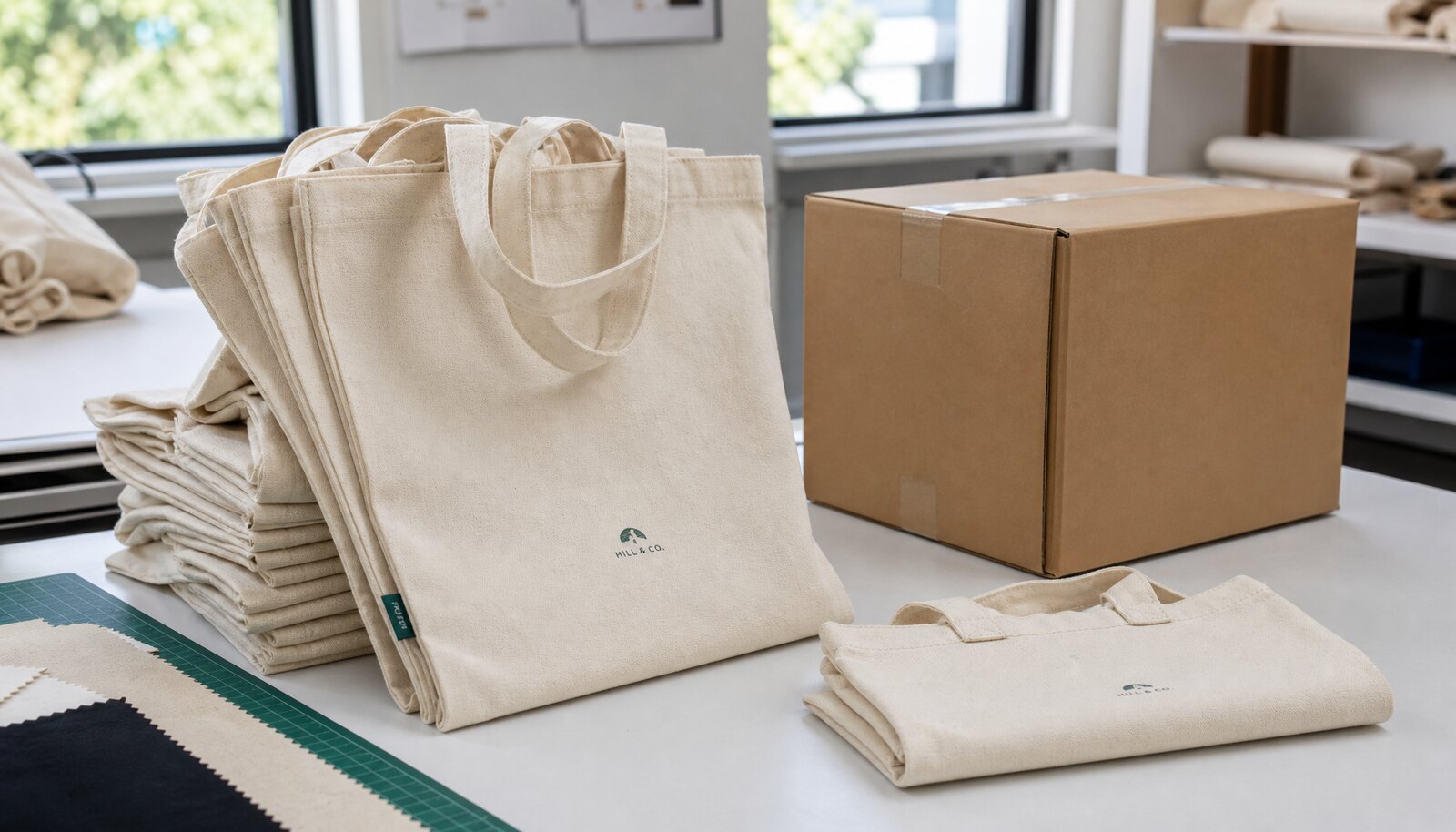
Why carton planning matters before you approve the tote
For organic cotton totes used in corporate gifting, carton planning is not a warehouse afterthought. It changes the quote, the print result, the freight bill, and the receiving experience at the destination. A tote that looks fine as a loose sample can still fail once it is folded, banded, packed, stacked, and shipped across long lanes. If the carton spec is vague, the factory fills the gap with its standard approach, and that standard is often designed for convenience, not for your campaign.
The real issue is that a gifting order is judged on presentation and timing, not only on unit price. Procurement teams often compare tote quotes that look similar on paper, but the carton count, packing method, and freight density are completely different. One supplier may quote a cheaper tote and then recover margin through oversized cartons, loose packing, or extra handling. Another may use a tighter carton plan that lowers freight and warehouse labor. The only way to compare them fairly is to define the packed unit, not just the bag.
- A carton spec affects freight class, carton damage risk, and receiving speed.
- Loose tote samples do not prove the packed shipment will hold shape or protect print.
- Corporate gifting orders usually fail on logistics details, not on the bag pattern itself.
Lock the tote spec first, or the carton math will drift
Start with the tote itself. For organic cotton totes, fabric weight is usually the first decision that changes packing behavior. A light promotional tote in the 140 to 160 GSM range folds small and packs efficiently, but it will feel softer and may show more wrinkling. A standard corporate gift tote often lands in the 180 to 220 GSM range because the bag holds its shape better, prints more cleanly, and looks more substantial when handed out. If the brief calls for a premium feel, some buyers move higher, but they should expect larger carton volume and higher freight weight.
The same is true for size and construction. A tote with longer handles, boxed corners, or a reinforced base takes more space in carton than a simple flat promotional bag. Handle length matters because long handles create more bulk when folded, and handle reinforcement changes stitch time and rejection risk. If the logo must be centered after folding, the fold rule has to be written down. Otherwise one worker folds to speed, another folds to appearance, and the packed carton becomes inconsistent.
- Useful GSM bands: 140 to 160 for lightweight promotion, 180 to 220 for standard gifting, higher only when the brief justifies it.
- Specify size in flat state and folded state.
- Write the fold direction, not just the bag dimensions.
Choose the packing route that fits the campaign, not the factory habit
There are three common packing routes for organic cotton totes in corporate gifting. The first is loose folded packing, which gives the best carton density and the lowest material cost. The second is banded or tissue-wrapped packing, which is better for presentation and still keeps the pack relatively efficient. The third is individual polybag packing, which protects print and surfaces in transit but adds labor, plastic, and volume. None of these is automatically right. The correct choice depends on the campaign, the route, and how the bags will be distributed after arrival.
For a simple gift handout, loose or banded packing usually works if the print is robust and the tote is not dark or heavily decorated. For humid lanes, long ocean transit, or a premium retail-like handoff, individual packing may be justified. What matters is that the pack style is priced as part of the quote. If the supplier prices the tote without saying how it is packed, the carton planning is incomplete. The buyer then compares apples to oranges, because one quote includes protected packaging and another assumes bare folded bags.
- Loose packing gives the best freight density but the least presentation control.
- Banded or tissue-wrapped packing balances unboxing quality and carton efficiency.
- Individual polybags should be justified by route, humidity, or print sensitivity.
Use the quote to expose the real cost drivers
A serious quote for organic cotton totes should break out the unit price, setup charges, packing method, carton spec, and any extra handling. The biggest cost drivers are usually not mysterious. Fabric GSM, print color count, special sewing, inner packing, and carton density create most of the spread between suppliers. MOQ logic also matters. A supplier may be willing to sew a lower quantity, but once you ask for custom print, split carton counts, or special labels, the effective MOQ rises because the line has to stop and reset more often.
This is where procurement teams should push for quote visibility. Ask for the same tote in multiple configurations: blank versus printed, loose folded versus banded, and standard carton versus reinforced carton. A supplier that can price these options clearly is easier to manage. A supplier that can only give one round number is usually hiding assumptions. If you later need a carton label change, a different master carton count, or a split delivery, you want to know the cost of those changes before PO release, not after production starts.
- Ask for setup charges separately from unit price.
- Request the same item quoted with different packing methods.
- Compare MOQ by print complexity, not only by bag quantity.
Match print method to transit risk and carton handling
Organic cotton totes can be decorated by screen print, heat transfer, embroidery, or woven/stitched branding details. For corporate gifting, screen print is usually the most efficient when the logo is simple and the color count is low. It gives predictable unit cost and a clean brand look, but the buyer still needs to check cure quality and rub resistance. Fine-line logos, gradients, or small text can fail if the screen setup is rushed or the fabric surface is too soft. If the brand wants a sharper premium look, embroidery may be considered, but it adds time, thickness, and bulk in the carton.
The print method also affects packing damage. Thick print layers can stick when stacked tightly, while embroidery can press marks into adjacent bags if the fold is too tight. If the tote is going to be packed in high count per carton, the print should be tested in the exact folded position. The approval should show how the logo sits after folding, how it behaves under pressure, and whether the carton lid closes without rubbing the print. If the bag is squeezed for freight efficiency but the logo loses finish, the shipment has saved money on paper and lost value at the handout table.
- Screen print is usually best for simple logos and controlled unit cost.
- Embroidery adds texture but also bulk and packing sensitivity.
- Approve the print in the exact folded and packed condition, not only on a flat sample.
Approve samples as a packed unit, not as a loose tote
A loose sample tells you about stitching and print. A packed sample tells you whether the project is actually ready. For this product category, the packed sample should use the same fabric weight, same fold direction, same inner pack, same carton size, and same seal method as production. That is the only way to catch problems such as print scuffing, handle distortion, carton underfill, or carton overfill. If the sample arrives in a presentation bag and the shipment will actually go loose in export cartons, the approval is incomplete.
During sample review, treat the bag and carton as one unit. Check that the tote sits flat, the logo is visible after folding, and the carton closes without forcing the handles. Verify that the carton mark is readable and that the bag count matches the packing list. If there are inserts, cards, or tissue, those need to be present in the sample too. A buyer who approves the wrong packed sample is usually buying a production surprise. That surprise shows up later as crushed corners, miscounted cartons, or a finished gift that looks different from the sign-off unit.
- Approve a packed pre-production sample, not only a loose bag.
- Verify fold, insert, seal, carton count, and labeling together.
- Reject samples that only look good before packing.
Set carton and label rules that your warehouse can actually receive
Carton planning should start from the receiving point. If the destination warehouse scans barcodes, needs color splits, or receives by ship-to location, the carton label format must match that workflow. The label should show carton count, product code, color or size split, destination, and any internal receiving reference. If the tote line has natural, black, and branded variants, the carton marks must be easy to separate at first glance. A label that only makes sense inside the factory is not useful once the cartons land in a distribution center with mixed freight.
The carton itself should be sized to the folded bag, not to the factory's standard box. A carton with too much empty space wastes freight and encourages movement inside the box. A carton that is too tight can crush the tote and make the handles deform. Board grade matters because a light carton may be fine for domestic transport but fail in export stacking. For gift campaigns, also decide whether you need palletization, corner protection, or moisture control. Those choices belong in the RFQ because they affect both cost and delivery condition.
- Use carton marks that match the receiver's workflow.
- Match carton dimensions to the folded tote stack, not to the factory's stock box.
- Specify palletization, corner boards, and moisture protection when the route needs them.
Control schedule risk before the tote becomes a calendar problem
Corporate gifting schedules often fail because buyers treat lead time as one line item instead of a chain of steps. Organic cotton tote production may involve fabric sourcing, cutting, printing, curing, sewing, folding, packing, carton labeling, and dispatch. If any one step needs approval, the total schedule stretches. Custom cartons or split packing can add another approval loop. The buyer should build the project plan backward from the delivery date and leave room for sample feedback, carton changes, and the reality that print or sewing revisions consume production time.
The biggest schedule risk is late change. A logo revision after print setup, a carton size change after sample approval, or a request to add inserts after packing has started can all move the ship date. If the tote is part of a campaign launch, that delay is more expensive than a slightly higher unit price on the front end. When the date matters, ask the supplier to show which steps are locked and which can still move. A clear schedule is better than an optimistic promise that collapses when the line starts.
- Work backward from the delivery date and include sample and carton approval time.
- Treat print changes, insert changes, and carton changes as schedule events.
- Do not assume the factory can absorb late packing changes at no cost.
Compare landed cost before you release the order
For organic cotton totes, landed cost is often driven by volume, not just unit price. A slightly cheaper tote can become the expensive option if the carton is oversized, the pack count is inefficient, or the freight mode shifts from ocean to air because the project was packed loosely. Compare quotes on the same basis: same GSM, same print method, same packed count, same carton spec, same ship term, and same destination. Otherwise the spreadsheet is lying to you, even if every line looks reasonable on its own.
A useful way to compare is to separate the bag cost, the packing cost, and the freight cost. The bag cost covers fabric and sewing. The packing cost covers folding, banding, inner bags, labels, and carton build. The freight cost covers the space the boxes consume. In many gifting projects, a tighter carton with slightly more packing labor wins on total landed cost because it saves cubic space. The right answer is not the cheapest tote. It is the tote and carton combination that lands cleanly, meets the brief, and does not force the warehouse to rework the shipment on arrival.
- Compare quotes on the same GSM, print method, packed count, and carton size.
- Split the total into bag cost, packing cost, and freight cost.
- A better carton plan can lower total landed cost even if unit packing cost rises.
Specification comparison for buyers
| Spec decision | Recommended option | When it fits | Buyer risk to check |
|---|---|---|---|
| Supplier route | Direct factory with carton planning handled in-house | You need control over fabric, print, fold method, and carton count in one quote | The factory may default to standard packing unless the carton spec is written into the RFQ |
| Supplier route | Trading company or sourcing agent managing tote plus packing | You are combining the tote with inserts, cards, or other gift items from different vendors | Hidden handling fees and weaker visibility into carton tests can make quote comparison messy |
| Packed units per master carton | 25 to 50 totes per carton for export efficiency | The tote is flat-folded, all-natural, and the campaign is moving by ocean freight | If the tote is bulky, too many units per carton can crush corners and distort print |
| Packed units per master carton | 10 to 20 totes per carton for easier warehouse picking | You expect many ship-to locations or frequent partial deliveries | More cartons raise freight and labor cost, so the logistics gain has to justify the split |
| Inner packing | No individual polybag, use tissue band or paper belly band | The brand wants a low-plastic presentation and the print surface is not abrasion-sensitive | Loose packing can scuff print edges or pick up dust during long transit |
| Inner packing | Individual polybag with desiccant where needed | You have humid lanes, long transit, or a surface finish that marks easily | More material and labor can change the landed cost and may conflict with sustainability claims |
| Outer carton build | 5-ply reinforced export carton | Stacking pressure is high or the shipment will move through multiple hubs | Carton dimensions must match the folded tote size, or you pay for dead air |
| Labeling route | Barcode plus carton count, color, and size split on every carton | The order will be received by more than one warehouse or DC | A wrong label format can create mis-picks even when the product itself is correct |
| Sample approval route | Pre-production sample packed in the same carton style as mass production | The gifting date is fixed and there is no room for pack surprises | Approving a loose tote sample does not prove the packed carton will survive transit |
Buyer checklist before sampling
- Confirm tote size in flat form and after folding, not just a nominal size on the quote.
- State fabric weight in GSM and whether the fabric is natural, bleached, dyed, or pre-shrunk.
- Specify handle length, handle width, and seam reinforcement requirements.
- Define the print method, number of colors, print placement, and any acceptable registration tolerance.
- Lock the inner pack method: loose fold, banded fold, tissue wrap, or individual polybag.
- Approve master carton dimensions, board grade, gross weight target, and pallet pattern if used.
- List carton marks, barcodes, ship-to labels, and any retailer or DC receiving rules.
- Request a packed pre-production sample before mass production starts.
- Set overrun and underrun tolerance in writing.
- Ask for the supplier's lead time broken into fabric, printing, sewing, packing, and dispatch.
Factory quote questions to send
- What fabric GSM are you quoting, and what tolerance do you hold on the delivered fabric weight?
- What tote size, handle length, and seam construction are included in the base quote?
- Which print method is included, how many colors are priced, and what setup charges apply?
- How many totes per inner pack and per master carton are you quoting?
- What carton size, board grade, and carton gross weight do you recommend for this packed count?
- Can you quote the same tote in loose-fold, banded, and polybagged packing so we can compare landed cost?
- What is the MOQ by fabric color, print color count, and packed configuration?
- Can you provide a packed pre-production sample and confirm whether the carton spec matches production?
- What is the lead time after sample approval and deposit, broken down by production step?
- What extra charges apply for carton labels, palletizing, corner protection, desiccant, inserts, or split shipments?
Quality-control points to confirm
- Fabric weight matches the approved GSM within the agreed tolerance.
- Fabric hand feel and weave density match the approved sample without visible thin spots.
- Stitching is straight, secure, and consistent, with reinforced handle attachment points.
- Print color, registration, and opacity match the approved artwork sample.
- Tote dimensions are within tolerance after folding and after packing into cartons.
- No loose threads, oil stains, odor, dust, or visible contamination on bags or cartons.
- Carton count is exact, with no overpack or underpack beyond the agreed tolerance.
- Carton labels, barcodes, and color or size splits are correct and easy to scan.
- Packed cartons survive a basic drop and edge-compression check without damage to corners or handles.
- The packed sample reflects the real mass-production fold, insert, and sealing method.