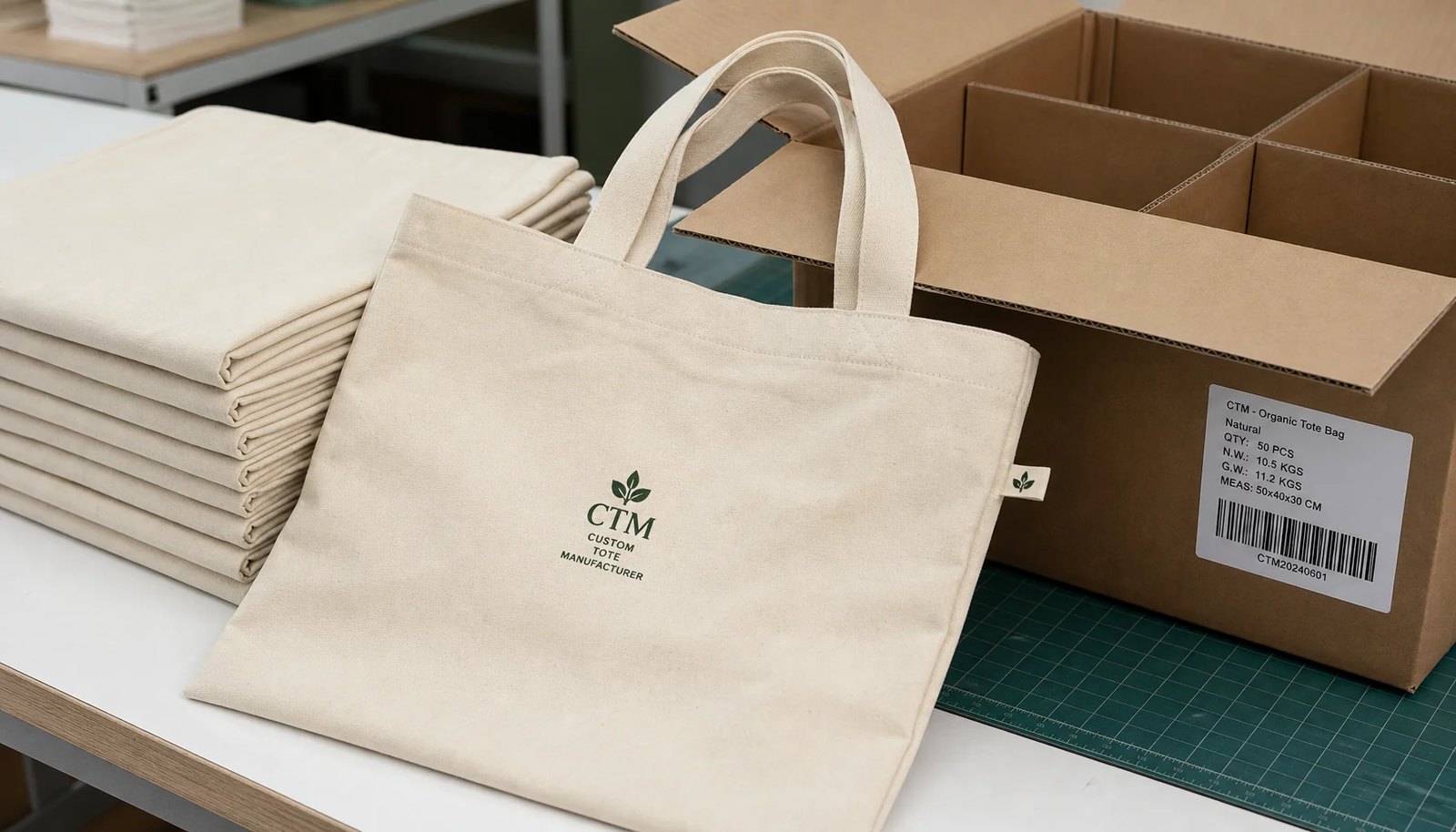
Why Carton Planning Matters for Bookstore Totes
Most organic cotton tote projects begin with the visible choices: canvas shade, campus logo, handle length, hangtag, and retail price. Carton packing often gets one vague line in the RFQ, such as standard export packing. For university bookstores, that is too loose. Tote cartons may arrive during the same receiving window as apparel, drinkware, course materials, plush, graduation items, and licensed seasonal goods. If the cartons are too heavy, undercounted, wet, crushed, or mixed by artwork, the issue moves quickly from the warehouse floor to the buyer’s desk.
A useful organic cotton totes carton packing plan for university bookstores links the product specification to the inbound workflow. Fabric weight, finished size, gusset depth, handle reinforcement, print method, inner bundle, carton quantity, carton dimensions, gross weight, SKU labels, and final inspection all affect receiving. An 8 oz event tote and a 10 oz retail tote may look similar in a supplier photo, but they fold differently, weigh differently, and create different pressure inside a master carton.
The goal is not simply to get bags across the ocean without visible damage. Bookstore buyers need cartons that are easy to receive, count, scan, store, allocate, and move to the sales floor. That means packing belongs in the RFQ, the supplier quote, the sample approval, the final inspection checklist, and the shipment release review.
- Define carton packing at RFQ stage, before artwork approval and bulk cutting.
- Compare carton CBM, gross weight, board strength, receiving format, and unit price together.
- Treat each campus artwork, logo color, event version, and bookstore SKU as a packing-control item.
- Require packed-carton photos, carton label approval, and final packing list review before shipment release.
- Ask the supplier to identify short cartons and approved mixed-carton exceptions before goods leave the factory.
Start with the Receiving Workflow
The best carton plan starts with the way the bookstore will receive and use the totes. Some stores receive at one campus warehouse and replenish a single sales floor. Others route goods through a university procurement center, licensed-goods distributor, 3PL warehouse, online fulfillment site, or multiple campus locations. The same tote may need different packing if quantities are split between the main bookstore, athletics shop, alumni event, orientation program, department buyers, and e-commerce stock.
Before asking suppliers for final pricing, procurement should gather the receiving rules that affect packing. These may include maximum carton weight, barcode format, carton label size, pallet height, carton sequence numbering, country-of-origin marking, plastic restrictions, and rules on mixed SKUs. If a routing guide exists, send it with the RFQ. If it does not, create a short inbound standard for this order: label fields, bundle quantity, carton weight limit, short-carton rule, and packing list format.
Predictability matters more than clever packing. If 96 cartons contain exactly 50 pcs and one carton contains 23 pcs, the short carton should be marked clearly and shown on the packing list. If five artwork versions are included, each version should have its own carton sequence. If goods are allocated by store or department, that allocation should appear on the packing list and, when required, the carton label. This is how buyers reduce receiving delays before orientation week, homecoming, graduation, or other fixed sales dates.
- Ask the warehouse or distributor for the preferred maximum carton weight before approving pcs per carton.
- Confirm whether mixed artwork cartons are prohibited, allowed, or allowed only for final short cartons.
- Use separate carton sequences for each SKU, fabric color, artwork version, or campus destination.
- Match carton labels to the packing list, commercial invoice, purchase order, and SKU master data.
- Confirm pallet requirements if the shipment moves through a distributor, campus warehouse, or LTL carrier.
Specify Organic Cotton Correctly
Organic cotton wording needs discipline. Natural-colored cotton is not automatically organic. Recycled cotton is not the same as organic cotton. A conventional cotton tote with an unbleached look should not be sold or documented as organic. The RFQ should state whether the buyer needs certified organic cotton, an organic cotton blend, or a natural cotton tote with no organic claim.
For certified programs, the supplier should explain exactly what documentation can be provided. Depending on the certification path and supply chain, buyers may ask for a valid supplier scope certificate, material composition records, transaction certificates, or other chain-of-custody documents. Confirm this before the PO is issued. Documentation availability can affect supplier selection, lead time, invoice wording, hangtag language, and the claims used in university sustainability records.
Physical fabric approval still matters. Natural organic cotton can show seed flecks, small slubs, and shade variation. These may be acceptable, even desirable, when approved in advance. Dyed organic cotton adds lab dip approval, shade tolerance, dye-lot control, and sometimes a fabric MOQ. Do not approve only a digital mockup and leave the base fabric open. Approve a swatch or pre-production sample that reflects the actual bulk fabric.
- State the exact claim: certified organic cotton, organic cotton blend, or natural cotton without organic claim.
- Request documentation before issuing the PO if the claim appears on hangtags, web listings, or procurement files.
- Approve natural cotton seed flecks, slubs, and shade range before bulk cutting.
- Use lab dips and shade-lot control for dyed organic cotton programs.
- Keep certification wording consistent across PO, invoice, hangtag, carton records, and product listing.
Choose Fabric Weight and Construction
University bookstore tote programs commonly sit between 8 oz and 12 oz organic cotton. An 8 oz tote, often around 230-240 GSM depending on weave and finishing, can work for orientation kits, admissions events, alumni giveaways, and budget retail bins. A 10 oz tote, often around 280-300 GSM, gives a stronger hand-feel and better performance when students carry books, notebooks, apparel, bottles, and laptop sleeves together. A 12 oz tote can feel premium, but it also increases folded bulk, carton weight, freight cube, needle stress, and sewing time.
The RFQ should say more than organic cotton tote. State fabric construction, ounce weight or GSM, finished color, body size, gusset depth, handle width, handle drop, seam type, and whether the fabric is natural, bleached, washed, or dyed. Also decide whether the tote must fold flat for backroom storage or hold shape on a retail display. Flat totes usually pack tighter. Gusseted totes with structured handles need more space if the buyer wants to avoid hard creases and distorted handles.
Fabric weight drives carton planning. A lightweight flat tote may work at 100 pcs per carton if the gross weight, carton strength, and carton bulge are acceptable. A 10 oz gusseted tote with reinforced handles may be better at 50 pcs per carton. A 12 oz premium tote with hangtag, belly band, or retail presentation may need 40 or 50 pcs per carton. Ask for carton data on the actual finished tote, not a generic estimate from a different style.
- 6-8 oz: suitable for promotions, event kits, welcome bags, and lighter bookstore use.
- 10 oz: balanced option for retail totes, alumni merchandise, and repeat-use campus store bags.
- 12 oz: premium feel but higher CBM, higher carton weight, and greater seam and needle stress.
- Natural color: simpler MOQ and lower dye risk, but seed flecks and tone variation need approval.
- Dyed fabric: requires lab dip approval, shade tolerance, fabric MOQ, and shade-lot control.
Build Carton Quantity from Real Limits
Carton quantity should be based on the finished bag, not habit. The key limits are bag thickness, safe handling weight, carton strength, folding pressure, and receiving speed. A flat 8 oz tote without a gusset may be practical at 100 pcs per master carton if the carton does not bulge and the weight fits the routing guide. A 10 oz organic cotton canvas tote with gusset and reinforced handles is often easier to manage at 50 pcs per carton. A 12 oz tote or retail-ready style with hangtags, belly bands, or individual packaging may need 40-50 pcs to protect shape and keep cartons liftable.
Ask suppliers for carton dimensions, gross weight, net weight, and CBM for each packing method. Many receiving teams prefer cartons around 12-18 kg gross weight and require written approval above 20 kg, but the bookstore or distributor rule should control. These numbers allow a real landed-cost comparison. A lower FOB price may be less attractive if the packing uses weak cartons, poor cube efficiency, or an unsafe lift weight.
When volume supports the exercise, quote two packing options. For example, compare 50 pcs per carton and 100 pcs per carton for a 10 oz flat tote. The 100 pcs option may reduce carton count, but it can create heavy cartons, compression marks, and slower manual handling. The 50 pcs option may increase carton count, yet improve counting, reduce carton splits, and make campus allocation easier. The best choice considers freight, labor, damage risk, safety, and routing rules together.
- Use 50 pcs per carton as a starting point for many 10 oz bookstore retail totes.
- Use 100 pcs per carton only after checking gross weight, carton board strength, and carton bulge.
- Use 40-50 pcs for premium gusseted totes, thick handles, hangtags, or individual packing.
- Ask for carton dimensions, gross weight, net weight, CBM, and carton count by SKU before approval.
- Mark final short cartons clearly and list short-carton quantity on the packing list.
- Do not change pcs per carton during production unless the buyer re-approves carton size and labels.
Control Folding, Bundles, and SKU Segregation
Inner packing is often where SKU control succeeds or fails. University bookstore orders may use one base tote across several versions: main campus logo, athletics mark, alumni association, parent weekend, orientation, department logo, or bookstore private label. Loose bulk packing saves material, but it can slow counts, increase dust exposure, create print abrasion, and raise the chance of mixed artwork. Bundles of 10 pcs are often a practical middle ground because they are fast to count, simple to allocate, and still efficient for warehouse handling.
Match the inner packing to the selling channel. For backroom replenishment, 10 pcs per clear bag, paper band, or belly band may be enough. For retail display, individual polybags keep totes clean but add cost, labor, carton volume, and plastic waste. Some universities prefer reduced-plastic packing, so ask for recyclable paper bands, uncoated belly bands, master bundles, or hangtags instead of default polybags. If barcode scanning is required, test sticker placement and scanability before mass packing.
Folding direction deserves its own approval. A fold through a large logo can leave a visible crease, especially with dense ink. Twisted handles inside a bundle can make cartons uneven and leave handles wrinkled. Ask the supplier for folded-bag photos, bundle photos, open-carton photos, and sealed-carton photos. The packing line needs a visual standard, not only a sentence in the PO.
- Loose bulk packing: lowest material cost but weakest for SKU control and receiving speed.
- 10 pcs per bundle: strong option for counts, allocation, dust control, and artwork separation.
- Individual polybag: clean retail presentation but higher cost, more volume, and more plastic.
- Paper band or belly band: useful for plastic-reduction goals and fast retail display setup.
- Barcode hangtag: requires approval of tag placement, string type, sticker adhesion, and scanability.
- Fold standard: keep logos, handles, and gusset folds consistent across all cartons.
Define Print, Trim, and Tolerances
Most university tote logos work well with water-based screen printing, especially one to three solid school colors on natural organic cotton canvas. Screen printing usually offers a strong balance of cost, color control, and durability in bulk. If the artwork has gradients, fine illustration, many colors, or photographic detail, digital printing may be considered, but it must be tested on the selected fabric. Textured canvas can soften edges, natural cotton can warm or dull color, and heavy ink coverage can change the hand-feel of the tote.
Print method also affects packing. Water-based ink must be cured and dry before folding. If bags are packed too soon, blocking, ink transfer, pressure shine, or ghost marks can show up inside bundles. Dense logo coverage can crease under carton pressure if the fold line is wrong. Approve a printed strike-off on the actual fabric, not only a digital proof. The strike-off should record print size, placement, color target, opacity, hand-feel, and rub resistance.
Tolerances should be measurable. For many tote programs, print placement can be controlled within plus or minus 5-10 mm depending on artwork size, fabric movement, and production method. Body dimensions and handle drop often use plus or minus 1 cm unless a display fixture requires tighter control. Trim also needs approval: hangtags, woven labels, barcode stickers, belly bands, care labels, and country-of-origin labels all need correct placement. A neat barcode sticker that will not scan is still a receiving failure.
- Water-based screen print: best for solid logos and medium-to-large bookstore orders.
- Digital print: useful for complex artwork but requires fabric-specific color and rub review.
- Embroidery: premium but slower, more expensive, and prone to puckering on lighter fabrics.
- Woven side label: good for brand identity but needs seam placement and pucker approval.
- Hangtag or belly band: improves retail presentation but changes folding, carton volume, and QC time.
- Print placement tolerance: agree a measurable limit such as plus or minus 5-10 mm before bulk.
Plan MOQ by Fabric, Artwork, and Allocation
MOQ gets complicated when the tote body is shared but the artwork changes. A factory may have one MOQ for fabric sourcing, another for dyeing, another for cutting efficiency, and another for printing setup. A total order of 1,000 pcs may be workable if all bags use natural 10 oz organic cotton and only the print artwork changes. The same total may price very differently if each version uses a different fabric color, handle color, label, hangtag, or packing method.
Separate base material MOQ from artwork MOQ in the RFQ. The quote should state whether MOQ applies per fabric color, per print design, per order, or per shipment. A split such as 500 pcs main bookstore logo, 300 pcs alumni logo, and 200 pcs orientation logo may share the same fabric, but it still needs separate screens, strike-offs, carton marks, barcode labels, and packing segregation. If the supplier must bundle by campus location or department allocation, include that labor in the quote.
An allocation table keeps merchandising decisions connected to packing. It should show SKU, artwork name, fabric color, print color, quantity, carton quantity, inner bundle format, destination, event date if relevant, and short-carton rule. Without this table, the factory may pack by production sequence rather than bookstore receiving needs. Total quantity can be correct while individual locations receive the wrong mix.
- State total order quantity and quantity per artwork in the first RFQ, not after pricing.
- Ask whether MOQ applies per fabric color, per print artwork, per PO, or per shipment.
- Group small artwork versions on the same base tote when possible to reduce fabric complexity.
- Expect setup charges for separate screens, ink mixing, strike-offs, carton labels, and barcode labels.
- Require carton marks and packing lists to identify each artwork version separately.
Make Sampling Include Carton Evidence
A loose pre-production sample proves only part of the program. It shows the bag shape, handle, seam, print, and trim, but it does not prove the carton plan. Buyers should approve at least one packed-carton arrangement before mass packing begins. For larger programs, this may be a physical packed carton. For smaller programs, a documented pilot carton may be enough if it includes open-carton photos, bundle photos, folded-bag photos, carton label image, carton dimensions, and gross weight.
Sample approval should record measurable acceptance points. Body width, body height, gusset depth, handle width, handle drop, fabric weight, print position, print size, print color, seam appearance, carton count, and carton label format should be written down. Avoid approval notes that simply say sample approved. A stronger record states what is approved, what is conditionally approved, and what must change before bulk production.
Packed-carton approval is especially important for dense prints, dark ink, thick handles, individual packaging, and retail hangtags. These details may look fine on a single loose tote but behave differently under carton pressure. Before shipment, ask for final packing photos that match the approved carton standard. If the factory changes carton size, pcs per carton, folding method, inner bundle material, or label format, the change needs buyer approval.
- Approve fabric swatch before cutting if shade, seed flecks, or fabric hand-feel matters.
- Approve printed strike-off before bulk printing, especially for licensed university logos.
- Approve one full pre-production sample with final stitching, handle reinforcement, and trim.
- Approve folded packing layout before cartons are filled, taped, and palletized.
- Record carton dimensions, gross weight, net weight, CBM, and pcs per carton on the approval sheet.
- Require re-approval if packing quantity, carton size, inner bundle, or label format changes.
Make Carton Labels Receiving-Ready
Carton labels are part of the receiving system. They are not decoration. University bookstores and distributors may require purchase order number, vendor code, SKU, item description, artwork version, color, quantity, carton number, total cartons, gross weight, net weight, country of origin, destination, and barcode. If the factory uses only a generic export mark, the goods may arrive in usable condition but still cause receiving delays, manual relabeling, chargebacks, or missed event dates.
The safest label format is simple, large, consistent, and readable from a warehouse aisle. Keep artwork descriptions short and easy to distinguish. Use a clear SKU naming structure for each campus logo and color. If barcodes are required, confirm barcode type, size, quiet zone, print contrast, and scan result before mass labeling. If cartons are palletized, labels should face outward. If the order ships LCL, through a consolidator, or to a distributor, durable labels and stronger carton board become more important because cartons may be handled many times.
Carton labels must match the packing list. If one SKU has 28 cartons, labels should read 1 of 28 through 28 of 28 for that SKU unless the bookstore asks for PO-level numbering. Short cartons should be marked clearly. Mixed final cartons should be avoided unless approved. If a mixed carton is approved, its full contents must appear on both the carton label and packing list so receiving can verify it quickly.
- Include PO number, SKU, artwork version, item description, color, quantity, and carton sequence.
- Use scannable barcode labels when required by the bookstore routing guide or distributor.
- Mark short cartons clearly and list short quantity on the packing list and final inspection report.
- Keep carton label data consistent with invoice, packing list, purchase order, and SKU master data.
- Photograph open cartons and sealed cartons with visible labels before shipment release.
Specification comparison for buyers
| Spec decision | Recommended option | When it fits | Buyer risk to check |
|---|---|---|---|
| Organic cotton claim | Specify GOTS, OCS, or another accepted organic cotton documentation route; state whether a shipment transaction certificate is required | Retail bookstore programs where sustainability wording appears on hangtags, web listings, purchase records, or university reporting | Do not accept vague phrases such as eco cotton, natural cotton, or organic style as substitutes for the documented claim |
| Fabric weight for bookstore retail totes | 10 oz organic cotton canvas, usually about 280-300 GSM, with bulk GSM tolerance such as plus or minus 5 percent written into the PO | Core university bookstore retail programs carrying books, apparel, drinkware, notebooks, laptop sleeves, and gifts | Too light can sag under textbooks; too heavy can raise carton gross weight, CBM, sewing difficulty, and manual handling risk |
| Economy event tote | 6-8 oz organic cotton canvas or sheeting, often about 170-240 GSM depending on weave and finish | Orientation kits, admissions visits, alumni events, sponsorship giveaways, and lower-price promotional programs | Thin fabric may show print-through, wrinkle heavily in cartons, and feel weak beside licensed apparel |
| Premium bookstore tote | 12 oz organic cotton canvas or heavy twill with gusset, reinforced handles, and retail trim | Alumni merchandise, graduation programs, higher retail price points, and reusable campus store bags | Cartons may need 40-50 pcs instead of 100; thick folds can create pressure marks and higher freight cube |
| Finished size tolerance | State finished body width, height, gusset depth, handle width, and handle drop with practical tolerances such as plus or minus 1 cm unless tighter limits are agreed | Orders where the tote must fit hang displays, counter bins, shipping mailers, or retail planograms | Uncontrolled size variation affects display, barcode placement, carton quantity, and customer perception |
| Handle construction | Cotton webbing or self-fabric handles with box-x, cross stitch, or bar-tack reinforcement; define stitch density and reinforcement size | Repeat-use bookstore totes where students may carry laptops, books, bottles, and apparel together | Unreinforced handles can pass visual review but fail under load, causing returns and safety complaints |
| Print method | Water-based screen print for 1-3 solid logo colors; digital print only after strike-off approval on the selected fabric | Screen print gives stable bulk cost and controlled school logo color on natural or dyed cotton | Poor curing can cause blocking after folding; digital print can shift on textured canvas or look dull on natural cotton |
| Carton quantity | Start with 50 pcs per master carton for many 10 oz totes; use 100 pcs only for lighter flat totes after gross-weight and carton-bulge review | Balances carton strength, manual handling, receiving speed, and freight cube for bookstore distribution centers | Overpacked cartons can exceed safe handling weight, split in LCL handling, crush bottom folds, or hide short quantities |
| Carton gross weight target | Ask suppliers to estimate gross weight before approval; many buyers prefer cartons around 12-18 kg and require written approval above 20 kg | Campus warehouses, distributors, and bookstore backrooms with manual receiving | Heavy cartons slow unloading, increase damage risk, and may conflict with routing-guide limits |
Buyer checklist before sampling
- Define finished tote size, gusset depth, handle width, handle drop, fabric construction, ounce weight or GSM, fabric color, organic cotton claim wording, and whether the tote must fold flat or hold shape on display.
- Write production tolerances into the PO: GSM tolerance, body size tolerance, handle drop tolerance, print placement tolerance, approved print color reference, and carton quantity tolerance.
- Confirm the organic cotton documentation required before order placement, such as supplier scope certificate, material certificate, transaction certificate, or other chain-of-custody records accepted by the bookstore or university procurement team.
- Set carton quantity by finished bag thickness, GSM, handle bulk, trim package, carton board strength, and safe gross weight instead of choosing the lowest carton count or smallest freight cube.
- Specify inner packing clearly: loose bulk, 10 pcs per bundle, individual polybag, recyclable paper band, belly band, retail hangtag, barcode sticker, store-allocation bundle, or no-plastic packing where required.
- Provide vector artwork files, Pantone or brand color references, print size, print placement, allowed placement tolerance, print method preference, and the approval process for licensed university marks.
- Require material swatches, lab dips for dyed fabric, printed strike-offs, a full pre-production sample, and at least one documented packed-carton example before bulk packing starts.
- Confirm carton label fields from the university bookstore routing guide, distributor manual, or campus receiving team before cartons or labels are printed.
- Request separate quote lines for tote unit cost, fabric upgrade, dye surcharge, print setup, screen charges, sample fee, hangtags, barcode labels, inner bundles, stronger cartons, palletization, and inland delivery.
- Set inspection criteria for fabric defects, GSM tolerance, stitching strength, handle load, print registration, print rub, carton count, mixed SKUs, carton crush, carton moisture, label accuracy, and barcode scanability.
Factory quote questions to send
- What organic cotton fabric options are available now in 6 oz, 8 oz, 10 oz, and 12 oz, and what GSM tolerance do you apply in bulk production?
- Is the quoted fabric certified organic cotton, organic cotton blend, or conventional cotton with a natural finish, and what scope certificates, material documents, or transaction certificates can be supplied with shipment?
- Does the quoted price include the finished tote size, gusset, handle length, handle material, seam type, stitch density, and handle reinforcement shown in our specification?
- What finished-size tolerance do you apply for body width, body height, gusset depth, handle width, and handle drop?
- What print method is included, how many print colors are included, what ink type is used, and what are the setup charges for each additional campus logo or artwork version?
- What print placement tolerance do you propose, and can you measure print position from the top edge, side edge, and bottom seam during QC?
- What is the recommended carton quantity for this tote size and GSM, and what are the expected carton dimensions, gross weight, net weight, and CBM?
- Can you quote both 50 pcs per carton and 100 pcs per carton so we can compare receiving cost, freight cube, carton strength, and safe handling weight?
- What carton specification is included, such as 5-ply corrugated carton, board grade, maximum gross weight, carton sealing method, and whether pallets or corner protection are included?
- What sample types are included: fabric swatch, lab dip if dyed, printed strike-off, blank fit sample, pre-production sample, and packed-carton sample?
Quality-control points to confirm
- Fabric GSM should be checked against the approved sample and purchase order tolerance, commonly plus or minus 5 percent unless a tighter tolerance is agreed in writing.
- Fabric identity and organic cotton claim should match the approved documentation; do not allow generic eco cotton, natural cotton, or sustainable cotton wording to replace the claim written on the PO or retail tag.
- Finished tote dimensions should be measured after sewing and pressing or folding, with practical tolerance such as plus or minus 1 cm for body size, gusset, handle length, and handle drop unless another tolerance is approved.
- Handle stitching should match the approved reinforcement method, with no skipped stitches, broken threads, weak bar tacks, or misaligned box-x patterns at stress points.
- Handle load should be tested with an agreed static load and duration, such as 8-12 kg for many bookstore totes, with pass criteria for seam slippage, tearing, and handle distortion.
- Seams, hems, corner turns, bottom gusset points, and stress areas should be checked for skipped stitches, loose threads, broken needles, puckering, uneven reinforcement, stains, and odor.
- Print color should be compared against the approved strike-off or Pantone target under consistent light, not approved only from phone photos or factory-floor lighting.
- Print position should be measured from top edge, side edge, and bottom seam; a practical bulk tolerance such as plus or minus 5-10 mm should be agreed before production.
- Print adhesion and rub resistance should be checked after curing and before packing, especially for water-based inks on heavier organic cotton canvas or dense logo coverage.
- Carton count should be verified by SKU, artwork, color, inner bundle quantity, and final short-carton status so bookstore assortments do not arrive short or misallocated.