Why carton packing drives the real landed cost
For eco apparel brands, organic cotton totes are often treated as a simple accessory: a store bag, event giveaway, loyalty item, packaging upgrade, or add-on product. Procurement teams usually compare the unit price first, but the hidden cost driver is soft-good packing. A tote that looks inexpensive at FOB can become expensive after ocean cube, courier dimensional weight, 3PL receiving labor, pallet inefficiency, and storage space are added. The carton plan is part of the commercial spec, not a packing-note afterthought.
Carton planning links decisions that buyers often review separately: fabric GSM, bag size, gusset depth, handle length, print coverage, fold method, bundle count, carton board strength, and whether the bag is individually packed. When these details are not connected, suppliers fill the gap with factory standard assumptions. That may be convenient for the mill or sewing floor, but it weakens procurement comparison because two quotes are no longer built on the same packing basis.
The better approach is to ask for one buyer-controlled RFQ that locks the bag construction and the packing rule before price comparison begins. Every supplier should quote the same finished size, the same fabric weight basis, the same print method, and the same carton target. Then ask for the measured carton dimensions, pieces per carton, and gross weight. That is the only way to compare landed cost rather than just line-item price.
- Carton cube affects freight and storage, not only the number of cartons.
- GSM and handle bulk can reduce pieces per carton even when bag dimensions stay the same.
- No-polybag packing can save material, but it needs cleanliness controls.
- A factory standard packing note is not enough for B2B procurement comparison.
- Measured packed-carton data is stronger than a theoretical carton estimate.
Lock the tote body before negotiating artwork splits
Most tote pricing starts with the body style. The supplier has to source or weave fabric, cut panels, prepare handle strips, sew the body, attach handles, and manage finishing before print variants matter. If a buyer keeps one finished size, one fabric weight, one gusset structure, one handle length, and one base fabric color, the factory can usually handle multiple print artworks with limited disruption. If every market or campaign changes the bag body, the order behaves like several small orders instead of one efficient program.
For eco apparel brands, a common finished size is around 38 x 42 cm, but that should not be copied blindly. A tote for folded T-shirts may work with a flat body or a shallow bottom gusset. A tote intended for hoodies, denim, or boxed accessories may need a bottom gusset of 8 to 10 cm. Side gussets add capacity, but they also add sewing time and make folded stacks less predictable. For carton efficiency, a bottom gusset is usually the cleaner compromise because it supports apparel use while preserving a stable folded profile.
Handle design affects both retail use and packing. A 60 to 65 cm finished self-fabric handle is usually suitable for shoulder carry. Handles that are too short feel promotional rather than retail-ready; handles that are too long can twist, create uneven folds, and add bulk in the carton. Handle width of about 2.5 to 3 cm is practical for many medium-weight totes, but the buyer should approve handle drop and reinforcement stitch, not only raw strip length from a pattern sketch.
- Freeze body size, gusset depth, handle length, handle width, and fabric weight before comparing suppliers.
- Use one tote body across artwork variants whenever possible.
- Avoid changing gusset depth by colorway unless there is a real merchandising reason.
- Specify finished dimensions in cm and define tolerance for each dimension.
- Confirm handle drop after sewing, not only raw handle strip length.
Quote GSM and natural cotton correctly
Fabric weight is one of the first decisions buyers make, but it is often discussed without the sourcing detail procurement needs. For most apparel retail totes, 8 oz to 10 oz, or roughly 270 to 340 GSM, is a practical range. It gives the bag enough body to feel intentional rather than disposable while still allowing consistent folding and carton loading. Lighter fabric can work for lower-cost promo programs, but it tends to wrinkle more and can look less substantial when unpacked. Heavier fabric feels premium but increases carton weight and reduces pieces per carton.
The first question is what the quoted GSM actually means. Some suppliers quote greige fabric before finishing, while others quote finished fabric after washing, bleaching, or compacting. Those are not interchangeable numbers. If the bag must be certified organic, the RFQ should also state what document the buyer needs with shipment, such as a certificate scope, transaction certificate, or other project-specific proof. The right document depends on the buyer's claim and market, so it should be written into the quote request rather than assumed.
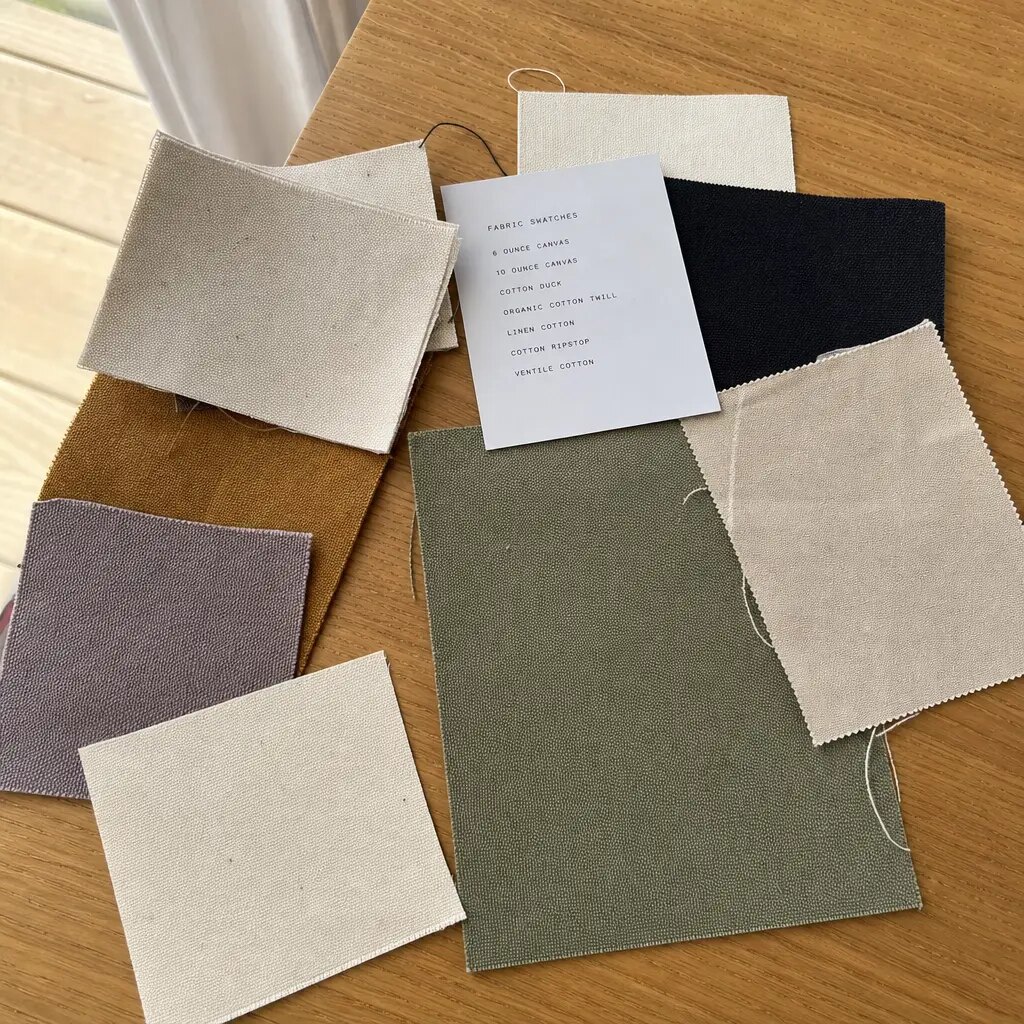
Natural unbleached cotton is popular for eco apparel brands because it supports a clear material story and avoids the processed look of bright white cloth. It also has normal variation. Seed flecks, slubs, and warm cream tone shifts may be acceptable if the buyer approves them in advance. The practical step is to seal a fabric standard or shade card, then define what variation is allowed across bulk. If a brand needs a very consistent off-white presentation for retail, that expectation has to be stated before fabric booking.
- Ask whether quoted GSM is greige, finished, washed, or unwashed fabric weight.
- Define acceptable GSM tolerance by roll lot or bulk lot.
- Approve natural cotton shade with a physical standard, not only a digital photo.
- Confirm whether slubs, seed flecks, and small natural fibers are acceptable.
- Review certification-document expectations before the supplier books fabric.
Print, cure, and fold without defects
Print is not only a design choice. It affects production sequence, drying time, hand-feel, stacking behavior, and inspection. For many organic cotton totes, 1 to 2 color water-based screen printing is the most practical option because it gives a soft feel and works well for simple apparel-brand graphics. It is also easier to quote than a complex multicolor process. Even so, the buyer should define the print area, number of colors, ink type, artwork version, print side, and placement tolerance. A small centered logo and a full-panel graphic are not the same commercial product.
Large solid print areas deserve special attention. They may require more careful curing, longer resting time before folding, and stricter approval for pinholes, rubbing resistance, and hand-feel. If bags are folded too soon after printing, the ink can mark, feel tacky, or crease at the fold. If the print crosses the fold line, the buyer should approve the fold method with the print in place. For no-polybag packing, printed panels can also rub against neighboring bags, so the supplier must confirm that curing is complete before final carton loading.
Digital printing, heat transfer, and embroidery can be valid for certain designs, but each one changes the carton plan. Digital print may suit detailed or multi-color art but can cost more and may have different durability expectations. Heat transfer can create a film-like hand and needs adhesion checks. Embroidery adds a premium detail but creates local thickness, which can distort the folded stack. Procurement should avoid accepting a cheaper process without testing it on the actual organic cotton base fabric.
- Approve a print strike-off on actual bulk-base fabric.
- State print dimensions, position from bag edges, color reference, and side count.
- Confirm whether print rubbing, washing, or dry crocking tests are required.
- Avoid placing heavy print coverage directly on a tight fold line when possible.
- Check whether curing time changes the packing schedule.
Build the carton plan from destination constraints
A carton packing plan should start with destination rules and work backward to the factory floor. Many buyers prefer export cartons under 12 to 14 kg gross because they are easier for manual unloading, safer for warehouse teams, and less likely to create receiving friction. Some channels can accept heavier cartons, and some courier networks penalize oversized cartons. The important point is to state the receiving limit before the factory chooses pieces per carton. If the supplier maximizes piece count first, cartons can become too heavy to handle or too soft to survive stacking.
Carton dimensions deserve the same attention as unit price. A long shallow carton may fit folded totes neatly but waste pallet height. A tall carton may compress the lower layers and crush handles or printed panels. Underfilled cartons can collapse when stacked. Overfilled cartons can split, bow outward, or arrive with stressed tape. A strong RFQ should ask the supplier for two or three packing options with measured length, width, height, net weight, gross weight, and pieces per carton. That lets procurement compare freight cube, storage behavior, and receiving labor instead of only total unit price.
The packed sample carton is the strongest checkpoint. A spreadsheet cannot show handle twist, carton bulge, inner stack movement, or label placement. For freight-sensitive projects, request one actual packed carton before bulk packing is locked. The sample should use the real fold method, bundle count, carton board, tape method, carton marks, and quantity. That one carton can expose problems while they are still cheap to correct.
- Set a target gross weight per carton before quoting is finalized.
- Request carton length, width, height, net weight, gross weight, and pieces per carton.
- Ask for two packing ratios, such as 80 pcs and 120 pcs per carton, when the carton plan is uncertain.
- Check whether the shipment is courier, LCL, FCL, palletized, or floor-loaded.
- Use the packed-carton sample to confirm cube, compression, barcode visibility, and handling.
Specify no-polybag packing without creating quality problems
Eco apparel brands often want to remove individual polybags, and for tote bags that can be a practical choice. A tote is usually less fragile than a finished garment and can often be shipped in clean bundles inside a master carton. But no-polybag packing is not simply the absence of plastic. It requires a defined process for folding, bundling, dust control, table cleanliness, storage protection, and carton lining if needed. Without those controls, a buyer may save on packaging material and still receive bags with dust, oil marks, abrasion, or inconsistent presentation.
A good packing instruction explains how each tote is folded and how the handles are managed. Handles may be tucked inside the bag, laid flat over the body, or folded to the back depending on the final pack size and print placement. The instruction should state the folded size target, bundle quantity, and whether each bundle is secured with a recycled paper band, cotton tie, paper wrap, or no inner band at all. If the order includes hangtags, barcode stickers, or sewn labels, their placement must survive folding and stacking without bending, peeling, or rubbing.
No-polybag packing also affects warehouse receiving. If the 3PL expects unit barcodes, the buyer must decide whether a carton-level barcode is enough or whether each tote needs a hangtag or sticker. If totes are unpacked at store level, neat bundle counts can reduce labor. If they are inserted into e-commerce orders, dust-free presentation becomes more important. Procurement should connect sustainability goals with the operational reality of how the bags will be received, stored, picked, and used.
- Define the fold sequence and handle position with a photo or approved sample.
- Set bundle count, such as 10 or 20 pieces, and keep it consistent across cartons.
- Use paper bands or carton liners when they improve cleanliness without adding unnecessary packaging.
- Confirm barcode and hangtag placement before approving the fold method.
- Add cleanliness checks when removing individual polybags.
Compare quotes by separating fixed spec from options
MOQ discussions become clearer when the buyer separates fixed construction from optional features. The fixed specification should include finished size, gusset, GSM, fabric base, handle type, print method, packing style, and carton target. Optional quote lines can include recycled polybags, hangtags, woven labels, inside care labels, barcode stickers, reinforced cartons, palletization, or different bundle counts. This structure lets procurement compare a true base quote while still seeing the cost and packing effect of add-ons.
Artwork splits should be discussed after the base body is stable. If a brand needs four store graphics, the supplier may be able to run one tote body and change screens or ink colors. But if each artwork has a different print size, different placement, or different ink coverage, the print cost and inspection risk change. A supplier may also set MOQ by artwork because setup time, screen preparation, and printing sequence still matter. Buyers should ask where surcharge breaks occur rather than assuming all splits are equal.
A fair quote comparison should include carton data. If one supplier quotes 100 pcs per carton and another quotes 150 pcs per carton, the lower unit price may not represent the better landed value. The higher carton count could be lighter, cleaner, or more stable, while the lower carton count may be oversized and expensive to ship. The quote sheet should therefore combine product cost, packing cost, carton size, gross weight, lead time, sample terms, certification documents, and inspection readiness. Procurement needs the full commercial picture, not only the FOB unit price.
- Keep fixed specs separate from optional quote lines.
- Ask MOQ by body, fabric color, print artwork, and trim item.
- Request surcharge breaks for small artwork or color splits.
- Compare quotes using total shipment cube as well as unit price.
- Reject vague lines such as packing as factory standard when freight planning matters.
Use a sample ladder, not one approval sample
A single tote sample is not enough to approve a B2B order that depends on freight efficiency and warehouse handling. Buyers should think in layers: fabric standard, print strike-off, pre-production sample, and packed-carton sample. Each sample answers a different question. The fabric standard confirms color, weight, texture, and acceptable natural variation. The print strike-off confirms ink color, coverage, hand-feel, curing, and placement on the real base fabric. The pre-production sample confirms sewing, handle reinforcement, dimensions, and final appearance. The packed-carton sample confirms that the approved product can actually be folded, bundled, marked, and shipped as planned.
The approval record should be specific. It should state finished size tolerance, handle drop tolerance, print placement tolerance, acceptable cotton shade variation, folding direction, bundle count, carton quantity, and carton marks. Wording such as as per sample creates problems later because a tote can match the general sample but fail a measurable buyer requirement. The sealed sample should be kept by both buyer and supplier, and final inspection should reference it alongside the written specification.
Packed-carton approval is especially useful when bags ship without individual polybags. It lets the buyer confirm that the bags remain clean, that printed panels are not rubbing excessively, and that carton strength is appropriate. It also gives the logistics team real data for pallet planning or freight booking. If the packed carton changes after approval, the supplier should notify the buyer before bulk shipment rather than updating the packing list at the end.
- Approve fabric standard before bulk fabric is cut.
- Approve print strike-off before mass printing begins.
- Approve pre-production sample before bulk sewing proceeds.
- Approve packed sample carton before final packing is repeated across the shipment.
- Keep one sealed reference sample for inspection and claims review.
Make QC standards measurable before bulk production
Organic cotton totes look simple, but simple products still need measurable QC standards. The most common claim areas are wrong dimensions, weak handles, print defects, stains, shade variation, incorrect carton counts, and packaging failures. A useful inspection plan classifies defects before production starts. Critical defects might include wrong artwork, missing handle, broken seam, unsafe foreign object, wrong SKU in carton, or incorrect country-of-origin marking. Major defects might include visible stains, print shift beyond tolerance, handle reinforcement failure, size out of tolerance, or carton quantity mismatch. Minor defects might include a small thread end, a light removable crease, or a natural slub within the approved fabric standard.
Handle strength deserves specific attention because the handles carry the functional risk. The buyer should approve the reinforcement stitch pattern and check for skipped stitches, loose threads, uneven handle length, raw edge exposure, or weak cross-stitching. If the bag will carry heavier garments or event materials, the buyer can ask for a load expectation or simple pull-test method, but the test should be agreed before production. It is better to define the practical requirement than to reject bulk based on a new standard after goods are finished.
Print QC should reference the approved strike-off. Inspectors should check color, registration, placement, curing, rubbing resistance if required, pinholes in key logo areas, and contamination. For no-polybag shipments, inspectors should also open random cartons to check dust, odor, moisture risk, bundle count, carton marks, and actual pieces per carton. Packing inspection is not secondary; it is part of whether the tote order is commercially usable.
- Define critical, major, and minor defects before final inspection.
- Measure bag width, height, gusset, handle drop, and print position against tolerances.
- Check handle reinforcement on both handles, not only one visible side.
- Open cartons during inspection to verify actual count and bundle method.
- Include cleanliness and odor checks when bags are packed without polybags.
Plan lead time around approvals, trims, and carton readiness
The sewing time for a tote bag may be straightforward, but the total lead time often depends on approvals and material readiness. Organic cotton fabric may need booking against a certification requirement. Natural base fabric may need buyer approval for shade and hand-feel. Print artwork may need a strike-off, especially when the print is large, dark, or placed on natural cotton. Hangtags, woven labels, barcode stickers, and carton labels can become hidden delays if they are not approved early. A supplier's single lead-time number is less useful than a stage-by-stage timeline.
A practical schedule separates tasks that must be frozen before cutting from tasks that can be finalized later. Finished size, GSM, gusset, handle construction, fabric base, and print size should be locked before bulk cutting. Print artwork and ink references must be approved before mass printing. Carton marks may sometimes be finalized later, but carton size, bundle count, and carton board should be confirmed early enough for packed-carton testing. If cartons are ordered only after production is complete, the factory may choose a size based on availability rather than optimized freight planning.
Procurement teams should also ask what happens if one artwork or trim item is delayed. If all print variants use the same tote body, the factory may be able to cut and sew the base bags while one artwork waits for final approval. If each variant uses a different construction, delays are harder to isolate. For programs tied to product launches, retail openings, or events, the production calendar should include approval deadlines, not only factory completion dates.
- Request a timeline for fabric booking, strike-off, PP sample, cutting, printing, sewing, packing, and inspection.
- Freeze fabric, size, handle, gusset, and print area before bulk cutting.
- Confirm trim and barcode approval dates if totes need labels or hangtags.
- Allow extra resting time for large solid prints before dense folding.
- Ask whether delayed artwork can ship separately without changing the carton plan.
Specification comparison for buyers
| Spec decision | Recommended option | When it fits | Buyer risk to check |
|---|---|---|---|
| Fabric weight | 8 oz to 10 oz organic cotton, about 270 to 340 GSM, quoted on finished fabric | Best for eco apparel retail totes that need structure, shelf presence, and moderate carry strength | Ask whether GSM is based on finished fabric, washed fabric, or greige fabric and require a tolerance band, usually plus or minus 5% |
| Fabric color base | Natural unbleached organic cotton with an approved shade standard | Fits eco positioning and keeps print cost simpler than dyed base cloth | Natural cotton varies lot to lot, so define an acceptable cream tone range and acceptability for slubs or seed flecks |
| Body size | Typical starting point: 38 x 42 cm flat with 8 to 10 cm bottom gusset | Works for folded tees, lightweight apparel, and promotional retail use | State whether dimensions are finished size or cutting size, and define tolerance separately for width, height, and gusset |
| Handle spec | 60 to 65 cm finished self-fabric handles, 2.5 to 3 cm wide, with reinforced stitching | Works for shoulder carry and most apparel retail programs | Check handle drop, symmetry, stitch density, and whether reinforcement is cross stitch, box stitch, or both |
| Print method | 1 to 2 color water-based screen print on actual bulk base fabric | Best for simple logos, medium runs, and a softer hand-feel on cotton | Define print position, coverage area, curing method, and whether print may cross the fold line |
| Individual packing | No polybag, or paper band / recycled wrap if cleanliness or retail presentation needs it | Useful for sustainability-led programs and full-case replenishment | If polybags are removed, require cleanliness controls, dust protection, and barcode or hangtag protection |
| Carton target | 12 to 14 kg gross per export carton unless destination receives heavier cases | Safer for manual handling, 3PL receiving, and stacked storage | Do not lock pieces per carton first; set the weight target and let pack ratio follow the folded thickness |
| Carton board | 5-ply export carton or board grade matched to shipping mode and stack height | Appropriate for ocean freight, LCL handling, and warehouse stacking | Ask for board grade, burst strength, and whether corner crush protection is needed |
| MOQ strategy | One tote body spec with shared fabric, handle, and packing method across artwork variants | Helps buyers compare print options without multiplying setup costs | Different artwork sizes, colors, or trims can trigger separate MOQ or surcharge breaks |
Buyer checklist before sampling
- State finished bag width, height, gusset type, gusset depth, and handle finished length in cm, not only from a reference image.
- Specify whether the quoted fabric weight is finished, washed, unwashed, or greige, and add an acceptable tolerance band.
- Define the base color as natural, bleached, or dyed, and require a physical shade standard if the order is not pure unbleached cotton.
- List print method, print size, print position, ink colors, artwork file version, and whether one-side or two-side printing is required.
- Confirm whether bags are to be pressed, lightly ironed, rested after curing, or folded immediately before packing.
- Set the individual packing rule: no polybag, recycled polybag, paper wrap, paper band, carton liner, or bulk bundle only.
- Define bundle count, folded dimensions target, handle placement during folding, and whether labels or hangtags must face outward.
- Request packed carton length, width, height, net weight, gross weight, and pieces per carton before order confirmation.
- State carton board requirement, such as 5-ply export carton, and whether drop resistance or extra edge protection is needed for courier, LCL, or e-commerce handling.
- Confirm shipping mark layout, barcode labels, carton numbering format, PO reference, SKU reference, color name, quantity marking, and country-of-origin marking requirements.
Factory quote questions to send
- What fabric GSM are you quoting, and is it based on finished fabric, washed fabric, or greige fabric weight?
- Is the quoted tote made from certified organic cotton fabric, and what certificate scope or transaction document can be provided if required by the buyer?
- What finished size tolerance are you applying for width, height, gusset depth, handle drop, and handle width?
- Is the body size quoted as finished size or cutting size, and does the dimension include seam allowance?
- What is the quote based on for print: number of colors, print coverage area, one side or two sides, ink type, curing method, and artwork size?
- How many pieces per carton are included in the quote, and what are the measured packed carton dimensions, net weight, and gross weight?
- If we remove individual polybags, what material cost, labor cost, and carton cube change per 1,000 pieces do you expect?
- What is the MOQ by bag body, fabric color, print artwork, and trim item, and where do surcharge breaks begin for small color or artwork splits?
- What lead time is needed for fabric booking, base fabric approval, print strike-off, pre-production sample, trims, bulk production, packed-carton approval, and final inspection?
- What carton board grade or ply are you quoting, and will the carton remain stable if stacked, palletized, or courier-handled?
Quality-control points to confirm
- Finished bag width and height within agreed tolerance, commonly plus or minus 1 cm, with gusset tolerance stated separately because it affects folded thickness.
- Handle pair symmetry, handle drop, stitch density, and reinforcement checked against the approved sample; no skipped stitches, raw edge exposure, loose reinforcement, or visibly uneven drop beyond tolerance.
- Fabric GSM and hand-feel consistent across bulk lots; no mixed lighter panels, obvious roll shade mismatch, mildew odor, oil marks, or storage dust in the same shipment.
- Print color, registration, curing, and rubbing resistance meet the approved strike-off; no obvious pinholes, ink cracks, ghosting, or print contamination in key logo areas.
- Natural cotton shade variation kept within the approved standard card or sealed sample range; slubs accepted only when they match the agreed fabric standard.
- Needle control, thread trimming, cleanliness, and stain prevention verified before packing, especially when bags are shipped without individual polybags.
- Correct folding direction, handle placement, bundle count, carton count, carton marks, barcode placement, and SKU separation match the approved packing instruction.
- Carton integrity suitable for export stacking and handling; no overfilled cartons causing side bulge, crushed top flaps, exposed tape failure, or underfilled cartons that collapse.
- Random carton opening during final inspection confirms actual pieces per carton, inner bundle quantity, and mixed-artwork separation where applicable.
- Packed-carton gross weight checked against buyer receiving limits and against the packing list before shipment release.