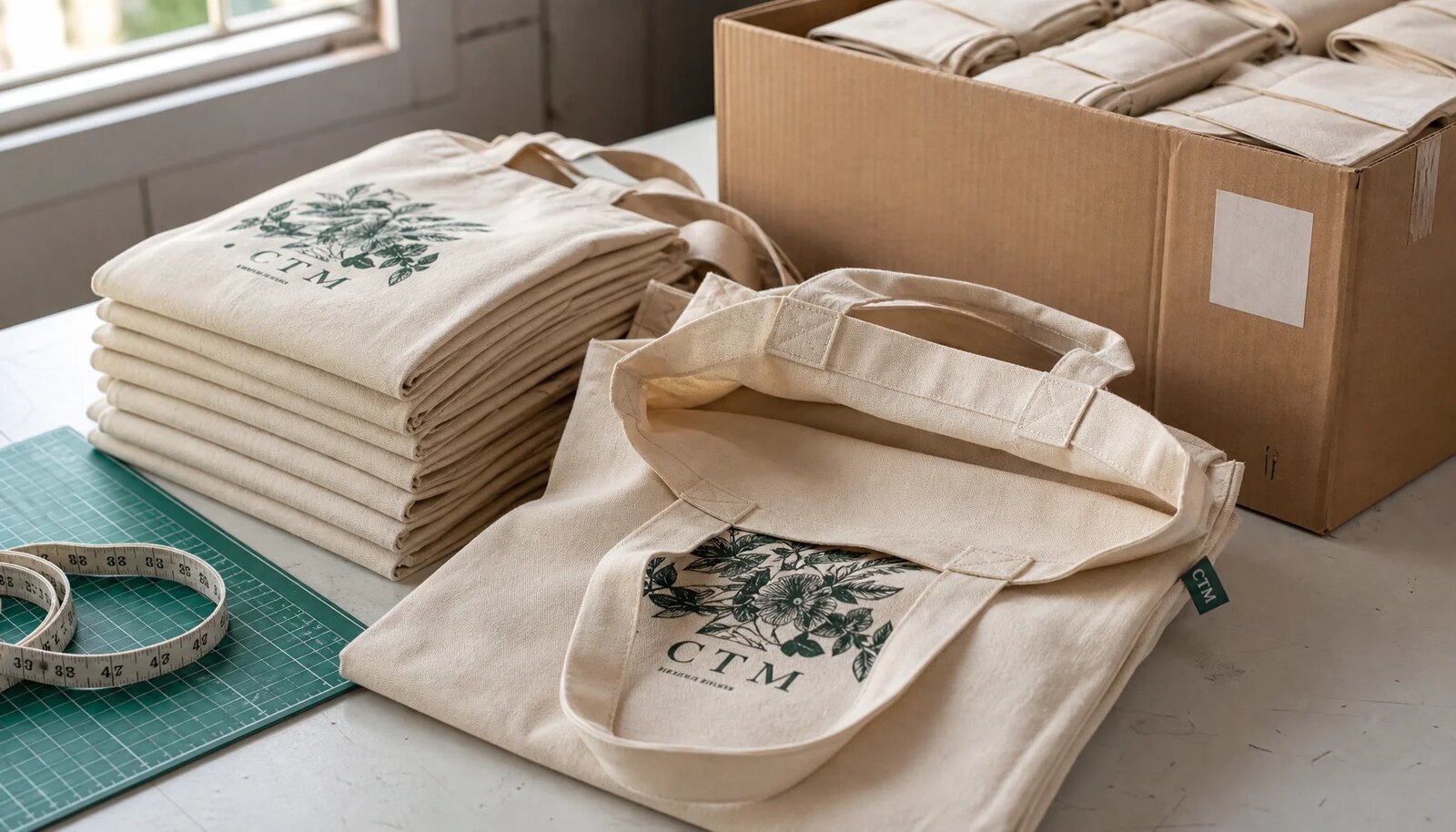
Start With the Carton Objective
For craft fair orders, carton packing is part of the product specification, not a warehouse detail to decide after production. Organic cotton totes may be used for maker fairs, museum markets, holiday pop-ups, farm markets, sponsor programs, vendor welcome kits, or merchandise tables. These orders usually have fixed event dates, multiple allocation groups, and limited time for domestic repacking.
A tote can pass sample review and still create operational problems. Cartons may be too heavy for booth staff. Printed bags may arrive loose, creased, dusty, or rubbed. Sponsor artwork may be mixed across cities. These failures usually come from an RFQ that describes the tote but not how it must be counted, bundled, labeled, inspected, and received.
A useful carton packing plan connects product specs, artwork versions, inner bundles, carton quantity, carton marks, inspection method, and freight data before the supplier quotes. Treat bundle count, pcs/carton, maximum carton gross weight, and label content as measurable requirements.
- Set packing rules before the PO, not after finished goods reach the packing room.
- Define whether cartons ship to a warehouse, event venue, distributor, booth team, or kit assembler.
- Set a maximum carton gross weight if volunteers or retail staff will handle cartons manually.
- Keep one artwork version per bundle and carton unless a written mixed-pack allocation is approved.
- Request trial-pack carton dimensions, gross weight, net weight, and CBM before freight booking.
Match the Tote to Event Use
Start with the job the tote must do. A lightweight visitor giveaway does not need the same structure as a retail tote displayed at a merchandise table. A booth shopping bag must carry several purchases for hours. A vendor welcome bag may be loaded with badges, catalogs, samples, drink tickets, or sponsor inserts before the event opens.
The use case changes the packing plan. If staff hand out bags in small batches, 10 pcs/bundle is easier to count than loose bulk packing. If totes are sold as merchandise, each piece may need a hangtag, barcode, individual sleeve, paper band, or controlled retail fold. If the bags are stored behind booths, paper-wrapped bundles may be more practical than individual sleeves.
Handling conditions matter. Indoor venues may have clean receiving areas and predictable storage. Outdoor markets may involve damp floors, van loading, tent storage, and repeated movement. More handling points call for stronger cartons, clearer labels, and realistic moisture protection.
- Giveaway use: control cost, count accuracy, simple bundle packing, and clean branding.
- Retail use: control fold quality, barcode placement, presentation, and shade consistency.
- Booth shopping use: control handle strength, practical size, fast replenishment, and manageable carton weight.
- Vendor kit use: control opening size, bundle count, allocation accuracy, and compatibility with inserts.
- Multi-city use: control carton numbering by destination, artwork segregation, and packing list detail.
Specify Fabric and Organic Cotton Basis
Many craft fair tote programs use 8 oz to 12 oz canvas, often about 230-360 GSM depending on yarn, weave, and finishing. An 8 oz canvas can work for low-load giveaways and paper inserts. A 10 oz canvas is a balanced starting point for general booth shopping and sponsor totes. A 12 oz canvas feels sturdier for retail merchandise or heavier goods, but it increases unit cost, carton weight, and shipping volume.
Do not compare supplier quotes by ounce description alone. Some suppliers quote greige fabric weight, while others quote finished fabric weight after washing, sanforizing, or pressing. The same ounce label can produce different hand feel if yarn count, weave density, shrinkage treatment, or finishing changes. Ask for GSM, ounce description, weave type, finishing method, shrinkage expectation, and fabric status.
Organic cotton documentation should be stated with care. A buyer may need a supplier declaration, certified fabric records, scope certificate visibility, or transaction certificate support. These routes are not equal in availability, cost, or lead time. If your internal policy requires specific documentation, include it in the RFQ and ask whether certificate handling is available and included.
- 8 oz / about 230-260 GSM: useful for light giveaways; check opacity, handle pull, and print show-through.
- 10 oz / about 280-310 GSM: practical for general craft fair totes; confirm actual hand feel by sample.
- 12 oz / about 320-360 GSM: better structure for heavier goods; trial pack before approving pcs/carton.
- Natural undyed cotton: simpler than custom dyeing; approve seed flecks, slubs, and shade variation.
- Custom dyed cotton: requires lab dips, dye lot control, MOQ review, extra lead time, and shade tolerance approval.
Lock Size, Handles, Gusset, and Tolerances
A common event tote size is about 38 x 42 cm with 60-65 cm total handle length and about 27-30 cm handle drop. This works for many craft fair purchases such as soaps, candles, stationery, small textiles, packaged foods, folded apparel, and prints in sleeves. Very small totes limit usefulness, while oversized totes increase carton volume and can feel awkward in crowded aisles.
Handle specifications should include both total handle length and handle drop. They are not the same measurement. Self-fabric handles give a cohesive cotton look and can be reinforced with box stitch, cross stitch, bartack stitching, or a combined method. Handle attachment is often the first stress point when visitors carry multiple purchases.
Gussets improve capacity for boxed goods, jars, ceramics, and folded apparel, but they reduce flat packing efficiency. A flat tote stacks cleanly and may support higher pcs/carton. A 5-10 cm gusset can make the bag more useful but may reduce carton quantity depending on GSM, fold method, and retail packing.
Write tolerances into the specification. Practical examples to confirm with the factory may include body width +/-1 cm, body height +/-1 cm, handle drop +/-1 cm, gusset depth +/-0.5 cm to +/-1 cm, and print placement +/-0.5 cm. Cotton sewing and pressing are not as dimensionally rigid as molded products, so unrealistic tolerances can create avoidable disputes.
- Specify finished dimensions after sewing and pressing, not only cut-panel dimensions.
- State handle length and handle drop separately to avoid inconsistent samples.
- Approve reinforcement type, stitch density, thread color, and seam allowance on the physical sample.
- Choose gussets for capacity, then recalculate pcs/carton, carton size, carton weight, and freight cost.
- Use written tolerances so inspection decisions are based on agreed standards.
Choose Printing With QC in Mind
Water-based screen printing is often practical for organic cotton totes with simple logos, event marks, and sponsor artwork. It gives a softer hand feel than heavy plastisol and supports the natural cotton positioning. For one to three solid colors, screen printing is generally easier to control than full-color methods, but cotton texture can soften edges and close small reversed text.
Heat transfer may suit gradients, photos, short runs, or many logo versions, but the buyer should check edge adhesion, hand feel, heat marks, and whether the film changes the natural cotton appearance. Digital print can help with samples or short runs, although production speed, color consistency, and durability should be confirmed before bulk approval. Embroidery can work for premium small batches, but large embroidery on light cotton may distort the panel.
Print planning affects carton packing. Screen prints need proper curing before folding. Under-cured ink can feel tacky, transfer to adjacent bags, smell inside cartons, or fail a dry rub check. Dark ink on natural cotton should be checked for pressure marks inside bundles. Approve the folding direction so the printed face is protected.
- Use water-based screen print for solid event logos and softer hand feel.
- Confirm minimum line thickness because fine lines and small reversed text may fill in on cotton texture.
- Approve a strike-off on actual production fabric, not only a digital mockup.
- Measure print placement from top and side edges using the same reference points at inspection.
- Include curing, dry rub, odor, folding, and pressure-mark checks before shipment release.
Read MOQ and Price Breaks Correctly
MOQ is driven by more than total order quantity. Fabric availability, dye route, cutting efficiency, print setup, label requirements, handle material, and packing complexity all influence the threshold. A natural organic cotton tote using one shared body may support several artwork versions more easily than a custom dyed tote with separate dye lots.
A B2B quote should separate recurring unit cost from one-time or order-specific charges. Screens, strike-offs, sample revisions, lab dips, carton label setup, barcode setup, and packing development may not repeat on a reorder. If the supplier gives only one blended price, the buyer cannot compare first-order cost against reorder cost.
Packing cost is easy to underestimate. Individual sleeves, barcode stickers, hangtags, paper bands, allocation labels, stronger cartons, and destination-specific packing add labor and materials. A lower tote unit price can become expensive if cartons arrive with mixed artwork or packing that requires domestic labor before the event.
- Fabric cost: GSM, weave, finishing, dyeing, shrinkage control, and documentation route.
- Printing cost: color count, screen count, artwork versions, strike-offs, print area, and curing time.
- Sewing cost: gusset, seam type, top hem, handle reinforcement, labels, thread, and stitch density.
- Packing cost: bundle count, sleeves, hangtags, barcodes, bundle labels, carton marks, and carton strength.
- Logistics cost: pcs/carton, carton dimensions, gross weight, dimensional weight, CBM, and destination splits.
Build Cartons Staff Can Use
A practical carton plan starts with folded size, target pcs/carton, maximum carton gross weight, and inner bundle quantity. For a flat mid-weight tote, 100 pcs/carton may be workable. For heavier canvas, gussets, individual sleeves, hangtags, or retail folds, 50-80 pcs/carton may be more realistic. The best carton count is the one that protects the product, keeps handling practical, and supports accurate receiving.
Inner packing should match the event workflow. Bundles of 10 pieces are easy for booth teams to count. Bundles of 25 pieces are efficient for central replenishment. Loose bulk packing may reduce factory labor, but it slows counting, increases creasing risk, and makes shortages harder to detect.
Carton labels must work in real receiving conditions. Staff should identify contents without opening cartons. At minimum, marks should include PO number, item code, artwork version, tote size, fabric color, quantity, carton number, gross weight, net weight, carton dimensions, and destination or booth group when relevant. Multi-city orders should number cartons by destination and artwork.
Ask for packing photos before shipment. Useful photos show an open carton with bundle arrangement, a bundle label, a carton mark, a sealed carton, and carton dimensions or weight if needed. For high-risk orders, inspection should open cartons from different packing stages and verify that labels match contents.
- Use 10 pcs/bundle for small booth allocations and fast counting by non-warehouse staff.
- Use 25 pcs/bundle for central distribution where larger replenishment quantities are normal.
- Keep one artwork per bundle and carton unless mixed packing is documented line by line.
- Set a practical maximum carton gross weight, such as 15-18 kg where manual handling is expected.
- Update freight data if GSM, gusset, fold, sleeve, hangtag, or pcs/carton changes after quoting.
Approve Samples Before Bulk Production
A strong sample process reduces late disputes. If the construction is new, begin with a fabric swatch and plain construction sample to approve fabric weight, handle drop, seam shape, gusset, and fold. Then approve a print strike-off on actual fabric. The pre-production sample should represent the real order: same fabric, print method, handle construction, label, fold, and similar packing approach.
Acceptance criteria should be written before bulk production. Finished body tolerance, handle drop, gusset depth, print placement, print registration, and print color should be agreed with the supplier based on construction and artwork. Color should reference Pantone or an approved physical sample, with realistic allowance for natural cotton base shade.
Functional review is as important as appearance. Load the sample with representative craft fair items such as books, candles, jars, boxed soaps, folded apparel, or catalogs. Check whether the handle feels comfortable, the bottom seam holds shape, and the opening works for the intended use. Fold the sample as it will be packed and check whether the logo is creased, rubbed, or hidden.
- Keep one sealed approved sample at the factory and one with the buyer or inspector.
- Approve fabric hand feel, opacity, stiffness, shade, and cotton surface characteristics before bulk cutting.
- Measure samples after sewing and pressing using the same method planned for final inspection.
- Approve print scale, placement, color, edge quality, hand feel, and rub result on real cotton fabric.
- Record sample approval date and version so revised artwork or packing changes do not create confusion.
Inspect Product, Packing, and Shipment Data Together
Final inspection should cover both tote quality and carton packing. Product checks include fabric defects, stains, odor, seam strength, skipped stitches, stitch density, handle reinforcement, print registration, print adhesion, finished dimensions, and label placement. Packing checks include bundle quantity, carton quantity, carton marks, mixed artwork control, folding direction, carton condition, moisture exposure, sealing method, and packing list accuracy.
Sampling should include cartons from the beginning, middle, and end of packing. If several artworks are produced, inspect each artwork as its own lot rather than treating the whole order as one uniform SKU. Open random cartons and confirm that the outside label matches the inside product.
Define defect severity before inspection. Wrong artwork inside a carton may be critical for a sponsor event even if sewing quality is acceptable. A loose thread may be minor if it can be trimmed, while an open seam at a handle attachment is major or critical depending on severity. The inspector should have the approved sample, artwork file, measurement tolerance, packing instruction, carton label format, and PO allocation list.
Delivery planning should run backward from the warehouse arrival date, not the ship date. Reserve time for sample approvals, printing, curing, packing photos, inspection, export handover, customs clearance, domestic sorting, and final delivery to the venue or distributor. Request revised carton data whenever the tote specification or packing method changes.
- Fabric check: GSM, shade, stains, holes, heavy slubs, oil marks, broken yarns, odor, and moisture exposure.
- Measurement check: body width, body height, gusset, handle length, handle drop, print size, and print placement.
- Sewing check: seam allowance, stitch density, top hem, open seams, skipped stitches, loose threads, and reinforced handle ends.
- Print check: color, registration, ink coverage, pinholes, curing, dry rub, scratch resistance, tackiness, odor, and pressure marks.
- Packing check: piece count, bundle count, fold direction, artwork segregation, carton label accuracy, carton condition, and packing list match.
- Shipment check: total cartons, CBM, gross weight, net weight, destination split, inspection result, and required arrival date.
Specification comparison for buyers
| Spec decision | Practical option | Best fit | Buyer risk to check |
|---|---|---|---|
| Fabric weight | Example range: 8 oz to 12 oz organic cotton canvas, often about 230-360 GSM depending on weave and finishing | Light giveaways at the lower end; general booth shopping around the middle; premium retail totes at the higher end | Do not compare ounce labels alone. Ask whether GSM is measured before or after finishing and approve hand feel from a physical sample |
| General craft fair tote body | Example size: 38 x 42 cm flat body with 60-65 cm total handle length and about 27-30 cm handle drop | Visitor shopping bags, sponsor totes, market merchandise, and event welcome bags | Confirm finished dimensions after sewing and pressing, not cut-panel measurements |
| Gusseted tote | Example: 5-10 cm bottom or side gusset when extra capacity is needed | Boxed soaps, jars, folded apparel, small ceramics, vendor kits, or packed gift sets | Gussets increase folded thickness, reduce pcs/carton, and add seam and corner inspection points |
| Print method | Water-based screen print for simple 1-3 color logos on natural cotton | Event logos, sponsor branding, and clean natural-cotton positioning | Require a strike-off on actual production fabric. Check curing, dry rub, odor, edge clarity, and registration |
| Inner packing | 10 pcs/bundle for booth teams or 25 pcs/bundle for central replenishment | Faster receiving, easier counting, cleaner allocation, and less event-day sorting | Mixed artwork inside bundles creates shortages and rework. Require bundle labels when versions or destinations differ |
| Carton quantity | Trial-pack the exact tote; common examples may range from 50-100 pcs/carton depending on GSM, gusset, fold, sleeves, and hangtags | Freight quoting, warehouse receiving, courier limits, and manual handling planning | Do not assume 100 pcs/carton. Confirm carton dimensions, gross weight, net weight, total cartons, and CBM |
| Carton marks | PO, item code, artwork version, fabric color, size, quantity, carton number, destination, GW, NW, and carton dimensions | Multi-logo, multi-city, sponsor, distributor, or booth allocation programs | Vague labels cause domestic repacking, missed allocations, and avoidable event deadline risk |
| Retail presentation | Controlled fold, hangtag, barcode, paper band, paper sleeve, or recycled sleeve if required | Totes sold as merchandise or handled through retail inventory systems | Retail packing adds labor, materials, carton volume, and extra QC points. Quote it separately from bulk packing |
Buyer checklist before sampling
- Define finished body width, height, gusset depth, handle length, handle drop, fabric weight, seam construction, handle reinforcement, and measurement stage after sewing and pressing.
- State the craft fair use case: visitor giveaway, booth shopping bag, retail merchandise, sponsor kit, vendor welcome bag, pre-packed product bundle, or multi-city allocation.
- Request GSM, ounce description, weave type, fabric status, finishing method, shrinkage expectation, shade tolerance, and whether fabric weight is greige, finished, washed, or pressed.
- Specify organic cotton documentation requirements carefully, such as supplier declaration, certified fabric records, scope certificate visibility, or transaction certificate support, and confirm availability and fees before PO.
- Provide vector artwork, Pantone or approved color target, print size, placement from top and side edges, minimum line thickness, and realistic placement or registration tolerance.
- Confirm print method, color count, screen count, ink type, curing process, target hand feel, and required dry rub, scratch, odor, and adhesion checks.
- Set practical tolerances as examples to confirm with the factory, such as body width and height +/-1 cm, handle drop +/-1 cm, print placement +/-0.5 cm, and zero carton quantity shortage unless approved.
- Define acceptable natural cotton characteristics before production, including seed flecks, slubs, shade variation, yarn irregularity, and visible fabric defects that are not acceptable.
- Set target pcs/carton, maximum carton gross weight, inner bundle quantity, bundle label content, carton strength, sealing method, moisture protection, and any courier or warehouse carton limits.
- Require a sample route: fabric swatch, plain construction sample if needed, print strike-off on actual fabric, pre-production sample from bulk material, and packing photo or pack-out sample for complex allocations.
Factory quote questions to send
- What exact fabric is quoted: GSM, ounce description, weave, yarn type if known, natural or dyed status, finishing method, and measurement stage for GSM?
- What organic cotton documentation can you support for this order, and are certificate handling, fabric records, declarations, or related fees included in the quote?
- Is the fabric in stock, greige, natural finished, bleached, garment washed, or custom dyed, and what MOQ and lead time apply to each route?
- What finished tolerances do you recommend for body width, body height, gusset depth, handle length, handle drop, print placement, and print registration?
- What handle attachment method is quoted, such as box stitch, cross stitch, bartack, or combined reinforcement, and what load or pull check will you perform?
- What stitch density, seam allowance, thread type, and seam construction will be used on side seams, bottom seam, gusset corners, top hem, and handle attachments?
- Which print method do you recommend for this artwork, and what are the minimum line thickness, maximum print area, color tolerance, curing process, and drying time?
- Can you provide a print strike-off on the actual production fabric before bulk printing, and how many artwork or color revision rounds are included?
- After trial packing this exact tote, what pcs/carton, carton dimensions, gross weight, net weight, total cartons, and CBM do you recommend?
- Can you pack 10 pcs or 25 pcs per inner bundle, and can each bundle be labeled by artwork, destination, booth group, barcode, or event day?
Quality-control points to confirm
- Verify fabric GSM using the method agreed in the PO; do not rely only on the supplier's ounce description or fabric name.
- Measure finished tote dimensions after sewing and pressing, including body width, body height, gusset depth, handle length, and handle drop.
- Compare natural organic cotton shade to the approved swatch or sealed sample, with only the agreed level of seed flecks, slubs, and shade variation.
- Inspect fabric panels for stains, oil marks, holes, weaving defects, heavy slubs, broken yarns, shade panels, mildew odor, and visible contamination.
- Check handle reinforcement for consistent stitching, no skipped stitches, loose threads, needle cuts, open seams, or weak stress points.
- Check stitch density and seam allowance on side seams, bottom seams, top hem, handle ends, and gusset corners.
- Measure print position from consistent reference points, usually top edge and side seam, especially when several artwork versions are produced.
- Inspect print registration, edge sharpness, ink coverage, pinholes, color consistency, hand feel, curing, odor, dry rub resistance, and pressure marks after folding.
- Confirm print color under consistent lighting against Pantone target or approved physical strike-off, allowing for the natural cotton base shade.
- Open cartons from different packing stages to verify piece count, bundle count, artwork version, carton label accuracy, folding direction, and no mixed product unless approved.