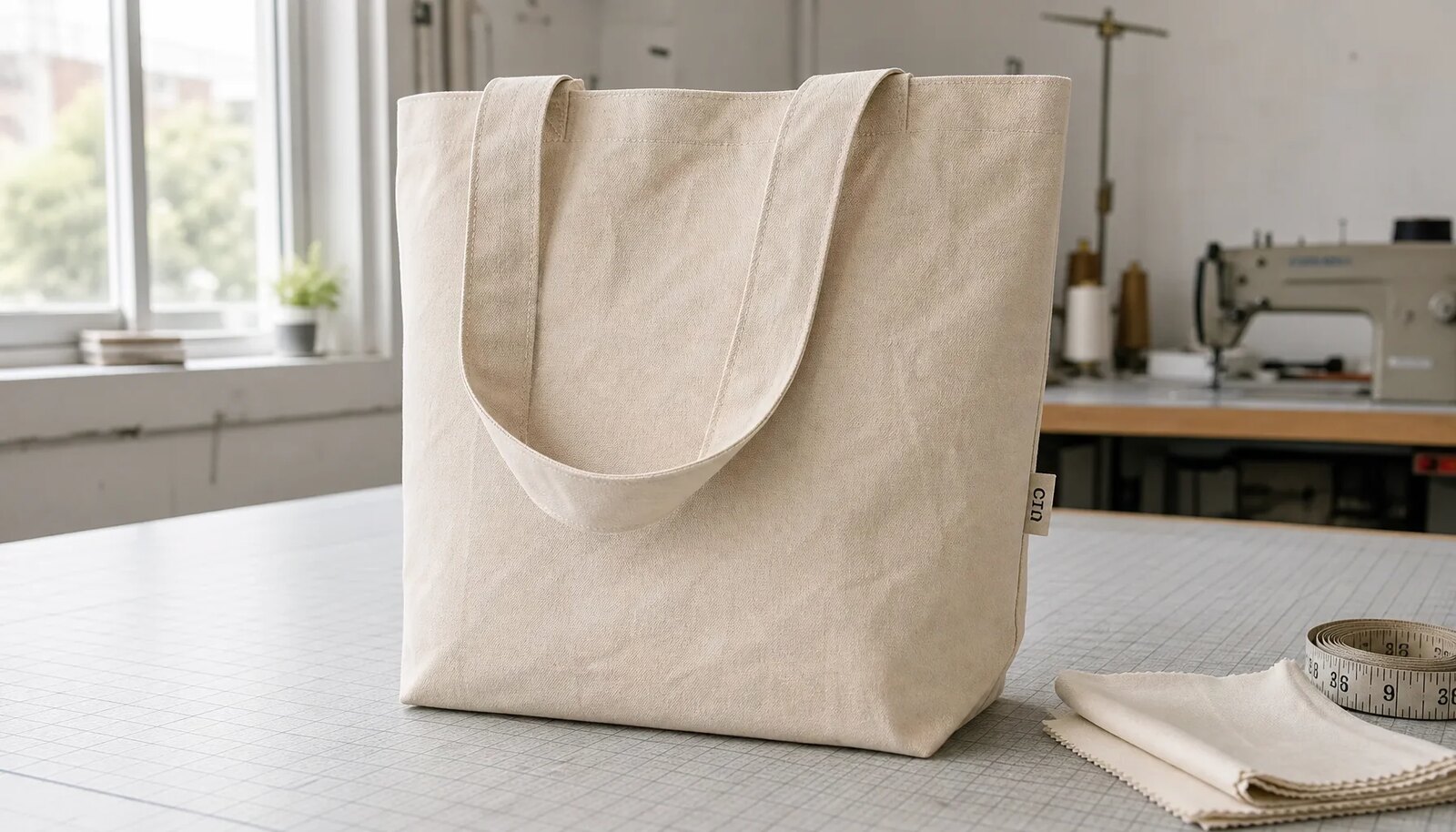
Procurement reality: a tote is small, but the buying risk is not
Organic cotton totes look simple on a product page, yet they create a surprisingly wide spread in wholesale quotes. One supplier may be pricing a lightweight stock blank with a simple print. Another may be pricing certified fabric, custom cut-and-sew construction, a woven side label, individual barcode packing, and a transaction certificate. Both may call the product an “organic cotton tote,” but the commercial result is not comparable.
For eco apparel brands, the tote often carries the same values as the clothing line. It may be used as a retail carry bag, a gift-with-purchase, a subscription-box insert, a conference item, or a branded accessory sold next to tees and sweatshirts. In each channel, the buyer has to protect margin, brand appearance, and claim accuracy. A cheap tote that feels thin, has a crooked print, or cannot support the intended organic claim can damage the retail program more than it saves in unit cost.
The buying process should start by defining the program: what the tote must do, what the brand will claim, how it will be packed, and how the shipment will be costed. Once those decisions are fixed, suppliers can quote on the same basis. Without that discipline, procurement teams often compare mismatched prices and discover the hidden differences only after sampling, inspection, or customs review.
- Define the sales channel first: retail accessory, apparel bundle, event giveaway, store carry bag, or wholesale distributor item.
- Separate product decisions from claim decisions; “organic cotton fabric” and “certified organic product” are not always the same thing.
- Treat packing, certification paperwork, and freight density as cost drivers, not afterthoughts.
- Use one controlled RFQ version so every supplier quotes the same size, GSM, print, label, packing, MOQ, Incoterm, and delivery assumption.
Organic cotton claims: GOTS, OCS, certificates, and chain of custody
Organic cotton specificity matters because the wording on the tote, hangtag, website, or wholesale line sheet may require documentation. GOTS and OCS are different tools. GOTS covers organic textile processing and includes environmental and social criteria across certified processing stages. OCS focuses on verifying the presence and amount of organic material through chain of custody. The right choice depends on the claim the brand wants to make and the certification scope of the suppliers involved.
A supplier saying “we use organic cotton” is not enough for a procurement file. Ask for the current scope certificate, not only a logo in a catalog. Check the certificate holder name, certificate number, issuing certification body, expiry date, product categories, and processing activities. For totes, pay close attention to whether the certificate covers fabric, dyeing or finishing if used, printing, sewing, labeling, packing, trading, and export. If the certified fabric is bought by one company, printed by another, sewn by a third, and sold through a trader, the chain-of-custody boundaries must be clear.
Transaction certificates are also important. A scope certificate shows that a supplier is certified for certain activities. A transaction certificate, when applicable, links a specific shipment or order to certified goods. If the brand needs to substantiate a certified product claim, confirm early whether a TC can be issued for the tote order, how long it takes, what it costs, and what minimum quantity applies. Some low-MOQ or blank-stock routes may use organic material but may not support the exact claim the brand wants to print on the product.
Certification affects commercial terms. Certified fabric may be more expensive, fabric options may be narrower, and the MOQ may be driven by certified roll quantities rather than sewing capacity. Lead time can also extend if the supplier must book certified fabric, arrange certified processing, or wait for documentation. This does not make certification impractical, but it must be priced and scheduled deliberately.
- Ask: “What exact wording can we legally and accurately use on the product and packaging based on your certification scope?”
- Check whether the tote itself, the material only, or the supplier company is certified; these are different procurement outcomes.
- Request certificate validity before sampling, then recheck before shipment if the order runs close to expiry.
- Confirm whether printing inks, labels, and packing steps affect the certified claim or require certified subcontractors.
- Do not approve hangtag or website wording until the certification route and transaction certificate process are confirmed.
Choose the sourcing route before choosing the cheapest quote
The comparison table above is designed to prevent a common sourcing mistake: comparing a stock blank route against a custom certified production route as if they were the same offer. The correct route depends on forecast confidence, claim requirements, artwork complexity, and time pressure. A first launch may be better served by stock organic cotton fabric with a custom print. A repeat retail program may justify custom cut-and-sew because the brand needs a consistent silhouette, gusset, woven label, and carton plan.
Stock finished blanks are useful for urgency, but they limit control. The buyer inherits the supplier’s available size, handle length, GSM, seam finish, and certification evidence. This can be acceptable for a pop-up event or a small influencer mailing, but it may not be strong enough for a permanent wholesale accessory line. By contrast, custom cut-and-sew gives more control but requires a clearer spec, longer sample cycle, and more disciplined QC.
Direct factory sourcing usually gives better visibility into fabric, sewing, inspection, and packing. A trading company can still be useful when the apparel brand needs totes, socks, caps, and packaging consolidated under one PO. The risk is not the existence of a trader; the risk is unclear responsibility. If the trading company handles the order, the buyer should still know who controls certification documents, who approves the PP sample, who pays for rework, and who releases final shipment.
A procurement-friendly route decision asks: how many units are needed, how much of the spec must be controlled, how strong the organic claim must be, and how quickly the order must ship. Once the route is chosen, MOQ and price make much more sense.
- Use stock blanks only when speed matters more than construction control.
- Use stock certified fabric plus custom print for test orders that still need better brand presentation.
- Use custom cut-and-sew for repeat programs where size, gusset, handle comfort, and retail packing are important.
- Use a direct factory when the brand has clear specs and wants stronger QC visibility.
- Use a consolidator only when mixed-category logistics create enough value to justify the extra communication layer.
Build the tote specification around apparel retail use
A tote for an eco apparel brand should be specified around what it will carry and how customers will experience it. A store carry bag for folded tees can be lighter than a premium tote sold as an accessory. A bundle insert for hoodies may need a gusset and stronger handles. A conference giveaway may prioritize cost, carton density, and simple print. If the buyer does not define the use case, the supplier will define it through the cheapest available construction.
For most wholesale apparel programs, 140–180 GSM organic cotton canvas, plain weave, or twill is a practical starting range. Around 140–160 GSM can work for lighter promotional or online bundle use. Around 160–180 GSM generally gives better structure, less print-through, and a more retail-friendly hand feel. Heavier fabric can be attractive, but it raises cost, carton weight, and freight. It can also make the tote less foldable if the brand needs compact packing.
Finished dimensions must be written as finished size after sewing, not cut-panel size. State width, height, gusset depth, handle length, handle width, seam allowance, and reinforcement method. Handle length is especially important for apparel brands because customers often carry totes over the shoulder while shopping. A total handle length around 60–70 cm and a width around 2.5–3 cm is common for shoulder carry, but the best choice depends on bag size and load expectation.
Natural cotton shade needs a tolerance. Undyed organic cotton can vary by lot and may show small flecks or slubs. That can support an eco aesthetic, but only if the sales team and buyer agree what is acceptable. If the brand wants a very clean, uniform look, discuss bleaching, dyeing, or finishing options and how they affect certification, lead time, cost, and claim wording.
- Specify fabric as fiber content + weave + GSM + finish, not simply “organic cotton.”
- State whether the tote must stand well for photography, fold flat for fulfillment, or carry a defined load.
- Define handle reinforcement: box stitch, cross stitch, bar tack, or another approved method.
- Confirm whether natural slubs, seed flecks, and shade variation are acceptable for the brand aesthetic.
- Ask whether GSM is measured before or after washing, dyeing, or finishing.
Printing, labels, and claim wording must be approved together
Artwork decisions affect cost, rejects, and certification claims. Water-based screen print is often the strongest option for one- or two-color logos at wholesale volume. It can look clean on natural cotton and usually has a softer hand than heavier transfer methods. However, fine text, small QR codes, thin lines, and large solid areas can create opacity or edge-sharpness issues, especially on lower-GSM fabric.
Heat transfer may be useful for short runs, many artwork versions, or urgent replenishment. It can help with detailed graphics, but buyers should evaluate hand feel, cracking risk, and wash behavior. Embroidery can work for a small logo on heavier fabric, but large embroidery areas can distort panels, add cost, and increase inspection points. Digital printing may be suitable for certain artwork, but it still needs strike-off approval and testing on the actual fabric shade.
Labels require the same care as print. A woven side label, inside care label, hangtag, and barcode sticker all need placement rules. If the label or hangtag says “GOTS certified” or uses another certification reference, it must match the certification route. The factory should not improvise claim wording. Procurement should provide approved text and confirm whether the supplier is allowed to apply certification marks under the relevant standard and certification body rules.
A proper print approval package includes artwork file version, print size, placement from seams or top edge, color target, acceptable tolerance, and testing requirements. A physical strike-off is safer than photo approval for brand-critical work because cotton texture and natural shade can change how the ink looks.
- Separate base tote price from print setup, screen charges, color-change fees, embroidery digitizing, and label tooling.
- Request a print strike-off on the actual fabric, not only on a similar cotton swatch.
- Set print placement tolerance, for example measured from top edge, side seam, or center line.
- Test print rub resistance; add wash testing if the product will be marketed as washable.
- Approve certification wording before printing hangtags, labels, or product inserts.
MOQ, sampling, and lead time: where wholesale orders usually drift
MOQ is rarely one number. It can apply to fabric, color, size, print design, label version, trim, packing format, or certificate issuance. A supplier may offer 500 pieces for a stock blank, 1,000 pieces for stock fabric plus print, and a higher minimum for custom dyed fabric or custom woven labels. The buyer should ask for MOQ by variable, not only MOQ by order.
For eco apparel brands testing sell-through, the safest route is usually one size, one natural fabric shade, one print position, and one packing format. Multiple SKUs look attractive for merchandising, but they dilute volume and increase setup. If the supplier allows same-fabric batching across different designs, confirm exactly how pricing changes and whether certification paperwork can still identify each item correctly.
Sampling should prove construction and production method, not just appearance. A blank sample helps evaluate size and handle comfort. A print strike-off checks ink behavior. A pre-production sample confirms final fabric, print, label, stitching, and packing. For important programs, keep a sealed reference sample at the factory and one signed sample with the buyer or inspection team. The final inspection should compare bulk goods against that exact sample.
Lead time should be milestone-based. Document verification and certificate review may happen before sampling. Fabric booking may start only after deposit. Printing may not start until artwork and Pantone targets are approved. Packing may wait for barcode and carton side-mark instructions. A supplier quote that says “25 days production” is not enough unless it states when the clock starts and what approvals are required first.
- Ask MOQ per fabric roll, color, artwork, label, carton assortment, and transaction certificate.
- Do not approve bulk production from photos alone when print, claim wording, or size is important.
- Lock artwork before PP approval; artwork changes after sampling should trigger revised cost and lead time.
- Build calendar buffers for certificate paperwork, print correction, carton rework, and inspection booking.
- Clarify whether deposit, PP sample approval, or fabric arrival starts the production timeline.
Packing decisions affect margin, freight, and customer presentation
Organic cotton totes are bulky compared with their unit value, so packing format can materially change landed cost. Bulk packing 100–200 pieces per export carton may be efficient for wholesale distribution. Individual polybags may be necessary for retail cleanliness, barcode scanning, marketplace fulfillment, or store receiving rules, but they add material cost, labor, carton volume, and sustainability questions. Eco apparel brands should decide whether polybags are truly required or whether paper bands, carton dividers, or bulk packing can satisfy the channel.
Carton dimensions are not a minor quote detail. They affect chargeable weight for air freight and container space for ocean freight. A quote without carton quantity, carton size, gross weight, and net weight cannot support a reliable landed-cost comparison. If the totes ship with apparel or other accessories, carton compatibility and pallet stability matter as well.
Moisture control deserves attention because cotton can absorb humidity during storage and transit. Overpacked cartons may trap moisture and create odor, mildew marks, or staining. Weak cartons may crush and deform the totes. Buyers should ask whether cartons are stored off the floor, whether finished goods are packed only when dry, and whether moisture checks or desiccants are used when climate and route require them.
Retail presentation should be specified before production starts. Hangtags, barcode stickers, suffocation warnings on polybags, carton side marks, carton assortment, and pallet labels all need clear instructions. If those details arrive after sewing, the supplier may have to reopen cartons, relabel goods, or repack, which adds cost and delay.
- Request two packing quotes when possible: bulk wholesale pack and retail-ready pack.
- Include carton quantity, dimensions, gross weight, net weight, and pallet plan in the quote sheet.
- Confirm whether polybags conflict with the brand’s sustainability policy or retail requirements.
- Specify barcode placement, hangtag attachment, carton side marks, and assortment rules before packing.
- Add carton moisture and carton crush checks to the final inspection plan.
Quote comparison: normalize Incoterms, payment, setup, duty, and freight
A procurement team should not compare organic cotton tote quotes by unit price alone. Normalize every supplier offer to the same landed-cost view. Start with the same product spec: finished size, GSM, weave, print method, print colors, label, packing, certification route, MOQ, and inspection standard. Then compare commercial terms: Incoterm, port, payment schedule, tooling, sample charges, certificate charges, freight mode, and duty assumptions.
Incoterms can change the apparent price dramatically. EXW may look cheap but leaves inland transport, export clearance, and local charges to the buyer. FOB is often easier for import programs because the supplier delivers to the named port and handles export formalities. CIF includes freight to the destination port but not all destination charges. DAP or DDP may simplify delivery but should be checked carefully for duty, tax, and customs responsibility. Buyers should state the required Incoterm in the RFQ and ask all suppliers to quote on the same basis.
Payment terms affect risk and cash flow. A common structure may include deposit before production and balance before shipment, often after inspection. For a first order, the buyer should connect final balance to inspection pass and document readiness. If certification documents or transaction certificates are required, specify whether they must be provided before balance payment, before shipment, or after shipment according to the certifier’s process.
Tooling and setup charges should be visible. Screen charges, embroidery digitizing, label mold fees, woven label MOQ, carton printing, sample courier charges, and certificate fees can make a low unit price less attractive. Duty and HS code assumptions should also be reviewed with a customs broker rather than accepted blindly from the supplier. The supplier can suggest an HS code, but the importer is typically responsible for correct classification and duty payment.
Freight mode completes the comparison. Air freight can destroy margin on bulky totes, even when the unit price is low. Ocean freight is usually more economical for larger programs but requires planning. Rail, truck, or regional delivery may be options depending on origin and destination. A true quote comparison includes cost per sellable unit landed at the buyer’s warehouse, not only cost per piece at the factory gate.
- Create one quote sheet with columns for EXW, FOB, CIF, DAP, or DDP assumptions as needed.
- Add setup charges, samples, certificate fees, inspection, inland freight, ocean or air freight, duty, tax, and destination handling.
- Compare carton density and chargeable weight; bulky packing can erase a lower unit price.
- Confirm who pays for failed inspection rework, reinspection, storage, and expedited replacement.
- Ask suppliers to state exclusions clearly rather than assuming missing costs are included.
QC standards: convert brand expectations into inspection criteria
Quality control should be agreed before deposit, not negotiated after defects are found. For sewn tote bags, many buyers use a final random inspection approach such as ANSI/ASQ Z1.4 or ISO 2859-1 sampling, commonly General Inspection Level II with agreed AQL limits such as 2.5 for major defects and 4.0 for minor defects. The exact level depends on the buyer’s channel and risk tolerance, but the key is to write it into the purchase order or quality agreement.
Measurement tolerances should be practical and specific. Finished width, height, gusset depth, handle length, handle width, and print placement should be measured from defined points. A tolerance such as ±1.0 cm for larger finished dimensions and tighter tolerance for label or print placement may be acceptable, but the buyer should decide what matters. If a tote must fit a folded hoodie box or retail shelf display, dimension tolerance is more critical.
Sewing inspection should focus on handle attachment, seam security, stitch density, skipped stitches, broken threads, loose threads, seam allowance, and reinforcement consistency. Handles are the failure point customers notice first. A simple handle-pull check and seam stress check on sampled pieces can catch weak construction before shipment. If the tote is expected to carry a defined load, state that load expectation in the spec and ask the supplier how they verify it.
Print QC needs both visual and functional checks. Inspect opacity, registration, color, edge definition, cracking, smudging, pinholes, and placement. Rub testing is useful for dry and wet color transfer risk. Wash testing is needed if the brand will describe the tote as washable or if the production process includes washing. Natural cotton background shade should be compared against an approved tolerance range, not judged subjectively carton by carton.
Contamination and packing controls matter for apparel brands. Oil stains, dirt, mildew odor, metal fragments, loose needles, and dust are unacceptable in retail channels. Ask for needle-control procedures, broken-needle logs, clean packing tables, and metal detection where required. At carton level, check count accuracy, inner packing, barcode labels, side marks, carton strength, moisture, and gross weight. A good final inspection report should include clear photos of measurement points, defects, carton markings, and packed goods, not only beauty shots.
- Write the AQL level, defect definitions, and measurement tolerances into the PO or QC checklist.
- Classify critical defects such as wrong claim label, mold, sharp metal, severe stain, or unsafe contamination.
- Require print rub testing and wash testing when the claim or end use makes durability important.
- Inspect carton moisture, odor, crushing, and count accuracy before shipment release.
- Keep the approved sample and inspection checklist tied to the same spec revision.
A procurement-ready RFQ for eco apparel tote programs
The strongest RFQ is short enough for suppliers to answer but specific enough to prevent assumption-based pricing. It should include the product use case, target order quantity, certification requirement, finished dimensions, fabric spec, print method, label requirements, packing method, inspection standard, destination, Incoterm, and launch date. If artwork is not final, say so and request provisional setup costs rather than pretending the quote is final.
Eco apparel buyers should include the intended claim in the RFQ. For example, “We need a tote that can support an OCS material claim with transaction certificate” is very different from “We prefer organic cotton fabric but will not print a certification claim.” This helps suppliers avoid quoting the wrong route and helps procurement compare realistic options.
Ask for a quote breakdown rather than a single number. The quote should show unit price, MOQ, sample charge, setup charges, certificate charges, label charges, packing charges, carton details, lead time by milestone, payment terms, Incoterm, validity period, and exclusions. Suppliers who can answer clearly are easier to manage during production. Suppliers who resist basic detail may still be capable, but the buyer will carry more risk.
Finally, keep version control. Every change to artwork, GSM, label, packing, MOQ, or Incoterm should create a revised quote and revised sample approval record. This protects both sides. It also makes reorder buying faster because the brand can return to an approved spec rather than rebuilding the program from memory.
- Attach artwork files, brand claim wording, and packing instructions as controlled versions.
- Request certification documents before investing time in detailed sample approval.
- Ask for both low-MOQ and scalable price breaks if the program may repeat.
- Require the supplier to confirm what is included, what is excluded, and what assumptions drive the price.
- Use the final approved quote, PP sample, QC checklist, and packing spec as the purchase order package.
Specification comparison for buyers
| Sourcing route | Best fit | Commercial advantage | Procurement risk to check |
|---|---|---|---|
| Stock organic cotton fabric + custom print | First wholesale order, seasonal apparel launch, event tote, online bundle insert | Lowest practical MOQ, faster sampling, easier price comparison across suppliers | Confirm whether the stock fabric is certified organic under GOTS or OCS, whether a transaction certificate can be issued, and whether natural shade variation is acceptable |
| Stock finished blank tote + added print or label | Very small test runs, urgent campaigns, market testing before a larger program | Fastest route and usually lowest setup complexity | Blank bag size, GSM, handle length, and certification scope may be fixed; relabeling may not support the brand’s intended organic claim |
| Custom cut-and-sew tote using certified fabric | Repeat retail program, controlled size, gusset, handle, pocket, label, and packing requirements | Better control over construction, print position, carton packing, and repeatability | MOQ is usually driven by fabric roll consumption, print setup, and sewing-line efficiency; sample and lead time are longer |
| Fully custom certified program with brand-specific fabric, dye, wash, and trims | Premium eco apparel collections, retail merchandising, subscription kits, private-label accessories | Strongest control over hand feel, shade, labeling, trims, and chain-of-custody documentation | Higher MOQ, higher pre-production cost, longer lead time, stricter certification document management, and more approval points |
| Direct factory sourcing | Stable repeat programs where the buyer has clear specs and wants tighter QC visibility | Better access to production details, packing density, inspection standards, and remake responsibility | Buyer must manage spec clarity, artwork approvals, Incoterms, inspection booking, and export documentation carefully |
| Trading company or consolidator | Mixed-category orders, smaller brands combining totes with apparel, hats, or packaging | Single communication point and possible consolidation across suppliers | Actual factory, certification chain, defect responsibility, and carton-level traceability can be less transparent |
| Domestic or regional print-on-blank route | Urgent replenishment, local events, low-volume personalization | Shorter logistics timeline and easier small-batch artwork changes | Base tote may cost more, organic certification documents may be limited, and print durability standards still need to be tested |
| Import bulk program by ocean freight | Large seasonal or annual wholesale program with stable forecast | Usually strongest unit economics when carton density and packing are optimized | Requires earlier planning, moisture control, export cartons, landed-cost calculation, and pre-shipment QC before balance payment |
Buyer checklist before sampling
- Define the intended claim before sourcing: GOTS-certified product, OCS-certified material, or simply made with organic cotton.
- Request the supplier’s valid certification scope certificate and confirm whether totes, printing, labeling, and trading are covered.
- Ask whether a transaction certificate can be issued for the order and what MOQ, cost, and timeline apply.
- Confirm the exact fabric spec: fiber content, weave, GSM, finishing, shrinkage allowance, and whether the fabric is stock, greige, dyed, washed, or custom milled.
- Lock finished bag dimensions after sewing, including gusset depth, handle length, handle width, seam allowance, and reinforcement method.
- Choose the sourcing route before comparing quotes: blank stock tote, stock fabric plus custom print, custom cut-and-sew, or fully certified custom program.
- Specify print method, artwork size, Pantone or approved color target, print position tolerance, setup charge, and color-change charge.
- Approve a physical pre-production sample with final print, label, handle construction, and packing method before bulk production.
- Set QC expectations before deposit: AQL level, measurement tolerances, seam strength checks, print rub or wash tests, contamination controls, and carton moisture checks.
- Request carton pack ratio, carton dimensions, gross weight, net weight, barcode/side-mark rules, pallet requirements, and whether polybags are required.
Factory quote questions to send
- What exact organic claim can this order support: GOTS-certified product, OCS-certified material, or non-certified organic cotton fabric only?
- Can you provide your current scope certificate, certificate number, issuing body, expiry date, and product categories covered?
- Can a transaction certificate be issued for this tote order, and is the certificate cost included or charged separately?
- Which steps are covered by certification: yarn, fabric, dyeing/finishing, printing, sewing, labeling, packing, trading, and export invoicing?
- What is the exact fabric spec, including fiber content, weave, GSM before and after finishing, shrinkage rate, and natural shade tolerance?
- Is the quoted price based on stock fabric, stock finished blanks, greige fabric, custom dyed fabric, or fully custom cut-and-sew production?
- What is the MOQ per fabric, color, print design, size, label version, and packing format? Can same-fabric SKUs be combined?
- What print method is included, what setup/tooling charge applies per color or position, and what is the charge for artwork revision after sampling?
- What sample types are available: blank sample, printed strike-off, pre-production sample, sealed reference sample, and carton packing sample?
- What is the sample charge, courier cost, sample lead time, and whether sample cost is refundable after bulk order confirmation?
Quality-control points to confirm
- Use a written final inspection plan, commonly General Inspection Level II with an agreed AQL such as 2.5 for major defects and 4.0 for minor defects, unless the buyer’s retailer requires another standard.
- Measure finished size, gusset depth, handle length, handle width, and print placement against the signed sample with agreed tolerances, such as ±0.5 cm for small dimensions and ±1.0 cm for larger panels where practical.
- Verify fabric identity by checking purchase records, roll labels, GSM, hand feel, shade lot, and certification document references against the approved spec.
- Inspect handle attachment with reinforced box stitch, cross stitch, or bar tack as specified, and check for loose threads, skipped stitches, seam slippage, and uneven seam allowance.
- Run practical seam-strength and handle-pull checks on sampled pieces, especially if the tote is intended to carry folded apparel, catalogs, footwear boxes, or retail kits.
- Check print opacity, registration, edge sharpness, placement, cracking, pinholes, and color match against approved artwork and strike-off.
- Perform print rub testing, and if the tote will be washed or marketed as washable, request a wash or colorfastness check before approving bulk.
- Check for oil stains, dirt, mildew marks, weaving slubs beyond tolerance, broken yarns, needle damage, and obvious natural cotton shade mismatches within the same carton.
- Apply needle and contamination controls: broken-needle log, clean sewing tables, no loose pins in packing, trimmed threads, and metal detection if required by the retail channel.
- Confirm label claim accuracy, including whether wording such as “GOTS certified,” “made with organic cotton,” or “organic cotton” matches the certification scope and transaction documentation.