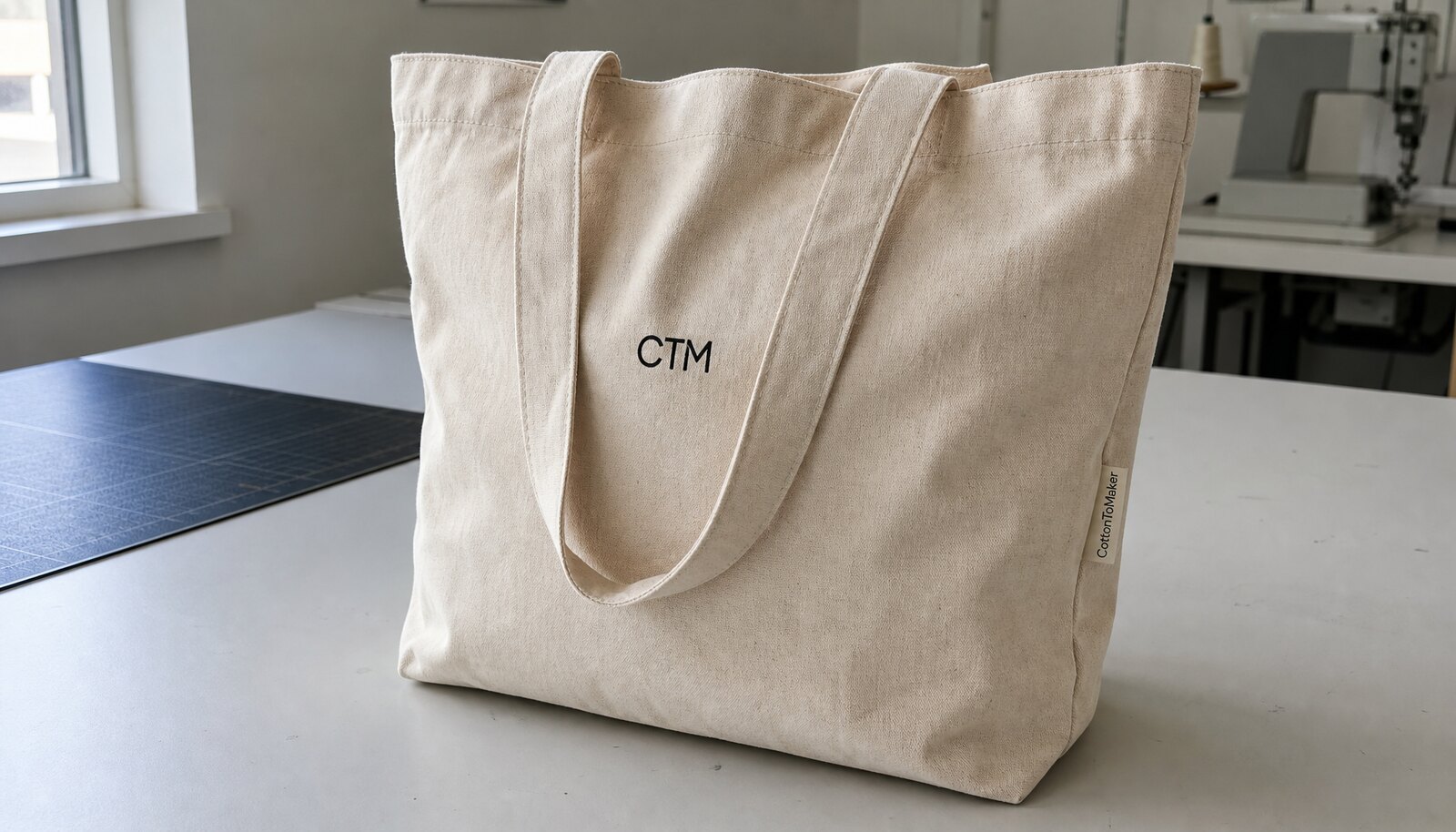
1. Start With the Selling Job, Not the Supplier Quote
Gift shops do not buy totes as fabric exercises. They buy them as retail items that must earn shelf space, support a ticket price, and replenish without creating store headaches. Before asking for a quote, define the tote’s job in the assortment. Is it a low-cost impulse item by the register, a museum keepsake, a seasonal souvenir, or a practical carry bag that should move in volume all year? Each use case points to a different balance of fabric weight, print complexity, packing format, and margin target.
That first decision matters because suppliers will price the brief you give them, not the product you imagine. If the brief is vague, one vendor may quote a lightweight tote with simple bulk packing while another quotes a heavier canvas bag with label finishing and retail-ready folding. Both may say “organic cotton tote,” but they are not offering the same commercial item. Procurement buyers get better results when they start from the retail role and work backward to the spec.
A useful internal question is: what must the tote do on day one in the store? If it needs to look tidy in a basket, hold its shape on a hook, and justify a higher shelf price, then weight, print quality, and fold consistency become part of the product. If it only needs to support a lower retail ticket and move quickly at checkout, cost control will matter more than premium presentation. The right answer is not “cheapest” or “best.” It is the tote that matches the store’s selling model.
This is also where buyers avoid a common procurement trap: starting with a target price and letting that number dictate the bag. A tote that barely fits a price ceiling may still fail commercially if it looks weak on shelf, wrinkles badly, or needs extra store labor to present well. For gift retailers, unit cost is only one side of the business case. The other side is sell-through. A slightly higher landed cost can still be the better buy if it supports a stronger retail ticket and less markdown risk.
The most reliable suppliers will ask about the retail role before they ask for artwork files. They want to know the sales context, packing assumptions, and likely reorder pattern. If a supplier only pushes a low unit price and does not ask how the tote will be sold, that is a signal to tighten the brief before moving forward.
- Define the tote’s retail role: impulse, premium souvenir, seasonal event, or replenishment item.
- Match spec to use case before discussing price.
- Treat shelf appearance, handle feel, and reorder stability as part of the product, not add-ons.
2. Fabric Weight Sets the Cost Floor and the Shelf Impression
Fabric weight is one of the clearest levers in organic cotton tote pricing. It affects raw material cost, sewing behavior, final handfeel, print performance, and how the bag sits in a display. Buyers often treat GSM as a quality label, but from a procurement standpoint it is also a pricing decision. A 140 gsm tote will usually cost less to make than a 180 gsm tote, but the lighter bag may wrinkle more, feel less substantial, and look less convincing next to other small-ticket retail items.
For most gift shop programs, 160 gsm is a practical middle point and 180 gsm is a reasonable premium step. The middle option often gives enough structure for shelf display while keeping the tote within a manageable landed cost. A lighter 140 gsm bag can make sense when the store wants an entry-price item or a foldable tote that feels casual. Heavier 200 gsm and above is better when the tote is part of a premium souvenir story and the buyer wants a sturdier, more substantial handfeel.
Ask for the full fabric description, not just a phrase like “heavy canvas.” A useful quote should state finished GSM, weave style, yarn or thread information if available, and whether the cloth is natural, bleached, dyed, or washed. Two suppliers can quote the same nominal GSM and still deliver very different results because weave density and finishing change how the fabric behaves. A tighter weave usually prints more cleanly and holds shape better. A looser weave can lower cost but expose more texture in the logo area.
The hidden cost issue is freight and carton efficiency. Heavier fabric adds weight to every carton. It can also make the folded bag thicker, which increases carton volume or reduces piece count per carton. That means a lower factory unit price may still produce a higher landed cost once freight and receiving labor are added. Buyers should not evaluate the bag only as a sewing cost; they should evaluate it as a shipped retail item.
A practical buying move is to ask for two pricing points in the same RFQ: a value version and a premium version. For example, request a 140 gsm and a 160 or 180 gsm option with the same artwork and pack format. The difference in quote will show how much the retail experience costs. That is far more useful than arguing over a single number before the product brief is stable.
- 140 gsm: useful for lower ticket totes and foldable items.
- 160 gsm: a common middle option for balanced retail value.
- 180 to 200 gsm: better when shelf presence and durability matter more than minimum cost.
- Ask for finished GSM and weave details, not only a marketing description.
3. Print Method Drives the Biggest Difference After Fabric
After fabric weight, decoration method is usually the biggest pricing lever. For bulk tote programs, one-color screen print remains the default for a reason. It is durable, repeatable, and relatively easy to control across reorders. In a gift shop setting, that matters because the tote is often part of the retail assortment rather than a disposable giveaway. A simple logo or short line of text can look sharp without forcing the supplier into high setup complexity.
Each added color increases control work. Two-color screen print may still be a good option for a brand-led souvenir item, but it raises registration demands and inspection effort. If the design uses fine text, small graphic elements, or large solid areas, the risk of visible misalignment or patchy ink coverage rises. That is where the quote starts reflecting process risk, not just ink and labor. Buyers should not assume a two-color version is only a small step up from one color.
Embroidery, woven patches, and sewn labels are sometimes attractive for premium positioning, but they should be treated as premium decoration rather than a default. Embroidery can create a nice tactile finish, yet it may pucker lighter cloth and slow throughput. Woven patches give a polished look but add another sourcing and sewing step. These methods make sense when the retail ticket can absorb them or when brand presentation is more important than minimum cost. For the first bulk order, keep the decoration simple unless the shelf price clearly supports more.
Print coverage matters too. A small front logo is not the same job as a large panel print or a print that sits close to a seam. Larger artwork uses more ink, increases cure sensitivity, and makes fabric irregularities more visible. It also creates more opportunities for misplacement during sewing and finishing. If the tote’s design does not depend on large graphics, a smaller and cleaner print often gives a better commercial result.
When comparing quotes, separate setup charges from unit print cost. Ask what is included for screens, plates, file prep, strike-offs, and any color changes. Also ask whether those setup charges will reappear on reorders. Some quotes look competitive on the unit line but recover cost through repeated setup items. A buyer trying to build a repeat gift shop program should know both the first-run price and the reorder price.
- One-color screen print is usually the best default for bulk tote pricing.
- Each additional color adds setup, registration control, and inspection effort.
- Embroidery and patches can work, but they should be treated as premium decoration.
- Ask whether screens or other setup charges repeat on reorders.
4. The Supplier Route Changes Control, Speed, and Risk
Not all sourcing routes give the buyer the same level of control. A direct cut-and-sew factory, a trading company, a domestic decorator using blanks, and a stock-program supplier can all produce a similar-looking tote. The commercial tradeoffs are different, though. Buyers should choose the route based on how much control they need over fabric, traceability, packing, and repeatability, not simply on which quote comes in lowest.
A direct factory is usually the strongest fit for repeat programs. It offers better visibility into fabric booking, cutting, sewing, printing, and packing, especially if more than one process happens in-house. That matters when the tote needs to be reordered later and the buyer wants the same result without reworking the spec. The tradeoff is that the buyer has to be much more precise. A direct factory will often build exactly what is written, including weak assumptions.
A trading company can be useful when a buyer wants one contact point or needs to combine several product categories into a single order flow. The risk is less transparency into the actual production site and the possibility of layered margins. That does not make the route bad. It just means the buyer should ask more clearly who owns the factory relationship, who controls the material, and who signs off on inspection and documentation.
Domestic decorators using imported blanks are a practical route for speed. They can work well for small seasonal launches, pop-up retail, or a quick test order. The limitations are control and consistency. If the blank bag already matches the finished size, handfeel, and claim path the buyer needs, this route can be efficient. If the tote requires precise label placement, specific fabric sourcing, or a strict organic documentation trail, the convenience can quickly disappear.
Stock-program or low-MOQ suppliers are useful when the buyer is testing demand. The main caution is pricing logic. Small-run prices do not always scale in a straight line, and sample-house economics often assume different volumes or less process control. Before committing, ask what changes when the order moves from test quantity to repeat quantity. The better supplier will explain which costs are fixed and which should improve at scale.
- Use a direct factory for repeatable specs and clearer production control.
- Use a trading company when you need category consolidation, but verify the real factory and process owner.
- Use a domestic decorator when speed matters and the blank bag already matches your required spec.
- Do not assume sample-house pricing represents scalable production economics.
5. Write the RFQ So Suppliers Cannot Quote Different Products
A weak RFQ creates the illusion of comparison. If the request only says organic cotton tote, suppliers will fill in the blanks differently. One may assume a 140 gsm bag with simple fold packing. Another may assume a 180 gsm canvas tote with retail-ready folding and sewn labels. The quotes will not be useful unless the buyer defines the product tightly enough that every bidder is quoting the same thing.
The product spec should include body dimensions, gusset depth if any, handle length, handle width, seam type, fabric color, finished GSM, print placement, number of print colors, and whether labels or hangtags are included. If the tote needs care labels, barcode labels, or branded side labels, say so. The goal is not to make the RFQ longer for its own sake. The goal is to eliminate room for guesswork. That saves time later and reduces the risk of re-quoting or sample churn.
Commercial terms need the same clarity. Buyers should state the destination, incoterm, currency, and whether the quote should include packing, local handling, or delivery to warehouse. Ex-works, FOB, and delivered pricing answer different questions. A low factory price means very little if the landed cost is higher after freight, duties, and receiving. Quotes are only comparable when they are built on the same basis.
A strong RFQ also tells suppliers what not to include. If the buyer wants one-color print only, say it. If inner polybags are not acceptable because the store prefers lower-plastic presentation, say that as well. If the cartons need a specific gross weight limit or carton mark format, include it. These are not admin details. They are commercial controls that change cost and execution. Without them, the quote will be incomplete even if it looks polished.
A good practice is to ask the supplier to repeat the assumptions back in the quotation. That makes hidden differences visible. It often catches the common mistakes: a blank-bag quote where printed bags were requested, a different carton count than the buyer intended, or a missing label step because it was not described. The best RFQ is the one that leaves little room for “we thought you meant something else.”
- State full product specs, not just product type.
- Include commercial terms, destination, and packing assumptions in the RFQ.
- Ask suppliers to restate assumptions in the quote so differences show up early.
6. Organic Claim Verification Needs a Real Paper Trail
For organic cotton totes, the organic claim is part of the commercial product. It is not enough for the supplier to say the bag is organic cotton. The buyer should understand how the claim is supported through the actual production chain, which site is certified for the relevant process, and whether the fabric used for the order is covered by that certification scope. Certification is usually site- and process-specific, so a general statement is not enough.
One common mistake is assuming the factory certificate automatically covers every subcontractor and every step. It may not. If fabric, printing, sewing, and packing happen across different sites, the buyer should ask how traceability is maintained between them. A clean file should show that the claim path is consistent from the fabric source to the final tote. If the supplier cannot explain that path in plain language, the quote is not ready for approval.
Where applicable, ask for transaction certificate or equivalent shipment documentation that links the certified material to the actual order. The exact document name depends on the certification system and the supplier’s workflow, but the principle is the same: the claim should be traceable to this shipment, not just to a general factory profile. Buyers should also verify that invoice wording, packing list wording, and product descriptions do not overstate the claim. Marketing language and compliance language are not interchangeable.
Scope mismatch is another practical risk. A factory may be certified for one process, but the tote order may involve another subcontractor or a different finishing step. That can create a gap between what is sold and what is documented. Procurement should check certificate scope, site name, expiry date, and whether the certificate is current at the time of production and shipment. If the supplier hesitates to share those basics, treat the documentation as incomplete until proven otherwise.
For gift shops, the retail consequence is straightforward. If the organic story matters to the end customer, it must survive a basic document review. The supplier should be able to explain the claim path without hiding behind jargon. Buyers do not need to become certification auditors, but they do need enough documentation to avoid claim risk and to answer a customer or retail partner if the tote is questioned later.
- Verify certificate scope, site, and process coverage, not just the supplier’s marketing statement.
- Ask for transaction certificate or shipment documentation where applicable.
- Check for scope mismatch when sewing, printing, or finishing happens at more than one site.
- Treat traceability as part of the commercial value of the tote.
7. Packing and Retail Presentation Change the Real Cost
Packing has a larger impact on gift shop totes than many buyers expect. These bags are often displayed quickly after receipt or pulled from cartons during busy seasonal periods. If the tote arrives loosely packed, it may look wrinkled or uneven even when the bag itself is well made. If it is over-packed, the fold can leave hard creases, the print can rub, and the carton can become more expensive to ship. Packing is both a merchandising choice and a logistics choice.
Bulk packing is usually the least expensive route and the easiest for the factory to run. It fits buyers whose stores can refold, steam, or re-display bags in-house. Retail-ready packing costs more, but it can reduce store labor and create a more consistent shelf look. That matters for gift shops with limited backroom space, seasonal staff, or multiple locations that need a simple replenishment standard. The right question is not whether retail-ready packing is nice. It is whether the store will recover the extra cost through lower labor and better presentation.
Ask for carton details, not just unit counts. The quote should include carton dimensions, gross weight, inner pack count, master carton count, and whether moisture protection is included. These numbers affect freight and receiving cost. A lower factory unit price can be erased by a larger carton footprint or a heavier packed carton. If the tote moves through a warehouse before reaching the store, carton marks and barcode placement matter too.
Packing defects are a common source of avoidable disputes. The bag may be acceptable, but the carton count is wrong, the folding direction is inconsistent, or the labels are placed where the store team did not expect them. Buyers should approve a sample carton before mass production and confirm that the master carton matches the packing spec. If the product is shelf-ready, the fold and label position need to be checked as carefully as the print.
For gift shops, the right packing format depends on store workflow. A low-price impulse tote may do fine in bulk pack. A higher-ticket souvenir tote usually benefits from cleaner retail presentation. The best buying decision is the one that protects the total margin after freight, labor, and merchandising are included, not just the one that lowers the factory line item.
- Bulk pack reduces cost; retail-ready pack reduces store labor.
- Check carton dimensions and gross weight because they affect freight efficiency.
- Verify fold direction, label placement, and carton marks with a sample carton before production.
- Treat packing as part of merchandising, not only logistics.
8. Price the Landed Cost Before You Price the Retail Margin
The factory quote is only the starting point. Buyers need landed cost, because freight, duty, local handling, receiving labor, and sampling can change the real economics of the tote. That is especially true when quotes use different incoterms or different packing assumptions. A low ex-works price is not very useful if the finished landed cost is higher after transportation and warehouse handling are added.
Gift shops also need a retail margin view. A tote that lands cheaply but feels flimsy may require a lower shelf price, weaker presentation, or markdowns. A slightly more expensive tote can still be the better buy if it supports a stronger ticket and looks worth the ask. In retail, presentation is part of the economics. Buyers should ask: what retail price can this tote support, and what gross margin does that leave after all costs are included?
A simple comparison exercise helps. Normalize each offer to the same product spec, same print, same packing, same currency, same destination, and same incoterm. Then estimate the all-in landed cost and compare that against the likely retail ticket. If one supplier looks cheaper only because the quote excludes setup, packaging, or transport, it is not the better offer. It is just the less complete offer.
The best tote programs often sit at the point where shelf appeal, landed cost, and reorder consistency overlap. The cheapest quote can lose money if it slows sell-through. The nicest tote can also fail if the landed cost leaves no room for the category’s margin target. Buyers should be honest about which side of the equation matters more for that specific store or season. Gift retail tends to reward products that look easy to sell and easy to replenish.
A practical rule: compare total landed cost per unit, then ask whether the tote can comfortably support the intended shelf price. If the answer is no, the supplier may not be wrong. The brief may be. That is why the RFQ and the pricing plan should be built together instead of separately.
- Compare landed cost, not ex-factory price alone.
- Tie the tote cost to retail ticket and gross margin.
- Normalize quotes before comparing; otherwise the cheapest quote may be the least complete.
9. QC Should Be Tied to Failure Modes, Not Generic Assurances
Quality control on organic cotton totes is often written in vague terms: good stitching, nice print, acceptable finish. That is not enough for procurement. Buyers need QC criteria tied to likely failure modes, so inspection teams know what to measure and what to reject. The useful questions are specific: where do totes usually fail, what does a bad tote look like, and how much variation is still commercially acceptable?
Fabric should be checked against the approved GSM, with an agreed tolerance and a method for checking roll-to-roll variation before cutting. The buyer should also know whether the supplier controls shade or texture variation between fabric rolls. Natural cotton can vary, and on a light or undyed tote that variation is more visible. A bag can be technically within spec and still look mixed on shelf if the panels come from different fabric lots without control.
The structural weak points are handle attachment, bartacks, side seams, bottom seams, and the top hem. Those are the first areas to inspect for skipped stitches, broken seams, and poor seam allowance. If the tote is meant for normal retail carry, ask for a simple pull test or equivalent factory test on the stress points. Cosmetic issues such as a few loose threads are different from structural defects. Buyers should define that difference clearly so minor trim issues do not get treated like functional failures.
Decoration needs its own controls. Print placement should be checked against the approved sample for location, size, density, and registration. If the logo is close to a seam or edge, the tolerance has to be tighter. Buyers should also look for smearing, pinholes, cracked ink, or uneven cure after folding and handling. The more complex the print, the more important it is to state what counts as acceptable variation before production begins.
Packaging deserves the same discipline. Verify unit count per inner pack, master carton count, carton labeling, and the orientation of the bags in the carton. A lot can be perfect and still fail the order if the count is wrong or the pack format is not what the store expected. For larger orders, an AQL-style or equivalent sampling plan is sensible, but the buyer should make sure critical defects are clearly defined. Wrong artwork, wrong size, missing labels, broken seams, and mixed carton counts are examples of defects that should not pass simply because the bag looks fine at a distance.
- Define critical, major, and minor defects before production begins.
- Measure dimensions, GSM, seam integrity, print placement, and carton count.
- Use an AQL-style plan or equivalent sampling method for mass production.
- Reject or rework for wrong artwork, wrong size, missing labels, broken seams, or mixed carton counts.
10. Build the Quote and Reorder Plan Together
A good tote quote should read like a production plan, not just a price line. It should state what is being priced, what is included, what is excluded, and what might change on reorder. That matters because gift shop tote programs often succeed only if the reorder behaves like the first run. If the tote sells well, the buyer needs the same spec, the same look, and a predictable replenishment path.
Ask the supplier to show the assumptions behind the price. Is the quote for blank bags or printed bags? Does it include one screen and one placement only? Are labels sewn in or supplied separately? Is the organic documentation part of the production flow or an add-on? Are carton marks, barcode labels, and retail-ready folding included? Clear answers let the buyer see whether the supplier is quoting a real production item or simply a starting number.
The reorder plan should be documented before the first shipment leaves. The factory should know which sample is the approved reference, which print files are locked, and which details must remain fixed for the next run. Buyers should also ask what could legitimately change on reorder: fabric lot, dye lot, freight basis, currency, or required lead time. That conversation prevents surprise price movement later and helps the buying team plan the next season with more confidence.
For gift shops, the commercial goal is to turn the tote into a dependable shelf item. Dependability means it looks right, prices right, and replenishes without constant correction. The best supplier relationship is the one that supports that stability. If the quote, QC plan, and reorder path all line up, the tote becomes much easier to manage and much more profitable to repeat.
The final check is internal alignment. Merchandising, finance, and operations should be looking at the same assumptions before approval. When everyone sees the same landed-cost logic, the tote becomes easier to approve and easier to scale. That is the real value of a strong pricing plan: it turns a simple product into a controlled retail program rather than a one-off sourcing exercise.
- A good quote names assumptions, inclusions, and exclusions.
- A good reorder plan preserves the approved spec, sample, and print files.
- A good supplier can tell you what may change on the next run and why.
Specification comparison for buyers
| Spec decision | Recommended option | When it fits | Buyer risk to check | Commercial note |
|---|---|---|---|---|
| Fabric weight for entry price | 140 gsm organic cotton canvas | Impulse-buy gift shops, event retailers, and simple promotional totes | Confirm the supplier is quoting finished GSM, not a loose yarn or fabric description | Lowest cost floor, but softer drape and less shelf structure |
| Fabric weight for balanced retail value | 160 gsm organic cotton canvas | Most museum shops, tourist shops, and general gift retailers | Check whether the bag still stands well after folding and packing | Usually the best balance between body, price, and print clarity |
| Fabric weight for premium feel | 180 to 200 gsm organic cotton canvas | Higher-ticket gift shops and souvenir assortments where the tote is part of the display story | Verify whether heavier cloth changes print cure, seam stress, or carton weight | Raises unit and freight cost, but can support a stronger retail ticket |
| Decoration for core SKU | One-color screen print | Logo-led designs, repeat orders, and stable artwork | Confirm screen setup charges and whether they repeat on reorders | Often the cleanest commercial choice for bulk pricing |
| Decoration for premium line | Two-color screen print | Brand-led gift assortments where visual impact matters | Check registration tolerance and spoilage risk on larger print areas | Better shelf presence, but each added color increases process control |
| Decoration for small premium detail | Woven label or sewn patch | Higher-ticket souvenirs or brand programs with a more finished look | Ask who supplies the label and where it is sewn in | Adds cost and an extra step, so treat as a premium option |
| Supplier route for repeat programs | Direct cut-and-sew factory | Orders with custom size, handle length, label placement, and planned reorders | Confirm the factory owns or controls fabric booking, printing, and packing | Best visibility into production, but the buyer must manage the spec tightly |
| Supplier route for fast launches | Domestic decorator using imported blanks | Small seasonal programs, pop-up retail, or quick tests | Make sure the blank bag still matches the organic claim path and finished size | Fast turnaround, but blank availability narrows the control you have |
| Supplier route for low-risk pilots | Stock-program supplier or low-MOQ sample house | Test orders before committing to a seasonal line | Ask how price changes when the order scales | Useful for testing demand, but sample pricing may not reflect production economics |
Buyer checklist before sampling
- Lock the tote size, fabric GSM, weave, handle length, seam construction, and finished fold size before asking for pricing.
- State whether the quote is for blank bags, one-color print, multi-color print, sewn patches, or retail-ready packed goods.
- Request the exact organic claim path for the order, including certificate scope, transaction certificate or equivalent shipment documentation where applicable, and the fabric source used for production.
- Set MOQ by color, art version, and size, then ask what changes if you reduce only one of those variables.
- Define carton pack count, carton size, gross weight target, outer carton mark format, and whether inner polybags are allowed.
- Agree on print placement, print area, ink type, and acceptable shade or registration variation before sampling.
- Confirm sample milestones: reference sample, pre-production sample, and golden sample approval tied to the purchase order.
- Compare all offers on the same incoterm, the same packing assumption, and the same currency basis, not on unit price alone.
Factory quote questions to send
- What fabric weight, weave, and finished GSM are you quoting, and is the cotton certified organic through the actual fabric source for this order?
- Is your price based on blank bags, printed bags, or finished retail-ready packing with labels, hangtags, and carton marks?
- What is the MOQ per size, color, and artwork version, and what changes if we cut the first run below that threshold?
- What setup charges apply for screens, plates, embroidery files, woven labels, hangtags, or special packing?
- What are the exact size tolerances, handle length tolerances, seam allowances, and print placement tolerances you will hold in production?
- Can you provide the certificate scope for the factory and the documentation path for the organic claim on this shipment?
- What is the realistic production lead time after sample approval, and which steps usually become the critical path?
- What carton pack count, carton dimensions, gross weight, shipping marks, and pallet assumptions are included in your quotation?
- What is your defect handling process if the production lot misses the approved sample or the stated tolerances?
- If we reorder the same tote later, what stays fixed and what can change due to fabric lot, dye lot, or print setup?
Quality-control points to confirm
- Fabric GSM matches the approved spec within the agreed tolerance, with roll-to-roll variation documented before cutting.
- Bag dimensions after sewing and final pressing stay within the approved size range, including body width, body height, and handle drop.
- Handle stitching, bartacks, seam allowance, and stress points hold under normal retail carry loads and a simple pull test.
- Print placement, print density, and registration match the approved sample; no obvious smearing, pinholes, or misalignment.
- Thread trimming is clean, with no loose ends, skipped stitches, broken needle marks, or seam puckering that affects display quality.
- Side labels, woven labels, care labels, and barcodes are placed exactly where the approved sample shows them.
- Carton counts, carton markings, inner pack format, and unit counts per SKU match the purchase order and shipping documents.
- Shade consistency is acceptable across the lot, with no obvious fabric roll mismatch or visible panel variation on the same bag.
- Odor, stain, oil spot, and contamination checks are clear at pack-out, especially on light-colored or natural canvas.
- Packaging verification includes fold direction, bag orientation, label placement, carton tape integrity, and sample carton drop resistance for transit.