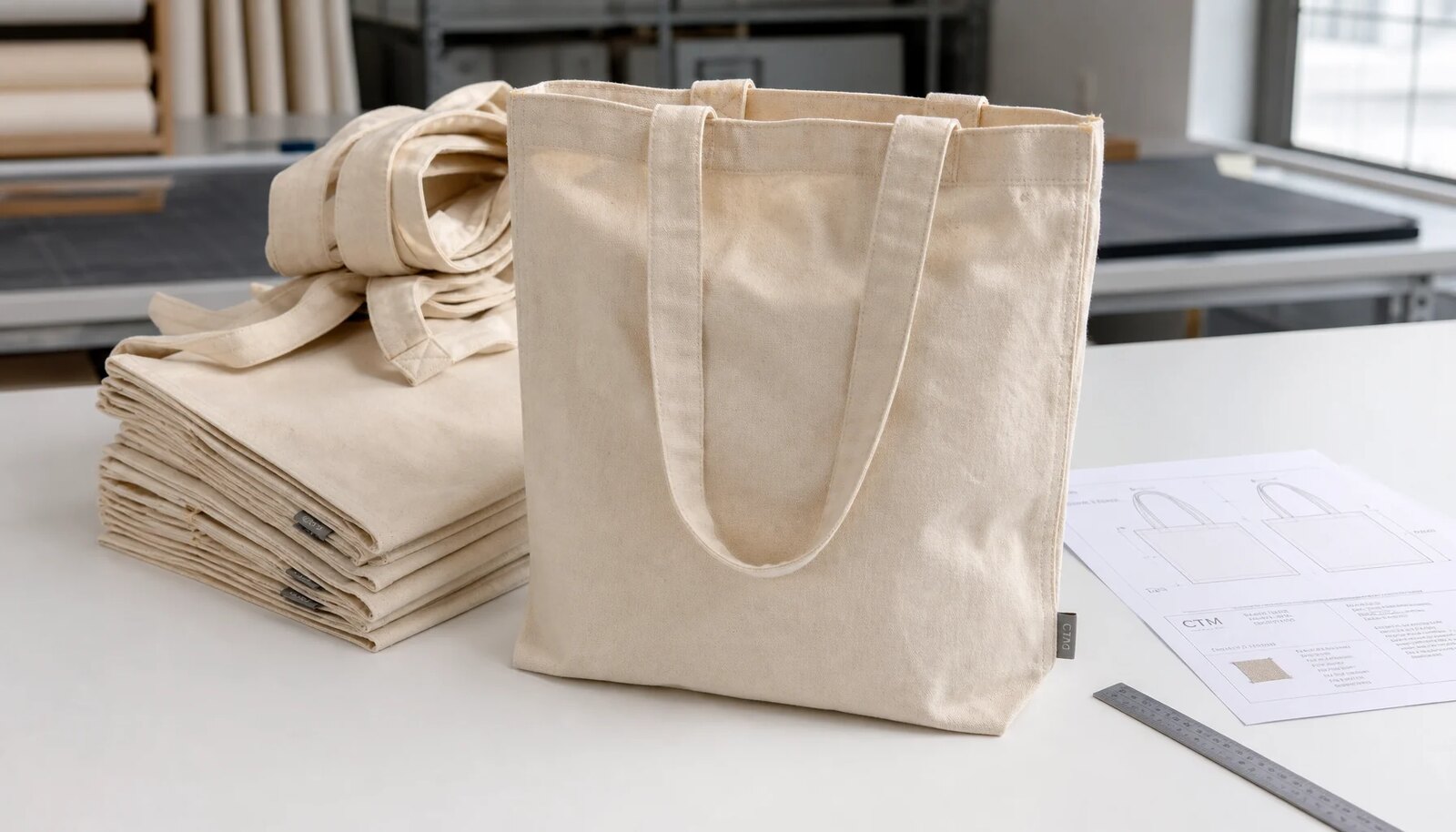
Price the tote your brand will actually use
Bulk tote buying goes wrong when the first quote is too vague. A supplier can price a thin flat bag with short handles and bulk packing while another prices a heavier gusseted tote with reinforced shoulder handles, labels, cartons, and print testing. Both may appear under the same product description, but they are not commercially comparable.
Start with the tote’s role in your business. A one-day event giveaway does not need the same construction as a retail merchandise tote. An ecommerce insert may prioritize low weight and fast packing. A store carrier bag needs better feel and enough strength for folded apparel. A wholesale kit may need labels, barcode accuracy, and consistent carton quantities.
A practical pricing plan should compare factory unit price, setup cost, packing cost, freight exposure, inventory risk, and QC cost together. The cheapest ex-factory line can become less attractive after heavy cartons, special packing, low sell-through, or rework. The goal is not to over-engineer a simple bag; it is to make sure every quoted price is based on the same product and the same delivery assumptions.
- Write one base specification before collecting supplier prices.
- Compare MOQ tiers only when GSM, dimensions, print, labels, packing, and trade term match.
- Treat screens, samples, documents, inspection, and freight as planned cost items.
- Use landed unit cost, not only factory unit price, when choosing volume.
Set a base specification that reflects channel use
Most apparel tote programs can begin with a small number of technical decisions: size, fabric weight, gusset, handles, reinforcement, decoration, label, and packing. A common starting point is a 38 x 42 cm flat tote. Add an 8–12 cm gusset when the bag must hold folded garments, catalogs, accessories, or multi-item purchases. A gusset improves capacity and presentation, but it adds fabric, cutting time, sewing time, and carton volume.
Fabric weight should be tied to the selling or distribution channel. A 140–160 GSM bag can work for light giveaways and low-cost inserts. A 180–220 GSM bag is often more appropriate for retail merchandise, wholesale kits, store carrier bags, and repeat-use apparel totes because it gives better body, opacity, seam support, and print appearance. Heavier than that may be useful for premium canvas styles, but freight and carton weight rise quickly.
Handles affect both comfort and failure risk. Shoulder-carry totes commonly use total handle lengths around 60–70 cm, depending on body size and intended drop. Wider handles feel more substantial but consume more fabric. Reinforcement at the handle attachment is a small cost compared with the brand damage of handles tearing during use.
- Record finished width, finished height, gusset depth, and measurement method.
- Define total handle length, handle drop, handle width, attachment position, and reinforcement.
- Use a finished GSM target such as 180 GSM or 200 GSM with a realistic tolerance.
- Add a diagram or approved sample photo for seams, top hem, bottom corners, and handles.
- Create a spec version number and use it on the RFQ, sample comments, PO, and inspection checklist.
Use concrete quote math before choosing the MOQ
A price ladder is only useful when it shows the same tote at different quantities. Below is a simplified example to illustrate how buyers can compare options. The numbers are not a market guarantee; they show the structure of a calculation you can request from suppliers and logistics partners.
Assume a 38 x 42 cm natural organic cotton tote, 180 GSM, no gusset, shoulder handles, reinforced stitching, one-color front screen print, woven side label, bulk packed 100 pcs per carton, quoted FOB. The supplier quotes recurring unit prices of $1.48 at 1,000 pcs, $1.26 at 3,000 pcs, $1.15 at 5,000 pcs, and $1.05 at 10,000 pcs. One-time charges are $90 for screen/setup, $45 for a print strike-off, and $75 for label setup, or $210 total. If estimated freight, duty, customs, and local handling equal $0.22 per unit at 1,000 pcs, $0.15 at 3,000 pcs, $0.12 at 5,000 pcs, and $0.10 at 10,000 pcs, the effective landed unit cost changes as follows.
At 1,000 pcs: $1.48 recurring price + $0.21 allocated setup + $0.22 landed add-on = $1.91. At 3,000 pcs: $1.26 + $0.07 + $0.15 = $1.48. At 5,000 pcs: $1.15 + $0.04 + $0.12 = $1.31. At 10,000 pcs: $1.05 + $0.02 + $0.10 = $1.17. The 10,000-piece tier looks attractive, but only if the brand can use the inventory before artwork, campaign, or packaging needs change.
- Effective unit cost = recurring unit price + allocated one-time charges + estimated landed add-ons.
- Allocated setup at 1,000 pcs is meaningful; at 10,000 pcs it becomes almost negligible.
- Freight can fall per unit at higher quantities, but heavier GSM and bulky gussets can push it back up.
- Choose MOQ after comparing unit savings with cash tied in inventory and leftover-stock risk.
Model how GSM, print, packing, and freight change cost
A supplier’s base quote rarely stays fixed once the final spec is added. The following example shows how common choices change economics. Begin with a 1-color, 180 GSM, flat tote at a recurring FOB price of $1.26 for 3,000 pcs. If the brand increases fabric to 220 GSM, the factory may add a material surcharge and freight may rise because cartons are heavier. If artwork changes from one-color front print to two-sided two-color printing, screens, ink, curing time, inspection, and reject risk all increase. If packing changes from bulk cartons to inner bundles with barcode labels, the unit price and warehouse readiness both change.
A useful comparison asks each supplier to show option pricing rather than burying changes in one revised number. For example: 180 GSM base at $1.26; upgrade to 220 GSM add $0.18; add 10 cm gusset add $0.20; second print color add $0.08 plus setup; back print add $0.12; woven label add $0.05 plus setup; inner bundles of 25 add $0.04; individual paper band add $0.06; stronger carton or special carton label add $0.02. These figures are illustrative, but the structure helps buyers see which decisions are driving the final price.
Do the same for freight. Ask for carton dimensions, gross weight, pieces per carton, and total carton count for each option. A heavier 220 GSM gusseted tote can have a stronger product feel but may reduce pieces per carton or increase chargeable volume. For air freight, bulk and weight can change the calculation dramatically. For ocean freight, carton count, cube, and destination handling still matter.
- Request option adders for GSM upgrades, gussets, extra print colors, second-side printing, labels, and packing.
- Ask whether freight is charged by actual weight or volumetric weight in your shipment mode.
- Compare a premium spec against a practical spec, not only against the cheapest possible tote.
- Keep the base spec stable once quotes are collected, or clearly reset the price comparison.
Clarify organic cotton claims before artwork and samples
The word organic can mean different things in early supplier conversations. It may refer to certified organic fiber, fabric with traceability documentation, a finished product certification route, or simply natural unbleached cotton described casually. Eco apparel brands should decide the claim they intend to make before sampling, because product pages, hangtags, wholesale line sheets, and sustainability reports may require specific evidence.
Documentation can affect MOQ, price, and lead time. A fabric route with stronger traceability may need earlier booking or a different material supplier. If the issue is discovered after print artwork and samples are approved, the buyer may need to change the claim, repeat sampling, or delay shipment. Ask what documents are available, what they apply to, and whether they connect to the actual lot used for the order.
Also decide how the claim appears on trims and packaging. If a woven label, printed label, hangtag, or carton label references organic cotton, the wording should match the documentation your compliance team accepts. Avoid letting a factory insert generic sustainability text unless it has been reviewed.
- Choose the claim language before sampling, not at shipment.
- Confirm whether documents relate to yarn, fabric, finished goods, or transaction records.
- Check whether documentation is included in the price or charged separately.
- Make label and hangtag language consistent with the approved claim.
- Hold bulk release until material basis and claim evidence are aligned.
Compare supplier scenarios, not just low and high prices
A low unit price is useful only if the supplier can deliver the required spec, documents, artwork quality, packing, and lead time. Buyers often receive quotes that look close but include different assumptions. One supplier may include strike-offs and export cartons; another may exclude them. One may quote FOB; another may quote EXW. One may accept mixed artwork under one blank tote run; another may treat each graphic as a separate MOQ.
A balanced comparison includes capability and operating fit. A supplier with a slightly higher unit price but clear carton data, responsive sampling, reliable print testing, and acceptable documentation may lower total risk. A lower-cost supplier may still be the right choice for simple event totes if the spec is basic and deadlines are flexible.
When reviewing suppliers, note which cost items are transparent. Can they explain the impact of GSM, gusset, print coverage, and packing? Can they provide pre-production measurements? Do they understand your barcode and carton-label rules? Do they know when organic cotton documentation will be available? The best buying decision is based on total landed cost and execution confidence, not quote-line price alone.
- Compare trade term, lead time, sample path, documentation, and packing support side by side.
- Check whether artwork splits can share one blank tote run.
- Ask if screen charges and label setups are reusable for reorders.
- Review communication quality during sampling; it often predicts bulk problem-solving.
- Use the same defect standards and tolerance sheet for each supplier.
Control print cost without flattening the design
Decoration can turn a simple tote into a complicated order. A one-color screen print on one side is usually the most predictable route for logos and simple graphics. Two colors can still be efficient when registration is forgiving. Costs and rejects rise with tight registration, gradients, halftones, large solid coverage, fine type, metallic ink, puff ink, discharge effects, high-opacity white, and two-sided printing.
Organic cotton fabric has texture, absorbency, and shade variation. Ink behaves differently on natural cotton than it does on a digital mockup. Pale ink on natural fabric may need more opacity. Fine text can fill in if the weave is coarse. Large solid areas can show uneven coverage or curing marks. A print strike-off on the intended fabric is the safest approval for brand-sensitive artwork.
Placement should be measured. Instead of saying the logo is centered, state the print width and height, distance from the top hem, horizontal centerline, and tolerance. If artwork sits near a seam, gusset fold, or handle attachment, confirm how much distortion is acceptable. Keep the approved strike-off for inspection and reorders.
- Provide vector files, Pantone references, print dimensions, and placement measurements.
- Price front print, back print, extra colors, and special inks as separate options.
- Approve a strike-off for large coverage, white ink, fine lines, or color-sensitive branding.
- Define acceptable commercial color match on cotton rather than assuming perfect Pantone reproduction.
- Include print curing and rub checks in QC when ink risk is high.
Use sampling to remove ambiguity
Samples should prove technical feasibility, not just look good in a meeting. Start with a fabric swatch when shade, handfeel, GSM, or documentation matters. For a new supplier or new construction, review a blank construction sample before approving decoration. This confirms size, gusset shape, handle comfort, seam strength, top hem, reinforcement, and workmanship.
A print strike-off confirms ink color, opacity, edge definition, registration, curing, and scale. For simple artwork, a printed panel may be enough. For a retail or brand-sensitive tote, a finished printed bag is more useful because it shows how the print sits on the actual shape and how it relates to handles, labels, and folds.
The pre-production sample should combine final fabric, final construction, final artwork, labels, hangtags, barcode stickers if used, and representative packing. Once it is approved, changes need control. A small change to print size, folding method, label position, or carton quantity can alter setup, labor, materials, and lead time.
- Record sample measurements instead of relying on visual approval only.
- Comment clearly: approved, approved with correction, or rejected with required changes.
- Keep one approved sample at the factory and one with the buyer or inspector when possible.
- Do not approve bulk production from a mockup if the fabric, print, or construction is untested.
- Use the pre-production sample as the standard for final inspection.
Put packing and warehouse requirements into the price
Packing affects cost, freight, and receiving performance. Bulk cartons of 50 or 100 pcs may be efficient for events or internal distribution. Retail, wholesale, and 3PL programs may need smaller inner bundles, SKU labels, hangtags, barcode stickers, fixed carton counts, and carton labels. Those tasks require materials, labor, and checking time, so they belong in the original quote.
Carton data should be available before logistics planning begins. Ask for pieces per carton, carton dimensions, net weight, gross weight, and total carton count at each MOQ tier. This helps estimate air, ocean, truck, or courier cost and prevents late surprises when a premium tote becomes heavier or bulkier than expected.
Sustainability preferences should also be specific. If individual polybags are not allowed, state that. If a master carton liner is allowed for moisture protection, say so. If paper bands, recycled cartons, or plastic-free inner packing are preferred, include them in the RFQ. Practical clarity is better than a broad instruction to avoid plastic.
- Define inner bundle count, master carton count, and folding method.
- List carton marks: PO, SKU, style, color, quantity, carton number, gross weight, and destination if required.
- Confirm barcode type, placement, scan requirements, and who supplies barcode files.
- Ask for carton dimensions and weights for the quoted spec, not for a generic tote.
- Include all labels, hangtags, paper bands, and carton stickers in the cost comparison.
Inspect the defects that cause returns and chargebacks
Organic cotton tote QC should focus on problems that buyers and customers will actually experience: weak handles, stains, odor, inconsistent GSM, crooked seams, uneven gussets, poor print opacity, cracking ink, wrong labels, wrong carton counts, and unreadable barcodes. A generic quality instruction is not enough. Inspection should follow the PO, approved sample, artwork files, packing rules, and tolerance sheet.
Use both measurement and visual review. Measure body width, height, gusset depth, handle drop, handle width, print placement, and label placement across samples from different cartons. Check shade, handfeel, slubs, stains, lint, and odor. Review seams for skipped stitches, open seams, puckering, needle damage, loose threads, and reinforcement accuracy. Inspect print for opacity, registration, smearing, pinholes, bleed, cracking, and curing issues.
Inspection timing depends on risk. Inline checks are useful for a new supplier, difficult artwork, tight delivery, or large order because they can catch repeat defects before everything is packed. Final inspection verifies finished and packed goods before shipment. For high-value or business-critical programs, use AQL or third-party QC. For smaller orders, still require supplier measurement reports, photos, and carton-count confirmation before release.
- Open cartons from different parts of the packed order, not only the top cartons.
- Check handle reinforcement carefully because it is the main stress point in use.
- Verify labels, hangtags, barcodes, carton marks, and SKU mix against the PO.
- Keep inspection records and approved samples for reorder comparison.
- Tie payment or shipment release milestones to sample approval and QC completion when appropriate.
Specification comparison for buyers
| Procurement choice | Illustrative bulk setup | Typical unit-economics tradeoff | Best fit |
|---|---|---|---|
| Light flat giveaway tote | 38 x 42 cm, no gusset, 140–160 GSM, 60 cm handles, 1-color front print, bulk packed 100 pcs/carton | Lowest fabric consumption and carton weight; print and setup still matter at low quantities; may feel thin for retail merchandise | Events, inserts, simple gift-with-purchase programs where low landed cost is more important than premium handfeel |
| Retail-grade apparel tote | 38 x 42 cm, 180–220 GSM, reinforced shoulder handles, optional woven side label, 1–2 color screen print, inner bundles | Higher fabric and sewing cost, but better body, opacity, durability perception, and print support | Brand merchandise, wholesale kits, ecommerce loyalty gifts, store carrier bags for premium apparel |
| Gusseted tote for folded garments | 38 x 42 cm with 8–12 cm gusset, 180–220 GSM, longer handles, reinforcement, carton packing by SKU | More fabric, cutting complexity, and carton volume; improves capacity and presentation when filled | Apparel launch kits, retail packaging, subscription boxes, multi-item purchases |
| Lower MOQ local or nearshore run | 500–2,000 pcs, faster communication, shorter transit, usually higher factory unit price | Less inventory risk and quicker replenishment; higher unit cost may be offset by lower freight exposure and faster correction cycles | First program, campaign test, deadline-sensitive launch, uncertain sell-through |
| Higher MOQ offshore run | 5,000–20,000 pcs, longer lead time, stronger volume price, more freight planning | Lower recurring factory unit price; requires tighter forecasting, earlier sampling, and more inventory control | Repeat SKU, multi-channel program, annual packaging plan, stable artwork and specification |
| Minimal packing | Bulk folded, 50–100 pcs per export carton, no individual polybag, carton marks only | Lowest packing labor and material cost; warehouse must tolerate bulk handling and possible repacking | Internal distribution, events, simple store replenishment |
| Retail or 3PL-ready packing | Inner bundles, SKU labels, hangtags, barcodes, carton labels, fixed carton quantities | Adds labor, labels, trim sourcing, and checking time; can reduce receiving friction and chargeback risk | Wholesale, retail, marketplace, or 3PL programs with strict receiving rules |
Buyer checklist before sampling
- Define the tote’s job: event giveaway, store carrier, ecommerce insert, retail merchandise, wholesale kit, subscription packaging, or repeat replenishment SKU.
- Choose one base spec before comparing prices: finished size, gusset, GSM, handle length, handle drop, handle width, seam construction, reinforcement, print, labels, and packing.
- Build a price ladder at the same spec for 1,000, 3,000, 5,000, and 10,000 pcs; do not compare different GSM or packing assumptions as volume discounts.
- Separate recurring unit cost from one-time charges such as screens, strike-offs, sample fees, label setup, barcode setup, artwork separations, and documentation charges.
- Request estimated carton dimensions, pieces per carton, gross weight, total cartons, and trade term so logistics can calculate landed cost instead of relying only on factory price.
- Decide the organic cotton claim before sampling, then confirm what documents are available for the actual yarn, fabric, finished product, or transaction record.
- Send production artwork in vector format with print size, color count, Pantone references, placement measurements, and front/back printing requirements.
- Approve samples in sequence when risk justifies it: fabric swatch, blank construction sample, print strike-off, pre-production sample, and packing sample.
- Set tolerances for body width, height, gusset, handle drop, GSM, print placement, label placement, carton count, and barcode accuracy.
- Plan QC around the failures that cause claims: weak handles, stains, odor, crooked seams, poor print curing, wrong labels, wrong carton count, and unreadable barcodes.
Factory quote questions to send
- What finished GSM, fabric construction, and GSM tolerance are included in this quote?
- Is the cotton quoted as certified organic, organic cotton with supporting records, or natural cotton without an organic claim? Which documents can be provided for this order?
- Are you quoting natural, bleached, dyed, or custom-colored fabric, and what shade standard will bulk production follow?
- What are the exact finished dimensions, gusset depth, handle length, handle drop, handle width, top hem, seam type, and handle reinforcement in the price?
- Is the handle self-fabric, folded fabric, or webbing, and how many stitch lines or bar tacks are included?
- Does the recurring unit price include one-side or two-side printing, print setup labor, ink mixing, curing, normal print wastage, and the quoted print size?
- What are the one-time charges for screens, artwork separations, strike-offs, samples, custom labels, barcode setup, or special documentation?
- What are the unit prices at 1,000, 3,000, 5,000, and 10,000 pcs using the same spec, artwork, packing, and trade term?
- Can one blank tote production run be split across multiple print artworks, or does each design require a separate MOQ and setup charge?
- What estimated carton dimensions, pieces per carton, gross weight, total cartons, and lead time apply to each MOQ tier?
Quality-control points to confirm
- Finished GSM is checked against the purchase order using an agreed method, and results are recorded against the tolerance rather than judged by handfeel alone.
- Fabric shade, weave, slubs, stains, lint, odor, translucency, and handfeel are compared with the approved swatch or pre-production sample under consistent lighting.
- Finished width, height, gusset depth, handle drop, handle width, handle attachment position, print placement, and label placement are measured across pieces from different cartons.
- Handle reinforcement is inspected for correct box/X stitching or bar tacks, secure stitch density, no skipped stitches, no needle cuts, and no loose threads at stress points.
- Side seams, bottom seams, gusset folds, top hems, and corners are checked for straightness, seam allowance consistency, puckering, open seams, and weak stitching.
- Print is checked for placement, opacity, clean edges, registration, pinholes, smearing, ghosting, bleed, cracking, curing marks, and visible shade mismatch against the approved strike-off.
- Dry and wet rub checks are performed when high-coverage ink, water-based ink, discharge, puff, metallic, or other special printing creates curing or transfer risk.
- Woven labels, printed labels, hangtags, barcode stickers, SKU stickers, care text, and carton labels are verified against the PO, artwork, and approved placement sample.
- Carton count, inner bundle count, SKU mix, carton marks, gross weight, carton condition, and moisture protection are checked before shipment release.
- Bags are clean, dry, odor-controlled, and free from oil marks, mildew risk, needle damage, stains, excessive lint, untrimmed threads, and loose packing debris.