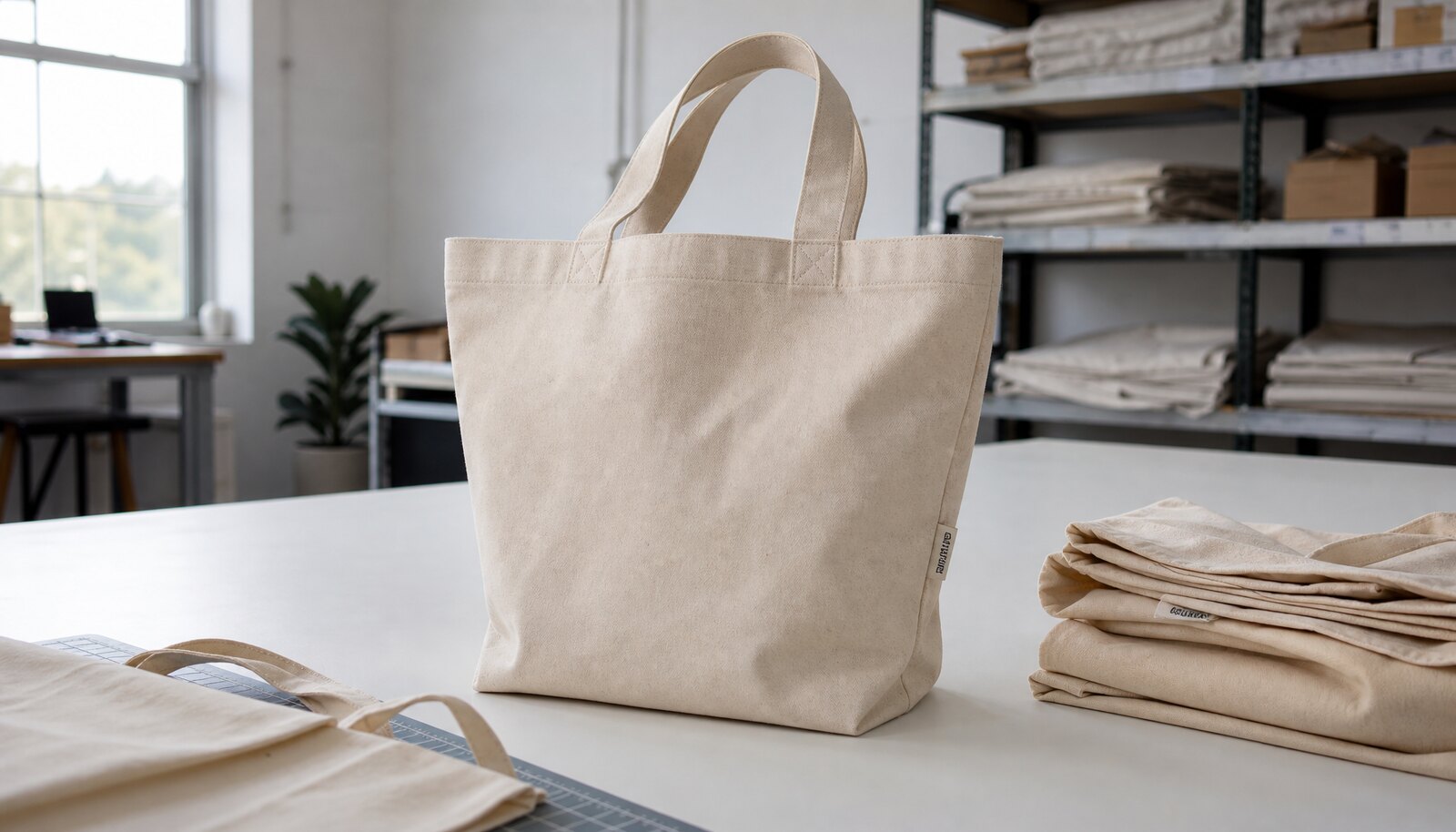
Start With The Bottle, Not The Bag
For boutique wineries, the right tote begins with the bottle it has to carry. A one-bottle gift bag, a two-bottle retail tote, a tasting-room merch item, and a gift-with-purchase insert are different sourcing jobs. They do not need the same fabric weight, handle reinforcement, packing format, or even the same shape. If the brief starts with a generic tote idea, the quote may look clean and still fail in the cellar door or retail counter.
The fastest way to make the spec usable is to write the actual use case in plain language. One standard 750 ml bottle for hand carry is not the same as two bottles with a paper insert, and neither is the same as a resale tote that should look good hanging on a shelf. Then convert that use case into dimensions: finished width, body height, gusset depth, handle drop, and whether the bag must stand upright after the bottle is inside. Those are the numbers the factory needs to quote a real product.
Bottle shape matters more than many buyers expect. Bordeaux, Burgundy, and sparkling bottles all change the load profile and the room needed at the shoulder and neck. If the winery sells mixed varietals, ask the supplier to fit the largest likely bottle, not the easiest one. A tote that works perfectly for one SKU can be too tight for a wider bottle and too shallow for a taller one. That is a product problem, not a style preference.
Wine buyers should also think about the channel. A tasting-room giveaway can tolerate a looser fold and simpler print. A merch tote that is sold next to bottles needs better visual balance and a cleaner finish. If the tote is carrying chilled bottles, ask how the fabric behaves when condensation shows up. That is a small detail, but it can change whether the bag still looks presentable after an event or cellar-door pickup.
The practical rule is simple: the bag should load easily, carry securely, and still look intentional after one real use. If the bottle has to be forced in, if the handles twist under weight, or if the tote collapses into an awkward shape when set down, the spec is not ready.
- Define the use case before asking for price.
- Name the actual bottle format, not just the wine category.
- Write finished size, gusset depth, and handle drop into the RFQ.
- Treat a resale tote and a giveaway tote as different products.
Choose The Organic Claim Path Up Front
The phrase organic cotton is not enough by itself. For procurement, the important question is which standard supports the claim and how the chain of custody is handled. GOTS and OCS are not interchangeable. GOTS is the stronger choice when you want broader process control, including the processing and finishing side of the supply chain. OCS 100 is useful when the claim is limited to organic fiber content and you need a clearer link back to the source material. If the bag will be sold or tagged as organic, do not rely on a generic marketing statement.
The other question is how the material moves through the chain. A physically segregated or identity-preserved flow is easier to defend on a finished tote order because the material can be tracked from certified input to finished shipment. A mixed-stream or loose accounting approach may be acceptable in some upstream contexts, but it is weaker when the end product is being sold as an organic item. For a customer-facing tote, ask for lot-level or shipment-level evidence, not just a brochure.
A certificate alone does not prove the whole bag is covered. The cotton may be certified while the sewing factory, printer, or finishing house is not. That matters if the supplier outsources any step. Ask which facility is actually in scope, what the scope covers, and whether any subcontractor touches the tote after the certified fabric arrives. If printing or washing happens outside the certified site, the supplier should be able to explain how that step is controlled and documented.
Common failure points are easy to miss. The certificate name may not match the exporter on the invoice. The finished product may be made at a site not listed in the scope. A transaction certificate may exist for the fabric but not the shipment. Or the claim may be correct internally but too vague to support a retail hangtag. These are avoidable problems if the buyer asks for the right documents before the PO is released.
If the winery wants to mention organic on the bag, hangtag, or product page, the support file should include the standard, the scope, the named facility, the shipment link, and the exact wording the supplier is allowed to use. If the paperwork is incomplete, keep the claim off customer-facing material until it is verified.
- Use GOTS when you want broader processing control.
- Use OCS 100 when the claim is primarily fiber content and traceability.
- Ask whether the tote is identity-preserved or only documented through a mixed stream.
- Do not let a certificate cover the fabric while the factory or printer sits outside scope.
Specify Fabric Weight, Weave, And Handle Strength
For most boutique winery programs, the useful middle ground is around 6 to 7 oz, or roughly 170 to 210 GSM. That range usually gives enough body for a bottle tote to feel credible without creating needless weight or freight cost. A lighter cloth can work for a promotional insert, but it will show the bottle, wrinkle faster, and feel less stable in hand. A heavier cloth can improve the premium impression, but it also raises cost, carton weight, and cube.
Structure matters as much as cloth weight. A tote can be the right GSM and still feel weak if the seams, hem, or handles are underbuilt. For wine use, check the side seams, bottom seam, top hem, and especially the handle join. Bar-tacks or equivalent reinforcement at the stress points are important because the load is concentrated where the hand pulls on the fabric. If the bag is gusseted, confirm whether it is a real sewn gusset or just a folded shape that looks wider in a photo.
The fabric finish also affects how the bag behaves in a tasting room. Unbleached or minimally processed cotton can show natural shade variation, which is fine as long as the variation stays within a controlled lot. If the tote must stay dimensionally stable, ask how much shrinkage the factory expects and how it compensates for that during cutting. Pre-shrunk or controlled cut dimensions can save you from bags that drift out of spec after handling.
For a single-bottle carry, a flat tote may be enough if the bottle is narrow and the bag is mainly a carrier, not a display piece. For one to two bottles, a gusseted shape is usually better because it gives the bottle room and improves the way the bag stands. For resale, a more structured cloth and a cleaner top hem often justify a modest price increase because customers judge the bag as a product, not just packaging.
The buyer should not compare quotes until the fabric weight and construction are locked. Otherwise the lower quote may simply be a thinner cloth, weaker stitch count, or narrower handle that happens to look similar in a sample photo.
- 6 to 7 oz is a practical default for most retail-facing winery totes.
- Use 4 to 5 oz only if the bag is a low-cost giveaway and the load is light.
- Ask for seam type, bar-tacks, and gusset construction explicitly.
- Define shrinkage behavior if the tote must stay stable after handling.
Lock The Branding Before You Buy The Run
Decoration is where many tote quotes become misleading. The same bag can be cheap or premium depending on print method, placement, and artwork complexity. For most winery programs, one-color screen print is the most dependable choice because it keeps the mark clean and repeatable on natural cotton. A woven side label or seam label can work better when the brand wants a quiet, elevated look or when the logo is too small or detailed to print cleanly.
The artwork has to be designed for the fabric, not just placed on top of it. Fine lines, small type, and tight crest details can fill in or blur on cotton if the line weight is too thin. Ask the supplier for a strike-off if the logo includes small text, thin borders, or exact placement requirements. That sample should be reviewed against the actual fabric, not a flat mockup. If the mark is meant to sit a specific distance from the hem or side seam, write that distance into the spec.
Ink choice affects both appearance and feel. Water-based inks are often a good fit for natural, understated branding because they keep the print softer in hand. Thicker inks can improve opacity on unbleached cloth, but they can also make the printed area stiffer. For a winery tote, that tradeoff is worth deciding up front. A tote that looks elegant but feels heavy in the logo panel may not read as premium once the customer actually uses it.
If the tote is part of a retail assortment, think about how it photographs and hangs next to bottles. A logo can be perfectly centered and still look awkward if it collides with the fold line or handle route. Placement should be measured from edges and seams, not described only as centered or near the top. That level of precision saves time in sampling and keeps the order from drifting during production.
The right sequence is artwork approval, strike-off, pre-production sample, and then golden sample. If the print method changes between sample and production, the approval is not really final.
- Use one-color screen print for the simplest and most repeatable result.
- Request a strike-off for small text, thin lines, or exact placement.
- Measure logo position from seams and hems in the spec.
- Consider a woven label when the brand wants a quieter premium finish.
Compare Supplier Routes On Control, Not Just Price
The way a tote is sourced changes the risk profile. A direct factory gives the clearest view of who is cutting, sewing, printing, and packing the order. That is usually the best route when the program is repeatable or when organic documentation matters. A trading company can be useful if the winery wants bundled items such as hangtags, inserts, and packaging, but the buyer should still ask for the real production site and the actual chain behind the tote.
A local decorator working from blank stock can be practical for urgent reorders or very small runs. The tradeoff is that the organic claim on the blank has to be checked carefully, and the buyer needs to know whether the blanks are truly what the quote says they are. A blank tote that looks clean is not evidence of traceability. If the source of the blank is unclear, the buyer is taking a documentation risk to save a little time.
The supplier route should follow the business need. If the winery has a seasonal release, direct factory sourcing may be better because it gives consistent color, fabric, and print setup across the line. If the order is a one-off event item and time is tight, a local finishing route might be acceptable, but only if the material origin and claim support are already clean. Do not compare those routes as if they were the same product.
Ask each supplier who owns each step: cotton sourcing, weaving or knitting, cutting, sewing, printing, label application, final inspection, and pack-out. If any part is outsourced, that should be visible in the quote. A polished sales deck is not enough. Buyers need enough production detail to know where the quality and traceability risks live.
The best quote is the one that can be repeated. For boutique wineries, reorder stability matters because the bag often comes back every harvest season or event cycle. If a supplier cannot keep the same fabric, same print method, and same factory path on reorder, the initial low price is less valuable than it looks.
- Direct factory works best for control and repeatability.
- Trading companies add convenience, but you still need the real production path.
- Blank-stock decorators are only safe if the blank origin and claim support are verified.
- Ask who owns each production step, not just who is selling the tote.
Make Samples Prove Fit, Load, And Shelf Presence
A sample is only useful if it answers the right questions. Start with a fabric swatch or print strike-off, then move to a pre-production sample, and only then approve the golden sample. For a wine tote, the sample review should test more than appearance. It should prove that the bottle fits, the handles hold, and the bag still looks clean after the load is inside.
Use the actual bottle whenever possible. If the winery knows the exact bottle format, put that bottle into the sample and lift it several times. If the sample is meant for a mixed assortment, use the largest likely bottle and confirm that the opening, body depth, and handle drop still work. If the bottle is chilled or likely to have condensation, inspect whether the bag shows moisture spots or shape change that would hurt the retail presentation.
The sample should also be checked for small but important details: print alignment, fold behavior, handle twist, and how the tote sits on a table or shelf. A bag can look fine in a flat photo and still feel awkward once the bottle is inside. If the program is for a tasting room or a shop wall display, the sample should be evaluated in that context, not only on a cutting table.
This is also the point to define what fails. A sample should be rejected if the print bleeds into the seam, if the handles are uneven, if the top hem waves badly, or if the bag is materially smaller than the approved spec. Small natural variation in organic cotton is fine. Weak construction is not. If the supplier needs a revision, ask for another sample before production starts. That delay is cheaper than sorting thousands of weak bags later.
A good sample stage answers three questions: does the bag fit the bottle, does it carry the load, and does it represent the brand well. If any answer is no, the order is not ready.
- Use a strike-off for print and a pre-production sample for construction.
- Test with the actual bottle or a close equivalent weight.
- Reject crooked handles, weak seams, and material size drift.
- Keep the approved golden sample on file and reference it in the PO.
Set QC Numbers Instead Of Vague Quality Language
High-level language like good quality is not enough for a commercial order. The buyer should write measurable tolerances so the factory knows exactly what passes. Define acceptable variation for finished size, handle drop, print placement, seam alignment, odor, and carton count. If the supplier cannot tell you what it accepts internally, the order has too much room for disagreement later.
A practical QC plan should include both visual and functional checks. Visual checks cover shade consistency, clean edges, thread trimming, and print clarity. Functional checks cover handle attachment, seam strength, and bottle load. For boutique winery totes, the most important defect is often not cosmetic. It is handle failure or seam opening under the actual bottle load. Those are critical issues, not minor ones.
An AQL-style inspection plan is useful when you need consistency across orders. The exact sampling method can be your internal standard or a third-party inspection process, but the important part is that the same method is used every time. Record defects by category so you can compare suppliers on real performance. That also helps when one factory looks fine on paper but produces more load-related defects than another.
For a premium resale tote, you can set tighter rules on print placement and fold quality. For a giveaway item, you may allow a little more cosmetic variation, but the bag still has to hold the intended bottle safely. A useful default is to reject any tote that cannot carry the expected bottle load without visible stress at the handle join, or any tote whose print lands outside the approved zone.
The more measurable the QC sheet, the less time the team spends debating subjective quality after the shipment lands.
- Write tolerance limits for size, print position, stitching, odor, and carton count.
- Use a structured inspection method consistently across orders.
- Treat handle failures, seam openings, and wrong labels as major or critical defects.
- Tie defect categories to the approved sample and PO annex.
Treat Packing And Freight Cube As Part Of The Spec
Packing changes both presentation and landed cost, so it should be decided before the quote is finalized. A tote sold in a tasting room may need a clean fold, a hangtag, or a barcode label. A tote shipped in bulk to a distributor may only need a compact fold and a tight carton pack. If the channel does not need retail presentation, do not pay for retail packing by default.
Carton cube is one of the easiest hidden costs to miss. A tote that folds loosely, ships in a bulky fold, or uses oversize retail packing can add freight cost even when the unit price looks attractive. Ask each supplier for carton dimensions, gross weight, and units per carton, then compare packed volume per unit. That gives a real landed-cost view instead of a fake unit-price comparison.
Bulk pack is usually the most efficient for freight, but it is not always the best choice for the winery's channel. If the tote is a resale item, a consistent retail-ready fold can reduce handling at the destination and improve shelf presentation. If the tote is a packaging insert or event giveaway, bulk pack is often the smarter option. Inner polybags should be added only if they protect the print or are required by the channel. Otherwise, they add cost and waste.
If the shipment is long-haul or likely to sit in humid storage, ask whether moisture protection is warranted. Do not add desiccant automatically, and do not reject it automatically. The decision should be based on transit time, carton exposure, and the finish on the bag. If cartons will be stacked in a warehouse, ask whether the carton strength is sufficient for the planned stack height.
The simplest habit is to ask for packing photos with the sample or the pre-shipment record. Show one folded unit, the internal pack, the carton label, and one open carton with the actual count visible. That tells the buyer more than a packing line item on the quote.
- Ask for carton dimensions, gross weight, and units per carton in every quote.
- Compare packed volume per unit, not just the bag price.
- Use bulk pack for freight efficiency and retail pack when the channel needs it.
- Request packing photos before shipment if the order is for resale or distributor delivery.
Watch The Import And Compliance Traps That Stall Orders
Import and compliance problems usually come from small mismatches. The invoice may name one company while the certificate names another. The shipment may be made at a site that is not in scope. The country-of-origin mark may not match the paperwork. Or the tote may be sold as organic in marketing copy even though the supplier can only support a weaker material claim. These issues can hold up customs clearance or create a claim problem later.
The first thing to check is document consistency. The seller name, factory name, certificate holder, and production site should line up across the PO, invoice, certificate, and shipment records. If the bag is decorated or packed by a subcontractor, ask whether that site is also within scope. If not, ask how the claim survives that step. A finished tote with a good-looking hangtag is not enough if the documentary chain breaks when someone compares the files.
The second trap is over-claiming. Organic cotton is a material claim, not a substitute for every other sustainability statement a brand might want to make. If the winery wants to say the tote is organic on the bag or on a retail tag, the supporting file has to be strong enough for that customer-facing claim. If the file is thin, keep the statement internal until the documents are cleaned up.
The third trap is assuming the supplier understands your market rules. If the tote is going into the US, EU, UK, or another regulated market, the buyer should confirm whether any labeling, origin marking, or customs description needs to be phrased a certain way. The broker or freight forwarder may need the product described more precisely than the sales team expects. If the production file says generic cotton tote while the marketing file says certified organic tote, fix that before shipment.
For wineries that want to keep the story clean, the safest move is simple: keep the claim tied to the documents, keep the documents tied to the shipment, and do not print more on the bag than the file can defend.
- Make sure certificate names, seller names, and facility names line up.
- Check whether any printing or finishing step falls outside scope.
- Do not use a stronger organic claim on the bag than the file supports.
- Verify origin marking and customs descriptions before shipment, not after.
Lock The PO Around Reorder Stability, Not Just The First Shipment
The last step is deciding whether this is a one-time event tote or a repeat program. Boutique wineries often need continuity across harvest events, seasonal releases, and gift campaigns. If that matters, the purchase order should protect the repeatable parts of the product: the same fabric weight, same print method, same finished size, same packing format, and same approval sample reference.
Ask the supplier what happens when a fabric lot changes, a print screen is replaced, or a subcontractor shifts. A good answer is not always identical forever. A good answer is a controlled fallback plan. For example, the supplier may hold a sample archive, keep the same factory line, or require approval if the fabric source changes. That is the kind of discipline that makes reorders predictable.
The PO should also name the approval chain. One person should own artwork sign-off, one person should own sample sign-off, and one person should own the final shipment review. When those roles are mixed, minor changes can slip through because everyone assumes someone else is checking them. A tote order is not large enough to justify a complicated governance process, but it is important enough to need clear ownership.
If you are comparing suppliers, ask them to quote the same spec in the same format and the same pack configuration. Then compare landed cost, lead time, document quality, and reorder stability. The cheapest first order is not always the best procurement decision if it creates a weaker claim, a messier sample process, or a one-off setup that cannot be repeated.
When the spec, documents, sample, and packing are all aligned, the tote becomes easy to buy: the factory knows what to make, the buyer knows what to inspect, and the winery knows what it will receive.
- Treat reorder stability as a buying requirement, not a bonus.
- Name the approved sample ID and attach it to the PO.
- Assign separate owners for artwork, sample approval, and final shipment review.
- Compare suppliers on landed cost plus documentation quality, not just factory price.
Specification comparison for buyers
| Bag spec item | Buyer-friendly range / default | What to verify in sample or quote | Common mistake to avoid |
|---|---|---|---|
| Fabric weight | 6 to 7 oz, or roughly 170 to 210 GSM, for most boutique winery retail use; 4 to 5 oz only for low-cost giveaways | Ask for exact GSM, finished fabric tolerance, and shrinkage allowance after cutting or washing | Approving a light bag that looks premium in a render but collapses around a bottle |
| Organic standard and traceability | GOTS for the strongest processing control, or OCS 100 if the claim is limited to organic fiber content; prefer lot-level shipment proof for customer-facing claims | Verify certificate number, scope, named facility, product coverage, and transaction certificate or shipment link | Assuming a fiber certificate covers sewing, printing, and packing when those steps are outside scope |
| Bag structure | Flat tote for a single bottle handout; gusseted tote for one to two bottles or a more retail-ready shape | Confirm bottle diameter, shoulder width, and height against the actual wine format | Choosing a flat bag for a bottle program that needs depth and upright stability |
| Handle construction | Self-fabric or cotton webbing handles with bar-tacks at the stress points | Check handle width, handle drop, stitch count, and whether the sample survives a load test without pull-out | Ignoring handle reinforcement when the bottle is the real load-bearing requirement |
| Decoration | One-color screen print for most logos; woven side label or seam label for minimal premium branding | Request strike-off, confirm minimum line width, placement tolerance, ink type, and cure or rub resistance | Pricing the tote before the artwork, placement, and print method are fixed |
| Packing | Bulk pack for freight efficiency or retail-ready fold if the channel needs shelf presentation | Ask for carton count, carton dimensions, gross weight, and whether inner polybags are actually needed | Letting packing be decided after freight is already quoted |
| QC tolerances | Measured pass or fail limits for size, print placement, stitching, odor, and carton count | Ask the factory what tolerance it accepts and mirror that in the PO or QC sheet | Using vague language like good quality instead of measurable standards |
| Load performance | The bag should safely carry the intended bottle count plus a small buffer without handle slippage or seam opening | Request a bottle-fit and weighted load test with the actual bottle shape or an agreed equivalent | Treating a wine tote like a generic promo bag and skipping functional testing |
Buyer checklist before sampling
- Define the use case first: one-bottle carry, two-bottle retail set, tasting-room merch, or gift-with-purchase.
- Name the actual bottle format or the largest likely bottle format before asking for price.
- Lock the finished size, gusset depth, handle drop, and whether the bag must stand upright on a shelf.
- Set the GSM target and state whether you need pre-shrunk behavior or can accept natural relaxation after use.
- Choose the organic standard you want to support, such as GOTS or OCS 100, and ask what documents will ship with the order.
- Write the print method, number of colors, artwork size, and exact placement into the RFQ.
- Ask for MOQ by size, color, and artwork version, plus the cost of reorders and screen or setup charges.
- Request swatch, strike-off, pre-production sample, and golden sample stages before mass production.
- Confirm carton count, carton dimensions, gross weight, and whether bulk packing or retail-ready fold is intended.
- Compare ex-works price, packing cost, inspection cost, freight cube, duty, and reorder stability before choosing a supplier.
Factory quote questions to send
- Which organic standard applies to this tote, and will you provide the certificate number, scope, product coverage, and shipment-level document?
- Is the sewing and printing factory itself within scope, or is the organic claim only valid upstream at fiber or fabric level?
- What exact GSM are you quoting, and what tolerance do you allow on finished fabric and finished bag dimensions?
- Which bottle format did you use when checking fit, and what is the maximum bottle diameter and height the tote will comfortably accept?
- What construction is included in the quote: side seams, bottom seam, gusset, top hem, handle type, and reinforcement at the stress points?
- Which print method are you pricing, what is the setup fee per color, and what minimum line width can you reproduce cleanly on cotton?
- What is the MOQ by size, color, and artwork version, and are screens, plates, or repeat setup charges included for reorders?
- What sample stages will you provide before production starts, and what sample is treated as the golden reference?
- What load test have you performed, what weight or bottle count did you use, and what result do you consider a pass?
- What are the carton pack count, carton dimensions, gross weight, and overrun or underrun tolerance?
Quality-control points to confirm
- Fabric GSM should match the agreed spec within the written tolerance, with no thin spots, holes, or weak slubs that affect strength or appearance.
- Finished width, height, gusset depth, and handle drop should stay within the approved dimensional tolerance, typically tighter for retail SKUs than for giveaways.
- Handles should be symmetrical, firmly attached, and reinforced with complete bar-tacks or the agreed stitch pattern at every load-bearing point.
- The tote should pass a practical load test using the intended bottle format or an agreed equivalent weight, with no seam opening, handle slip, or excessive distortion.
- Print should sit in the approved zone, with registration and placement within the written tolerance and no obvious bleed, ghosting, or fill-in on fine type.
- Shade variation in natural cotton is acceptable within the lot, but obvious carton-to-carton outliers or mismatched print tone should be rejected.
- There should be no strong odor, oil marks, needle damage, or loose threads at critical seams and handle joins.
- Carton labels, pack count, and carton dimensions should match the approved packing spec before shipment.
- Any organic claim on the bag, hangtag, or packing should match the certificate scope, the shipment lot, and the named production chain exactly.
- Wrong origin marking, wrong certification data, or missing shipment documentation should be treated as a critical defect, not a cosmetic issue.