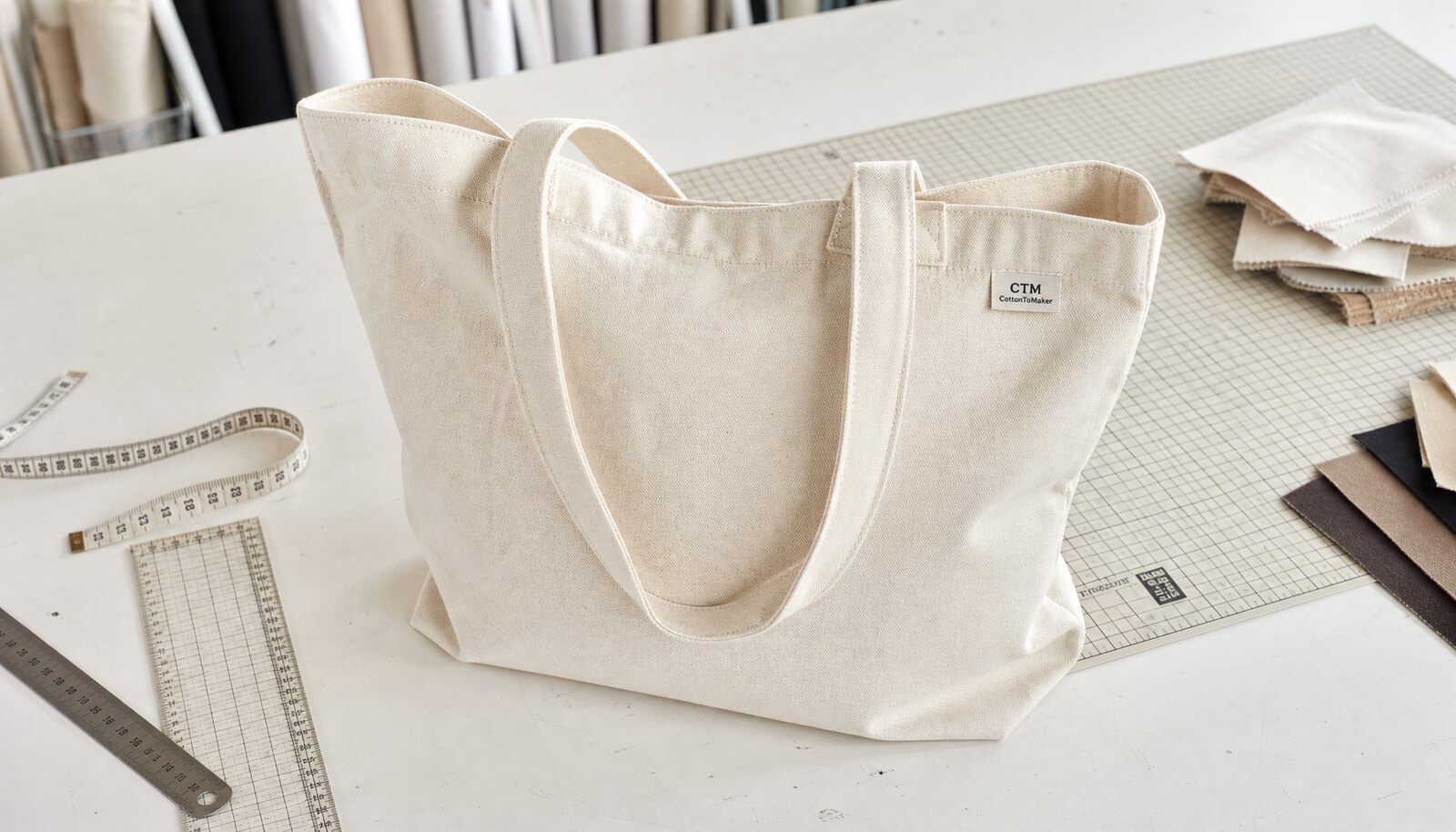
Why winery buyers need a durability test, not just a nicer-looking tote
For boutique wineries, an organic cotton tote is rarely just a carry bag. It can function as packaging, retail merchandise, a gift carrier, or a keepsake that stays in circulation long after the bottle is gone. That makes the buying decision different from a standard promotional tote. The bag has to support a premium brand story, survive real handling, and still look intentional on a tasting-room counter or in a customer’s car.
The common sourcing mistake is approving a sample because the logo looks clean and the color sits well beside the label palette, then discovering later that the handle stretches, the side seam twists, or the bottom sags after the first few uses. For a boutique winery, that failure is visible. The tote becomes part of the customer’s memory of the bottle, the tasting experience, and the brand itself.
The right starting point is the actual use case. A bag built for a complimentary tasting-room bottle is not the same as a bag intended for retail resale or a wine club gift. A single-bottle carry tote can be lighter and simpler than a two-bottle or gift-set tote. A resale item needs cleaner finishing, better print durability, and more consistent shape retention because customers will inspect it as a product, not as disposable packaging.
That is why the phrase organic cotton totes for boutique wineries durability testing checklist matters. Buyers need a spec that connects material choice to the way the bag will be used. If the tote is going to be lifted by one hand, folded into a shopping basket, or reused repeatedly, the weak points are predictable: handle attachment, seam integrity, and print wear. The sourcing conversation should start there, not with artwork alone.
- Treat the tote as part of the winery product experience, not only as packaging.
- Match the build to the channel: giveaway, retail resale, gift set, or event merchandise.
- Center the spec on handle strength, seam integrity, and print durability before price comparison.
Start with the bottle load and the way the bag will actually be carried
Bottle format drives almost every meaningful tote decision. A standard 750 ml bottle is a very different load from a magnum or a two-bottle gift pack. A single bottle creates a narrow, rigid center of gravity. Two bottles create more weight and more shift. If the bag is meant to carry a bottle plus a brochure or a small gift item, the base needs more stability and the handles need more reinforcement.
This is why sample approval should always use the real bottle format. Sandbags and generic weight estimates hide problems that appear only with a glass bottle. The neck may push against the top hem, the shoulder of the bottle may abrade the print area, or the base may twist when the customer picks the bag up by one handle. Those issues are common in winery use and easy to miss in a neutral sample room.
Buyers should also think about the carry motion. A tasting-room guest typically lifts the bag off a counter, walks to a car, sets it down, and may lift it again later. That repeated handoff is more punishing than a single static hang test. A tote that survives one careful pull can still look tired after repeated lifts if the handle attachment is underbuilt or if the side seam transfers stress unevenly.
The practical answer is to design the tote around the use pattern, then test it under the same pattern. If the winery wants a premium feel, a bag that stands on its own and keeps the bottle upright is worth more than a softer bag that collapses on the counter. If the tote is just a low-cost carry item, the buyer can relax the presentation standard somewhat, but not the load-path standard. The bag still has to keep the bottle secure.
For most boutique programs, a single-bottle tote and a two-bottle tote should be treated as different products, even if they share the same logo. The force acting on the seams, handles, and base is different enough that a one-size spec usually creates compromise. Buyers who separate those use cases usually get better quotes and fewer surprises later.
- Test the exact bottle format the winery will use, not a substitute weight.
- Separate single-bottle, two-bottle, and gift-set totes into different specs if the load differs materially.
- Judge the tote by how it behaves after repeated lift-and-set handling, not by a single static hang.
Fabric weight and weave matter, but GSM is not a quality score
For most boutique winery programs, 200–240 GSM organic cotton canvas or heavy twill is the most balanced starting point. That range usually gives enough body for a bottle tote to stand up, hold shape, and feel substantial without turning the bag into a rigid promotional sack. Lighter weights can work for simple giveaways if the construction is stronger, but they tend to collapse around the bottle and show wear faster at the handles.
The important point is that GSM by itself does not tell the whole story. Two fabrics with the same weight can behave very differently if one is a loose weave and the other is tightly finished. Canvas generally offers more structure and a more obvious retail presence. Twill tends to feel smoother and slightly more elevated in hand. Plain weave may be suitable for lighter merchandising, but it usually needs more careful reinforcement if the tote is expected to carry wine regularly.
It also matters whether the GSM was measured before or after finishing. That detail sounds small, but it changes quote comparisons. A factory that reports pre-finishing weight may deliver a bag that feels lighter after washing, calendaring, or surface treatment. Buyers comparing suppliers need a common measurement basis or the numbers are not meaningfully comparable.
A useful way to think about fabric selection is to start with the brand story. If the tote will be sold as a premium merchandise item, a smoother twill or tighter canvas often reads better at first touch. If the tote is mostly functional packaging, structure and cost may matter more than hand feel. Either way, the bag should be evaluated while loaded, because an empty tote can flatter a fabric that will fail once the bottle is inside.
For procurement, the best spec line usually names the fiber source, weave, GSM, finish, and expected behavior in one place. That gives the supplier less room to interpret the brief loosely and makes the sample discussion much cleaner.
- Use GSM as one input, not as a quality rating on its own.
- Pair the GSM with weave and finish so the bag is judged on actual behavior.
- Clarify whether the quoted weight is measured before or after finishing.
Handles, seams, and the bottom are where tote failures usually start
In a bottle tote, the main stress path runs from the handles into the top hem, then into the side seams and bottom seam or gusset. That means the visible design is often less important than the hidden reinforcement. A good-looking tote with weak attachment stitching will fail in the exact place customers grab it. For winery buyers, that is the line between a premium accessory and a complaint.
Self-fabric handles with X-box reinforcement or dense bar-tacks are usually the most defensible option for a cotton tote in this category. The handle width should feel comfortable in the hand, but comfort alone is not enough. Buyers should examine how much stitch density is used at each attachment point, how the reinforcement is placed, and whether both handle ends receive the same treatment. Uneven reinforcement is a common source of early distortion.
The bottom construction deserves the same attention. A gusseted base generally improves stability and makes it easier for the tote to stand in a tasting room or on retail shelving. A reinforced flat bottom can also work if the seam allowance is generous and the stitching is clean. In either case, the base has to support a bottle that may shift during car transport or when the bag is set down on an uneven surface.
A practical inspection habit helps here: load the tote, stand it upright, and look at the seams from multiple angles after a few lifts. If the side seam begins to pucker, if the bottom twists, or if the handle attachment pulls the top hem outward, the design is underbuilt for the intended use. Those flaws may not be visible on the flat sample, which is why a functional check matters more than a simple visual approval.
If the tote is going into retail, also check the inside finish. Loose threads, uneven overlock, and rough seam edges are minor in a warehouse tote and unacceptable in a merchandise tote. The quality bar rises once the customer sees the bag as part of the product, not only as an accessory.
- Look for reinforcement at the handle base, not just a neat exterior finish.
- Use the bottom construction to keep the bottle stable and the tote upright.
- Treat inside seam finish as a retail-quality issue when the bag is sold or gifted.
Choose print and branding methods by wear resistance, not by mockup convenience
Boutique wineries often want a restrained logo, a small mark, or a short line of text. That is good news for production because simpler branding usually holds up better on cotton canvas than dense artwork does. The real question is not whether the print looks good in the mockup. It is whether it stays legible after folding, handling, and being packed against other bags in a carton.
Water-based screen print is usually the most durable and cost-effective choice for a simple winery logo. It is well suited to repeat orders and low-color artwork, and it sits naturally on cotton rather than looking like a sticker on top of the fabric. Buyers should still test it for fold-line behavior and rub resistance, especially if the tote will be stacked tightly or reused often.
Heat transfer can work for short runs or more complex graphics, but it is more vulnerable to cracking, edge lift, and glossy patches when the tote is folded or rubbed. That does not make it unusable. It simply means the buyer should treat it as a higher-risk method unless the sample has already been tested in the way the bag will actually ship and be handled.
A woven or sewn label can be the better answer when the winery wants a premium, low-wear brand mark rather than a large printed panel. This is especially useful when the tote itself is the merchandise item. The label creates a more subtle brand presence and avoids some of the abrasion issues that can affect ink on rougher canvas. It does cost more, so it makes sense when presentation value is part of the product strategy.
Alignment tolerance is another area that deserves precision. A logo that is shifted a few millimeters may seem minor in isolation, but asymmetry is easy for customers to notice on a simple tote. For a wine brand that values restraint and polish, clean placement and crisp edges matter as much as the art itself.
- Use screen print for simple logos and repeatable branding.
- Treat heat transfer as a higher-risk option unless fold and rub performance is proven.
- Use a woven or sewn label when the tote is intended to feel like a premium retail item.
Organic verification needs a paper trail, not a supplier promise
Organic cotton is a claim that should be supportable, not decorative. In procurement terms, that means the buyer needs a traceable chain from the fiber source to the finished tote. A supplier statement may be part of the record, but it should not be the only evidence. The useful documents are the certificate scope, the issuing body, the validity dates, the lot reference, and the production paperwork that ties the batch back to the quoted material.
For many buyers, third-party frameworks such as GOTS or OCS are the most familiar reference points because they provide a clear traceability structure. The important part is not the acronym itself. It is whether the certificate actually covers the relevant entity in the chain, whether the scope matches the material used, and whether the final tote can be linked back to the correct lot. If those links are missing, the claim is weak even if the sample looks perfect.
This matters for boutique wineries because the brand story is often careful and specific. If the tote is being used in a retail program, a tasting-room bundle, or a club member gift, the buyer may need to show how the organic claim is supported. That is especially true when the tote appears alongside other premium claims. Clean documentation prevents awkward downstream questions from retail partners or internal compliance teams.
It is also smart to separate the fiber claim from the rest of the build. A tote can be made from organic cotton but still include labels, threads, inks, or finishing agents that are outside the buyer’s claim narrative. That does not automatically make the product a problem, but it does mean the buyer should be precise about what is actually being represented. Organic claims become confusing when the spec is loose.
The practical sourcing rule is simple: if the supplier cannot show how the claim travels from the certified source to the finished batch, the buyer should not rely on the claim in a retail-facing program. This is one of the few places in tote sourcing where the paperwork matters as much as the physical sample.
- Keep the certificate scope, validity, and batch reference aligned to the actual fabric used.
- Treat supplier letters as supporting material, not as proof by themselves.
- Separate the organic fiber claim from labels, inks, and finishing agents unless the documentation covers them clearly.
Use a durability test that produces a real pass or fail
A good durability checklist is specific enough that two people would make the same decision from the same sample. For organic cotton totes for boutique wineries, that means the buyer-side test should use the actual bottle, a fixed number of lift cycles, and a defined inspection point after the test. If the tote only gets a vague statement like “seems strong,” the approval is not really controlled.
A practical sample plan is to test three pre-production samples per size or colorway before bulk starts. For the first production lot, inspect the first five finished bags or one bag for every 50 units, whichever is greater. If the order is very small, inspect every piece. That is not a laboratory protocol; it is a buyer-side control that gives enough data to catch construction problems before they become a full lot issue.
The handle pull test can be simple and still useful. Load the tote with the intended bottle format, hold it by the handles for 60 seconds, then repeat 10 lift-and-set cycles. Accept only if the handles remain attached, the seams stay closed, and the handle stretch remains below 5% or 15 mm, whichever is smaller, relative to the approved sample. Any visible stitch failure, bar-tack lift, or seam opening should fail the sample.
Seam strength is the next checkpoint. Side seams and the bottom seam or gusset should not open under normal carry load. A good buyer-side rule is to reject any seam opening greater than 3 mm or any stitch slippage greater than 10 mm. If the tote shows puckering or distortion but no outright failure, it may still be acceptable for a back-of-house giveaway, but it is not strong enough for a premium retail or gifting program.
The print rub test should be equally direct. After 10 dry rubs with a white cotton cloth and a fold along the most common shipping crease, the logo should not crack, flake, bleed, or transfer visibly to the cloth. Repeat the rub after the fold because that is where the weak ink systems often fail. If the tote is going to sit on a shelf or be reused many times, a clean logo after folding is not optional.
Finally, check odor and surface cleanliness. Cotton is forgiving, but it can still arrive with oil smell, damp storage smell, lint, or staining. Those defects are small in a warehouse sample and obvious to a customer standing at a tasting bar. If the bag is intended to feel premium, the QC standard should include presentation, not only structure.
- Use three pre-production samples per size or colorway before bulk starts.
- Run a 60-second hold and 10 lift cycles with the real bottle.
- Reject handle stretch above 5% or 15 mm, seam opening above 3 mm, or stitch slippage above 10 mm.
- Fail any print that cracks, flakes, or transfers after a dry rub and fold test.
Sample approval should lock appearance, function, and documentation together
A sample should not be approved just because it looks good flat on the table. For a winery tote, the approval needs to cover three things at the same time: appearance, function, and paper trail. If one of those is weak, the production batch can still create trouble even when the other two are solid.
The cleanest approval method is to review a pre-production sample against a signed reference sample and record the finished dimensions, print position, handle length, handle drop, and seam details. Photos should show the front, back, inside seam finish, label placement, and base construction. That record reduces later arguments about whether the bulk goods match the approved standard.
A sealed reference sample is worth keeping on both sides. It creates a physical benchmark for later comparisons when the production lot arrives. Without that reference, minor differences in shade, print density, or handle shape can turn into subjective debates. With it, the buyer can compare the production goods against a shared baseline and make a faster decision.
The sample process should also include the documentation packet. For an organic cotton tote, the buyer wants the certificate details, lot reference, invoice description, and packing list to line up. If the sample is right but the paper trail is missing, the buyer does not actually have an approvable item for a retailer-facing program. The best sample in the world does not fix a traceability gap.
The main discipline here is to avoid treating the sample as a design artifact only. It is also the control standard for bulk production and the proof that the supplier can repeat the spec. That is the real purpose of a pre-production sample in procurement.
- Approve the sample only after checking appearance, performance, and documents together.
- Record the finished dimensions and photo set, not only the artwork proof.
- Keep sealed reference samples on both sides for repeat orders and dispute resolution.
Packing and warehouse handling can damage a good tote before it reaches the customer
Soft goods are vulnerable to packaging decisions. A well-made tote can still arrive in poor condition if it is folded badly, packed too tightly, or shipped without enough moisture protection. For boutique wineries, that matters because the bag often enters a premium environment immediately after receipt. A flat-packed tote with a clean fold and stable carton count is much easier to receive and resell than a loosely stuffed bag with uneven presentation.
The buyer should define the carton count, fold method, moisture protection, and carton marks before production begins. If the bags are going to retail, the fold line and outer appearance matter because the customer may see the tote before using it. If the bags are destined for back-of-house use, the presentation standard can be simpler, but the count and protection still need to be controlled.
Overpacking and underpacking both create problems. A carton stuffed too tightly can crush handles, deepen fold creases, and rub print surfaces against each other. A loose carton lets the bags move around in transit and can produce scuffing, count discrepancies, or wrinkling that makes the bag look old before it has been used. The correct packing density depends on fabric thickness and shipping route, but the decision should be made in advance instead of left to the factory’s default.
It is also useful to request carton photos before shipment. That gives the buyer a chance to check fold quality, carton markings, and visible condition before the goods leave the factory. In a repeat winery program, that step catches avoidable mistakes early and is much cheaper than correcting receiving issues after arrival.
Packing is not a secondary detail. It is the last quality-control step before the tote enters the market or the tasting room, and it can preserve or destroy the value of an otherwise well-made bag.
- Set carton count, fold method, and moisture protection before production starts.
- Avoid overpacking that crushes handles or rubs print surfaces.
- Request carton photos before shipment so folding and labeling can be checked early.
Turn the checklist into an RFQ that suppliers can answer without interpretation
The best RFQ for this category reads like a controlled product brief, not a long list of vague preferences. It should name the exact bottle format, finished size, fabric weight, weave, finish, handle structure, print method, organic documentation, sample process, and packing method. That makes it easier for suppliers to quote honestly and makes it easier for the buyer to compare offers on the same basis.
One useful way to think about the RFQ is to separate what is fixed from what is negotiable. Fixed items are the bottle format, finished dimensions, organic claim support, and durability test thresholds. Negotiable items are MOQ, lead time, carton pack count, and maybe the branding method if the buyer is open to alternatives. When the fixed items are clear, the supplier can still propose options without changing the product identity.
That structure also improves quote quality. A factory that knows the buyer will review seam reinforcement, handle test results, and carton photos is more likely to respond with a true production quote rather than a rough promotional estimate. For boutique wineries, that is the goal: fewer surprises, cleaner comparisons, and less time spent decoding supplier assumptions.
The final test of a good RFQ is simple. If two suppliers quote the same spec, the buyer should be able to compare price, lead time, and risk without re-reading the brief. If that is not true, the RFQ still needs work. The right brief saves time on the front end and prevents rework after sample approval.
For a premium wine program, the tote is small, but the sourcing process should still be precise. The bag has to look considered because the brand experience depends on it.
- Fix the bottle format, finished size, fabric, handles, print, documentation, sample process, and packing before requesting price.
- Treat MOQ and lead time as negotiable; treat the core product spec as fixed.
- Write the durability thresholds into the RFQ so suppliers know what bulk release depends on.
Specification comparison for buyers
| Spec decision | Recommended option | Why boutique winery buyers choose it | Tradeoff / buyer risk to check |
|---|---|---|---|
| Fabric weight | 200–240 GSM organic cotton canvas or heavy twill | A strong middle range for a single bottle tote: enough body to protect shape, but not so heavy that the bag feels rigid or difficult to sew | GSM can be reported before or after finishing; if the measurement method is unclear, the tote may arrive lighter or softer than the sample |
| Weave and finish | Canvas for structure; twill for a smoother premium hand feel | Canvas stands upright better on a tasting-room counter; twill can feel more refined for retail merchandise | Coarse weave can blur fine print; smoother twill may need stronger reinforcement to stay crisp under bottle weight |
| Handle construction | Self-fabric handles with X-box or dense bar-tack reinforcement at both ends | Handle failure is the most common weak point in bottle-carry totes, so buyers want a visible reinforcement path | Handle length alone does not prove strength; check stitch density, thread quality, and attachment width |
| Bottom construction | Gusseted base or reinforced flat bottom with a wide seam allowance | Helps the tote stand, pack, and hold one or two bottles without tipping or twisting | A weak bottom can distort when the bottle shifts, especially during car transport |
| Print method | Water-based screen print for simple logos; woven or sewn label for premium low-wear branding | Clean branding that survives folding, stacking, and repeated retail handling | Heat transfer may crack on fold lines; fine detail can disappear on textured canvas |
| Compliance / organic documentation | Mill-level organic certificate, lot reference, and claim-supporting documents tied to the production batch | Useful for retailer onboarding, internal compliance review, and brand protection | A supplier letter is too thin on its own; the certificate scope must match the actual fiber source |
| Sampling strategy | Pre-production sample plus sealed approved reference sample | Reduces disputes over size, shade, logo placement, and seam finish | If the factory skips a true pre-production sample, bulk risk rises quickly |
| MOQ strategy | 300–1,000 pcs per artwork/colorway for a first program, adjusted by custom components | A workable range for seasonal winery launches and merchandising tests | Low MOQ can hide stock-fabric substitution or simplified finishing unless the spec is written tightly |
| Packing method | Flat pack with defined carton count, moisture protection, and carton marks | Protects print surfaces and makes receiving easier at warehouse or retail level | Loose packing can crease the bags, rub the print, and create count errors on arrival |
Buyer checklist before sampling
- Define the use case first: tasting-room giveaway, retail resale, gift-with-purchase, wine club insert, or event merchandise.
- State the bottle format the tote must carry: one 750 ml bottle, two bottles, a magnum, or a mixed gift pack.
- Lock the finished bag size, not only the flat cut size, and include seam allowance in the specification.
- Choose fabric weight, weave, and finish together; do not judge the bag by GSM alone.
- Set handle length, handle width, and reinforcement style so the factory does not default to a generic promo tote build.
- Confirm whether the organic claim is supported at mill or spinner level and traceable to the production lot.
- Name the print method, color count, placement, and acceptable alignment tolerance.
- Approve a pre-production sample and keep one sealed reference sample on both sides.
- Tie bulk release to a simple durability test for handle pull, seam integrity, and print rub.
- Define carton count, fold method, moisture protection, and whether bags ship flat or folded with inserts.
Factory quote questions to send
- What exact fabric are you quoting: GSM, weave, finish, and whether the fiber is certified organic at mill or spinner level?
- Can you identify the mill or spinner behind the organic cotton and share the certificate scope that covers this batch?
- Is the quoted unit price based on finished bag size or cut pattern size, and does it include seam allowance and reinforcement stitching?
- What handle structure is included, and how many bar-tacks or reinforcement stitches are applied at each attachment point?
- Which print method is included, how many colors are covered, and what setup charge applies per artwork or screen?
- What is the MOQ by color, artwork, and custom label, and is there a surcharge for mixed sizes or mixed carton packs?
- Can you provide a recent pre-production sample photo set and in-line inspection photos for a similar tote?
- What test method do you use for loaded-handle performance, seam strength, and print rub, and what are your pass/fail limits?
- How do you connect the organic claim documents to the specific fiber lot used in production?
- What packing format is included, how many units per carton, and what gross carton weight should we expect?
Quality-control points to confirm
- Fabric verification: compare the bulk lot against the approved sample and record GSM with the same method each time. For buyer-side control, treat a variance of more than about 5% from the approved sample as a review item, even if the tote still looks acceptable by eye.
- Finished dimensions: measure height, width, gusset depth, and handle drop after sewing and pressing. A tote that misses a key dimension by more than 3% or 5 mm, whichever is larger, should be reviewed before release.
- Handle reinforcement: inspect both ends of each handle for skipped stitches, loose threads, uneven bar-tacks, and puckering. A single visible attachment defect is enough to fail a premium winery tote.
- Handle pull test: load the bag with the intended bottle format, hold it by the handles for 60 seconds, then repeat 10 lift-and-set cycles. Accept only if there is no handle detachment, no seam opening, and no permanent handle stretch greater than 5% or 15 mm, whichever is smaller.
- Seam strength: side seams and bottom seams should remain closed under normal carry load. Reject any seam opening over 3 mm, stitch slippage over 10 mm, or visible thread break at the load path.
- Print rub and fold test: rub the logo area with a white cotton cloth for 10 dry passes, fold along the most common shipping crease, then repeat 10 more rubs. Any visible ink transfer, cracking, flaking, or edge lift is a fail for retail or gifting use.
- Color and shade control: compare the bulk batch under the same light source used for sample approval. Natural cotton variation is expected, but obvious shade drift from the approved sample should not pass for a branded winery program.
- Odor and cleanliness: reject bags with oil smell, mildew smell, surface staining, or excessive lint if they will sit in a premium retail environment. Customers notice odor and surface cleanliness immediately.
- Packing verification: count cartons, check carton marks, verify fold method, and inspect moisture protection. A correct unit count does not compensate for crushed handles, scuffed print, or wet cartons.
- Documentation check: match the certificate, invoice, packing list, and production lot code before release. If the traceability chain does not line up, hold the lot until the supplier closes the gap.