Why salon chains need a scorecard, not just a tote quote
An organic cotton tote looks simple until it becomes part of a chain-wide salon program. The same bag may be sold at reception, used as a gift-with-purchase carrier, packed with stylist onboarding tools, distributed to franchise locations, or replenished as a retail carryout bag. Each use changes the real specification. Fabric weight, gusset depth, handle strength, logo method, folding style, barcode labeling, carton allocation, and delivery timing all start to matter.
A supplier scorecard turns a subjective buying decision into something marketing, operations, finance, and sustainability teams can review together. Marketing wants a clean logo and a premium hand feel. Operations wants cartons that match store allocation rules. Finance needs landed cost, not only an EXW unit price. Sustainability or legal teams may need evidence before the tote is described as organic cotton. The scorecard brings those requirements into the open before the purchase order is issued.
The biggest shift is this: compare process control, not staged product photos. A supplier may show a beautiful sample and still struggle with bulk shade variation, weak handles, missing documents, or inaccurate packing. For B2B salon chains, the real question is not, 'Can you make a cotton tote?' It is, 'Can you repeat this tote with the same approved fabric, construction, logo placement, claim support, carton labeling, and defect standard across the full order and future replenishment?'
- Use the scorecard before final pricing so every supplier quotes the same construction, decoration, and packing scope.
- Treat organic cotton as a documented material claim, not a loose design adjective.
- Include carton marking, store allocation, and barcode rules if bags move through a DC or franchise network.
- Score communication quality during RFQ; vague technical answers often predict production problems.
- Separate one-time campaign orders from repeat retail programs before selecting the sourcing route.
- Keep the signed sample, quote, tolerance sheet, artwork proof, and inspection record together in the order file.
Start with the salon use case before choosing fabric and size
The use case should drive the bag specification. A lightweight event tote for brochures does not need the same construction as a retail tote carrying two one-liter bottles, a conditioner, a brush, and a boxed treatment set. A staff kit bag may need a wider opening and reinforced handles because it could hold tools, towels, uniform pieces, or training materials. A resale tote needs cleaner finishing, sharper logo control, and retail-ready folding or tagging.
For many salon retail programs, a practical starting point is 10 oz to 12 oz organic cotton canvas, roughly 280 to 340 GSM. This range usually gives a stronger hand feel than thin promotional cotton without the cost and carton weight of very heavy canvas. Lighter 6 oz to 8 oz cotton, roughly 170 to 230 GSM, can work for events or light carryout use. Heavier 14 oz canvas and above, often around 400 GSM plus depending on construction, can support a premium resale position but increases material cost, sewing difficulty, and freight weight.
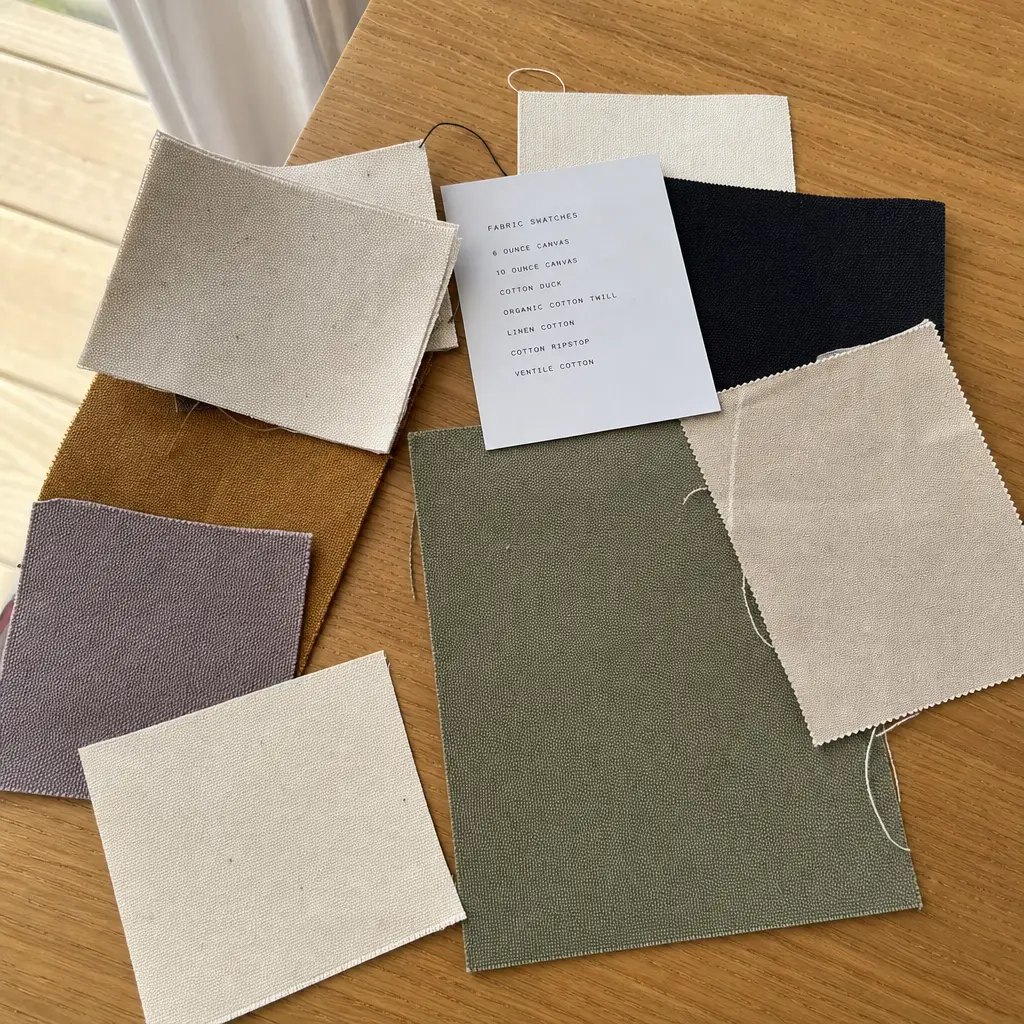
Natural organic cotton is not pure white. It often has a warm ecru tone with visible seed flecks, slubs, and neps. That can fit a wellness or natural beauty position, but it should be approved in writing. If the brand needs ivory, black, sage, blush, clay, or another specific color, dyed fabric adds shade tolerance, crocking checks, dye-lot minimums, and longer lead time. Good suppliers explain these tradeoffs early. Be cautious with suppliers that say every color, weight, and finish is equally easy.
- 6 oz to 8 oz cotton: light event tote, lower unit cost, less structure, and limited suitability for heavy bottles.
- 10 oz to 12 oz canvas: balanced salon retail option, stronger hand feel, better print surface, and practical for gift sets.
- 14 oz and above: premium canvas look and higher durability potential, with higher cost and carton weight.
- Flat tote: lower cost and easier packing, suitable for light retail, events, or brochure distribution.
- Bottom or side gusset: better volume for bottles, jars, boxed sets, and reception display.
- Long handles: specify handle drop for shoulder carry; do not assume the supplier's standard handle is comfortable.
- Natural cotton: lower dye complexity, but visible flecks and shade variation must be approved.
- Dyed cotton: stronger brand-color control, but shade tolerance, crocking, and batch control need more attention.
Translate brand language into measurable tote specifications
Procurement teams often receive briefs that say 'premium', 'strong', 'minimal', or 'large'. Those words are useful direction, but they are not enough for sourcing. A technical RFQ should state finished size after sewing, target fabric GSM, tolerance, handle drop, handle width, gusset depth, stitch details, print dimensions, and packing format. Without those numbers, suppliers may quote different bags while appearing to compete on the same price.
A typical salon retail tote might be specified as 380 x 420 x 100 mm finished size, with 30 mm wide handles and a 250 to 300 mm handle drop for shoulder carry. This is not a universal standard; it simply shows the level of detail needed. Finished dimensions are the key. Cut-panel dimensions can change after shrinkage, sewing allowance, pressing, and finishing. Common commercial tolerances are often agreed around ±10 mm for major finished dimensions and ±5 mm for logo placement, but the right limit depends on the design and supplier capability.
Construction details decide whether the bag survives real salon use. Handles need enough insertion depth into the top hem and reinforcement at stress points. Reinforcement may be a box stitch, cross stitch, bar tack, or a combination. Stitch density should be specified or at least checked, because loose stitching can reduce durability and make the tote look cheap. If the inside seams are visible, define whether raw edges, overlocked seams, French seams, or bound seams are acceptable.
- State finished size in millimeters and define whether tolerance is ±5 mm, ±10 mm, or another agreed range.
- Specify target GSM and acceptable tolerance, commonly handled as a percentage such as ±5% if both parties agree.
- Define handle width, handle drop, insertion depth, and reinforcement type at the top edge.
- Specify gusset style: bottom gusset, side gusset, boxed bottom, or no gusset.
- Clarify top hem height, seam type, seam allowance, thread color, and visible stitch requirements.
- State intended carrying load or representative product load, then test the sample against that use.
- Define label position and attachment method if woven labels, care labels, or brand tags are used.
Build a weighted supplier scorecard your team can defend
A useful organic cotton tote supplier scorecard for salon chains should give weight to the issues that create real commercial risk. If the tote will be sold, visual quality, label accuracy, barcode application, and repeat consistency deserve more weight. If the tote is for a one-time internal training kit, durability, schedule reliability, and price may matter more. If the salon chain will publicly market the bag as organic cotton, documentation and claim support should carry heavy weight.
A simple 100-point model is easy to use in internal reviews. One practical structure is: material and documentation 20 points, construction and durability 20 points, logo and decoration control 15 points, packing and distribution 15 points, lead time and capacity 10 points, commercial clarity 10 points, QC transparency 5 points, and communication quality 5 points. Adjust the weighting if needed, but keep the principle. A low unit price should not outweigh missing documentation, unmeasured samples, weak handles, or inaccurate store packing.
Ask each supplier to submit evidence in the same format. Useful evidence includes fabric swatch photos, GSM data, certificate scope, sample measurements, print tolerance, carton dimensions, factory inspection plan, and lead-time milestones. Suppliers that answer with clear figures are usually easier to manage than suppliers that rely on broad assurances such as 'no problem' or 'standard quality'.
- Material and documentation: organic evidence, fabric lot control, GSM, shade, shrinkage, and dye risk.
- Construction: seam type, handle reinforcement, gusset, top hem, SPI, load expectation, and inside finish.
- Decoration: artwork proof, ink type, Pantone target, minimum line thickness, curing, and rub resistance.
- Packing: folding, bundle count, carton quantity, carton marks, barcode labels, and store allocation.
- Operations: sample lead time, bulk schedule, capacity, first-piece approval, inspection, and rework process.
- Commercial clarity: MOQ, quantity breaks, setup charges, sample costs, Incoterms, payment terms, and quote validity.
- Service response: speed, specificity, and willingness to put tolerances in writing.
Compare sourcing routes by control, transparency, and repeatability
Salon buyers may receive quotes from direct factories, trading companies, specialized bag workshops, stock blank suppliers, local decorators, and promotional distributors. None of these routes is automatically right or wrong. What matters is which party controls fabric sourcing, sewing, printing, inspection, packing, and corrective action. A chain-wide program needs clear ownership because one defect pattern or packing error can affect many salon locations at once.
A direct sewing factory can be strong for custom sizes, gussets, handles, and repeat construction. A specialized bag workshop may be especially capable with tote details such as reinforcement, labels, and retail finishing. A trading company can be useful if it coordinates multiple services and communicates well, but buyers should know who authorizes rework when sewing or printing fails inspection. A local decorator or stock blank route can be practical for urgent small quantities, though the buyer may have limited control over fabric origin, organic documentation, and future batch consistency.
Transparency should score highly. Ask where fabric is sourced, where printing takes place, who owns the inspection report, and whether the approved sample is kept at the production line. If a supplier avoids explaining the production route, treat that as a sourcing risk even when the quoted price looks attractive.
- Factory direct: stronger for custom construction, repeat programs, and production-line feedback.
- Specialized bag workshop: good for tote engineering, labels, handle details, and small construction changes.
- Trading company: useful for coordination, but confirm factory identity and QC authority.
- Local decorator: fast for urgent small runs, limited by blank stock and available print methods.
- Promotional distributor: convenient account management, but request full technical specifications behind the quote.
- Stock blank importer: speed advantage, weaker control over organic evidence and future batch consistency.
Organic cotton documentation: match evidence to the exact claim
Organic cotton terminology needs careful handling in B2B sourcing. It may refer to organic fiber, organic yarn, organic fabric, a certified finished product, or simply a supplier's preferred material description. Start by deciding how the salon chain will use the claim. An internal material preference requires less support than a retail hangtag, product page, ESG report, or paid campaign that describes the tote as organic.
The common sourcing risk is generic documentation. A supplier may send a company certificate, an old mill document, or a certificate that covers a different scope than the actual order. Those documents may show capability, but they may not prove that the fabric used for the salon chain's purchase order is organic. Depending on the claim and market, buyers may need certificate scope, fabric supplier details, transaction references where applicable, lot numbers, invoices, and chain-of-custody evidence. Confirm these requirements before paying a deposit and before fabric is purchased.
If documentation is limited, keep the claim conservative. Do not approve a hangtag or product-page statement unless the evidence supports it. The scorecard should reward suppliers that explain what documents are available, whether they are order-specific, when they are issued, and what claim language they can reasonably support.
- Ask whether the organic fabric is in stock or purchased after order confirmation.
- Check certificate scope: fiber, yarn, fabric, processing, trading, or finished product.
- Request evidence that links to the production fabric lot, not only a general supplier profile.
- Confirm whether dyeing, printing, or finishing affects documentation or testing needs.
- Review hangtag, invoice, product page, retail signage, and carton wording before production.
- Keep documentation, approved claim wording, and fabric lot references in the PO file.
- If in doubt, avoid overclaiming; unsupported sustainability language creates brand risk.
Control decoration quality: screen print, labels, embroidery, and artwork tolerances
Most salon totes use screen printing because it is practical for logos, slogans, line art, and one-to-three color branding. Water-based inks are often selected for a softer feel on cotton, while plastisol or other ink systems may be considered depending on supplier capability and local requirements. The ink should be tested on the actual fabric, not only on a smooth test panel, because weave texture, cotton shade, and curing conditions affect the final result.
Artwork instructions should be measurable. Provide vector files, Pantone or brand color references, print size in millimeters, location measured from the top edge and side seam, minimum line thickness, and smallest text height. On coarse canvas, very thin lines and small text can fill in, break, or look uneven. A digital mockup is helpful for alignment, but it is not enough when logo accuracy matters. Request a strike-off or pre-production sample on production fabric.
Other decoration methods can work well when used for the right reason. Embroidery may look premium for a small mark, but it can pucker lighter fabrics and become expensive for dense logos. Woven side labels are useful for subtle retail branding and repeat programs. Heat transfers can reproduce complex graphics, but buyers should test edge adhesion, hand feel, cracking, and rub resistance on cotton canvas. The best recommendation is the one based on artwork, fabric, and use—not the one that simply sounds more premium.
- Screen print: best for clean logos, campaign text, and medium-to-large print areas.
- Water-based ink: softer hand feel, but curing and rub resistance must be checked.
- Embroidery: suitable for small premium marks; avoid dense oversized embroidery on light canvas.
- Woven label: clean retail detail for repeat salon programs and subtle brand identity.
- Heat transfer: useful for complex graphics; test adhesion, cracking, edge lift, and hand feel.
- Multi-color print: confirm registration tolerance and inspect alignment on bulk production.
- Approve print position with millimeter tolerances from fixed reference points, not visual centering.
MOQ, price breaks, and landed cost: find the real cost driver
MOQ is driven by more than supplier preference. Fabric availability, dye-lot minimums, cutting efficiency, screen setup, sewing-line changeover, label production, carton allocation, and inspection effort all affect the minimum. A natural organic cotton tote in a standard size may be feasible at a lower MOQ than a custom dyed gusseted tote with woven labels, multiple artwork versions, and store-specific packing.
Salon chains should separate launch quantity from replenishment quantity. The first order may need enough volume to justify fabric sourcing, print screens, custom labels, and packing setup. Reorders are usually easier when the same approved fabric, dimensions, print screen, label, and carton format are retained. Procurement can often get more accurate pricing by sharing an annual forecast: number of salons, initial rollout, expected quarterly replenishment, seasonal campaigns, and whether artwork will change.
Compare landed cost per usable approved bag, not only the quoted unit price. A cheaper EXW quote may exclude export handling, carton labeling, screen charges, barcode labels, sample courier, inspection support, or inland transport. A slightly higher supplier price may be cheaper overall if it reduces defects, repacking, DC labor, or delivery errors.
- Lower MOQ is more likely with natural fabric, standard size, flat construction, and one-color print.
- Higher MOQ is likely with custom dyeing, special handles, gussets, labels, multiple artworks, or store packing.
- Separate MOQ by fabric color, print design, label type, and packing style.
- Ask whether screen charges are one-time, repeated per artwork, or repeated after a storage period.
- Request quantity breaks that match demand, such as 500, 1,000, 3,000, 5,000, and 10,000 pieces if relevant.
- Confirm whether unused fabric, labels, or screens can be reserved for repeat orders and for how long.
- Compare EXW, FOB, and delivered quotes on the same landed-cost basis.
Sampling and approval: catch production risk before bulk cutting
A pre-production sample should be more than a polished prototype. It should use the intended production fabric, final bag dimensions, final handle construction, final thread color, final logo method, final label, and proposed packing. A sample made from substitute fabric may not predict shrinkage, print absorption, stiffness, seam behavior, or shade. For a customer-facing salon retail program, do not approve bulk cutting from a photo or generic blank sample alone.
Test the sample with representative salon products. Load it with actual or similar shampoo bottles, conditioner, jars, brushes, towels, boxed gift sets, or staff-kit contents. Check whether the gusset is deep enough, whether the handles feel comfortable, whether the bag distorts, and whether the logo remains visible when the bag is filled. If the bag will be sold, review the folded appearance, hangtag location, barcode readability, and shelf or reception display presentation.
Approval comments must be specific. Instead of 'move the logo down slightly', write 'move logo center point 20 mm lower than sample 1'. Instead of 'make stronger', specify a higher GSM, wider handles, different reinforcement, or deeper gusset. The approved sample should be signed, dated, measured, photographed, and retained by both buyer and supplier.
- Measure sample width, height, gusset, handle drop, handle width, top hem, and seam allowance.
- Confirm logo size and location from top edge, side seam, or gusset fold in millimeters.
- Check print edge quality, ink coverage, readability of fine text, and curing.
- Load-test with representative salon products and inspect seam and handle stress.
- Fold and unfold the sample to check print cracking, transfer, and pressure marks.
- Photograph front, back, inside seams, handle reinforcement, label, and packing method.
- Create a signed sample approval sheet with tolerances, revision notes, and authorized approver.
Inspection criteria and tolerances for bulk organic cotton totes
Quality control should be agreed before production starts. The buyer and supplier should define critical, major, and minor defects, sampling method, and acceptance criteria. Many B2B buyers use an AQL-based final random inspection, but the exact AQL level and defect definitions must be agreed by the parties. A broken handle seam, mildew odor, wrong artwork, or severe stain may be critical or major. A small loose thread may be minor if it does not affect appearance or function.
Tolerances should be written, not assumed. Common commercial tolerances may include finished dimensions within an agreed millimeter range, fabric GSM within an agreed percentage, logo position within an agreed millimeter range, and carton piece count exact or within a clearly defined allowance. The supplier should confirm what can actually be held in bulk. If the tolerance is too tight for the fabric and process, resolve it during sampling instead of waiting for final inspection.
Inspection should cover function, appearance, and packing. Function includes handle strength, seam security, and load performance. Appearance includes shade, stains, print clarity, logo position, wrinkles, and odor. Packing includes piece count, carton marks, barcode labels, store allocation, and moisture protection. For salon chains, packing errors can be as disruptive as sewing defects because they create store shortages and DC rework.
- Define critical defects: wrong material, wrong logo, unsafe handle failure, mildew, severe contamination, or incorrect claim label.
- Define major defects: open seams, skipped stitches in stress areas, serious stains, distorted bag, poor print registration, or wrong carton allocation.
- Define minor defects: small removable thread ends, slight shade variation within approved range, or minor creasing if presentation is acceptable.
- Measure dimensions on a representative sample of finished pieces from different cartons.
- Check GSM and shade by production lot, especially if multiple fabric rolls are used.
- Inspect print curing, rub resistance, registration, and readability of small text.
- Verify carton labels, PO references, SKU, store code, campaign name, barcode, and piece count.
- Require photo reporting for first piece, in-line production, final packed cartons, and any rework.
Specification comparison for buyers
| Supplier option | What to verify | Commercial advantage | Buyer risk to control |
|---|---|---|---|
| Direct sewing factory | fabric batch documents, dye-lot photos, approved sample archive, and final QC record | Better sample-to-bulk control and faster production feedback | May be weaker on export paperwork or branded packing unless checked early |
| Trading company | Factory name, production photos, trim-source proof, and who owns QC decisions | Can coordinate small mixed orders and extra services | Markup can hide real factory capability and slow defect decisions |
| Specialized bag workshop | seam allowance, handle reinforcement, label attachment, fabric pre-shrink note, and batch shade control | More practical for detailed construction, trims, and repeat programs | Capacity may be limited during peak seasons |
| Low-price general supplier | organic cotton canvas, batch documentation where available, undyed or low-impact dyed fabric, and shrinkage control | Useful for simple promotional runs with loose specs | Material downgrades, weak packing, and vague inspection scope can erase savings |
| Retail-ready supplier | plastic-reduction request, recycled carton note, bundle count, carton mark, and moisture protection without overpacking | Can handle labels, SKU separation, carton marks, and receiving rules | Higher unit cost must be compared against reduced warehouse work |
| Compliance-focused supplier | Fabric records, labeling review, test plan, and production traceability | Safer for retail programs and repeat brand orders | Documentation claims need evidence, not only sales language |
| Local sample room plus bulk factory | Signed sample, bulk factory handoff, first-piece photos, and deviation owner | Good for complex branding before large production | Sample room quality may not match bulk line unless handoff is controlled |
Buyer checklist before sampling
- Define the exact salon use case: retail resale tote, gift-with-purchase bag, launch event bag, staff kit, franchise support item, loyalty welcome bag, retail carryout bag, or quarterly replenishment item.
- Specify fabric accurately: organic cotton canvas or plain weave, target GSM and ounce equivalent, natural or dyed color, acceptable slub/nep/seed fleck level, shrinkage tolerance, and whether pre-washing or sanforizing is required.
- State finished bag dimensions after sewing, not cut-panel dimensions: width, height, gusset depth, handle width, handle drop, top hem height, seam type, seam allowance, and expected safe working load.
- Give construction detail: inside seam finish, bottom/gusset construction, handle insertion depth, handle reinforcement method, stitches per inch, thread color, bar tack or cross-stitch position, and label placement if any.
- Provide vector artwork and decoration instructions: print method preference, print size, Pantone references, ink type, minimum line thickness, smallest text height, logo position from fixed reference points, and acceptable position tolerance.
- Decide how the organic claim will be used: internal material preference, ESG documentation, hangtag claim, product page wording, retail signage, invoice description, or franchise marketing asset. Match evidence requirements to the claim.
- Use one RFQ template for all suppliers: Incoterm, named port if FOB, MOQ, quantity breaks, sample cost, setup cost, test cost, bulk lead time, packing method, carton dimensions, carton gross weight, and quote validity.
- Require a pre-production sample made with production fabric, final handle construction, intended logo process, correct thread color, final label, and proposed folding or packing before approving bulk cutting.
- Set measurable acceptance criteria for fabric shade, GSM, dimensions, handle strength, logo color, logo position, print rub resistance, loose threads, stains, odor, sewing defects, carton marks, barcode labels, and store allocation accuracy.
- Choose an inspection approach before production starts: factory self-inspection, buyer inspection, third-party inspection, sample size, AQL level if used, defect classification, and remedy process for rejected lots.
Factory quote questions to send
- Are cutting, sewing, printing, labeling, inspection, and packing handled in your own facility, or will any process be subcontracted? If subcontracted, which processes and who controls QC decisions?
- What exact fabric do you propose: weave, target GSM, ounce equivalent, yarn type if known, natural or dyed finish, and whether the weight is measured before or after washing/finishing?
- What fabric weight do you recommend for salon retail totes carrying shampoo bottles, conditioner bottles, jars, brushes, towels, boxed gift sets, or hot-tool accessories, and what safe working load do you design for?
- Is the quoted fabric certified organic cotton, in-stock organic cotton, made-to-order organic cotton, or conventional cotton unless organic is separately requested?
- What order-specific evidence can you provide to support the organic cotton claim, and can the document or transaction reference be linked to the production fabric lot used for our PO?
- What is your MOQ by fabric color, dyed color, finished bag size, gusset style, print design, label type, hangtag, and packing style?
- Which print method will you use for our artwork, what ink type is planned, and what are the minimum line thickness, smallest readable text height, print placement tolerance, and color-matching method?
- Can you make a pre-production sample with production fabric, final print size, final thread color, final handle reinforcement, final label, and proposed folding or packing method?
- What tolerances do you normally hold for finished width, height, gusset, handle drop, fabric GSM, logo position, print color, and carton piece count? Please state figures, not only 'normal tolerance'.
- What is your standard inspection method: in-line checks, final random inspection, AQL level if applicable, sample size, critical/major/minor defect definitions, and rework procedure?
Quality-control points to confirm
- Verify fabric GSM from production material using an agreed test method or calibrated fabric cutter/scale, not only from the supplier's catalogue or quotation sheet. Record the acceptable tolerance, commonly specified as a percentage such as ±5% unless another limit is agreed.
- Check finished dimensions after sewing and pressing: width, height, gusset depth, handle drop, handle width, top hem height, and seam allowance against the approved sample and tolerance sheet.
- Inspect stitches per inch, seam straightness, skipped stitches, broken threads, back-tacking, bar tacks, cross-stitch boxes, and handle insertion depth at stress points.
- Perform a practical load check using representative salon products or an agreed test weight. Inspect handle stress, seam distortion, tearing, and top hem deformation after lifting and a short carry simulation.
- Confirm logo position from fixed reference points such as top edge, side seam, gusset fold, or bottom seam. Avoid visual centering only. Record tolerances in millimeters.
- Rub-test the printed logo after curing and after folding. For dark ink on natural cotton or water-based ink on textured canvas, check smearing, crocking, cracking, under-curing, and ink transfer to tissue.
- Inspect natural cotton color consistency across cartons and fabric rolls. Agree in advance how much seed speck, slub, nep, crease mark, and shade variation is commercially acceptable.
- Open random cartons to verify piece count, folding method, bundle quantity, carton marks, barcode labels, PO references, shipping marks, and store allocation accuracy.
- Reject or segregate bags with oil stains, dirty marks, needle holes, broken stitches, skipped stitches, open seams, serious creasing, wet odor, mildew odor, ink smears, or visible print contamination.
- For dyed organic cotton totes, check shade variation, wet/dry crocking risk, color fastness expectations, and whether dark fabric transfers color to tissue, hangtags, barcode labels, or other packed items.