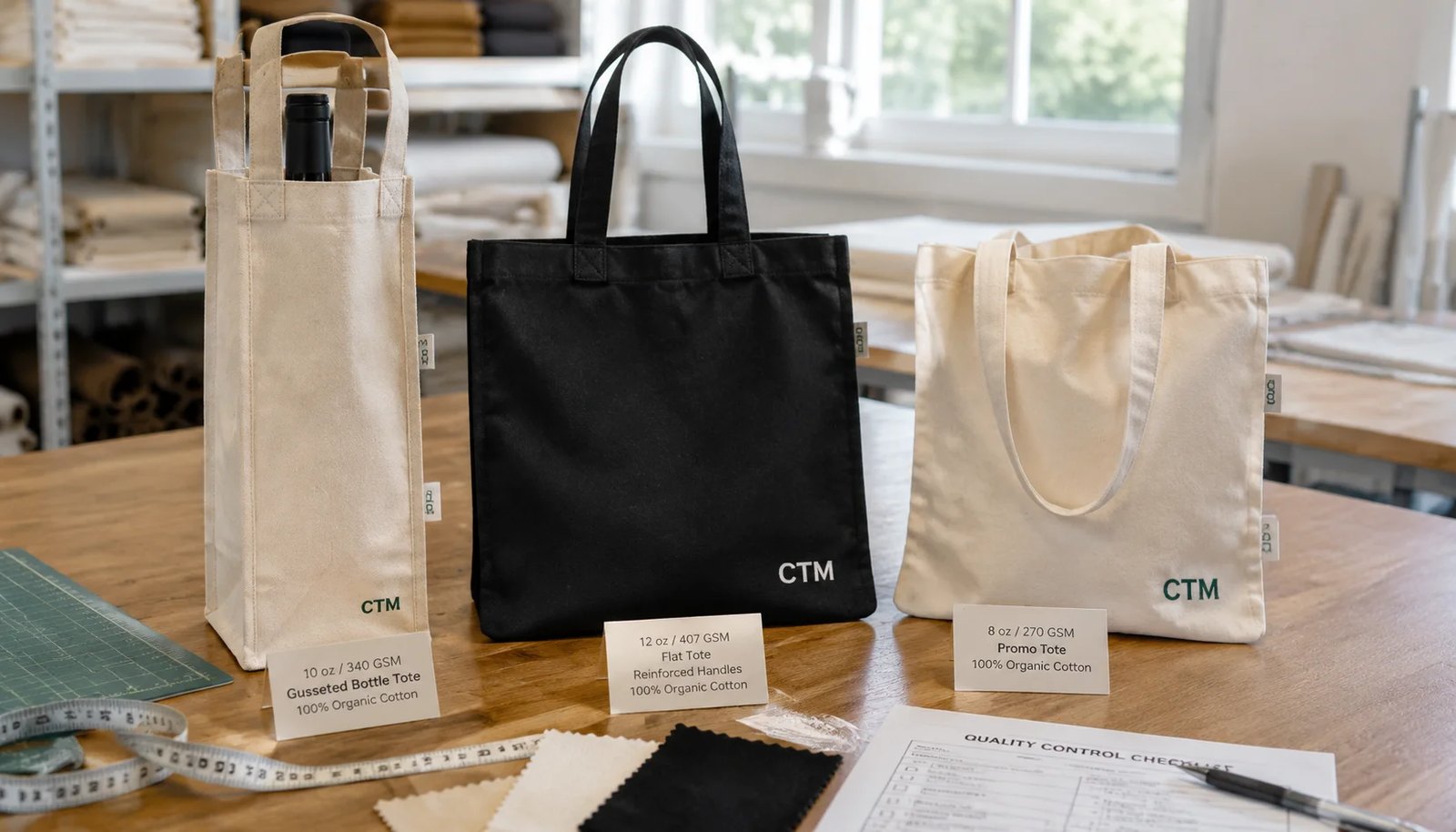
Why liquor retail programs need a tighter compliance brief than generic organic totes
An organic cotton tote for a liquor retailer is not just a soft-goods promo item. It carries glass, often at high point loads, and it may be sold or given away in stores that apply stricter brand, labeling, and audit requirements than a standard event giveaway. The buying problem is usually not whether a supplier can sew a tote. The real issue is whether the supplier can prove the right material origin, build a bag that holds bottle weight safely, and pack it in a way that arrives clean and retail-ready.
Buyers often lose time by mixing sustainability, merchandising, and logistics requirements into one vague brief. A better approach is to separate three decision layers: compliance evidence, physical construction, and shipment execution. If one of those layers is weak, the supplier quote may still look competitive but become expensive later through failed samples, delayed approvals, or repacking at destination.
- Liquor retail use raises load-bearing expectations compared with lightweight grocery or event totes.
- Organic claims need to be tied to the purchased material, not just to a supplier's marketing sheet.
- Dark bottle-store branding on natural fabric creates print and offset risks that need process control.
- Store rollout dates are often fixed around holidays and gift seasons, so lead-time slips are costly.
Start with the right tote specification for bottle weight and retail use
For liquor retailers, the safest starting point is not the cheapest cotton fabric. A practical base spec for a one- to two-bottle organic cotton tote is 10 oz to 12 oz fabric, roughly 340 to 407 GSM, with a bottom gusset or side-and-bottom gusset. This gives better shape retention, less seam strain, and more stable carrying than a flat 6 oz to 8 oz promo tote. If the intended use is only lightweight checkout carry for one standard bottle plus small add-ons, 8 oz or about 270 GSM may be workable, but it should not be approved on price alone.
Construction details matter as much as GSM. Handle width around 2.5 cm is common, but attachment depth and reinforcement pattern decide actual performance. A quote that only says 'organic cotton tote with long handles' is too loose for commercial comparison. Buyers should define bag size, gusset, top hem fold, handle insertion depth, and reinforcement method. Without that, one supplier may quote a strong tote and another may quote a promotional tote, making price comparison meaningless.
- Common retail bottle tote starting point: 35 to 38 cm width x 38 to 42 cm height x 8 to 12 cm gusset.
- Premium carry use: 340 to 407 GSM canvas with X-stitch or bartack handle reinforcement.
- Light promo use only: about 270 GSM can work if the retailer accepts lower load margin.
- Natural, black, and dyed dark shades should be reviewed separately because print behavior and rub risks differ.
What supplier compliance evidence is actually useful to a buyer
Many suppliers can send a certificate image quickly. That does not automatically solve a retailer compliance review. Procurement teams should separate company-level evidence from order-level evidence. Company-level evidence may show that a supplier or upstream mill operates within a recognized scheme. Order-level evidence should show whether the organic cotton used for your tote order can be tied to relevant supply-chain documents, lot references, or transaction records that support the claim made on the product or packaging.
It also helps to define what you are claiming in the market. If the tote is marketed as made from organic cotton, your team should align with legal, compliance, and packaging teams on the exact wording and backup required. Overstated claims create more risk than conservative claims. A practical supplier is one that can explain the evidence chain clearly, identify which steps are in-house or outsourced, and tell you early where documentation gaps exist.
- Request material traceability evidence linked to the PO or production lot where required by your program.
- List all subcontracted processes: fabric weaving, dyeing, printing, sewing, washing, finishing, and packing.
- Match marketing wording to available documentation before artwork approval.
- Keep a record set: supplier declarations, test reports if required, sample approvals, and shipment packing records.
Compare supplier quotes by process route, not just by unit price
Two organic tote quotes can differ by 20% or more even when the bag looks similar in photos. The biggest reason is process route. One supplier may use heavier fabric, larger seam allowance, and in-line QC. Another may use lighter cloth, shorter handles, or looser carton specs. Buyers should break quotes into components: fabric, cutting and sewing, printing, trims and labels, packing, sampling, testing if applicable, and export carton configuration. This exposes where a low quote is truly efficient and where it is simply underbuilt.
MOQ logic is another place where quote comparison often goes wrong. A low MOQ claim may apply only to a single color, single print, and standard fabric already in stock. If your liquor retail program needs three colorways, custom side labels, and mixed store-ready packing, the usable MOQ becomes higher. A better quote review compares total cost by actual SKU mix rather than by a headline price for one plain sample.
- Ask for fabric cost basis by GSM and color category: natural, dyed light, dyed dark.
- Separate print setup cost from running cost; this matters if the retailer tests a pilot order first.
- Identify whether carton liners, polybags, barcode labels, and hangtags are included or extra.
- Ask whether the quoted unit price assumes full-carton shipping by SKU or mixed assortments.
Print method choices for liquor retail branding and their hidden tradeoffs
Most liquor retail tote branding works best with water-based or plastisol screen printing, depending on the artwork, hand feel target, and retailer preference. For one-color or two-color logos on natural organic cotton, screen print usually gives the best balance of appearance, repeatability, and unit cost at volume. It also gives clearer pricing logic because setup and per-color charges are easy to compare across factories.
Digital print, DTF, or transfer methods can help for small pilot runs or multicolor art, but they need closer review on hand feel, curing, cracking risk, and shade consistency across repeats. Embroidery may suit a premium gift bag with small branding, but it adds labor cost and can distort lighter canvas. Buyers should align the print choice with order quantity and replenishment intent, not just with the look of the first sample.
- Screen print is usually the commercial default for solid retail logos on organic cotton totes.
- Digital or transfer methods can reduce setup pain for small trials but may raise unit cost at scale.
- Dark print on natural fabric needs proper curing to avoid offset during packed transit.
- Approve print placement by measured distance from top hem and side seam, not by photo only.
Sample approval that prevents bulk mistakes instead of just approving appearance
A useful sample workflow for organic cotton totes usually has three stages: a stock reference sample to confirm general shape, a pre-production sample in the actual fabric and print method, and a sealed approval sample retained against shipment. The common mistake is approving a nice-looking prototype made from stock canvas that does not match the booked bulk fabric. That creates predictable disputes later on thickness, shrinkage, print sharpness, and handle feel.
The pre-production sample should be treated as a mini technical test, not a photo approval exercise. If the tote will carry bottles, load-test the sample in-house with the actual intended weight. Review whether the gusset opens correctly, whether the base twists under load, and whether dark bottles rub the print area. A supplier that supports this level of sample review usually performs better in bulk because the construction points are forced into writing before cutting begins.
- Approve actual fabric GSM, color, print method, and handle construction at PP sample stage.
- Measure handle drop and total handle length on the physical sample; comfort and carry angle matter in-store.
- Do a simple load test with one to three filled bottles depending on use case.
- Keep one signed or sealed reference sample for post-production comparison.
Quality thresholds that matter most on liquor retail tote orders
The highest-risk failures on these totes are usually not dramatic. They are gradual-use failures such as weak handle joins, side seam opening, base distortion, print offset, and visible shade variation between replenishment lots. Buyers should set acceptance criteria around those points early. If your internal QC guide does not already cover textile bags, build a short product-specific addendum instead of relying only on a generic AQL grid.
For practical control, define which defects are critical to retail use and which are cosmetic. A handle stitching break, wrong barcode, or organic claim mismatch is a commercial problem. A slight slub in natural cotton may be acceptable if the retailer understands the fabric character. This distinction helps your factory and inspection team focus on defects that create returns, customer complaints, or compliance trouble.
- Major-use defects: loose or skipped handle stitches, seam opening, wrong size beyond tolerance, unreadable barcode, wrong artwork.
- Moderate appearance defects: print misalignment beyond approved tolerance, visible stains, strong shade mismatch within the same shipment.
- Natural cotton characteristics such as minor slubs should be pre-aligned with retailer expectations.
- If retail packing is barcode-driven, carton labeling errors can be as costly as product defects.
Packing decisions that affect retail receiving, cleanliness, and freight cost
Packing is often left until late in the process, but it changes both cost and claim risk. Organic cotton totes for liquor retail are commonly packed flat in export cartons, with or without individual polybags depending on retailer policy. If the program avoids polybags, the factory should still address print offset, dust, and humidity exposure through curing control, carton liners, desiccant policy where appropriate, and disciplined carton loading. A cheap packing plan can create expensive destination cleaning or resorting.
Carton count should be set by both handling practicality and gross weight. Overpacked cartons reduce freight efficiency only if they trigger warehouse rejection or breakage during handling. Underpacked cartons waste space and raise the landed cost per tote. Buyers should specify carton dimensions, maximum gross weight, and SKU assortment logic before the factory confirms final case pack.
- Typical export packing variables: pieces per carton, inner bundle size, carton liner, polybag yes or no, barcode label format.
- Natural fabric with dark print should be monitored for offset under pressure in humid transit conditions.
- Set maximum carton gross weight to match your warehouse and retail DC handling limits.
- Mixed-SKU cartons may help small store allocations but can add pack labor and receiving complexity.
Lead time planning: where organic tote programs usually slip
Lead time risk on organic cotton totes usually appears before sewing starts. Fabric booking can be longer when the required organic material, dye shade, or GSM is not held in stock. Printing queues also affect schedules, especially near seasonal peaks. Buyers should not treat the quoted ex-factory lead time as one fixed block. Break it into stages: sample revision, fabric confirmation, fabric production or booking, printing prep, cutting and sewing, final inspection, and booking for shipment.
For liquor retail programs tied to holidays, a one-week delay can miss the selling window even if the product itself is fine. That is why the factory's planning discipline matters almost as much as its sewing ability. A useful supplier will state what dependencies could move the ship date: artwork freeze, organic material document timing, print strike-off approval, or mixed-packing approval. This gives the buyer something operational to manage instead of hearing only 'production is in progress'.
- Natural stock fabric may move faster than custom dyed organic canvas, but not always in peak season.
- Artwork delays and barcode approval delays are common buyer-side causes of shipment slip.
- Split shipments can protect launch dates but may raise freight and handling cost.
- Request milestone dates, not just one ex-factory promise.
Build a landed-cost view before choosing the cheapest quote
A supplier with the lowest FOB unit price is not always the lowest landed-cost option for liquor retail. Heavier or better-constructed totes may reduce returns and avoid emergency air shipments caused by rework. Cleaner packing can reduce destination labor. Better carton density can lower freight cost per unit. If one supplier needs two sample revisions and another gets approved in one cycle, the cost difference is not just in tooling or courier fees. It also affects launch timing and internal labor.
For comparison, buyers should build a simple landed-cost model using the same assumptions across suppliers: unit price, sample charges, testing if required, print setup, packaging extras, inspection cost, freight estimate by carton cube and weight, import duty if applicable, and likely cost of non-compliance or repack risk. This shifts the decision from headline unit price to total program efficiency.
- Include sample courier and revision cost when comparing first-time suppliers.
- Estimate cost of retailer chargebacks from labeling or packing errors where relevant.
- Review cube efficiency: gusseted bags may pack differently than flat totes.
- A stronger tote can justify a slightly higher unit price if it supports premium retail positioning or resale.
Specification comparison for buyers
| Supplier option | What to verify | Commercial advantage | Buyer risk to control |
|---|---|---|---|
| Direct sewing factory | fabric batch documents, dye-lot photos, approved sample archive, and final QC record | Better sample-to-bulk control and faster production feedback | May be weaker on export paperwork or branded packing unless checked early |
| Trading company | Factory name, production photos, trim-source proof, and who owns QC decisions | Can coordinate small mixed orders and extra services | Markup can hide real factory capability and slow defect decisions |
| Specialized bag workshop | seam allowance, handle reinforcement, label attachment, fabric pre-shrink note, and batch shade control | More practical for detailed construction, trims, and repeat programs | Capacity may be limited during peak seasons |
| Low-price general supplier | organic cotton canvas, batch documentation where available, undyed or low-impact dyed fabric, and shrinkage control | Useful for simple promotional runs with loose specs | Material downgrades, weak packing, and vague inspection scope can erase savings |
| Retail-ready supplier | plastic-reduction request, recycled carton note, bundle count, carton mark, and moisture protection without overpacking | Can handle labels, SKU separation, carton marks, and receiving rules | Higher unit cost must be compared against reduced warehouse work |
| Compliance-focused supplier | Fabric records, labeling review, test plan, and production traceability | Safer for retail programs and repeat brand orders | Documentation claims need evidence, not only sales language |
| Local sample room plus bulk factory | Signed sample, bulk factory handoff, first-piece photos, and deviation owner | Good for complex branding before large production | Sample room quality may not match bulk line unless handoff is controlled |
Buyer checklist before sampling
- Match the tote use case to load: one bottle, two bottles, mixed retail purchases, or gift set; do not approve fabric weight before defining expected carry weight.
- State whether the program requires transaction-linked organic cotton documentation or only a general organic material declaration.
- Specify finished bag size, gusset depth, handle length, handle width, and reinforcement method in the RFQ instead of leaving construction 'standard'.
- Request fabric GSM tolerance and finished size tolerance in writing; a common commercial starting point is GSM tolerance within about plus or minus 5% and size tolerance within about plus or minus 1 cm, subject to your program standard.
- Define print method by artwork type: screen print for solid logo, digital for short-run multicolor art, embroidery only for premium non-large-area branding.
- Approve a pre-production sample made in the actual organic cotton fabric, not just a stock sample in similar canvas.
- Review seam density, bartack or X-stitch reinforcement, top hem fold width, and handle insertion depth during sample approval.
- Set carton count, maximum carton weight, carton dimensions, and assortment rules before bulk production starts.
- Clarify whether individual barcodes, hangtags, retail inserts, suffocation warning labels, or carton shipping marks are needed.
- Request a production timeline with sample revision days, fabric booking, printing queue, sewing days, final inspection, and booking cutoff for vessel departure.
Factory quote questions to send
- Can you provide the exact fabric composition, yarn type, weave, and tested or declared GSM for the organic cotton tote quoted?
- What evidence can you provide to link the organic cotton material used for this PO to the relevant certified supply chain records or transaction documents?
- Is cutting and sewing done in your own factory, and which steps are subcontracted, if any, such as dyeing, printing, washing, or packing?
- What is your standard handle reinforcement for a 2-bottle liquor tote: X-stitch, bartack, handle wrap depth, and stitch count per inch?
- What print method is included in the price, and what are the added costs if the artwork changes from one-color screen print to two-color screen print or digital print?
- What MOQ applies per size, per color, and per print design, and are there surcharges for split deliveries or mixed carton assortments?
- What sample stages are chargeable: stock sample, custom pre-production sample, print strike-off, and shipment sample?
- What are your standard production tolerances for size, GSM, print position, color shade, and loose thread acceptance?
- How do you prevent print offset, mildew risk, and carton damage during humid-season export shipments?
- What carton packing plan did you use for the quote: pieces per carton, net weight, gross weight, carton size, and whether polybags or carton liners are included?
Quality-control points to confirm
- Verify fabric hand feel and GSM against approved sample; lightweight substitution is one of the most common hidden cost-down methods on basic totes.
- Measure finished bag width, height, and gusset at relaxed lay-flat condition using the same method across sample and bulk inspection.
- Inspect handle placement symmetry, handle drop consistency, and reinforcement stitching on every sampled unit classed as major-use points.
- Test seam security at side seam, bottom seam, and handle attach points; skipped stitches and low stitch density show up quickly under bottle weight.
- Confirm print position from top edge and side seam, print shade against approved standard, and curing quality by rub test where relevant.
- Check for fabric contamination, oil marks, mildew odor, needle damage, and color migration on natural organic cotton shades.
- Review carton count accuracy, barcode placement, assortment ratio, and carton gross weight to prevent receiving problems at retail DCs.
- Retain one sealed shipment sample with approved packing for post-shipment claims reference.