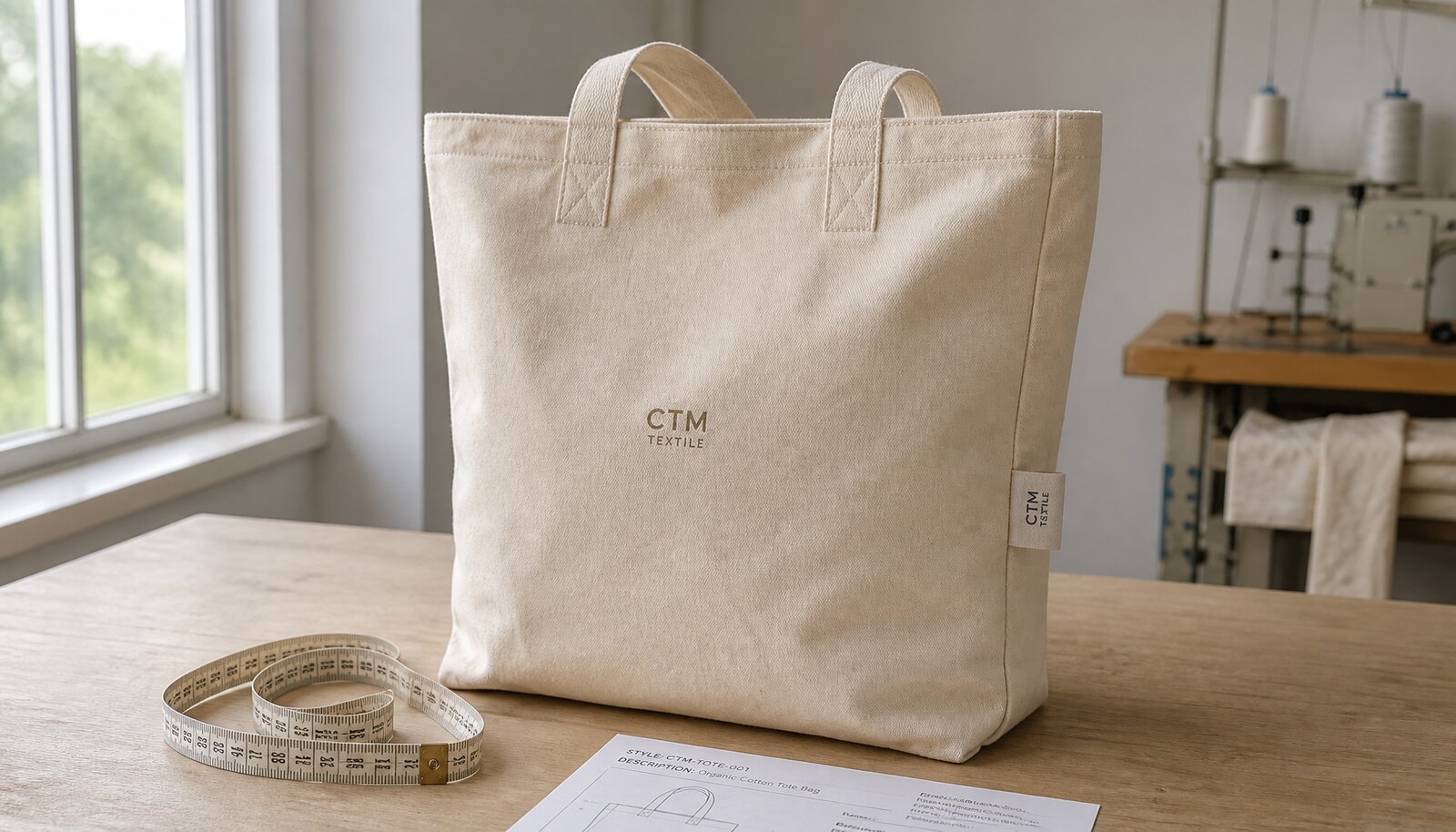
Why boutique wineries need a stricter tote inspection standard
An organic cotton tote for a boutique winery is not a generic shopping bag. It is part carry bag, part brand carrier, and part gift presentation. It may move from the tasting counter to a retail shelf, then into a customer’s car or a shipment box. If the bag looks premium but the handle seam fails after a few uses, the product becomes a complaint instead of an asset. That is why procurement teams should inspect structure, not only decoration.
The most expensive tote mistakes usually begin with incomplete specs. Two suppliers may both say they are quoting an organic cotton tote, but one is using light canvas with weak reinforcement while the other is quoting a denser build with a stronger base and better finish. A winery buyer cannot judge those offers by unit price alone. The tote has to carry a bottle safely, present well under shop lighting, and hold up through repeated handling in tasting rooms and warehouse replenishment.
For procurement buyers, the correct question is not just “What does it cost?” but “What exactly are we buying, how will it be verified, and what happens if it drifts during production?” Once those points are written down, the tote becomes much easier to source, compare, and inspect.
- Treat the tote as a retail product and protective packaging item, not a simple giveaway.
- Tie bottle load performance and handle reinforcement to the written spec.
- Compare suppliers on construction control, not just on quoted unit price.
Choose the tote structure before you ask for pricing
Before requesting quotes, buyers should decide how the tote will actually be used. A one-bottle tasting-room bag has different requirements from a two-bottle gift set or a retail merch tote. The use case determines whether the tote should be flat or gusseted, whether it needs a reinforced base, and whether a divider or insert is worth the added cost. If the supplier quotes before that choice is made, the buyer often receives a price built around the supplier’s assumptions instead of the winery’s real need.
Fabric weight should be specified in a way the factory can actually manufacture and inspect against. For premium winery use, organic cotton canvas in a practical midweight range is usually the starting point, but buyers should avoid treating any one GSM as universal. The right weight depends on bottle count, bag dimensions, decoration method, and whether the tote needs to stand on a shelf. A bag that is too light will sag and wrinkle; a bag that is too heavy can slow sewing and increase cost without adding much value.
Construction matters just as much as fabric. Flat totes are efficient and easy to pack, but gusseted totes give better volume and bottle stability. If the bag must stand upright, the base construction becomes a quality issue, not a design preference. If the bag includes a divider, the buyer should ask how it is attached, whether it shifts in transit, and whether it changes the final folded size for packing.
- Define the tote’s use case before comparing prices.
- Choose flat, gusseted, or divider construction based on bottle stability and presentation.
- Ask the supplier to confirm finished size, fabric build, and folding method in writing.
Comparison table: which sourcing option fits which winery program
For boutique wineries, the best sourcing option depends on volume, control needs, and how much risk the buyer can absorb. A small cellar-door program may tolerate a simpler construction and lower MOQ, while a premium retail or gift program usually needs tighter QC and stronger traceability. The comparison below is more useful than a basic spec sheet because it shows how the buying route changes the risk profile, not just the product description.
The most important point is that a lower quote can hide a weaker sourcing route. A trading-layer offer may look convenient, but if the buyer cannot see who controls cutting, sewing, printing, and inspection, quality problems are harder to correct. Direct factory sourcing often gives better visibility, but only if the buyer is prepared to manage sample approval and inspection details with discipline.
How to write a procurement-ready tote specification
A usable spec needs enough detail for the factory to quote, cut, and inspect without guessing. Start with the finished dimensions, the intended bottle count, the fabric construction, and the decoration method. Then add the details that usually get missed: handle width, handle drop, seam allowance, reinforcement pattern, and whether the tote must remain upright when loaded. If those points are not in the brief, the factory will make assumptions, and those assumptions often become the root cause of rejection.
The best spec also says what not to change. If the logo placement must sit a certain distance from the top edge, write that distance down. If the tote must remain natural-colored and unbleached to support the winery’s brand position, say so. If the bag is meant to fit into a retail shelf or display cube, give the exact maximum size, not a rough estimate. This is especially important for boutique wineries where packaging often sits next to wine gift sets and branded accessories.
A written spec should also include what the buyer will use as the reference sample. That sample can be the pre-production sample or a sealed gold sample approved by both sides. When bulk production starts, the factory should know which sample controls color, print placement, seam finish, and packing fold.
- List the finished dimensions, bottle count, and target carry use.
- Record handle width, handle length, and handle drop instead of saying “standard handles.”
- Define print placement tolerances and the approved reference sample.
- Add any retail display limit or shelf-fit limit that the bag must meet.
What to compare in supplier quotes before sample approval
A buyer-friendly quote breaks the program into visible cost drivers. If the supplier gives one lump sum, it is hard to tell whether the price comes from fabric choice, decoration method, packing complexity, or margin built into the order. Ask for separate lines for fabric, sewing, printing, labels, packing, inspection, and export carton cost. If the supplier cannot separate those items, the buyer cannot compare like for like.
MOQ should be treated as a pricing lever, not a quality guarantee. A lower MOQ can help launch a new winery line, but it often raises unit cost because setup fees are spread across fewer bags. Buyers should ask for price breaks at realistic quantities, such as 1,000, 3,000, and 5,000 pieces, especially if the program may repeat. That lets procurement see whether the quote is built for a one-time order or for a stable replenishment plan.
The quote should also state whether the factory is charging for screens, plates, artwork changes, label changes, or packing changes. A quote that seems low can become expensive after setup fees are added, and a quote that seems high may include better inspection, better packing, or a better traceability package. Procurement should compare the total landed logic, not only the ex-factory number.
- Request a line-by-line quote instead of a lump sum.
- Ask for price breaks at multiple volumes if the program may repeat.
- Confirm setup fees, artwork changes, and packing changes before approving the sample.
- Compare ex-factory price with expected freight, receiving, and reject risk.
Organic claim verification: what documents to request and how to check them
“Organic cotton” should not be accepted as a marketing phrase without proof. Buyers need to know whether the claim applies to the fiber, the fabric, the factory, or the finished tote. The document set should tell the story clearly from raw material source to finished bag. At minimum, ask for the current organic certificate for the fiber or fabric supplier, the transaction or traceability document that links the lot used for your order, and the factory’s own quality and production records for the batch.
Do not rely on a certificate screenshot alone. Verify the certificate number, the certifying body, the scope of certification, and the date range. The name on the certificate must match the entity that is claiming the certification. If the supplier says the fabric is certified but the sewing factory is not certified for processing that material, ask how chain-of-custody is maintained and what documents will travel with the shipment. If the order is for a market with stricter labeling or customs scrutiny, the document set should be stronger, not weaker.
A practical buyer file should include: certificate copies, transaction certificate or lot traceability reference if available, fabric mill invoice or lot reference, batch dye or cutting record, and a signed declaration of what components are organic and which are not. If the tote includes labels, thread, or inserts that are not organic, the supplier should identify them clearly so the buyer does not assume the whole product is certified in a way that it is not.
- Request the current organic certificate and verify the certificate number directly.
- Ask for lot-level traceability from fabric source to finished tote batch.
- Confirm the certificate scope: fiber, fabric, processing, or final product.
- Get a written statement identifying which components are organic and which are not.
Print, label, and decoration control for premium winery branding
Most boutique winery orders use simple branding, which is helpful because simple graphics are easier to control. Screen print is usually the most practical method for stable volume and clean logos. The main quality risks are poor registration, weak ink coverage on textured canvas, and curing that is not strong enough to survive folding and packing. Fine text, thin lines, and small type are especially vulnerable on natural cotton because the fabric texture can soften the image.
Heat transfer can work for short runs or complex art, but buyers should treat it as a different quality path, not a drop-in substitute. Transfers can look sharp at first and still fail later if the edge bonds are weak or the film feels too thick. If the winery wants a premium natural look, the buyer may also consider a woven label or sewn side label instead of a large printed graphic. That can reduce the risk of print defects, but only if the label stitching is clean and the placement does not interfere with fold or handle use.
The artwork approval should state the print size, distance from edge, acceptable shade range, and whether the print must remain centered within a specific tolerance. That gives the inspector a concrete pass/fail point. A premium tote that is 8 mm off-center may be acceptable to one buyer and a reject to another, so the tolerance should be written before production starts.
- Use screen print for simple, repeatable winery logos when volume is stable.
- Use heat transfer only if the artwork or volume makes it necessary, and inspect edge durability.
- Consider woven label or sewn branding if the winery wants a quieter, premium look.
- State print size, print distance from edge, centering tolerance, and acceptable shade range.
Strict quality inspection checklist: AQL, defect tiers, measurements, and load tests
This is where many tote articles stay too general. A procurement-grade checklist needs a real inspection framework. For boutique winery orders, a common approach is to use a normal inspection plan with AQL 2.5 for major defects and AQL 4.0 for minor defects. If the order is especially visible, or if the buyer has already had quality issues, the buyer can tighten that threshold. The key is to put the AQL level in writing before the factory starts bulk production.
Defects should be divided into three tiers. Critical defects are items that make the bag unusable or non-compliant, such as wrong organic claim documents, wrong size that cannot fit the intended bottle, torn handles, or severe contamination. Major defects are functional or visible issues that would likely lead to customer complaint, such as seam failure, off-center print beyond tolerance, or a bag that cannot stand correctly if that is a required feature. Minor defects are small issues that do not affect function but can reduce perceived quality, such as slight thread trim remnants or small unevenness within a reasonable cosmetic tolerance.
Measurement tolerances should also be written down. A practical buyer spec can set tolerances such as finished body width and height within ±0.5 cm for smaller totes or a similar buyer-approved range, handle length within a narrow tolerance, and print placement within a fixed distance from the center line or edge. The exact tolerance depends on the design, but the important thing is that there is a number. If the bag is built to carry wine, the factory should also perform a load test using the actual bottle type or a clearly defined equivalent weight. The pass/fail rule should state that handles must not open, seams must not separate, the base must not collapse beyond the acceptable limit, and the bag must retain usable shape after loading and short hold time.
Stitch density should not be left vague either. For handle and high-stress seams, buyers should ask the factory to state stitch-per-inch or stitches per centimeter and the reinforcement pattern used. If the supplier does not measure stitch density or cannot explain reinforcement length, that is a warning sign. The stitched area is usually where the failure starts, not the logo panel.
- Use a written AQL plan, such as AQL 2.5 for major defects and AQL 4.0 for minor defects, unless the buyer sets a stricter standard.
- Classify defects as critical, major, or minor before inspection starts.
- Record measurement tolerances for body size, handle length, and print placement.
- Set a load-test pass/fail rule for seam opening, handle failure, and unacceptable shape collapse.
- Require the factory to state stitch density for handles and stress seams.
Pre-shipment inspection checklist for organic cotton totes
A pre-shipment inspection should follow the approved sample and the written spec line by line. Inspecting only carton count is not enough. The inspector should confirm dimensions on a flat tote, then check stitch quality at the handle joins, top hem, side seams, and base corners. If the tote includes a divider, label, or insert, the inspector should verify that the part is attached correctly and does not shift or distort the bag. The sample should be nearby during inspection so the inspector can compare hand feel, color, and print sharpness directly.
The inspection should also include cleanliness and presentation. Natural cotton can pick up lint, dust, and oil marks if packing is sloppy. Printed bags should be checked for rub marks where folded areas touch the decoration. If the bags are going to retail shelves, the fold direction and label visibility matter as much as the construction. A factory that ships the right quantity in the wrong presentation format can still create retail handling work on arrival.
For lot control, the buyer should ask the inspector to record defect counts by type and by carton range. That makes it easier to identify whether a defect came from a specific sewing line, print batch, or packing team. If a problem appears in the top cartons only, the root cause may be packing. If the issue shows across all cartons, the issue may be in fabric, cutting, or an incorrect production reference.
- Compare the shipment against the approved sample, not against memory.
- Inspect dimensions, seam finish, print placement, and label placement on random samples from across the lot.
- Check for dust, lint, stains, oil marks, and print rub caused by folding.
- Record defect counts by type and carton range for root-cause tracking.
Packing, cartonization, and receiving controls that prevent avoidable damage
Packing is often where an otherwise acceptable tote becomes a warehouse problem. If the bags are printed, they need protection from abrasion during folding and carton movement. If the bags are unprinted natural cotton, they still need clean bundling so they arrive free of dust and handling marks. The packing method should match the receiving workflow. For wholesale distribution, simple and repeatable is better than elaborate. For retail presentation, the fold must be consistent and the bag should open with a neat appearance.
Carton design should be realistic for manual handling and transit. Overpacked cartons save little if they cause corner crush or body deformation. Buyers should ask for carton dimensions, net and gross weight, and how many units fit per inner bundle and master carton. If the winery operates multiple store locations or a central warehouse, the carton label should include style, color, quantity, PO number, and any internal receiving code. That avoids opening cartons just to verify contents.
At receiving, the buyer should inspect carton condition first, then random-open totes for print rub, odor, seam condition, and count accuracy. If the bags are packed with tissue or poly sleeves, confirm that the protection does not leave wrinkles or sticking marks. For export programs, consider whether cartons need palletization guidance or humidity protection based on the route and season.
- Use packing that protects print surfaces and keeps the tote clean.
- Keep carton weights manageable for receiving staff.
- Label cartons clearly with style, color, quantity, and PO number.
- Match packing style to the buyer’s warehouse or retail workflow.
Specification comparison for buyers
| Buying route | Best for | Pros | Buyer watch-outs |
|---|---|---|---|
| Lightweight plain cotton tote | Event giveaways, very short carry distances, low-cost promo use | Lowest material cost, fast sewing, easier carton density | Usually too flimsy for bottle carry; can sag, twist, and show the logo poorly |
| Organic cotton canvas tote, flat construction | Retail merch, tasting room carry-outs, one-bottle gift packs | Cleaner look, stable print surface, easier to control unit cost | Less bottle stability unless the spec controls body width, handle reinforcement, and fabric weight |
| Organic cotton canvas tote, gusseted with reinforced base | Premium winery retail, bottle sets, cellar-door gifting | Better bottle stance, better load distribution, more premium shelf presence | Requires tighter size tolerances and more careful seam inspection |
| Bottle tote with divider or insert | Two-bottle gifting, shipping-ready presentation, higher-value sets | Reduces bottle knock, improves perceived value, protects labels | More parts to inspect, more assembly risk, and more packaging variables |
| Screen-printed tote with simple artwork | Repeat orders, one-color or two-color winery logos, stable volume | Durable, cost-effective, easy to repeat on future orders | Needs good registration and cure control; fine text can fill in on textured canvas |
| Woven label or sewn-branding tote | Minimalist branding, premium natural look, lower ink coverage | Less risk of print cracking, looks refined, can support small logos | Brand impact depends on label placement and stitching quality; not ideal for large artwork |
| Direct factory purchase | Buyers who need production transparency and stronger QC control | Clearer accountability for cutting, sewing, printing, and inspection | Requires stronger procurement discipline and more detailed spec communication |
| Trading company or sourcing agent | Smaller buyers needing multi-item sourcing support or local coordination | Can simplify communication and consolidate programs | Buyer must verify who actually makes, inspects, and packs the goods; quality ownership can be indirect |
Buyer checklist before sampling
- State the exact use case: one-bottle carry, two-bottle gift, tasting room retail, or wholesale resale, because the structure and QC thresholds change by use case.
- Lock the finished dimensions, fabric construction, target GSM, handle width and length, and whether the tote must stand upright with bottles inside.
- Request organic certification documents before sample approval, not after bulk order, and verify every certificate number directly with the issuing body or public database where possible.
- Ask for the production flow in writing: who supplies fabric, who cuts, who sews, who prints, who inspects, and who packs.
- Define the print method, color count, artwork file format, placement tolerance, and acceptable shade variation before any plates or screens are made.
- Set a pre-production sample approval process that includes material swatch, decorated sample, and a sealed gold sample for bulk comparison.
- Specify the inspection standard you want used at final random inspection, including AQL level, defect categories, measurement tolerances, and load-test criteria.
- Agree on packing format, carton count, carton markings, and whether retail presentation requires bagging, tissue, or dust protection.
- Ask for lead time by stage, not just one total date: fabric sourcing, decoration setup, sewing, inspection, packing, and shipment.
- Request a corrective action path for failed inspection: rework timeline, replacement policy, and who pays if the goods miss the approved spec.
Factory quote questions to send
- What exact fabric construction are you quoting, and is the GSM measured before or after finishing?
- Can you separate the quote into fabric, cutting, sewing, printing, labels, packing, inspection, and export carton cost?
- Do you have current proof for organic cotton certification, and can you provide the certificate numbers for the fabric supplier and the factory if applicable?
- Who actually performs cutting, sewing, printing, final inspection, and packing, and are any of those steps outsourced?
- What stitch density do you use on the handles and side seams, and what reinforcement pattern is included?
- What is the finished size tolerance you can hold on width, height, gusset, and handle length?
- Which AQL level do you recommend for this program, and what defect categories do you use for critical, major, and minor defects?
- What load test do you perform, for how long, and what failure result causes rejection?
- What is your MOQ by color and by print design, and how does the unit price change at 1,000, 3,000, and 5,000 pieces?
- What are your sample lead time, bulk production lead time, and recovery time if the pre-production sample needs revision?
Quality-control points to confirm
- Fabric is the agreed construction and color, with no mix-up between plain cotton and certified organic cotton canvas.
- Finished dimensions stay within the written tolerance for body width, body height, gusset depth, and handle length.
- Stitching is straight and secure, with no skipped stitches, loose threads, seam puckering, or needle damage around stress points.
- Handles are reinforced to the approved pattern, with no lifting, twisting, uneven box stitching, or weak backtack.
- Print is centered, aligned, and correctly cured, with no smearing, pinholes, cracking, or color contamination.
- Inner labels, woven labels, and side seams are attached in the approved location and do not affect fold or retail appearance.
- Bags are clean, odor-free, and free from oil stains, dust, lint, thread scraps, and visible contamination.
- Carton count matches the carton mark, inner bundles are consistent, and outer cartons are labeled with PO, style, color, and quantity.
- Load test passes without seam opening, handle extension beyond the acceptable limit, or body failure.
- Packing protects the print surface and keeps tote shape acceptable for retail or warehouse receiving.