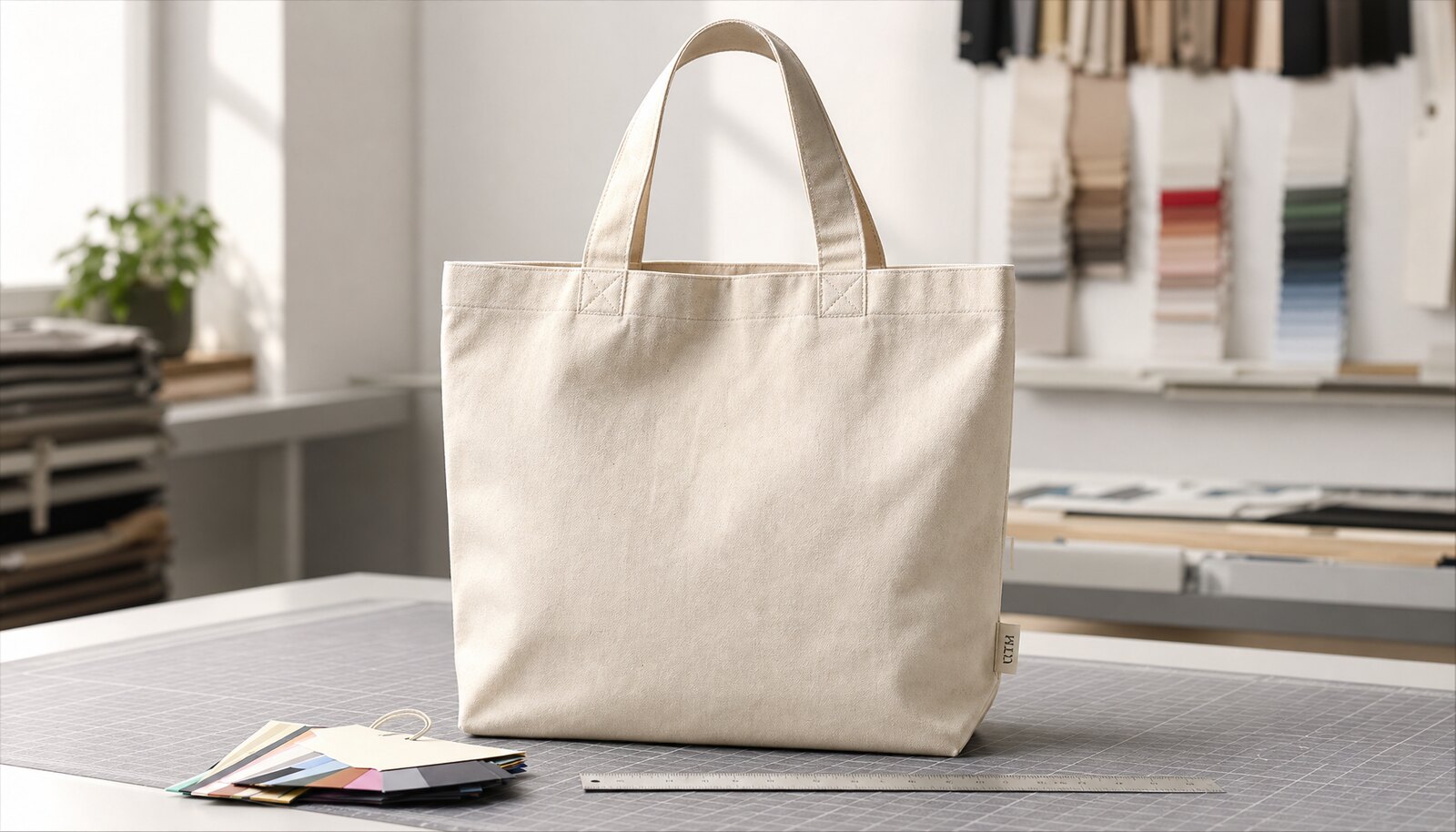
Why proofing matters on an organic cotton tote
An organic cotton tote looks simple, which is exactly why buyers get caught out at proof stage. The bag seems like a blank canvas, but the fabric can vary in weave density, surface fuzz, shrinkage, and drape. Those variables change how a logo prints, how the bag sits on the table, and how the finished piece reads as a corporate gift. If the proof only confirms artwork placement and ignores fabric behavior, the bulk order can still arrive with a logo that looks dull, off-center, or distorted by seams and handles.
Proofing should solve three commercial risks before you commit the PO: print appearance, production repeatability, and packing reality. For corporate gifting, the bag usually needs to feel more like a branded item than a throwaway promo. That means the proof has to confirm the front panel is flat enough for the logo, the print method matches the artwork, and the final pack format is acceptable for distribution. A good proof is not a courtesy sample. It is the control point that prevents reprints, delayed campaigns, and internal approval loops.
- A bag with a decent logo mockup can still fail if the fabric is too loose or the seam pulls the print out of alignment.
- Treat the proof as a production control step, not a design review.
- For gift orders, include the pack format in the proof so the factory does not improvise later.
Lock the tote specification before you proof artwork
Start with the bag, not the logo. For organic cotton totes, fabric weight is one of the first decisions that changes both appearance and cost. Rough ranges are useful in sourcing: around 120 to 150 gsm works for light promotional use, 180 to 220 gsm suits standard corporate gifting, and 240 gsm or above feels closer to retail or premium event merchandise. A heavier cloth usually prints more cleanly, hides show-through better, and gives the tote a better hand feel, but it also raises material cost and can affect lead time if the factory does not stock that weight.
Size, gusset, handle length, and stitching style matter just as much as GSM. A large front logo on a narrow bag can crowd the seam or fold line, while a gusseted bag may shift the logo into a distorted panel if the print area is not mapped correctly. Ask the supplier to quote the actual finished size, not just a nominal template. If the order is going to a brand team or a gift agency, lock the tote spec before artwork sign-off so everybody is working from the same base structure.
- Use a heavier GSM when the bag will carry inserts, notebooks, or other giveaway items.
- Leave more print clearance near side seams and top hems if the bag is narrow.
- If the cloth is lightly dyed or natural, confirm whether the logo color will need an underbase.
Choose the print method by artwork, quantity, and finish
The right print method depends on more than the logo file. For one to three flat colors and a medium-to-large run, screen printing is usually the cleanest commercial choice. It gives stable color, predictable setup, and a familiar proofing process. Water-based or low-puff inks are often preferred on cotton because they keep the hand feel softer, which matters when the bag is meant to look more like a branded gift than a promotional throwaway. If the artwork needs a very crisp edge, specify registration control and ask for the curing method in the quote.
For gradients, photographic art, or low-volume runs, digital print or transfer can work, but it changes the risk profile. Digital methods may look good on a sample and still need rub and wash testing because the ink sits differently on the fabric. Heat transfer can give a sharper image, but the buyer needs to test cracking, edge lift, and the feel of the printed area after folding. Embroidery is rarely the right answer for a full tote graphic, but a small woven or sewn label can be a good secondary brand element. Use the method that matches the artwork, not the one that the sales team happens to have in stock.
- Screen print: best for solid logos, repeat orders, and simple color counts.
- Digital print: best for low MOQ and complex art, but verify rub resistance.
- Transfer: useful for detail, but test folding, heat, and edge cracking before approval.
- Small woven or sewn labels: useful for brand mark consistency when the main print is minimal.
Build a proof package the factory can actually execute
The factory does not need a pretty presentation. It needs a proof package that removes ambiguity. At minimum, send vector artwork with outlined fonts, the exact tote size, the print area dimensions, and the desired position measured from fixed points such as the top hem and side seam. Add a Pantone reference or an approved physical color target if brand color matters. If the print is supposed to sit above the gusset line or below the handle stitch, say that explicitly and show it in a simple drawing. A supplier can print cleanly only if the location is measurable.
A good proof package also includes non-artwork instructions. State whether the bag should arrive bulk packed or individually packed, whether an insert card is included, and whether the print needs to face one way in the carton. For launch orders, ask for a strike-off or pre-production sample that uses the actual fabric and actual ink system. A digital mockup is useful for internal approval, but it is not a substitute for a physical proof because cotton texture, ink absorption, and curing all change the final look.
- Send one file for art and one simple spec sheet for measurements and packaging.
- Use fixed reference points for placement so the supplier can reproduce the layout at scale.
- Request the exact same print method on the proof that will be used in bulk.
Compare supplier routes before you compare the quote total
The cheapest unit price is not always the lowest-risk buying route. Factory-direct sourcing usually gives the strongest control over fabric, stitching, and print repeatability, especially when the order is large enough to justify the setup. Trading companies can be helpful when the procurement team wants one contact for mixed products, but the buyer must watch whether the quote hides multiple layers of margin and whether the proof feedback loop is slower than expected. Local decorators using imported blanks are often useful for deadline-driven campaigns, yet the blank tote may vary from lot to lot, which makes repeat ordering harder.
Before you decide, compare the route, not just the number. If the order needs brand-sensitive color, in-house print control, or organic traceability, a factory-direct or specialist supplier is usually the safer path. If the run is small and the deadline is tight, a local decorator may win on speed even if the unit price is higher. What matters is whether the supplier can keep the same fabric, same print method, same pack format, and same proof control from sample to shipment. The comparison table below is the right way to frame that decision.
- Factory-direct is strongest when quality control and repeatability matter more than convenience.
- Trading companies are practical when you need many SKUs under one purchase order.
- Local decorators can be useful for urgent launches, but they are not the best long-term spec owner.
- A hybrid route works when the brand team wants a quick proof and the bulk run can follow the same spec.
Read the quote line by line, not just the total
A usable tote quote should separate the bag, the print, the packing, and the logistics assumptions. If the supplier gives a single price without showing fabric GSM, number of print colors, screen or plate fees, packaging format, or carton size, the number is not comparable. Procurement teams often get trapped by a low headline price that grows after setup charges, color changes, extra packaging, or shipping documents are added. The quote should be structured enough that two vendors can be compared on the same basis.
Ask for the quote in a way that reveals cost drivers. For example, a supplier should state the blank bag price at the agreed GSM, the print setup cost by color count, the unit price at each quantity tier, and any extra charge for individual polybags, inserts, or special carton marks. If the order needs export documents, retailer labels, or kitting, those costs should be visible too. A clean quote gives you leverage. A vague quote gives the supplier room to adjust later when the production window is already tight.
- Break the quote into blank bag, decoration, packing, and freight or export handling.
- Ask for price breaks at realistic quantities, not only the lowest possible MOQ.
- Confirm whether sample fees are refundable or deductible from bulk.
- Make sure the quote states the same FOB or EXW basis for every vendor you compare.
Set QC thresholds for print, sewing, and packaging
Your quality plan should be specific enough that the factory knows what passes and what fails. For print work, the usual pain points are color shift, fuzzy edges, uneven coverage, and registration drift. On a centered front logo, a simple placement tolerance of about 5 mm is often workable, but if the design has a border or tight alignment, the buyer may need a tighter spec. Fabric weight should be checked against the approved target, and the finished bag size should be measured after production because cutting and sewing can move the dimensions slightly.
Do not ignore the soft defects that hurt corporate gifting. A tote can technically pass dimensions and still look poor if the handles twist, the print feels tacky, or the seams pucker around the top edge. If the ink is not fully cured, you will see rub-off during packing or transit. If the carton count is wrong, the event team will discover the problem too late. Put the critical defects in writing before production starts, and decide whether you want replacement, rework, or credit if the supplier misses the agreed standard.
- Check print placement, color match, and curing before you inspect carton count.
- Look for loose threads, skipped stitches, and handle reinforcement quality.
- Use a daylight or neutral light source when comparing the print to the approved sample.
- Verify that the bag still hangs straight after the logo is printed.
Approve the sample without taking shortcuts
A digital mockup can help with internal alignment, but it should not be mistaken for sample approval. The approval sequence should move from artwork layout to blank fabric sample to strike-off or pre-production sample, then to bulk. Each step removes a different risk. The blank sample confirms size, hand feel, handle length, and stitching. The strike-off confirms print behavior on the actual cloth. The pre-production sample confirms that the factory can repeat the same result with the real production setup. If one of those steps is missing, you are approving blind in at least one area.
When the first sample is not right, avoid casual approval language. Comments like looks okay or close enough create arguments later because they are not measurable. Instead, annotate the sample with exact corrections: move the logo 12 mm down, increase the ink opacity, reduce the border thickness, or change the pack format. If the supplier cannot rework the sample accurately, the bulk order is likely to repeat the same error. The sample stage exists to force precision while the quantity is still small.
- Approve based on measured corrections, not general impressions.
- Keep one signed golden sample for the factory and one for your file.
- If the bag will ship to multiple regions, get sign-off from the actual recipient team before bulk starts.
Plan packing, lead time, and landed cost early
Corporate gifting usually adds packaging complexity that the bag quote does not show on its own. Some orders need individual polybags, insert cards, barcode stickers, or gift-ready fold standards. Others ship in bulk cartons for later kitting. Each pack format changes labor, carton size, and freight efficiency. A tote that looks cheap at the unit level can become expensive once you add individual packing, mixed carton ratios, and export labeling. If the supplier has not quoted the packing method, the comparison is incomplete.
Lead time should be broken into sample, approval, production, and shipping, not just one promise date. A realistic plan often includes a few days for sample creation, a correction loop if artwork changes, the production window, and transit time based on the shipping mode. Landed cost also includes the less visible items: cartons, inner packs, print reruns, document fees, duty, and the cost of a missed campaign date. Buyers who only evaluate the FOB number often discover that the cheapest quote became the most expensive order once the full delivery path was added.
- Confirm the pack format before final price comparison.
- Ask whether carton dimensions were optimized for sea freight, air freight, or courier shipment.
- Build time into the plan for one sample revision cycle if the artwork is brand-sensitive.
- Include duty, inland delivery, and rework risk when you compare landed cost.
Specification comparison for buyers
| Spec decision | Recommended option | When it fits | Buyer risk to check |
|---|---|---|---|
| Factory-direct tote manufacturer | Best for 1,000+ units with one or two solid logo colors and repeat orders | When you need control over fabric GSM, seam quality, and print placement in one place | Check whether printing is truly in-house or quietly subcontracted |
| Trading company managing several plants | Useful when the order includes mixed items, complex packing, or a single PO for multiple SKUs | When procurement wants one contact point and fewer vendor files | Watch for hidden margin, weaker proof control, and slower answers on production faults |
| Local decorator using imported blanks | Good for short lead times, event deadlines, or very small runs | When the priority is speed over lowest unit cost | Confirm the blank tote quality, shrinkage, and whether the bag body varies by lot |
| Hybrid local proofing plus overseas bulk | Strong choice for brand-critical launches where the first proof must be fast and precise | When the artwork is sensitive to placement, color, or ink feel | Two-stage timing can create mismatch if the bulk factory does not copy the approved sample exactly |
| Small-batch digital printer | Best for photo-like art, gradients, or low-MOQ campaigns | When the order is under a few hundred units and visual detail matters more than run speed | Test wash fastness, rub resistance, and the hand feel of the printed area |
| Screen-print specialist using blank totes | Best for simple corporate logos, large flat areas, and repeatable color | When the design is one to three colors and the buyer wants stable unit economics | Check whether they control fabric shrinkage and print registration after curing |
| Organic-certified specialist factory | Best when the brand story needs traceability and the buyer will audit documentation | When organic claim language appears in packaging, retail copy, or compliance files | Expect higher MOQ, tighter document requests, and longer confirmation cycles |
| Regional converter with in-house packing | Useful for kitting, inserts, retail-ready carton marking, and mixed packing formats | When the totes must arrive ready for distribution or gifting | Verify which steps are done in-house and which steps are outsourced without notice |
Buyer checklist before sampling
- Send vector artwork with outlined fonts, not a flat screenshot or low-resolution JPEG.
- State the bag size, gusset, handle length, and target fabric GSM before discussing print.
- Confirm the print method by artwork type: solid logo, gradient, photo, or multi-color design.
- Provide a Pantone reference or an approved color target and define the acceptable color range.
- Mark the exact print position from the top edge, side seam, and bottom gusset on a drawing.
- Request a physical pre-production sample or strike-off before bulk approval.
- State whether the order needs any organic claim language, and ask what documents support it.
- Define the pack format: bulk packed, individual polybag, tissue, insert card, or gift-ready set.
- Ask for the MOQ at each price tier, not only the headline price.
- Set your inspection standard in writing for print position, color, stitching, and carton count.
Factory quote questions to send
- What is the exact fabric composition, weaving style, and GSM of the tote blank?
- Is the print done in-house, and if not, who controls the proof and final approval?
- Which print method do you recommend for this artwork, and why is that method better here?
- What setup charges apply for screens, plates, digitizing, color changes, and sample work?
- What is the MOQ for each price break, and does MOQ change with print colors or pack format?
- What sample can you provide first: digital mockup, strike-off, blank sample, or pre-production sample?
- What are the expected lead times for sampling, proof approval, and full production?
- What is included in the unit price: bag, print, packing, carton marks, and inner packaging?
- Can you separate EXW, FOB, and any inland or export handling costs in the quotation?
- What inspection photos, measurements, or test data can you provide before shipment?
Quality-control points to confirm
- Confirm the final fabric GSM against the approved target and record any allowed tolerance in the PO.
- Measure the finished bag dimensions, including gusset and handle length, against the signed sample.
- Check that the print position is within the agreed tolerance, especially on centered front logos.
- Inspect color against the approved reference in daylight and under warehouse lighting.
- Look for ink bleed, fuzzy edges, pinholes, smudges, or uncovered fibers inside solid areas.
- Run a rub check on the printed area to see whether curing is complete and whether color transfers.
- Inspect seams, bar-tacks, and stress points at the handle attachment and bag mouth.
- Verify that no loose thread, skipped stitch, or broken needle mark is visible on the face panel.
- Count units per inner pack and per carton, and compare the actual pack-out to the packing list.
- Check that the carton marks, SKU labels, and gift inserts match the approved packing instruction.