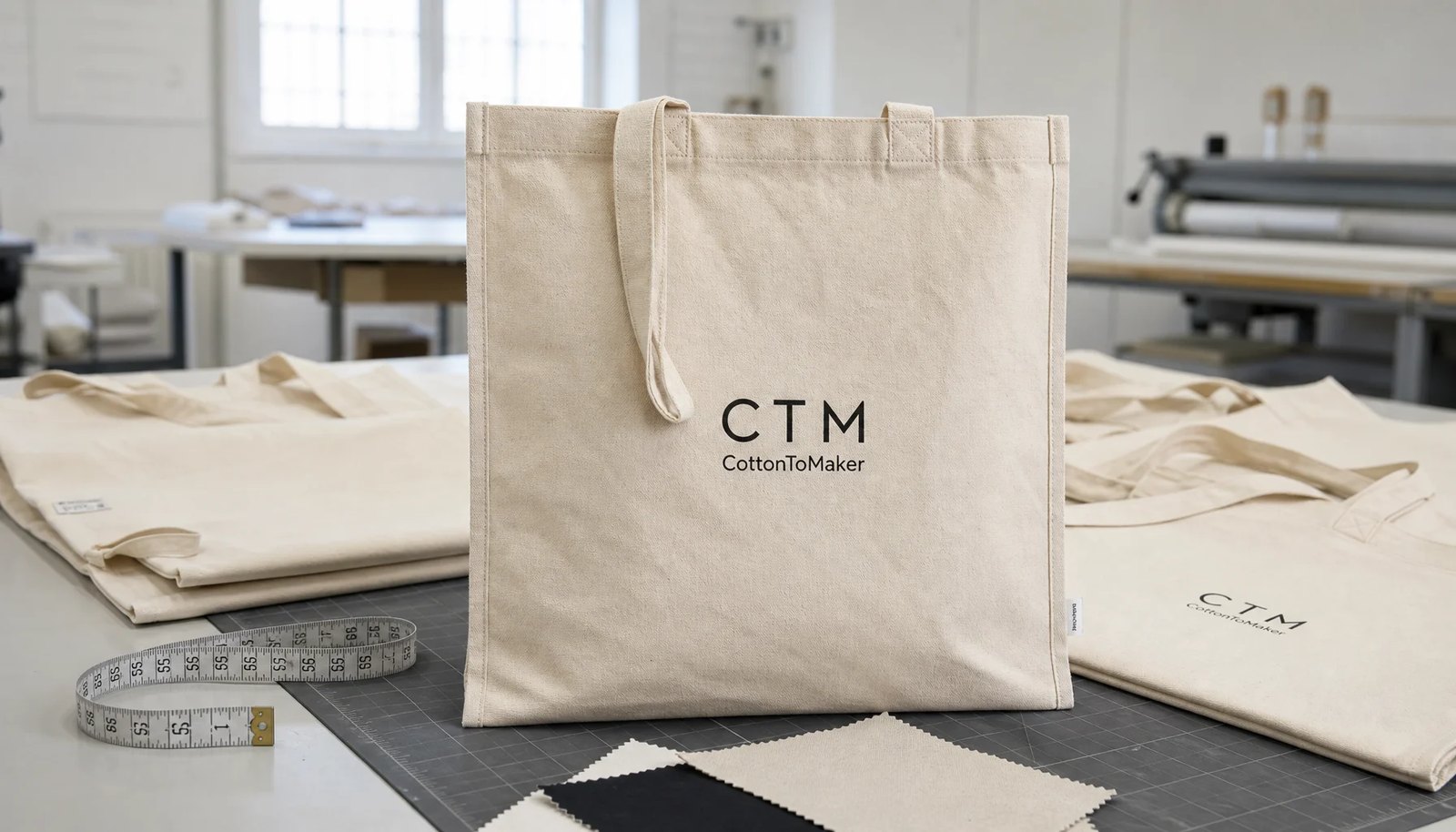
Why Proofing Matters Before a Trade Show
Organic cotton totes for trade show exhibitors look simple, but the risk is concentrated in the proofing stage. The buyer usually has a fixed event date, a brand team watching color, a logistics team counting cartons, and a booth team that will discover mistakes only when there is no time to remake the goods. A print proofing checklist keeps those decisions connected before bulk production starts.
The most common failure is not a completely wrong bag. It is a bag that is almost right: the logo sits 20 mm too low, the natural cotton shade makes the brand color look dull, the handle feels too short over a jacket, the ink marks other bags in the carton, or the carton count does not match the event kit plan. These are preventable when the RFQ, artwork proof, strike-off, pre-production sample, and packing approval use the same data.
- Use one approved specification sheet for bag size, GSM, handle length, print size, and packing.
- Treat the print proof as a production control document, not a design preview.
- Approve color on the real fabric because natural organic cotton is not a white paper background.
- Build the sample calendar backward from the event delivery date, not from the factory's standard lead time.
Define the Tote Function Before Choosing GSM
For trade show use, GSM is both a cost driver and a performance decision. A 140-160 GSM organic cotton tote can work for very light pamphlets, but it may feel thin if the exhibitor expects visitors to carry catalogs, a water bottle, and samples. A 180-220 GSM tote is a common middle ground for high-volume handouts. For premium sponsor bags or retail-style merchandise, 260-340 GSM organic cotton canvas gives better structure and a more substantial hand feel.
Do not let suppliers quote only by bag size and logo. Two bags with the same finished dimensions can differ strongly in cotton consumption, sewing time, carton weight, and perceived value. If a supplier offers a surprisingly low price, the fabric GSM, handle width, seam allowance, or packing may have been reduced. Put the target GSM and allowed tolerance in the RFQ so quotes can be compared cleanly.
- Light giveaway tote: 140-180 GSM, lower freight weight, less premium feel.
- Standard exhibitor tote: 180-220 GSM, practical balance for volume events.
- Premium canvas tote: 260-340 GSM, better for catalogs, VIP kits, or resale.
- Common tolerance: agree a fabric GSM tolerance before production, such as plus or minus 5%, if acceptable to your buyer.
Organic Cotton Documentation and Buyer Claims
Organic cotton claims need to be handled carefully because different buyers mean different things by organic. Some need certified organic fiber documentation for internal sourcing records. Some need transaction certificate support. Others only require that the factory can source organic cotton fabric from a certified mill. These are not the same requirement, and they do not carry the same cost or lead time.
For an exhibitor bag, the safest RFQ language states the exact claim you plan to make. If the tote or packaging will say organic cotton, clarify whether the claim must be supported by certificates for the finished product, fabric, or yarn. If your distributor or retail customer needs documentation at shipment, include that in the quote request instead of trying to add it after production.
- State the required organic cotton standard or documentation level in the RFQ.
- Confirm whether certificate fees, audit paperwork, and document handling are included in the quoted price.
- Do not approve a generic fabric swatch unless it represents the certified material for the order.
- Keep documentation requirements aligned with hangtag, carton label, website, and event marketing claims.
Choose the Print Method Around Artwork and Fabric
Screen printing is usually the practical choice for organic cotton totes with solid logos, campaign marks, and one to four spot colors. It gives good cost control at trade show quantities and can deliver clean edges when the artwork is vector-based. Water-based ink can feel softer, while other ink systems may give stronger opacity. On natural cotton, white or pale ink may need careful testing because fabric texture and base color affect coverage.
Digital print, DTF, or heat transfer can make sense for short runs, gradients, small text, or artwork with many colors. The tradeoff is hand feel, film edge, curing stability, and possible cracking after folding or abrasion. For a trade show bag that will be stacked, shipped, and handled heavily, proof the print for rub resistance and carton transfer, not only visual appearance.
- Screen print: best for clean logos, spot colors, and larger quantities.
- Digital print: useful for complex images but requires approval for sharpness and wash/rub behavior.
- DTF or transfer: flexible for smaller runs, but film feel and edge durability must be reviewed.
- Embroidery or woven label: premium look, slower production, and different MOQ logic.
Build an Artwork Proof That Production Can Follow
A good artwork proof uses millimeters, Pantone references, and clear placement rules. It should show the finished bag size, print size, distance from top edge, distance from side seams, and whether the print is centered on the panel or aligned to another feature. If the tote has a gusset, pocket, label, or seam interruption, the proof must show how the artwork sits in relation to those parts.
The factory should not be guessing from a JPEG presentation image. Vector AI, EPS, or editable PDF files reduce redraw errors and keep edges sharp. If the brand color is critical, provide Pantone coated or uncoated references and a previous approved physical sample when available. Natural cotton fabric can make colors look warmer or less bright, so the proof should always lead to a fabric strike-off before bulk printing.
- Include print width and height in millimeters.
- Define placement tolerance, for example plus or minus 5 mm for standard tote printing if acceptable.
- Mark whether the artwork is printed before or after sewing.
- Separate artwork versions clearly when several exhibitors, sponsors, or departments share the same tote style.
- Name every file with SKU, color, print method, and revision date.
Sample Approval Sequence That Reduces Rework
The strongest approval path is fabric swatch, print strike-off, pre-production sample, and sealed reference sample. The fabric swatch confirms GSM, shade, and hand feel. The strike-off confirms color, ink coverage, and edge quality on the same material. The pre-production sample confirms sewing, handle length, dimensions, print placement, and packing presentation. The sealed sample becomes the standard for bulk inspection.
Skipping steps saves a few days on paper but often costs more time later. If the buyer approves only a digital proof, the first physical confirmation may happen after bulk panels are printed. At that stage, a color or placement correction can mean remaking screens, wasting fabric, or accepting a bag that brand managers dislike. For fixed-date trade shows, sample discipline is usually cheaper than emergency freight.
- Fabric swatch approval: GSM, shade, weave, shrinkage expectation, and texture.
- Print strike-off approval: color, opacity, edge definition, curing, and rub behavior.
- Pre-production sample approval: total construction, print placement, handles, seams, and label.
- Sealed sample control: one sample at factory, one with buyer or inspector, both signed and dated.
MOQ Logic for Exhibitor Tote Orders
MOQ is not only a factory preference. It comes from fabric sourcing, dyeing, cutting efficiency, screen setup, labor scheduling, and packing setup. A natural color organic cotton tote with one screen print often has a lower MOQ than a dyed fabric tote with multiple artwork versions. If the buyer wants five sponsor logos in separate versions, the bag MOQ and print MOQ may move differently.
For trade show exhibitors, the best negotiation point is usually standardizing the base tote while allowing controlled artwork variation. For example, one fabric, one size, one handle, and one packing method can support several front prints with clearer cost impact. The factory can quote screen charges and per-version setup separately, which is more useful than blending everything into one unclear unit price.
- Separate MOQ for fabric, sewing style, print color count, and artwork version.
- Ask whether blank totes can be produced first and printed by version later.
- Clarify price breaks at realistic quantities such as 500, 1,000, 2,500, and 5,000 pieces.
- Avoid over-ordering only to meet MOQ if storage, event leftovers, or obsolete logos create waste.
- For repeat events, discuss holding screens, repeat sample rules, and fabric reorder consistency.
Cost Drivers Hidden in a Tote Quote
The unit price is only one part of the buying decision. Fabric GSM, organic documentation, print color count, ink type, handle reinforcement, inner packing, carton size, sample charges, and freight weight can change the landed cost. A quote that is two cents cheaper per bag may become more expensive if cartons are oversized, packing is unsuitable for event distribution, or sample revisions are not included.
Ask suppliers to break out the quote in a way your procurement team can compare. For organic cotton totes, useful data includes fabric specification, unit price by quantity, sample charge, screen charge, packing method, carton quantity, carton dimensions, gross weight, FOB port, lead time, and validity date. This also helps importers calculate duty, freight, warehouse handling, and final cost per event kit.
- Fabric cost rises with GSM, certified material requirements, dyeing, and shrinkage allowance.
- Print cost rises with color count, print size, ink opacity needs, and artwork versions.
- Labor cost rises with gussets, pockets, reinforced stitching, trimming, and inspection requirements.
- Packing cost rises with individual bags, custom labels, retail barcodes, and plastic-free options.
- Landed cost rises with carton volume, gross weight, shipment method, and emergency delivery.
Packing Decisions That Affect Booth Execution
Packing is often treated as a warehouse detail, but trade show bags are handled under time pressure. A booth team may need to count 300 bags quickly, load welcome kits, or distribute cartons across several halls. If totes are packed loosely with mixed artwork versions, the event team can lose hours sorting. If they are over-compressed, the print may crease and the bags may look tired on the first day.
For most exhibitor orders, flat packing in bundles of 25 or 50 pieces works well. Each carton should carry one SKU or one artwork version when possible. Carton labels should show PO number, item code, artwork version, quantity, gross weight, destination, and event name or reference. If the buyer wants reduced plastic, specify paper bands, bulk bundle packing, or recyclable inner bags and test whether the print remains protected.
- Use consistent inner bundle counts for fast booth counting.
- Avoid mixing artwork versions in the same carton unless the carton label clearly lists the split.
- Confirm carton dimensions before shipment because bulky cartons affect air freight and warehouse storage.
- Use moisture protection for sea freight, especially with natural cotton and humid-season production.
- Keep printed panels facing inward or protected if ink transfer is a known risk.
Lead Time and Schedule Risk
A realistic schedule starts after complete artwork and specification approval, not after the first inquiry. Organic cotton fabric sourcing, print strike-offs, pre-production samples, and buyer revisions all consume calendar time. During peak event seasons, the factory may have capacity, but screen printing, sewing lines, or inspection slots can become the bottleneck. The RFQ should ask for lead time by stage.
For an event order, build a backward calendar from the required delivery date. Reserve time for final inspection, document correction, customs, inland transport, and booth receiving. If the goods must arrive at an advance warehouse, the required arrival date may be much earlier than the trade show opening date. Any late artwork revision should trigger a schedule update because print screens, placement, and sample approval may need to restart.
- Artwork review: allow time for file correction, Pantone confirmation, and print area approval.
- Strike-off: plan for curing, shipping photos, and possible revision.
- Pre-production sample: approve dimensions, sewing, print, packing, and label before bulk.
- Bulk production: confirm daily output and whether fabric is already in house.
- Shipping: include inspection, booking, customs documents, and final-mile delivery to event location.
Specification comparison for buyers
| Spec decision | Recommended option | When it fits | Buyer risk to check |
|---|---|---|---|
| Fabric weight for handout tote | 180-220 GSM organic cotton plain weave | Good for high-volume trade show giveaways where freight weight and unit cost matter | Print can look less solid on loose weave; approve strike-off on the actual fabric, not paper |
| Fabric weight for premium exhibitor bag | 260-340 GSM organic cotton canvas | Best when the tote must carry catalogs, samples, or retail-style brand presentation | Higher GSM increases carton weight, duty basis, and drying time after print |
| Print method for solid logo | Screen print with Pantone-matched water-based or low-PVC ink | Works for one to four spot colors and clean corporate marks | Ink shade can shift on natural cotton; define tolerance against approved fabric strike-off |
| Print method for photo or gradients | DTF or digital print only after wash and rub testing | Useful for small runs, complex artwork, or variable campaign graphics | Film edge, hand feel, and cracking risk must be checked before bulk approval |
| Handle construction | Self-fabric handles with box-and-cross or reinforced X stitching | Suitable for bags expected to carry booth literature, bottles, or boxed samples | Weak handle bartacks cause returns; set pull-strength expectations before production |
| Artwork proof format | Vector AI/PDF with size, placement, Pantone, and print area marked in millimeters | Needed when several suppliers quote the same tote and buyer wants comparable pricing | JPEG-only artwork leads to redraw charges, blurred edges, and inconsistent logo scale |
| Packing method | Flat pack by 25 or 50 pieces per inner bundle, moisture barrier if sea freight | Best for event kits where distributor or booth team needs fast counting | Over-compressed cartons may crease print or distort bag shape before the show |
| Sample approval route | Fabric swatch, print strike-off, pre-production sample, then sealed reference sample | Appropriate when event date is fixed and artwork color accuracy matters | Skipping the sealed sample makes later disputes about shade, handle length, or placement hard to settle |
Buyer checklist before sampling
- Define the tote use case: giveaway, VIP kit, retail resale, conference welcome bag, or sample carrier.
- Specify organic cotton standard required by your market or customer, and state whether transaction certificate support is needed.
- Choose fabric weight in GSM and construction, not only the word canvas or cotton.
- Give finished bag size, handle length, gusset requirement, seam style, and expected carrying load.
- Send vector artwork with Pantone references, print size, print position from seams, and acceptable placement tolerance.
- Require a print strike-off on the final fabric color and GSM before approving the pre-production sample.
- Set objective acceptance limits for print color, registration, pinholes, smudges, ink migration, and skew.
- Confirm whether the print method is screen print, digital, DTF, heat transfer, embroidery, or woven label.
- Request carton dimensions, gross weight, pieces per carton, and packing layout for freight and booth handling.
- Lock the approval calendar with dates for artwork file review, strike-off, pre-production sample, bulk start, inspection, and shipment.
Factory quote questions to send
- What exact fabric will be used: organic cotton plain weave or canvas, GSM, yarn count if available, dyed or natural, pre-shrunk or not?
- Which organic cotton certification or documentation can be provided for this order, and does the quoted price include certificate handling fees?
- What is the MOQ for the bag style, fabric color, and print method separately, and what changes if we order multiple artwork versions?
- Will the print strike-off be made on the same fabric lot planned for production, and how many revisions are included?
- Which ink system is quoted, what curing process is used, and what rub, wash, or adhesion test can be performed?
- What are the standard placement tolerances for front print, side label, handle length, and finished bag size?
- How many pieces are packed per polybag, inner bundle, and export carton, and can plastic-free packing be quoted as an option?
- What is the realistic lead time after artwork approval, after sample approval, and after deposit, including peak-season capacity limits?
- What inspection level and AQL does the factory normally accept for tote bags, and can final inspection be done before balance payment?
- Please quote unit price, sample charge, mold or screen cost, packing cost, certificate cost, domestic transport, FOB port, carton data, and production validity period.
Quality-control points to confirm
- Fabric GSM should be measured from production fabric, with practical tolerance agreed before cutting.
- Finished tote dimensions should be checked after sewing, not only on cut panels.
- Print color should be compared against approved fabric strike-off under consistent light, with buyer-defined tolerance.
- Logo placement should be measured from the top edge, side seam, and bottom edge to catch skew before packing.
- Print surface should be free from obvious pinholes, scumming, ghosting, bleeding, cracked film, and wet ink transfer.
- Handle attachment should pass agreed pull checks and show secure box stitch or reinforcement without broken thread.
- Seams should have consistent stitch density, no skipped stitches, no loose thread nests, and no open corners.
- Odor and moisture should be controlled before carton sealing, especially for sea freight and humid-season production.
- Carton labels should match PO, SKU, artwork version, quantity, gross weight, destination, and event reference.
- Packed cartons should be drop-resistant enough for export handling without crushing the printed front panels.