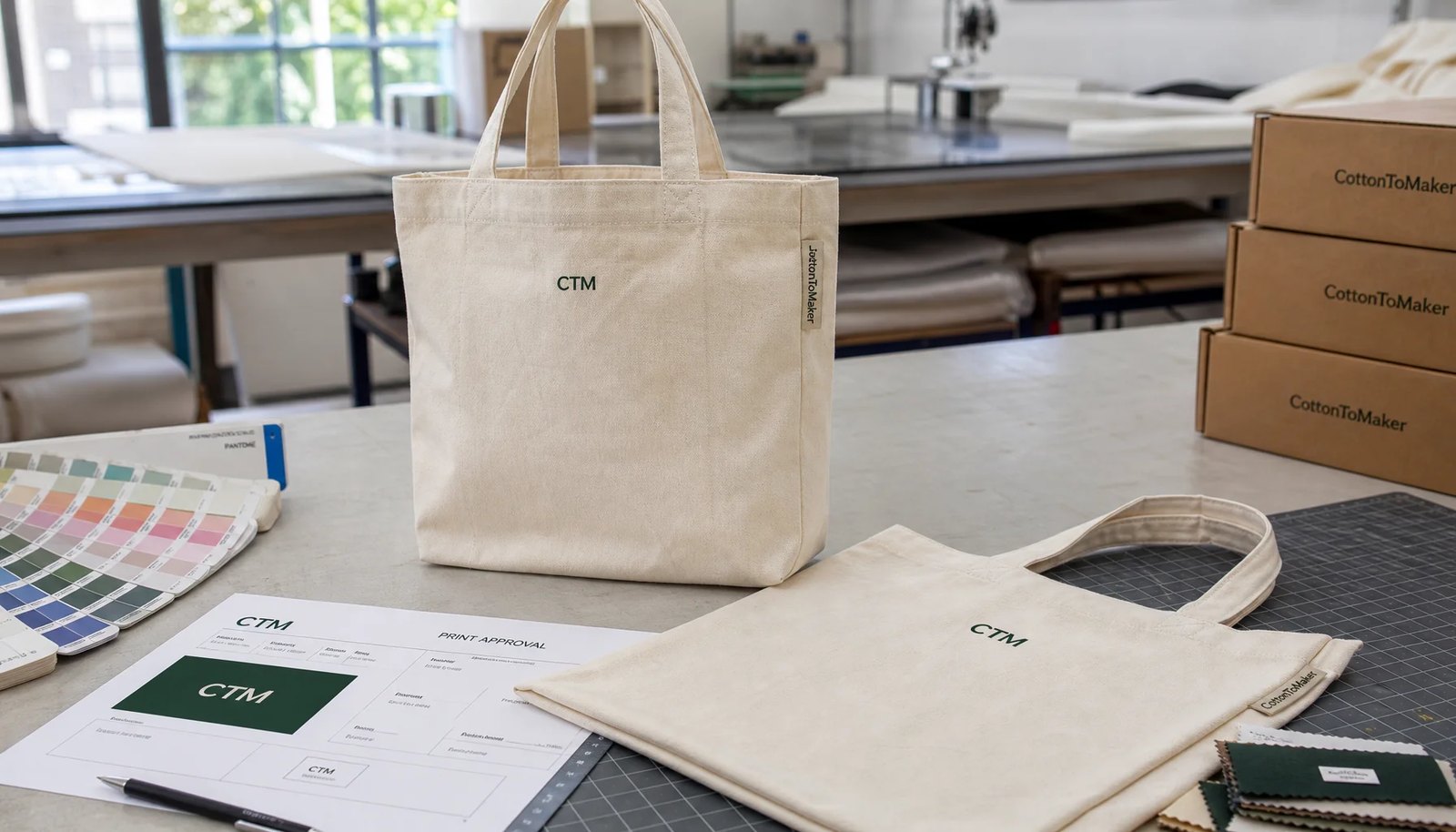
Start With the Event Risk
Organic cotton totes look simple on a purchase request: one bag, one logo, one delivery date. The problems usually appear after approval, when a natural fabric shade warms the brand color, a centered logo sits low on the sewn panel, or cartons arrive mixed by artwork version. For trade show exhibitors, those defects are not cosmetic annoyances. They affect booth setup, sponsor visibility, visitor experience, and whether the giveaway is usable when the doors open.
Treat the proof as a production record, not a quick visual signoff. It should connect the bag specification, organic claim, artwork file, color target, placement, print method, sample approval, packing, carton marks, and inspection criteria. A buyer, supplier, inspector, freight coordinator, and brand owner should all be able to read the same proof and understand what has been approved.
A tight organic cotton totes for trade show exhibitors print proofing checklist also makes quotes easier to compare. When every supplier is quoting the same GSM, size, print size, version count, evidence requirement, sample route, and packing plan, a low price is less likely to hide a weaker fabric, missing setup charge, loose tolerance, or incomplete documentation path.
- Lock the proof only after fabric weight, finished size, print method, and packing fold are known.
- Use centimeters, Pantone references, revision numbers, and written tolerances instead of visual proportions alone.
- Approve print behavior on the fabric shade planned for production whenever timing allows.
- Keep an approved strike-off or sealed sample available for final inspection comparison.
- Treat artwork, claim wording, packing, and carton mark changes as controlled revisions.
Define the Tote Before the Logo
Artwork scale depends on the bag. A 24 cm logo may look balanced on a 38 x 42 cm tote and undersized on a 45 x 45 cm tote. A gusset changes the usable front panel, while longer shoulder handles leave more open space above the print when the tote is hanging. Buyers should approve the product geometry before debating whether the logo looks right.
For many exhibitor giveaways, 38-42 cm wide by 40-45 cm high is practical. It fits A4 or letter-size literature, notebooks, badges, pens, and light samples without feeling oversized. A 60-70 cm handle is common when shoulder carrying matters. An 8-12 cm gusset helps with boxed samples or thicker brochure packs, but it increases carton volume and can change how the bag folds.
Fabric weight should match the load and perceived value. Standard giveaways often use 180-220 GSM because the bag still feels useful while controlling cost and freight. A stronger event bag may use 240-280 GSM. Premium kits, catalog-heavy programs, apparel, or resale-style totes may justify 280-340 GSM canvas with reinforced stitching. The heavier the bag, the more attention should be paid to seam bulk, fold marks, and print pressure near edges.
- Specify finished dimensions, not only cut-panel dimensions.
- State whether dimensions are measured flat before packing, after pressing, or after washing or finishing.
- Use handle drop, not only total handle length, to confirm shoulder clearance.
- Keep important artwork away from side seams, bottom folds, gussets, and handle reinforcement stitching.
- Load the sample with real booth contents before approving construction.
Separate Organic Material From Claims
The word organic needs a precise role in the order. One buyer may want organic cotton for an internal sourcing preference. Another may need evidence for a client audit, distributor file, retail listing, ESG campaign, or public claim. A supplier may be able to source organic cotton fabric, but that does not automatically authorize certification logos, hangtag language, or broad sustainability statements.
Procurement should separate three issues: what the tote is made from, what evidence the supplier must provide, and what the product or packaging may say. Documentation may include a supplier material declaration, scope certificate evidence, transaction certificate support, or other chain-of-custody paperwork depending on the program and market. If certification marks are involved, logo-use rules and claim wording need approval before printing.
This matters because claim requirements affect sourcing route, MOQ, lead time, artwork, labels, hangtags, invoices, and sometimes carton text. A late compliance review can force a rewrite after screens, transfer films, labels, or packaging have already been produced. Keep the tote print, woven label, hangtag, carton label, product listing, and invoice aligned with the evidence actually available.
- State whether the tote is a free giveaway, client resale item, distributor item, retail item, or internal staff item.
- Ask what documentation is available before placing organic wording in artwork.
- Confirm whether transaction certificate support or certification logo approval is required.
- Do not print certification marks until logo-use rules and chain-of-custody requirements are confirmed.
- Assign one buyer-side owner for final sustainability wording before proof release.
Match Print Method to Artwork
Screen printing is often the most efficient method for solid logos, sponsor marks, and repeat event graphics. It works well for one to four spot colors, especially when artwork has bold shapes and clean edges. Water-based and pigment inks can give a softer hand on cotton, while higher-opacity systems may improve coverage. The tradeoff is that textured cotton absorbs ink, so fine lines, small type, tight registration, and light ink on darker cloth need testing.
DTF and heat transfer can be useful for gradients, many colors, small version quantities, or late sponsor changes. They may reduce screen setup complexity, but they bring different risks: heavier hand feel, visible film edge, corner lift, cracking, or pressure marks after folding. These risks cannot be judged from a clean PDF.
Ask whether the factory prints cut panels before sewing or finished bags after sewing. Panel printing can improve flatness but requires earlier artwork control. Finished-bag printing may be faster for standard totes, but seams, gussets, and handle reinforcements can limit placement accuracy. The approved proof should reflect the actual production method.
- Use screen print for solid marks, limited color counts, repeat designs, and medium-to-large quantities.
- Use DTF or heat transfer for full-color artwork, gradients, small batches, or many sponsor versions.
- Ask for minimum stroke width, minimum text height, and minimum QR code size on the selected fabric.
- Test QR codes from the printed sample, not from the PDF.
- Require rub, adhesion, fold, and edge-lift checks for transfers and high-coverage prints.
Build a Measurable Proof
A procurement-grade proof is more than a front-view image. It should show finished bag size, print dimensions, print position, color references, label position, handle details, approved quantity, final artwork file name, revision number, and tolerance notes. If the logo is centered, define what it is centered within: the full front panel, the visible body excluding gusset, or the finished bag width.
Placement needs fixed reference points. If the print starts 9 cm below the top edge, show that measurement. If it is centered horizontally, define the vertical centerline and acceptable left-right movement. For standard front-panel tote printing, +/-5 mm is often practical when confirmed by the factory, but second-side alignment, pocket alignment, and seam-adjacent graphics may need separate discussion.
Version control is equally important. Trade show programs may include sponsor tiers, regional logos, language versions, distributor marks, or booth numbers. Each version should have a unique file name, proof number, revision date, approved quantity, and carton marking instruction. Old files should be removed from the production path.
- Include print width and height in centimeters.
- Show distance from top edge, side seam, centerline, and bottom edge where relevant.
- Mark the agreed placement tolerance in millimeters.
- Use vector artwork with outlined fonts before screens, films, or transfers are made.
- Name every artwork version clearly and link it to quantity and carton marks.
- State that artwork may not be resized, moved, or substituted without approval.
Control Color on Cotton
Natural organic cotton is not a neutral white base. It may appear cream, warm beige, greyish, seed-specked, or uneven depending on yarn, weave, and finishing. A Pantone color that looks exact on coated paper can look warmer, duller, or less opaque on unbleached cotton. A digital proof can confirm layout and scale, but it cannot show absorption, fabric texture, pinholes, opacity, or edge softness.
The strongest approval tool is a printed strike-off on actual production fabric or fabric from the same lot. If timing is tight, define an acceptable range instead of chasing an unrealistic perfect match. For strict brand colors, include time and cost for at least one revised strike-off in the RFQ.
Review color under consistent lighting with the approved strike-off or sealed sample as the reference. Photos are helpful for communication, but camera settings, factory lighting, and screen brightness can all distort color. For repeat event programs, ask whether the supplier can hold fabric or notify you before switching to a new lot.
- Reference Pantone numbers, but approve final appearance on cotton.
- Record whether fabric is natural, bleached, dyed, washed, or otherwise finished.
- Check light ink opacity on natural or dyed cotton before bulk release.
- Inspect dark ink for pinholes, fuzzy edges, uneven coverage, and texture loss.
- Keep one approved strike-off with the buyer and one with the factory when possible.
Approve Samples Like Production
A sample made with substitute fabric, a temporary handle, or a different print method can help early discussion, but it should not release bulk production. The pre-production sample should match the quoted GSM, fabric shade, handle width, stitching, label, print method, print size, and packing fold as closely as possible. Any temporary element should be identified in writing.
When the schedule is tight, a split approval route can work: approve a blank bag for construction and a printed strike-off for color and print behavior. This is practical when the factory has a standard tote body but the artwork is still moving. The final production record must combine both approvals before cutting, printing, or sewing at scale.
Evaluate the sample the way the event team will use it. Load it with the planned brochure stack, catalog, notebook, sample box, or giveaway item. Check handle comfort, bottom distortion, seam strain, print visibility, and loose threads. Then fold it as packed. If the fold crosses the logo, hold it compressed when timing allows and inspect for hard creases, sticking, abrasion, transfer marks, or edge lift.
- Measure width, height, gusset depth, handle width, and handle drop on the sample.
- Compare sample GSM and shade with the quoted specification before focusing on artwork.
- Load-test handles, side seams, bartacks, and bottom corners.
- Record all sample changes on a revised proof, not only in email comments.
- Confirm whether sample changes affect price, MOQ, lead time, carton count, or documentation.
Compare Quotes Beyond Unit Price
Organic cotton tote quotes can look similar when the buyer compares only unit price. The real program cost may include fabric MOQ, bag MOQ, print setup, proof revisions, custom labels, hangtags, documentation support, packing labor, carton marking, inspection, and freight volume. A stock fabric route may be faster and lower minimum. A custom fabric route may offer more control but require a larger commitment.
Print details can move the quote quickly. Screen printing usually has setup charges by color and print position. A one-color logo on one side is simple; a two-sided tote with sponsor colors adds screens, curing checks, and inspection points. Transfer printing may simplify full-color artwork but raise unit print cost. Ask every supplier to quote the same print size, color count, print positions, version quantities, proof route, and revision assumptions.
MOQ should be broken down by component. There may be a minimum for fabric purchase, dyeing, sewing, screen printing, transfer film, woven labels, hangtags, and each artwork version. A program with five sponsor versions at 200 pieces each may total 1,000 bags, but each version may still be inefficient. Make version quantities visible in the RFQ.
- Separate bag unit price from setup, sample, proof revision, documentation, packing, and inspection costs.
- Ask whether pricing assumes stock fabric, custom fabric, dyed fabric, or a specific certified supply route.
- Confirm MOQ by artwork version, label version, hangtag version, and carton marking plan.
- Ask whether repeat orders can reuse screens and whether screen storage has a time limit or fee.
- Request carton dimensions and gross weight during quoting, then confirm after sample packing.
Make Packing and QC Event-Ready
Packing is often left until after product approval, but it can decide whether the shipment works on site. Bulk packing is usually efficient for giveaways because it lowers cost and speeds distribution. Individual packing may suit premium or cleanliness-sensitive totes but adds cost and unpacking labor. Inner bundles are often useful when cartons must be sorted by artwork version, booth, destination, or distributor.
The fold should be tested with the print. A fold through a large logo can create a hard crease, especially when cartons are compressed during warehousing and transport. Water-based prints, high-coverage prints, and transfers may show pressure marks if packed too tightly or before curing is complete. Carton quantity should be confirmed from the folded sample, not copied from a generic listing.
A trade show order has a fixed failure date. Build the schedule backward from the true in-hand deadline, including proofing, revision, fabric preparation, production, inspection, balance payment, export handover, transit, customs, domestic delivery, and any advance warehouse receiving window. QC should tie directly to the approved proof: dimensions, print color, placement, curing, handle strength, stitching, version separation, packing quantity, and carton marks.
- Confirm pieces per carton, carton dimensions, gross weight, net weight, and carton material.
- Use inner bundles when cartons contain multiple artwork versions or booth allocations.
- Mark cartons with item number, artwork version, PO number, destination, quantity, and carton sequence.
- Ask for packing photos showing folded bags, bundles, carton marks, and closed cartons.
- Build inspection time into the schedule before final payment and shipment release.
- Compare air, sea, express, and split shipment options early for event-critical cargo.
Specification comparison for buyers
| Buyer decision | Typical specification | Best use | Control point |
|---|---|---|---|
| Standard exhibitor tote | 180-220 GSM organic cotton plain weave or light canvas; 38-42 cm W x 40-45 cm H | General giveaways carrying brochures, pens, notebooks, badges, and light samples | Confirm GSM tolerance, natural fabric shade, finished dimensions, and print opacity on the approved cloth |
| Premium booth tote | 280-340 GSM organic cotton canvas; reinforced handles; optional 8-12 cm gusset | Catalog-heavy kits, boxed samples, apparel, bottled samples, or retail-style gifts | Keep artwork away from seam bulk and test loaded shape, handle strength, and folded packing marks |
| Screen print | 1-4 spot colors; Pantone references; water-based or pigment ink depending on hand feel and opacity target | Solid logos, sponsor marks, repeat artwork, and medium-to-large event quantities | Approve a fabric strike-off; define line thickness, text height, placement tolerance, and curing checks |
| DTF or heat transfer | Full-color transfer with adhesion and edge checks; version quantities quoted separately | Gradients, small runs, many sponsor versions, or late artwork changes | Check film edge, hand feel, cracking, edge lift, rub resistance, and fold compression on final fabric |
| Organic claim route | Material declaration, certification documents, transaction certificate needs, and logo-use approval defined before artwork release | Client reporting, ESG campaigns, distributor programs, and retail or resale channels | Organic material access does not automatically permit certification logos or broad product claims |
| Sample approval | Blank pre-production bag plus printed strike-off on matching fabric, or a complete printed pre-production sample | Orders where construction, print placement, color, and packing must be inspected before bulk | Digital proofs cannot show cotton absorption, shade shift, print texture, pinholes, or carton compression behavior |
| Packing plan | Bulk pack 50-100 pieces per carton, or bundled by artwork, booth, distributor, or destination | Trade show shipments with tight receiving windows and fast booth setup | Approve fold direction, carton quantity, carton marks, version separation, gross weight, and packing photos |
Buyer checklist before sampling
- Define finished tote width, height, gusset depth, handle width, handle drop, fabric GSM, fabric shade, seam style, and print position before requesting prices.
- State the organic evidence required for the intended claim: internal preference, client reporting, resale, public sustainability wording, certification logo use, or transaction certificate support.
- Send vector artwork with Pantone references, outlined fonts, print dimensions in centimeters, minimum text size, clear space, and a unique file name for each version.
- Require a printed strike-off or pre-production sample on the same fabric weight, weave, shade, and finishing planned for production.
- Measure the sample flat and loaded; check width, height, gusset, handle drop, handle strength, bottom distortion, and fit for real booth contents.
- Set print placement from fixed reference points such as top edge, side seam, centerline, bottom edge, and handle reinforcement area.
- Test the printed area by dry rub, damp rub, light scratch, tape pull where suitable, fold compression, and edge-lift inspection for transfers.
- Fold the sample as packed, hold it compressed when timing allows, then inspect for creasing, sticking, transfer marks, abrasion, or logo damage.
- Confirm carton quantity, folded size, gross weight, carton marks, pallet requirements, packing photos, and sorting by booth, destination, distributor, or artwork version.
Factory quote questions to send
- What finished bag dimensions, gusset depth, handle width, handle drop, stitch construction, fabric GSM, weave, shade, and GSM tolerance are included in the unit price?
- Is the fabric greige, natural unbleached, bleached, dyed, washed, or otherwise finished, and what shade variation should we expect between lots?
- What organic cotton documentation can you provide for our claim level, and are transaction certificates, certification logo approvals, hangtags, or label wording reviews included?
- Which print method are you quoting, how many colors and print positions are included, and what setup charges apply per screen, transfer film, artwork version, or repeat order?
- Will the proof be printed on actual production fabric, and what are the cost and timing for one revised proof if color, scale, or placement is rejected?
- What placement tolerance can you commit to from the top edge, side seam, centerline, bottom edge, and handle reinforcement area?
- What minimum stroke width, text height, and QR code size do you recommend for this cotton texture, ink system, curing process, and handling method?
- What MOQ applies to the bag, fabric purchase, dyeing, print method, each logo version, custom label, hangtag, and carton marking plan?
- What is the lead time by stage: artwork check, proofing, proof revision, fabric preparation, cutting, printing, curing, sewing, QC, packing, export handover, and transit buffer?
- How many pieces per carton are quoted, what are the carton dimensions and gross weight, and can carton marks identify booth number, artwork version, PO number, destination, or distributor?
Quality-control points to confirm
- Fabric GSM checked against the approved specification or sealed sample, with production tolerance agreed before order placement.
- Fabric shade and surface reviewed before printing for stains, oil marks, weaving defects, heavy slubs beyond the accepted standard, and lot variation.
- Finished bag dimensions measured flat using the same method at sample and bulk inspection, including width, height, gusset, handle width, and handle drop.
- Print color compared with the approved fabric strike-off under consistent lighting, with any acceptable shade range written into the approval record.
- Print placement measured from fixed reference points, not judged only by eye or by a photo mockup.
- Ink curing and adhesion checked by dry rub, damp rub, tape pull where suitable, light scratch, fold compression, and edge-lift review for transfers.
- Fine text, URLs, QR codes, sponsor marks, and thin strokes inspected for filling, broken lines, blurred edges, loss of detail, and real scanning or readability.
- Handle attachment tested with expected event load plus margin, especially for catalog-heavy kits, bottled samples, and premium giveaways.
- Seams, bartacks, thread trimming, label attachment, and loose ends inspected at handles, side seams, bottom corners, gussets, pockets, and woven labels.
- Carton packing verified for quantity, fold direction, artwork version separation, carton compression, carton marks, gross weight, packing list accuracy, and print protection.