Why salon chains need a print-proof first, not a bulk quote first
For salon chains, the print proof is not a formality. It is the only way to lock artwork size, placement, and color before the factory starts cutting and printing at scale. A tote that looks fine on a flat digital mockup can still fail in real production if the logo sits too close to a seam (e.g., <3 cm), the type is too small for screen print (e.g., <6 pt), or the fabric weight changes the visual balance of the artwork (e.g., 180 GSM vs 240 GSM).
That is why buyers should lead with a print-proof request before negotiating price. The proof should show the tote size (e.g., 38 x 42 cm), artwork dimensions (e.g., 150 x 50 mm), distance from top edge and side seam (e.g., 10 cm from top, 5 cm from side), print method (e.g., screen print, 1 color), and the exact fabric base (e.g., 220 GSM organic cotton canvas). Once those items are fixed, supplier quotes become comparable instead of speculative.
For salon chains with multiple store locations, a consistent print proof also ensures that every tote in the order looks identical, avoiding brand inconsistency across different outlets. A single approved proof becomes the master reference for all subsequent reorders, reducing the risk of artwork drift over time. Store the approved proof as a digital and physical record for reorder consistency.
- Use the proof to lock artwork size and placement, not just logo color.
- Ask the factory to show the proof on the same fabric type intended for bulk production.
- Treat proof approval as part of the commercial contract, not a casual design review.
- Store the approved proof as a digital and physical record for reorder consistency.
Choose the right tote spec for salon use
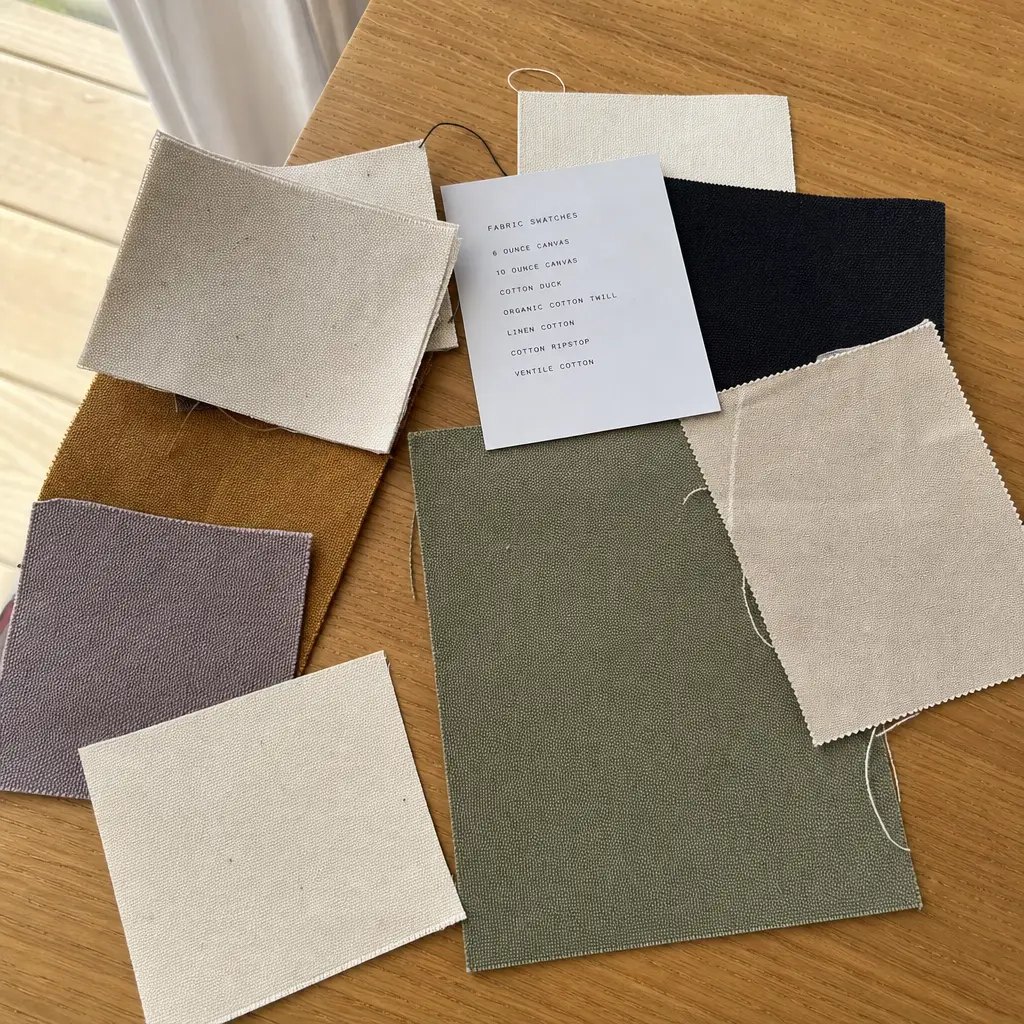
Salon chains usually need a tote that looks retail-ready but can still carry product samples, take-home kits, towels, or refill items. In practice, that means a natural organic cotton canvas between 200 and 240 GSM is often the most usable range. Below 180 GSM, the bag can feel too soft and the print may telegraph through; above 260 GSM, cost rises fast (e.g., 15-20% increase per 20 GSM) and the tote starts behaving like a heavy utility bag rather than a clean brand accessory.
Size matters just as much as weight. A medium tote around 38 x 42 cm with a 8-12 cm gusset works for most checkout and gift programs, while a larger format (e.g., 42 x 48 cm) helps when salons bundle products or training kits. Handle length should match the actual carry use. If the bag will be used on the street or in retail, short handles (e.g., 30 cm drop) usually feel too tight; if it is a counter handout, long straps (e.g., 60 cm drop) can look loose and less controlled. The goal is a shape that prints cleanly and folds consistently for warehouse packing.
Additionally, consider the bag's intended load. A salon tote used for product samples may need reinforced bottom seams or double-stitched handles (e.g., 5-7 SPI). For lighter promotional use, a simpler construction suffices. Document these requirements in the spec sheet to avoid ambiguity with the factory. Confirm finished size tolerance (e.g., ±1 cm) so every store receives a consistent bag profile.
- 200-240 GSM is the usual buying band for branded salon totes.
- Confirm finished size tolerance (e.g., ±1 cm) so every store receives a consistent bag profile.
- Do not ignore gusset depth; it changes both capacity and print visibility.
- Specify handle drop length based on carry use: short for counter (e.g., 30 cm), long for retail (e.g., 60 cm).
- Define load expectation (e.g., 3-5 kg) to guide seam reinforcement.
Best print methods to compare for a simple logo tote
For most salon chain programs, the best shortlist is usually screen print, heat transfer, or embroidery-style branding on a woven label or patch. Screen print is still the workhorse for one- or two-color logos because it is stable, economical (e.g., $0.50-1.00 per tote for 1 color), and easy to repeat across reorders. It performs best on bold artwork with clear edges and enough line weight (e.g., min 1.5 mm) to survive the weave of organic cotton.
Heat transfer has a place when the design is more detailed or the brand needs small type (e.g., <6 pt), but it can bring a softer hand feel and higher risk of edge lift if the substrate or application is poor (e.g., wash test failure after 10 cycles). Embroidery is less common on flat totes because it adds cost (e.g., $2-3 per tote) and can distort lighter fabric, but a sewn patch or side label can support a premium look when the main print needs to stay very simple. The right choice depends on artwork complexity, expected order volume, and whether the bag is intended for resale or promotion.
For salon chains with seasonal campaigns, screen print offers faster turnaround for reorders since screens can be stored (e.g., $50 setup per screen, reusable for 10,000+ prints). Heat transfer may require new transfers each time, adding lead time (e.g., 5-7 days for new transfers). Evaluate the total cost of ownership over multiple orders, not just the first run.
- Use screen print for bold logos, simple icons, and repeatable bulk orders.
- Use heat transfer only when artwork detail justifies it and the supplier can show durable application samples (e.g., wash test at 40°C for 30 minutes).
- Use sewn labels or patches as a support element, not a replacement for a weak main print.
- Consider reorder frequency: screen print screens can be reused, reducing setup costs for repeat orders.
Top 5 sourcing routes for organic cotton tote print proof projects
Not every quote comes from the same kind of supplier, and the sourcing route changes how much control you get over the proof. A factory with in-house sewing and printing gives the most direct accountability. A sewing factory that outsources print work can still be workable, but the buyer must manage more handoff risk. Trading companies can help with communication and consolidation, yet they rarely control the process tightly enough to reduce print surprises on their own.
The table below compares the routes buyers usually face when ordering salon chain totes. Use it to decide which quote deserves a deeper sample round and which quote is only useful as a price reference. For each route, ask about the print subcontractor's experience with organic cotton and their quality control process. A supplier that cannot name their print partner or provide their QC records is a higher risk.
Route 1: Factory with in-house sewing and printing (best for quality control). Route 2: Factory with in-house sewing, outsourced printing (manage handoff risk). Route 3: Trading company with multiple subcontractors (lowest price, highest risk). Route 4: Print-only shop that sources bags (limited bag quality control). Route 5: Full-service sourcing agent (good for complex orders, but higher fees).
- Compare quotes by route, not just by unit price.
- Ask which process is in-house and which step is subcontracted.
- A low quote from a routed supplier is only useful if print responsibility is clearly assigned.
- Request references or sample photos from the print partner for organic cotton projects.
How to read supplier quotes without missing hidden costs
A tote quote can look competitive until the buyer notices that the price excludes print screens, artwork setup, extra colors, carton labeling, or sample shipping. For organic cotton tote programs, the quote should list fabric GSM (e.g., 220 GSM), bag size (e.g., 38 x 42 cm), handle length (e.g., 30 cm), print area (e.g., 150 x 50 mm), print colors (e.g., 1 color), packing count (e.g., 50 pcs per carton), and Incoterm or freight basis (e.g., FOB Shanghai). Without those details, one supplier may appear 8 percent cheaper only because they quoted a smaller tote or a lighter fabric.
For salon chains, it is also worth separating one-time setup costs from recurring unit cost. Screen setup (e.g., $50 per screen), artwork correction (e.g., $25 per hour), and sample proofs (e.g., $50-100 per sample) can be acceptable if the program will repeat. But if the first order is a one-time campaign, a lower setup fee and faster proof cycle may matter more than a marginal unit discount. Ask for the commercial split in writing so finance teams can compare like for like.
Also, check for hidden charges like color matching fees (e.g., $30 per color), rush order premiums (e.g., 10-15% surcharge), or packing material surcharges (e.g., $5 per carton for custom labels). A transparent quote lists all line items; a vague quote often hides costs that emerge later.
- Separate setup cost, sample cost, and unit price.
- Require the same tote dimensions and GSM across all quotes.
- Make sure shipping terms are stated clearly, especially if comparing EXW, FOB, or delivered pricing.
- Request a full cost breakdown including any potential surcharges.
Sample approval rules that prevent production mistakes
A proper sample approval for a printed tote should not stop at a flat print proof. Buyers need to see at least the printed fabric evidence and, for new projects, one sewn sample or pre-production sample that reflects the actual bag shape. That is where alignment problems usually show up. A logo that looks centered on a flat panel can shift once the side seams, gusset, and top hem are built (e.g., shift of 5-10 mm).
Build the approval process around measurable points. Define the print size (e.g., 150 x 50 mm), the centerline, the distance from the top edge (e.g., 10 cm), and the accepted color reference (e.g., Pantone 123C, ΔE < 2). If your artwork includes small text, set a minimum line thickness (e.g., 1.5 mm) and minimum letter height (e.g., 8 mm) that the factory must follow. For chain orders, keep a signed photo record of the approved sample so reorders can be compared against the same standard without reopening design debates.
Include a timeline for approval: e.g., 48 hours to review the print strike-off, 72 hours for the sewn sample. Delays in approval can push production lead times, so set clear expectations with the factory. Use a digital approval form with checkboxes for each spec point.
- Approve both print appearance and sewn bag structure when the order is new.
- Measure artwork position from physical seams, not from the edge of a screen image.
- Keep a signed photo of the approved sample with date and bag spec.
- Set approval deadlines to avoid production delays.
QC thresholds that matter for salon chain distribution
The most useful QC targets are the ones that affect store consistency. Start with fabric and print, then move to sewing and packing. Fabric should not vary enough to change the bag’s stiffness or show through after printing (e.g., GSM tolerance ±5%). Print should have clean edges and even ink coverage, with no obvious registration drift between colors (e.g., <0.5 mm). Sewing should hold the handles flat and anchored, because salon totes are often carried with product weight rather than used as light promotional giveaways.
Packing is where many chain orders fail in practice. If the totes are going to multiple stores or DCs, carton labeling, fold direction, and carton count must be fixed early. A beautifully printed tote still causes complaints if the warehouse receives mixed counts or if the artwork creases badly because the fold line lands across the logo. Set these acceptance points before mass production starts, not after cartons are sealed.
Implement a simple AQL (Acceptable Quality Limit) sampling plan, such as AQL 2.5 for major defects (e.g., print misalignment >3 mm, seam failure, handle detachment) and AQL 4.0 for minor defects (e.g., slight color variation within tolerance, loose threads). This provides a structured way to accept or reject shipments. Use a sample size of 200 pcs for a 10,000 pc order, with a reject limit of 5 major defects or 10 minor defects.
- Inspect print alignment, ink coverage, and edge clarity under consistent light (e.g., D65).
- Use a simple load expectation (e.g., 5 kg) in your internal spec so handle stitching is chosen accordingly.
- Require carton labels that match the PO, colorway, and pack count exactly.
- Adopt an AQL sampling plan to standardize acceptance criteria.
Packing, lead time, and reorder logic
For salon chains, lead time should be planned as a sequence: sample proof, sample approval, bulk production, packing, and transit. A realistic factory estimate for a custom printed organic cotton tote usually starts with 5 to 10 days for proof/sample work and 25 to 40 days for bulk after approval, depending on fabric availability and print complexity. If the supplier promises a very short schedule (e.g., 15 days total), verify whether they are quoting from stock fabric, skipping a sewn sample, or assuming air freight.
Reorders are easier when packing and art data are locked properly on the first order. Keep the approved artwork file (AI or EPS), print size (e.g., 150 x 50 mm), bag measurements (e.g., 38 x 42 cm), carton count (e.g., 50 pcs per carton), and folding method (e.g., flat fold with tissue) on file. That reduces future errors when a different buyer or distributor places the reorder. It also helps the factory quote faster because they can price from an existing spec instead of rebuilding the job from scratch.
Consider a buffer in lead time for seasonal peaks (e.g., holiday promotions). Ordering 4-6 weeks ahead of the required delivery date gives room for sample revisions or production delays. For reorders, expect a 10-15% reduction in lead time if the spec is unchanged.
- Treat production time as a chain of steps, not one flat lead time.
- Store the approved art file and photo record with the PO for reorder use.
- Do not rely on a rush lead time unless the supplier states exactly what is being compressed.
- Build in a buffer for seasonal or high-volume periods.
Landed-cost comparison for bulk buyers
Unit price alone is a weak buying signal. For salon chain totes, the landed cost changes with print color count (e.g., $0.50 per color per tote), carton packing (e.g., $5 per carton for custom labels), factory location (e.g., China vs Vietnam), freight mode (e.g., sea vs air), and any sample or artwork setup charges. A supplier that is slightly higher on ex-factory price may still land cheaper if they control packing better and reduce damage or rework. Another supplier may quote aggressively low but push costs into artwork edits, extra plates, or revised shipping terms later.
A clean comparison sheet should list the tote spec (e.g., 220 GSM, 38 x 42 cm), print method (e.g., screen print, 1 color), setup fees (e.g., $50 per screen), unit cost at MOQ (e.g., $1.50 at 1,000 pcs), carton count (e.g., 50 pcs per carton), and estimated freight (e.g., $500 for 20 cartons). That is enough to show whether a quote is real or artificially light. Buyers who compare only the headline number often end up paying more once the order is corrected, repacked, or re-shipped.
Use a simple spreadsheet to calculate total cost per tote including all fees. For example, if Supplier A charges $1.50 per tote with $200 setup, and Supplier B charges $1.60 with $100 setup, the breakeven point at 1,000 units is $1.70 vs $1.70, but at 2,000 units, Supplier A becomes cheaper ($1.60 vs $1.65). This analysis helps make informed decisions. Include a 5% buffer for unexpected costs.
- Compare ex-factory and landed cost separately.
- Include setup, sample, packing, and freight in the same worksheet.
- Use identical spec inputs for every supplier before you judge price.
- Calculate total cost per tote at your expected order volume to find the true best value.
Sustainability certifications and documentation
For salon chains emphasizing eco-friendly branding, organic cotton totes should come with verifiable certifications. The most common is GOTS (Global Organic Textile Standard) for the fabric, which ensures organic fiber content (e.g., 95% organic cotton) and environmental standards in processing. Some buyers also require OEKO-TEX certification for print inks to guarantee no harmful chemicals (e.g., Standard 100, Class I for baby products).
Request certification documents from the supplier, such as a GOTS certificate (valid for 12 months) or test reports for the fabric and ink. These documents add credibility to your marketing claims and protect against greenwashing accusations. For bulk orders, ask for a certificate of conformity with each shipment, including lot numbers and test results.
If the supplier cannot provide certifications, consider whether the organic claim is worth the premium. In some cases, a non-certified organic cotton may still be acceptable if the buyer trusts the source, but for chain-wide programs, certification reduces risk. Expect a 10-15% premium for GOTS-certified fabric vs non-certified organic cotton.
- Require GOTS certification for organic cotton fabric to ensure authenticity.
- Ask for OEKO-TEX or similar certification for print inks to avoid harmful substances.
- Request certification documents with each shipment for traceability.
- If certifications are unavailable, assess the supplier's credibility and consider alternative sourcing.
Specification comparison for buyers
| Spec decision | Recommended option | When it fits | Buyer risk to check |
|---|---|---|---|
| Fabric weight | 200-240 GSM organic cotton canvas | Salon retail bags, refill bundles, premium gifting | Too light (<180 GSM) prints look weak and bag walls wrinkle; too heavy (>260 GSM) raises cost and slows sewing; verify ±5% GSM tolerance |
| Print method | 1-2 color screen print for flat logos | Simple salon logos, brand names, seasonal campaigns | Fine gradients, small type (<6 pt), and tonal artwork may fill in or break on weave; heat transfer for detail but risk edge lift |
| Print placement | One main panel centered or upper chest (e.g., 10 cm from top edge) | Standard handout totes, retail checkout bags | Handle rub, seam distortion, and logo visibility if placement is too close to side seams (<3 cm); measure from seam, not edge |
| Construction | Stitched side gussets with reinforced handle cross-stitch (e.g., 5-7 stitches per inch) | Higher load use, retail resale, product sets | Weak handle attachment fails in daily salon use; ask for stitch count (min 5 SPI) and seam allowance (min 1 cm) |
| Lamination/coating | No coating for pure organic cotton claims | Programs that prioritize natural hand feel and certification logic | Any coating can change handfeel, reduce breathability, and complicate organic positioning; verify GOTS compliance |
| Sample route | Pre-production print strike-off plus sewn sample | New artwork, new supplier, new fabric lot | Approve both print appearance and bag shape; a flat print proof alone misses alignment issues (e.g., logo shift after sewing) |
| Packing | Bulk packed with carton count and barcode label (e.g., 50 pcs per carton, flat fold with tissue) | Warehouse receiving and multi-store distribution | Loose folding causes crease lines over artwork; unclear carton labels create pick/pack errors; verify fold direction avoids print area |
| Supplier type | Factory direct with in-house printing | Larger rollouts and repeat orders | Outsourced print shops increase handoff risk; require clear responsibility for color and registration; ask for print partner QC records |
| Lead time | Sample 5-10 days, bulk 25-40 days after approval | Planned launches and reorder programs | Short dates often hide skipped sampling, partial production, or airfreight assumptions; verify fabric availability and print queue |
Buyer checklist before sampling
- Confirm final bag size (e.g., 38 x 42 cm), gusset depth (e.g., 10 cm), handle drop length (e.g., 30 cm for counter, 60 cm for retail), and usable loading weight in kilograms (e.g., 3-5 kg).
- Specify fabric type (e.g., 100% organic cotton canvas, plain weave), GSM weight (e.g., 220 GSM ±5%), color tolerance (e.g., ±5% from Pantone reference), and expected shrinkage after first wash or print curing (e.g., <3%).
- Send vector artwork (AI or EPS format) and define logo size in millimeters (e.g., 150 x 50 mm), print position measured from top edge and side seam (e.g., 10 cm from top, 5 cm from side), and Pantone references for each color.
- Request a pre-production print strike-off on the exact bulk fabric, plus one sewn sample for new bag shapes, before approving bulk production; allow 48 hours for print review, 72 hours for sewn sample.
- Agree on carton packing quantity (e.g., 50 pcs per carton), folding method (e.g., flat fold with tissue paper to avoid crease on print), barcode or hangtag requirements, and shipment marks before production starts.
- Record inspection checkpoints for stitching (stitch count per inch, e.g., 5-7 SPI; seam allowance, e.g., 1 cm), print adhesion (rub test with 500g weight for 10 cycles; wash test at 40°C for 30 minutes), stains, and quantity count per carton.
- Adopt an AQL sampling plan: AQL 2.5 for major defects (e.g., print misalignment >3 mm, seam failure), AQL 4.0 for minor defects (e.g., slight color variation within tolerance).
Factory quote questions to send
- What exact organic cotton fabric are you quoting: weave (e.g., plain, twill), GSM (e.g., 220 GSM ±5%), finished size tolerance (±mm, e.g., ±1 cm), and expected shrinkage after printing or washing (e.g., <3%)?
- Is the price based on one-side print, two-side print, or different artwork on each side, and how is each added cost calculated (e.g., per color, per screen, per side)? Include setup fees for screens (e.g., $50 per screen).
- Will you provide a pre-production print proof on the bulk fabric, a sewn sample, or both, and what is included in the sample charge (e.g., screen setup, fabric, labor) or refundable fee? Specify timeline (e.g., 5-7 days for print proof, 7-10 days for sewn sample).
- What is your MOQ by fabric color, print color, and carton packing format (e.g., 500 pcs per color, 1,000 pcs per design), and do mixed designs (e.g., different logos per store) change the unit price?
- Who owns color approval: your in-house printing team, an outsourced print partner, or a subcontracted workshop, and what is the process for color correction if the strike-off does not match (e.g., re-screen fee, lead time extension)?
- What carton packing count (e.g., 50 pcs per carton), folding method (e.g., flat fold, roll, tissue interleaving), and label details (e.g., barcode, store code, quantity) are included in the quote, and what is charged extra (e.g., $5 per carton for custom labels)?
- What is the standard production lead time after sample approval (e.g., 25-30 days), and what happens if artwork changes after approval (e.g., re-screen fee of $50, lead time extension of 5-7 days)?
- What QC photos or inspection reports can you provide before shipment, especially for print alignment (measured from seam, e.g., ±3 mm), handle stitching (cross-stitch count, e.g., 5-7 SPI), and carton count verification? Include a ruler for scale.
Quality-control points to confirm
- Fabric should match the quoted GSM within a reasonable supplier tolerance (e.g., ±5%); for salon retail totes, avoid very thin cloth (<180 GSM) that shows through after printing or feels flimsy under load; verify with a fabric weight scale.
- Artwork position should be centered within the agreed measurement from top edge and side seam (e.g., ±3 mm tolerance); reject obvious drift or misalignment that affects brand presentation; measure with a ruler from the seam, not the edge.
- Print color must match the approved strike-off under daylight or standard viewing light (e.g., D65); compare against the same Pantone reference every time and document any deviation (e.g., ΔE < 2); use a spectrophotometer if available.
- Edges of the print should be clean with no major pinholes, heavy ink pooling, or fuzzy type on small text (e.g., minimum 6 pt font for screen print, minimum 1.5 mm line thickness); reject if readability is compromised; use a magnifying glass for inspection.
- Handle stitching, side seams, and bottom seam reinforcement should hold load without visible skipped stitches, loose thread ends, or seam separation; test with a standard weight (e.g., 5 kg) for 30 seconds; check stitch count (min 5 SPI) and seam allowance (min 1 cm).
- Folding and carton count should match the packing list so store distribution teams do not receive mixed counts or mislabeled cartons; verify carton labels against PO details (e.g., store code, quantity, colorway); inspect fold direction to avoid crease on print.
- Final shipment photos should show carton labels, quantity per carton, and at least one full bag image for each artwork or colorway, with a ruler for scale reference; include a close-up of the print for color and alignment verification.
- Perform a rub test on the print: use a 500g weight with a dry cloth, rub for 10 cycles; reject if ink transfers or smudges. Perform a wash test: wash at 40°C for 30 minutes with mild detergent; check for color fading, bleeding, or print peeling.