1. Start with the job the tote has to do
A spa retail tote looks simple until procurement has to buy it. The same organic cotton bag might be a paid boutique item, a gift-with-purchase, a hotel-room welcome amenity, a treatment launch carrier, a subscription kit outer pack, or a staff support bag. Those uses do not need the same fabric, handles, print, packaging, or minimum order quantity. A tote carrying two sample sachets and a brochure can be light and foldable. A tote sold next to premium skincare needs more body, cleaner presentation, and stronger repeat-use performance.
Before you ask for pricing, write the buying brief in plain language. For example: natural organic cotton tote for a spa retail gift set, sized for two 250 ml bottles, one folded face towel, and a brochure, shoulder carry, one-color muted green front print, flat bulk pack to central warehouse. That one sentence gives a factory more useful information than a mood board and a request for the lowest price. It describes load, feel, branding, and distribution.
MOQ should follow risk. If the bag supports a seasonal event with a short selling window, keep the body simple and limit artwork versions. If the tote will carry your brand into guest homes for months, spend more attention on fabric handfeel, print softness, handle drop, stitching, labels, and packing. The lowest MOQ is attractive on a spreadsheet, but it can create a tote that feels wrong for a spa boutique.
- Define the tote purpose first: resale, amenity, gift set, event bag, subscription packaging, influencer mailer, or operational use.
- List the actual items the bag must hold: bottles, jars, towels, robes, brochures, candles, boxes, or treatment menus.
- Decide whether the tote must feel reusable. Reusable positioning usually needs better fabric, reinforced handles, and tighter QC.
- Confirm the receiving route: central warehouse, direct-to-spa shipment, 3PL, distributor, or later kitting with products.
- State any claims the tote will carry, such as organic cotton, undyed cotton, reusable packaging, or reduced-plastic packing.
2. Break MOQ into the minimums that really matter
MOQ is rarely one clean number. An organic cotton tote order usually contains several minimums: fabric, cutting and sewing, artwork, labels, hangtags, barcode stickers, packing materials, and sometimes documentation. When a quote says “MOQ 500 pcs,” ask what that means. It may mean 500 pieces of one natural fabric, one size, one print design, one label setup, and standard export bulk packing. Add a second logo or a woven side label and the minimum may change.
This matters for spa groups with several properties. A factory may be able to sew 2,000 identical natural cotton tote bodies and print four location logos at 500 pieces each. That is efficient. It is very different from asking for four sizes, four dyed colors, four handle drops, or four construction styles. Those changes turn one order into separate body SKUs, and each SKU can carry its own MOQ and setup risk.
Organic cotton documentation can also change the discussion. Some suppliers can offer a cotton tote they describe as organic, but they may not be able to provide order-specific documents or chain-of-custody support. If your product page, hangtag, or internal sourcing policy requires documentation, put that requirement in the first RFQ. Do not wait until after a low quote is chosen.
- Fabric MOQ: minimum meters, yards, or kilograms for the selected organic cotton weight, color, and finish.
- Body MOQ: minimum quantity for one size, gusset, handle length, handle reinforcement, and construction method.
- Artwork MOQ: minimum quantity per print artwork, screen set, embroidery file, transfer layout, or colorway.
- Trim MOQ: minimums for woven labels, printed labels, care labels, hangtags, belly bands, inserts, or cords.
- Packing MOQ: minimums for custom cartons, paper bands, barcode labels, inner liners, polybags, or printed carton marks.
- Documentation MOQ or cost: fees, handling rules, or quantity requirements linked to organic cotton transaction records or traceability.
3. Specify fabric weight in a way a mill and factory can actually follow
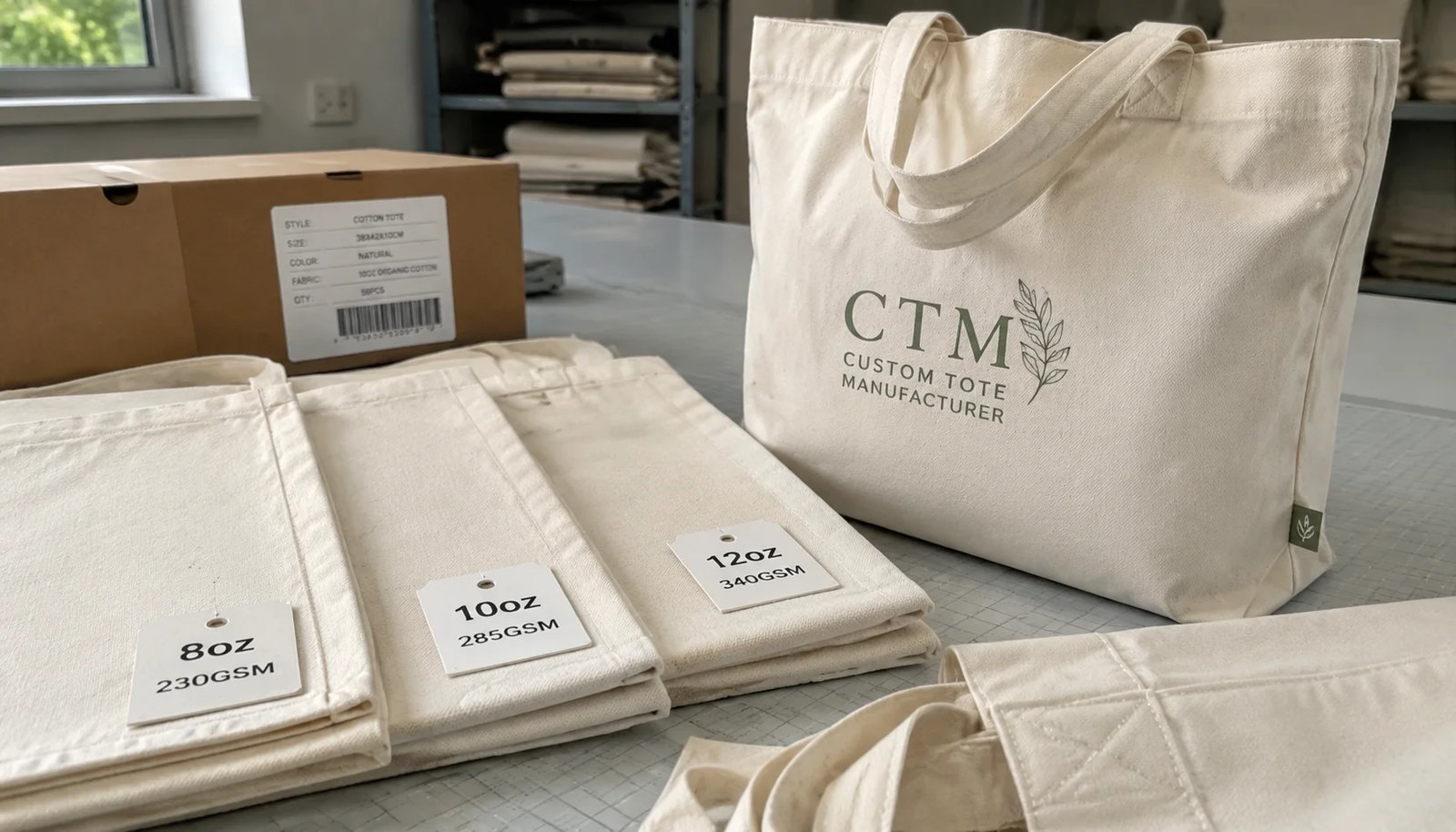
Spa buyers often compare 8oz, 10oz, and 12oz organic cotton canvas. Those labels are helpful, but they are not enough. In many sourcing conversations, 8oz canvas is roughly about 270 GSM, 10oz about 330-340 GSM, and 12oz about 400 GSM. The exact number depends on the supplier’s convention, weave, finishing, and measurement method. A washed canvas can feel softer and denser than an unfinished fabric with a similar nominal weight.
For light gift-with-purchase, launch events, and welcome amenities, 8oz may be enough if the contents are modest and the brand wants a relaxed, foldable bag. For core spa retail, 10oz is often the safer first benchmark because it gives more structure without becoming too bulky. For premium resale or heavier kits with glass jars and larger bottles, 12oz can improve shelf presence and durability. It also brings higher fabric cost, slower sewing, larger cartons, and more freight weight.
Do not approve fabric from a number alone. Test the sample with real products. Fill it, carry it, place it on a boutique shelf, and fold it the way the warehouse will fold it. Watch whether the side seams twist, whether the logo wrinkles, whether the panel collapses, and whether the handles feel comfortable over a robe sleeve or jacket. Then compare carton data, because a heavier tote can change landed cost more than the unit price suggests.
- Request oz and GSM together, with the supplier’s acceptable production tolerance.
- Ask whether the fabric is plain canvas, duck canvas, twill, brushed canvas, washed canvas, or another construction.
- For natural unbleached cotton, approve the shade range, seed flecks, slubs, and neps before cutting.
- For dyed fabric, require lab dips, bulk shade approval, and a written tolerance under an agreed light source.
- If washing or steaming is part of the process, ask for shrinkage data after the same finishing process.
- For each fabric option, request pieces per carton, carton dimensions, gross weight, net weight, and total CBM.
4. Control SKU count before it eats your MOQ advantage
Spa merchandising teams often want variants for sound reasons: property logos, seasonal wellness messages, regional languages, event marks, or collection names. Production sees those variants differently. Every version adds setup, artwork approval, screen management, sorting, curing, inspection, folding, and carton labeling. The total order might meet MOQ, but small version quantities can still drive up cost and mistakes.
For a first order, the cleanest structure is usually one shared bag body with controlled decoration splits. Keep the same fabric weight, natural base color, size, gusset, handle drop, reinforcement, and packing method. Then allow artwork changes only where the quantity per version justifies the setup. A parent-brand tote may support several spa locations better than separate property-specific totes, especially before you know sell-through.
SKU discipline helps replenishment too. If the launch order includes ten location-specific totes and only three locations reorder, you may be left with slow-moving inventory for the others. For lower-volume properties, consider using a hangtag, barcode sticker, store allocation label, or carton label rather than changing the tote itself. If a property mark is essential, keep the same ink color and print placement to reduce variation.
- Set a minimum quantity per artwork before new logo versions are approved.
- Use one parent-brand tote for multiple spa locations when possible.
- Keep one ink color across versions if brand rules allow it.
- Avoid multiple fabric colors on the first order unless each color meets a practical body MOQ.
- Do not change handle drop, gusset, label position, or size by location without treating it as a separate SKU.
- Ask the supplier how printed versions will be segregated during curing, folding, packing, and carton labeling.
5. Choose decoration that suits a spa brand and the fabric surface
Organic cotton totes for spa retail usually look best with calm, deliberate branding. Water-based or pigment screen print is often the practical route for one to three spot colors on natural canvas. It can give a softer handfeel than many heavy transfer or plastisol-style effects, and it suits botanical marks, quiet resort logos, wellness typography, and minimalist retail graphics. The artwork still has to be designed for cotton texture, not just for a digital mockup.
Decoration limits belong in the RFQ. Coarse canvas can swallow fine lines. Small reversed text may fill in. Pale ink on natural cotton can look weaker than expected. Large solid areas may print unevenly or feel stiff. Embroidery can look premium for a small logo on 10oz or 12oz fabric, but dense embroidery on lighter fabric may pucker the panel. Heat transfers can hold detail, yet some spa brands dislike the surface feel because it conflicts with the natural-cotton message.
Ask for a strike-off on the approved fabric or a bulk-equivalent fabric. A print that looks crisp on smooth cotton can change on slubbed organic canvas. For retail-facing totes, define placement by measurement, not by a screenshot. Use distances from the top seam and side edges. Provide Pantone or brand color references, but approve the printed color visually on the actual cotton base because cream, natural, and dyed fabrics shift the perceived shade.
- Water-based screen print: good for soft handfeel and simple spa branding; check curing, dry rub, and wet rub if relevant.
- Pigment print: common for cotton totes; verify edge sharpness, colorfastness, and wash response if laundering is expected.
- Embroidery: best for small premium marks on heavier fabric; check backing, puckering, stitch density, and thread color.
- Woven side label: useful for discreet private-label detail; define size, fold, placement, background color, and seam position.
- Care or content label: confirm fiber content, country of origin, care wording, importer details, and required languages.
- Hangtag or belly band: stronger retail presentation, but it adds MOQ, barcode control, artwork approval, and packing labor.
6. Build an RFQ that makes quotes comparable
Two tote quotes can look far apart because they are not pricing the same product. One supplier may be quoting 8oz natural cotton with no documentation and standard bulk packing. Another may be quoting 10oz organic cotton with order-specific documents, a woven label, a hangtag, individual packing, and stronger carton marks. Unit price alone does not tell procurement which option is better.
A useful RFQ includes finished size, fabric weight, GSM, fabric color, organic documentation requirement, handle width, handle drop, reinforcement method, artwork size, print method, ink colors, print placement, label requirements, packing format, destination, and target delivery date. If demand is uncertain, request quantity breaks such as 500, 1,000, 2,500, and 5,000 pieces. Ask suppliers to separate setup charges so artwork splits do not disappear into a confusing blended unit price.
Landed cost needs packing data. Cotton totes are bulky, especially when heavier, gusseted, individually packed, or banded for retail display. A supplier with a slightly higher unit price may still be the better choice if carton efficiency, QC clarity, and rework risk are better controlled. Request pieces per carton, carton dimensions, gross weight, net weight, total CBM, and packing method with every quote.
- Compare the same finished size, not just the same general tote category.
- Compare the same fabric weight, weave, and finish, with oz and GSM stated together.
- Confirm whether organic cotton documentation is included, excluded, optional, or unavailable.
- Separate product price from screen fees, sample fees, label fees, packing fees, courier fees, and inspection fees.
- Ask whether the price changes when artwork count increases but total order quantity stays the same.
- Request full export packing data before estimating ocean, air, courier, or truck freight.
- Clarify Incoterms, payment terms, sample lead time, bulk lead time, quote validity, and the trigger date for production.
7. Use sampling to make decisions, not to keep browsing
Sampling should reduce production risk. A showroom tote can show basic sewing capability, but it does not prove the supplier can deliver your fabric weight, handle drop, print color, label position, or packing method. Treat exploratory samples and pre-production samples differently. Exploratory samples help you compare 8oz versus 10oz or flat versus gusseted. The pre-production sample should represent what the factory will actually make.
A proper pre-production sample should use actual or booked fabric where possible, final thread color, final handle construction, final print method, final artwork size, labels, folding method, and intended packing. If a substitution is unavoidable, write it down. For example, if the sample uses available 10oz cotton but production will use newly sourced organic 10oz fabric, the fabric difference still needs approval before bulk cutting.
Spa retailers should test the sample in the real environment. Fill it with the planned skincare set. Carry it over the shoulder. Put it on the boutique shelf. Fold it flat for warehouse packing. Check whether the logo lands in a crease, whether the handles distort the top edge, whether the print rubs after handling, and whether the bag still feels appropriate beside your retail assortment. These simple checks are cheaper than finding the issue after 2,000 pieces are packed.
- Measure the sample: width, height, gusset, handle width, handle drop, and print placement.
- Load the tote with actual bottles, jars, towels, candles, brochures, or boxes and check seam stress.
- Review print color and contrast under store-like lighting, not only from factory photos.
- Fold the tote as it will ship and check whether handle pressure creates deep creases across the logo.
- If consumers may wash the tote, request care guidance and test shrinkage and print durability.
- Keep one signed approval sample and require the factory to keep a matching counter sample for production reference.
8. Set QC rules before fabric is cut
Organic cotton canvas is a natural woven material. That is part of its appeal, but it also means procurement needs clear acceptance rules. Natural cotton may show seed flecks, slubs, small neps, and shade variation. Some spa brands welcome that character. Others need a cleaner surface for premium retail presentation. Either way, approve a limit sample before production and define what is acceptable.
QC should cover fabric, sewing, printing, trims, labels, cleanliness, odor, moisture, and packing accuracy. A small seed fleck on the inside panel may be fine. An oil mark on the front logo panel should not be. Slight texture in a screen print may be normal on canvas. Smearing, ghosting, misregistration, pinholes, color contamination, or uncured ink are different issues. Loose threads may be reworkable; open seams and weak handles are more serious.
For larger orders, many buyers use AQL-based final inspection. For smaller spa programs, a documented factory inspection with clear photos may be more practical. Either way, classify defects in advance. Critical defects may include mold, damp cartons, sharp contamination, severe odor, incorrect fiber claim, or unsafe construction. Major defects may include wrong size beyond tolerance, broken seams, major stains, poor print, wrong artwork, or wrong labels. Minor defects may include small loose threads or natural slubs within the approved range.
- Define size tolerance, commonly around plus/minus 1 cm for standard sewn totes unless the supplier confirms tighter control.
- Define print placement tolerance, often around plus/minus 5 mm for retail-facing logos if the factory can hold it.
- Set handle drop tolerance and inspect after sewing, finishing, pressing, or folding.
- Classify fabric defects by location: front logo panel, back panel, side panel, interior, bottom, and handle.
- Reject mold, musty odor, damp cartons, oil stains, severe dirt, incorrect artwork, and incorrect organic claim labeling.
- Agree on rework or replacement rules for loose threads, skipped stitches, open seams, poor curing, and wrong carton labels.
9. Plan packing for receiving, presentation, and claim consistency
Packing affects freight cost, warehouse labor, receiving accuracy, and how the tote looks when it reaches the spa. Flat bulk packing is usually efficient for cotton totes, especially when the order goes to a central warehouse or will be kitted later with skincare products. Depending on size and fabric weight, export cartons may hold roughly 50 to 100 pieces, but do not assume that number. A 12oz gusseted tote with belly bands or individual packaging can require much larger cartons than an 8oz flat tote.
Spa brands often want lower-plastic packaging. At the same time, natural cotton needs protection from dust, moisture, carton rub, and warehouse handling. Individual polybags keep each tote cleaner, but they add plastic, cost, labor, and waste. A bulk inner liner or master polybag can be a reasonable compromise for central distribution. For resale, a paper belly band or hangtag can improve shelf presence, but it adds artwork approval, barcode control, packing time, and another component MOQ.
For multi-location programs, carton labeling is not a small detail. Mixed artwork cartons may save space but can create receiving errors if labels are unclear. If goods ship directly to different spa locations, the packing list and carton marks must match destination, artwork, PO, SKU, and quantity. If a 3PL will allocate the bags, ask the 3PL for label and barcode requirements before production packing begins.
- Flat bulk pack: efficient for warehouse receiving, lower material use, and easier palletization.
- Individual polybag: cleaner for resale or direct-store handling, but less aligned with low-plastic positioning.
- Bulk inner liner: protects natural cotton from carton dust while reducing individual plastic use.
- Paper belly band: useful for boutique display; confirm band size, paper weight, barcode position, and labor cost.
- Mixed cartons: use only with buyer approval, clear assortment labels, and count verification.
- Master carton label: include SKU, artwork, PO, quantity, carton number, gross weight, net weight, and destination.
10. Protect launch timing by locking materials and artwork early
Organic cotton tote lead time includes more than sewing. A realistic schedule may include fabric sourcing, lab dips for dyed fabric, bulk fabric finishing, cutting, sewing, printing, curing, label insertion, folding, packing, inspection, export booking, international transit, customs clearance, and domestic distribution. A natural fabric tote with one print color is much lower risk than a custom dyed, multi-artwork, multi-label program.
For spa launches tied to holiday retail, treatment menu updates, resort openings, or seasonal gift sets, work backward from the date the tote must be in the spa, not the date it leaves the factory. Build in time for sample shipping, internal approval, legal review of organic cotton wording, barcode setup, and kitting. If the tote will be packed with skincare, the tote has to arrive before the kitting window, not merely before the retail launch.
A practical sequence is to freeze the bag body first and artwork second. Once the body is approved, the factory can secure fabric and prepare production. Artwork versions need a hard cutoff date. Late changes to woven labels, care labels, or side-seam labels can stop sewing because those pieces are inserted during assembly. Air freight may solve some urgent timing problems, but cotton totes are bulky, so air freight can quickly wipe out savings from a low unit price.
- Choose natural or stock-equivalent fabric when schedule is more important than a custom body color.
- If dyeing is required, allow time for lab dip approval, bulk shade review, and possible correction.
- Freeze size, gusset, handle drop, reinforcement, and label position before cutting starts.
- Set an artwork approval deadline for each spa property, event, or seasonal version.
- Approve carton marks and destination allocation before packing begins.
- Schedule final inspection before the vessel, truck, or air booking deadline so release is not rushed.
Specification comparison for buyers
| Procurement decision | Typical B2B specification to request | Best-fit spa retail use | Tolerance or buyer risk to control |
|---|---|---|---|
| Fabric weight for light programs | 8oz cotton canvas, often about 270 GSM depending on weave and finish | Gift-with-purchase, launch event, welcome amenity, low-load retail kit | Confirm actual GSM tolerance, opacity, shrinkage, and handle reinforcement; 8oz can feel too soft for paid resale |
| Fabric weight for core spa retail | 10oz cotton canvas, often about 330-340 GSM depending on finish | Boutique tote, skincare set packaging, reusable customer bag | Check carton gross weight and folded thickness; compare landed cost rather than unit price only |
| Fabric weight for premium structure | 12oz cotton canvas, often about 400 GSM depending on mill standard | Higher-value resale, structured gift set, heavier bottles or jars | Higher material cost, needle marks, bulkier cartons, and slower sewing; confirm seam strength and CBM |
| Organic cotton claim | State required standard, chain-of-custody expectation, and whether order-specific documents are needed | Retail programs making an organic material claim on product page, tag, or packaging | Supplier claim is not the same as transaction documentation; define documents before quote comparison |
| Base color | Natural/unbleached fabric for lower complexity; custom dyed fabric only when quantity and schedule allow | Natural spa aesthetic, wellness packaging, multi-property common body | Natural shade varies by lot; dyed fabric requires lab dip, bulk shade approval, and shade tolerance |
| Bag construction | Flat tote or modest bottom gusset before adding multiple sizes | First purchase test, multi-location spa group, central warehouse allocation | Different gusset, handle, or size usually creates a separate body SKU and may reset MOQ |
| Handle specification | Shoulder-carry drop commonly specified as a measured finished drop; reinforcement by X-stitch or bartack | Customer tote, robe/towel kit, boutique shopping bag | Measure drop after sewing and any washing/finishing; weak handle attachment is a functional defect |
| Logo method | Water-based or pigment screen print for one to three spot colors on flat panels | Botanical spa marks, minimalist resort branding, calm retail graphics | Define minimum line width, reversed text size, placement tolerance, curing, and rub resistance |
| Premium branding detail | Small woven side label, inner care/content label, hangtag, or paper belly band | Private-label spa boutique or resale program | Each component can have its own MOQ, artwork approval, barcode control, and insertion labor |
Buyer checklist before sampling
- Write the commercial use case before the RFQ: resale, gift-with-purchase, amenity, event, subscription kit, influencer mailer, or staff support bag.
- Specify finished bag dimensions in centimeters or inches, including width, height, gusset depth if any, handle width, and finished handle drop.
- Quote fabric by both oz and GSM, and ask the supplier to state the conversion basis, weave, finish, and acceptable GSM tolerance.
- State whether the fabric must be certified organic cotton, whether product labeling will mention organic cotton, and which documents are required for your market or internal policy.
- Decide if natural cotton seed flecks, slubs, and cream shade variation are acceptable; request a physical limit sample or approved photo range.
- Keep the first order to one shared bag body where possible: same fabric, same size, same handle, same construction, and same base color.
- Set a minimum practical quantity per artwork before approving location-specific logos, seasonal messages, or language variants.
- Provide vector artwork, Pantone or brand color references, logo size, print placement, print side, and acceptable print placement tolerance.
- Ask for all setup costs separately: screens, print colors, artwork versions, woven labels, hangtags, belly bands, barcode stickers, and custom cartons.
- Approve a pre-production sample made with actual or booked fabric, final decoration method, final handle construction, labels, and intended packing.
Factory quote questions to send
- What is the MOQ for the same organic cotton fabric, size, handle, and construction, and what is the minimum quantity per print artwork?
- What is the fabric specification: yarn count if available, weave, oz, GSM, finish, shrinkage expectation, and GSM tolerance?
- Is the fabric greige, scoured, bleached, unbleached, pre-shrunk, washed, dyed, or otherwise finished before cutting?
- Which organic cotton standard or documentation can you support for this order, and is order-specific documentation included in the quoted price?
- Can you quote 8oz, 10oz, and 12oz in the same finished bag size with carton quantity, carton dimensions, gross weight, net weight, and total CBM for each option?
- What finished-size tolerance do you normally apply for sewn cotton totes, and can you hold plus/minus 1 cm on width and height?
- What handle attachment do you recommend for our load: X-stitch, bartack, double row, or another method, and what load test can you perform?
- For our artwork, what print method do you recommend, what is the minimum line width, and what is the minimum reversed text height on this canvas?
- What print placement tolerance can you hold from the top seam and side edges, and how will placement be checked during production?
- What are the setup charges per screen, per ink color, per artwork version, per woven label, per hangtag, per belly band, and per barcode sticker?
Quality-control points to confirm
- Verify fabric weight by cutting and weighing a measured sample area or by another agreed method, not only by supplier declaration; define acceptable GSM or oz tolerance before production.
- Define finished bag width, height, and gusset tolerance. For standard sewn totes, plus/minus 1 cm is often practical, while tighter tolerances should be agreed before quoting.
- Measure handle drop from the top opening to the handle apex on a finished bag. Confirm tolerance after sewing and after any washing, steaming, or finishing process.
- Check handle attachment strength with a realistic load test based on the intended spa kit weight. Reinforced X-stitch or bartack should be consistent and not fray.
- Measure print placement from the top seam and side edges, with a written tolerance such as plus/minus 5 mm for retail-facing programs where visual alignment matters.
- Test water-based or pigment print after full curing for dry rub, wet rub if relevant, cracking on fold, color transfer, and handfeel.
- Approve natural cotton shade, seed flecks, slubs, and small neps with a signed limit sample; define separate rejection rules for stains, oil marks, mold, and large dark defects.
- Inspect logo quality for pinholes, smearing, ghosting, misregistration, uneven ink coverage, poor edge sharpness, and color contamination.
- Check sewing defects including skipped stitches, broken stitches, open seams, uneven top edge, twisted handles, puckering, loose threads, and incorrect label placement.
- Confirm labels and legal markings match the approved bill of materials: fiber content, country of origin, care wording, importer details, barcode, and SKU where required.