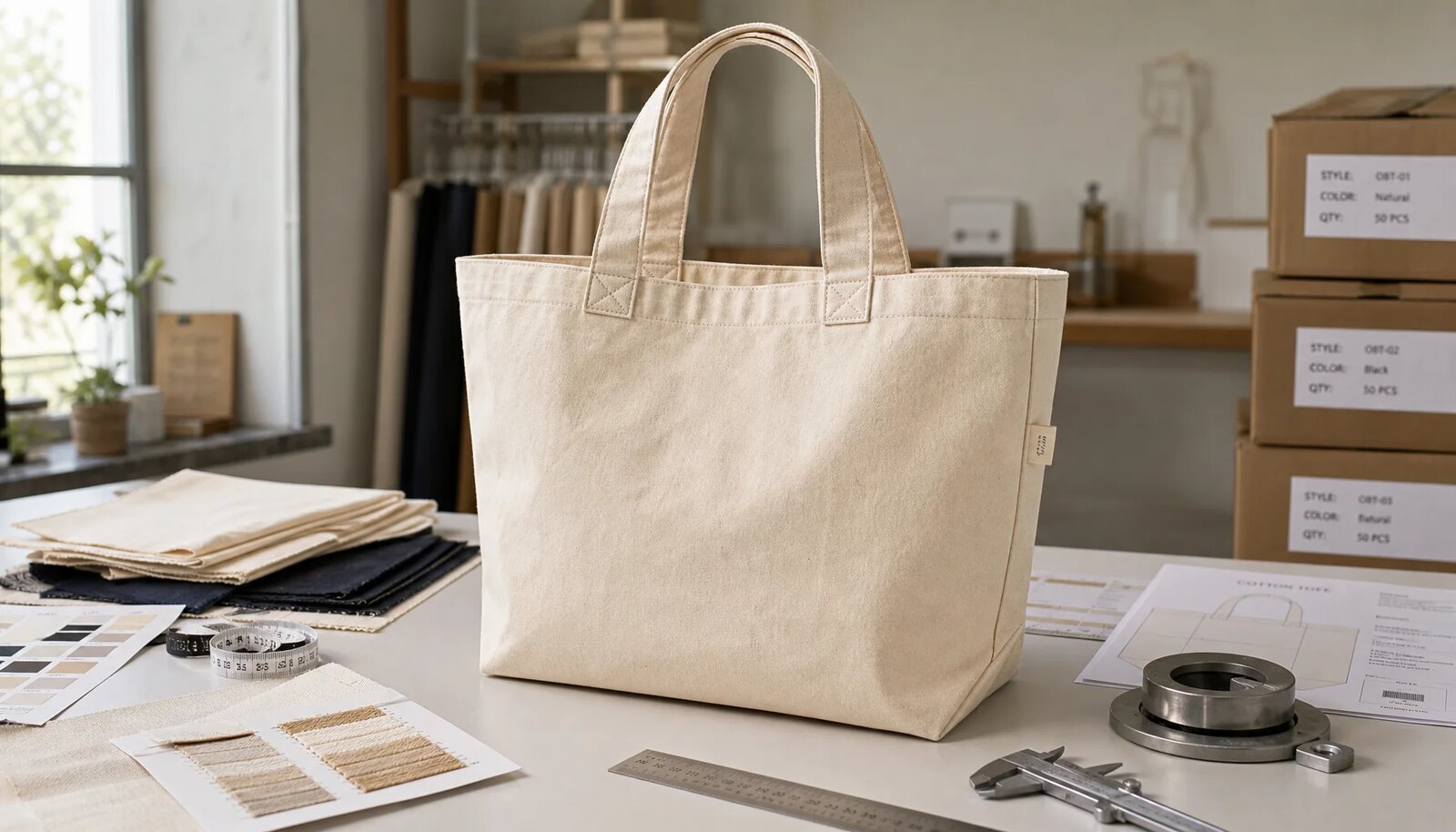
Why event tote sourcing needs a real spec
Organic cotton totes look simple until they become part of an event operation. They carry delegate materials, display sponsor artwork, move through receiving docks, sit on registration tables, and often travel home with attendees. A bag that seems acceptable in a catalog photo can still cause trouble on-site if the cloth is thin, the handles pull at the top hem, the logo prints poorly, or the cartons arrive with unclear labels.
For procurement buyers, the first challenge is quote comparability. One supplier may price a 120 gsm flat tote with basic stitching. Another may quote a 180 gsm gusseted canvas tote with reinforced handles, a strike-off, pre-production sample, and marked export cartons. Both offers may say organic cotton tote, but they are not the same product. The cheaper line may simply leave out fabric tolerance, certification detail, print risk, packing, or inspection support.
A strong organic cotton totes material selection guide for event planners turns a creative request into a buying specification. It gives suppliers the same baseline, makes tradeoffs visible, and keeps the approval path clean for brand, sustainability, operations, and finance teams. The aim is not to over-engineer a giveaway. It is to avoid vague purchasing language when the event date cannot move.
- Write the tote specification before requesting pricing, including fabric, finished size, handles, print, packing, delivery term, and sample stage.
- Normalize quotes by gsm, weave, certification basis, reinforcement, print method, packing, and inspection assumptions.
- Keep one approved sample and final spec sheet for receiving checks, reorders, and supplier accountability.
- Treat carton labeling and packing as part of the product, not as an afterthought handled after production.
Start with the actual event load
The best material choice starts with the contents, not the logo. A tote holding an agenda, badge card, pen, and slim notebook does not need the same fabric as a bag carrying a bottle, boxed sample, hoodie, catalog, and sponsor inserts. Registration teams also add last-minute materials more often than anyone plans for, so buyers should estimate the heaviest realistic pack rather than the neatest version shown in the planning deck.
Fabric weight and handle construction should move together. For paper-only programs and short-duration giveaways, 120 to 140 gsm organic cotton may work when a softer, lighter bag is acceptable. For most business events, 140 to 180 gsm is a more practical starting point because it usually improves opacity and handfeel without making carton weight excessive. For VIP kits, merchandise, bottles, or heavier inserts, evaluate 180 to 220 gsm canvas with reinforced handle points.
Shape matters too. A flat tote is efficient for documents, brochures, and folders. It can bulge awkwardly when the contents include bottles, boxes, or apparel. A gusset adds fabric cost and carton volume, but it can make packing faster and the finished kit neater. For mixed insert programs, an 8 to 12 cm finished gusset is a useful test range. Approve the sample with the real insert pack inside; an empty tote can hide a sizing mistake until the venue team discovers it.
- Create a contents list with approximate dimensions and loaded weight before sending the RFQ.
- Use 140 to 180 gsm as a baseline for standard conference totes, then adjust based on load and budget.
- Move to 180 gsm or higher when the bag must carry bottles, boxed samples, apparel, or premium merchandise.
- Ask for a sample filled with the planned insert pack or build an internal dummy pack before approving size.
- Confirm whether the handle works for shoulder carry, hand carry, or both.
Define organic cotton claims carefully
Organic cotton wording needs more precision than many RFQs give it. A tote may be made from organic cotton fiber, made from certified organic fabric, or covered by a finished-product certification scope. Those are different claim positions. The right answer depends on the supplier, mill, processing route, documentation, and certification program. Procurement should not assume that the phrase organic cotton tote supports every sustainability statement a marketing team might want to print.
Ask the supplier what is certified and what documents can be provided for buyer files. If only the fiber or fabric is covered, finished-product language may need to be more restrained. If chain-of-custody or transaction documents are available, collect them before artwork, packaging, website copy, or sponsor-facing materials are finalized. It is much easier to adjust wording before production than to explain a claim gap after the bags arrive.
Do not let sustainability language replace the physical spec. Organic cotton does not automatically mean thicker cloth, stronger seams, lower shrinkage, sharper printing, or better packing. The material claim and the performance requirements are connected buying decisions, but they are not the same decision. A serious RFQ names both: the supportable organic cotton basis and the construction details that make the tote function on-site.
- Ask whether certification applies to fiber, fabric, processing, finished product, or a specific chain-of-custody scope.
- Collect support documents before approving printed sustainability claims or sponsor-facing language.
- Avoid broad claims that the supplier cannot document for the finished tote.
- Separate claim approval from performance approval: gsm, weave, stitching, print, and packing still need inspection.
- Keep certification documents with the purchase order, artwork approval, and final inspection records.
Choose gsm, weave, and finish together
GSM is a useful number, but it is not the whole fabric story. Two 160 gsm organic cotton fabrics can feel and perform differently. A tighter plain weave may print more cleanly and hold its panel shape better. A looser, hairier cloth can look more casual but may create fuzzy print edges, more lint, and weaker opacity. Canvas often feels more substantial, though it also increases folding bulk, carton cube, and freight weight.
Ask suppliers to quote nominal gsm and tolerance. If a quote says 160 gsm, clarify whether that is a target, an average, or a minimum. Some variation is normal in sewn cotton goods, but the buyer should know the allowed range before production. Retain the approved swatch and pre-production sample, then check bulk fabric against them using an agreed method such as a GSM cutter and calibrated scale when inspection is required.
Finish changes both appearance and operations. Natural undyed organic cotton usually has a warm, unbleached look and may show seed flecks or lot variation. Bleached white can help certain logos stand out, but it adds shade and process controls. Dyed fabric can support strong brand colors, yet it adds color matching, approval, and sometimes lead-time complexity. Washed finishes feel softer but may crease or shrink differently. Crisp finishes can photograph well but may feel less relaxed in the hand.
- Specify nominal gsm and an acceptable gsm tolerance instead of using gsm as a loose marketing descriptor.
- Name the weave: plain weave, canvas, twill, or another construction if relevant.
- Check opacity by placing dark brochures, badges, or printed papers inside the sample.
- Approve natural cotton shade under daylight and indoor venue lighting.
- Ask whether shrinkage control, washing, bleaching, or dyeing changes the final measurements or lead time.
Specify size, gusset, handles, and sewing
Finished dimensions should be written as finished measurements. Cutting size is not enough because sewing, hemming, washing, and pressing can change the final bag. A common conference tote size is around 38 x 42 cm, but it is only a starting point. Catalogs may need more width. Tall folders or rolled materials may need more height. Mixed kits may need a gusset. The purchase order should state finished body width, finished height, finished gusset depth, and the allowed tolerance.
Tolerances should be realistic and visible. A common buyer-controlled approach is plus or minus 1 cm for body width and height, with separate tolerances for gusset depth, handle drop, print size, and print placement. The exact numbers should reflect construction and factory capability. What matters is that they are agreed before production, because an inspection team cannot enforce a standard that was never written.
Handles deserve extra attention because they are the highest-stress point. A practical shoulder handle often falls around 60 to 70 cm in total length, with 2.5 to 3.5 cm handle width depending on the style. The attachment should use a box stitch, cross stitch, bartack, or equivalent reinforcement. The top hem also needs enough strength to carry that reinforcement. A strong-looking stitch pattern will not save a weak top edge if the bag is loaded quickly at registration.
- Use finished size, finished gusset, finished handle length, handle drop, and handle width in the RFQ.
- Set tolerances for body dimensions, gusset depth, handle drop, print size, and print placement.
- Confirm side seam, bottom seam, top hem, and gusset construction before approving the sample.
- Ask for close-up sample photos of handle reinforcement and stitch quality.
- Load-test the tote with real inserts, then inspect whether stitches pull, seams open, or the top hem distorts.
Match print method to artwork and fabric
Print should be decided after the base fabric is chosen. Organic cotton has texture, fiber variation, and absorbency, and those details affect color appearance and edge sharpness. Screen printing is often practical for event quantities with simple spot-color logos, sponsor marks, and one to four colors. Water-based inks may give a softer handfeel, while other ink systems may be chosen for opacity, coverage, or factory capability. The method should be proven on the actual fabric, not approved in theory.
Complex artwork needs tighter control. Fine lines, small reversed text, low-contrast marks, gradients, photographic effects, and large solid blocks can all behave poorly on textured cotton. Small type may fill in. Heavy coverage may feel stiff or show cracking if curing is weak. Natural cotton shade can also shift brand colors, so a Pantone reference on white paper is not enough. Request a strike-off at actual size on the final base fabric before bulk production.
Placement needs numbers. Centered is a direction, not a specification. State print width, print height, distance from the top edge, distance from side seam or centerline, and placement tolerance. If the tote has a gusset, pocket, seam, or label, make sure the printable area avoids those construction features. For multi-sponsor artwork, confirm legibility at final size and ask whether each artwork version, color count, or print position changes setup cost.
- Provide vector artwork where possible, with color references, print size, and placement dimensions.
- Test ink color and edge clarity on the actual fabric, especially for natural undyed cotton.
- Avoid very small reversed type, thin lines, and low-contrast marks unless the strike-off proves them readable.
- Check dry rub and light damp rub performance before approving bulk production.
- Clarify whether price changes by color count, artwork version, print position, coverage area, or ink type.
Build an RFQ that exposes quote differences
A useful RFQ removes hidden assumptions. Instead of asking for an organic cotton tote with logo, give suppliers the intended event use, quantity, delivery deadline, destination, finished size, gusset, fabric gsm, weave, color, handle specification, sewing reinforcement, print details, packing format, sample requirement, and delivery term. That shared baseline lets suppliers price the same bag and flag risks clearly.
Ask suppliers to show exclusions. Does the price include artwork setup, strike-off, pre-production sample, sample courier cost, inspection support, export carton packing, carton labels, freight, duties, destination charges, or venue delivery? A quote that excludes these items can look attractive at first and become expensive once the order is live. Event dates are fixed, so late surprises usually cost more than early clarity.
Invite technical alternatives, but require them to be named. A supplier may recommend increasing fabric from 140 gsm to 160 gsm, reducing print coverage, adjusting gusset depth, standardizing handles, or changing carton quantity. Those comments are valuable when tied to cost, lead time, or quality risk. Record alternatives in the comparison sheet so stakeholders can see why two offers differ instead of assuming one supplier is simply cheaper.
- Send the same specification and artwork to every quoting supplier.
- Require suppliers to state fabric gsm, tolerance, weave, certification basis, print method, packing, and delivery term in the quote.
- Ask for price breaks at realistic quantity bands if attendee count may move.
- Compare FOB, EXW, DDP, and delivered-to-venue quotes separately unless all cost elements are normalized.
- Keep quote comments, exclusions, and assumptions visible in the buyer comparison table.
Control MOQ, versions, and reorder risk
MOQ is shaped by more than supplier preference. Fabric sourcing, dyeing or bleaching, cutting yield, printing setup, sewing efficiency, packing complexity, and destination splits all influence the minimum. A single natural cotton tote with one print position is much easier to manage than five city versions with different sponsor panels, carton labels, and delivery points. Every version adds setup, QC, labeling, and shortage risk.
Event teams often want personalization by city, sponsor, attendee tier, or theme. That can be worthwhile, but the buyer should price the complexity before committing. Sometimes the base tote can stay standard and personalization can move to a hangtag, insert card, belly band, sticker, or carton allocation. If the tote artwork must change, ask for MOQ and pricing by artwork version, not only by total quantity.
Reorder planning should start before the first order closes. Repeat events benefit from stable specifications: same fabric range, same finished size, same handle construction, same print position, and retained samples. If fabric lots or mills change between runs, natural cotton shade and handfeel may shift. A clean reorder file should include the approved sample, artwork, placement dimensions, packing format, carton marks, tolerances, and inspection findings from the previous run.
- Ask for MOQ by fabric color, bag size, print version, destination split, and packing version.
- Compare the cost of one standardized SKU against multiple event-specific SKUs.
- Use hangtags, insert cards, or carton allocation for personalization when the bag itself does not need to change.
- Confirm whether approved screens, patterns, or retained samples can support reorders.
- Add contingency quantity for damaged goods, sponsor changes, staff needs, and late attendee additions.
Approve samples as production references
Sample approval is more than a brand review. It creates the physical reference for bulk production and receiving inspection. A fabric swatch can confirm material direction, but it cannot prove sewing, handle strength, shrinkage, or print behavior. A blank sample can prove construction but not logo quality. A strike-off can prove ink on fabric but not the full finished bag. For event procurement, the strongest approval point is a pre-production sample made with final fabric, final construction, final print, and the agreed packing approach.
Measure the sample against the specification. Record body width, height, gusset depth, handle length, handle drop, handle width, print size, and print placement. Fill it with the planned contents and carry it the way an attendee will. Fold it as it will be packed and check whether the print sticks, transfers, cracks, or picks up lint. View it in daylight and under indoor lighting similar to registration and sponsor areas.
After approval, changes need discipline. Moving the logo, changing fabric weight, adding a sponsor mark, switching ink type, or altering handle length can affect price, schedule, and QC references. If a change is necessary, update the specification and confirm whether a revised sample is required. Label, date, photograph, and retain the approved sample so it is treated as a production standard rather than an informal mockup.
- Require a pre-production sample for high-visibility, premium, or schedule-sensitive programs.
- Measure the sample and keep an approval record with actual values, not only pass or fail notes.
- Check the sample loaded, folded, stacked, and handled, not only displayed flat.
- Confirm what changes are allowed after approval and what changes trigger resampling.
- Keep retained samples with the buyer, supplier, and inspection team when practical.
Set QC and packing criteria early
Quality control should be agreed before fabric is cut. For event totes, the most important checks are fabric consistency, finished measurements, handle strength, seam quality, print execution, cleanliness, packing count, and carton labeling. These are the defects that create real event problems: torn handles, wrong artwork, dirty bags, visible shade spread, unreadable logos, short quantities, and mixed destination cartons.
Define major and minor defects in writing. Major defects may include wrong fabric, wrong size outside tolerance, wrong artwork, severe print misregistration, open seams, handle failure, major stains, mildew odor, wrong carton quantity, or wrong destination labeling. Minor defects may include light wrinkles, small thread tails, minor natural fiber specks, or small print imperfections within agreed limits. If the order uses AQL inspection, state the inspection level and acceptance limits in the purchase documents. If formal AQL is not used, still define sample size and acceptance rules.
Inspection should pull from more than one carton and more than one part of the run. Checking only top pieces can miss shade spread, sewing drift, or packing errors. For higher-risk events, request in-line production photos and a final inspection before shipment. Include practical checks: measurements, dry rub or light damp rub on printed areas, loaded carry tests, carton count verification, and photo evidence of carton marks. Packing is part of quality, especially when boxes must be split by venue, city, sponsor, or registration zone.
- Use the approved sample as the reference for fabric, shade, stitch, print, and finish.
- Inspect units from start, middle, and end-of-run cartons when possible.
- Define major defects and minor defects in writing before production.
- Check print rub, handle reinforcement, seam integrity, odor, stains, and carton counts before shipment.
- Document accepted deviations so the receiving team knows what was approved and why.
Specification comparison for buyers
| Spec decision | Procurement baseline | When it fits | Buyer risk to control |
|---|---|---|---|
| Fabric weight | 140 to 180 gsm organic cotton plain weave or light canvas, with quoted gsm tolerance stated | General conferences, delegate bags, sponsor packs, press kits, and mixed paper inserts | Below-spec fabric may be translucent, distort during sewing, crease heavily, or fail earlier at handle stress points |
| Premium fabric weight | 180 to 220 gsm organic cotton canvas with reinforced handle points and controlled shrinkage | VIP kits, resale merchandise, higher-load inserts, and reuse-focused event programs | Higher gsm increases fabric consumption, carton weight, freight volume, and folding bulk; confirm landed cost, not only unit price |
| Lightweight option | 120 to 140 gsm organic cotton only for low-load, budget-sensitive giveaways | Flat agendas, single brochures, light stationery, or short-duration handout use | Can look thin, show contents, feel less structured, and be less suitable for sponsor-heavy branding |
| Weave and finish | Tight plain weave or canvas, clean surface, low lint, and shrinkage-controlled finishing | Programs needing sharper print edges, stable finished dimensions, and consistent presentation in photos | Loose or hairy cloth can cause fuzzy print edges, shade variation, lint, and panel distortion |
| Finished size and tolerance | Finished dimensions stated in cm, commonly around 38 x 42 cm, with tolerance such as plus or minus 1 cm for body dimensions | Standard conference kits, notebooks, catalogs, handouts, and light merchandise | Quotes based on cutting size or unstated tolerance can produce bags that are visibly smaller or inconsistent across cartons |
| Gusset | 8 to 12 cm finished gusset for mixed inserts; no gusset for flat paper-only programs | Bottles, boxed samples, apparel, catalogs, welcome kits, or any pack needing volume | Too little gusset makes loading awkward; too much gusset raises fabric use, carton cube, and unit cost |
| Handle length and construction | 60 to 70 cm self-fabric handles, 2.5 to 3.5 cm wide, with box stitch, cross stitch, bartack, or equivalent reinforcement | Shoulder-carry event totes handled repeatedly during registration, sessions, and travel | Short handles reduce usability; weak attachment can tear at top hem when the bag is loaded quickly |
| Print method | Screen print with suitable ink for simple spot-color logos; sample-test detailed artwork on final fabric | One to four spot colors, sponsor marks, event logos, and repeatable production quantities | Fine lines, small reversed text, gradients, and dense coverage may fail on textured cotton without a strike-off |
| Color strategy | Natural undyed organic cotton as default; bleached or dyed fabric only with shade approval and claim review | Sustainability-positioned events, lower color-matching complexity, and neutral brand palettes | Natural cotton shade varies by lot; bleached or dyed cotton adds processing, shade-control, and approval variables |
Buyer checklist before sampling
- Define the tote use case first: registration handout, delegate bag, sponsor pack, press kit, VIP gift, staff kit, retail merchandise, or post-event reusable bag.
- List planned contents with approximate dimensions and loaded weight before selecting gsm, gusset, handle length, and reinforcement.
- Set a fabric range in the RFQ, such as 140 to 180 gsm for standard conferences, 180 to 220 gsm for premium kits, or 120 to 140 gsm only for light-load giveaways.
- State the exact material position: certified organic cotton fiber or fabric, natural undyed, bleached, dyed, plain weave, canvas, washed finish, crisp finish, or other finish.
- Ask what certification documents are available and what claim wording is supportable for the finished product, packaging, and buyer records.
- Specify finished body width, finished height, gusset depth, handle length, handle width, seam allowance expectations, stitch type, and measurement tolerance.
- Share artwork before pricing, including print dimensions, color count, Pantone or brand references, coverage area, placement, file format, and any small text or thin-line risks.
- Require a strike-off or pre-production sample on the actual bulk fabric before bulk production, especially for natural cotton shade, ink color, and print edge approval.
- Define acceptable tolerances for print placement, print size, handle drop, body dimensions, shade spread, thread trimming, and carton count accuracy.
- Request packing details in the quote: inner pack quantity, master carton quantity, carton dimensions, gross weight, carton marks, barcode labels if needed, and destination splits.
Factory quote questions to send
- What is the exact fabric specification, including nominal gsm, gsm tolerance, weave type, yarn count if available, finish, shrinkage control, and whether the cotton is natural, bleached, or dyed?
- Is the cotton certified organic under a recognized program, and which documents can you provide for buyer files without overstating claims about the finished bag?
- Does the quote cover certified organic cotton fiber only, certified fabric, or a finished product certification scope? Please state the claim basis clearly.
- What finished bag size, gusset depth, handle length, handle width, and measurement tolerance are included in this quotation?
- What stitch construction is included at handle points, top hem, side seams, bottom seam, and gusset corners, and can you provide sample photos of the reinforcement?
- What is the assumed stitch density or stitches per inch range, and how will skipped stitches, open seams, loose threads, and fraying be controlled?
- Which print method is included, what ink type is assumed, and how does pricing change by color count, print size, coverage area, artwork version, or print position?
- Can you produce a strike-off on the actual bulk fabric, and what can still be changed after strike-off approval without affecting price or lead time?
- What is the MOQ by bag size, fabric color, fabric weight, print artwork, destination split, and carton-label version?
- What price breaks apply at higher quantities, and do they depend on fabric purchasing, printing setup, cutting efficiency, or packing format?
Quality-control points to confirm
- Verify fabric gsm with an agreed method, such as a GSM cutter and calibrated scale, and compare bulk fabric against the retained approved sample.
- Measure finished body width, height, gusset depth, handle drop, handle width, and print placement on units from multiple cartons, not only from the approved pre-production sample.
- Compare weave density, handfeel, opacity, surface hairiness, lint, and shade against the approved sample so lighter, looser, or visibly different fabric is not substituted.
- Inspect handle attachment points for box stitch, cross stitch, bartack, skipped stitches, weak back-tacks, needle damage, loose thread ends, and edge fraying.
- Check top hems, side seams, bottom seams, gusset corners, and seam allowances for consistent stitch density, straightness, open seams, raw edges, and trimming.
- Review print registration, edge sharpness, ink density, curing, placement, color consistency, coverage, and small-type legibility under daylight and indoor venue-style lighting.
- Perform dry rub checks on printed areas and, where relevant, a light damp rub check to identify tackiness, transfer, poor curing, or color bleed before cartons are sealed.
- Load-test the tote with a realistic event insert pack, including brochures, notebooks, bottles, samples, or merchandise, then carry it by the handles for practical handling simulation.
- Check shade spread across cartons and inner packs, especially for natural organic cotton where fiber tone, seed flecks, and lot variation may be visible.
- Inspect for odor, lint, stains, oil marks, mildew signs, printing smears, cutting dust, loose fibers, and contamination from sewing or packing areas.