Start with the tote job, not the logo
For farmers market vendors, an organic cotton tote is a working container first and a branding surface second. It has to carry produce, jars, bread, flowers, and the kind of impulse purchases that happen at the table without collapsing or feeling awkward in the hand. If the bag only needs to hand out a coupon, the spec can be lighter. If it is expected to replace a plastic carrier every Saturday, the construction needs to be deliberate from the start.
The right spec depends on how shoppers will use the bag, how often they will reuse it, whether it will be sold or given away, and how much brand risk the buyer can tolerate if the tote pills, twists, or loses shape early. A bag for weekly market trips needs different design priorities than a premium retail tote or a one-off event handout. Procurement works better when the use case is written clearly before anyone starts quoting fabric or print.
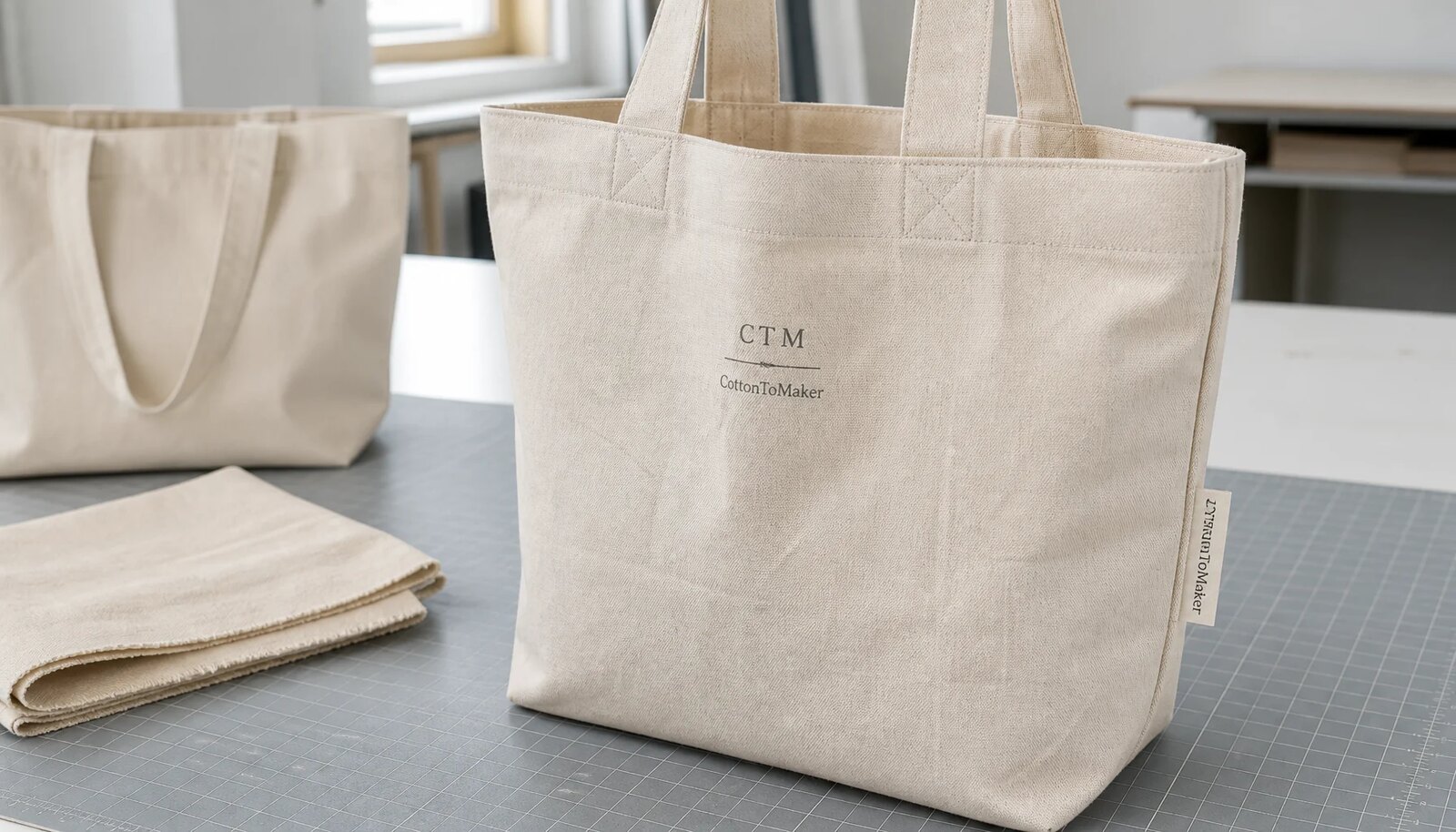
A practical starting point for many market programs is a finished size around 38 x 42 cm with an 8 to 12 cm gusset and handles long enough for shoulder carry. That size is large enough for a normal grocery load but still compact enough to fold, stack, and display neatly at the booth. If the tote needs to stand upright on a table or shelf, its shape matters as much as the fabric because a bag that holds its form often sells better than one that looks limp when empty.
- Choose one primary load scenario and quote to that use case only.
- Decide whether the tote must fold flat for checkout storage or stand upright for display.
- Set the carry style early because shoulder carry and hand carry drive different handle lengths and seam loads.
- Write the expected reuse frequency into the brief if the tote must survive weekly market use.
Match fabric weight and weave to real payloads
Fabric weight is one of the biggest drivers of feel, performance, and cost. A 120 to 140 gsm cloth can work for light promotional use, but it often feels too soft for shoppers carrying heavier produce or several items at once. For a reusable farmers market tote, 140 to 180 gsm is a more defensible starting point because it gives the bag enough body to carry weight without becoming too stiff or difficult to fold.
If the tote is also a retail item or premium brand merchandise, 180 to 220 gsm can be justified because the bag feels more structured and durable in hand. The tradeoff is higher material cost, slower drying after printing or washing, and a larger folded volume. Plain weave is usually the most economical and prints cleanly. A heavier canvas build adds structure, but it also changes the drape on the shoulder and can make the tote look bulkier when empty.
Natural unbleached fabric is often the easiest fit for an organic cotton program because it supports the material story and avoids dye-lot complexity. If the buyer wants white or a dyed color, the quote needs to include shade standards, lot control, and the expected variation across production. A supplier saying premium cotton or heavy canvas is not enough. Procurement needs a measured gsm, a weave description, and a fabric width so quotes can be compared on the same basis.
- Ask for measured gsm, not a catalog name or marketing term.
- Require the supplier to state fabric width so cutting yield is visible in the quote.
- Ask for shrinkage expectations after steam or wash if the tote will be reused often.
- Define whether visible slubs and natural variation are acceptable or whether you want a cleaner retail finish.
Treat organic claims as a scope question
Organic cotton is not a single sourcing statement. There is a difference between fabric made from organic fiber and a finished tote that sits inside a documented chain of custody. If the bag will be sold through retail channels or used in packaging with a formal environmental claim, the buyer needs to know exactly which part of the supply chain is covered and what evidence the supplier can provide at the finished-bag level.
That distinction matters because trims, labels, thread, and printing inks can affect the claim path. Some buyers only need an organic fiber content statement and can work with a simpler document set. Others need the finished tote, the label, and the packing process to stay inside a recognized organic textile standard. Those requirements should be set before sample development starts because changing the claim standard later can force a new label, new packing, or a new print process.
If the supplier offers a certificate but cannot show the certificate scope, transaction documents, and the product names covered by that scope, the buyer should treat the claim as unverified until proven otherwise. For procurement, the safest approach is to define the acceptable claim language in the spec sheet and ask the factory to confirm whether the tote can be produced inside that scope without exceptions.
- Separate the marketing story from the compliance requirement in the RFQ.
- Decide whether thread, labels, and hangtags must also satisfy the same organic standard.
- Ask for proof at the finished bag level, not only at the yarn or fabric-roll level.
- Confirm how the supplier handles transaction certificates, invoice naming, and lot traceability.
Specify construction that survives weekly reuse
The weak points on a tote are predictable: handle roots, top hem, side seams, and the bottom seam. If the bag is going to carry produce week after week, the buyer should care more about those details than about decorative stitching. A clean double topstitch, properly reinforced handle anchors, and consistent seam allowances usually matter more than a fancy finish that adds cost without adding strength.
The bottom shape affects real performance. A gusset gives the bag volume and helps it stand open at the market stall, but the gusset has to be balanced with body size or the tote becomes bulky and awkward. If the buyer wants the bag to sit flat on a table or hold square when loaded, a reinforced base or insert may help. If the goal is simple foldability and lower cost, a softer construction may be the better answer.
A construction spec should explain exactly how the factory reinforces stress points. Terms like standard reinforced construction are too vague to use in procurement. The buyer should ask for the stitch type, stitch density, seam allowance, and handle reinforcement method so there is no room for a supplier to substitute a weaker build and still claim compliance with the PO.
- Use bar tacks or box-X reinforcement at the handle roots.
- State the seam type for the side seams and bottom seam instead of leaving it to factory default.
- Specify whether the bag needs a self-fabric lining, a base insert, or no internal structure at all.
- Ask for a pull-strength check on the handle attachment if the bag is intended for heavier loads.
Choose the decoration method by artwork and wear life
For most organic cotton tote programs, screen printing is still the most practical choice when the artwork is simple. It gives good coverage, consistent color, and a straightforward cost structure for repeat runs. Water-based inks are often preferred when the buyer wants a softer hand feel, while heavier ink systems may feel more durable but can also add stiffness or crack if the cure is poor or the cloth is too light.
The artwork should be evaluated against the tote, not in isolation. A farmers market bag usually works best with a restrained logo, a short message, or a clean one-color graphic. Fine lines, tiny type, and gradients increase risk because they can shift between strike-off and bulk, especially on natural cotton with visible texture. If the design is too complex, the better procurement answer may be to simplify the artwork instead of forcing a difficult decoration method onto a utility bag.
Print durability matters because this is a reusable item that will be folded, carried, and sometimes washed. The buyer should ask how the ink is cured, how the supplier tests rub resistance, and what happens if the print needs to sit across a seam or near a handle anchor. A sample that looks good on a table is not enough if the print flakes after a few uses.
- Match the print method to the number of colors, line weight, and intended reuse rate.
- Ask the supplier to quote the print area, number of screens, and curing method separately.
- Avoid tiny type or highly detailed gradients unless the factory has already proven that capability on the same fabric.
- Require a rub test or wash test on the approved sample before bulk printing begins.
Build the quote so suppliers price the same bag
A clean RFQ is the difference between a usable quote and a number that only looks low. The buyer should force every supplier to price the same finished dimensions, same fabric gsm, same print method, same packing format, and same delivery basis. If one supplier is quoting ex works, another is quoting with cartons and labeling included, and a third is bundling samples into the unit price, the comparison is not real.
The quote should break out fabric, cutting, sewing, print setup, print run, labels, packing, and cartons. It should also show sample fees, strike-off fees, screen or plate charges, and the expected MOQ by color or by artwork configuration. That structure helps the buyer see whether a cheap unit price is actually coming from a lighter cloth, a weaker print, or a packing format that creates extra labor on arrival.
For seasonal or reorder programs, add a note about the expected replenishment window and whether the supplier should reserve the same fabric source for the next lot. That matters because even small changes in fabric lot, thread, or packing method can create a bag that looks close in photos but fails the approved sample in hand.
- Send one tech pack or spec sheet with all dimensions and artwork placement marked clearly.
- Ask for MOQ by color, by print setup, and by packing configuration.
- Request sample fee, strike-off fee, and bulk unit price as separate line items.
- State the incoterm or delivered basis so freight and duty assumptions do not hide inside the tote price.
Compare supplier routes before unit price
The same tote can come from a direct factory, a trading company, a local decorator, a small cut-and-sew workshop, or a larger commodity tote mill. Those routes are not interchangeable. Direct factories usually give the clearest control over construction and repeat orders. Trading companies can help when the spec is still moving, but the buyer needs to know who actually makes the bag and who is responsible if the order goes off spec. Local decorators on imported blanks can be useful for rush orders, though they often weaken traceability on the base bag.
A small workshop can be the right answer for samples, low MOQ development, or a pilot retail launch because it is more flexible about minor changes. A large commodity mill is better when the order is standardized and cost pressure is the main issue. The risk is that a commodity supplier may try to simplify the bag or switch to a lighter fabric unless the buyer has locked the spec tightly enough to make substitution obvious.
If the tote program matters to the brand, the buyer should ask who controls each step: fabric sourcing, sewing, printing, packing, and final QC. The lowest quote is not useful if the selling season is missed or the supplier cannot prove which facility made the final bag.
- Confirm whether the seller is the actual maker or a middle layer managing the order.
- Ask which processes are in-house and which are subcontracted.
- Verify who signs off on final quality before shipment.
- Keep a backup supplier approved if the tote will be reordered during peak season.
Approve samples with measurable gates
A useful sample process has three stages: the physical sample, the print strike-off or lab sample, and the final top sample before bulk. The first sample should prove the size, hand feel, construction, and label placement. The print sample should prove color, opacity, alignment, and cure on the exact fabric the factory expects to use. The final top sample should match the bulk line plan, not just the prototype room.
The buyer should define acceptance criteria before the sample arrives so the conversation stays factual. That usually means stable finished dimensions, consistent handle length, no skipped stitches, no visible stress at the handle roots, and a print that does not bleed through the cloth unless the design intentionally uses a heavy ink layer. If the sample misses those targets, the order should not move to bulk just because the quote is attractive.
For reusable market totes, the sample should be checked with some realism. Load it with the kind of items a customer will actually carry, fold it the way it will be stored, and if possible wash or steam it the way the end user might. A sample that only looks good on a table can still fail in real use, and that failure usually comes from construction or fabric choice, not from artwork.
- Retain one golden sample and require the factory to keep a matching reference.
- Check dimensions, handle symmetry, seam density, and label placement on every approval sample.
- Test rub resistance and wash response before releasing bulk print.
- Inspect the bag after loading it with a realistic market weight, not only when empty.
Pack and ship for shelf readiness
Packing is not a low-value detail on a tote program. It affects labor, appearance, and damage risk. A neatly folded tote with clean labeling can move straight from carton to shelf or booth, while loose bulk packing may save money but shifts work to the buyer on arrival. The right answer depends on whether the bags are going to retail stores, warehouse storage, or immediate distribution at a market event.
For export and wholesale programs, the buyer should lock the fold method, inner pack count, master carton size, and carton mark format before production begins. Cotton can crease, and those crease lines can affect how the printed bag looks when it is first displayed. If shelf presentation matters, the buyer may want a more controlled fold or a simple inner wrap that preserves appearance without creating too much extra packaging.
Transit planning matters too. Master cartons that are too heavy can be awkward to handle and may cause damage if they are stacked poorly. Cartons that are too loose can collapse or deform the bags inside. The packing spec should therefore cover not only count, but also carton strength, pallet pattern, moisture protection, and barcode placement for receiving.
- Define retail-ready packing separately from bulk warehouse packing.
- Confirm carton dimensions, gross weight, and pallet plan before shipment.
- Make sure barcode, SKU, and PO marks match the buyer's receiving system.
- Ask whether the supplier uses moisture barriers or desiccants if the route is humid or long haul.
Protect lead time and landed cost before the season starts
Organic cotton tote schedules usually slip because of sample approval, fabric booking, print congestion, or packing changes. Sewing is rarely the hardest part. A realistic timeline should include sample development, print approval, material booking, production, packing, and a buffer for correction. If the bag is tied to a market launch, that buffer matters more than shaving a few days off the factory estimate.
Landed cost should be compared on the same basis every time. The buyer needs to include fabric spec, construction, print method, packing labor, cartons, inland freight, main freight, duties, and destination handling. A low factory-gate price can become the wrong choice once heavier cloth, extra label work, or a slower shipping route pushes the bag beyond the selling window.
For seasonal programs, it is worth planning a backup route before the first PO is placed. That can mean a secondary factory with the same spec or a domestic replenishment option for emergency fill-in. The point is not to over-source. The point is to keep the tote program from failing because one supplier delay landed directly on the market opening date.
- Build a schedule buffer if the tote must arrive before a seasonal market launch.
- Ask which steps are done in-house and which are sent to subcontractors.
- Compare full landed cost, not just ex-works or FOB price.
- Keep a backup replenishment path if the tote is needed for a fixed event date.
Specification comparison for buyers
| Spec decision | Recommended option | When it fits | Buyer risk to check |
|---|---|---|---|
| Direct factory with in-house sewing and print | Best for repeatable tote programs with fewer handoffs and clearer accountability | When you need stable construction, reorder consistency, and one owner for sample, production, and corrective action | Confirm fabric sourcing, sewing, printing, labeling, and packing are actually in-house and not split across unvetted subcontractors |
| Certified integrated factory | Best when the finished bag must support a stronger organic claim or retail audit trail | When the buyer needs documented chain of custody and product-level traceability | Check certificate scope, transaction certificate handling, and whether trims, labels, and print stay inside the covered process |
| Trading company with a fixed factory panel | Useful when you need faster quote coverage or multiple factory options | When the spec is still moving or you want price points from more than one production route | Verify which factory makes the final bag and who owns final QC, corrective action, and shipment release |
| Local decorator on imported blanks | Good for short runs, event merchandise, or rush replenishment | When lead time matters more than strict control over fiber origin or blank consistency | Watch for blank variation, missing traceability, and a higher landed cost once local labor and freight are added |
| Small cut-and-sew workshop | Good for low MOQ development, sample-heavy programs, or pilot retail launches | When flexibility matters more than the lowest possible unit cost | Expect wider stitch tolerance, slower scale-up, and more run-to-run variation |
| Large commodity tote mill | Best for larger volume orders with simple artwork and tight cost control | When the order is standardized and brand risk is low | Confirm the supplier is quoting the exact organic cotton spec and not a generic cotton tote with loose language |
| Dual-source production plan | Best when one approved backup supplier is needed before peak season | When demand is seasonal or launch timing is risky | Both suppliers must match dimensions, fabric hand, print position, and packing rules closely enough that the buyer can switch without re-approval |
| Domestic emergency replenishment supplier | Best for store-opening shortages, missed ocean freight, or late seasonal fill-ins | When time to shelf matters more than margin | Expect a higher unit cost and make sure the replacement tote still matches the approved sample on size, color, and print placement |
Buyer checklist before sampling
- Define the tote's primary use first: giveaway, paid retail item, or daily market carry bag.
- Set one finished size, gusset depth, and handle length before requesting quotes.
- Specify a measured fabric gsm range and a weave type, not just organic cotton.
- Decide whether the order needs a documented organic claim at the finished-bag level or only organic fiber content.
- Lock the decoration method, print area, number of colors, and ink finish before sampling.
- Define packing style, inner pack count, carton marks, and whether the tote must arrive shelf-ready.
- Request a physical preproduction sample, a print strike-off, and a final top sample before bulk release.
- Compare suppliers on the same spec sheet, the same incoterm, and the same delivery destination.
- Confirm whether thread, labels, hangtags, and cartons must sit inside the same certification or compliance scope.
- Write tolerances for size, shade, print alignment, stitch quality, and shrinkage before production starts.
Factory quote questions to send
- What is the measured fabric gsm, weave type, yarn count if available, and fabric width used for this tote?
- Can you prove the finished bag sits inside the organic certification scope, or is only the fiber organic?
- What is the MOQ by color, print setup, and packing configuration?
- Which construction details are included: seam type, seam allowance, top hem depth, and handle reinforcement?
- Which print method do you recommend for this artwork, and how is the ink cured?
- What are the sample fee, strike-off fee, tooling or screen charges, and bulk lead time after approval?
- How will the bags be folded, packed, cartonized, and marked in master cartons?
- What exact quote line items cover fabric, sewing, print, labels, packing, cartons, and inland handling?
- What shade variation should we expect between fabric lots, and how do you approve against the reference sample?
- Which processes are subcontracted, if any, and which steps stay under your direct control?
Quality-control points to confirm
- Finished dimensions should stay within an agreed tolerance, typically plus or minus 1 cm on body length and width and plus or minus 0.5 cm on handle length unless the buyer sets a tighter limit.
- Fabric weight should stay within the approved gsm band, with no substitution to a lighter cloth unless the buyer signs off in writing.
- Handle anchors should use bar tacks or box-X reinforcement with no skipped stitches, broken seam lines, loose thread nests, or uneven stitch density.
- Top hem width, seam allowance, and gusset depth should stay consistent enough that the bag hangs square and does not twist when folded.
- Print should pass the agreed rub test, tape test, or wash test after curing, with no sticky ink, visible bleed, cracking, or off-register placement beyond the approved tolerance.
- Shrinkage after wash or steam should stay within the buyer's stated threshold, often around 3% to 5% in the body and handles unless a different spec is approved.
- Carton counts, SKU marks, barcodes, and packing labels must match the purchase order and packing list exactly.
- Color consistency should stay within the approved shade band when the order is split across more than one production day or fabric lot.
- Label placement should be centered and level, with no crooked stitching, puckering, or damage to the tote face.
- A golden sample should be retained by both buyer and supplier so every bulk lot can be checked against the same reference.