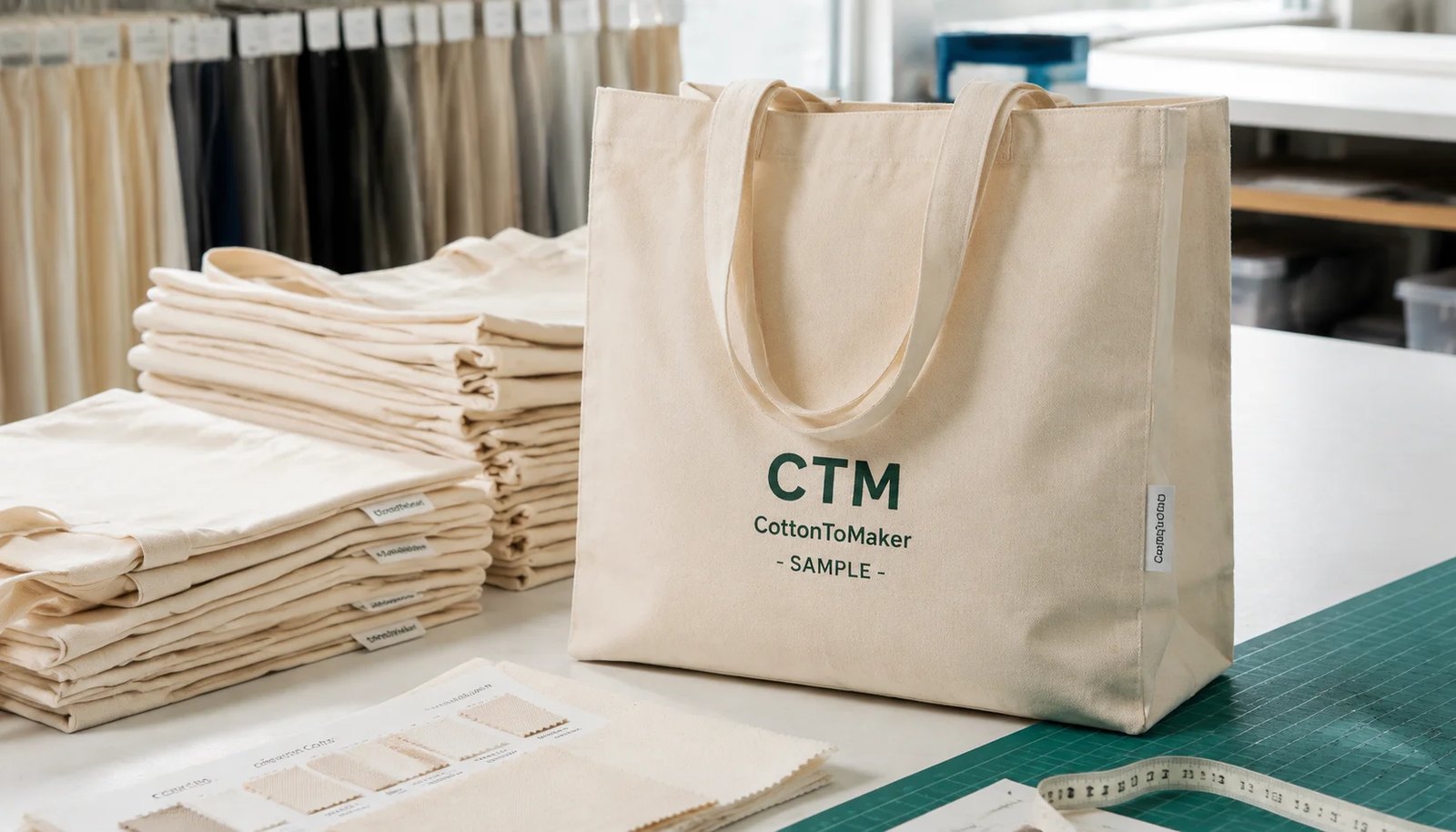
Plan From the Warehouse Date
A useful lead time plan starts with the date the totes must be received, counted, and available for stores, not the date the marketing campaign starts. Natural grocers often need time after import for distribution center receipt, item setup, store allocation, shelf placement, and promotion staging. If that internal time is not visible in the calendar, procurement may think the factory is late when the real problem is that the purchase order was placed too close to the required warehouse date.
For a custom organic cotton tote, the supplier schedule normally begins only after the quote is accepted, deposit or payment terms are settled, artwork is usable, fabric is confirmed, and the sample route is defined. A factory cannot reserve fabric or assign production capacity from an incomplete RFQ. The buyer should separate the calendar into decision dates and production dates so every department understands which approvals can delay the order.
The most useful working document is a reverse timeline. Start with the warehouse arrival date, then work backward through customs clearance, freight booking, final inspection, packing, sewing, printing, cutting, fabric readiness, sampling, RFQ comparison, and internal approval. This exposes the real deadline for approving the pre-production sample, which is usually the most important date in the project.
- Reserve internal receiving and store allocation time before promising a campaign launch date.
- Treat sample approval, fabric reservation, and certification review as schedule milestones, not informal tasks.
- Ask suppliers to show when their quoted lead time starts and what buyer actions can pause it.
- Use a larger buffer for first orders, dyed fabrics, retail packaging, or claim-sensitive organic programs.
Build the RFQ Around Fixed Decisions
The strongest RFQ is short on assumptions and clear on the few details that drive cost and timing. For custom organic cotton totes, those details are finished size, gusset, fabric weight, base fabric color, handle style, print method, artwork count, certification requirement, packing method, inspection standard, and required delivery term. If those inputs are missing, suppliers will quote different products and the lowest price will not be meaningful.
Natural grocers should also define the commercial use of the bag. A paid retail tote needs tighter cosmetic standards, cleaner packing, barcode control, and stronger hangtag or label review than a free event giveaway. A checkout resale bag needs durability and fast replenishment. A loyalty tote may need a more premium hand feel because it represents customer value. The use case affects construction, QC, and how much risk the buyer can accept.
Keep the RFQ version-controlled. If marketing changes the print size, sustainability changes the claim language, or operations changes carton allocation after quoting, the timeline may need to reset. A clean RFQ reduces rework because the factory can price actual production rather than guessing from a mood board or a prior tote photo.
- Include one target warehouse date and one acceptable latest ship date.
- List every artwork version, print color, tote color, and packing version at the start.
- Require suppliers to quote carton dimensions, gross weight, and pieces per carton with the unit price.
- Ask for sample cost, sample lead time, production lead time, inspection window, and freight term as separate lines.
Choose Fabric by Use, Not Habit
Organic cotton tote specifications are often copied from a prior program without asking whether the bag will be used the same way. Natural grocer customers may carry glass jars, produce, supplements, frozen goods, bulk items, and packaged groceries. A thin 5 oz or 6 oz cotton tote can work for a conference handout, but it usually feels too light for a bag sold at checkout or merchandised near reusable grocery products.
For many grocery retail programs, 10 oz to 12 oz organic cotton canvas is a practical starting range, roughly 280 to 340 GSM depending on weave and finishing. The buyer should still compare finished GSM, not ounce labels alone. Ounce descriptions can vary by market, and some quotes may refer to greige fabric before finishing. GSM gives procurement a better basis for comparing supplier offers, especially when quotes come from different regions.
Fabric color also changes timing. Natural unbleached organic cotton is usually the simplest route and matches the visual language many natural grocers want. Dyed organic cotton can be appropriate for private label assortments or seasonal campaigns, but lab dips, dye lot MOQ, shade approval, and colorfastness checks can add time. If the campaign date is fixed, choose the fabric path before sampling begins.
- 6 oz to 8 oz: suitable for light promotions, but weaker for paid grocery tote programs.
- 10 oz: balanced for reusable checkout bags, regional campaigns, and moderate retail pricing.
- 12 oz: stronger hand feel for premium programs, heavier loads, and longer reuse expectations.
- 14 oz and above: premium and durable, but higher material cost, freight weight, and sewing time.
Specify Construction Before Price Comparison
A tote price without construction detail is only a rough indication. The buyer should define finished width, height, gusset depth, handle drop, handle width, seam finishing, bottom construction, and reinforcement method before comparing suppliers. A boxed bottom or side gusset usually performs better for grocery use because the bag can hold packaged goods more efficiently and stand more predictably during loading.
Handle construction deserves special attention. Short handles may look tidy but can be uncomfortable over a coat. Very long handles can make a loaded bag swing low and feel unstable. For reusable grocery programs, many buyers prefer a shoulder-capable handle drop with a width that does not cut into the hand. Reinforced cross-stitch or box-stitch at the handle attachment should be treated as a functional requirement, not a premium extra.
The construction spec should also state whether dimensions are measured empty, laid flat, after pressing, or after packing. If a buyer wants a specific retail-facing shape, the supplier needs to know before cutting. Small changes in gusset depth, seam allowance, or handle length affect fabric consumption and production time, so they must be locked before the final price is approved.
- State finished dimensions, not cut panel dimensions or approximate capacity.
- Define gusset depth because it changes both usability and carton volume.
- Require reinforced handle stitching for grocery loads and inspect the stress points.
- Consider cleaner inner seams when the tote is sold at retail rather than given away.
Control Organic Claim Documents
Certification planning is where natural grocers need more precision than a generic tote buyer. GOTS and OCS are not interchangeable labels for every situation. GOTS covers organic textile processing with broader environmental and social criteria. OCS verifies organic material content and chain of custody. Which one is appropriate depends on the claim, the supply chain, the certified processing steps, and the buyer's internal claim policy.
A scope certificate shows that a company is certified for specified activities during a validity period. It does not, by itself, prove that a specific purchase order contains certified material. A transaction certificate is order-specific and may be required when the buyer wants stronger chain-of-custody support for an organic claim. Procurement should ask which entity can issue which document, at what stage, and whether document release affects shipment timing or invoice wording.
Claim control matters because grocery customers are sensitive to sustainability language. If a tote, hangtag, website, receipt description, or shelf sign says organic cotton, the buyer should make sure the documentation supports that exact wording. Avoid letting suppliers use broad phrases such as eco, natural, sustainable, or organic look as substitutes for certification evidence. If the program only needs natural cotton appearance and no organic claim, document requirements may be lighter, but the RFQ should still say that clearly.
- Use GOTS when the program requires certified organic textile processing and the chain supports it.
- Use OCS when the main need is verified organic material content and chain of custody.
- Request scope certificates from the certified supplier and confirm the listed product categories and processing activities.
- Request transaction certificates when the buyer's claim policy, retailer policy, or customer-facing language requires order-level evidence.
Match Printing to Artwork and Claims
Most natural grocer tote artwork works best as a clean one- to three-color screen print. Water-based screen printing can give a softer fabric hand than a thick transfer and usually fits the understated look expected from organic cotton bags. It is also easier to control for repeat programs when artwork, ink color, and print position remain stable.
More complex artwork needs a different conversation. Gradients, photographs, fine type, large ink coverage, and many colors can push the supplier toward heat transfer, digital printing, or higher-cost screen setups. Those methods may be acceptable, but the buyer should review hand feel, wash or rub performance, ink compliance, and how the print looks on natural cotton texture. A beautiful digital proof on screen is not the same as a production print on canvas.
Print approvals should be physical whenever the order is new or claim-sensitive. A strike-off can confirm ink color, print size, edge quality, and curing before the factory prints hundreds or thousands of panels. If panels are printed before sewing, print placement tolerance must be measured from cut or sewn reference points. If printing occurs after sewing, the factory should confirm the maximum print area and any distortion near seams.
- Provide vector artwork, Pantone references, print dimensions, and placement from fixed edges.
- Approve a print strike-off for new ink colors, large coverage, fine text, or new suppliers.
- Check dry rub and wet rub risk when dark ink prints on natural or light fabric.
- Avoid changing artwork after screen making unless the schedule and cost are reopened.
Use Sampling as Risk Control
Samples should not be treated as sales props. For a custom organic cotton tote, sampling is the buyer's chance to lock the physical standard for fabric, construction, print, packing, and workmanship. The approved sample should be labeled, dated, photographed, measured, and referenced in the purchase order. A duplicate should stay with the factory production or QC team so the inspection standard is visible on the floor.
Different samples answer different questions. A fabric swatch confirms shade, weave, GSM, and hand feel. A lab dip confirms dyed color before bulk fabric. A blank construction sample confirms size, gusset, handle drop, and seam quality. A print strike-off confirms artwork, ink, curing, and placement. A packing sample confirms folds, belly bands, hangtags, barcode labels, carton marks, and store allocation. Combining all of those into one rushed sample can save a few days but often creates ambiguity.
Approval notes should clearly state what is final and what is representative. If a construction sample uses stock fabric, do not treat its shade as approved. If a print proof is made digitally, do not treat its hand feel as the bulk screen print standard. Good notes prevent disputes during final inspection because everyone knows which sample controls which feature.
- Approve fabric before bulk cutting, especially for GSM, shade, and weave.
- Approve construction before mass sewing, especially handle drop and gusset shape.
- Approve print before panel printing, especially size, color, curing, and registration.
- Approve packing before cartons are sealed, especially for retail labels and store allocation.
Plan MOQ Around Production Reality
MOQ is not just a finished-bag number. It can come from fabric availability, dye lot size, cutting efficiency, print setup, label production, hangtag production, packing materials, and the number of artwork versions. A request for 2,000 totes can be simple if it uses one fabric, one size, one print, and one packing method. The same 2,000 units can become complicated if split across five store logos, two fabric colors, two handle colors, and retail packing for only part of the order.
Natural grocers often want local store identity, but versioning should be managed carefully. Every added artwork version may need separate screens, sample approvals, production changeovers, carton labels, and inspection checks. If the launch date is tight, a common master design with store allocation controlled by carton labels is usually more reliable than many printed versions.
The buyer should ask suppliers to quote MOQ by driver. Fabric MOQ, print MOQ, label MOQ, and finished bag MOQ may not be the same. This helps procurement decide whether to simplify the program, increase order quantity, or accept a longer schedule. It also prevents surprise charges after the supplier realizes the requested split is inefficient.
- Keep one fabric weight, one base color, and one construction when timing is tight.
- Put every artwork and packing version into the first RFQ, not after price approval.
- Ask whether MOQ is driven by fabric, dyeing, printing, labels, packing, or cutting yield.
- Use carton labels for store allocation when printed store versions add too much risk.
Set Factory-Facing QC Standards
QC language must be specific enough for a factory and inspector to use. A purchase order that says good quality or approved sample standard leaves too much room for interpretation. For organic cotton totes, define the inspection plan, AQL levels, defect classifications, measurement tolerances, load test expectation, rub test reference, shade standard, and packing checks before production starts.
A common final inspection approach is ANSI/ASQ Z1.4 general inspection level II, with AQL limits such as critical 0, major 2.5, and minor 4.0. The exact limits should match the buyer's risk tolerance. Critical defects might include safety contamination, severe odor, mold, or a wrong organic claim label. Major defects might include weak handle stitching, wrong size outside tolerance, wrong print, open seams, heavy stains, unreadable barcodes, or print transfer. Minor defects might include small loose threads or slight natural slubs within the approved standard.
Functional checks matter because grocery totes carry weight. The buyer should define a load test, such as holding 10 to 15 kg for a set time with no seam tearing, handle detachment, or gusset failure. Printed areas should be checked for dry rub, wet rub where relevant, cracking, and blocking in folded stacks. Final inspection should also verify carton count, SKU separation, barcode readability, carton marks, and whether mixed cartons match the packing instruction.
- Use written AQL limits and defect classifications rather than informal visual approval.
- Measure finished size, handle drop, print placement, and GSM from production units.
- Test loaded samples at realistic grocery weight and inspect handle stress points afterward.
- Check rub resistance, curing, blocking, stains, odor, carton marks, and barcode readability.
Compare Quotes by Landed Reliability
The lowest unit price is not automatically the best procurement outcome. A quote for an 8 oz flat tote with single stitching should not compete directly against a 12 oz gusseted tote with reinforced handles, certified document support, retail packing, and final inspection. Buyers need a quote comparison sheet that forces every supplier to answer the same questions in the same units.
Landed reliability includes cost, arrival date, document readiness, and defect risk. Carton dimensions and gross weight can change freight cost. Individual retail packing can increase labor and cube. Dyed organic cotton can add lab dip time and shade risk. Missing certification documents can delay claim approval even if the shipment is physically ready. A supplier with a slightly higher unit price may be the better option if the timeline, documentation, and QC controls are clearer.
Before awarding the order, ask each supplier to confirm the milestone schedule in writing: sample date, fabric-ready date, bulk start date, inline inspection window, final inspection date, shipment handover date, and document release date. This turns the quote from a price into a production plan. For natural grocers managing fixed promotions, that discipline is often more valuable than shaving a small amount from the unit price.
- Normalize quotes by GSM, finished dimensions, construction, print method, packing, and document scope.
- Separate sample, screen, label, hangtag, certification document, inspection, and freight charges from unit price.
- Compare EXW, FOB, CIF, DDP, and delivered estimates only when included services are clear.
- Award based on acceptable quality at a reliable arrival date, not unit price alone.
Specification comparison for buyers
| Timeline stage | Repeat program, standard natural fabric | New custom tote, natural fabric | Dyed or document-heavy program |
|---|---|---|---|
| RFQ and spec alignment | 2 to 4 working days if the prior spec is complete | 1 week to compare GSM, size, print, packing, and terms | 1 to 2 weeks if certification, dye color, or claim language needs review |
| Fabric reservation | 2 to 5 working days after deposit and PO | 1 week after swatch and GSM approval | 2 to 4 weeks for lab dips, dye lot planning, or made-to-order organic fabric |
| Sampling | May skip or use approval sample from prior order | 1 to 2 weeks for swatch, construction sample, print strike-off, or pre-production sample | 2 to 3 weeks when dyed fabric, custom labels, retail packing, or extra document checks are involved |
| Bulk production | 3 to 5 weeks after approved sample and fabric ready | 4 to 6 weeks after approved pre-production sample | 5 to 8 weeks depending on dyeing, order volume, packing labor, and inspection plan |
| Inline and final inspection | 2 to 4 days if inspection booking is pre-arranged | 3 to 5 days including report review and corrective action time | 1 week or more if reinspection, lab testing, or document release must happen before shipment |
| Freight and customs | Domestic or regional: 1 to 2 weeks; ocean import varies by lane | Add ocean, air, or truck time based on required warehouse date | Allow extra time for customs document review if organic claim paperwork travels with shipment |
| Recommended buyer buffer | 1 to 2 weeks | 2 to 3 weeks | 3 to 5 weeks for fixed promotions, store launches, or retail shelf dates |
Buyer checklist before sampling
- Define the business use first: paid retail tote, checkout resale bag, loyalty reward, staff bag, or event giveaway.
- Write the finished tote size as width x height x gusset and include handle drop, handle width, and reinforcement style.
- Specify fabric by GSM and ounce reference, plus weave, color, shrinkage expectation, and whether the quoted weight is before or after finishing.
- Decide whether the claim will be organic cotton, made with organic cotton, or natural cotton appearance only, then align documents with that claim.
- Ask for GOTS or OCS scope certificates from the certified entity in the chain and clarify whether transaction certificates are required for the order.
- Freeze artwork as vector files with Pantone references, actual print dimensions, print placement measurements, and version count.
- Limit store-specific artwork versions unless the budget and timeline can absorb extra screens, approvals, packing controls, and MOQ splits.
- Approve a physical pre-production sample before bulk cutting when using a new supplier, new fabric weight, dyed fabric, new print method, or retail packing.
- Set written tolerances for finished dimensions, handle drop, print placement, print color, GSM, shade range, carton quantity, and barcode placement.
- Confirm AQL inspection level, acceptable defect limits, load test expectation, rub test method, carton marks, and shipment handover terms before deposit.
Factory quote questions to send
- What exact organic cotton fabric is quoted: GSM, ounce reference, weave, yarn count if available, shrinkage allowance, color, and finishing method?
- Is the fabric in stock, reserved after deposit, or made to order, and what milestone confirms it is secured for this PO?
- Which certification documents can you provide: GOTS scope certificate, OCS scope certificate, transaction certificate, invoice claim language, or other chain-of-custody evidence?
- Which company in the supply chain is certified for the claimed processing step, and does the certificate scope cover fabric, cutting, sewing, printing, or only trading?
- What MOQ applies separately to fabric, dye lot, bag construction, print setup, label production, hangtags, packing, and each artwork version?
- Which print method is included, how many colors are quoted, what is the maximum print area, and what ink or curing standard will be used?
- What sample path is included: fabric swatch, lab dip, blank construction sample, print strike-off, pre-production sample, duplicate sealed sample, and packing sample?
- What are your standard tolerances for finished size, handle drop, GSM, print position, print color, shade variation, carton quantity, and barcode placement?
- Which inspection standard do you accept, such as ANSI/ASQ Z1.4 general inspection level II, and what AQL limits do you propose for critical, major, and minor defects?
- What load test can you perform on the finished tote, how much weight is used, how long is it held, and what failure points are checked?
Quality-control points to confirm
- Use a defined inspection standard, commonly ANSI/ASQ Z1.4 general inspection level II for final random inspection, unless the buyer requires another sampling plan.
- Set AQL limits before production; a common starting point is critical 0, major 2.5, and minor 4.0, adjusted for retail sale risk and buyer policy.
- Classify critical defects as safety or claim failures, such as sharp contamination, wrong fiber claim label, missing required compliance label, or severe mold or odor.
- Classify major defects as consumer-visible or functional failures, such as weak handle stitching, open seams, wrong size beyond tolerance, wrong artwork, poor curing, or unreadable barcode.
- Classify minor defects as small workmanship issues that do not affect function, such as light loose threads, minor slubs within the approved standard, or slight fold marks.
- Check GSM from production fabric, not only the development swatch, and record the sampling location and measurement method.
- Measure finished width, height, gusset, handle drop, handle width, and print placement against the approved sample and PO tolerance.
- Run a load test that reflects grocery use; many buyers specify a practical weight such as 10 to 15 kg held for a defined time, with no seam tearing or handle detachment.
- Check dry rub and wet rub resistance on printed areas when relevant, referencing a recognized rub test approach such as crocking or colorfastness to rubbing, rather than a vague hand wipe.
- Inspect print curing and blocking by checking whether stacked or folded bags transfer ink, stick together, mark adjacent fabric, or show cracking after flexing.