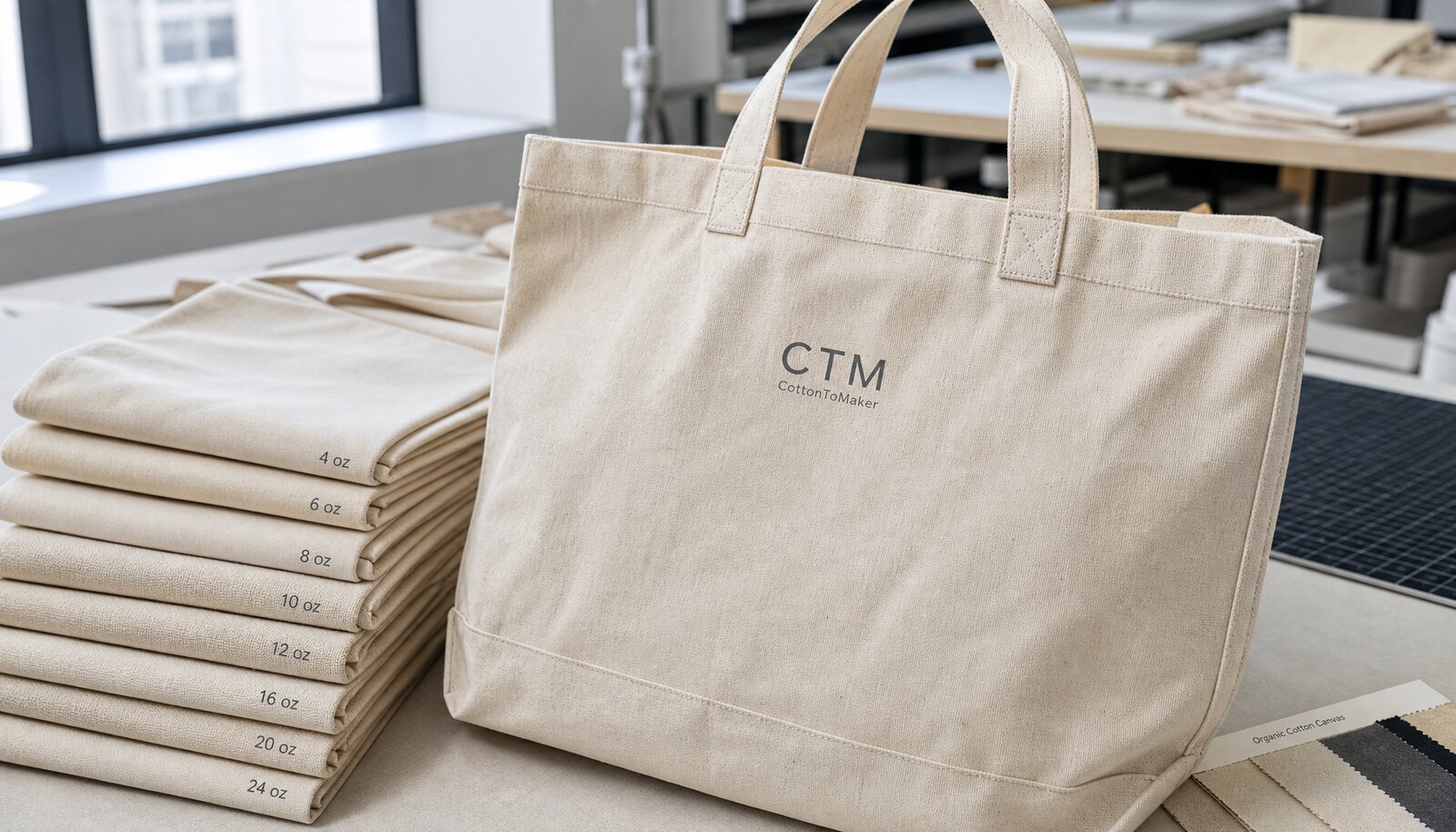
Start with the winery job, not the fabric chart
A boutique winery tote should be specified around what it has to do on site. The same bag shape might appear in a tasting room, a club pick-up line, a holiday gift set, a release weekend event, or a small retail display. In a mockup, those uses can look identical. In production, they put very different demands on the cotton, handle attachment, gusset, print method, folding, carton pack, and final landed cost.
Begin the RFQ with the operating scenario. Is the tote carrying tasting notes and a receipt, or is it expected to hold a filled 750 ml bottle? Will customers pay for it as merchandise, or will staff hand it out by the case during a festival? Does it need to sit cleanly on a retail shelf, arrive flat in club packing, or hold mixed tasting-room purchases such as candles, olive oil, apparel, and printed inserts? Those answers matter more than the first fabric number on a supplier's price list.
This organic cotton totes fabric weight guide for boutique wineries is not an argument for buying the heaviest cloth every time. The better goal is a controlled specification: strong enough for the real load, polished enough for the brand, and efficient enough for the budget. Overbuilding a paper-only event bag adds cost and freight. Underbuilding a retail or bottle-carry tote creates sagging, weak strap joins, distorted artwork, and a customer experience that feels careless.
Suppliers can quote more accurately when they understand the job before the decoration. Without that context, many quotes drift toward a basic flat promotional tote because it is fast to price and looks attractive on unit cost. That may be fine for paperwork. It is not the same as a reusable winery retail bag.
- Paper-only event use can often stay near 170 GSM when the bag size is modest.
- General tasting-room retail programs usually need a stronger starting point around 240 GSM with reinforced handles.
- Premium merchandise and gift programs may justify 340 GSM when structure and perceived value support the cost.
- Bottle-carry expectations should be written into the RFQ and verified through a practical load check.
Use GSM precisely and treat ounces as shorthand
GSM, or grams per square meter, is the cleanest procurement language for cotton tote fabric weight because it can be measured. Buyers will still see ounce labels such as 6 oz, 8 oz, and 10 oz. Those labels are common in tote sourcing, but they are not always used in the same way. One supplier may mean a market category. Another may be converting from finished GSM. Another may be referring to greige fabric before finishing.
A practical working range is 6 oz at about 170 GSM, 7 oz at about 200 GSM, 8 oz at about 240 GSM, and 10 oz at about 340 GSM. Treat those as sourcing ranges, not laboratory conversions. Weaving, dyeing, washing, calendaring, and other finishing steps can shift the final weight, stiffness, opacity, and hand feel. For a B2B purchase order, the quote should state the finished GSM and the tolerance used in production.
Finished fabric weight matters because the buyer approves a finished tote, not a roll of raw cloth. Natural organic cotton at the same nominal GSM can feel different if the weave is open, the yarn is different, or the finishing changes. A dyed bag may feel denser than an undyed natural bag at a similar stated weight. Even two 8 oz samples can perform differently once they are sewn, printed, folded, and loaded.
The safest approach is to make the approved sample the physical standard, then support it with written specs. Keep the sample with the purchase record. Record target GSM, allowed tolerance, body dimensions, gusset, handle construction, print method, and packing fold. That pairing gives procurement, production, and QC the same reference when the order is inspected or reordered later.
- Ask for finished GSM and tolerance, not only 6 oz, 8 oz, or 10 oz wording.
- Clarify whether the stated tolerance applies before or after dyeing, washing, or finishing.
- Compare hand feel, opacity, drape, weave tightness, and print result alongside the stated number.
- Avoid changing GSM after print approval because the fabric surface affects ink coverage and artwork clarity.
Match weight to load and customer experience
A lightweight tote around 170 GSM can be the right choice when the load is controlled. It suits tasting cards, maps, receipts, postcards, slim catalogs, and light event inserts. It can still look tidy if the body size is not oversized, the artwork is simple, and the sewing is clean. Trouble starts when the same lightweight bag is expected to behave like a reusable retail carrier.
Around 200 GSM gives the winery a little more body and opacity while staying in a budget-sensitive range. It is useful when a basic promotional feel is not quite good enough, but the program does not justify a merchandise-grade tote. Test it carefully if customers may add a bottle, book, candle, folded sweatshirt, or boxed item at checkout.
Around 240 GSM is often the best starting point for boutique winery retail use. It balances durability, print surface, cost, and carton efficiency better than moving directly to heavy canvas. With reinforced handles and a bottom gusset, it can support common cellar-door purchase patterns more confidently than a flat lightweight tote. It also gives logos, small location text, and crest marks a more stable surface.
Around 340 GSM belongs where the tote itself is part of the value proposition. It is appropriate for paid merchandise, premium club gifts, holiday bundles, and higher-value brand programs where the structure, opacity, and hand justify the extra cost. The tradeoff is real: heavier cotton usually affects unit price, sewing time, carton volume, gross weight, warehouse space, and freight exposure.
- 170 GSM: choose for controlled light loads and simple promotional use.
- 200 GSM: use when a better feel is needed but the program is still price-sensitive.
- 240 GSM: start here for many winery retail, tasting-room, and club pick-up applications.
- 340 GSM: reserve for premium merchandise, gift sets, and programs where structure has commercial value.
- Any bottle-carry use: validate the final handle, top hem, seams, and gusset, not fabric weight alone.
Engineer the construction around stress points
Fabric weight helps, but it does not carry the load by itself. On a winery tote, the highest-stress areas are usually the handle joins, top hem, side seams, bottom seam, and gusset corners. A filled 750 ml bottle creates concentrated pull at the strap attachment, especially when a customer carries the bag by one handle or walks with it swinging. If that join is weak, heavier body fabric will not rescue the product.
The RFQ should define handle width, handle drop, material, and reinforcement. Self-fabric handles can give a clean, continuous look with the body fabric. Cotton webbing can offer more consistent dimensions and a stronger hand. Either option can work when the sewing is specified. Long shoulder handles may be more comfortable, but they also change the hanging angle, retail display behavior, and stress pattern at the top hem.
Do not let the phrase reinforced handles stand alone. Ask for the stitch box size, cross-stitch or bar-tack detail, stitch density, thread color, and attachment method. If bottles are part of the intended use, the reinforcement needs to be visible in the written spec and present on the approved sample. Top hem construction should also be clear because the handle join is only as dependable as the material it is sewn into.
Gussets should be specified as finished depth. A bottom gusset helps the tote accept bottles, gift boxes, and mixed purchases more naturally than a flat body. Side-and-bottom gussets add capacity and shelf presence, but they also add fabric, sewing steps, inspection points, and artwork-placement decisions. Finalize the pattern before approving decoration, especially when the logo sits near a fold or corner.
- Specify finished dimensions rather than only cut-panel dimensions.
- Define handle width, handle drop, handle material, reinforcement pattern, thread color, and top hem method.
- Require measurable reinforcement for bottle-carry and retail-use totes.
- Confirm seam allowance, stitch density, and gusset depth in the technical notes.
- Inspect top corners, strap joins, and gusset corners because those areas reveal most construction shortcuts.
Control print quality on the chosen fabric
Organic cotton has texture, and texture changes print results. Natural fiber variation, slubs, seed flecks, weave openness, and fabric weight can all affect color density and edge sharpness. A winery logo that looks refined on a digital proof may soften on a rougher cotton surface. Small serif type, estate crests, fine vineyard illustrations, and location lines deserve special attention at actual production size.
Screen printing is usually the strongest option for solid winery logos, clean typography, and repeat programs. It can deliver good opacity and repeatability on natural cotton when the artwork is prepared for fabric. Buyers should request a strike-off on the exact fabric weight and body color selected for production. A strike-off on a different cotton weight may be helpful for direction, but it should not be treated as final approval.
Digital print or heat transfer can make sense for detailed seasonal art, gradients, short runs, or club-only designs. These methods need their own checks. Review hand feel, adhesion, edge lift, cracking, rub resistance, and how the decoration behaves when the bag is folded. A transfer that photographs well can feel too heavy for a premium organic cotton tote. A digital print may need pretreatment or color adjustment to reach the expected result.
Placement should be controlled after the finished pattern is confirmed. Keep important marks away from the top hem, side seams, gusset folds, and bottom crease. Review the tote filled and hanging, not only flat on a table. Customers see the bag in use, and a logo that disappears into a fold can make a well-made tote look poorly planned.
- Use screen print for solid logos, repeat orders, and clean brand marks.
- Use digital print or transfer for complex artwork only after testing the actual fabric and hand feel.
- Set print position tolerance from fixed points such as the top edge and side seam.
- Review small text at actual production size before approving screens or files.
- Inspect color, opacity, cure, adhesion, rub resistance, and edge quality during QC.
Build the RFQ so quotes are truly comparable
A strong RFQ prevents suppliers from quoting different bags under the same project name. Include finished size, GSM, fabric color, handle material, handle drop, gusset style, print method, artwork size, labels, folding, carton pack, quantity by version, delivery location, and required in-hand date. If the buyer sends only a logo and total quantity, the quotes may look comparable but describe different products.
MOQ language should be exact. Minimums may apply by fabric weight, fabric color, body size, handle color, print method, and artwork version. A winery may think of three seasonal designs as one order. The factory may see three print versions with separate setup, sorting, packing, and overrun risk. That difference affects price, schedule, and carton marking.
Ask suppliers to state what is included in the unit price. Organic cotton fabric, cutting, sewing, reinforcement, printing, labels, hangtags, folding, cartons, export packing, inland transport, and sampling are not always bundled the same way. If the buyer is comparing domestic decoration, distributor sourcing, and direct factory sourcing, landed cost is more useful than a simple unit price.
Substitution control belongs in the purchase order. The supplier should not change GSM, weave, fabric color, handle construction, print method, reinforcement, label wording, folding method, or carton pack without written approval. Some changes may be reasonable when timing is tight, but they should be visible before production moves forward.
- Attach a simple dimensioned sketch or tech pack when available.
- List quantities by artwork version, destination, SKU, or club tier.
- Ask for pricing on the same Incoterm or shipping basis for all suppliers.
- Require written approval for any change to fabric, construction, print, labels, or packing.
- Ask for optional pricing on 240 GSM and 340 GSM when stakeholders need a quality-cost comparison.
Approve samples with measurements, not impressions
Sample approval is the main control point between a nice concept and a reliable bulk order. A photo, blank stock sample, or close-enough reference bag is not enough for a fabric weight decision. The pre-production sample should use the final GSM, finished dimensions, gusset, handle construction, reinforcement, label placement, print method, and folding method. If it does not, mark it as a development reference rather than an approved production standard.
When the sample arrives, measure it. Record body width, body height, bottom gusset, side gusset if present, handle width, handle drop, logo position, stitch density, and overall appearance. Compare the measurements to the RFQ. Memory is not a specification, and small differences can matter when bottles, gift boxes, printed collateral, or retail display dimensions are involved.
Then use the tote the way a customer will use it. For a paper-only event bag, fill it with the actual collateral package. For a tasting-room retail bag, test one filled 750 ml bottle plus the expected inserts. If the tote will be sold as a two-bottle carrier, test that load with the final gusset and final handles. This is practical validation, not a dramatic destruction test.
Approvals should be written, dated, and specific. If the sample is approved with corrections, the supplier should confirm the corrected standard before bulk cutting or sewing. Keep one approved sample for procurement and, when possible, one for QC inspection. Reorders become far easier when the team can compare new production to a real physical reference.
- Label each sample as swatch, development sample, pre-production sample, or approved production reference.
- Measure finished dimensions and record them with tolerances.
- Approve fabric, construction, print, labels, and packing together when they interact.
- Test the approved sample with the intended winery load.
- Keep the approved sample for bulk inspection and future reorders.
Set tolerances before production starts
Tolerances turn subjective quality conversations into inspection criteria. Cotton totes are sewn products, so minor variation is normal. The buyer's job is to define what variation is acceptable before production begins. Without that agreement, a supplier may treat visible differences as normal variation while the winery team sees them as defects.
Useful tolerances include finished body width and height, gusset depth, handle drop, handle width, logo placement from top and side edges, print registration, fabric shade, and finished GSM. The exact numbers should be agreed with the supplier based on the process and the tote's role. A paid merchandise program usually deserves tighter visual consistency than a low-cost event giveaway.
Color and surface tolerances need extra care with organic cotton. Natural cotton may show seed flecks, shade movement, and slubs. Those characteristics can be part of the material story, but stains, heavy contamination, inconsistent dye lots, oil marks, mildew odor, or strong foreign smell should not be accepted as normal. If the winery chooses dyed cotton, confirm whether body panels and handles are dyed in the same lot.
Defect categories should be simple and commercial. Critical defects affect safety, legality, or major function. Major defects affect use, appearance, or brand acceptability. Minor defects are small imperfections that do not materially affect use or presentation. This structure helps the buyer decide whether to accept, rework, sort, replace, discount, or hold goods before release.
- Agree on dimensional, GSM, shade, print, and packing tolerances before bulk production.
- Define natural cotton character separately from unacceptable stains, odor, or contamination.
- Set stricter tolerances for paid merchandise than for low-cost event giveaways.
- Use defect categories so inspection results lead to clear commercial action.
- Keep tolerance notes with the approved sample and purchase order.
Inspect fabric, sewing, print, and packing together
Quality control should look at the whole tote, not only the logo. Start with fabric checks against the approved sample: weight, shade, weave, natural specking, slubs, contamination, odor, and hand feel. If the fabric feels materially different from the approved standard, raise that issue before moving on to print or carton checks.
Sewing inspection should concentrate on stress points. Check handle placement, reinforcement size, stitch density, skipped stitches, broken threads, loose ends, top hem puckering, side seam straightness, bottom seam security, and gusset corner strength. A tote can look acceptable in a quick glance while hiding weak strap joins or uneven seams that show up under load.
Print inspection should include color density, registration, edge sharpness, small text legibility, curing, adhesion, rubbing, cracking, and placement relative to seams and gussets. Inspect bags flat, filled, and hanging. Boutique winery branding often uses fine typography, crests, vineyard marks, and location lines, so the inspector should look closely at details that can fill in or blur on textured cotton.
Packing inspection protects presentation and cost. Confirm bag count per inner pack and carton, artwork version separation, labels, barcodes, carton marks, fold method, carton dimensions, net weight, gross weight, and carton strength. Poor folding can crease print areas. Overfilled cartons can deform handles and corners. Incorrect version separation can cause receiving problems across tasting rooms, club programs, and event teams.
- Check fabric before accepting the rest of production quality.
- Measure bags from different cartons, not just the top sample from one carton.
- Use the intended load when checking handle joins and seam strength.
- Inspect print under normal light and at both customer distance and close detail distance.
- Verify carton specification against the quote because freight and receiving depend on it.
Plan MOQ, lead time, and landed cost together
Fabric weight decisions affect more than the feel of the bag. Heavier cotton increases material cost, may slow sewing, may reduce units per carton, and can increase freight weight and storage needs. A 340 GSM tote may be exactly right for a premium retail product. It should not be chosen casually for a high-volume giveaway without checking landed cost, carton count, and warehouse impact.
Lead time depends on organic cotton availability, dyeing if required, sample development, print strike-off, sewing capacity, packing materials, inspection, and shipping. Build the calendar backward from the required in-hand date for a release weekend, holiday gift program, club shipment, or off-site event. Changing GSM, artwork, gusset, or handle construction after sample approval can reset part of the timeline.
Reorder planning matters for boutique wineries that start with a modest run and expand if the tote sells well. Ask whether the supplier can repeat the same fabric weight, shade, handle, and print method later. Confirm whether pricing changes at lower reorder quantities and whether the same MOQ applies. A complete spec sheet and approved sample reduce drift when the program repeats.
Overrun and underrun tolerance should be agreed before the PO is issued. Extra units may be acceptable for a core winery logo, but they can be a problem for dated events, vintage-specific artwork, or seasonal club gifts. Short shipments can disrupt packing schedules and retail launches. Decide in advance how quantity variance will be handled commercially.
- Request carton dimensions, gross weight, net weight, bags per carton, and total CBM before comparing quotes.
- Compare unit price and landed cost when choosing between 170, 240, and 340 GSM.
- Separate swatch, pre-production sample, strike-off, bulk production, inspection, and shipping milestones.
- Confirm reorder pricing and material consistency if the tote may become a core SKU.
- Agree on overrun and underrun tolerance before issuing the purchase order.
Specification comparison for buyers
| Decision area | Typical B2B specification | Best fit for boutique wineries | Quote and QC risk to control |
|---|---|---|---|
| 6 oz / about 170 GSM | Lightweight organic cotton; flat or shallow-gusset body; usually simple one-color print | Event handouts, tasting notes, maps, receipts, lightweight retail inserts, welcome packs with paper only | Confirm finished GSM tolerance, not catalog weight; avoid promising bottle carry unless load tested |
| 7 oz / about 200 GSM | Light-to-mid organic cotton with better opacity and hand feel than basic promo cotton | Budget-sensitive tasting-room bags where the winery wants a better feel but still controls cost | Check sagging, handle join strength, and print coverage on actual fabric before approval |
| 8 oz / about 240 GSM | Midweight organic cotton; reinforced handles; suitable for bottom gusset construction | Most general-purpose boutique winery retail bags, club pick-up bags, and cellar-door purchases | Require handle reinforcement, seam allowance, top hem spec, and practical one-bottle or two-bottle load check |
| 10 oz / about 340 GSM | Heavy organic cotton canvas-style tote; more structure; stronger retail feel | Paid merchandise, premium club gifts, holiday gift programs, and higher-value winery bundles | Higher cotton cost, slower sewing, larger cartons, greater gross weight, and more freight exposure |
| Flat tote body | No bottom depth; rectangular panels; lowest fabric and sewing complexity | Paperwork, folded apparel, postcards, small gift cards, light events | Limited volume; poor bottle stability; may look cheap if used for premium purchases |
| Bottom gusset | Added bottom depth, commonly specified in centimeters or inches after finishing | One or two bottles, gift boxes, olive oil, candles, or mixed tasting-room purchases | Gusset depth changes usable print area, folding behavior, carton volume, and load distribution |
| Side-and-bottom gusset | Higher-capacity body with more structure and more sewing operations | Retail shelves, wine club pick-up days, multi-item gift sets, premium reusable totes | Needs final pattern before artwork placement; inspect corner sewing and side seam alignment carefully |
| Self-fabric handles | Handles cut from the same or similar cotton fabric as bag body | Clean retail look, color continuity, premium natural-cotton positioning | Confirm handle width, folded thickness, stitch pattern, and whether the handle fabric is same GSM as body |
| Cotton webbing handles | Separate woven cotton tape, often stronger and more consistent than cut fabric strips | Bottle-carry bags, repeat-use totes, or programs needing stable handle dimensions | Check webbing width, color match, shrinkage behavior, and attachment reinforcement |
Buyer checklist before sampling
- Define the tote's main commercial role: free tasting-room bag, paid merchandise, wine club gift, bottle carrier, event welcome bag, e-commerce insert, or retail packaging.
- Write the expected load in plain terms: paper only, one 750 ml bottle plus inserts, two bottles, boxed gift set, apparel, or mixed tasting-room items.
- Specify finished fabric weight in GSM and include an acceptable tolerance, such as plus or minus 5 percent or the supplier's documented production tolerance.
- Clarify whether ounce descriptions such as 6 oz, 8 oz, or 10 oz refer to market naming, finished fabric, or pre-finished greige fabric.
- Provide finished bag dimensions: body width, body height, bottom gusset depth, side gusset depth if any, handle width, and handle drop.
- Require handle attachment details: self-fabric or webbing, stitch box size, cross-stitch or bar-tack reinforcement, thread type, and top hem construction.
- Define seam construction and minimum seam allowance for side seams, bottom seams, gusset corners, and top hem.
- Select the print method and specify artwork size, number of colors, Pantone or brand color references, print location, and minimum distance from seams, folds, and gussets.
- Request fabric swatches plus a pre-production sample made in the final GSM, final pattern, final handle construction, final print method, and final packing fold.
- Set measurable tolerances for body dimensions, handle drop, gusset depth, logo placement, print registration, color shade, and carton quantity before bulk production.
Factory quote questions to send
- Is the quoted weight finished fabric GSM, greige fabric GSM, or an approximate ounce label such as 8 oz? What tolerance do you apply in production?
- What fabric weights can you supply for this exact tote size and expected load, and what changes in cost, hand feel, sewing, carton size, and lead time with each option?
- What is included in the unit price: organic cotton fabric, cutting, sewing, reinforcement, printing, labels, hangtags, folding, cartons, export packing, and inland handling?
- What certificate or transaction documentation is available for organic cotton content, and what wording may be used on the tote, label, or hangtag?
- What is the MOQ per fabric GSM, body color, handle color, bag size, artwork version, and print method?
- Can you produce a pre-production sample using the final GSM, final pattern, final gusset, final handle construction, final print method, and intended folding method?
- What are your standard tolerances for finished width, height, gusset depth, handle width, handle drop, fabric weight, logo placement, and print registration?
- What handle construction are you quoting: self-fabric or webbing, width, drop, stitch pattern, stitch density, reinforcement size, thread specification, and top hem method?
- What practical load test can you perform for handle joins, top hem, side seams, and bottom corners, and how many samples are tested?
- Which print method are you quoting, and how will you control ink coverage, cure temperature or dwell time, adhesion, edge sharpness, registration, and rub resistance?
Quality-control points to confirm
- Verify finished fabric weight against the approved sample and written GSM tolerance by using a measurable fabric-weight method or supplier QC record, not only the catalog description.
- Measure finished body width, body height, bottom gusset, side gusset if present, handle width, handle drop, seam allowance, and logo placement across samples from different cartons.
- Check natural cotton shade, specking, slubs, weave consistency, dye-lot variation if dyed, stains, oil marks, odor, mildew risk, and visible contamination before goods are released.
- Inspect handle joins for reinforcement size, stitch density, skipped stitches, broken threads, loose ends, needle damage, top hem puckering, and uneven strap placement.
- Perform a practical load check based on the approved use, such as one filled 750 ml bottle plus printed materials or two bottles if the tote is sold as a bottle carrier.
- Inspect side seams, bottom seams, gusset corners, and top corners for seam slippage, twisting, open seams, weak backtacks, uneven folding, and visible raw edges where not approved.
- Check print color, opacity, registration, edge sharpness, small text legibility, ink cure, transfer adhesion, cracking, crocking, and rub resistance on the final fabric weight.
- Confirm artwork remains visually centered and undistorted when the tote is filled, hanging by the handles, and viewed from normal customer distance.
- Review labels, hangtags, barcodes, organic content wording, country-of-origin marks, care instructions, carton marks, and artwork version separation.
- Verify folding method, bags per inner pack, bags per carton, carton dimensions, gross weight, net weight, carton strength, and pallet or shipment configuration against the quote.