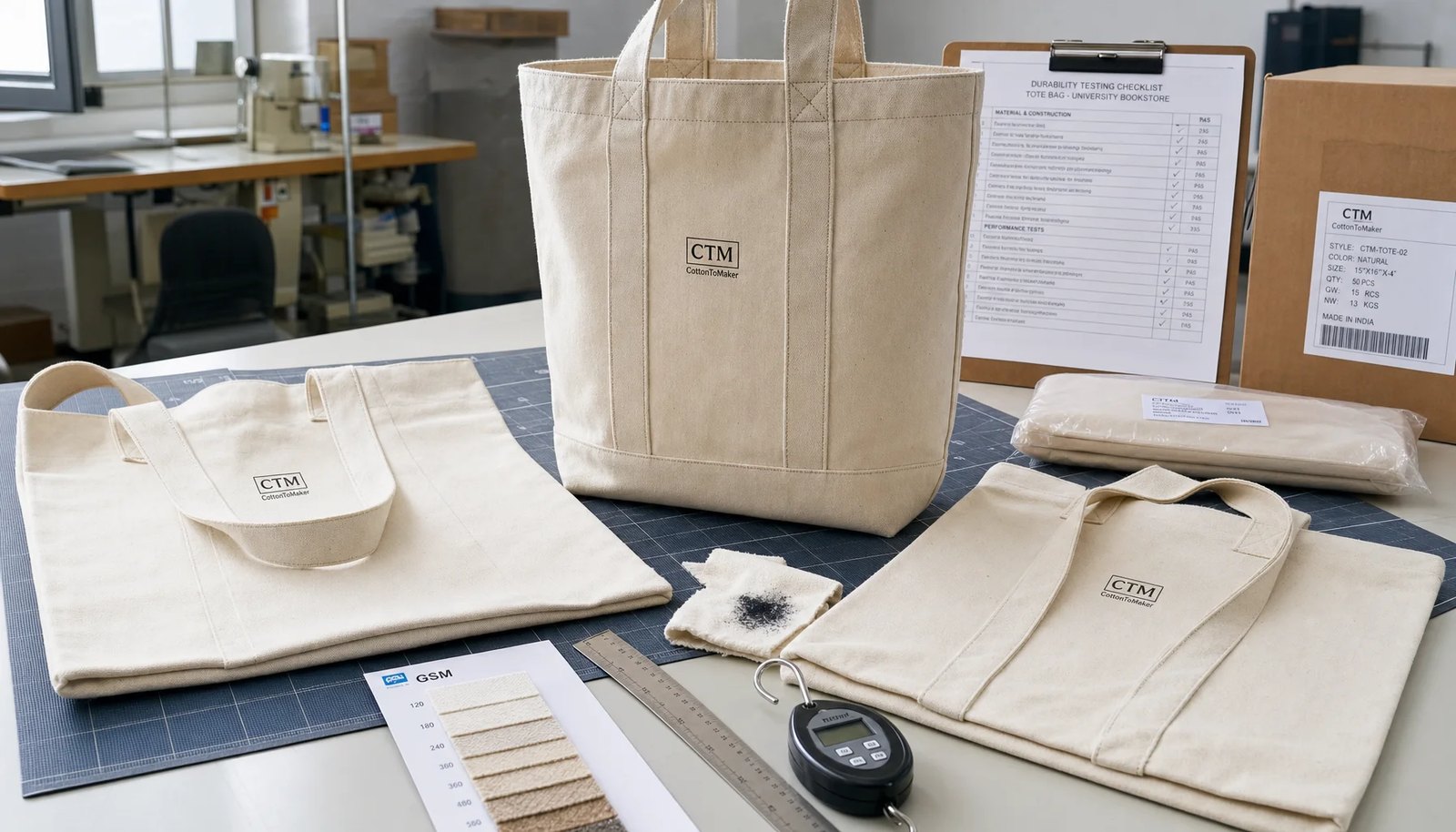
Why Bookstore Tote Durability Needs a Written Standard
A university bookstore tote is not just a giveaway bag with a campus logo. It may carry orientation packets in August, textbooks in September, spirit wear on game day, alumni gifts at homecoming, and online orders during graduation season. After purchase, students often reuse the same bag for library books, groceries, gym clothes, laundry, dorm supplies, and laptops. That mix of uses puts pressure on handles, bottom seams, gusset corners, print surfaces, and packing folds. When a handle rips or a logo rubs onto a sweatshirt, the complaint lands with the bookstore or university brand team, not the sewing line.
Many RFQs still read like this: organic cotton tote, natural color, front logo print. That is too thin for accurate B2B procurement. One factory may price a 7 oz light cotton tote with narrow handles and basic overlock seams. Another may price a 12 oz canvas tote with wider webbing, stronger bartacks, controlled curing, retail cartons, and organic cotton documentation. Both can appear comparable in a spreadsheet if the buyer does not ask for finished bag weight, seam construction, load testing, print rub checks, carton details, and claim evidence.
A written durability checklist makes suppliers quote the same product. It also keeps approval decisions practical. A tote can survive a quick hang test and still fail receiving because the school color is off, the mascot cracks across the fold line, the ink transfers onto adjacent fabric, or carton labels do not match the bookstore system. For university programs, quality control has to cover construction, licensed artwork, packing, documentation, and inspection criteria together.
- Use the organic cotton totes durability testing checklist at RFQ stage, not after the first bulk sample fails.
- Make every supplier quote the same finished size, fabric weight, handle width, seam structure, print method, packing plan, and documentation level.
- Test finished totes because fabric swatches do not prove handle attachment, seam durability, print curing, or carton performance.
- Treat licensed logo durability as a product requirement, not only a graphic-design approval.
- Put acceptance criteria into the purchase order so factories, inspectors, and bookstore receiving teams use the same standard.
Start With Use Case, Contents, and Load
The right tote specification starts with the job the bag must do. An orientation giveaway may carry a campus map, coupons, one T-shirt, and a few flyers. A checkout tote may carry textbooks, notebooks, drinkware, sweatshirts, and boxed merchandise. An alumni gift tote may need a cleaner finish and a more polished presentation because it represents the institution long after the event. These are different bags, even when the dimensions and logo look similar.
Convert the use case into an expected load. For light events, a buyer may set a practical static load around 8-10 kg for 30 minutes, followed by inspection for handle movement, seam opening, and distortion. For everyday bookstore retail, a higher target such as 15 kg for 30 minutes is common. For heavier book or merchandise totes, 20 kg may be appropriate when fabric, handles, and seam construction are designed for that level. These numbers are procurement targets, not universal legal standards, so they should be agreed with the supplier and tied to real contents.
This step prevents two expensive mistakes. Overbuying happens when a one-day handout tote is built like premium retail merchandise, with heavy canvas, strict cosmetic tolerances, woven labels, and individual packing the program does not need. Underbuying is worse: a lightweight event bag is sold as a durable bookstore tote and fails under normal student use. The checklist should make the intended use obvious to every bidder.
- Orientation or welcome-week bag: prioritize budget, simple print, acceptable appearance, and a moderate load test.
- Bookstore checkout tote: prioritize handle comfort, bottom seam strength, print durability, and quick receiving.
- Textbook or course-material tote: prioritize higher load capacity, gusset strength, and handle attachment testing.
- Alumni or donor gift tote: prioritize fabric handfeel, clean inside finishing, shade control, and retail-ready presentation.
- E-commerce tote: add fold-crease, barcode, carton-drop, and abrasion checks because the bag may ship through parcel networks.
Fabric Weight, GSM, Weave, and Finish
Organic cotton tote quotes often use ounces, GSM, or both. As a sourcing reference, 7 oz fabric may fall around 220-240 GSM, 8 oz around 250-280 GSM, 10 oz around 300-340 GSM, and 12 oz around 360-400 GSM. These are working ranges, not fixed conversions. Actual GSM changes with yarn count, weave density, finishing, moisture, washing, and measurement method. Ask for declared fabric weight and finished bag weight. Finished bag weight is useful because it helps reveal when two quotes are not really equal.
Weave matters as much as headline weight. A tighter canvas can print more sharply and hold shape better under load. A looser weave may feel softer but can stretch at seams and create rougher logo edges. Natural organic cotton usually has a warm tone and visible seed flecks. That look may support a sustainability message, but it must be approved on a physical swatch because a digital mockup will not show how a school color, seal, or mascot will behave on real fabric.
Finish changes both appearance and tolerance. Bleached cotton may produce cleaner print color, but it has different shade and processing cost. Dyed canvas needs shade-band control, colorfastness review, and sometimes an underbase for logo opacity. Washed or garment-washed totes often feel softer, yet they usually need wider size tolerance because washing moves the fabric. Pre-shrunk fabric can reduce later shrinkage risk, but if washability is claimed, the finished tote still needs a wash check.
- Ask for oz, GSM, weave, yarn count if available, finish, shrinkage result, and finished bag weight.
- Confirm whether GSM is measured before washing, after dyeing, after finishing, or on the final fabric roll.
- Approve fabric shade, seed flecks, handfeel, stiffness, weave tightness, and print absorption using physical swatches.
- For dyed bags, define shade tolerance and ask whether the logo requires an underbase or extra print pass for opacity.
- Do not compare two 10 oz quotes unless size, gusset, handle construction, seam type, print scope, and packing are aligned.
- Keep a sealed fabric swatch or approved cutting from the pre-production sample for final inspection reference.
Make Sewing Specifications Inspectable
Words like heavy duty, reinforced, and durable sound reassuring, but they are not inspectable by themselves. A factory, third-party inspector, and bookstore buyer need measurable details: seam type, seam allowance, stitch density, thread type, handle insertion depth, bartack placement, and inside finishing. For standard bookstore totes, inside overlock plus top stitch may be enough. Premium retail totes may use French seams, binding, or another clean finish. The right choice depends on price point, expected load, and how finished the inside of the bag needs to look.
Handle attachment deserves close attention because it is a frequent failure point. The body fabric may be strong while the bartack is too short, too close to the cut edge, or partly sewn into a weak seam area. A useful spec names the handle material, width, thickness, drop, attachment depth, and bartack length. Cotton webbing handles around 2.5-3.0 cm wide are common for regular bookstore use because they spread pressure better than very narrow tape. Heavy-use bags may benefit from 3.0-3.5 cm handles if the design and budget support them.
Stitch density should be written in stitches per inch or stitches per centimeter. A supplier under price pressure may reduce stitch density, shorten bartacks, narrow seam allowance, or use thinner thread without changing the quoted fabric weight. Those changes may not show in a product photo, but they show up under load. Measure and photograph the approved sample so the bulk line and inspector have the same target.
- Specify seam type: overlock plus top stitch, French seam, bound seam, folded seam, or another approved construction.
- Set minimum seam allowance, commonly 8-10 mm for many canvas tote constructions unless the design requires otherwise.
- Define stitch density in SPI or stitches/cm and check it at side seams, bottom seams, handle attachments, and top hem.
- State bartack length, number of bartacks, handle insertion depth, and distance from edge or seam line.
- Classify loose bartacks, skipped stitches at stress points, open seams, and handle tear-out as major defects.
- Require inspection after load testing because weak seams often look acceptable before stress is applied.
Finished-Bag Durability Test Checklist
Durability testing should happen on the finished tote, not only on loose fabric. A swatch can confirm GSM, shade, handfeel, and print absorption. It cannot prove handle tear-out resistance, seam strength, body distortion, print cracking after folding, or packing recovery. For university bookstore orders, the factory should test the approved construction and record results before bulk production. For larger or higher-risk orders, repeat the same checks during inline inspection or final inspection on random samples.
A practical static-load test needs four things: agreed weight, agreed duration, sample size, and written pass criteria. The tote can be hung by both handles with the specified load for 30 minutes, then rested and inspected. The report should say whether handles stretched, bartacks shifted, stitches popped, seams opened, fabric tore, or the body became excessively distorted. A photo of a weighted bag is helpful, but it is not enough without the load weight, duration, and post-test observations.
For heavier bookstore programs, add handle attachment checks and seam slippage review. A formal pull test can be performed at each handle attachment point with an agreed force and method. For lower-risk programs, a simplified factory check may be acceptable if it is repeatable and documented. The point is not to over-test every order. The point is to make sure a tote expected to carry textbooks, laptops, or bottles is tested like it will be used.
- Light event tote: consider 8-10 kg static load for 30 minutes, then inspect handle movement and seam opening.
- General bookstore tote: consider 15 kg static load for 30 minutes, then inspect all stress points after resting.
- Heavy-use tote: consider 20 kg static load if the fabric, seam, and handle design are specified for that level.
- Handle check: inspect all four attachment points for fabric tear-out, shifted bartacks, broken thread, and uneven load distribution.
- Seam check: inspect bottom seam, side seam, gusset corners, top hem, and any label insertion point after loading.
- Document sample size, load weight, duration, pass/fail result, photos, and corrective action before approving bulk production.
Print Durability for Licensed Marks
University marks need tighter control than ordinary promotional graphics. School colors may be tied to brand guidelines, licensing approvals, alumni expectations, and retail presentation. A logo that looks fine in a digital proof may print too dull on natural cotton, too transparent on dyed canvas, or too jagged on coarse weave. For licensed artwork, require a physical strike-off on the actual fabric before bulk printing.
Water-based screen printing is often suitable for organic cotton totes because it can give a softer handfeel and works well on many natural cotton designs. It still depends on the right ink system, mesh, screen setup, curing temperature, curing time, and fabric preparation. Dark dyed cotton may need an underbase or a different ink approach for opacity. Large solid areas can crack or whiten at fold lines if the ink deposit is too heavy or under-cured. Fine-line mascots, seals, and sponsor lockups can lose definition on rough canvas.
Print checks should be done after curing and cooling. Dry rub checks reveal surface transfer. Wet rub checks are useful if the tote may meet rain, damp clothing, humid storage, or water bottles. Fold checks matter when the packing plan crosses the printed area. If the tote is marketed as washable, define the wash method and inspect color loss, cracking, shrinkage, seam twisting, and print distortion after washing.
- Define print method, ink system, artwork size, print location, color target, registration tolerance, and placement tolerance.
- Use physical Pantone references or an approved strike-off for university colors; do not rely on monitor color.
- Set logo placement tolerance, commonly +/-5 mm for centered front-panel prints unless artwork or bag shape requires otherwise.
- Check opacity on the selected fabric color, especially natural flecked cotton, dark dyed cotton, or coarse canvas.
- Perform dry rub and wet rub checks after full curing and cooling, not immediately after printing.
- Approve a folded sample if the packing plan creates a fold line through the logo or mascot.
Organic Cotton Documentation and Claim Control
Organic cotton claims need exact wording. A supplier saying organic cotton does not automatically mean the buyer has the paperwork needed for a certified consumer-facing claim. Some bookstore programs may accept a supplier declaration for an internal event order. Others may require Organic Content Standard, Global Organic Textile Standard, transaction certificates, scope certificates, or other documents depending on the claim, market, and internal compliance policy. Name the required evidence in the RFQ before comparing prices.
Documentation can change MOQ, price, supplier eligibility, and lead time. If a certified claim is required, confirm which parts of the supply chain are covered: spinner, weaver, dyeing or washing unit, printer, sewing factory, exporter, and trader if applicable. If the tote uses organic cotton body fabric but conventional handles, thread, labels, or hangtags, the product copy must not imply more than the documentation supports.
Claim control also applies to packaging and sales copy. Plastic-free presentation, washable claim, certified organic claim, and made with 100% organic cotton claim all need to match the real specification. Keep supplier documents, approved label copy, hangtag artwork, product page text, and purchase-order wording in the same file. That way receiving, marketing, licensing, and compliance teams are working from the same claim basis.
- State the exact organic cotton evidence required before suppliers quote.
- Ask whether documentation covers fabric only, finished product, or the full chain needed for the intended claim.
- Confirm whether handles, thread, labels, interlinings, hangtags, and packaging are included or excluded from the claim.
- Do not approve consumer-facing claim language until compliance, licensing, or the bookstore brand team reviews the documents.
- Keep certificates, transaction documents, declarations, approved wording, and supplier invoices with the purchase-order record.
- Ensure hangtags and product pages do not promise certified, washable, plastic-free, or fully organic features unless the spec supports them.
Sampling Sequence and Approval Gates
A good sample process separates design approval from production approval. A proto sample helps review size, gusset shape, handle drop, logo scale, and overall look. It may be made with sample-room fabric, available handles, or substitute thread, so it should not be treated as proof of bulk durability. A print strike-off confirms artwork, color, opacity, curing, and ink behavior on the selected fabric. A pre-production sample confirms whether the real bulk materials and final construction meet the specification.
The pre-production sample should use bulk fabric, bulk handles, approved thread, approved label, final print method, final ink system, and intended packing fold. Ask for a compact QC report with measurements, finished bag weight, handle width, stitch density, seam allowance, load test result, print rub result, and shrinkage result if washability is required. Not every order needs a lab report, but every order benefits from objective evidence that the finished tote matches the intended use.
Change control matters after approval. If the buyer changes logo size, fabric color, handle length, barcode placement, carton quantity, packing fold, hangtag copy, or documentation wording, the previous approval may no longer cover the product. The factory should keep a sealed approval sample. The buyer or third-party inspector should work from the same reference during final inspection.
- Gate 1: approve fabric swatch for shade, flecks, handfeel, weight, shrinkage risk, and print absorption.
- Gate 2: approve artwork strike-off on actual fabric for color, opacity, registration, edge clarity, and curing result.
- Gate 3: approve proto sample for size, gusset, handle drop, logo scale, and overall appearance.
- Gate 4: approve pre-production sample made with bulk materials and final print/packing method.
- Gate 5: approve inline production photos or inspection report before the full order is packed.
- Gate 6: release shipment only after final inspection verifies measurements, sewing, print, packing, labels, and carton marks.
Packing, Cartons, and Bookstore Receiving
Packing is part of durability. Poor packing can damage a tote that passed sewing and print checks. Over-compressed cartons can create deep folds, crush handles, distort gussets, and press ink against fabric. Weak cartons can collapse during export handling, domestic trucking, campus storage, or parcel fulfillment. If the approved fold crosses a large logo, print cracking or whitening may be visible before the tote ever reaches a student.
Bookstore receiving teams need predictable labeling. Define SKU labels, barcode type, barcode placement, PO number, carton marks, color identification, mixed-carton rules, and carton quantity before packing starts. Late barcode data or hangtag artwork can stop production or force rework. Wrong carton marks can make campus staff open cartons just to identify inventory, adding labor cost that never appeared in the unit price.
Reduced-plastic packing can work well, but it needs a protection plan. Belly bands, paper wraps, carton liners, or bulk flat packing may fit campus sustainability goals if moisture, dirt, abrasion, and ink offset are controlled. Individual polybags offer more protection but may conflict with reduced-plastic requirements. Make the tradeoff deliberately instead of letting the factory choose the cheapest default.
- Set carton quantity by tote size, fold method, print location, carton strength, and gross weight, not by maximum compression.
- Keep carton gross weight practical for warehouse handling, often below 15-18 kg unless the buyer approves otherwise.
- Avoid fold lines across heavy print areas unless fold cracking, whitening, and ink offset are tested and approved.
- Define barcode label position, SKU sticker content, hangtag attachment, PO number, carton marks, and mixed-carton rules before packing.
- Use carton liners, moisture protection, or desiccants where transit route, season, and storage conditions justify them.
- Run carton drop or handling checks on the final packed carton style if the order will move through parcel, campus, or multi-stop distribution.
MOQ, Cost Drivers, and Quote Comparison
MOQ for organic cotton totes is driven by more than sewing capacity. Fabric booking, dyeing minimums, organic documentation, printing setup, label production, hangtags, carton printing, and inspection time can all affect the minimum order quantity. A natural 10 oz tote with one-color print may have a very different MOQ from a dyed canvas tote with two print locations, woven labels, barcode stickers, retail hangtags, and plastic-free packing.
Procurement teams should compare scope, not just unit price. A lower quote may use lighter fabric, looser weave, narrower handles, shorter bartacks, lower stitch density, weaker cartons, or no documentation. It may exclude pre-production samples, print strike-offs, revised samples, barcode application, carton-drop checks, or inspection support. A higher quote may include better materials and fewer receiving problems. Without a controlled quote sheet, the buyer cannot tell whether the price gap is true efficiency or missing specification.
Landed cost also matters. Finished bag weight affects freight. Carton quantity affects CBM. Packing method affects warehouse labor and damage risk. Delivery terms affect which costs are included. If one supplier quotes EXW and another quotes FOB, the numbers are not comparable. If one quote includes organic cotton transaction documentation and another excludes it, the lower price may not meet the bookstore’s claim requirements.
- Fabric cost changes with GSM, weave density, custom dyeing, washing, pre-shrinking, and organic cotton documentation.
- Print cost changes with color count, print area, ink system, underbase, curing control, registration tolerance, and reject allowance.
- Sewing cost changes with gussets, pockets, clean seams, binding, labels, wider handles, bartacks, and higher stitch density.
- Packing cost changes with individual packing, belly bands, hangtags, barcode labels, carton strength, carton quantity, and carton marks.
- Inspection cost changes with measurement reporting, load tests, print rub checks, carton checks, photo evidence, and third-party AQL inspection.
- Compare unit price together with finished bag weight, carton CBM, gross weight, MOQ driver, documentation scope, and delivery term.
Specification comparison for buyers
| Sourcing item | Recommended B2B specification | Typical acceptance target | Procurement risk to control |
|---|---|---|---|
| Daily bookstore retail tote | 10-12 oz organic cotton canvas, approximately 300-400 GSM depending on weave and finish, with reinforced handle attachment | Finished size commonly within +/-5 mm for width and height on unwashed goods; finished bag weight recorded against approved sample | Do not award on GSM alone; compare weave, finished bag weight, handle width, seam allowance, print method, carton plan, and documentation scope |
| Orientation or welcome-week giveaway | 7-8 oz organic cotton, approximately 220-280 GSM, simple construction, reinforced handles, and controlled print curing | Static load commonly set around 8-10 kg for 30 minutes when contents are brochures, apparel, coupons, or light stationery | A low unit price may hide narrow handles, short bartacks, thin thread, reduced seam allowance, or weak cartons |
| Heavy-use book or merch tote | 12 oz canvas or equivalent finished-bag strength, 2.5-3.5 cm handles, bottom and side seam reinforcement, stronger bartack control | Static load commonly set around 15-20 kg for 30 minutes, followed by seam, handle, and distortion review | A bag can pass a brief hang test but still fail at gusset corners, handle tear-out, or stitch popping after repeated use |
| Fabric documentation | Supplier declaration for basic claim, or OCS/GOTS transaction documentation and scope certificates when a certified consumer-facing claim is required | Documentation type named in the RFQ, purchase order, label copy, and supplier invoice before production starts | Organic cotton wording is not interchangeable; do not approve hangtags or product pages before compliance reviews the claim basis |
| Handle construction | Cotton webbing or self-fabric handles, usually 2.5-3.0 cm wide for regular bookstore use, with attachment depth and bartack length specified | Handle drop tolerance commonly +/-10 mm; left/right handle placement commonly +/-5 mm against approved sample | Narrow handles may hold weight in a static test but cause complaints when carrying textbooks, laptops, or bottles across campus |
| Seam construction | Inside overlock plus top stitch for standard totes; French seam, binding, or clean-finish seams for premium retail styles | Minimum seam allowance specified, often 8-10 mm depending on fabric and construction; stitch density recorded in SPI or stitches/cm | Terms like reinforced or durable are not inspectable unless seam allowance, stitch density, bartack placement, and thread are defined |
| Logo print | Water-based screen print for many natural cotton bookstore totes; pigment or other systems only after fabric-specific strike-off approval | Placement tolerance commonly +/-5 mm; color approved by physical strike-off, not only digital proof | Licensed university marks can fail receiving even when the bag is structurally sound if color, opacity, registration, or placement is wrong |
| Durability test package | Finished-bag static load, handle pull or attachment check, seam slippage review, wash shrinkage if marketed washable, print dry/wet rub, fold crease, and carton drop | Pass criteria written as no handle tearing, seam opening, stitch popping, objectionable ink transfer, or carton damage affecting saleable goods | Testing loose fabric does not prove the finished tote; the weak point is often sewing, print curing, folding, or packing |
| Packing and receiving | Flat pack or controlled fold, approved fold line, carton quantity, barcode position, carton marks, moisture protection, and gross weight limit | Carton gross weight often kept below 15-18 kg unless the buyer approves otherwise; drop test performed on final packed carton if required | Over-compressed cartons can crease prints, distort handles, transfer ink, slow receiving, and increase rework before shelf display |
Buyer checklist before sampling
- Define the program before asking for price: resale item, checkout bag, gift-with-purchase, orientation welcome bag, event sponsor bag, alumni merchandise, or e-commerce add-on. The use case sets the load test, cosmetic tolerance, and packing plan.
- List real contents instead of using a generic promotional-bag spec: brochures only, apparel plus stationery, two textbooks, drinkware, laptop, boxed merchandise, or mixed bookstore purchases.
- Specify finished width, height, gusset depth, handle drop, handle width, handle material, fabric weight in oz and GSM, finished bag weight, and the measurement stage: flat, pressed, washed, or recovered after packing.
- Ask the supplier to identify fabric construction and finish: natural, bleached, dyed, washed, pre-shrunk, plain weave, canvas weave, yarn count if available, and whether GSM is measured before or after finishing.
- Make sewing details measurable: minimum seam allowance, stitch density, thread type, bartack length, bartack count, handle insertion depth, handle placement tolerance, and acceptable inside seam finish.
- Control artwork in writing: print method, ink system, number of colors, artwork size, Pantone or approved color target, placement tolerance, curing requirement, licensed mark status, and university brand approval gate.
- Request a physical sample path: fabric swatch, print strike-off on actual fabric, proto sample, corrected sample if needed, pre-production sample from bulk materials, and sealed approval sample for inspection reference.
- Put finished-bag durability tests into the RFQ: static load, handle attachment check, seam inspection after loading, print dry rub, wet rub if relevant, fold/crease review, wash shrinkage if marketed washable, and packed-carton drop when shipping risk is material.
- Confirm organic cotton claim evidence before quote comparison: supplier declaration, OCS/GOTS scope certificate, transaction certificate, or other documentation required by the bookstore, licensing team, retailer, or sales channel.
- Define retail packing early: flat or folded, fold line location, individual polybag or plastic-free band, hangtag, barcode label, SKU sticker, carton quantity, carton dimensions, carton ply, moisture protection, and maximum carton gross weight.
Factory quote questions to send
- What fabric options are included in the quote: oz rating, actual GSM, weave, yarn count if available, natural/bleached/dyed/washed finish, shrinkage result, and GSM measurement stage?
- What finished bag weight should we expect for the quoted size, handle type, and fabric weight, and what production tolerance will you control against the approved sample?
- Is the fabric in stock, booked to order, or custom woven/dyed? What MOQ applies by fabric weight, fabric color, dye lot, and organic cotton documentation requirement?
- What organic cotton evidence is included in the quoted price: supplier declaration, scope certificate reference, transaction certificate, or no certified transaction documentation?
- What exact sewing construction is quoted: seam type, stitch density, thread type, seam allowance, bartack length, bartack count, handle insertion depth, and any reinforcement at bottom corners or gussets?
- What handle material, width, thickness, drop length, attachment depth, and placement tolerance are included, and what static load or handle pull result can the approved finished tote meet?
- Which print method and ink system are quoted, and how will the factory control opacity, color matching, curing, registration, dry rub, wet rub, fold cracking, and ink transfer during packing?
- Will the pre-production sample be made from bulk fabric, bulk handles, approved thread, approved label, and final ink, or from available sample-room materials?
- What measurement tolerance, logo placement tolerance, stitch-density tolerance, and defect classification will you accept in the purchase order and final inspection?
- What inline QC points are included before shipment, and can you provide photos or reports for fabric shade, cutting, printing, curing, sewing, load testing, measurements, and packing?
Quality-control points to confirm
- Finished width and height on standard unwashed totes should commonly be controlled within +/-5 mm against the approved sample; washed goods, heavy canvas, or garment-dyed styles may need a wider buyer-approved tolerance.
- Gusset depth should be measured at the same location on every sample because side-gusset distortion can change usable capacity and retail appearance.
- Handle drop should commonly be controlled within +/-10 mm, measured after sewing and pressing, with left and right handles symmetrical and aligned to the approved placement marks.
- Handle attachment depth should be consistent at all four points so bartacks sit fully inside the reinforced area and do not run partly onto the cut edge, side seam, or weak fabric zone.
- Bartacks should be straight, dense, secure, and long enough to distribute load. Loose threads, skipped stitches, diagonal bartacks, short bartacks, or bartacks placed off the handle should be treated as major functional defects.
- Seam allowance should meet the purchase-order minimum, often 8-10 mm depending on construction, and raw edges should be fully covered by overlock, folded seam, binding, or other approved finish.
- Static load testing should use the buyer-agreed weight and duration, such as 8-10 kg for light event totes or 15-20 kg for heavier bookstore retail totes, with no handle tearing, seam opening, stitch popping, or excessive distortion after resting.
- Handle attachment testing should be performed on finished totes, not handle webbing alone, because failure frequently occurs through fabric tear-out, poor bartack placement, or weak thread.
- Print dry rub and wet rub checks should be done after full curing and cooling. The report should separate dry transfer, wet transfer, ink smearing, and color transfer to adjacent fabric when relevant.
- Wash shrinkage should be measured on the finished tote when washability is claimed, including body width, height, gusset, handle drop, print appearance, and seam twisting after the agreed wash method.