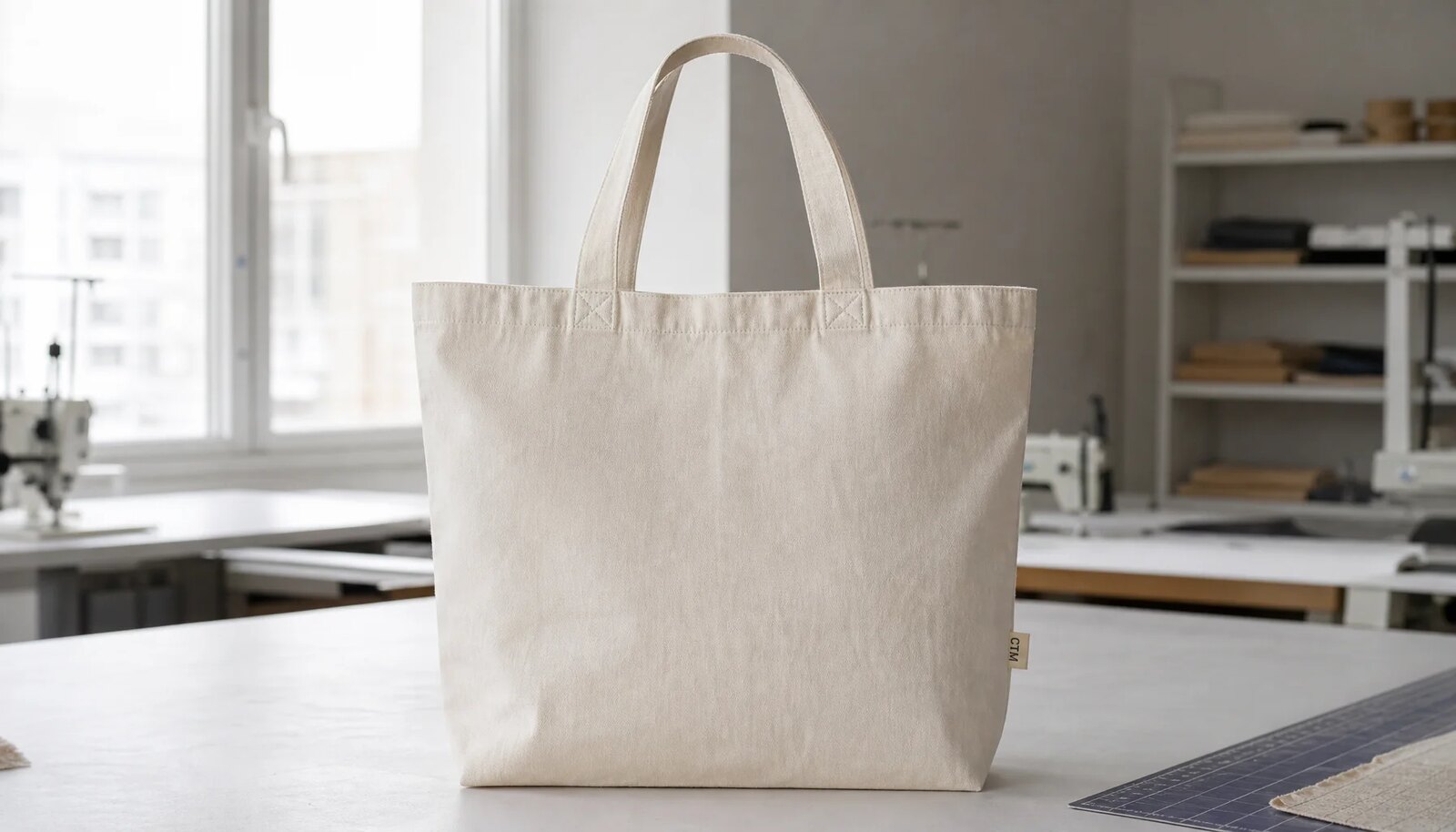
Start With The Filled Bag, Not The Logo
An organic cotton tote is a branded surface, but at an event it is also a working carry product. It has to move through registration tables, sponsor packing, venue corridors, hotel rooms, and the trip home. That is why the durability brief should begin with the filled bag. A tote carrying a badge, agenda, and brochure is not the same product as a tote carrying catalogs, a bottle, dense samples, a hoodie, or a VIP kit.
Write the expected contents into the sourcing brief before suppliers quote. If the final insert list is still changing, use a load class and update it before pre-production approval. A clear note might say: standard attendee tote, estimated filled weight 4 kg, shoulder carry preferred, two-day conference, no wash requirement, packed flat for registration tables. That short description gives the factory useful direction on fabric weight, handle length, seam strength, print placement, and carton packing.
Durability is not only about whether the tote breaks. A bag can technically hold weight and still fail the event if the handles twist, the top edge collapses, the logo scuffs, or the front panel looks crushed when unpacked. Separate structural failure from presentation failure in your checklist. Structural failure includes handle pull-out, seam opening, fabric tearing, and bottom seam failure. Presentation failure includes severe distortion, stains, print damage, poor folding, or logo placement outside the approved tolerance.
- State the expected filled weight in kilograms, not only the item list.
- Classify the order as light 2-3 kg, standard 4-5 kg, or heavy/premium 6-8 kg when the contents justify it.
- Use a 20%-30% safety margin if sponsor items may be added after the purchase order.
- Define structural and visual pass/fail points before approving samples.
Choose Fabric By Use, Then By GSM
GSM is a useful shortcut, but it is not a full durability specification. For many light giveaways, 140-160 GSM organic cotton can work when the bag carries paper materials and light inserts. For standard attendee programs, 160-200 GSM usually gives better structure, opacity, and perceived value. For premium kits or heavier contents, 200-240 GSM may be appropriate. The important part is pairing the fabric with the right handle and seam construction. A heavier body fabric with weak handle attachment is still a weak tote.
Two organic cotton fabrics with the same GSM can behave differently. Weave density, yarn quality, finishing, shrinkage, and handle material all influence strength and appearance. A loose weave can feel thick yet distort around seams. A stiff finish may print cleanly but crease sharply in cartons. Natural cotton can show flecks, seed marks, and small shade variation. That may fit an organic brand story, but it should be approved consciously rather than discovered during final inspection.
Ask for a target GSM and a written tolerance. For sewn cotton bags, buyers often see tolerances such as +/-5% to +/-10%, depending on the mill source, weave, and finishing route. The exact tolerance should come from the supplier and be written into the quote, sample approval, and inspection standard. If the tote is dyed, confirm shade tolerance. If the tote is natural cotton, agree how slubs, flecks, and shade variation will be judged.
- Ask whether handles are made from the same fabric as the body or from separate cotton tape.
- Review opacity with the actual intended contents inside the bag if show-through matters.
- Confirm shrinkage only when washing or repeated consumer use is part of the brief.
- Do not treat higher GSM as a substitute for reinforced handle attachment.
Turn Construction Into A Written Spec
A useful tote RFQ removes guesswork. List finished body width, body height, gusset depth, handle length, handle drop, handle width, top hem depth, seam allowance, stitch density, thread type, and handle reinforcement method. Without those details, two suppliers can both quote an organic cotton tote while pricing very different products. One may assume a basic flat bag with simple handles; another may include reinforced stress points and a deeper hem.
Handles deserve close attention because they carry the load and shape the attendee experience. Decide whether the tote is meant for hand carry or shoulder carry. A short hand-carry handle can look neat on a table, but it may frustrate attendees walking across a venue with several items. A wider handle, often 2.5-3.8 cm depending on design, can improve comfort. Width alone is not enough; the handle base must be secured with an approved reinforcement such as bar-tack, box stitch, cross stitch, or a stable double-row attachment.
Seams matter just as much. The bottom seam must resist spreading when the tote is filled. Side seams need even tension and enough seam allowance. Gusseted bags need careful corner construction because stress concentrates where panels meet. For higher-value or heavier programs, request close-up construction photos of the approved sample and keep them with the measurement sheet. Those photos become practical evidence during final inspection.
- Specify handle drop separately from total handle length because it affects carry comfort.
- Ask the supplier to state seam allowance and stitch density instead of relying on a generic sample description.
- Require the same reinforcement method in bulk production as in the approved pre-production sample.
- Keep a signed sample, measurement sheet, and construction photos for final inspection reference.
Use A Test Matrix People Can Repeat
Event tote testing does not always require a laboratory protocol. It does require repeatable checks. A practical organic cotton totes durability testing checklist for event planners should cover structural strength, dimensional stability, print durability, and packing presentation. Each check should have a test weight, hold time, sample quantity, and pass/fail standard where possible. The point is to catch the failures that would matter at the venue, not to create paperwork nobody uses.
The static load hold is the foundation. Fill the tote with expected contents or equivalent weights, add the agreed safety margin, and hold it for 30-60 minutes. After the hold, inspect handle bases, top hem, side seams, bottom seam, gusset corners, and body shape. Do not look only for a dramatic break. Early warning signs include stitch opening, handle base distortion, top hem pulling inward, and fabric tearing around stress points.
For heavier kits, add repeated lift cycles, such as 20-50 controlled lifts at the approved test weight. A bag may pass a static hold yet weaken under repeated handling by staff and attendees. Then include print and packing checks in the same matrix. Rub the printed area with a clean dry cloth after curing, fold the tote as it will be packed, and inspect for cracking, offsetting, scuffing, or visible crease damage. These simple checks often predict event success better than broad statements like good quality.
- Record test weight, hold time, lift count, and number of samples tested.
- Reject pass/fail language such as normal quality unless it is tied to visible criteria.
- Test both a sewn sample and a printed packed sample before bulk release.
- Add wash testing only when reuse after washing is part of the requirement.
Treat The Sample As Evidence
The pre-production sample is the buyer's best chance to prevent a bulk problem. It should be made from production fabric, production thread, final handle construction, intended print method, intended ink or transfer, and the planned folding and packing method. If the supplier uses substitute fabric or a different decoration process for speed, the sample can still help with concept review. It should not be used as the final durability approval.
Measure the sample against a written sheet. Check body width, body height, gusset, handle drop, handle width, print size, print placement from the top edge, and print placement from the side edge. Sewn totes will vary slightly. That is normal. The question is whether variation stays inside the approved tolerance. Commercial tolerances may be around +/-1 cm for body measurements and +/-0.5-1 cm for print placement, but the right standard depends on design, fabric behavior, and supplier capability.
Then handle the sample the way the event team will. Fill it with real contents if available. If the inserts are not ready, use books or calibrated weights equal to the target load. Lift it, hold it, set it down, fold it, and inspect it again. Check whether the top hem pulls inward, whether the handles sit evenly, whether the bag twists, and whether the print still presents well after folding and pressure.
- Do not approve durability from a digital mockup or artwork proof alone.
- Ask which sample details are included in the quoted bulk price and which are upgrades.
- Photograph stress points before and after load testing for the approval record.
- Require a revised sample if fabric, handle construction, print method, or packing method changes.
Specify Print Durability In Plain Terms
Print failure can make a structurally strong tote unacceptable. Screen printing is often a strong option for one-to-three-color logos and sponsor marks because it scales well and can perform well when ink is properly cured. Digital print or heat transfer can be appropriate for gradients, photographic artwork, small runs, or complex color work. Those methods need careful review for hand feel, cracking, edge lift, abrasion, and fold behavior.
Ask the supplier to identify the print system, ink or transfer type, curing or fixing method, and artwork limits. Large solid areas may feel heavier and can show scuffs more easily. Fine lines may fill in on textured canvas. Light inks on natural cotton may need opacity control. If the bag is folded through the artwork, test that fold before bulk production. A perfect logo on an open sample may look very different after carton pressure.
Color approval should account for the fabric underneath. Natural organic cotton is not a smooth white coated paper. Flecks, texture, and shade can show through the print. Set expectations for color tolerance and opacity before mass printing. If sponsors require tight brand matching, ask whether Pantone matching is practical on the chosen fabric and print method. When budget and timeline allow, approve a physical strike-off instead of relying only on a screen proof.
- Check dry rub only after the ink or transfer has fully cured or fixed.
- Confirm registration tolerance for multi-color prints, especially small text or sponsor marks.
- Avoid placing critical logos directly on hard fold lines unless the fold has been tested.
- Include print rub, scratch, fold, curing, and carton-contact review in QC.
Define Tolerances And Defect Classes
Procurement disputes often begin with a gap: the buyer expects one standard, the supplier works to another, and nobody writes down the difference. Organic cotton totes are sewn goods, so every piece will not be identical. Slight measurement variation is expected. What causes trouble is leaving the important dimensions, construction details, and defect severity undefined until final inspection.
Create a measurement sheet for the dimensions that affect use and brand presentation. Body width, body height, gusset depth, handle drop, handle length, handle width, print size, and print position should each have a tolerance. Some items deserve tighter control than others. A small body width difference may not affect event use, while a handle drop that is too short can change whether the attendee can carry the bag comfortably on the shoulder.
Defect classes should be simple enough for inspectors to apply. Critical defects include sharp objects, broken needle contamination, heavy mold odor, or unsafe foreign material. Major defects include wrong fabric, wrong print, handle failure, seam opening, severe stains, incorrect dimensions outside tolerance, or print damage visible at normal viewing distance. Minor defects include small thread tails or slight natural cotton variation within the approved standard. Clear language keeps decisions consistent when time is tight.
- Attach the measurement sheet to the purchase order or sample approval.
- Define critical, major, and minor defects before final inspection.
- Ask whether the supplier uses an AQL sampling plan or an agreed internal sampling method.
- Use in-line inspection for orders where final inspection would leave no time for correction.
Make Packing Part Of Quality
Packing is not just an operations detail. For event totes, it determines how the product looks when it reaches the venue. Poor folding can crease the front logo. Overfilled cartons can distort handles and corners. Loose or dirty packing can make bags look tired before they ever reach attendees. If the totes need to move straight from carton to registration tables, packing belongs in the product brief.
Flat packing is usually practical for bulk event distribution, but the details matter. Specify fold direction, inner pack quantity, pieces per master carton, whether bags are bundled, and whether printed panels touch each other. If a large logo covers the front panel, avoid folding through the most visible artwork when possible. If the bags will be kitted with inserts, carton counts should match the kitting workflow so staff do not need to recount every piece under time pressure.
Carton dimensions and gross weight affect landed cost and handling. A heavier canvas bag may look better and feel more premium, but it can increase freight weight. Bulky folding can increase shipment volume even when the unit price is attractive. Ask for carton dimensions, gross weight, and packing photos before comparing total cost. If the shipment may face humidity, long storage, or outdoor staging, discuss carton strength and moisture protection.
- Approve fold direction on a printed sample, not only on a blank bag.
- Confirm inner pack count and master carton count match venue or kitting needs.
- Ask whether tissue, separators, or polybags are necessary for print protection or moisture control.
- Include shipping marks, carton labels, gross weight, and carton dimensions in the quote.
Compare Landed Cost Per Usable Bag
The lowest unit price is not always the best procurement result. A quote that excludes reinforced handles, pre-production sampling, suitable packing, inspection, or realistic carton data can create higher total cost. Event planners work inside narrow replacement windows. A tote that fails inspection one week before the event is expensive in a way the first spreadsheet may not show.
Compare suppliers only after the specification is aligned. Fabric GSM and tolerance, organic cotton documentation, dimensions, handle construction, seam details, print method, color count, packing, inspection, carton data, and lead time should all be visible. If one supplier quotes 160 GSM with basic handles and another quotes 200 GSM with reinforced handles, those prices are not describing the same product or the same risk.
Landed cost should include setup charges, sampling, freight volume, freight weight, customs documents where applicable, inspection, sorting, rework, and the cost of unusable bags. It should also include schedule confidence. A supplier that clearly states assumptions, test methods, and approval gates may be a stronger B2B partner than one that offers a lower number with vague specifications.
- Build a quote comparison sheet with one row for each specification and QC requirement.
- Mark supplier assumptions separately from confirmed included items.
- Compare carton volume and gross weight before choosing a fabric upgrade.
- Evaluate the cost per usable, approved, delivered bag rather than the cheapest ex-factory unit price.
Write An RFQ Suppliers Can Price
A strong RFQ helps suppliers quote the same tote. Start with event date, delivery location, order quantity, target use, expected contents, target load, attendee carry style, and artwork requirements. Then add the product specification: organic cotton content, documentation needs, fabric GSM range, finish, body dimensions, handles, reinforcement, seams, print method, packing, inspection, and testing requirements.
Ask suppliers to state assumptions clearly. If they assume natural cotton instead of dyed fabric, standard handle tape instead of self-fabric handles, one-sided printing instead of two-sided printing, or bulk carton packing instead of inner bundles, the price and quality risk change. Invite alternatives, but require the supplier to explain what changes in durability, MOQ, appearance, cost, and lead time.
End the RFQ with approval gates. Common gates include fabric swatch approval, artwork proof, printed strike-off if needed, pre-production sample, load-test approval, in-line inspection for high-risk orders, final inspection, packing approval, and shipment release. Assign owners and dates for each gate. Event schedules are unforgiving, and late approvals can consume the production time the buyer is trying to protect.
- Include the phrase expected filled weight in the RFQ and provide a kilogram value.
- Require the sample to match bulk material, construction, print, and packing.
- Ask suppliers to quote optional upgrades separately so tradeoffs are visible.
- Keep all approvals in one record for inspection and shipment release.
Specification comparison for buyers
| Procurement decision | Recommended specification or check | When it fits | Quote or QC risk to verify |
|---|---|---|---|
| Load class | Light event giveaway: 140-160 GSM organic cotton plain weave or light canvas, tested at 2-3 kg filled weight | Brochures, badge inserts, lanyards, light notebooks, small sponsor cards, and short handout programs | Do not use this class for bottles, catalog packs, dense samples, or retail resale without upgrading handles, seams, and inspection criteria |
| Load class | Standard attendee tote: 160-200 GSM organic cotton canvas, tested at 4-5 kg filled weight | Conferences, trade shows, registration kits, multi-session attendee materials, and moderate sponsor inserts | Confirm handle width, top hem depth, seam allowance, stitch density, and visible distortion after the load hold |
| Load class | Premium or repeated-use tote: 200-240 GSM organic cotton canvas, tested at 6-8 kg filled weight when contents justify it | VIP kits, product launches, heavier samples, employee welcome packs, premium branded programs | Higher GSM increases freight weight; require reinforced handles and bottom seam control or the fabric upgrade is only a partial durability improvement |
| Fabric tolerance | Target GSM with written tolerance, commonly +/-5% to +/-10% depending on mill source, weave, and finish | Any bulk order where suppliers must quote the same material standard | Ask whether GSM is checked before cutting and whether handles use the same fabric weight or a separate cotton tape |
| Measurement tolerance | Finished size tolerance stated by dimension, often around +/-1 cm for body width/height and +/-0.5-1 cm for print placement on sewn totes | Orders with sponsor logo placement, kitting fit, venue distribution plans, or carton count requirements | Tolerance must be tied to an approved measurement sheet; digital mockups alone do not control sewn dimensions |
| Handle construction | Handle width 2.5-3.8 cm, handle drop matched to hand or shoulder carry, reinforced by bar-tack, box stitch, cross stitch, or approved double row | Any bag carrying more than light paper inserts, especially multi-day events or attendee travel | Check actual stitch security after load testing; the reinforcement style in production must match the approved sample |
| Seam construction | Straight side and bottom seams with adequate seam allowance, even tension, secure top hem, and no skipped stitches | All event programs, especially heavy contents, gusseted totes, or bags packed tightly in cartons | Ask the supplier to state stitch density, thread type, seam allowance, and whether bottom corners or gusset corners are reinforced |
| Durability test | Static load hold using expected contents or equivalent weight plus a 20%-30% safety margin for 30-60 minutes | Before pre-production approval and during QC spot checks on bulk production | Pass/fail must include no handle pull-out, seam opening, fabric tearing, or unacceptable permanent distortion |
| Handling test | Repeated lift test, such as 20-50 lift cycles at approved test weight, followed by stress-point inspection | Multi-day events, dense kits, venue movement, attendee bags reused between sessions, or hotel-to-venue transport | Look for handle base tearing, top hem deformation, seam opening, handle twist, and progressive distortion rather than only final breakage |
Buyer checklist before sampling
- Define the event use in measurable terms: expected contents, target filled weight, maximum likely added sponsor items, carry duration, venue handling, and whether the tote must work for hand carry or shoulder carry.
- Assign a load class before quoting: light 2-3 kg, standard 4-5 kg, or premium/heavy 6-8 kg, then ask the supplier to confirm that the quoted fabric, handles, seams, and reinforcement are suitable for that class.
- Specify organic cotton content, certification or chain-of-custody documents required, fabric weave, natural or dyed finish, target GSM, GSM tolerance, and whether the same fabric is used for handles.
- Approve fabric swatches for weight, opacity, shade, slubs, seed flecks, hand feel, print surface, and whether natural cotton variation is commercially acceptable for the brand and sponsor artwork.
- Write finished measurements into the RFQ: body width, body height, gusset depth, handle length, handle drop, handle width, top hem depth, seam allowance, print size, and print position.
- Set practical measurement tolerances before sampling, including body dimensions, handle drop, handle width, logo placement, and print size tolerances that reflect event usability and brand requirements.
- Require a pre-production sample made from bulk fabric, bulk thread, bulk handle construction, intended print method, intended ink or transfer, and planned folding and packing method.
- Run a static load hold on the sample using expected event contents or equivalent calibrated weight, plus an agreed 20%-30% safety margin, for a defined hold time such as 30-60 minutes.
- Add repeated lift checks for heavy kits, bottles, catalogs, venue movement, or multi-day programs; inspect handle bases, top hem, side seams, bottom seam, gusset corners, and bag distortion after the cycles.
- Validate print durability with dry rub, scratch or scuff review, fold pressure check, curing review, and carton-contact review; add wash and shrinkage testing only when post-event reuse or resale-like use is part of the brief.
Factory quote questions to send
- What exact organic cotton specification is included in the quote: cotton content, certification scope, chain-of-custody documents available, weave type, target GSM, GSM tolerance, yarn count if available, natural or dyed finish, and any pre-shrink or finishing process?
- Is the fabric inspected before cutting for GSM, shade, contamination, holes, oil marks, severe slubs, mildew odor, and shrinkage behavior, and can those inspection records be shared if requested?
- What are the finished body width, body height, gusset depth if any, handle length, handle drop, handle width, top hem depth, seam allowance, and dimensional tolerances?
- Are the handles made from self-fabric or separate tape, and are they the same GSM and shade as the body fabric? If not, what material, width, construction, and shade tolerance are quoted?
- How are the handles attached, and what reinforcement is included at stress points: bar-tack, box stitch, cross stitch, double row, or another method? Please provide close-up sample photos or construction drawings.
- What thread type, thread count, stitch density, and seam type will be used on side seams, bottom seams, gusset seams, top hem, and handle attachment points?
- What load test do you recommend for the quoted construction, including test weight, hold time, lift cycles if any, number of samples tested, and pass/fail criteria?
- Which print method is included, what ink or transfer system is used, how is it cured or fixed, and what are the limitations for fine lines, large solids, opacity, color matching, and print placement?
- What dry rub, scratch, fold, curing, registration, and print placement checks are included before bulk packing, and can a printed pre-production sample or strike-off be approved before mass printing?
- What are the MOQ and price-break rules by fabric GSM, fabric color, certification documents, handle type, print method, number of colors, print positions, packing configuration, and split shipment?
Quality-control points to confirm
- Fabric GSM is checked against the approved target and tolerance, and variation between front panel, back panel, gusset if any, and handles is commercially acceptable.
- Organic cotton documentation matches the purchase order requirement and is traceable to the quoted material scope; certification language is not overstated beyond the documents available.
- Fabric surface is clean and acceptable for the approved finish, with no oil stains, mildew odor, heavy contamination, holes, needle cuts, severe slubs in stress areas, or obvious shade mismatch within the same bag.
- Finished body width, body height, gusset depth, handle length, handle drop, handle width, top hem depth, print size, and print placement match the approved measurement sheet and tolerances.
- Side seams, bottom seams, gusset seams, and top hems are straight, secure, and free from skipped stitches, broken threads, loose thread tails, puckering, uneven tension, or seam allowance too narrow for the approved load class.
- Handle attachment uses the approved reinforcement method and stitch pattern, with consistent thread tension and no tearing, stitch opening, handle twist, or top-edge distortion after the agreed load test.
- Static load test samples hold the agreed weight for the agreed time without handle pull-out, bottom seam failure, side seam opening, gusset corner failure, fabric tearing, or permanent distortion beyond the approved standard.
- Repeated lift samples, when required, complete the agreed lift cycles without progressive stitch opening, stress whitening, handle base tearing, or body deformation that affects normal use.
- Print position, size, color, opacity, and registration stay within the approved artwork tolerance, with no visible smearing, cracking, edge lift, blocking, or unacceptable scuffing after dry rub and fold checks.
- Printed panels are fully cured or fixed before folding and packing; printed surfaces do not stick together, offset ink, or receive hard crease pressure through critical artwork unless approved.