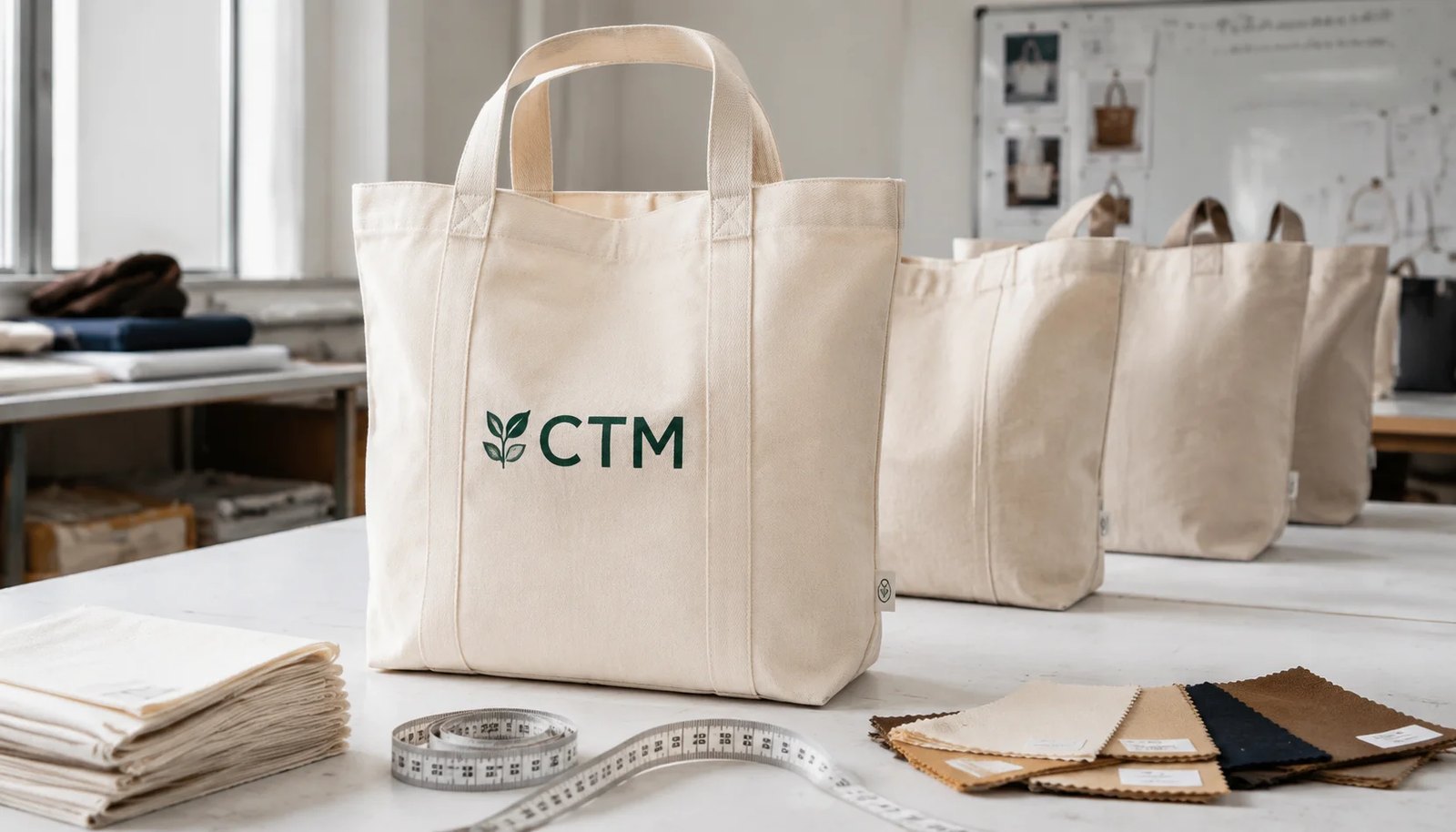
Start with the real grocery load, not the artwork
For wholesale organic cotton totes for natural grocers, durability starts with the shopping behavior the bag must survive. A tote used as a promotional giveaway may only carry a few packaged items. A tote sold at checkout or included in a membership program may carry jars, canned food, produce, milk alternatives, bread, and cleaning products in the same trip. Those items create concentrated pressure on the bottom gusset and repeated shock on the handle stitching.
A practical RFQ should state the expected load and use cycle. For many natural grocery applications, buyers specify an 8 kg to 12 kg working load with a safety margin in testing. That does not mean every shopper will carry 12 kg every time. It means the construction has room for real-world misuse. Without a target load, suppliers may quote the cheapest cotton tote that matches the dimensions and print, while the buyer assumes it is suitable for reusable grocery use.
- Light retail giveaway: usually 5 kg to 7 kg working load, lower repeat-use expectation.
- Standard grocery tote: usually 8 kg to 10 kg working load with reinforced handles.
- Heavy reusable grocery tote: usually 10 kg to 12 kg working load, heavier canvas, stronger gusset, and stricter seam testing.
- Do not rely on the word durable unless the quote states a test weight, test time, and failure criteria.
Choose organic cotton fabric weight by function and cost
The most common cost mistake is choosing fabric weight only by hand feel. For natural grocers, the buyer normally needs a fabric that can handle repeated loading, folding, and abrasion against checkout counters and car trunks. A 5 oz or 6 oz organic cotton bag can be useful for events, light produce, or packaging, but it is usually not the right starting point for a grocery tote sold as a long-use item.
For structured reusable totes, 10 oz to 12 oz organic cotton canvas, roughly 340 to 407 GSM, is a more practical range. An 8 oz fabric may work when the tote is smaller, the load is moderate, and the handle reinforcement is good. Going heavier can improve perceived value, but it increases material cost, carton weight, freight cube, and sometimes sewing difficulty. The best specification balances target load, retail price point, and the grocer's sustainability claim.
- 5 oz to 6 oz cotton: suitable for light promotional bags, not ideal for heavy grocery loads.
- 8 oz cotton canvas: a cost-controlled option for medium reusable totes when dimensions are not oversized.
- 10 oz cotton canvas: a strong common choice for grocery totes with side and bottom gussets.
- 12 oz cotton canvas: better for premium retail totes, heavier loads, and stronger shelf presentation.
- Specify both ounce weight and GSM because suppliers in different markets may use different conventions.
Specify tote size, gusset, and handle drop as working dimensions
A tote can look correct on a flat drawing and still perform poorly in a grocery environment. Width and height matter, but the gusset determines how the bag accepts cartons, produce containers, and jars. A side gusset gives volume. A bottom gusset helps the load sit flat. If the bottom is too narrow, the bag tips over at checkout. If it is too wide without enough fabric weight, the bottom corners wear quickly.
Handle drop is equally important. Short handles work for hand-carry bags but can feel uncomfortable when the load is heavy. Longer shoulder handles improve usability, but they increase leverage on the attachment point and may require stronger reinforcement. For natural grocers, buyers often choose a finished handle drop around 25 cm to 30 cm, depending on whether the tote is intended for hand carry, shoulder carry, or both.
- Use finished dimensions, not only cutting dimensions, because fabric shrinkage and seam allowance change the final size.
- State width x height x side gusset x bottom gusset in centimeters or inches.
- Define handle width, handle length, and finished handle drop.
- Set tolerances such as plus or minus 1 cm for major dimensions and tighter tolerance for print placement.
- For heavy grocery use, avoid oversized flat totes with weak handle stitching; volume and load must match construction.
Build the durability testing checklist into the PO
A durability checklist only works when it becomes part of the commercial order, not an informal email comment after production starts. The purchase order should include the tests, the sample standard, the acceptance criteria, and what happens if units fail. For grocery totes, a visual inspection is not enough. The main failures are handle tear-out, seam opening, bottom corner stress, fabric distortion, and print cracking after folding.
Factories can perform practical in-house checks, and buyers can also arrange third-party inspection for larger orders. The key is consistency: test the approved pre-production sample first, then test bulk units the same way. If the sample barely passes, bulk production may fail because fabric lots, stitch tension, and operator handling vary. A good factory will help adjust reinforcement before bulk cutting rather than argue after cartons are packed.
- Static load test: hang the tote with the agreed load for a defined time, such as 24 hours for higher-risk retail programs.
- Dynamic carry test: lift, swing, and set down a loaded tote repeatedly to simulate customer handling.
- Handle pull test: apply force at each handle attachment and inspect for broken thread, fabric tearing, or seam slippage.
- Seam inspection: check skipped stitches, seam allowance, stitch density, puckering, and loose thread trimming.
- Abrasion review: inspect bottom corners and lower side seams after rubbing against a rough surface.
- Print rub and adhesion: test after ink curing, especially for water-based screen print on natural cotton.
- Carton drop test: test packed cartons, not loose bags, because compression and folding can affect presentation.
Match print method to organic cotton and grocery branding
Most natural grocer tote artwork uses one to three solid colors, usually a logo, icon, slogan, or store message. Water-based screen printing is often the best commercial choice on natural or dyed organic cotton because it gives a softer hand feel and fits sustainability-oriented branding. It also scales well for wholesale quantities. The supplier still needs to control ink opacity, curing temperature, registration, and fabric absorption.
Digital printing can work for detailed artwork or small runs, but it may not be the most cost-effective route for bulk grocery totes. Heat transfer can handle complex designs, yet many grocers dislike the plastic feel on cotton bags, and transfers may crack or peel if poorly applied. Embroidery is premium but adds cost, weight, needle holes, and production time. The RFQ should include artwork size, Pantone references, fabric color, print position, and durability expectation.
- Water-based screen print: good for simple grocery branding, softer touch, economical at volume.
- Discharge or pigment print: depends on fabric dye and color; test before approval.
- Digital print: useful for short runs or full-color art, but confirm wash and rub performance.
- Heat transfer: clean detail but may conflict with natural hand feel and repeated folding.
- Embroidery or woven label: premium accent option, but less common for large front grocery graphics.
- Always approve a printed sample on the actual production fabric, not only a paper proof.
Understand MOQ logic before comparing quotes
MOQ for organic cotton totes is not just a factory preference. It is affected by fabric availability, dyeing minimums, printing setup, cutting efficiency, label production, packing method, and certification paperwork. A natural-color organic cotton tote with one-color print may have a lower MOQ than a custom-dyed tote with four print colors, retail belly band, barcode label, and multiple store allocation cartons.
When comparing supplier quotes, check what is driving the minimum. One supplier may quote a lower MOQ using stock organic cotton canvas, while another requires greige fabric weaving or dyeing from scratch. Neither is automatically better. Stock fabric can reduce time and risk, but shade and documentation may vary by lot. Custom fabric gives control but increases lead time and commitment. Buyers should align MOQ with launch forecast, warehouse capacity, and reorder timing.
- Fabric MOQ: depends on whether organic cotton canvas is in stock or made to order.
- Dye MOQ: custom colors usually require higher minimums and lab-dip approval.
- Print MOQ: each color and artwork position adds screen setup and waste.
- Label MOQ: woven labels, hangtags, and barcode stickers may have separate minimums.
- Packing MOQ: retail bands or printed cartons can raise the practical order quantity.
- Reorder planning: keep fabric and print specs stable to avoid new setup costs each cycle.
Use samples to approve construction, not just appearance
A photo sample can confirm general shape and logo placement, but it cannot prove durability. For a first order, the buyer should approve a physical pre-production sample made from the correct organic cotton fabric weight, correct handle material, correct thread, correct gusset, correct print method, and final folding style. If any part is substituted, the sample should be clearly marked as a reference only.
Sample approval should include measurements and a short handling test. Load the tote with realistic grocery items, not only smooth weights. Boxes and jars create edge pressure that reveals weak seams and thin bottom panels. Fold and unfold the printed bag several times to see whether the print cracks or sticks. If the bag will be sold at retail, inspect how it looks after being folded into the planned band or polybag.
- Measure finished width, height, gusset, handle drop, and print placement from fixed reference points.
- Compare the sample GSM to the requested fabric weight using a measured swatch when possible.
- Review stitch density and reinforcement shape at each handle attachment.
- Load the sample with mixed grocery items and carry it for a short walking test.
- Check odor, loose fibers, stains, oil marks, needle damage, and excessive wrinkling.
- Keep one signed approval sample at the factory and one with the buyer or inspection team.
Control packing so the tote arrives retail-ready
Packing is often treated as a small detail until the shipment arrives with heavy creases, dusty fabric, wet cartons, or mixed quantities. Organic cotton totes are absorbent and can pick up moisture, odor, and dirt during storage and transit. Natural-color fabric shows contamination easily. A grocer that plans to put totes near checkout needs clean, consistent, presentable units, not only technically acceptable bags.
The best packing method depends on how the bags will be sold or distributed. Loose bulk packing can be economical for back-of-house use or event distribution. Individual polybags protect the product but may conflict with a plastic reduction policy unless recyclable material is accepted. Belly bands create a retail-ready look and can carry a barcode or product message, but they add labor and require folding consistency. Carton strength, liner bags, desiccants when appropriate, and clear carton marks should be part of the quote.
- Bulk pack: lowest packing cost, higher risk of creasing, dust, and counting issues.
- Individual recyclable polybag: better protection, but review sustainability policy and local labeling rules.
- Paper belly band: good retail presentation, needs consistent folding and band artwork approval.
- Inner carton allocation: useful when shipping to multiple stores or distribution centers.
- Export carton: specify ply strength, gross weight limit, carton marks, and moisture protection.
- Carton quantity should balance warehouse handling with compression risk; overpacked cartons can deform handles and prints.
Protect the schedule from fabric, print, and inspection delays
Lead time for wholesale organic cotton totes depends on more than sewing capacity. Organic fabric procurement, documentation, dyeing, lab dips, print screens, ink curing, packing material, and final inspection can each create delays. A simple natural-color tote with stock fabric and one-color print may move quickly. A custom-dyed organic cotton tote with multiple SKUs, retail labeling, and third-party testing needs more calendar time and earlier decisions.
Procurement teams should build a schedule backward from the required in-store date, including ocean freight or air freight, customs clearance, distribution center receiving, and store allocation. Sample revisions are the most common hidden delay. If the first sample has the wrong handle length or weak stitching, a second sample may be necessary before bulk production. Rushing approval can save a week but may create a much larger problem if a container of totes arrives with preventable defects.
- Artwork proof and technical review: allow time for print size, color, and placement confirmation.
- Material preparation: stock organic cotton is faster than custom weaving or dyeing.
- Sample making: include physical transit time if the buyer must review the sample in hand.
- Bulk printing and curing: production cannot be packed immediately if ink requires proper curing.
- Sewing and trimming: heavier canvas and reinforced handles take more time than light cotton bags.
- Inspection window: reserve time for rework if final inspection finds issues.
- Freight buffer: natural grocers with fixed seasonal campaigns should not rely on best-case transit only.
Compare landed cost, not only unit price
A lower unit price can become expensive if the tote has weak handles, oversized cartons, poor packing, or missing documentation. For importers and distributors, the real comparison is landed cost per usable tote. This includes product cost, mold or screen charges if any, sample and courier fees, inspection, testing, export packing, inland freight, ocean or air freight, duty, customs brokerage, warehousing, and expected reject or rework rate.
Freight cube matters because cotton totes are bulky even when folded. A heavier 12 oz tote may have a better retail feel but increases carton gross weight and can reduce carton quantity. A belly-banded retail pack may improve store presentation but add carton volume. Buyers should request carton dimensions and gross weight at quotation stage, then calculate cost per cubic meter and cost per store-ready unit. For natural grocers, it is often worth paying more for a construction that reduces customer complaints and supports a credible reuse message.
- Request FOB unit price and packing details together; one without the other is incomplete.
- Compare carton quantity, carton size, gross weight, and estimated cubic meters per 1,000 units.
- Separate one-time setup charges from repeat-order unit pricing.
- Include inspection or testing cost if durability claims are important to the program.
- Estimate reject allowance; a cheaper tote with a higher defect rate may not be cheaper at retail.
- Review duty classification and import documentation with your broker before final supplier selection.
Specification comparison for buyers
| Spec decision | Recommended option | When it fits | Buyer risk to check |
|---|---|---|---|
| Fabric weight for grocery use | 10 oz to 12 oz organic cotton canvas, roughly 340 to 407 GSM | Reusable grocery totes carrying produce, boxed items, jars, and mixed dry goods | Very light 5 oz to 7 oz fabric may pass a visual review but fail handle strain, corner abrasion, and shelf-life expectations |
| Construction style | Side gusset plus bottom gusset with lockstitch seams and reinforced stress points | Retail totes expected to stand open at checkout and hold bulky groceries | Flat totes are cheaper but reduce usable volume and concentrate stress along the side seams |
| Handle attachment | Cross-stitch or box-X reinforcement using matching heavy cotton or poly-cotton thread | Orders where shoppers may carry 8 kg to 12 kg loads from store to car | Single-line handle stitching can tear even when the fabric itself is strong |
| Print method | Water-based screen print for 1 to 3 solid colors on natural or dyed organic cotton | Natural grocer logos, slogans, store locations, and simple artwork with good hand feel | Low-opacity inks, poor curing, or excess ink thickness can crack after folding and laundering |
| Organic claim evidence | Transaction certificate or supplier documentation aligned with the fabric lot, plus label wording review | Brands making organic cotton statements on hangtags, e-commerce pages, or retail signage | A finished tote is not automatically certifiable just because the mill used organic yarn; documentation must match the claim |
| Sample approval route | Pre-production sample in correct GSM, handle length, gusset, print size, and packing method | First orders, new artwork, dyed fabric, or any order tied to retail launch dates | Approving only a blank fabric swatch leaves risks in shrinkage, print placement, seam strength, and final packed appearance |
| Packing specification | Individual fold with belly band or recyclable polybag, then export carton with moisture protection | Retail-ready distribution, store allocation, or warehouse receiving with barcode needs | Loose bulk packing lowers cost but increases creasing, contamination risk, and counting disputes |
| Durability testing level | Static load, dynamic carry, seam slippage, handle pull, rub test, print adhesion, and carton drop checks | Wholesale organic cotton totes for natural grocers where repeat use is part of the brand promise | Relying only on factory visual inspection may miss failures that happen during first customer use |
Buyer checklist before sampling
- Define the intended grocery load in kilograms or pounds, not only the tote size.
- Specify fabric type, organic cotton documentation requirement, weave, ounce weight, and approximate GSM.
- Confirm finished dimensions with tolerance for width, height, side gusset, bottom gusset, and handle drop.
- Set minimum seam construction: lockstitch, bartack or box-X reinforcement, stitches per inch, and trimmed threads.
- Choose print method based on artwork, color count, fabric shade, wash expectations, and acceptable ink hand feel.
- Require a pre-production sample made with production fabric, production handles, production print, and final packing.
- Include durability tests in the purchase order: static load, dynamic carry, handle pull, seam slippage, rub resistance, and carton drop.
- State acceptable tolerance for print position, print size, fabric shade, shrinkage after wash if applicable, and final folded size.
- Clarify retail packing, carton quantity, carton marks, barcode labels, moisture protection, and pallet requirements.
- Compare quotes using landed cost per usable tote, including duty, freight cube, rejected units, rework risk, and documentation cost.
Factory quote questions to send
- What organic cotton fabric weight do you recommend for a reusable grocery tote carrying 8 kg to 12 kg, and what is the GSM tolerance?
- Is the fabric greige, bleached, natural, dyed, or washed, and what shrinkage should we expect after production or consumer washing?
- Which seam construction and handle reinforcement will be used, and can you provide photos from a similar production sample?
- What is the maximum safe print area for our tote size, and which print method is most suitable for our artwork and fabric color?
- What documentation can be supplied for the organic cotton claim, and at which stage is it connected to the fabric or finished goods?
- What is the MOQ by fabric weight, tote size, handle color, print color count, and packing style?
- How many days are required for artwork proof, sample making, sample revision, bulk fabric preparation, printing, sewing, QC, and packing?
- What in-line and final inspections do you perform, and what load test weight and duration are used for grocery totes?
- How will the totes be folded and packed, what is the carton size and gross weight, and how many cartons fit per cubic meter?
- What quote assumptions are excluded, such as hangtags, barcode labels, retail bands, organic certification documents, testing reports, or palletization?
Quality-control points to confirm
- Fabric GSM should be measured from production fabric, with the agreed tolerance shown in the QC report.
- Finished tote dimensions should be checked after sewing and pressing, not only from cutting panels.
- Handle drop must be consistent across the shipment so the tote feels balanced when carried by hand or over the shoulder.
- Handle attachment should withstand a defined pull force without stitch breakage, seam opening, or fabric tearing.
- The loaded tote should pass a static hang test using the buyer-approved grocery load plus a safety margin.
- Dynamic carry testing should include repeated lifting and swinging, because many failures occur from motion rather than static weight.
- Bottom gusset and lower side seams should be inspected for skipped stitches, puckering, needle holes, and uneven seam allowance.
- Print adhesion should be tested by tape pull or rub testing after proper curing and cooling.
- Print placement tolerance should be measured from the finished bag edges, not from unsewn fabric panels.
- Cartons should pass reasonable drop and compression checks when packed at the approved quantity and gross weight.